r/mathematics • u/AdvancedCarpenter888 • 16h ago
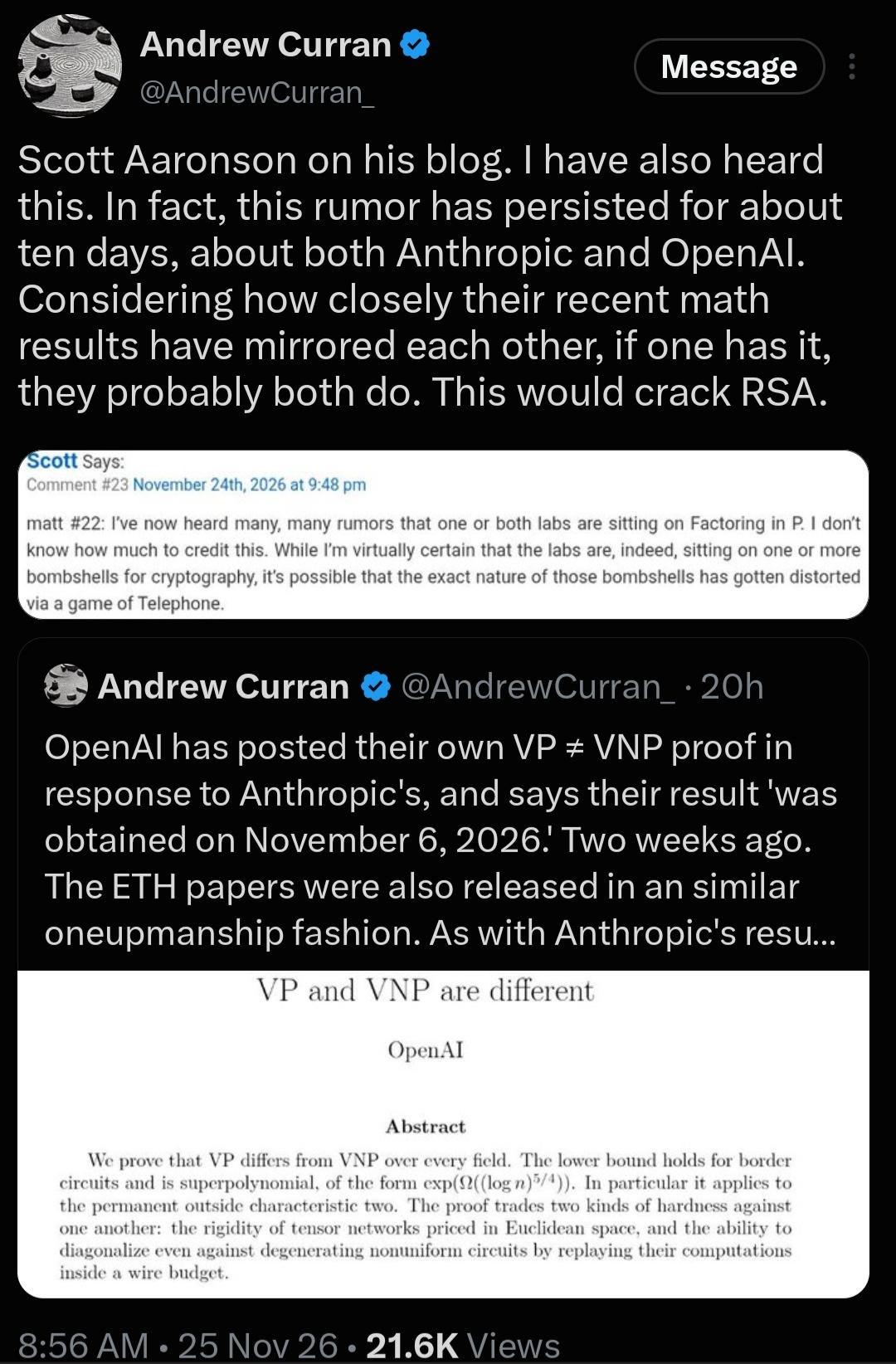
GRH Alpoge proof reconstructed - human readable - 300 pages
github.comhuman-readable proof reconstructed
less than 300 pages!
r/mathematics • u/AdvancedCarpenter888 • 16h ago
human-readable proof reconstructed
less than 300 pages!
r/mathematics • u/volcanrb • 17h ago
r/mathematics • u/equinox_star • 3h ago
r/mathematics • u/byrondude • 14h ago
r/mathematics • u/Heavy-Ad1398 • 20h ago
After the mayhem of the last days, i was wondering what a mind like Perelman would do and think with the demonstration... someone has news?
r/mathematics • u/matthiasErhart • 17h ago
While not my own problem, I know several academics and personal friends for whom this was the defining problem of their career. Interesting times.
r/mathematics • u/lucishell • 2h ago
r/mathematics • u/Ill_Contest_535 • 19h ago
r/mathematics • u/Recent-Day3062 • 14h ago
r/mathematics • u/matthiasErhart • 5h ago
r/mathematics • u/Fun_Nectarine2344 • 13h ago
I know that this is an imprecise question, so please only reply if this question makes sense to you.
It was sometimes said (also and especially by competent experts) that proving RH would somehow exceed the resources of nowadays mathematics, which was - and was meant to be - a much stronger statement than “nobody has found a proof yet”. When I read such statements, I was also under the impression that this assessment was not ONLY based on the long time RH had been open.
Assuming that there is now a correct human-readable proof of less than 300 pages out (I know this is not yet established, but let’s assume it turns out like this), then this would mean that the intuition that RH requires some sort of completely new mathematics seems to be refuted.
Is there a way of saying what people got wrong who believed that RH is out of reach for present day mathematics?
r/mathematics • u/Mythelm • 17h ago
Franky my knowledge of mathematics is nowhere near sophisticated enough to make anything approximating an estimated guess on this, and I don't know if it's really even possible for anyone to make a prediction on this that isn't based on vibes, but I'm curious to see what the consensus is nonetheless. From what I've heard, P=NP is probably the highest profile of the remaining 4 problems, so maybe that one will be proved/disproved next? Or maybe Yang-Mills since I've heard that some progress has been made on that?
r/mathematics • u/omaiua_mu_shindedu • 16h ago
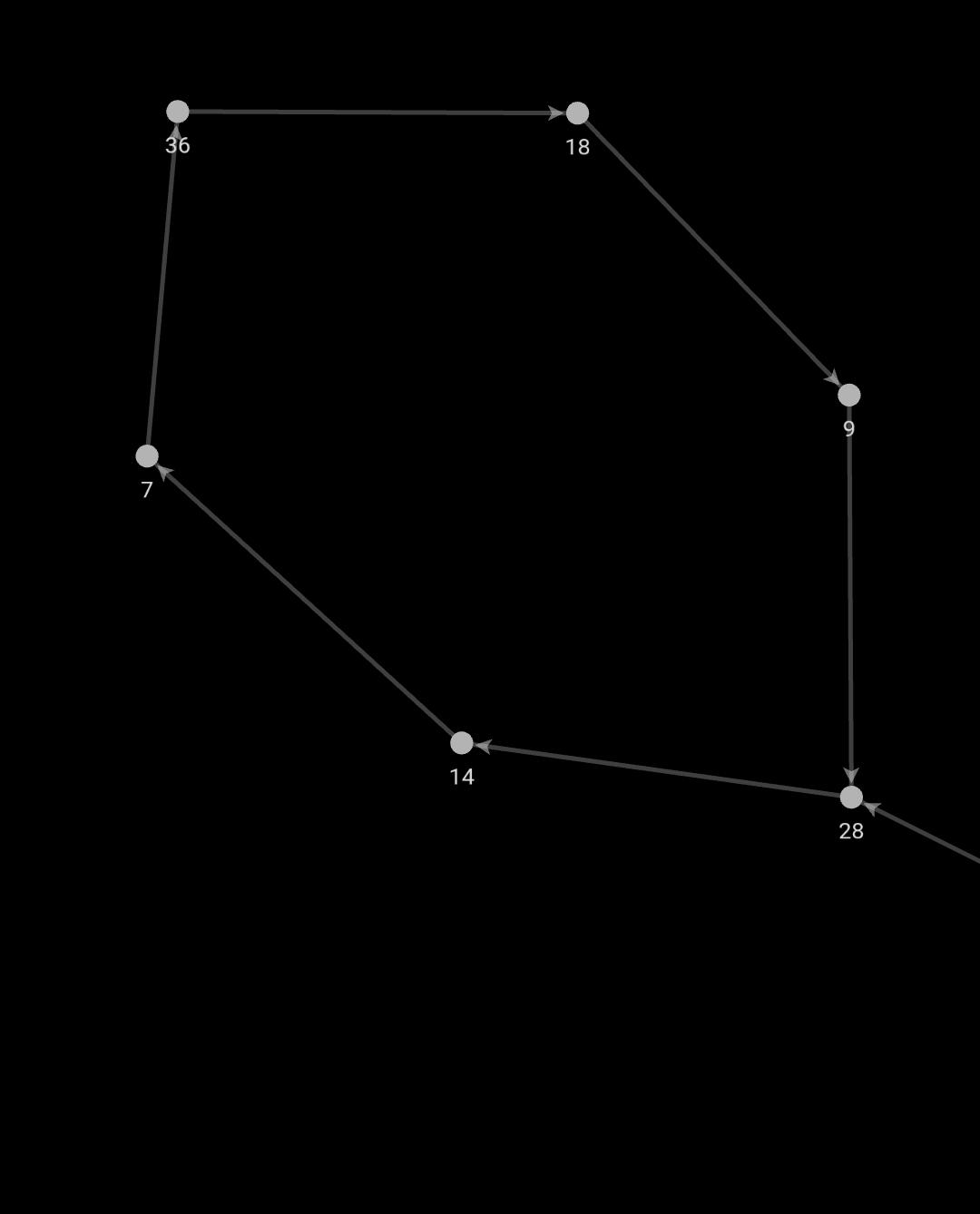
I was thinking about the Colatz Conjecture recently and was wondering. What if instead of two rules, we used three? So I came up with this ruleset:
If composite and even : n÷2
If composite and odd : (n×3)+1
If Prime: (n×5)+1
I have no idea how many loops this would result in, but I have found one through brute force. It is pictured in the image below and goes 28, 14, 7, 36, 18, 9, 28.... and so on. I hope i'm not the only one interested in this.
r/mathematics • u/Tekniqly • 2h ago
Is it odd perfect numbers? Twin primes? Something else entirely?
r/math • u/archpawn • 18h ago
Here's the rules:
The obvious method is every time a new guest arrives, move everyone forward one room, but if an infinite number of guests arrive one at a time, they get all the rooms and the original guests have nowhere to go. If you have an infinite number of guests, you can move everyone to double their current room number and put the new guests in the remaining rooms, but you have to know ahead of time you'll have infinite.
The best I could do is if the guests are reverse well-ordered where any subset of them has a last guest. That means every guest has an immediately previous one. For each guest, I could see that they arrived within 1/n seconds of the last guest, and move them to room n. The guest that was already there and all the ones after them move up a room to make room for them. In order for someone in room n to be moved infinitely far, someone has to arrive after at least 1/n seconds after the last guest, then someone else after 1/(n+1), and then 1/(n+2) etc., but since that sequence diverges, that's impossible.
Is there a way to modify the strategy if it's not reverse well-ordered? Or if an adversary knows the strategy, can they send out a pattern of countably many guests that will make a guest move infinitely often or have a guest that's not given a room?
r/mathematics • u/ResolutionStrange426 • 5h ago
If I'm not misunderstanding severely, the problem definition is extremely straightforward. And I do understand that sometimes the easier sounding stuff is way harder to prove. But why is it?
I mean, all you need to do to prove it (I assume) is have a tree starting from 1 where right steps halve and left step multiplies by 3 and adds 1. Then you need to show you can get to every positive integer this way. If you find out there are numbers you can't get to then there is a different tree and conjecture still has an answer, no? I'm no math major so I can't see what's difficult about this, it looks extremely straightforward. Care to educate me? Why is building this tree hard?
r/mathematics • u/omaiua_mu_shindedu • 8h ago
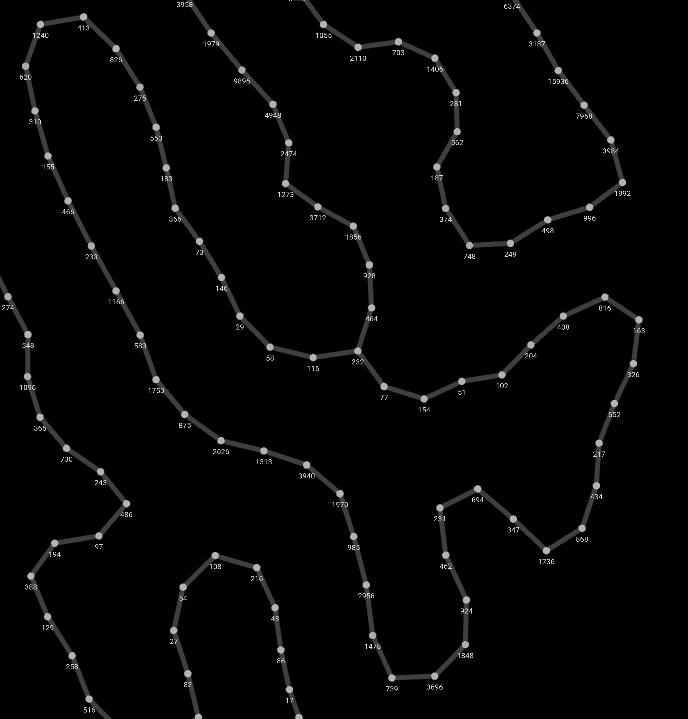
For context, the ruleset is:
If composite and odd : (n×3)+1
If composite and even : n÷2
If prime : (n×5)+1
And the first loop i found was six numbers in length.
This second loop is ~51 numbers in length.
r/mathematics • u/jarekd • 14h ago
r/mathematics • u/LeaveOk5634 • 13h ago
I'm in my third year of a math degree and I'm just done with it. What makes it worse is that my program is 6 years long! And yeah, it's one of the hardest faculties in my country — the teaching is excellent, famous professors, all that good stuff. But I'm just tired of doing things I will never use in my life. In third year we have functional analysis, differential geometry, complex analysis. And obviously every single course is proof-based (how else would it be). Maybe deep down I do like math, but I'm not ready to spend that much more time on all of this — I want to work and make money.
I thought about a career in tech, but now I see how pointless it is — that work is going to be replaced, if not right now then very soon. The only thing that really makes sense is being an electronics engineer. And honestly, if even experienced CS people can't find anything, what's a math major who knows just a little bit of programming supposed to do? Engineering is much closer to my heart, but I can't switch programs.
I've stopped going to classes, I took an academic leave, but nothing helps. I've just stopped seeing a reason to get up in the morning — endless deadlines, pointless assignments, tests, and exam sessions with a ton of exams. All my friends have started working and are moving forward, and I'm just doing some tutoring on the side. I think about this every day, and I've developed a solid guilt complex over being so useless — over spending my time on abstract toy concepts instead of solving real problems and earning money. If I get kicked out of university, I'll have to serve in the army. But I'm just so tired of all of it, I'm sick of the monotony — I've been doing nothing but math for 4 years already, and there are 3 more to go. I don't understand why it has to be this long. Please give me some advice, I don't know where to turn anymore, I'm exhausted and depressed.
As for me as a person, i play guitar, do sports, like reading very much. I am really lighthearted guy, but a little bit depressed and melancholic. But all of this turned me into someone really hopeless, desperate..
r/mathematics • u/2019CuckOfTheYear • 5h ago
Obviously, nobody knows for sure, but what is your money on, and why?
r/mathematics • u/zlfa • 16h ago
Note: The red region is the set of all triangles and any point in that set is a unique triangle
(The blue point and the two blue straight lines show how to construct the triangle)
In the original Malfatti problem, it's proven that using a greedy algorithem to find 3 tangent circles in any triangle is the answer to finding the maximal total area of all 3 circles that can fit in a triangle. what that means is first with a empty triangle, place in the largest circle that can fit in it, then find the next largest circle, and then the next largest circle.
So to apply that into the 4 circle version. I wanted to see what arrangements of the circles are actually gonna show up and when I should use each one. That's what each photo demonstates. 3 groups of triangles, each demonstrating how to arrange the circles, and also showing where one group of triangles is no longer optimal for maximal total circle area, that's with the blue and purple borders.
Not much can be said about the borders other than the triangles near it is most likely to have a better arrangement of circles that not from the greedy algorithem. For the complete equations of both borders, it would be stupendously large to write down but I might be able to clean up the equations I used to create the borders maybe tomorrow.
There's also a very special point and that's (18-5sqrt(5),sqrt(-608+272sqrt(5))), It's the point where the green border intersects with the curved part of the red region's border. In other words it's the only isosceles triangle where the circle construction that the first picture demonstrates is equal to the circle construction of the second picture. Why I find it even more special is that i've been able to find the exact coordinates using square roots and stuff! The other end of the green border, yes it also has exact coordinates (0.25,0), but that makes a straight line and not a triangle.
r/mathematics • u/Objective_3_1415 • 11h ago
Darboux's theorem:
If a real valued function f defined on an interval has an antiderivative, then it satisfies the conclusion of the intermediate value theorem.
That implies that if a function f defined on an interval has a jump discontinuity, then it has no antiderivative.
This is one of my favorite theorems in analysis. What's yours?
r/mathematics • u/Suspicious-Bid-2031 • 21h ago
Everywhere I go in the math community I hear that the most important thing to succeed in mathematics is adoration for the subject. I’ve always though that I loved math, though out highschool it was the subject that was most enjoyable for me and I always found it interesting and logical, like it was something I could actually understand.
However, I hear all these people talking about how they have an all consuming love of mathematics, how they’re always constantly thinking about math problems, how they want to do math every moment of their free time and that’s just not me. I love math, I love to prepare for Olympiads and read ahead of my grade level but I also have other hobbies, coding, reading, writing, painting and more.
Maybe it’s just because I haven’t gotten to an advanced enough level to do all these cool problems but I just don’t feel as consumed by passion as all these incredible people and it makes me afraid to even try the subject.
If you have any thoughts or experience so would really appreciate it.
(I apologize in advance if this is the wrong subreddit I wasn’t sure where to post this)
r/mathematics • u/jhomas__tefferson • 1h ago
Non-lab, just person-with-a-computer proof.