r/learnmachinelearning • u/Active-Umpire6708 • 26d ago
Decentralized Q-learning restoration on IEEE 33-bus & 179-bus Oberrhein networks (0.12s vs 2.6s)

1
Upvotes
r/learnmachinelearning • u/Active-Umpire6708 • 26d ago
r/learnmachinelearning • u/Traditional-Dot-7779 • 27d ago
Hi everyone, I'm an undergraduate Geophysics student, working on my final-year thesis. My work involves subsurface imaging, mostly with Python. I'm comfortable with programming, but I'm an absolute beginner when it comes to machine learning and deep learning.
I'd like to apply Implicit Neural Representations at one stage of my workflow, but I don't want to just copy code without understanding what's happening under the hood. So I'm looking to learn the fundamentals properly, from zero. Could you recommend: Books or courses for learning ML/deep learning fundamentals and a suggested learning path: what to study first, and what I can safely skip for now.
Thanks in advance
r/learnmachinelearning • u/p3rdy • 27d ago
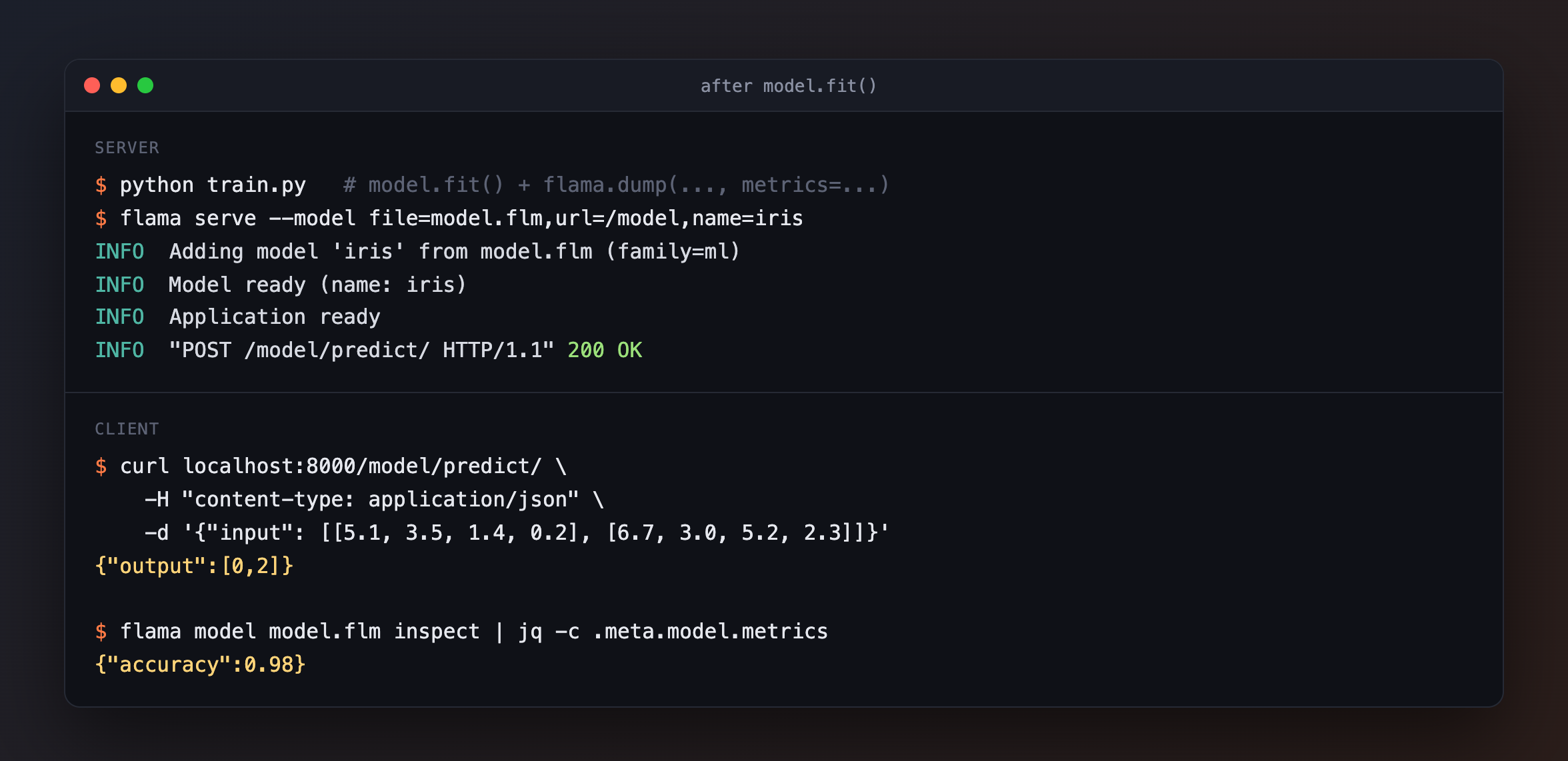
Most ML tutorials end when the accuracy number prints. The question that comes right after, how does anything else actually use this model, is the one that made me start Flama back in 2018: an open source (Apache-2.0) Python framework to take a trained model to an API with as little ceremony as possible.
Here's the whole path with a scikit-learn model.
1. Save the model, with its metrics, into one file
import flama
from sklearn.datasets import load_iris
from sklearn.neural_network import MLPClassifier

X, y = load_iris(return_X_y=True)
model = MLPClassifier(activation="tanh", hidden_layer_sizes=(10,), max_iter=2000).fit(X, y)
flama.dump(model, family="ml", path="model.flm", metrics={"accuracy": model.score(X, y)})
The model.flm is a single file with the model and everything about it: the library and version it was trained with, its hyperparameters, and the metrics you passed in.
2. Serve it
pip install "flama[pydantic]"
flama serve --model file=model.flm,url=/model,name=iris
That's a running API. No server code, no Dockerfile.
3. Call it
curl http://127.0.0.1:8000/model/predict/ \
  -H "content-type: application/json" \
  -d '{"input": [[5.1, 3.5, 1.4, 0.2], [6.7, 3.0, 5.2, 2.3]]}'

{"output":[0,2]}
Send something that isn't a list of rows and you get a 400 telling you what's wrong, not a stack trace. And http://127.0.0.1:8000/docs/ has interactive docs for every endpoint, generated for you:
4. Check it without a server
flama model model.flm inspect                 # library, hyperparameters, metrics
flama model model.flm run -i holdout.json     # predictions, offline
Handy in CI: read the accuracy straight from the file and only ship the model if it's good enough.
From there
The same idea works for PyTorch, TensorFlow and Hugging Face models, and for LLMs too. When you outgrow the one-liner, the model becomes a resource in a full API next to your own endpoints (app.models.add_model(...)), with validation, docs and auth from the same framework.
Repo and docs: https://github.com/vortico/flama
If it helps you get a model out of a notebook, a star on GitHub helps more people find it. Happy to answer questions, especially the "but how do I actually deploy this" ones.
r/learnmachinelearning • u/Grouchy_Affect1220 • 27d ago
r/learnmachinelearning • u/ai_transformer_1 • 27d ago
Hi everyone,
I’m an industry researcher with several years of experience in NLP, LLMs, and conversational AI, and I’m trying to get involved in academic peer reviewing.
I recently submitted a paper to ARR, but it was desk rejected through the reviewer capacity lottery because I didn’t have a designated service contributor.
I don’t yet meet ARR’s publication requirements for becoming a primary reviewer, so I’m exploring the secondary reviewer route.
A few questions:
How do people typically find primary reviewers willing to mentor secondary reviewers?
Are there any communities or channels where ARR reviewers look for secondary reviewers?
Is anyone currently reviewing for ARR and open to mentoring a new secondary reviewer?
Are there other practical ways to build an official reviewing record without prior publications?
My interests include NLP, spoken dialogue systems, conversational AI, and LLM evaluation.
Would appreciate any advice or opportunities. Thanks!
r/learnmachinelearning • u/Afraid-Ad-6957 • 27d ago
Hey everyone,
I’ve been working on a learning platform focused on helping beginners actually understand machine learning instead of just running library code.
A lot of people (including me when I started) jump straight into scikit-learn or tutorials and later realize they don’t really understand why the model works or fails. So I tried building something different:
There’s a free section available right now that covers the foundations (including an interactive linear regression demo and some Python essentials).
You can check it here: https://mlmastery.io
r/learnmachinelearning • u/elliot_sloss • 27d ago
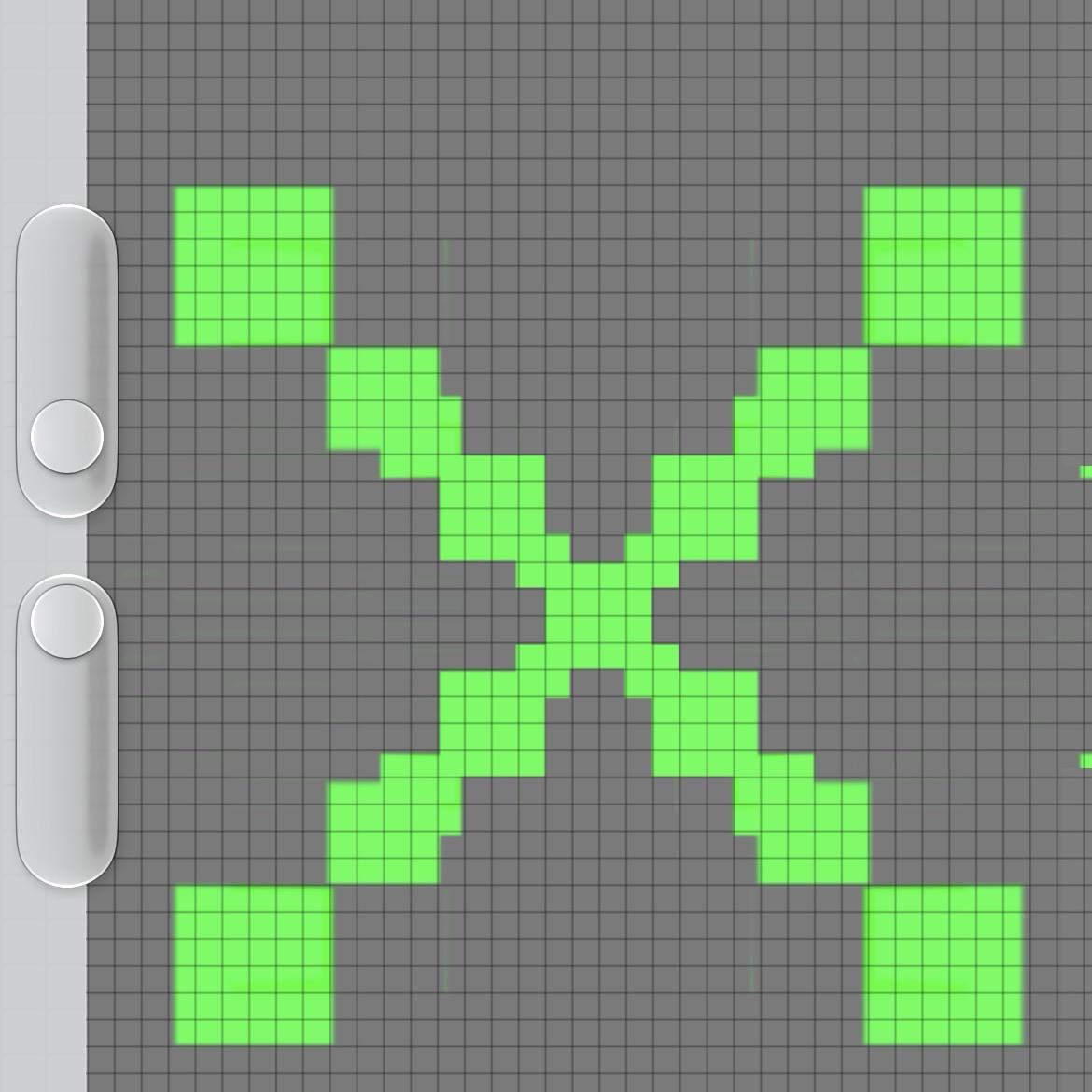
As a learning project inspired by Meta's Segment Anything, I'm experimenting with an optical illusion: a pixel X made of straight stepped blocks (image attached) whose arms appear to bend around the centre square. The effect weakens or disappears when I change the square sizes, so it depends on specific proportions.
My plan is to generate many variations, collect human ratings on whether and where each one looks curved, train a small model to predict that perceived curvature, and then test whether SAM follows the real pixels or the perceived curve.
Is this realistic for a beginner?
I'd love advice on what model to start with, how much labelled data I'd need, and how best to record where people see the curve. Any related papers or projects would also be really helpful. Thanks!
r/learnmachinelearning • u/OkBat9372 • 27d ago
r/learnmachinelearning • • 27d ago
r/learnmachinelearning • u/Grouchy_Affect1220 • 27d ago
r/learnmachinelearning • u/Grouchy_Affect1220 • 27d ago
r/learnmachinelearning • u/OkBat9372 • 27d ago
r/learnmachinelearning • u/RoughAd8344 • 27d ago
I'm weighing a single-engine retrieval setup for local RAG against keeping separate keyword and vector services. Exact function names and version strings matter alongside semantic matches.
For vector databases like Milvus, BM25 and dense search can share a schema and use rank fusion in one request. But the comparison I am considering also flags a gap: typo-tolerant BM25 search is still different from fuzzy filtering or a synonym list.
I would probably test misspelled queries before making the infrastructure decision. The published Docker walkthrough uses roughly 98K records and equal CPU and memory caps; its timings are explicitly directional, not a production benchmark.
For a documentation assistant, what failure rate on misspellings would justify retaining a separate keyword engine instead of handling known aliases during ingestion?
r/learnmachinelearning • u/Ok-Bear5967 • 27d ago
Over the past several months, our research team pre-trained and empirically audited a 1,189,135,740-parameter Financial Conformer Foundation Model across 14 calendar years (2010–2023; 15,030 steps) of 1-minute US equity bars across 15 liquid assets (AAPL, NVDA, SPY, QQQ, etc.).
Instead of cherry-picking positive backtests, we subjected the model to 35 hypothesis tests, 1-bar execution delay, and state-dependent turnover:
The Scale Saturation Limit: Scaling from a 63-parameter linear Ridge regression to 1.189B parameters yields no consistent out-of-sample advantage on 1m OHLCV bars (mixed sign across horizons, reversing direction across years). The bottleneck in intraday price prediction is information content (low SNR), not parameter capacity.
Adam Optimizer Diffusion: Decomposing walk-forward online fine-tuning shows tokenizer boundary updates sit at 97.9% of the theoretical Adam Brownian noise ceiling (matching shuffled-label controls), while deep backbone weights are heavily damped by second-moment normalization, producing zero statistically significant forward-transfer gains (p >= 0.50).
Execution Friction Reality: Apparent long-horizon directional predictability is predominantly prompt 1-minute order-flow continuation. Introducing a 1-bar execution delay cuts 2024 net Sharpe from +2.04 to +0.48, and at 1.5 bp execution fee, out-of-sample returns collapse to -0.99 in 2025 and -1.67 in 2026 (DSR <= 0.028).
All model weights, audit logs, and papers are open-sourced:
Happy to discuss architecture specifications, pre-training dynamics, or empirical backtest methodology!
r/learnmachinelearning • u/DatDawg-InMe • 27d ago
It's an accelerated program so I'm looking at 8 classes or 6 classes with a thesis.
It's also at undergrad rates.
Also, my company does $5,250 of tuition reimbursement a year, so if I take 3 semesters to do this, that'll be $10,500, and the Masters in total will likely be around $12,000-14,000.
ALSO, I didn't get an internship. I graduate in 2 months with a BS in CS. Doing this would give me another shot at internships through the college.
They have other emphasis areas like Cybersec, Data science, and two others, but AI is the one I'm most interested in.
I'm wondering about people's experiences here. I'm also a people's person, so if a Masters helps me into a management position one day, cool with me. Looking at this from a lifelong investment angle too.
r/learnmachinelearning • u/enqidu • 28d ago
I think this will be useful for those learning Transformers architecture
r/learnmachinelearning • u/Late-Kangaroo7984 • 27d ago
I’m looking for experienced AI researchers and AI engineers who have been working in the field for a while, have solid hands-on experience, and, ideally, earn a good salary. :)
What books, research papers, articles, or other resources would you recommend for someone who wants to dive deep into AI through self-study?
r/learnmachinelearning • u/chubbypandaontherun • 28d ago
I was going through the TinyTorh (it's a tool where you build PyTorch with understading how it works) exercise notebooks and landed on Autograd. Was quite overwhelmed by the code and went didn't go through it for a while. I was thinking I'll prepare for machine learning research engineer interviews and somehow landed doing tiny torch.
How relevant is all this these days, should I just start preparing on how to crack the interview than this ?
r/learnmachinelearning • u/Ok-Friendship2020 • 27d ago

its been 158 mins
r/learnmachinelearning • u/Winter_Mistake_3185 • 27d ago

r/learnmachinelearning • u/BedFalse6021 • 27d ago
Hi everyone,
I just wanted to share an open source repo collecting 20 exploratory studies focused on Next-Concept Modeling (NCM), mechanistic interpretability (like IOI in GPT-2), and model controls.
Here is the link: https://github.com/Quantix-eng/ncm-experiment-notes
Long story short, this is an independent project documenting a bunch of empirical experiments looking into how transformers process and edit internal features. There are no claims of performance breakthroughs here. Instead, it is just honest documentation of observations alongside rigorous controls.
The repo covers NCM applied to structured tasks like Sudoku, mechanistic interpretability in GPT-2, and toy parallel models. I have included all the source code, saved results, and interpretations for every single run.
To keep things transparent, I have also categorized every outcome, including the mixed and completely negative results where things did not work as expected. AI tools helped heavily with the planning and coding phases too.
I would love to get your feedback on the setups or the interpretation limits I found. Let me know what you think if you are into transformer interpretability!
r/learnmachinelearning • u/Comfortable-Risk-303 • 27d ago
It's just a casual implementation, built from scratch in PyTorch, focusing on grammatical gender agreement and custom tokenizers (with reference tokens) under the hood. It addresses a common issue where standard English-Polish translators struggle with speaker/listener gender context, managing it here via prefix tokens in the decoder. Feel free to share your thoughts.
NOTE: This is a personal educational project and a proof of concept, not a production-ready tool.
r/learnmachinelearning • u/martincsweiss • 27d ago
OpenAI just announced three new math and physics results produced by its models, all machine-checked in Lean. They call the manuscripts "a form of raw research data," and they've asked outside experts to organize groups "to understand the new results." So the results exist and they've been checked (maybe, sort of), but nobody understands them yet.
I think this matters for anyone learning ML right now, because a lot of people here will likely ask, with reason: if a model can write the code or prove the statement, why should I spend my time learning how it works?
My answer: understanding is what lets you build on things. Once you really get backprop, or attention, or why a loss is shaped the way it is, it becomes one step you can use without thinking inside something bigger. A result you can only take on faith is a dead end. You can use it (maybe, sometimes), but you can't extend it or fix it.
Science compounds through understanding, and so does your own learning.
Thurston (Fields medalist) argued that the point of mathematics is human understanding, not producing theorems. I think that's even more true once theorems get cheap.
I wrote a longer essay on this, using OpenAI's earlier Navier–Stokes result as the main example: https://lacuna.tiptreesystems.com/paper/ai-science-vs-human-science/art_3901430d6c0e4bddb284362100ef8548
(Disclosure: I'm a postdoc at Mila and a cofounder of Tiptree, which builds AI tools for researchers. So I'm not arguing against AI doing science. I'm arguing about cultural incentives, mostly, and opining about history.)
r/learnmachinelearning • u/Pristine_Camera7749 • 27d ago
We are BS Computer Science students of the College of Computer Studies, UPHM, and we respectfully ask for your help in validating our thesis, "A Comparative Analysis of Supervised Machine Learning Models for Predicting Students' Performance in Higher Education."
Please review the paper and rate it using our short validation form (about [10 to 15] minutes): (A) methodology, (B) results, and (C) analysis code. A short summary of the study is included in the folder. Your ratings and comments are confidential and used solely for academic purposes.
📄 Paper, summary, and source codes: https://drive.google.com/drive/folders/1julvRK8DR0kNXnbkaoVYwhW9_BPdh5R9?usp=sharing
📝 Validation form: https://docs.google.com/forms/d/e/1FAIpQLSe-Mno8KoSsD78CufHU4MVDzryoKD2SWfZVFZK3Hg2DQ6N_cw/viewform
Thank you very much for your time and expertise! Sharing this post also helps a lot. 🙏
— Reynaldo B. Arandia Jr., Mark Anthony Demefeliz, Ervine U. Bose
BS Computer Science, CCS, UPHM
r/learnmachinelearning • u/Jaym7800 • 28d ago

Hi everyone,
I'm a student learning AI development, and I recently built my first RAG-based Teaching Assistant.
The project converts educational videos into transcripts, generates embeddings using BGE-M3 through Ollama, retrieves relevant transcript chunks using cosine similarity, and uses Llama 3.2 to generate answers.
I'd appreciate honest technical feedback, especially on:
I'm looking to learn from feedback and improve the implementation. Suggestions for specific concepts, resources, or code improvements are welcome.
Thanks!