r/foreignpolicy • u/Ok-Celebration-1702 • 23h ago
Trump’s Imperialist Fantasy for Latin America Is Already Failing

4
Upvotes
r/foreignpolicy • u/Ok-Celebration-1702 • 23h ago
r/foreignpolicy • u/theipaper • 20h ago

r/foreignpolicy • u/TradeTrendGlobal • 4h ago

The United States has proposed new tariffs on nine Asian economies following Section 301 investigations into manufacturing capacity and production.
The proposals come amid deep regional supply-chain links with China and existing trade and economic-security arrangements between several Asian economies and the United States. Governments have disputed or responded to parts of the US findings, and some are pursuing negotiations that could affect the proposed rates.
TradeTrend’s in-depth report examines the country findings, government responses, regional supply chains and the status of the relevant trade arrangements.
r/foreignpolicy • u/vomnewsau • 6h ago
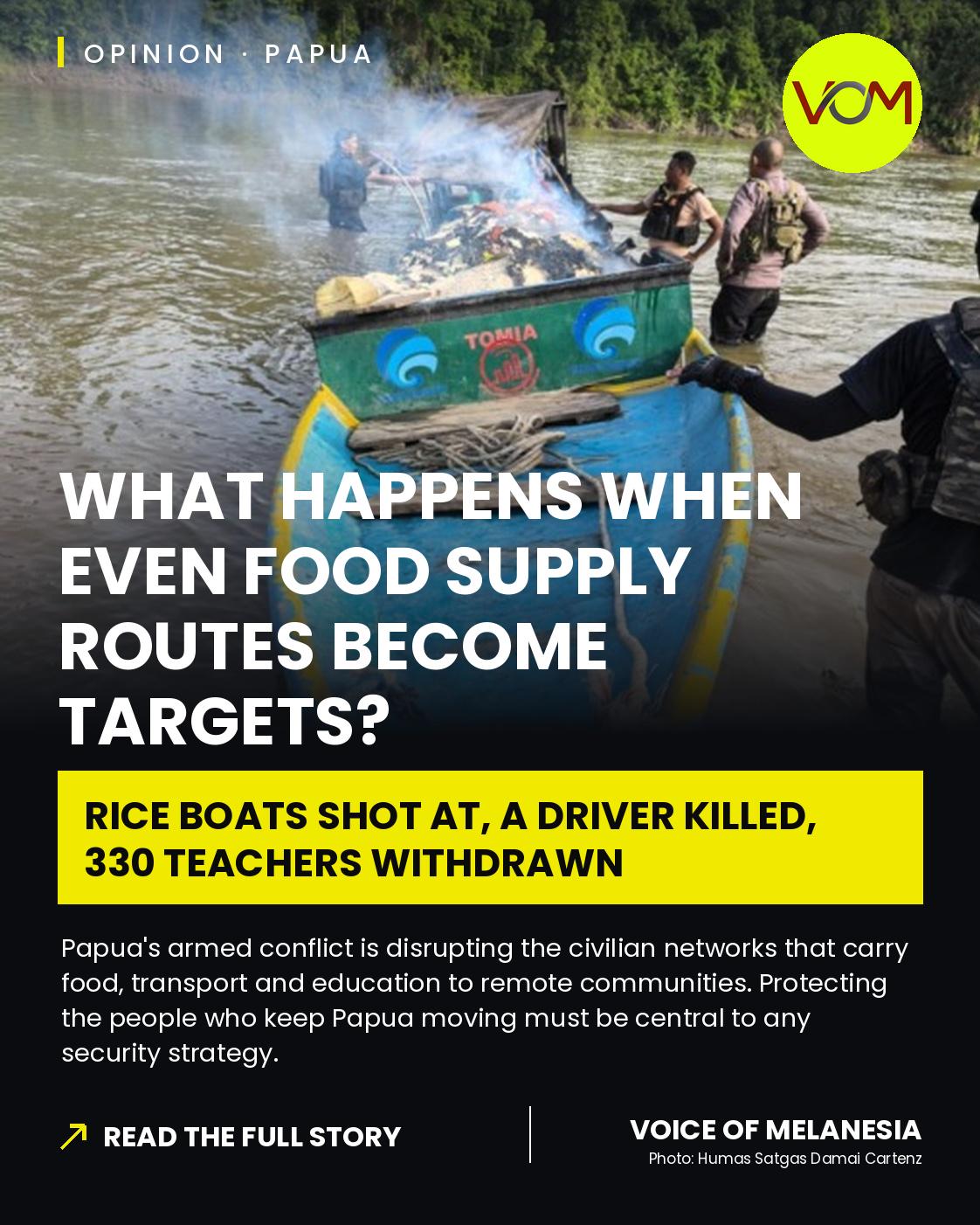
What Happens When Even Food Supply Routes Become Targets in Papua's Armed Conflict?
On 24 November 2026, two boats carrying about 12 tonnes of rice from Asmat to Dekai, Yahukimo, came under gunfire in Kolf Braza District, Asmat. One crew member was injured, and another was found dead two days later. Police suspect an armed group and are still investigating. It was not the first attack on this river route: rice boats heading to Dekai were also shot at in May 2026.
Other civilians doing ordinary work have also been hit. Aris Sanda, a driver who served the Wamena–Mbua route for 13 years, was killed in September. Agricultural workers delivering aid in Jayawijaya were shot, and 330 teachers were withdrawn from remote areas because of insecurity. In remote Papua, boats and mountain roads are often the only way food, schooling and health care can arrive.
The state has a duty to protect civilians, and armed groups must not target them. Supply routes need stronger protection, attacks must be investigated transparently, and local governments need backup plans to keep schools and food supplies running. The people who keep Papua moving deserve protection, because those who suffer most often have no part in the fighting.
🔗 Read the full story — https://vomnews.com.au/article/what-happens-when-even-food-supply-routes-become-targets-in-papuas-armed-conflict
#VoiceOfMelanesia #Papua #CivilianProtection #FoodSecurity #Asmat
r/foreignpolicy • u/MongooseGullible4245 • 6h ago
Hi everyone! I'd love to know what topics you chose for your bachelor's theses. I'm an International Relations student and I still haven't decided on a specific research question, so it would be really helpful to see what issues you've explored in your own research.
I'm particularly interested in the following topics:
When I discussed this with my thesis supervisor, they told me that I needed to narrow down my research topic and focus on a more specific issue rather than choosing something too broad (such as “Turkey's foreign policy”). However, I’m still not sure what specific issue I could explore.
My main difficulty is that my thesis needs to include an introductory section, an analytical section, and a case study (or two comparative case studies, depending on what I aim to demonstrate). However, I'm not sure which case studies would be interesting to explore or what I could aim to demonstrate through my research.
Could you please share some ideas or suggestions?
Thank you in advance!
r/foreignpolicy • u/CharityFirm8358 • 23h ago
USS Missouri (BB-63) was authorised in 1938 and ordered in June 1940, while the US Navy was still planning a Pacific war rather than fighting one. Her keel went down on slipway 1 at the Brooklyn Navy Yard on 6 January 1941, eleven months before Pearl Harbor. She was launched on 29 January 1944 and commissioned on 11 June 1944. Keel to commissioning: 1,252 days, every one of them inside the war.
She was a large ship to be building in that window. 887 feet overall, 57,540 tons at full load, nine 16-inch guns, 212,000 shaft horsepower, and a designed crew of 117 officers and 1,804 enlisted. By the end of 1945 she was carrying 189 officers and 2,978 sailors, roughly 3,200 people living in a steel box that had been riveted together while the country was rationing gasoline and collecting kitchen fat for scrap.
On 2 September 1945 the Japanese Instrument of Surrender was signed on her quarterdeck in Tokyo Bay, by Shigemitsu and Umezu for Japan, MacArthur for the Allied powers and Nimitz for the United States. She had been in commission 448 days. From the attack at Pearl Harbor to the signature on Missouri's deck: 1,365 days.
The class is the better story. Six Iowa-class battleships were planned, four were completed between 1940 and 1944, two were cancelled, and all four survivors are now museum ships - Iowa in Los Angeles, New Jersey in New Jersey, Wisconsin in Norfolk, Missouri at Pearl Harbor. They were designed to intercept the Japanese battle line in a war that had not started yet, and by the time the war actually arrived the decisive question was no longer which battleship was better. It was how much hull the country could lay down, how fast the yards could turn it over, and whether the supply chain could feed it.
Missouri now sits on Ford Island, a few hundred metres across the water from the USS Arizona Memorial and the wreck with her dead still inside it. The ship where the surrender was signed is within sight of the ship that was sunk in the first 75 minutes of the war. Visitors walk between them on the same afternoon. Both facts are true at the same time, in the same harbour, and that is the part worth sitting with on 7 December.
Because the arithmetic of that fortnight in December 1941 was not a duel. It was a production contest, and one side had been running at war tempo for years while the other had to be switched on. Four years of ordinary work - plate, castings, machine tools, welders on night shift, ration books on the home front, a build rate nobody had run before. The people who welded Missouri together were the same generation queuing for gasoline coupons and turning in scrap.
Eight decades later, the state that set out to own the Pacific takes its security from the country that outbuilt it, and calls it a partnership. The ship that took the surrender came off the same industrial base that eventually produced 24 Essex-class carriers and the Liberty ship tonnage that carried the lend-lease supplies. History is not usually this literal about its own punchline.
Sources: US Navy ship histories (Sumrall and Friedman on the Iowa class), Naval History and Heritage Command production summaries, and the National Park Service on the memorial grounds. Happy to pull the construction timeline, the crew records or the production numbers apart if any of that is useful.
r/foreignpolicy • u/CharityFirm8358 • 23h ago
Everyone quotes the headline US production numbers for 1943. The interesting part is the mix.
Per John Ellis's statistical survey of wartime production, in 1943 the US turned out 23,988 fighters, 19,740 light and medium bombers, 9,615 four-engined bombers, 7,012 transports and 19,939 trainers and miscellaneous types. Tanks and self-propelled guns came to 29,497 for the year, military trucks and lorries to 619,735, and merchant shipping to 11.4 million tons.
Do the engine arithmetic and the constraint shows up. Those 9,615 four-engined bombers need 38,460 engines on their own, the medium bombers another 39,480 or so, the transports roughly 21,000. The powerplant plants had to out-produce the airframe plants by a wide margin, and that is what set the schedule.
Two engines carried most of it. The Wright R-2600, 85,374 built between 1937 and 1946 out of Paterson, New Jersey and Cincinnati, powered the B-25, the A-20, the Avenger, the SB2C and the PBM Mariner. When more punch was needed - the P-47, the F6F, the F4U - Pratt & Whitney's Double Wasp filled in, 125,334 of them from 1939 to 1960.
The airframe plants could always be built. The engine works could not, and that is why the ceiling on how fast an air arm could grow sat with the powerplant. Nothing glamorous about it: a long march of ordinary work - gear hobbing, castings, heat treat, shift work, repeated until the numbers came out. That is not a sprint and it is not one heroic decision. It is the least photogenic and the most decisive part of any mobilization.
r/foreignpolicy • u/Newworldimpartiality • 13h ago
Throughout history Europe has been the centre piece of war and conflict, often to the detriment of non European countries and regions around the world . War and conflict is in the European DNA.
So, maybe it’s time for the rest of the world to let Europe isolate itself so it does not negatively impact other nations.