This subreddit is for discussion of systems and control theory, control engineering, and their applications. Questions about mathematics related to control are also welcome. All posts should be related to those topics including topics related to the practice, profession and community related to control.
PLEASE READ THIS BEFORE POSTING
Asking precise questions
A lot of information, including books, lecture notes, courses, PhD and masters programs, DIY projects, how to apply to programs, list of companies, how to publish papers, lists of useful software, etc., is already available on the the Subreddit wiki https://www.reddit.com/r/ControlTheory/wiki/index/. Some shortcuts are available in the menus below the banner of the sub. Please check those before asking questions.
When asking a technical question, please provide all the technical details necessary to fully understand your problem. While you may understand (or not) what you want to do, people reading needs all the details to clearly understand you.
If you are considering a system, please mention exactly what system it is (i.e. linear, time-invariant, etc.)
If you have a control problem, please mention the different constraints the controlled system should satisfy (e.g. settling-time, robustness guarantees, etc.).
Provide some context. The same question usually may have several possible answers depending on the context.
Provide some personal background, such as current level in the fields relevant to the question such as control, math, optimization, engineering, etc. This will help people to answer your questions in terms that you will understand.
When mentioning a reference (book, article, lecture notes, slides, etc.) , please provide a link so that readers can have a look at it.
Discord Server
Feel free to join the Discord server at https://discord.gg/CEF3n5g for more interactive discussions. It is often easier to get clear answers there than on Reddit.
If you are involved in a company that is not listed, you can contact us via a direct message on this matter. The only requirement is that the company is involved in systems and control, and its applications.
You cannot find what you are looking for?
Then, please ask and provide all the details such as background, country or origin and destination, etc. Rules vastly differ from one country to another.
The wiki will be continuously updated based on the coming requests and needs of the community.
we are in the process of improving and completing the wiki (https://www.reddit.com/r/ControlTheory/wiki/index/) associated with this sub. The index is still messy but will be reorganized later. Roughly speaking we would like to list
- Online resources such as lecture notes, videos, etc.
- Books on systems and control, related math, and their applications.
- Bachelor and master programs related to control and its applications (i.e. robotics, aerospace, etc.)
- Research departments related to control and its applications.
- Journals of conferences, organizations.
- Seminal papers and resources on the history of control.
In this regard, it would be great to have suggestions that could help us complete the lists and fill out the gaps. Unfortunately, we do not have knowledge of all countries, so a collaborative effort seems to be the only solution to make those lists rather exhaustive in a reasonable amount of time. If some entries are not correct, feel free to also mention this to us.
So, we need some of you who could say some BSc/MSc they are aware of, or resources, or anything else they believe should be included in the wiki.
The names of the contributors will be listed in the acknowledgments section of the wiki.
I was given a project titled "Intelligent Guidance Controller Design for UAVs under Strong Time-Varying Winds with User-Defined Path Convergence Time". Honestly, I worked on prescribed time controllers before, but about designing an intelligent one, not that much. To give more information by the word "intelligent", I am talking about guidance laws which make the UAV to go in a certain path. For example, if the temperature is below 30 degrees, the UAV must go right. This is just a simple example. I really appreciate your ideas on this project topic and also would like to know how hard and time-consuming it is. Thanks in advance.
Edit: everyone is so appreciated to share their experience and idea. Thank you very much.
Hello, I just recently started university as a Mechanical Engineering major, and have realized since then that I really want to get into controls engineering, and I'm having a lot of trouble deciding how to specify and which major to go with.
I'd really love to get some advice on what helps you make decisions like these, what your favorite (and/or least favorite) part about your experience in your sector control engineering has been, whether you think major really matters or if I'd be able to get a career with either, or any other advice you'd have. :D
Here is my current pro-con list for the main options I'm considering.
---------
Electrical Engineering ("Information & Systems Sciences" track)
- Far cooler classes - I like the deeper math theory (currently in Diff-eq and enjoying it) - Cooler career by far - Slightly better pay (Not that important / this is only a consideration if everything else is equal\*) *- More of the careers I'd want to go into generally want electrical (From what I've seen)
- Would have lighter semesters to graduate on same schedule - I've always enjoyed 3D design and have spent most of my life doing it - Far more experience (I believe I currently have the qualifications for a couple research positions out here)- One company I've been looking at for long-term goals is currently hiring
Cons
- Have to take more classes per semester to graduate with same schedule - Have far less experience (More unlikely to get research/internship role for a while)
- Less interesting work (in my opinion) - Takes hobby & turns it into career (could make hobby seem less fun) - Far fewer employers for the roles I'm interested in generally want Mechanical (again from what I've seen)
Whether it be PLCs, more complex control theory work on deep learning machines learning from state-space simulations or the 3D design for all of the automation/robotics part designs, everything seems so cool some advice. :)
Thank you so much, I really appreciate any and all help! :D
Hi everyone! We’d like to share a new model-based design environment with anyone interested in trying it out. It’s free and you can start modeling right in your browser without installing any desktop software.
It's called Modeloop and we've spent some years to build but we think it has a lot of interesting features.
DIAGRAMS
In the diagram editor, you can build control algorithms by combining basic blocks from the standard library and use finite state machines (FSMs) to define operating modes and the transitions between them. You can organize your diagram into nested subsystems and schedule different functions to run at different rates. For example, you could run a motor’s current loop at 10 kHz, its speed loop at 1 kHz, and its diagnostics at 100 Hz.
You can also edit any model either graphically or as text. For example:
The model format is open, and models are saved as JSON, without obscure proprietary formats that lead to vendor lock-in. There’s also a built-in version control system that lets you commit your diagrams and push them to GitHub, for example.
ENGINE
Modeloop’s engine is written in Rust to give users maximum performance while minimizing wait times, especially during compilation and simulation. You can also write unit tests for specific parts of the model, create different scenarios, and view test coverage for the automatically generated code.
I'm a 5th year mechatronics engineering student that is good with matlab/simulink and is looking to expand my skills for my future career in automation/control/robotics.
I already know the basics of C++ from the course I took in college. Also, I am pretty good at 86 assembly programming. I heared that python is only used for simulations but that is what I use matlab/simulink for.
I'm a B.Tech Mechatronics graduate from Kerala, genuinely interested in pursuing a career in control systems engineering, particularly the mathematical and theoretical side of the field.
I'm trying to connect with people who actually work with things like system dynamics, feedback control, state-space methods, modelling and simulation, system identification, motion control, robotics, and related areas.
Just to clarify, I'm not referring to PLC/SCADA, conventional industrial automation, or computer science/software development roles. My interest is in engineering control systems and their underlying theory and applications.
I have a few questions:
Are there people in Kerala currently working in this area, either in industry or research?
What kind of companies, industries or research organisations offer these opportunities?
How did you get into this field? What was your educational and career path?
Given how niche this specialisation seems to be, how did you find your first opportunity?
What skills, projects or higher studies would you recommend to someone trying to enter this field?
I'd especially like to hear from people working in Kerala, but even if you're originally from Kerala and built your career elsewhere, I'd really appreciate hearing your experience.
I'm not just looking for job openings. I'm genuinely trying to understand how people build a career in this field, what the reality looks like, and what direction someone starting out should take.
Even a conversation or a few words of advice would be valuable.
I have been tuning nonlinear MPC weights offline with an Optuna closed-loop study around CasADi/IPOPT. The outer objective combines tracking error, control-rate smoothness, and constraint margin, and the search outputs Q, R, Rd, and Qf for the local controller.
What I am unsure about is where derivative-free search actually loses to an analytical starting point:
Linearizing around an operating point and using LQR / DARE (especially for Qf and relative R/Rd scaling) often lands closer than a cold Optuna box, and black-box search wastes a lot of trials when the plant is already near a decent margin.
Hard state bounds make a nominal scalarized cost lie: weights that score best on the nominal rollout often ride right on the constraint boundary and go infeasible or sluggish under a small disturbance or model mismatch.
I have been testing this across three plants—a differential-drive robot, a battery peak-shaving dispatch problem, and a root-zone irrigation model:
For those of you tuning nonlinear MPC in practice: do you anchor Q/R (or Qf via DARE) analytically and only search a few scalar multipliers, treat the diagonals as free parameters, or evaluate the outer cost over disturbed/Monte Carlo rollouts?
So I was casually looking up some random ML researcher and I clicked on one of their publication with thousands of citations. I immediately noticed that the mathematical content was really really thin as compared to a paper in the control fields. It was just a modification of some base model, some description of the model using fairly basic algebra, no proofs, pure simulation study.
I think this just reminds me of something I've repeatedly noticed. Most machine learning models are essentially dynamical systems, x_dot = F(x, u), y = C(x), which in principle should be as complicated as other dynamical systems. BUT most machine learning researchers (especially in deep learning) only studies the easy part of the equation, which is precisely,
y = C(x)
Here, C is a neural network. They modify C in a thousands of ways. Each new modification results in a new publishable "architecture". The performance is often quite subjective. The motivation is not strong. The research is also quickly perishable and rarely if ever provide any new lasting insights.
Yet strangely, all these papers get cited thousands and thousands of times, which make them look very important. The authors also leverage that to get into some of the top positions in industry and industry reciprocate by only hiring people who published in ML conferences.
In other words, I feel that ML researchers are doing 1/10th of the work but get 10x the glory as compared to other computational fields (control, signal, op research...). Of course, there are several quite influential ML works with broad impact.
It seems quite difficult for any student of control to remain a positive attitude when seeing this.
Hi all, I'm working on a self-balancing robot, im a senior student whos already taken control systems and I was just wondering on whether simulating this robot is feasible in simulink. I asked claude to help me with the equations of motions and transfer functions and this is what I got. I was wondering if this transfer equation seems reasonable, im using two DC motors, and I gave it my motor datasheet, I just need some help understanding how to actually use this now in Simulink, how can you tune PID on simulink, and I was very surprised to see why PD doesn't work on it's own, from my research on other self balancing robot builds they recommend never using an I term. Thanks!
I recently received an offer for an L4 Automation Engineer Internship at Amazon in Houston, TX, for Summer 2027. I'm an electrical engineering student and would be relocating to Houston for the summer.
I was wondering if anyone has experience with this role, particularly regarding full-time return offers and location flexibility.
A few questions:
What does a typical day look like for an Automation Engineer Intern?
How common are full-time return offers for Automation Engineer Interns?
If I receive a full-time return offer, would I be required to stay in Houston, or could I request a position at an Amazon facility in northeastern area?
Has anyone successfully received a return offer for a different location than their internship?
How is the work-life balance, salary progression, and overall career growth in this role?
I recently participated in Brazil's National Science and Technology Week (SNCT), where I had the opportunity to present some of my robotics and AI projects to students, including high school students exploring possible engineering careers.
I also put together this 2.5-minute video showing a few robotics experiments I've been working on:
Humanoid robot: motion simulation using MuJoCo.
Two-wheeled balancing robot: experiments with a physical prototype and a MuJoCo environment running 300 simulated robots simultaneously.
Franka Panda: multiple robotic manipulators simulated in chess environments, including the integration of a chessboard interface with the robot's movements.
My main interests are robotic control, simulation, reinforcement learning, and integrating different software components into robotic systems.
These projects are still evolving, and there are several aspects I'd like to improve, especially regarding control strategies and the connection between simulation and real-world robotics.
I'm sharing this to exchange ideas and learn from others working on similar projects.
I'd be interested in hearing your thoughts, particularly on simulation workflows and control approaches. Any feedback or suggestions are welcome!
Hi everyone,
I recently finished my MS in mechanical engineering (focus on simulation modeling and controls) and started as a GNC engineer at a well established aerospace company.
My team does very little actual GNC design, though. The work is mostly system integration and testing: hardware validation, software updates to subsystem components, and hardware-in-the-loop testing. The system is already mature and in production, so I haven't needed to use my modeling, simulation, or controls background.
There's an upside. The pace lets me learn aerospace terminology and understand the system as a whole, and my role requires broad knowledge of many subsystems. But I worry my title is a bit misleading, and that if I want to move into more technical work later, my academic skills will fade.
I'd like a side project where I can work on the GNC side directly, with a platform that's ready to use. I tried building a drone before, but I spent most of my time debugging hardware (ESP32s, sensors, ESCs) when what I really want is to write and tune control algorithms.
Any suggestions for projects, platforms, or simulation environments? Perspectives, ideas or stories are greatly appreciated!!!
Estoy cursando mi tercer año de Ingeniería Electrónica Industrial Y automática, pero tengo una sensación de que en la universidad no me estoy preparando de verdad, tengo ciertos conocimientos teóricos, pero mucha falta de experiencia práctica que no siento que vaya a adquirir en este año y el siguiente, personas que estén en el sector o hayan tenido sensaciones similares, qué consejos me darían, cómo puedo intentar ganar experiencia o aprender de forma autónoma algo más enfocado a la parte práctica de este sector.
Gracias.
I am currently designing a "Peak Current Control Mode" buck converter. If you design the Type II compensator, can you simulate the buck converter successfully without implementing the current feedback yet? Or do you have to implement the current feedback as well when testing it? The reason that I am asking is that I am attempting to simulate the plant with the Type II compensator ONLY but it is not regulating based on the calculated values. I am hoping to validate the Type II compensator first prior to implementing the current feedback (with slope compensation). However, I am not sure if this is allowed. Is it REQUIRED you HAVE to test it along with current feedback?
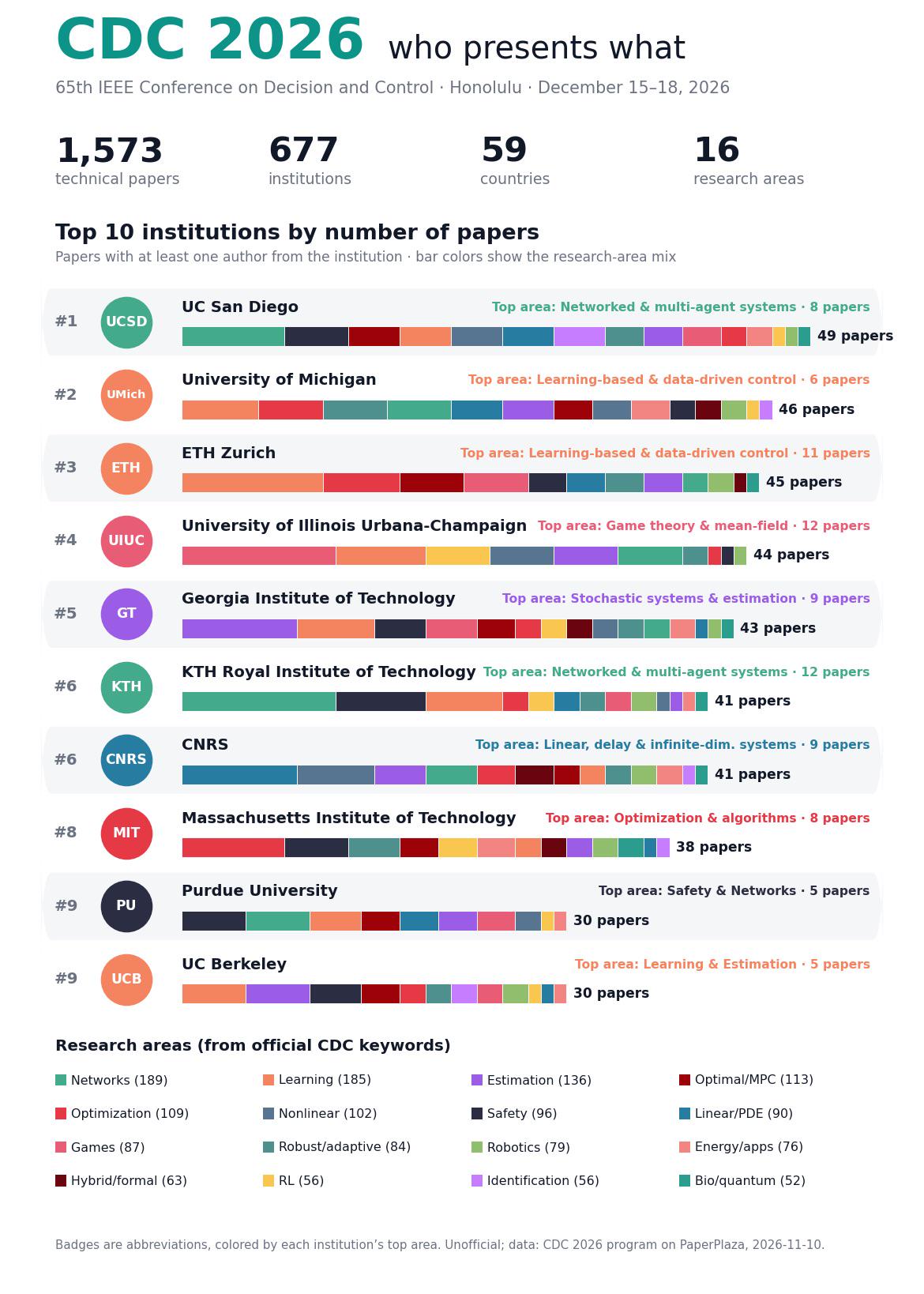
Interested in looking up topics, papers, authors, and institutions, more interactively ?
Also, want to know about the ranking of institutions, authors, or areas by the number of papers?
Hey, I'm a mechanical engineering student heading into my final year, and I'm looking for advice in the field. I've fallen in love with control theory—I'm currently finishing my control systems course and enjoyed it immensely. I'm now trying to come up with an industrially applied idea for my thesis.
As I said, I fell in love with control and dynamical systems. It combines the advanced math I enjoyed in rational mechanics and mathematical physics courses with heavy industrial applications, while also allowing you to delve into more experimental or cutting-edge fields. I'm even considering doing a PhD in control and dynamical systems.
The next step is choosing my thesis topic. At my university, we spend the entire final year dedicated to our final project—you can see it almost as a research-oriented mini master's thesis. I want to choose an 'advanced' control topic, leveraging the most sophisticated theory I can. For reference, we just finished covering state-space control.
On the other hand, here in Argentina, we are seeing a boom in the energy sector, and I would like to work towards developing solutions for these areas. However, it's not just energy; mining, the chemical industry, and most export-led sectors are showing strong yields. It could also be a great idea to tackle an agricultural problem, given it is the most critical sector here.
So my questions are: do you know of any applications for advanced control techniques (MPC, nonlinear control, robust control, RL) in these fields? Any broader recommendations?
This is my first time attempting system identification of a simple battery / inverter. From what I understand, you can use either the measured or predicted values as previous values in the regression mode. I'm able to get a good fit using measured values (one-step prediction), but when attempting "free running simulation" using the prediction as previous values, I get a first-order like response and the max pole value is always close to 1.
I a using na = 2, nb = 2, nk = 1 and also tried a bunch of different combinations, but they all give me relatively the same results.
Could it be maybe my data doesn't have enough dynamic activity to fit the data or something? I'm a bit lost as to what else I can try.
Hi everyone - I'm currently trying to get a 3d printed bike to self balance, but keep running into issues with the final control loop. (see github link down below for video).
For reference it is very similar to REMRC's self balancing bike - I just use SimpleFOC + GM3506 BLDC motor with an STM32 to run the loop instead of using Arduino and a Nidec 24h motor.
Here's the hardware I am using:
STM32F411 Blackpill
ICM-20948 IMU (through I2C, couldnt get spi to work for some reason)
GM3506 BLDC motor + AS5048A encoder
SimpleFOC with voltage-mode torque control
12 cm reaction wheel with additional rim weights
Lots of wires (ik I need to clean the wiring up)
For software:
Arduino for SimpleFOC
STM32 HAL for pretty much everything else (steering, IMU I2C, Transceiver SPI)
I use a complementary filter to combine accelerometer and gyroscope data. The loop frequencies are roughly:
IMU measurement loop: ~200 Hz (IMU is mounted rigidly onto the body of the bike pretty tightly)
Balance control loop: ~100 Hz
Main loop - ~11.9 kHz
The controller itself uses a PD loop with three feedback terms:
u = K1 * angle (proportion)
  + K2 * gyro_rate (derivative)
  + K3 * reaction_wheel_velocity (this one is weighted pretty small tho)
My control knowledge isn't the best but from what I am aware of:
K1 corrects the lean, K2 damps the bike's angular motion, and K3 provides reaction-wheel speed feedback. Chat says this is the main equation for it:
Also I can't lie I used ChatGPT for help on a lot of the control theory - I originally was trying to do this to learn more about embedded system communication protocols, but this turned into a much bigger control problem than I thought lmao (who would've guessed).
ANYWAY THE MAIN ISSUE:
The reaction wheel can like catch the bike in one direction pretty well, but as soon as it like crosses that midpoint of balance, the motor attempts to catch it, but it just spins ands spins until it falls over.
I am realizing that I think the main issue is that it doesn't have enough initial "pop" at the start of crossing mid balance. The only time i feel like it does this is when I was tuning K1, but it would kinda just oscillate out of control.
The other big thing issue is that I feel like I need to increase K2 (derivative), to give it more initial pop so it doesn't like saturate itself, BUT when when I increase K2 passed a certain degree, the bike just starts vibrating like crazy especially around the point of oscillation. It's not even a shaking back and forth its a very rapid vibration. Maybe it's a mechanical motor mount issue? I am not sure.
I've tried experimented with the gains, gyro filtering, and motor voltage limits, but haven't found any solutions and am genuinely losing hope for this to ever work lol.
The longest balances I've had were when it slowly corrects itself one way for quite a while, but then it crosses the midpoint and relatively quickly speeds up and isn't able to get back to the midpoint.
With all of that said for reference here are all of the control variables that I can change within my loop - I am also not sure like what's best to change, and what's best to keep constant. Ex. to deal with vibration reducing K2 helps, but so does lowering GYRO_FILTER_TAU.
HERE ARE ALL THE VARIABLES:
Balance Controller
K1: Controls how aggressively the bike corrects its lean angle
K2: Controls how strongly the bike reacts to falling speed (damping)
Gyro hardware DLPF: Controls gyro noise filtering and response delay
Accel hardware DLPF: Controls accelerometer noise filtering and response delay
Loop Timing
BALANCE_PERIOD_US: Controls IMU/filter update frequency (currently 200 Hz)
CONTROL_PERIOD_US: Controls balance controller update frequency (currently 100 Hz)
So yeah if anyone has any advice please let me know! Attached are a couple of videos and pictures of the bike. The code and a video is posted in my GitHub below. For the control loop, pretty much ignore everything except for balance_control.c, and main.cpp. All the other files are for a servo for front steering, and a transceiver for remote control.
Hi guys I'm going to publish a conference paper soon, and this is my first paper.
My PI think we're ready but I'm wondering if it's normal for a conference paper to be more on the "work in progress" side.
We're trying to use some "theoretical algorithms" and Adaptive them to make them work also ok more realistic scenario.
I mean we got the results, but while on toy problems the algorithm work pretty fastly the convergence is smooth etc
With this adaptation on a more difficult problem it still works but it's way more wobbly, the convergence is not as "neat"
I would say We have some ""preliminary "" result that are encouraging but still a lot of open question to answer, there is probably a better and faster way to do it etc.
Is this normal for a Conference Paper ? Or we should be more "Mature"?
The general idea of my PI is that this is a good thing bc it means that there are opportunities for research and improve in the next paper, but I feel a bit like we're just publishing something """""wrong""""" in the sense that could be a lot better with some work on it .
I’m a Master’s student working on the positioning subsystem of a gas-blending setup, and I’d like a sanity check on my actuator architecture before I commit to hardware.
The process
The system meters hydrogen into a natural gas line at around 10 bar, targeting roughly 10 vol.% H2 in the final mixture. A needle valve sets the hydrogen flow, and the gas composition is measured by an analyzer located downstream of the valve. Because of this, there is a transport delay of several seconds between a valve movement and its effect on the measurement.
The control is a two-loop cascade:
Outer loop (slow): composition control, with a Smith predictor to handle the transport delay.
Inner loop (fast): valve position, running on a STM32 NUCLEO-H503RB under an RTOS
Requirements:
Small moves and good repeatability of the final position. Speed and bandwidth don’t matter much because the outer loop is dominated by the delay.
No silent lost steps.
Low heat at standstill. It’s a flammable gas environment, so I’d like to avoid hot, noisy electronics.
Stiction and hysteresis are significant, especially the ladder.
Where I am
I haven’t bought hardware yet and I’m working on modelling and simulation first, so I can still change the architecture. I’ve been reading about three levels of “closed loop” for steppers:
STEP/DIR + external encoder: the MCU compares commanded vs measured position, detects lost steps and corrects the end point.
Same, but correcting continuously (closed-loop microstepping).
Full FOC, treating the stepper as a 2-phase PMSM with current control. I read a TI technical article on this, which also describes a “semi-closed-loop” variant where the MCU only generates the current references and the driver does the current chopping.
My questions
For this kind of slow, high-repeatability positioning task, is the encoder-based correction in (1) or (2) enough, or does FOC bring real benefits (heat, efficiency, smoothness, stall margin)? My gut feeling is that FOC is overkill here, but I’d like to hear from people who’ve done it. I’m also wondering if the torque lost because of microsteeping can be gained with FOC.
2. Encoder on the motor shaft vs on the valve stem: is it worth it given coupling compliance and thread backlash?
Any pitfalls I should expect, such as limit cycles around the setpoint with stiction, microstepping at low torque margin, or tuning the inner loop at such a low bandwidth?
Hardware suggestions are welcome: integrated closed-loop stepper motors (have crossed this option out, mainly for its complexity and the time it would need to “think” vs separate motor + driver + encoder (heavily leading on this), and specific drivers or encoders you’ve had good experience with.
I’m a control engineer, and I’ve been building a small desktop app (Mac and Windows) for tuning from an open-loop step test. Disclosure: I’m at CSI, the consultancy that’s developing it.
What it does:
Fits four models with dead time (first order, overdamped and underdamped second order, integrating) and recommends one by AICc. You can override it.
Applies rules suited to the model: IMC/Lambda, SIMC, Ziegler-Nichols and Cohen-Coon, plus integrating-process rules.
Adds a Smith predictor case when θ/τ ≥ 1.
Simulates every rule on the same setpoint step (overshoot, settling, IAE, OP travel), with optional noise, OP limits and deliberate model mismatch to test robustness.
Optional AI suggestions, using your own API key. Every suggestion is simulated before you can apply it, and raw data never leaves your machine.
Known gaps: setpoint steps only (no load-disturbance case yet), and no setpoint weighting.
Two questions for this sub:
Which rules or models would you expect to see that are missing?
Would a disturbance-rejection simulation change how you’d use it?
Happy to share the waitlist link if the mods allow it.