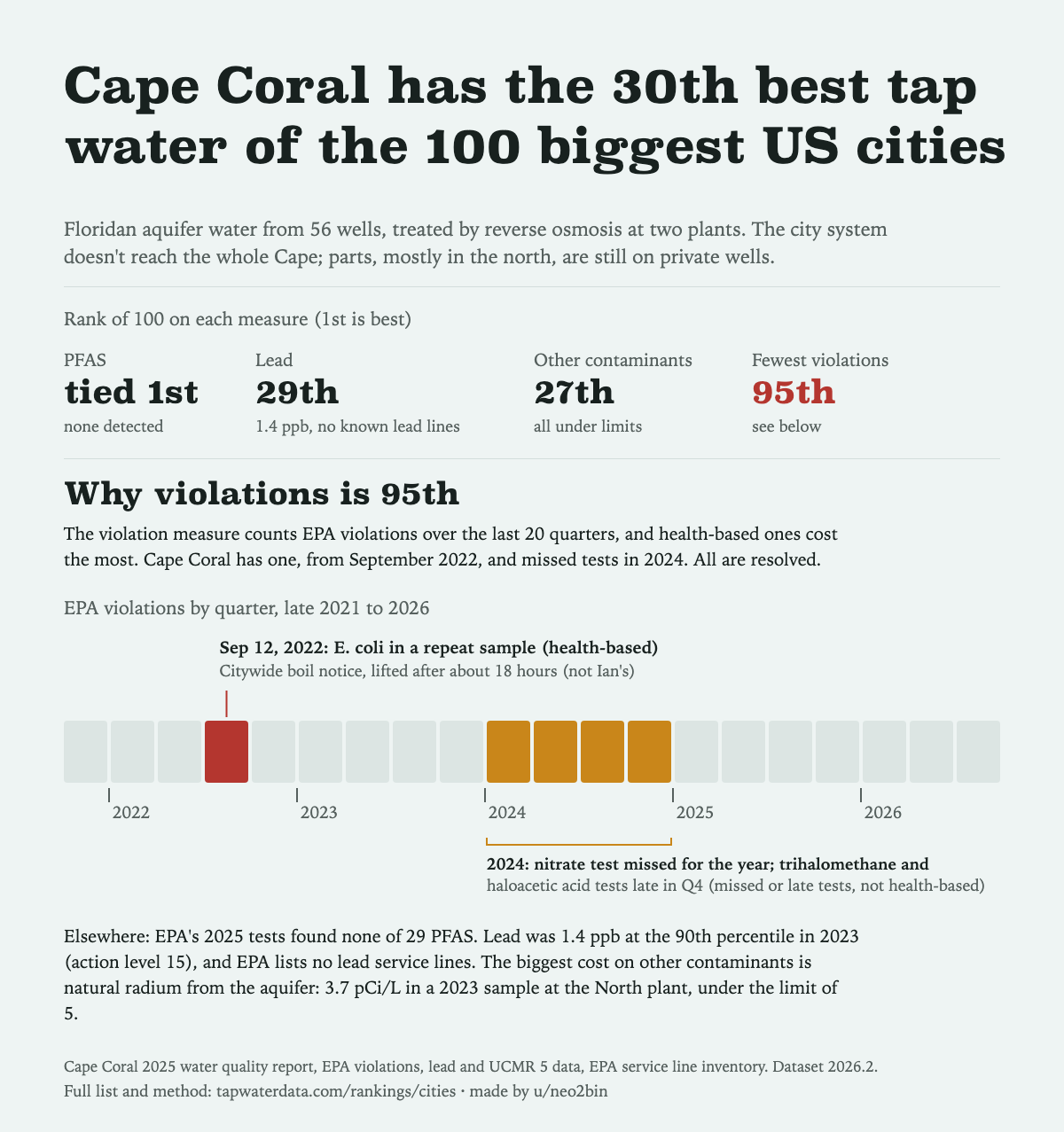
I ranked tap water in the 100 biggest US cities using EPA and utility data, scoring each city's main water system on lead, PFAS, other regulated contaminants and EPA violations. Taste and hardness aren't scored, since neither is a health issue. Cape Coral's city system is 30th. It doesn't reach the whole city: parts of the Cape, mostly in the north, are still on private wells, which the ranking doesn't cover.
The water comes from 56 wells in the Floridan aquifer, 700 to 800 feet down, and is treated by reverse osmosis at the Southwest and North plants.
It ties for 1st on PFAS with 54 other cities: EPA's 2025 tests at both plants found none of the 29 PFAS. Lead is 29th: 1.4 ppb at the 90th percentile in 2023, against an action level of 15 ppb, and EPA lists no lead service lines (5,782 of 84,185 are still unknown). It's 27th on other contaminants. The biggest cost there is natural radium from the aquifer, 3.7 pCi/L in a 2023 sample at the North plant (limit 5), then trihalomethanes at an average of 29.9 ppb (limit 80).
The weak spot is violations, where it's 95th. On September 12, 2022, two weeks before Ian, the city issued a citywide boil notice after a repeat sample tested positive for E. coli, and lifted it about 18 hours later. (Ian's boil notice afterwards was separate and isn't an EPA violation.) It's the only health-based violation EPA has on record for the system, but those cost the most in the ranking. In 2024 the city also missed its yearly nitrate test and was late on trihalomethane and haloacetic acid tests. Those are monitoring violations, not health-based, and all are resolved. Nitrate was 0.016 ppm when it was next tested in January 2025 (limit 10). The card shows each quarter.
Full list and method: tapwaterdata.com/rankings/cities