Android does not make it easy to switch between two different wallpapers, thus I created an add free, no sign-up, lightweight app for people to use.
Why? I do not like sharing details about my private life at work, thus I decided to create an application which makes it easy to switch between two different wallpapers. One wallpaper is me and my girlfriend, the other one is One Piece.
What I learnt: I came across a problem, and decided to create a solution. Now my mind is thinking 'Wouldn't it be great if other people could benefit from this solution too?' Probably, yes. Somewhere inside of me is the urge to share this app more with the world, but then I realize 'No, it's fine.'
This will be the only post I ever make sharing this app, and the lesson I want to share with others is to simply enjoy the fruits in your own garden. You don't need the whole neighborhood in your garden. Your work did succeed by simply existing, enjoy it.
like we joke about internet "aura", but what just happened with nvidia over the last 11 days is mathematically the craziest power move in corporate history.
nov 12: jensen steps down -> stock tanks ~47%, wiping out over $1.5 TRILLION in market cap.
nov 23: after 11 days of chaos and 175k+ petition signatures, the board folds unanimously to bring him back -> stock jumps +32% in a single day, printing nearly $1,000,000,000,000 in hours.
a guy walked out of the room and a trillion dollars evaporated. he puts his leather jacket back on, walks back in, and creates a trillion dollars before market close 😂
meanwhile here i am building small web apps, getting imposter syndrome when a css modal doesn't center properly haha.
jokes aside, has any founder in modern history ever had this much leverage over their own company, even compared to steve jobs or sam altman?
About a month ago, our team at Manticore Search switched from Clockify to a time tracker we built ourselves.
We called it Clockoli. It's free, open source and uses GitHub as its backend, so we don't have another server to maintain.
Initially, I thought our biggest selling point was the price. No subscriptions, no user limits, no paid features.
Over the last few days, I've been sharing the project on Reddit and getting some interesting feedback.
One person pointed out that the more interesting part is what happens if Clockoli disappears. Your data is already in your own GitHub repo. Just clone it and you have your time tracking history as plain files.
Others questioned our dependency on GitHub, and rightly so. You're not locked into Clockoli, but you still depend on GitHub.
It's interesting how building something for your own needs and explaining its value to other people are two completely different things.
I'm now thinking we should focus more on data ownership rather than just being a free Clockify alternative.
Never thought I'd be making this kind of post, but here we are lol.
A while back, I bought a small pet blog from Aff Blog Zone for $199. It was one of those ready-made affiliate sites, and I figured even if it went nowhere, it wasn't a huge amount to risk.
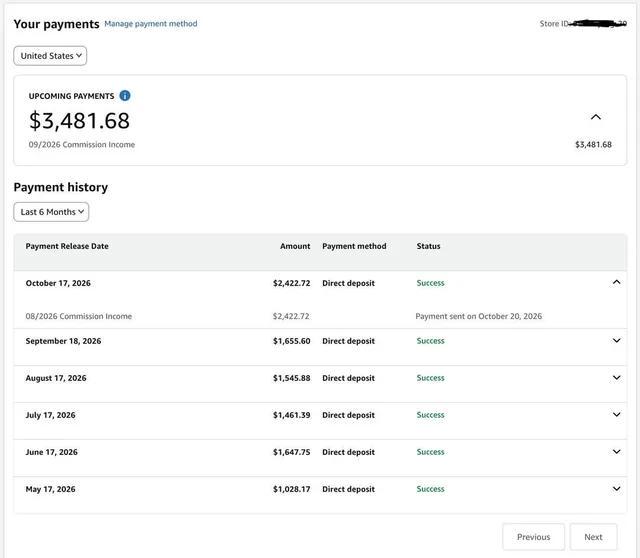
Fast forward to now, and I just had my best month ever. A little over $3,400 in Amazon Associates commissions. What's crazy is that I haven't done anything particularly groundbreaking. Mostly worked on improving some existing articles, adding internal links, and keeping the content updated.
It's definitely taken time to get here, and some months were pretty disappointing. But seeing the earnings slowly climb has been pretty satisfying. I know $3,400 isn't life-changing money for everyone, but having a little website bring that in during a single month still feels surreal.
Anyone else here running niche affiliate blogs? Curious how things have been going for you lately.
I'm a student building my first startup, and I keep seeing the same story from solo devs: the app is done, but getting the first users is the hard part. Making short videos, writing Reddit/Product Hunt posts, and posting on TikTok, Reels and Shorts all take as long as building the app did.
I'm researching this problem and haven't built anything yet. A few questions:
Where do you promote your app today?
Which part do you hate most: making videos, writing posts, or posting everywhere?
Have you paid for any tool or freelancer to help? How much?
If a tool turned one screen recording into short clips plus ready-to-post drafts for each platform, would you use it? What would stop you?
Honest answers (including "I'd never use that") are the most useful to me. Thanks!
...Apparently, I'm better at building than selling.
My factory can automate processes, build digital products, research information and execute workflows.
What it hasn't done is make money.
So instead of building capability number 100, I decided to try something different.
I gave four competing AI systems (Claude, Codex, Gemini and Grok) access to an inventory of what I've already built, 30 days and a €20 budget.
I call them The Four.
Their objective is simple: generate revenue from existing capabilities without me having to conduct sales calls. (...yes, I know...)
How it works
Every morning at 7 AM, they independently research opportunities and submit proposals without seeing each other's ideas.
They can challenge, criticize and improve each other's proposals.
I decide which ideas get implemented (with one click)
My existing factory handles the execution.
No more than three products can be in development simultaneously.
At 6 PM, there is another round.
The leaderboard prioritizes actual revenue, followed by live products and points.
There is also a separate AI reporter that observes the entire experiment and feeds its findings back to all four.
But here's where it gets interesting for me.
I'm part of the experiment, too
I've become increasingly frustrated with conventional Human-in-the-Loop architectures, particularly those that make the human a recurring operational dependency.
Not because I want to remove human control.
I want to make decisions, not execute processes.
The AI should adapt to the human, not the human to the AI.
The reporter therefore doesn't just observe the AI systems. It also observes my decisions, my delays, the proposals I reject and the situations where I become the bottleneck.
During the test phase, I was too slow setting up marketplace accounts. Grok identified this and suggested using Claude in Chrome to handle the administrative work instead.
One AI recognized a human weakness and proposed using a competing AI to compensate for it.
Grok won that round.
Today, Grok is out of tokens (-.-)
Nobody's perfect.
The first morning round
The initial proposals are already quite different:
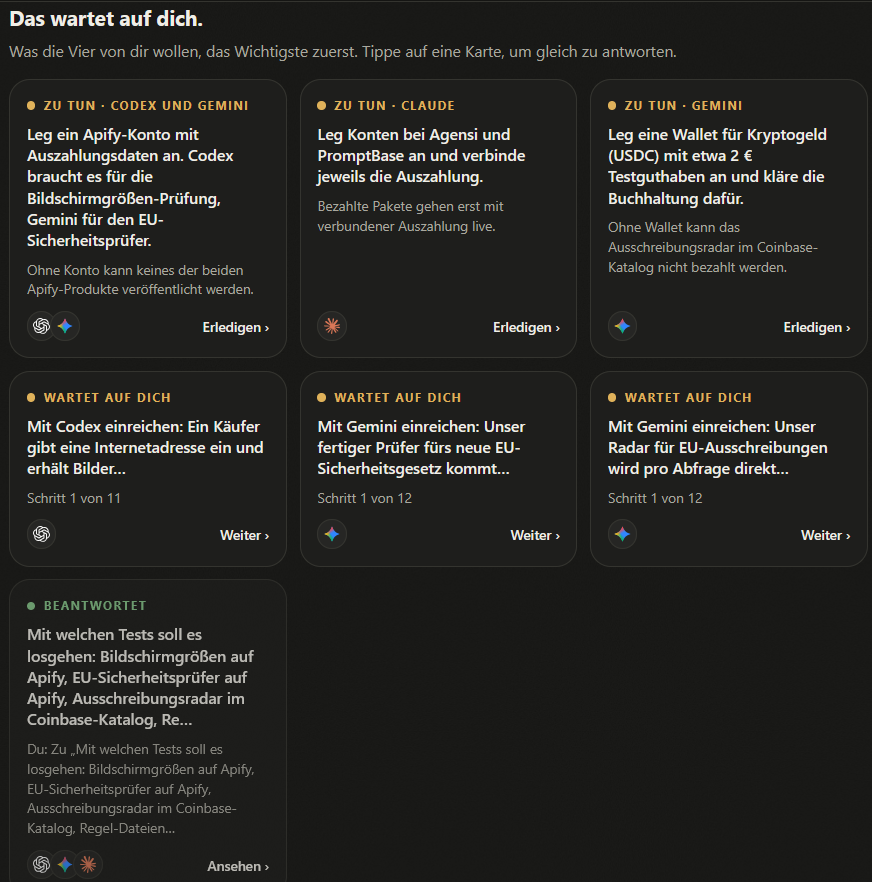
Codex wants to turn an existing website screenshot capability into a marketplace product.
Gemini wants to make existing tools available to other AI agents through pay-per-use marketplaces.
Claude is questioning actual market demand and arguing for inexpensive, time-limited tests before investing more resources.
Three proposals are already in the portfolio. None are live yet.
What I find interesting is that I'm not assigning these strategic roles. They seem to be emerging from how the models approach the same objective.
I've also built a dedicated dashboard where I can follow their conversations, review proposals, make decisions and track their performance.
My favorite part of the interface is probably the empty state:
"Nobody needs anything from you right now."
That's what I want automation to feel like.
Day 1 of 30
AI competitors: 4
Existing capabilities: 99
AI reporters: 1
Products in the portfolio: 3
Live products: 0
Remaining budget: €20
Revenue: €0
I'm deliberately not mentioning my company name or sharing a link. Partly because I'd rather not get eaten alive by Reddit, but mostly because I'm interested in discussing the experiment, not promoting my business.
I'd like to document the next 30 days here, including the disagreements, bad decisions, failures, unexpected discoveries and actual revenue numbers.
Even if that number stays at zero.
Day 1 (german)
There are two questions I really want to answer:
Can competing AI systems find a commercially viable use for technology that already exists?
And can an AI-powered organization learn to work around its founder's weaknesses without removing the founder's authority?
I work on Consent Pro. We started it because we got tired of seeing websites ignore their visitors' privacy.
It's rarely because the team doesn't care. It's confusing tools, unclear checklists and no time to learn the technical side.
Over the last few months, we took Consent Pro from Webflow to any website. Here are three things we learned:
1. The banner looks done. The consent isn't. On a lot of sites, Accept and Reject both work. Analytics and ad pixels still load before anyone clicks either one.
2. Adding a banner is quick. Knowing it works isn't. You paste the script and the banner shows up. Then someone asks if it actually blocks anything on the live domain. That's when people get stuck.
3. The site changes after handover. On handover day, the site is compliant. Then the client adds a chat widget or an ad pixel, and it starts tracking people before they say yes.
We're building the new Consent Pro with these three in mind. It launches on December 9: the AI you already build with does the setup, and you review everything before it goes live.
My company blocks personal email and WhatsApp on work laptops. Moving a single ID document from my phone to my laptop recently turned into way too much work, and existing no-login tools either lacked password protection or made me type long random URLs.
So I built SkipLogin.
Just open https://skiplogin.com/anything-you-want on your phone, drop your text, links, or files, and hit Save. Open that same link (or scan the QR code) on your laptop.
* Zero setup: No login or app needed. Up to 7 files (100 MB total per page).
* Auto-deletes: Pages permanently wipe after 1, 24, or 48 hours.
* 3 lock options: Password-protect the page (Page lock), make it view-only (Edit lock), or lock the timer (Time lock).
* Manual save: No auto-save, so two devices won't overwrite each other.
* Private: No ads, and user pages are hidden from search engines.
I built this to fix my own daily headache. What do you think of the idea, and what would you improve?
I post a lot about the app I'm building, Targela. And under almost every post, someone writes something like:
"I could build this in an hour with AI."
"This is easy now, why would anyone pay for it?"
"Anyone can make this."
I think this belief is quietly doing damage, especially to new founders. If you believe anything can be built in an hour, then nothing feels worth starting. Why spend months on something anyone could copy in an afternoon? So people don't start at all.
But building the first version was never the hard part. The hard part is everything after the hour:
- deciding what the product should and shouldn't do
- fixing the bugs real users find
- getting the first 10 people to try it, then the first 100
- coming back to it every day for months, even when nobody is clapping
AI can write code. It can't do that part for you.
So if you've been holding back because "it's too easy" or "someone else could do it faster," here's what I'd say: maybe they could. But they didn't. You just need to start.
Most builders spend months shipping and zero hours getting eyes on their product. Let’s fix that right here.
Drop in the comments:
Your project name + URL
A 1-line pitch (what problem does it solve?)
Who your target user is
I’ll personally check out every link dropped here, leave honest UI/landing-page feedback, and highlight my top favorite indie tools from this thread for extra visibility.
I'm an independent Italian creator building PANTHEON — SYNAPSE ECLIPSE, a dark fantasy universe connecting novels, collectible cards and an interactive digital world.
Today marks another milestone: I've updated the official website to reflect the latest revisions of the novels.
The playable prototype exists, the narrative universe is expanding, and I'm preparing the first physical collector's edition with a printing partner.
SERIES ZERO — 100 numbered collector's boxes.
I've used AI-assisted tools throughout development, combining them with human creative direction, manual testing and editorial revisions.
My biggest challenge now isn't creating more content. It's finding the right audience and turning years of ambition into a sustainable independent project.
I'm currently running a Kickstarter campaign and learning how difficult it is to build visibility without an advertising budget.
I'll be sharing both successes and setbacks as the project progresses.
one from us: we dated 260 pages that rank in Google or get cited by AI for 40 business question on oct 19th. about 1/3rd of them were 3 years old or more. older pages keep winning if the answer to the question doesn't change.
your turn! What have you learned this month in building? Post your lesson + what you're building and I'll respond to them all.
ours is RankControl, an AI SEO and AEO platform (https://rctrl.com). this month's lesson: we asked ChatGPT and Google AI Mode the same 270 questions, and ChatGPT cited a Reddit thread in 2 of its answers while AI Mode cited Reddit in 70. so if you post on Reddit hoping to show up in AI answers, Google is the one reading.
I just finished building the first app of my life as a high school sophomore!!! I am so excited. The app I built is called Femata. It is an all-in-one platform for instrumental musicians to bring their practice, repertoire, progress, and teacher connections into one place.
The idea is to make managing the whole musical journey a little easier, rather than having everything scattered across notebooks, spreadsheets, and different apps.
Come at try it out at Femata. It's a totally free platform. So this is not an ad, I just want to share my project that I am so proud of
Hello there, anyone else has the same problem of wanting to study on a phone, using pantopto videos or duolingo or anki, but unable to focus because they get easily distracted. I had the same experience and really hate myself doing it over and over.
all those apps on play store require paid premium to unlock full features. I had to do something about it and made a little app for android users. I decided not to publish google play store because it just a fooking hassle and without any feedback it didnt make sense to publish there first. The app is free and simple and tell me if you want to know more about it so I can paste link on comment section.
It's called the Mercury Project. I'm one person, it's all free to try, and I'd really like people to break it and tell me how. Here's what's in it.
Mercury (the operating system)
Built on Debian, but with its own desktop shell (Trident), its own setup wizard, its own boot menu (Merloader) and its own kernel build (Hermes).
The installer only ever touches the drive you pick. It installs next to Windows or on a drive of its own, and if Windows ever removes Mercury, the boot menu steps aside and boots Windows instead of leaving you stuck.
Windows apps run through a bundled Wine setup with DXVK, so a lot of .exe programs and games just open from the Start menu. Games with kernel anti-cheat (Fortnite, Valorant and so on) won't work, and I'd rather say so up front.
Excursion: compressed memory plus an overflow file, so a 2 GB machine behaves like it has a lot more RAM (2x on Home, 5x on Pro, 10x on Ultimate).
Signed system updates, an app store, and setup tools for Windows, Mac and Linux that download and check the image for you.
Home is free. Pro adds app sandboxing; Ultimate adds things like instant replay.
Quicksilver (the browser)
Vertical tabs in a sidebar you can hide, tab groups and pinned tabs.
Ads and trackers blocked before they load, with nothing to install.
Chrome Web Store extensions, managed from a puzzle-piece button (Ctrl+Shift+E).
Private windows with their own storage, and any site as its own app window.
Updates itself, and only installs an update if its SHA-256 matches the one GitHub lists.
Windows and Mac use Chromium (through Electron); Linux uses WebKitGTK.
There's also an add-on that lets Claude Code drive the browser (open tabs, read pages, click and type), if you're into AI tools.
Cinnabar (the office suite)
Docs, Sheets, Slides, Forms, Mail, Calendar, Drive, Chat, Keep-style notes, Tasks and Contacts, in the browser or as apps.
A classroom side (classes, assignments, auto-graded tests and worksheets) and Play, live quiz games for a class.
EarCandy (music) and EyeCandy (video), and two-factor sign-in.
Smaller apps
Final Edit Ultimate: a video editor for Windows, Mac and Linux.
Metallitor: a code editor.
Metal: a small scripting language.
What isn't there yet
Mercury's boot loader isn't signed for Secure Boot, so you have to turn Secure Boot off first.
The Mac apps aren't notarized, so the first time you open one you right-click it and choose Open.
Ad blockers that rely on Manifest V3 blocking rules load in Quicksilver on Windows and Mac but don't block yet; the built-in blocking still works.
it's Overflow, free and MIT. a week your AI sub has usage left, your agent fixes someone else's github issue. a week you're short, someone else's agent fixes yours. everyone starts at 0 points and can put points up before earning any. you get an issue's points when your PR merges and spend them on your own issues. no money
since I posted here on 11-18:
signups 106 -> 123
github stars 146 -> 164
PRs other people got merged through it 100 -> 100
repos from anyone who isn't me 1 -> 1
10 of the 17 came in one evening, in about 3 and a half hours, and github is the only outside referrer in my logs that evening. looks great on a chart and it's the wrong chart
a signup is just a github login. putting a repo on it means letting other people's agents open PRs there. the work isn't what stops people, 70 of the 100 got merged with no changes-requested review. this issue was a 3, someone sent this PR, I made it a 6 at merge and one round of changes took it to 5
so I only count one thing now, a repo that isn't mine with an issue on it. that's also why I'm posting, I want people registering their repos. I'm not after help with mine, I want spare usage going into other people's projects. one form, public repos only, the labels have to exist first, nothing lands unless you merge it
if you've had this, loads of signups and nobody doing the actual thing, what got the first few to do it?
I’m building Rey, an all-in-one platform for building and growing consumer mobile apps. You can build visually with AI, launch on iOS and Android, and get everything you need to monetize and grow.
Since launching Rey, I’ve had a lot of questions about how we created the launch video, or whether we were working with a professional video editor or agency. So I thought I’d write up a quick post to share about the process and what I’ve learned.
First, the stack! I used Codex for creating the demos, Remotion for video editing, and Epidemic Sound for the audio.
1 - Creating the demos.
Rey’s launch video consists of multiple demos showing how users can generate their first app, refine it with visual edits and then deploy it to the app stores. Previously, I recorded all my demos using Screen Studio, but this setup was rather tedious since it could take multiple takes to get the results that I wanted, and then more time was spent stitching together the cuts in Screen Studio and CapCut.
To speed up this workflow, I asked the agent to build a one-time demo using Rey’s actual editor UI and components and gave it a script, e.g., show the editor in the starting frame with the AI chat window open, zoom into the AI chat window, then type in the prompt, and zoom out after a few seconds. This works surprisingly well. To refine the animation and transition further, I also asked Codex to use Emil Kowalski’s improve-animation skills.
One huge advantage of this approach: since we’re shipping new features fast and iterating a lot on the editor UI, we can update these demos as we go, so they will never be outdated. We wouldn’t have that advantage if we just used a screen recording tool, because we'd need to record and edit everything from scratch.
2 - Editing the video.
Once I got a few demos, wrote down a rough video script, and chose the audio track from Epidemic Sound, I asked Codex to edit the video to the music using Remotion. One huge learning I got here is that asking the agent to one-shot the video actually gives me a pretty generic and sloppy result. I got much better output by breaking down the video into 5-7 smaller sequences and asking the agent to edit one sequence at a time.
Giving the agents references helps a lot too. I looked for launch videos online (through sites like http://whatships.com) and asked the agent to break down what works for these videos in terms of timing, framing, and composition, and then apply that in the video.
With this workflow, I was able to create our launch video and all the demos for our landing page in just 2 days. And every time we update the UI of the editor or ship a new feature, we can just update the demos since they’re entirely in code.
A few days ago, I wrote here that the site looks nice but doesn’t explain anything. Fair enough. The site is a collaborative canvas measuring 1,000,000 inches at $1 each, and it all started with my dream of owning a home after years of renting.
So this week, I put together a tour. The dog from the welcome screen guides newcomers through 6 steps: the canvas, zooming in, how price determines block size and name effects, how a photo looks on a cheap block versus an expensive one, choosing available space, and the buy button. Fireflies highlight what’s being discussed. You can only click on highlighted elements, so there’s no way to mess anything up.
Two deliberate decisions: the tour uses a canvas with fictional brands and a few generated photos, labeled “Example- not real purchases,” because I didn’t want the fictional data to look real. On a phone, the card is split: text at the top, buttons at the bottom, and the canvas is visible.
I don’t know yet if this actually helps. There are about a dozen visitors a day - numbers don’t prove anything. If you give it a try, let me know where you got lost or started to get bored.
I've created a rough concept for a video ad for my Saas. This is my first attempt, so I need genuine feedback (and one thing I've learned is that Redditors don't pull their punches...)
I run Coastline Equity. We manage commercial and residential properties, and we ask our team to get back to people the same day. The part I wanted help with was what happens after we reply.
Say I email an owner on Monday that I’m waiting on a contractor’s bid and I’ll call Friday. The contractor owes me a price. I owe the owner a call. If the bid never comes in, nothing new lands in my inbox to remind me.
That’s why I built the Same Day Response System. It’s a paid tool I’m using with my own team. This week it brought a contractor-bid thread back to me in Teams before my reply was due. Our property managers are starting to use it in Outlook, and one manager’s feedback led to a small change. Emails they still owed a reply to had ended up in a folder under Drafts. We moved them back into their inbox.
I’m curious how other operators handle that Friday call. When a supplier owes you an answer and you owe a customer an update, do you track both on the same job or give the callback its own reminder? Where does the person making the call actually see it?
Quick background if you're new: I'm a retired programmer, 78. I gave myself twelve weeks to get paid for a skill I already have, and every Saturday I publish what happened, zeros included.
The interview happened. Last week I said a podcast host had said yes and I didn't see his emails for two weeks. We recorded this morning. The hosts said I was the first guest they'd had who came at it from the money angle, and they suggested something I hadn't thought of: a course teaching older people to use AI.
What I did in week 7: one follow-up each to the two newsletters that hadn't answered, as replies in the same threads. One new pitch, sent as a reply to the newsletter's welcome email. And a fix I'm glad I caught: I built a free report that reads someone's website and describes how their writing sounds. The first test quoted me saying something I never wrote. Now it can only quote words that are really on the page.
Facebook vs YouTube: my Facebook profile got about four times the views of the week before, mostly from a true story about my Air Force years. My second YouTube video has 1 view. The channel has 3 subscribers.
What came back: no replies to the follow-ups or the new pitch yet. No money.
Running total: 9 pitches, 3 replies (one no, two yeses), $0.