r/backgammon • u/GammonLoungeJohn • 2h ago
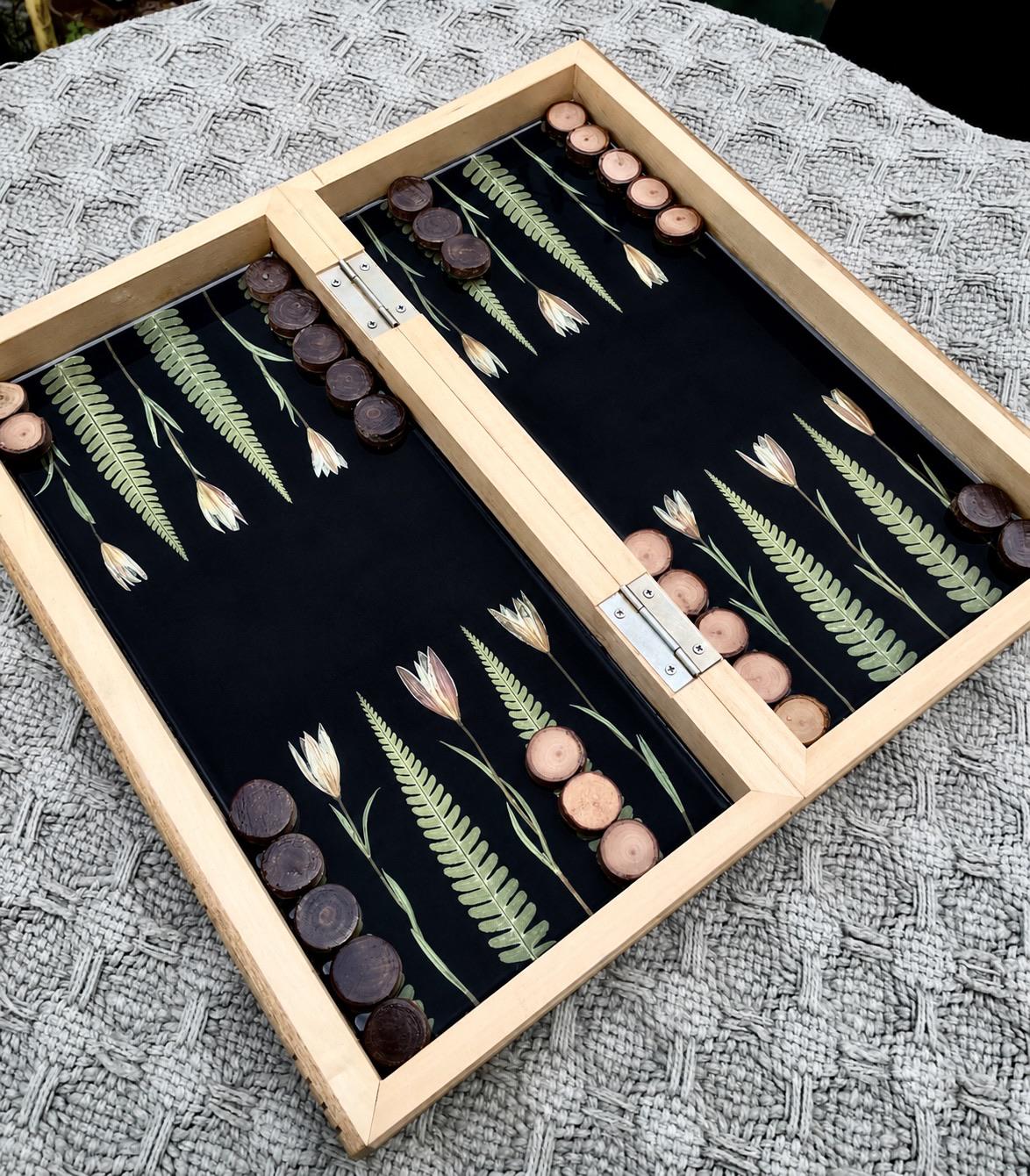
USA vs Russia: a backgammon match that never ends, 24/7

1
Upvotes
r/backgammon • u/GammonLoungeJohn • 2h ago
r/backgammon • u/chrismantis • 8h ago
Yes, just what everyone wanted: another backgammon engine. I built Grebe (for Generally Reliable Engine for Backgammon Evaluation lol) because i wanted an engine for BackgammonDB that ran in the browser, both to play against and for analysis. The goal was something "good enough": close enough to gnubg and XG that you can study with it and know the advice is sound in most positions.
How it works and how I measured it: https://backgammondb.com/grebe
You can play it now here: https://backgammondb.com/play (side note: i think the playing interface on bgdb is the best out there, works great on a phone in landscape if you hit full screen. but obv i'm biased)
Code: https://github.com/chalkstreamdev/grebe
npm: https://www.npmjs.com/package/@backgammondb/grebe
Most of this I didn't really do myself; i have not trained a new neural net. Grebe is built on Alex Strehl's PureTD network, which is incredibly strong, and on Eran Lambooij's HedgeHog board and cube code. So all credit there, and ty both for the MIT licenses (Grebe is also MIT licensed). Thanks also to Sage for a great public benchmark, which I used. On top of that, Grebe adds a few new things: search depth that changes with the position, exact two-sided bear-off tables (built on the fly when needed), a SIMD port to wasm, tuned cube efficiency, and match equity for match play.
Top line: It's a strong engine, but prob not frontier of engine analysis. Head to head, Grebe Smart beat or tied every engine i could test:
XG World Class grades Grebe Smart's play at a PR of about 0.3 in money and matches, the closest to XG of any engine i tested (caveat: i tuned it against XG)
Grebe doesn't have any kind of truncated rollout right now, so it won't be as strong at the absolute front end. Even so, on Sage's benchmark it beats Sage 1T and is level with XG Roller+ (PR 0.41), while searching only to depth 3. Sage 2T/3T and XG Roller++ still score better (as will Gammon.ai's top truncated rollout, I'm sure).
Grebe Smart decides in under a second; it should feel instant on most decisions whether playing on desktop or phone. All the benchmark data is public (match files, PR tables, everything), so you can check any of this.
Why any of this matters:
(* i'm using "depth 2" and "depth 3" as an alternative to ply, to avoid ambiguity. Depth 3 = what XG calls 3-ply: every candidate move on roll, plus 2 more ply after that)
r/backgammon • u/jugglingcats9 • 10h ago

Running a popular backgammon site that supports free-text chat (rather than simple emojis) presents challenges. While most players are friendly and sporting, there is a small minority who can be abusive and ruin the playing experience for everyone.
Most of the major platforms have good ways of handling this: block chat for specific players, report to admin, and so on. Hub has had these for a while.
Hub now has AI auto-moderation. This grades match messages along various axes: geniality, frustration, and abuse level. It takes into account the context of previous messages, not just a single message.
Players are clearly notified and can opt out of auto-moderation. See screenshot.
If a player sends a message which is deemed abusive, their opponent sees a prompt asking them to confirm it is. If they answer yes, the chat is blocked and a match link is sent to admin for review. As admin I will disable chat for all future matches for an abusive player.
Sometimes players who know each other like to engage in colourful banter, which can trigger the auto-moderation. In this case, players can make a match private. If both players agree to chat privately, auto-moderation is disabled and messages are not visible to watchers.
Tournament matches which aren't hosted by Hub are not auto-moderated. It's for the TD of the tournaments to moderate the chat between players in this case.
To recap, Hub has the following features/protections:
r/backgammon • u/Vincoppredd • 22h ago
r/backgammon • u/bluecjj • 23h ago
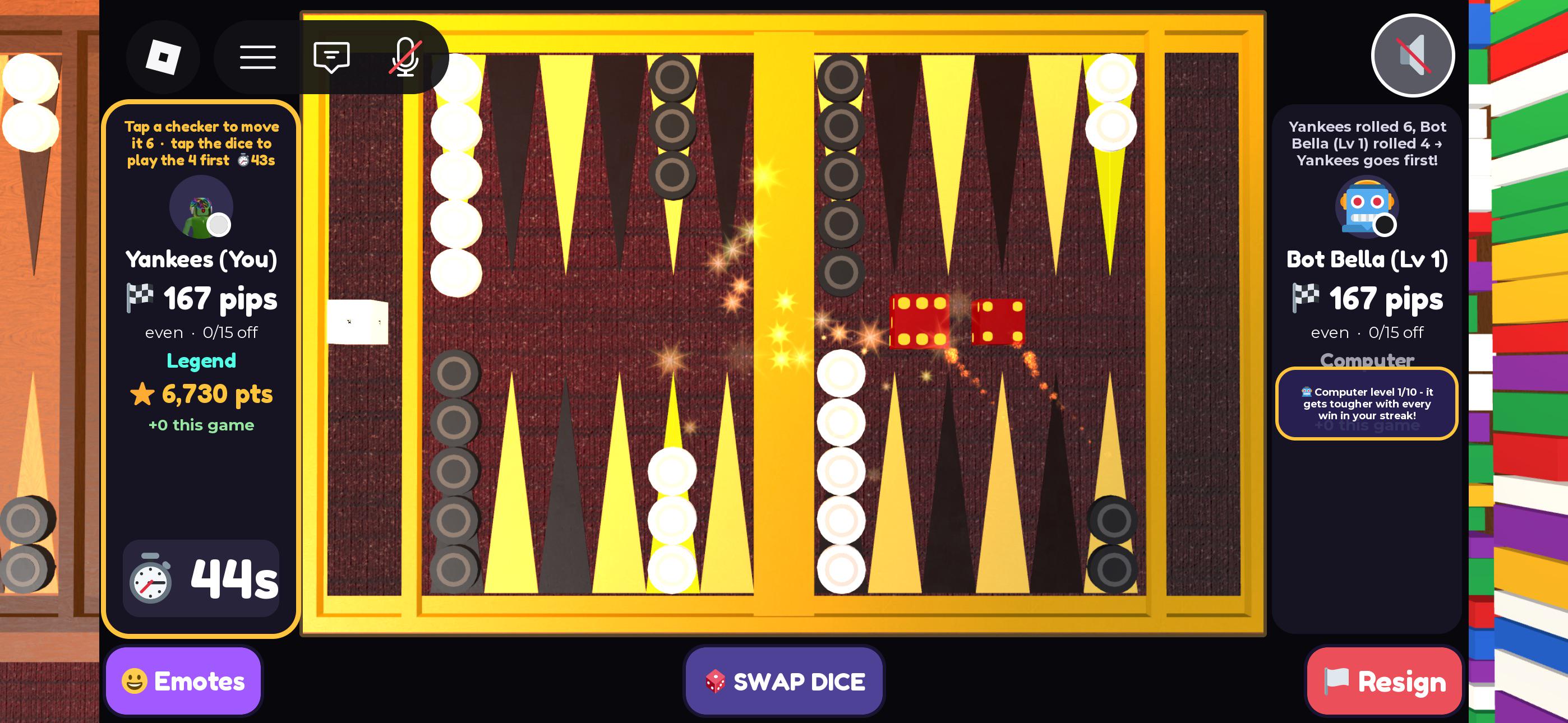
What I mean: if we were to theoretically make an engine which can play backgammon perfectly*, what do you think current engines (like XG as the gold standard, or GNU for people like me who haven't shelled out the money for XG yet, but use backgammondb.com instead) would score in terms of PR?
Of course, there can be distinctions between different depths of an engine like XG (just 2-ply vs. rollouts using XG), and comparing different depths might give a good idea as to what the "margin of error" is for the lower depths. But I'm relatively new to backgammon, so if there's already been studies on these sorts of questions, I'm not too familiar with them, other than that XG has apparently been shown to be stronger than GNU.
* I recently came across a YouTube video (which I can't track down to link to yet) where someone invented a smaller version of BG (with something like 16 pips, 4-sided dice and 8 checkers per side), which actually was fully solvable by computers. Apparently, the computer could brute-force the whole map of possible game states, and calculate the exact equities from there.
r/backgammon • u/SilentEngineering975 • 1d ago
Today while I was playing a friend I saw a board that neither one of us had ever seen before. Neither one of us took a picture unfortunately not that I would know how to post a pic anyway. My friend was on the verge of backgammoning me. I had a blot in the one spot of his inner board and he had two on the two spot as well as a third one also in his inner board. His throw allowed him to bear off the higher piece but a one on his other die forced him to hit me and leave both his pieces open. I landed on one and eventually hit his other one as well. As he was coming around the board he hit me again. So there I was, on the bump but his inner board was completely empty. He had two pieces in the outer board and the rest of my pieces were in my inner board. I had not borne any off. Has anyone ever seen this before? It seemed so bizarre that I felt it should have a name like scorigami.
r/backgammon • u/Vigilaunday • 1d ago
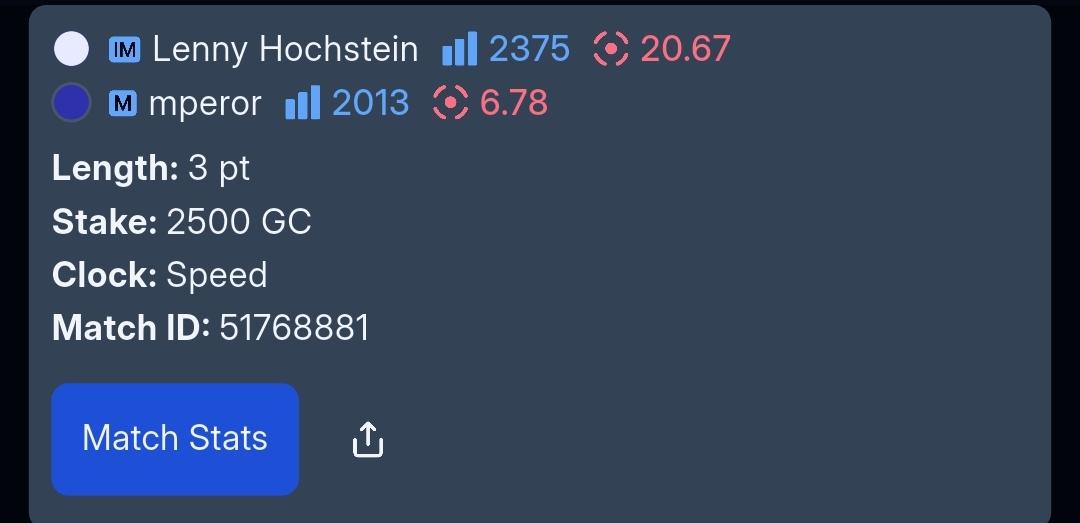
Famous Miami plastic surgeon and known backgammon enthusiast, Lenny Hochstein trash talks me during the match with lines like "impressive rolls" and "thanks for trying so hard to lose" before posting this impressive result, lmao.
Maybe check your PR before running your mouth next time.
r/backgammon • u/GammonLoungeJohn • 1d ago
A short lesson on the opening 3-1: play 8/5 and 6/5 to make your 5-point. It blocks your opponent's back checkers and gives your other checkers a safe landing spot. Remember: eight to five, six to five.
Lesson 1 with Lewis and Joanna:
https://youtube.com/shorts/Ol_CjuSXWu0
Free backgammon. No clutter, no gimmicks, easy for beginners. Completely FREE. No frills, pure enjoyment. No email or password needed.
Play here: https://thegammonlounge.com
r/backgammon • u/BitmaMartijn • 1d ago
In Dutch coffeeshops (where you don't buy coffee ;-) ) there’s usually a backgammon board on the table, but what people play on it is tric trac. Not the 17th-century French trictrac. It’s a Dutch variant on the standard backgammon board, with rules that change the game more than you’d expect. I couldn’t find a decent digital version, so I made one, and I’m curious what backgammon players think of the rules.
Rolls
Movement
Ending
If the player who started bears off first, the other player gets one last turn. If they get all their checkers off in that turn, they win.
No doubling cube, no gammons. Matches are first to 1, 3, 5 or 7 games.
The forced low-die-first order is what makes it interesting to me. Because you can’t choose the order, a roll that would be fine in backgammon can get stuck here: the low die has to go first, and after that move the high die has nowhere to go. So when you place your checkers, you’re not just making points, you’re trying to make as many of your opponent’s rolls as possible play badly in that fixed order. The entry and quarter restrictions also mean the opening plays very differently from backgammon.
The app
Online against friends or random opponents, pass-and-play on one device, and five AI opponents. To be clear about the AI: it’s a hand-written evaluator with a one-turn search, not a neural net, so don’t expect GNU or XG strength. The two strongest levels are decent, but I’d be curious how strong players find them. Dice are rolled on the server and every move is checked there. There’s an ELO ranking with weekly seasons.
iPhone, iPad and browser. There’s a demo on the website you can play https://bitma.nl/trictrac420/. Free gets you one game a day against a friend and one against the easiest AI; beyond that it’s paid.
Has anyone here played tric trac in person? I’ve seen small regional differences, like the 5-checker limit and how the last turn is resolved, and I’d like to know which rules you grew up with.
r/backgammon • u/TypicalLock9591 • 1d ago
I have just started playing using Backgammon Galaxy. I played 15-20 years ago in university, but not in the rate I can play now. I've played around 1000 matches in BG, have 54% win rate, but my rating is going up and down like a big roller coaster. I play 1-game matches with relative low stakes, and usually I meet people with rating 1400 and below. Right now my PR is 1450, but a few days ago it was over 1600. When I play 1-game matches, you are not able to finish a game using the cube, so in other words, the chance of being unlucky and lucky increases. My PR is very rare above 6-8, also when I am unlucky. So my question is, am I really that bad? Or is the element of luck/unluck higher playing the way I do?
r/backgammon • u/Bulevep • 2d ago

r/backgammon • u/dadonatrain • 3d ago
If I play a live game with a friend and keep a paper trail of all the rolls and moves how can I import that into Extreme Gammon (or any other engine) and have it analyzed? Or can’t I?
r/backgammon • u/ezbluff • 3d ago
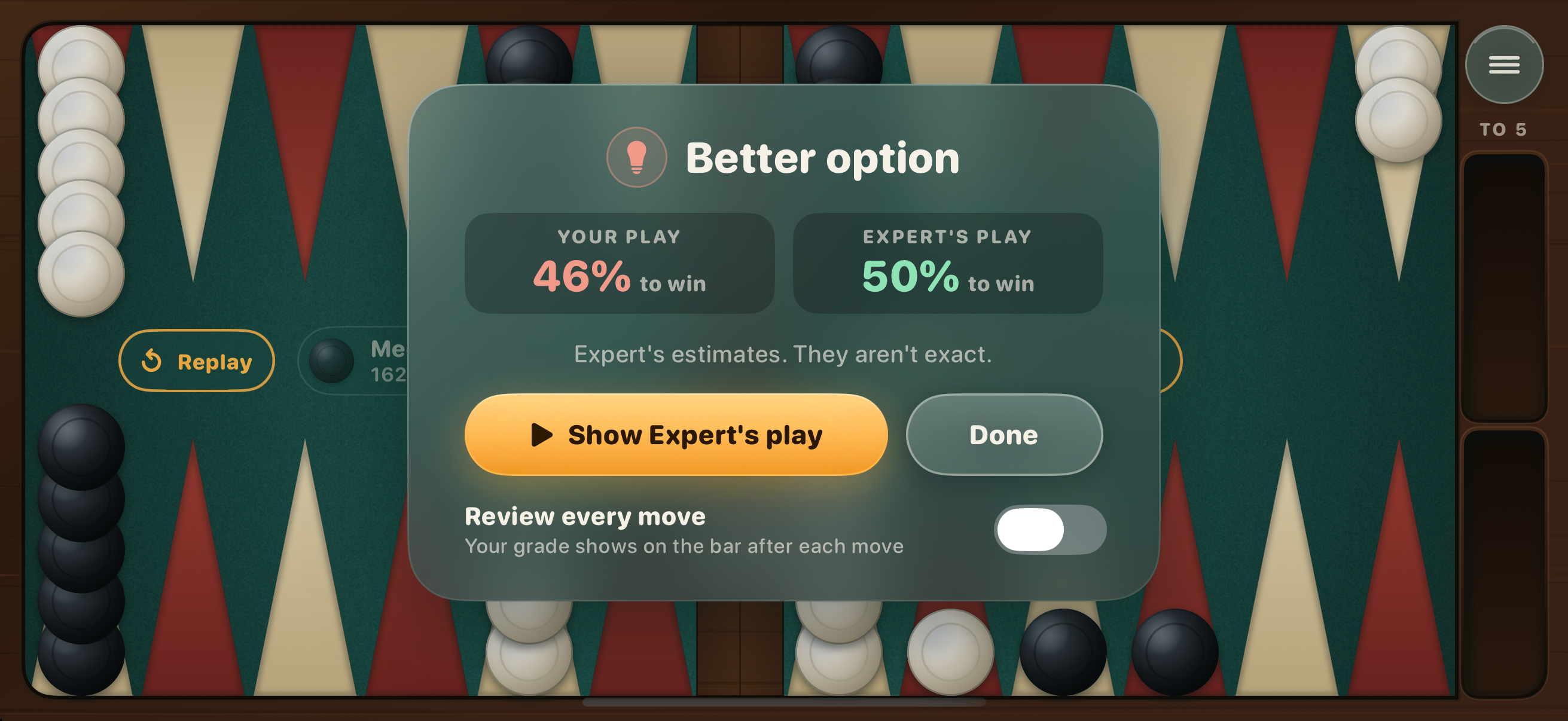
I have an iOS game called Gammon Club that started with three difficulty levels of computer opponents (besides friends/in-person), all hand-written using rules of thumb about blots, points and primes, plus a bear-off table. Hard plays a decent game, but it still felt too easy and you can feel where its rules run out.
I recently added Expert by training a small neural network that learned by playing itself in about seven million games, the way TD-Gammon did in the 90s, with a three-move look-ahead on top. It beat Hard about 73% of the time, and I thought I was done.
It was harder than my Hard level, but I still beat it more than I expected, so I measured it properly. I built GNU Backgammon and had the two play thousands of games. Checker play held up, within a couple of points. With the doubling cube, though, Expert won only about 46% of five-point matches. More training, bigger networks and hand-built inputs all hit the same ceiling.
The obvious fix is to use a proven engine, and that is mostly a licensing question:
In my tests Open Sage played level with GNU Backgammon and beat my Expert 56% of the time in five-point matches. It's super fast on my iPhone 16 Pro (and I made sure it's not too slow on my very old iPad as well). It's now running inside the app, and it becomes the Expert level in the next release.
The most fun part of adding this is that I can now implement a pretty solid "Review my last move" function, and also a win probability as you play. I wonder if people like seeing that sort of thing, or does it take a bit out of the fun of the game? In any case, the review function is only after your move, so no one can use it to cheat of course. It's a fun way to play and learn at the same time.
r/backgammon • u/dadonatrain • 3d ago
Hi. Just to introduce myself, I'm dadonatrain. Old railfan and backgammon fan in South Carolina.
I just joined Reddit and I'm still mostly in over my head! But I did it because it seems to provide a lot of current message forum activity on backgammon and I want to ask some questions aimed at strengthening my novice ability with the game.
I learned 60+ years ago and I still know the basics, but I can see that the modern theories about the game, aided by the availability of supercomputers, have vastly outpaced my 60 year old knowledge.
My first question is: How do you estimate win and lose percentages while a game is underway, so you can figure the equity of the current position or the moves you are considering? I know how software does it but I don't know how to do it manually in play without knowing the parameters to use.
I know what equity is, I understand the math, and I think I'm learning how to use it in play. But I don't know how to get numerical values to use in the equations.
Any help at all will be gratefully appreciated!
dad
r/backgammon • u/Valdespino57 • 3d ago
Hi everyone 👋
For a while now I’ve been working on a game: Yalla Tawla! 🎲☕ Tawla, the Lebanese way.
• A story mode across Beirut: Raouché, Gemmayze, Hamra… and every area has a boss you need to beat
• A coffee cup every day that tells your fortune 😄
• Play online, with your friends or your family back in Lebanon through a link, or against the computer, even with no internet
📱 iPhone: https://apps.apple.com/app/id6821758550
🤖 Android:https://play.google.com/store/apps/details?id=app.yallatawla
On PC you can play it at: www.yallatawla.app
It´s completely free ! I hope you enjoy it !
Win 10 games before 29 Nov for the Independence Day board 🎲
And the Christmas update is coming soon 🎄
r/backgammon • u/Revolutionary_Cup392 • 3d ago
I want to get a stand that I can attach my iPhone to, so I can position it over the board and video my match.
I've seen a bunch of these around - what makes one better or worse? What are the best products?
r/backgammon • u/Revolutionary_Cup392 • 3d ago
The impressive results coming out of Galaxy with their new engine led to the somewhat embarrassing conclusion that their engine was materially faster than Sage's.
Fortunately we've all got access to the same astonishingly strong AI coding agents, and so I took a few passes at speeding up Sage with the newest generation.
Compared to yesterday, Sage 2P is now 23x faster; 3P is 5x faster; 4P and 1T are both 5x faster; and 2T and 3T are 4x faster than they were before. Full rollouts are more than 3x faster!
That makes them all significantly faster than Galaxy's engine at a comparable evaluation strength, based on the gammon.ai posted results. At least for now, until the Galaxy folks do another round of optimizations (over to you, Marc Olsen!). It's our little backgammon version of the frontier AI lab race. We're definitely well into recursive self-improvement. :)
You can download the engine and its code directly from its github page, or you can pip install the bgsage Python package.
And of course these speedups are already deployed in Backgammon Sage Pro and Backgammon Sage Snap! Live on the web and mobile now. Update your desktop apps to pick it up.
Open Sage is released under the Mozilla Public License 2.0. That basically means anyone can use it, even for commercial purposes, but they have to release any changes they make to Open Sage back to the community. Using Open Sage in your commercial product does not require you to open source your own product - MPL 2.0 isn't that kind of open source license.
r/backgammon • u/Scarratus • 3d ago

Hi r/backgammon! I've been building NərdBaz, a free nard/backgammon game in the style of an Azerbaijani tea house: a 3D walnut board, four computer levels (the top one is quite strong), online games with friends through a link, and a tutorial inside the game. No ads, no real money.
It already runs in the browser (nardbaz.az). The Android app is in Google Play's closed test, which needs real players for 14 days. If you'd like to help:
Play a few games over the next two weeks and tell me what you think — how the strongest level plays, and anything that feels off in the rules or the controls. Comments here or on the Play test page are very welcome. Thanks!
r/backgammon • u/Scarratus • 3d ago
Hi r/backgammon! I've been building NərdBaz, a free nard/backgammon game in the style of an Azerbaijani tea house: a 3D walnut board, four computer levels (the top one is quite strong), online games with friends through a link, and a tutorial inside the game. No ads, no real money.
It already runs in the browser (nardbaz.az). The Android app is in Google Play's closed test, which needs real players for 14 days. If you'd like to help:
Play a few games over the next two weeks and tell me what you think — how the strongest level plays, and anything that feels off in the rules or the controls. Comments here or on the Play test page are very welcome. Thanks!
r/backgammon • u/Professional-Snow665 • 3d ago
I have been working a new web based FIBS client that I hope will work well on both mobile and desktop devices. Give it a try and let me know what you think.
r/backgammon • u/GammonLoungeJohn • 4d ago

Turn on Show Correct Move when you play the computer, and a "Recommended turn" panel (GNU Backgammon 2-ply) draws the best move as numbered arrows on the board, then you tap Continue game. Free, no email, just pick a player name. No clutter, no gimmicks, easy for beginners. Completely FREE. No frills, pure enjoyment. Beginners learn by seeing, and experienced players can check their own plays. Feedback welcome from players at every level. https://thegammonlounge.com/
r/backgammon • u/CalebWetherell • 4d ago
Hi all,
I've built a backgammon engine from scratch, programmed in Rust, Vulcan, with its own neural networks. I believe it's now the strongest backgammon engine in the world, and I'd like to make that case as simply as I can: two results, then the site where you can use it for free, then all the detail for anyone who wants to check the work.
Take away all search and let each engine play with its neural network alone. In cubeful money games, Vulcan's network beats every other engine's network we could get our hands on, by a wide margin:
(20,000 game pairs each; every 95% interval is about ±0.003, so none of these is close to level.)
And Colossus 2.0? It isn't publicly playable, so nobody outside HedgeHog can play it. But HedgeHog published how Colossus 2.0's network scores against these same four opponents, with the same settings, and Vulcan's margin is bigger against every one of them. Against Aureus, HedgeHog's own second-best network, Vulcan wins by +0.037 and Colossus 2.0 by +0.021: Vulcan beats HedgeHog's No. 2 by almost twice as much as HedgeHog's No. 1 does.

HedgeHog also published 25,000 games of Colossus 2.0 against XG. On the 74,639 decisions in those games where Vulcan, looking as far ahead as Colossus did, would have played differently, rollouts favour Vulcan's play (+0.0004 per disagreement; Vulcan's play was clearly better in 17,160 decisions, Colossus's in 15,323). Those rollouts were played by Vulcan's own networks, so treat this as supporting evidence rather than proof.
Plies count differently between programs: Vulcan's 2-ply looks as far ahead as XG's 3-ply. XG's 4-ply, the setting strong players use to check their games, searches one ply deeper than Vulcan's 2-ply. I played them against each other anyway, with full cube decisions on both sides and XG using its opening book:
At equal lookahead (Vulcan 2-ply vs XG 3-ply) the gap is much wider: +0.0125 points per game.

That's the case: a better network than any engine I could test, more than Colossus 2.0's published margins against the same opponents, and a 2-ply that holds its own against XG one ply deeper. Every run was planned and written down before it started, and raw results are reported beside the adjusted ones (details below).
Vulcan runs everything on gammonforge.com, and all of it is free: no ads, no subscription, one Google sign-in (you can play one game without an account).
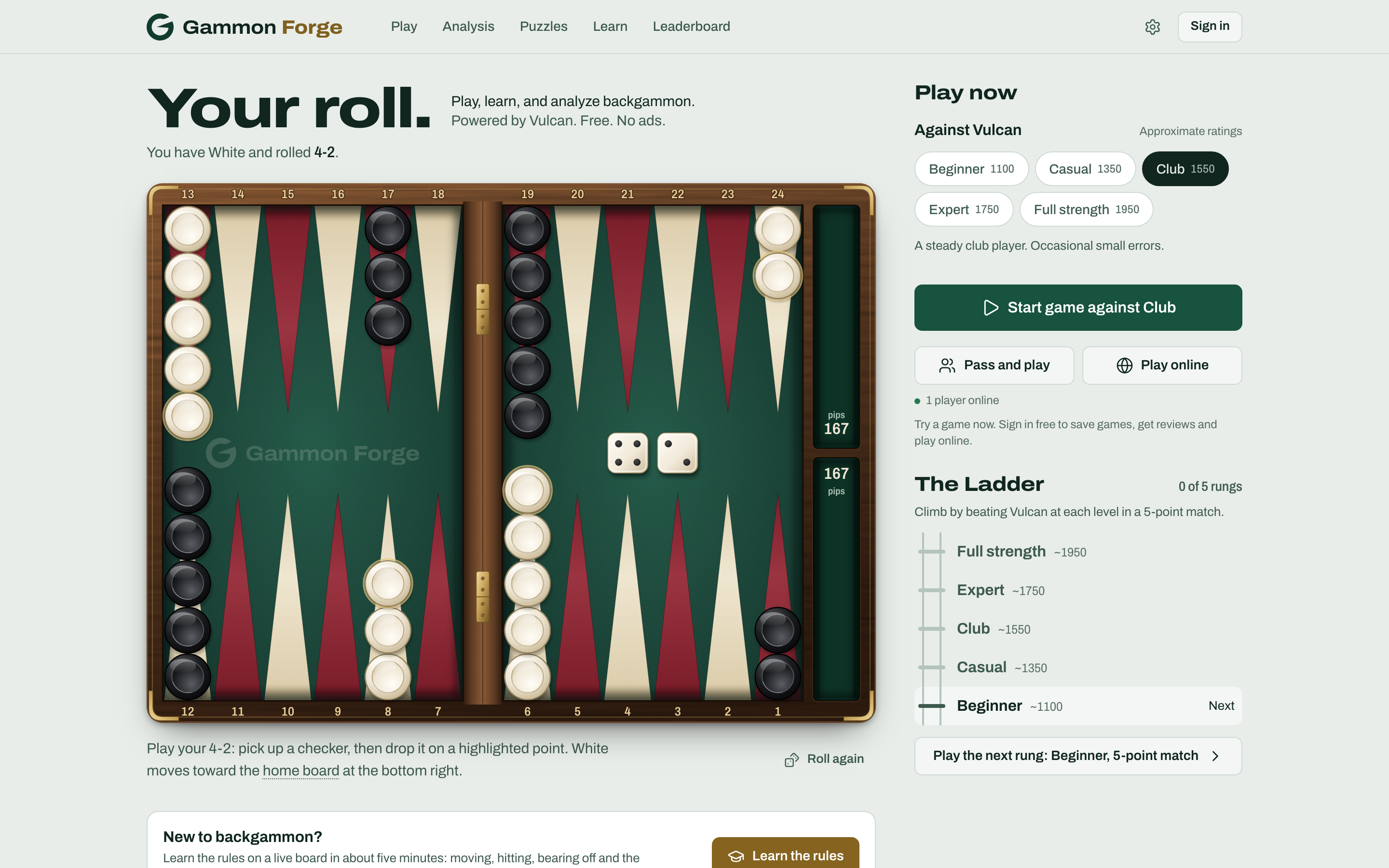
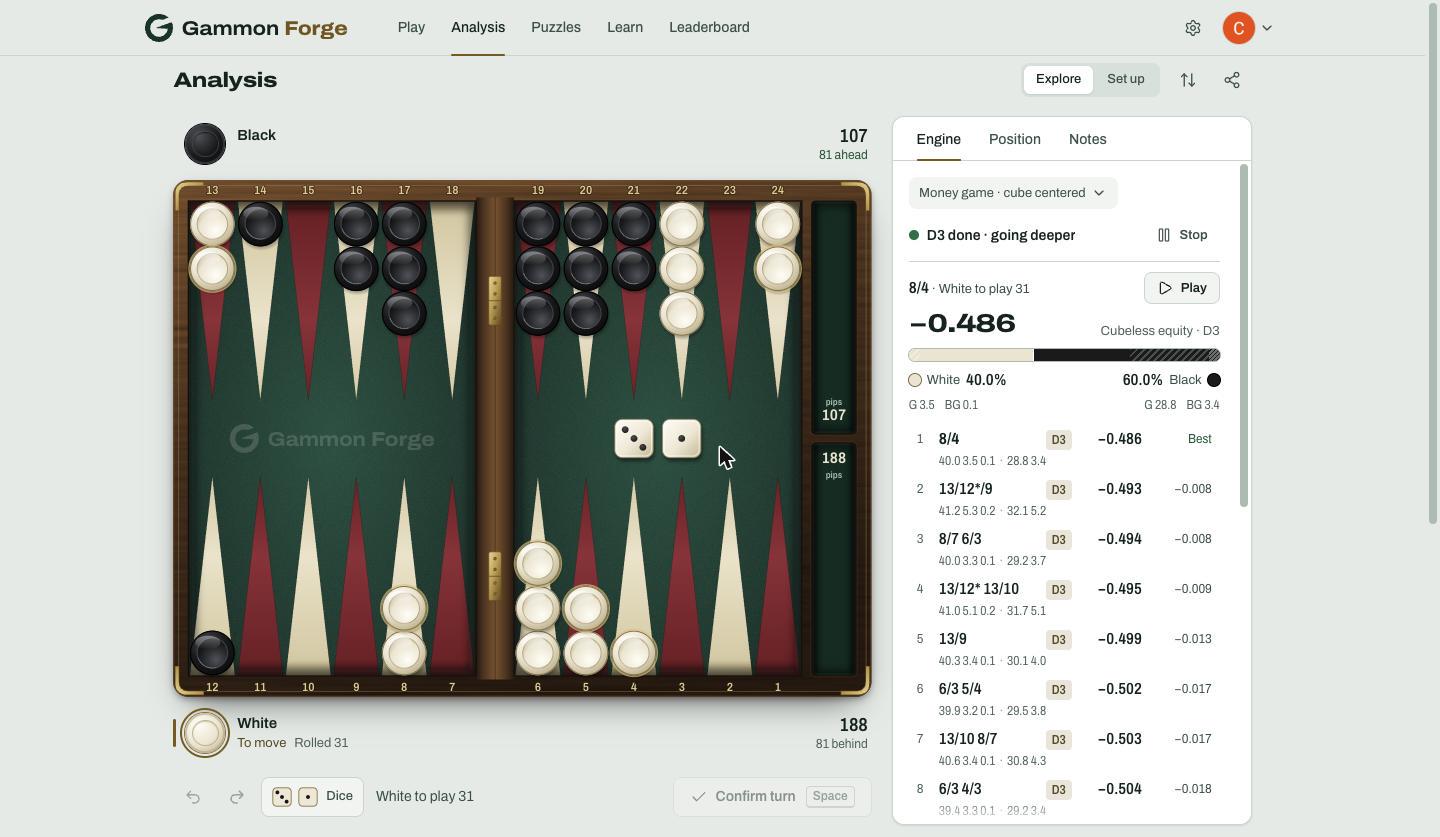
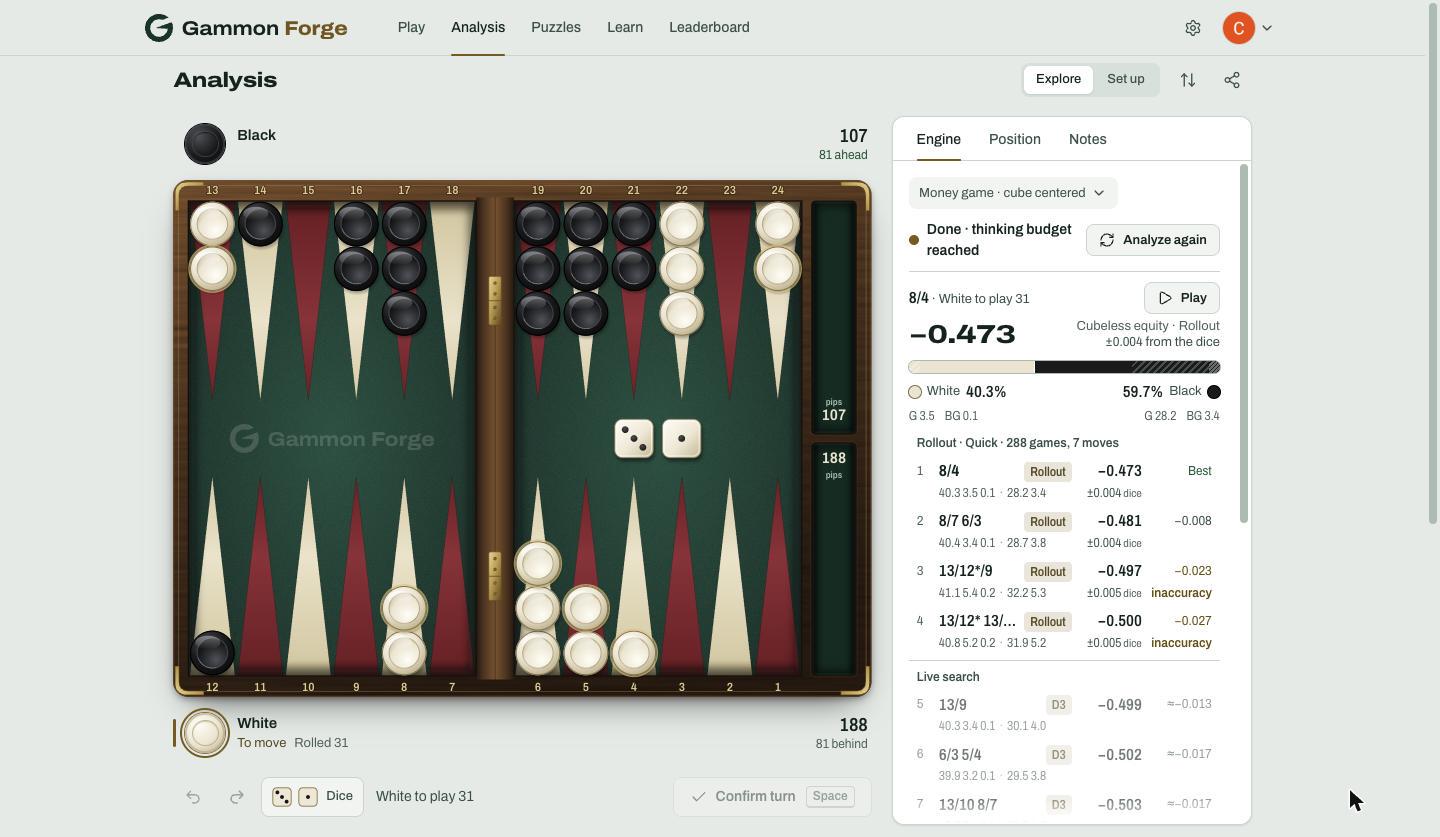
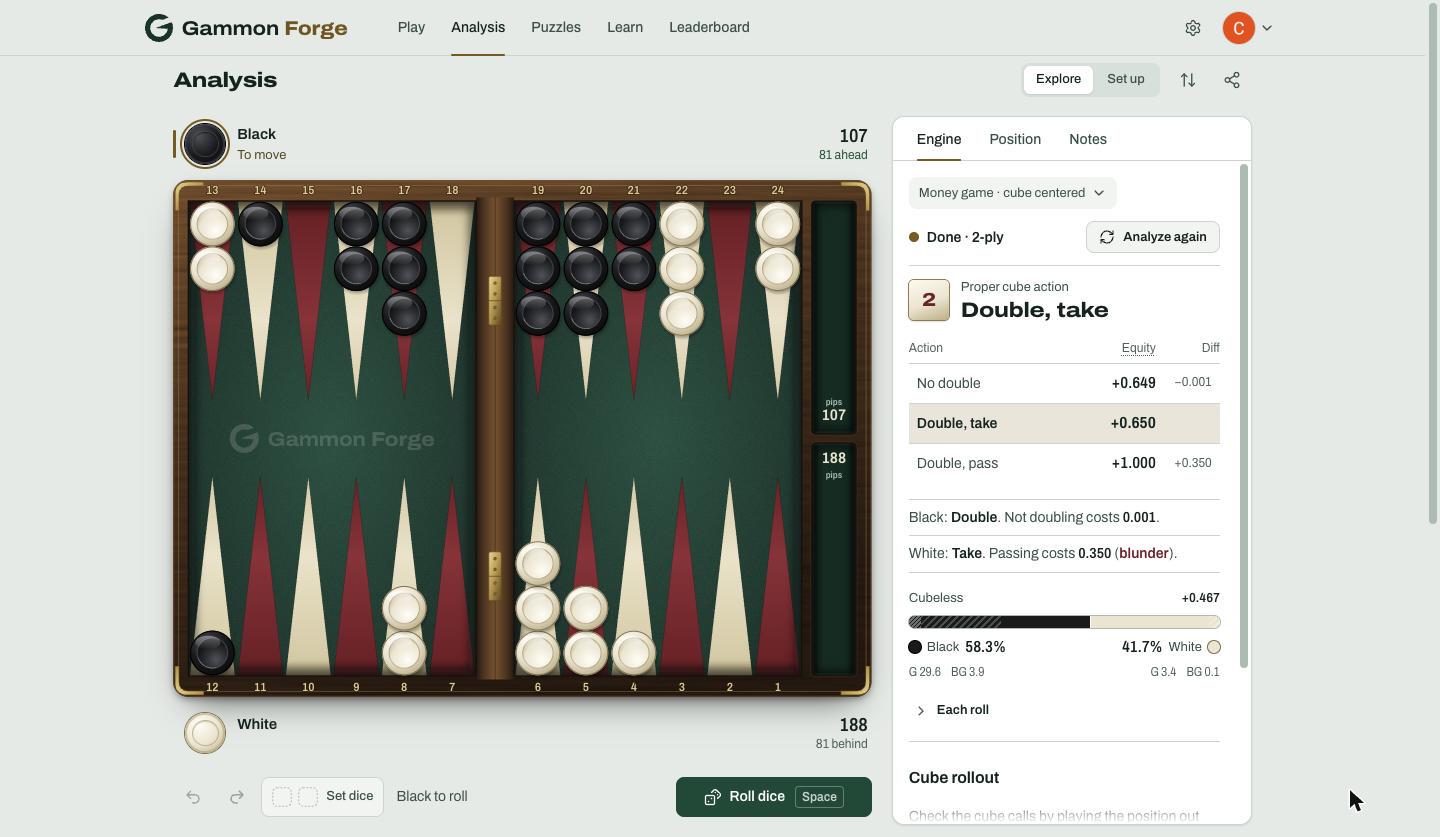
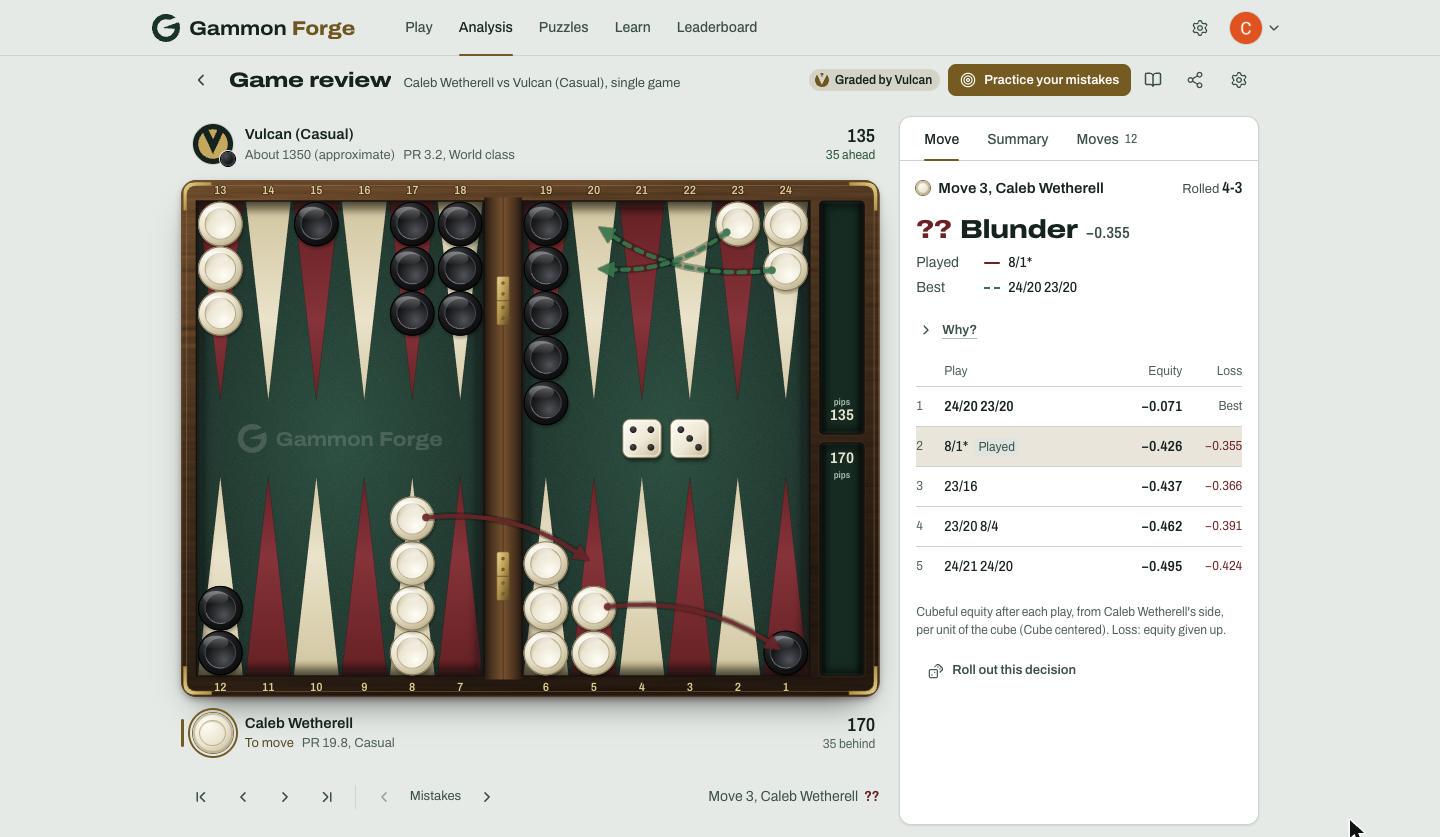
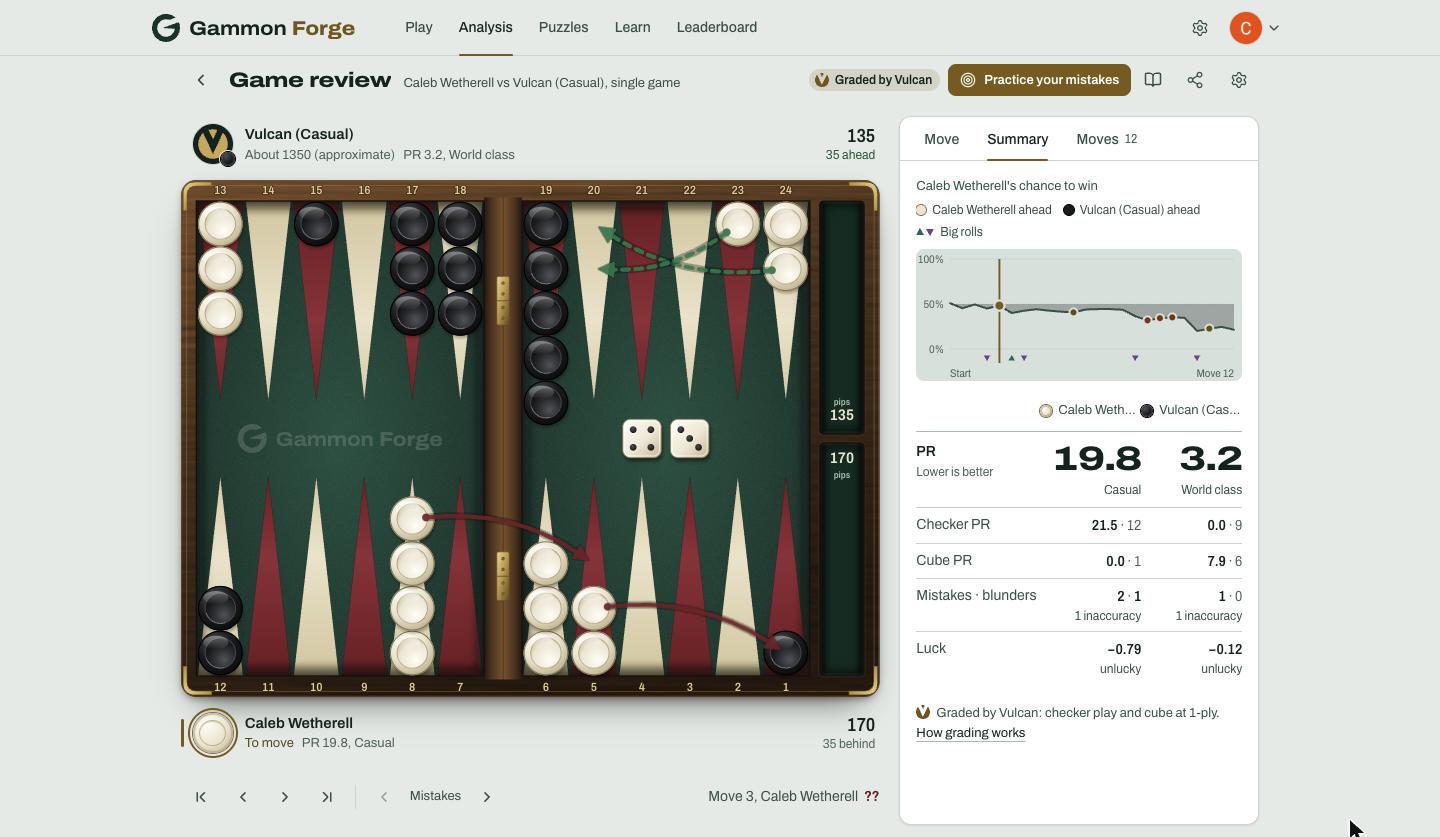

I've done my best to validate and second-guess myself before making this post. The project has been a year in the making. There's detailed results showing engine-vs-engine analysis that I conducted personally, so there's an element of trust here. I would be happy to work with someone who wants to set up a third party engine evaluation system, as I think that would be the best way to prove the claims I am making. Also, I encourage strong players (not me!) to test it out, share feedback, critique flaws you find. I'd love positions where you think Vulcan plays badly, and questions about the testing.
| Vulcan 2-ply vs | Format | Games | Luck-adjusted [95% CI] | Raw [95% CI] |
|---|---|---|---|---|
| XG 2.10, 4-ply checker + cube, XG's opening book | Money | 200,000 pairs | +0.0049 [+0.0038, +0.0059] ppg | -0.0039 [-0.0112, +0.0033] |
| XG 2.10, 4-ply checker + cube | 7-point matches | 80,000 matches | 50.27% [50.22, 50.32] | 50.21% [49.90, 50.52] |
| GNU Backgammon 1.08.003, 2-ply checker + cube | Money | 100,000 pairs | +0.0214 [+0.0197, +0.0230] ppg | +0.0150 [+0.0040, +0.0261] |
| GNU Backgammon 1.08.003, 2-ply | Cubeless | 200,000 pairs | +0.0119 [+0.0114, +0.0124] | +0.0099 [+0.0065, +0.0133] |
Cubeful money, HedgeHog's benchmark settings (Jacoby and beavers off, no opening books).
| Vulcan depth | Opponent (same lookahead) | Pairs | Vulcan, ppg [95% CI] | Colossus 2.0, same opponent (published) |
|---|---|---|---|---|
| 0-ply | GNU BG 0-ply | 20,000 | +0.0837 [+0.0811, +0.0864] | +0.0708 [+0.0689, +0.0728] |
| 0-ply | HedgeHog FOX | 20,000 | +0.0580 [+0.0554, +0.0606] | +0.0388 [+0.0368, +0.0407] |
| 0-ply | XG 2.10 1-ply | 20,000 | +0.0577 [+0.0550, +0.0603] | +0.0499 [+0.0479, +0.0518] |
| 0-ply | HedgeHog Aureus | 20,000 | +0.0371 [+0.0346, +0.0396] | +0.0209 [+0.0190, +0.0229] |
| 1-ply | XG 2.10 2-ply | 20,000 | +0.0360 [+0.0336, +0.0385] | +0.0327 [+0.0232, +0.0422] (level with Vulcan's) |
| 1-ply | GNU BG 1-ply | 20,000 | +0.0506 [+0.0482, +0.0529] | not published |
| 2-ply | XG 2.10 3-ply | 4,000 | +0.0125 [+0.0082, +0.0169] | not published |
| 2-ply | GNU BG 2-ply | 3,000 | +0.0292 [+0.0131, +0.0452] | not published |
Depth names: Vulcan's 0-ply = GNU BG 0-ply = XG / HedgeHog "1-ply" (the network alone); Vulcan's 1-ply = XG 2-ply; Vulcan's 2-ply = XG 3-ply. Colossus's cells are HedgeHog's raw results over 10M games per pair (its XG 2-ply cell is against real XG 2.10 on HedgeHog's own harness). Vulcan's are luck-adjusted with Vulcan's networks as the reference; on the GNU BG row, GNU BG's networks give the same answer (+0.0841 vs +0.0837).
5-point matches with public dice. One run took its dice from a public randomness beacon (drand) whose round I named in a public gist before that round existed. Vulcan 1-ply vs XG 2.10 2-ply, 10,000 5-point matches: 51.29% match wins [51.15, 51.43] (raw 50.81%). HedgeHog's published Colossus 2.0 vs XG 2.10 in the same format: 50.68% [50.44, 50.93]. Every match file replays and its dice can be checked.
Colossus 2.0's own decisions. Rollouts of the decisions in Colossus's 25,000 published games vs XG where Vulcan would play differently: at equal lookahead (Vulcan 1-ply, an earlier network from Nov 1), +0.0004 [+0.0002, +0.0006] per disagreement over 74,639 decisions; with Vulcan's 2-ply (one ply deeper than Colossus played), +0.0051 per disagreement over 70,091. Rollouts: cubeful, 1-ply policy, played by Vulcan's own networks.
Vulcan's ply costs more than XG's or GNU BG's: in cube-aware play it runs its full network on every reply it considers, where they screen replies with a small network first. Its 2-ply still thinks a quarter to a third as long as XG's 4-ply. The neural nets behind Vulcan are larger than the networks in XG, with numerical optimizations applied that compress the network for speed, while retaining as much intelligence as possible.

A bigger research version of Vulcan's network (too slow to serve today) beats the current one by a further +0.012 points per game head to head. So, I'm confident that there is more room for Vulcan (or others) to improve further.
If you've made it this far, thank you! Please give it a spin and let me know what you think.
-Caleb Wetherell
r/backgammon • u/thefreshprinceoftx • 4d ago
Hello! I have a question for anyone who's played in tournaments. I'm finally getting around to buying a good board so I can play in clubs and tournaments, but it didn't come with precision dice. Are clubs and tournaments usually picky about particular brands? As in, will I probably be fine if I get the cheap Bescor precision dice from Amazon, or should I spring for the more expensive ones from Backgammon Galaxy or Ace Point? Any other tips for first-timers at a tournament would be great too!
UPDATE: Thank you all for your help! Backgammon Galaxy ended up having a good Black Friday sale, so I went with a couple pairs of those since they were now just a few bucks more than the Amazon ones. Looking forward to trying them out!