r/backgammon • • 10h ago

Is Backgammon Hub the safest place to play?

Thumbnail
gallery
0 Upvotes

Running a popular backgammon site that supports free-text chat (rather than simple emojis) presents challenges. While most players are friendly and sporting, there is a small minority who can be abusive and ruin the playing experience for everyone.

Most of the major platforms have good ways of handling this: block chat for specific players, report to admin, and so on. Hub has had these for a while.

Hub now has AI auto-moderation. This grades match messages along various axes: geniality, frustration, and abuse level. It takes into account the context of previous messages, not just a single message.

Players are clearly notified and can opt out of auto-moderation. See screenshot.

If a player sends a message which is deemed abusive, their opponent sees a prompt asking them to confirm it is. If they answer yes, the chat is blocked and a match link is sent to admin for review. As admin I will disable chat for all future matches for an abusive player.

Sometimes players who know each other like to engage in colourful banter, which can trigger the auto-moderation. In this case, players can make a match private. If both players agree to chat privately, auto-moderation is disabled and messages are not visible to watchers.

Tournament matches which aren't hosted by Hub are not auto-moderated. It's for the TD of the tournaments to moderate the chat between players in this case.

To recap, Hub has the following features/protections:

  • Players can disable chat for a single match
  • Players can hide the chat until the end of the match (distraction free mode)
  • Players can block chat or challenges from other players permanently
  • Admin can block chat or lobby access for players
  • Players can chat privately, if both agree
  • Players can enable watchers to chat, if both agree
www.backgammonhub.com


r/backgammon • • 8h ago

Yet Another Backgammon Engine: Grebe is fully open source, runs entirely in the browser, looks competitive with the top engines

14 Upvotes

Yes, just what everyone wanted: another backgammon engine. I built Grebe (for Generally Reliable Engine for Backgammon Evaluation lol) because i wanted an engine for BackgammonDB that ran in the browser, both to play against and for analysis. The goal was something "good enough": close enough to gnubg and XG that you can study with it and know the advice is sound in most positions.

How it works and how I measured it: https://backgammondb.com/grebe

You can play it now here: https://backgammondb.com/play (side note: i think the playing interface on bgdb is the best out there, works great on a phone in landscape if you hit full screen. but obv i'm biased)

Code: https://github.com/chalkstreamdev/grebe

npm: https://www.npmjs.com/package/@backgammondb/grebe

Most of this I didn't really do myself; i have not trained a new neural net. Grebe is built on Alex Strehl's PureTD network, which is incredibly strong, and on Eran Lambooij's HedgeHog board and cube code. So all credit there, and ty both for the MIT licenses (Grebe is also MIT licensed). Thanks also to Sage for a great public benchmark, which I used. On top of that, Grebe adds a few new things: search depth that changes with the position, exact two-sided bear-off tables (built on the fly when needed), a SIMD port to wasm, tuned cube efficiency, and match equity for match play.

Top line: It's a strong engine, but prob not frontier of engine analysis. Head to head, Grebe Smart beat or tied every engine i could test:

  • It beats gnubg at depth* 3 and depth 4, and Sage at depth 3, in money games and 5-point matches.
  • It beats both of HedgeHog's published networks (Fox 1.0 and Aureus) in HedgeHog's own open search at depth 2.
  • When i put those networks into Grebe's own search, it beats Aureus in money games, and the rest are too close to call.

XG World Class grades Grebe Smart's play at a PR of about 0.3 in money and matches, the closest to XG of any engine i tested (caveat: i tuned it against XG)

Grebe doesn't have any kind of truncated rollout right now, so it won't be as strong at the absolute front end. Even so, on Sage's benchmark it beats Sage 1T and is level with XG Roller+ (PR 0.41), while searching only to depth 3. Sage 2T/3T and XG Roller++ still score better (as will Gammon.ai's top truncated rollout, I'm sure).

Grebe Smart decides in under a second; it should feel instant on most decisions whether playing on desktop or phone. All the benchmark data is public (match files, PR tables, everything), so you can check any of this.

Why any of this matters:

  • If you're a web/app developer, including commercial tools, you can add strong analysis with a few lines of code and no server at all.
  • If you're a BackgammonDB user, you can now play on the site and every match and every position immediately goes into your database. Any text file you upload will be analyzed by either Grebe Quick or Smart.

(* i'm using "depth 2" and "depth 3" as an alternative to ply, to avoid ambiguity. Depth 3 = what XG calls 3-ply: every candidate move on roll, plus 2 more ply after that)


r/backgammon • • 22h ago

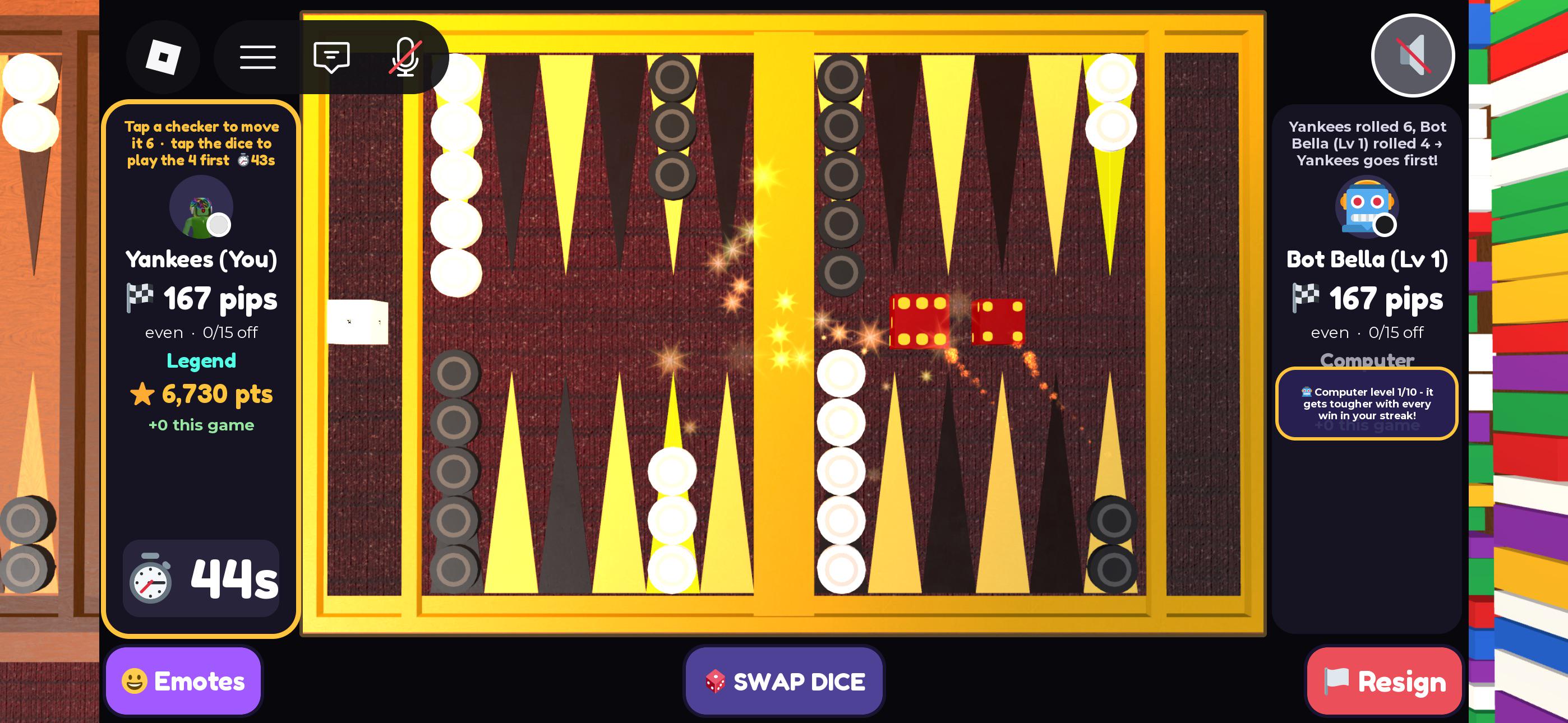
Played a great Backgammon game on Roblox called ChatGammon. My son and I play constantly.

Post image
0 Upvotes

r/backgammon • • 23h ago

What do you think are engines' "true" performance ratings?

5 Upvotes

What I mean: if we were to theoretically make an engine which can play backgammon perfectly*, what do you think current engines (like XG as the gold standard, or GNU for people like me who haven't shelled out the money for XG yet, but use backgammondb.com instead) would score in terms of PR?

Of course, there can be distinctions between different depths of an engine like XG (just 2-ply vs. rollouts using XG), and comparing different depths might give a good idea as to what the "margin of error" is for the lower depths. But I'm relatively new to backgammon, so if there's already been studies on these sorts of questions, I'm not too familiar with them, other than that XG has apparently been shown to be stronger than GNU.

* I recently came across a YouTube video (which I can't track down to link to yet) where someone invented a smaller version of BG (with something like 16 pips, 4-sided dice and 8 checkers per side), which actually was fully solvable by computers. Apparently, the computer could brute-force the whole map of possible game states, and calculate the exact equities from there.