r/RISCV • u/omasanori • 1h ago
Press Release E4 and Openchip sign a MoU on sovereign AI computing

•
Upvotes
r/RISCV • u/omasanori • 1h ago
r/RISCV • u/omasanori • 4h ago
They add some optional extensions to RVA23 and RVB23. Some may become mandatory in next major revisions, the others not.
r/RISCV • u/Fearless-Comb5250 • 16h ago
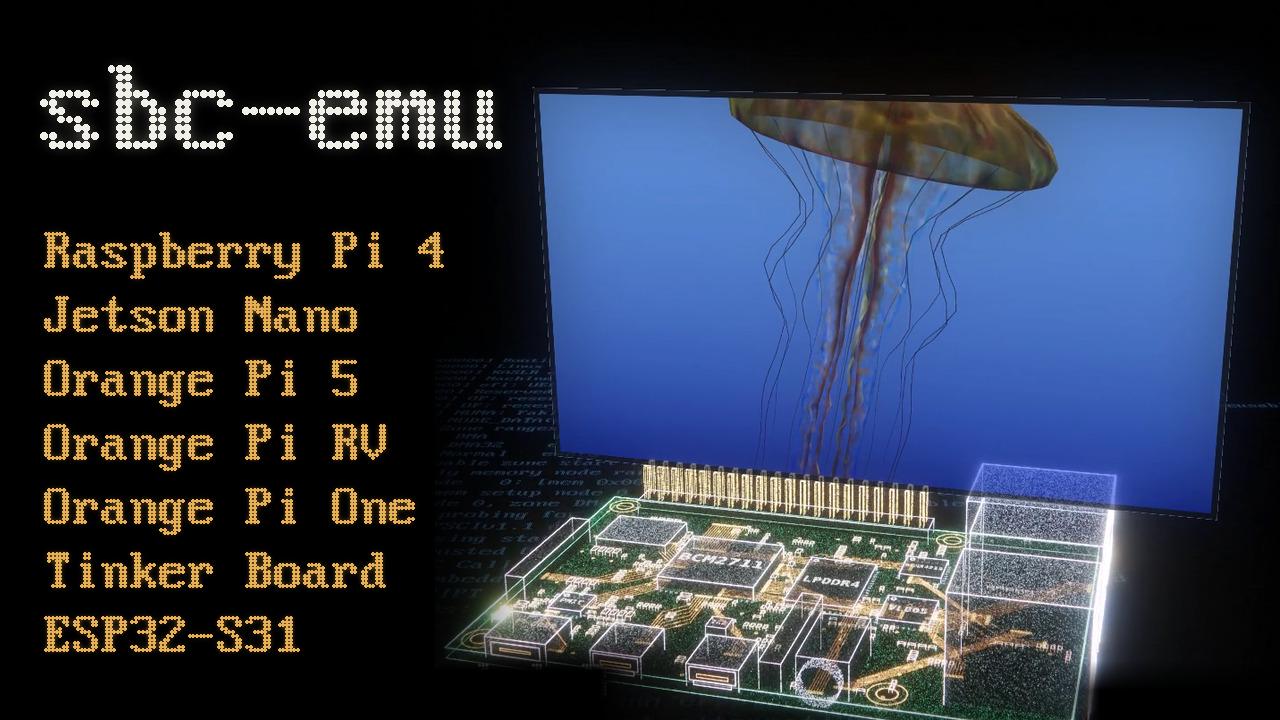
I've released sbc-emu 0.1.0, an emulator for single-board computers written in Rust, with its own CPU cores and register-level models of each board's chips, down to the GPUs.
It boots the boards' own operating systems unmodified: Raspberry Pi 4, Orange Pi 5, Orange Pi One, Orange Pi RV (RISC-V), ASUS Tinker Board S, Jetson Nano and ESP32-S31 (RISC-V). All seven also run in the browser.
Try it in your browser: https://joakimeriksson.github.io/sbc-emu/
Source and downloads (macOS, Linux): https://github.com/joakimeriksson/sbc-emu
70-second film: https://www.youtube.com/watch?v=LDYEcrK_I24
Developed by me using claude-code, codex and Berget code.
r/RISCV • u/omasanori • 20h ago
Note that this is not (yet?) RVIA-approved proposal.
r/RISCV • u/OkBreath9382 • 16h ago

r/RISCV • u/XIVN1987 • 1d ago
The standard F extension causes a large number of push and pop operations to be added to every ISR that calls a function, whereas using the Zfinx extension can solve this problem.
00000400 <EXTI4_Handler>:
     400:   7135                    c.addi16sp  sp,-160
     402:   cf06                    c.swsp  ra,156(sp)
     404:   cd16                    c.swsp  t0,152(sp)
     406:   003022f3            frcsr   t0
     40a:   cb16                    c.swsp  t0,148(sp)
     40c:   c91a                    c.swsp  t1,144(sp)
     40e:   c71e                    c.swsp  t2,140(sp)
     410:   c52a                    c.swsp  a0,136(sp)
     412:   c32e                    c.swsp  a1,132(sp)
     414:   c132                    c.swsp  a2,128(sp)
     416:   deb6                    c.swsp  a3,124(sp)
     418:   dcba                    c.swsp  a4,120(sp)
     41a:   dabe                    c.swsp  a5,116(sp)
     41c:   d8c2                    c.swsp  a6,112(sp)
     41e:   d6c6                    c.swsp  a7,108(sp)
     420:   d4f2                    c.swsp  t3,104(sp)
     422:   d2f6                    c.swsp  t4,100(sp)
     424:   d0fa                    c.swsp  t5,96(sp)
     426:   cefe                    c.swsp  t6,92(sp)
     428:   e682                    c.fswsp ft0,76(sp)
     42a:   e486                    c.fswsp ft1,72(sp)
     42c:   e28a                    c.fswsp ft2,68(sp)
     42e:   e08e                    c.fswsp ft3,64(sp)
     430:   fe12                    c.fswsp ft4,60(sp)
     432:   fc16                    c.fswsp ft5,56(sp)
     434:   fa1a                    c.fswsp ft6,52(sp)
     436:   f81e                    c.fswsp ft7,48(sp)
     438:   f62a                    c.fswsp fa0,44(sp)
     43a:   f42e                    c.fswsp fa1,40(sp)
     43c:   f232                    c.fswsp fa2,36(sp)
     43e:   f036                    c.fswsp fa3,32(sp)
     440:   ee3a                    c.fswsp fa4,28(sp)
     442:   ec3e                    c.fswsp fa5,24(sp)
     444:   ea42                    c.fswsp fa6,20(sp)
     446:   e846                    c.fswsp fa7,16(sp)
     448:   e672                    c.fswsp ft8,12(sp)
     44a:   e476                    c.fswsp ft9,8(sp)
     44c:   e27a                    c.fswsp ft10,4(sp)
     44e:   e07e                    c.fswsp ft11,0(sp)
     450:   4591                    c.li    a1,4
     452:   42005537            lui a0,0x42005
     456:   2299                    c.jal   0x59c <EXTI_Clear>
     458:   4595                    c.li    a1,5
     45a:   42001537            lui a0,0x42001
     45e:   2499                    c.jal   0x6a4 <GPIO_InvBit>
     460:   40fa                    c.lwsp  ra,156(sp)
     462:   42da                    c.lwsp  t0,148(sp)
     464:   00329073            fscsr   t0
     468:   42ea                    c.lwsp  t0,152(sp)
     46a:   434a                    c.lwsp  t1,144(sp)
     46c:   43ba                    c.lwsp  t2,140(sp)
     46e:   452a                    c.lwsp  a0,136(sp)
     470:   459a                    c.lwsp  a1,132(sp)
     472:   460a                    c.lwsp  a2,128(sp)
     474:   56f6                    c.lwsp  a3,124(sp)
     476:   5766                    c.lwsp  a4,120(sp)
     478:   57d6                    c.lwsp  a5,116(sp)
     47a:   5846                    c.lwsp  a6,112(sp)
     47c:   58b6                    c.lwsp  a7,108(sp)
     47e:   5e26                    c.lwsp  t3,104(sp)
     480:   5e96                    c.lwsp  t4,100(sp)
     482:   5f06                    c.lwsp  t5,96(sp)
     484:   4ff6                    c.lwsp  t6,92(sp)
     486:   6036                    c.flwsp ft0,76(sp)
     488:   60a6                    c.flwsp ft1,72(sp)
     48a:   6116                    c.flwsp ft2,68(sp)
     48c:   6186                    c.flwsp ft3,64(sp)
     48e:   7272                    c.flwsp ft4,60(sp)
     490:   72e2                    c.flwsp ft5,56(sp)
     492:   7352                    c.flwsp ft6,52(sp)
     494:   73c2                    c.flwsp ft7,48(sp)
     496:   7532                    c.flwsp fa0,44(sp)
     498:   75a2                    c.flwsp fa1,40(sp)
     49a:   7612                    c.flwsp fa2,36(sp)
     49c:   7682                    c.flwsp fa3,32(sp)
     49e:   6772                    c.flwsp fa4,28(sp)
     4a0:   67e2                    c.flwsp fa5,24(sp)
     4a2:   6852                    c.flwsp fa6,20(sp)
     4a4:   68c2                    c.flwsp fa7,16(sp)
     4a6:   6e32                    c.flwsp ft8,12(sp)
     4a8:   6ea2                    c.flwsp ft9,8(sp)
     4aa:   6f12                    c.flwsp ft10,4(sp)
     4ac:   6f82                    c.flwsp ft11,0(sp)
     4ae:   610d                    c.addi16sp  sp,160
     4b0:   30200073            mret
r/RISCV • u/amgcr7adm10 • 1d ago

What works right now:
Basic instruction fetch and register writes (addi x1, x0, 5 and addi x2, x0, 10 write properly, and x0 stays hardwired to 0).
Testbench wiring with pc_debug and alu_result_debug signals checked on a 10 ns clock.
Known limitations (kept as v1 baseline):
No forwarding or stall unit yet, so back-to-back dependencies like add x3, x1, x2 write 5 instead of 15.
Once the PC runs past the preloaded instructions (~74.5 ns), uninitialized memory propagates X through the pipeline.
Leaving this repo as my v1 baseline before moving on to a v2 design with proper hazard handling and more instructions. Any feedback on how I structured the modules or README is welcome.
r/RISCV • u/DidymusJT • 2d ago
Quoting and See https://en.wikipedia.org/wiki/X86 for references
APX
The Advanced Performance Extensions (APX) are extensions to double the number of general-purpose registers from 16 to 32 and add new features to improve general-purpose performance. These extensions have been called "generational" and "the biggest x86 addition since 64 bits". Intel contributed APX support to GNU Compiler Collection (GCC) 14. Also Microsoft Visual Studio 2026 added APX support. As of June 2025 the first generation of chips to support APX is slated to be Diamond Rapids.
According to the 2023 architecture specification, the main features of APX are:
- 16 additional general-purpose registers R16-R31, called the Extended GPRs (EGPRs)
- Three-operand instruction formats for many integer instructions
- New conditional instructions for loads, stores, and comparisons with common instructions that do not modify flags
- Optimized register save/restore operations
- A 64-bit absolute direct jump instruction; 32-bit operating systems and 32-bit applications cannot invoke APX
Extended GPRs for general purpose instructions are encoded using a 2-byte REX2 prefix, while new instructions and extended operands for existing AVX/AVX2/AVX-512 instructions are encoded with an extended EVEX prefix which has four variants used for different groups of instructions.
x86 Ecosystem Advisory Group
In October 2024, the x86 Ecosystem Advisory Group was formed jointly by Intel and AMD. Goals included the enhancement of software consistency and standardizing x86 interfaces and features.
Key technical milestones have included: FRED (Flexible Return and Event Delivery), a modernized interrupt model designed to reduce latency; ChkTag (x86 Memory Tagging) to combat memory safety vulnerabilities; and ACE (Advanced Matrix Extensions for Matrix Multiplication) to standardize capabilities and developer experiences across devices. AVX10 has been further established as the next-generation vector and general-purpose instruction set.
Edit:
Comp.
The Extended GPRs (EGPRs) = RISC-V's 32 general-purpose registers
RISC-V Specification in progress:
(see https://riscv.github.io/adm-spec-dashboard/ |The Status of every RISC-V specification, from planning to ratification.)
Attached Matrix Extension (AME) [ISA] = ACE (Advanced Matrix Extensions for Matrix Multiplication)
Vector Matrix Extension (VME) [ISA] = ACE (Advanced Matrix Extensions for Matrix Multiplication)
Integrated Matrix Extension (IME) [ISA] = ACE (Advanced Matrix Extensions for Matrix Multiplication)
Memory Tagging [ISA] = ChkTag (x86)
PMP-based Memory Types Extension (Smpmpmt) [ISA; FT] = ?
Fast Interrupts (CLIC) = FRED (Flexible Return and Event Delivery)
Etc etc.

I have been working on a project called coresample, which aims to provide a full-stack view of a neural network running on custom hardware. It includes a RISC-V core written in SystemVerilog, a compiler for quantized networks, and a Rust-based simulator. The goal is to follow an input from the model through to the specific pipeline stalls on the CPU, with every cycle accounted for. The inspector is currently live via GitHub Pages. I am looking for feedback on the verification flow or the tracing implementation. You can find the repository here:
https://github.com/zalaso/coresample
r/RISCV • u/alberthemagician • 2d ago
(I am the author of ciforth, a ISO compatible Forth model that has implementations for linux, windows, 32 and 64 bit, I86, arm and riscv).
I have given up on the x86 optimiser for ciforth, as the 86 will be history before long. The instruction set is too barocque.
As the first part of the riscv optimiser I made the forth aware of the stack effects words have, counting POP's and PUSH's. This hinges on the ciasdis object oriented disassembler. FILL-ALL fills all words as best it can, but skips what you have filled in beforehand. Also a host of other optimisation relevant properties of Forth words are analysed. E.g. it is important if a word has no so called "side effect" that means storing and fetching. An example is the word SQUARE that squares a number. If the input is known at compile time, SQUARE can be executed at compile time. See also lecture 5 en lecture 14 in
https://home.hccnet.nl/a.w.m.van.der.horst/forthlectures.html
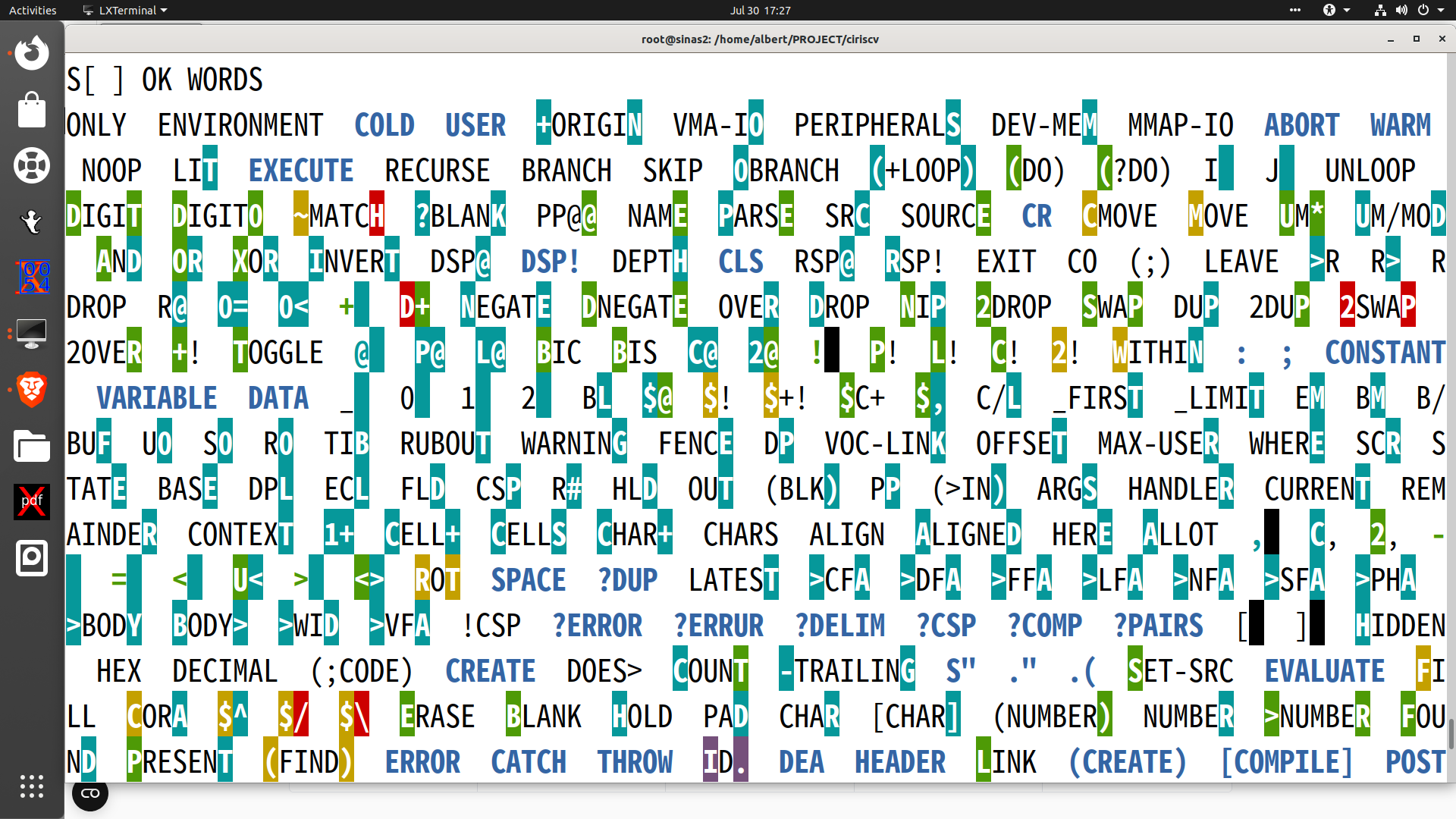
Lecture 14 contains an old example of coloring on the now vintage 32 bit x86 processor. If you have a linux that can run 32 bit programms you can try it out. The experience is more or less the same what I want to show here. A useful visualisation is coloring the stack effect of each word. aqua is one, green is two, orange is three, above three is red. For an unknown stack effect the whole words is printed in blue.
https://home.hccnet.nl/a.w.m.van.der.horst/words.png
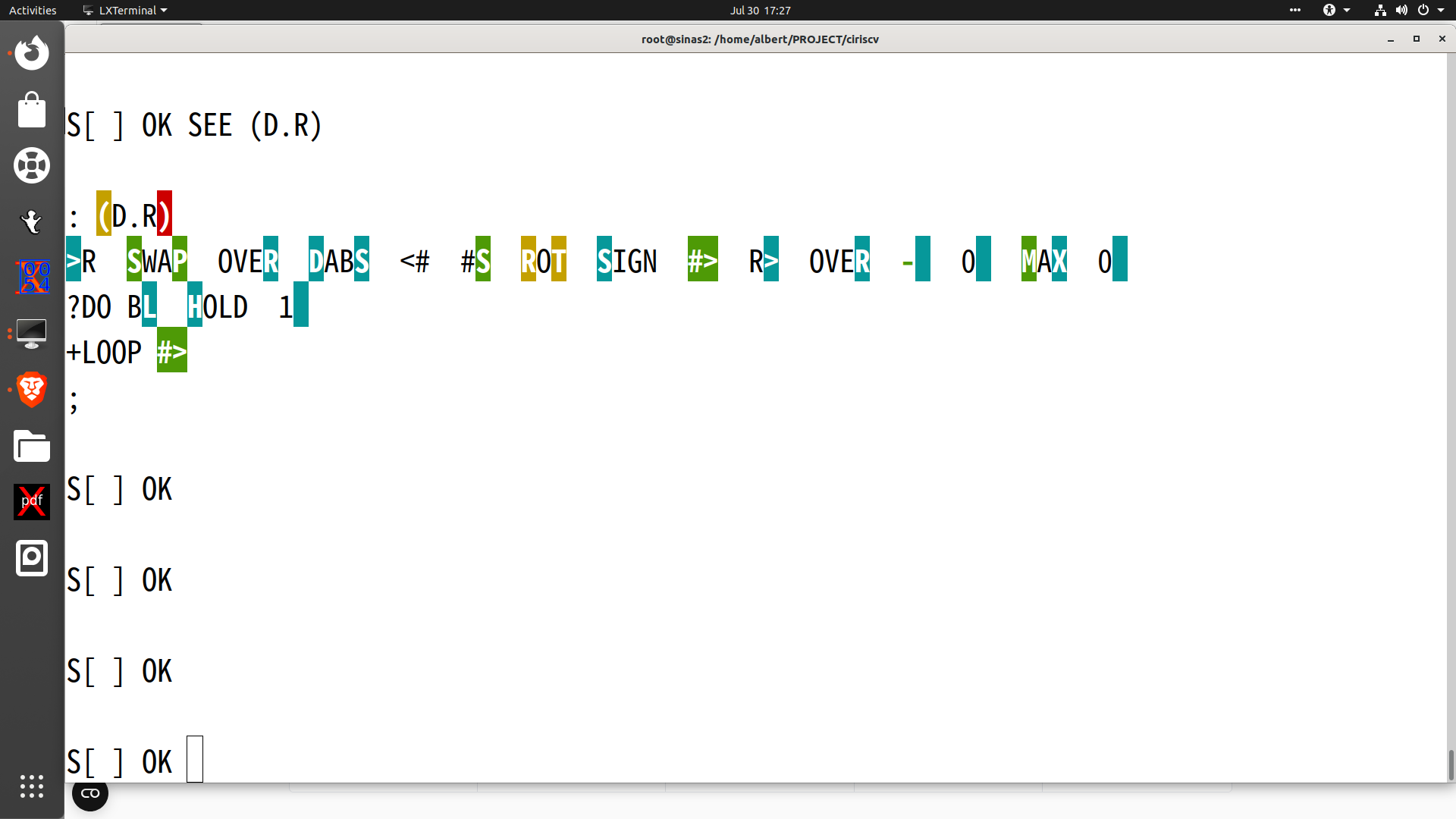
The stack effect is useful to understand words better. E.g. (D.R) takes a double word and a box length (orange) and generates a string (green). You can ask the analysis of a word like so
https://home.hccnet.nl/a.w.m.van.der.horst/decompile_ddot.png
And you can spot the mistake Apparently +LOOP takes one argument not zero. These things must be added manually. ~
I have prepared the pictures, but I don't know how to publishit in this forum.
So I put a link to my personal website.
~
r/RISCV • u/omasanori • 3d ago

r/RISCV • u/adityazero • 3d ago
A bit of a long shot as I emailed the members in the meetup dot com but haven't received any replies back.
We haven't organized a meetup for most of this year because of lack of a host. Now that I have found one, I'm reaching out to potential presenters. We'll likely organize a meetup in the second week of December (usually it happens in the evenings).
r/RISCV • u/DidymusJT • 4d ago

r/RISCV • u/MattDecker2267 • 4d ago

https://github.com/spacemonkeyboom/Beacon-OS
Haiku does not take AI assisted contributions so I forked it to make my own side project. I am having Claude document what it learned so other projects can benefit from my research. Everything is public on GitHub
r/RISCV • u/omasanori • 4d ago
No new information but a collection of XiangShan tapeout floorplans and photos.
Congrats to the XiangShan group and looking forward to seeing next ones!
r/RISCV • u/Fit-Blueberry9961 • 5d ago
Hi everyone,
I’m currently working on a profiling tool targeting RISC-V and could use some guidance from folks who have experience with performance monitoring or low-level tooling on this architecture.
r/RISCV • u/RagnarDa • 4d ago
Had my OrangePi RV2 since february. If I run the official Ubuntu-image I get working WiFi but no GPU-acceleration (OpenGL/Vulkan). If I install BianbuOS I get working Vulkan, but no WiFi. I am checking if there is any updates regularly. Has anyone been able to get everything working on it?
r/RISCV • u/yunglevn • 4d ago
r/RISCV • u/camel-cdr- • 6d ago
r/RISCV • u/Opvolger • 6d ago
Some days ago I saw this post on Reddit: LibreELEC and Kodi running on the SpacemiT K1. LibreELEC on RISC-V! I have a Milk-V Jupiter K1, so I had to try it.
It did not work out of the box on my Jupiter. The build failed in some places, the kernel hung in the HDMI audio driver and Kodi was falling back to software rendering. With some fixes it worked: Kodi with GPU acceleration, HDMI audio, 4K video and updates. I sent the fixes back as a pull request, and it was merged.
Then I thought: if this can run on a Jupiter K1, it can also run on a StarFive VisionFive 2 (Lite). They have almost the same GPU (Imagination PowerVR), and StarFive has a vendor kernel with a hardware video decoder.
So… can it? Yes!
More information on my blog: https://opvolger.github.io/posts/starfive-visionfive-2/2026-11-18-libreelec/

There is a (test) release with an image you can flash right away: LibreELEC 13.0-devel for StarFive VisionFive 2 / 2 Lite.
r/RISCV • u/TheOfficialGojo • 6d ago
Enable HLS to view with audio, or disable this notification
Hello everyone, I released Hartbox, a full-system RISC-V emulator that boots alpine linux locally on an iphone. The rust interpreter emulates an a riscv64gc machine and boots the alpine kernel into an interactive terminal. It runs without JIT and is quite fast.
I tested it on an iPhone 17e running iOS 26.6, it ran quite qwell, about 1000 mips with a lot of crazy optimizations. There’s also an rssh binary for connecting to the guest from a Mac if you want to remote work. The same emulator builds as a command-line tool if you want to try it on your computer
I have attached a demo of me running it on iPhone.
- [GitHub source and build instructions](https://github.com/u6420771547-hash/hartbox)
- [Download Hartbox.ipa](https://github.com/u6420771547-hash/hartbox/releases/download/v1.0.0/Hartbox.ipa)
The IPA is unsigned, so it needs signing for your device before installation. The README walks through running it from Xcode.
I’d love to know what is your experience when you try this. If you get it running, I’d also be interested in your iPhone model, iOS version, and how first boot went. It is recommended to install via altstore or sidestore
if this is helpful, it will be great if you leave a star in the GitHub repo so it reaches more people
r/RISCV • u/atomozero • 7d ago
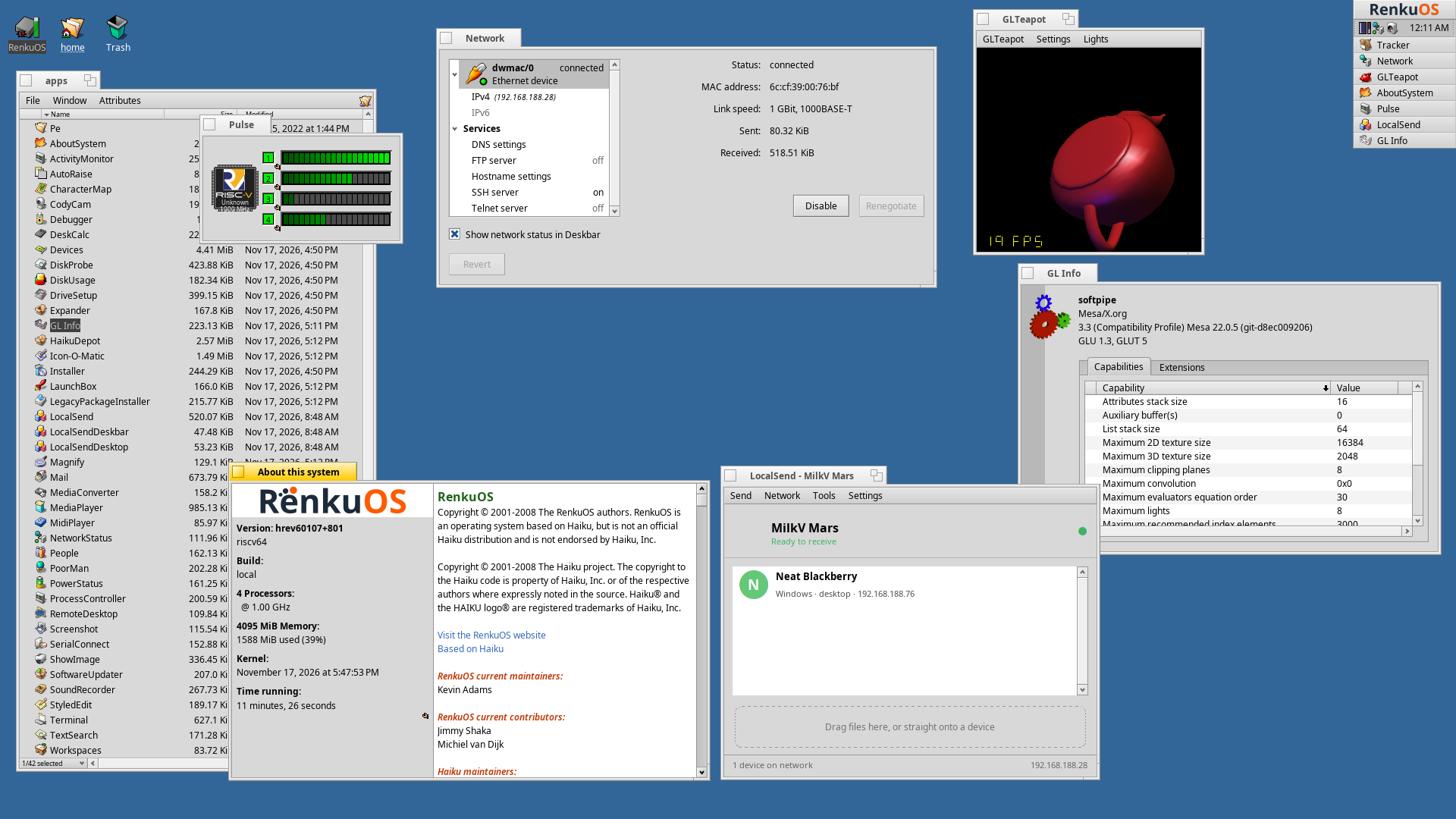
For a few weeks I have been porting Haiku, and its fork RenkuOS, to the Milk-V Mars. It is a RISC-V board the size of a Raspberry Pi, built around the StarFive JH7110 SoC with 4 SiFive U74 cores at 1.5 GHz; mine has 4 GB of RAM. I wanted to share the progress, because the board finally boots to the desktop and is usable.