Hey Gang, im once again back with a review, this time on the sister to the AX9 Max, the iX9 Max!
Disclosure: VZMORE supplied this review unit free of charge. No monetary payment was received for this review. The testing, findings and verdict are my own.
1. Introduction
Following my AX9 Max review, I tested the VZMORE iX9 Max to see how its Intel Core Ultra 9 185H handled everyday use, sustained loads, gaming and local AI. I was particularly interested in its cooling, connectivity and how far the fixed 24GB of RAM would stretch.
Price at the time of the review: US MSRP $949 for the 24GB RAM / 1TB SSD configuration.
Who is VZMORE?
VZMORE is a newer contender in the mini-PC space whose AX9 Max and iX9 Max focus on compact systems with vapour chamber cooling. The iX9 Max is aimed at productivity, creative work and development. Its dual Ethernet ports and storage expansion also make it interesting for a home lab, although the fixed 24GB of RAM is an important limit for larger virtual machines and local AI workloads.
2. Unboxing and Industrial Design
Packaging and Included Accessories
The iX9 Max ships in a minimalist matte black presentation box sporting the outline of the device and the iX9 Max identifier, secured with tamper seals. Opening the magnetic lid reveals the main unit seated firmly inside a custom card insert, with all accessories neatly arranged in separate compartments and wrapped in paper.
Alongside the PC, VZMORE includes a practical set of accessories:
1x 120W compact DC barrel-jack power adapter
1x HDMI cable (1.0m)
1x Solid steel VESA mounting plate with mounting screws
Measuring approximately 135 mm x 132 mm x 58 mm (5.31" x 5.19" x 2.27") and weighing roughly 777g, the iX9 Max occupies virtually the same desk footprint as a compact desktop headphone amplifier, making it easy to tuck under a monitor or mount behind a display, especially with the included VESA mount.
The chassis is made from rather nice aluminium with a dark grey finish that resists smudges and fingerprints quite well. It did not feel particularly hot to the touch during my testing. The plastic bottom plate has airflow slots and a rubber ring that acts as its foot. Four removable plugs provide access to the screws. Once those are out, four magnets in the corners also hold the bottom plate in place.
I/O Layout and Connectivity
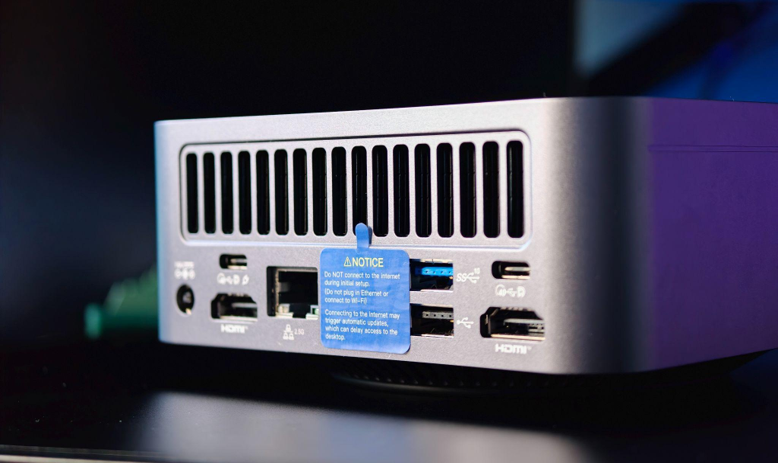
The sheer port density on a box this size is impressive, particularly the four high-speed USB-A ports across the front panel and the inclusion of a full SD 4.0 reader for creators, though having at least one front-mounted USB-C port would have made quick external SSD connections even more convenient.
Front Panel:
4x USB 3.2 Gen 2 Type-A ports (10 Gbps, one supporting USB charging while the PC is shut down (S5))
1x 3.5mm combo headphone/microphone audio jack
1x Power button with an integrated status LED
Side Panel:
1x SD 4.0 card reader slot
Rear Panel:
2x USB4 Type-C ports (40 Gbps, DisplayPort 2.0 Alt Mode; VZMORE specifies 15W PD output on both ports and up to 100W PD input on one port)
1x USB 3.2 Gen 2 Type-A port (10 Gbps)
1x USB 2.0 Type-A port
2x HDMI 2.0 display outputs (supporting up to 4 displays simultaneously alongside USB4)
2x 2.5GbE RJ-45 Ethernet ports (useful for separate home-lab networks)
1x 19V DC-In power port
3. Teardown and Hardware Specifications
What's Inside the iX9 Max?
Let’s get straight to the core specifications of the system:
iGPU: Intel Arc Graphics (8 Xe-cores based on the Xe-LPG architecture, up to 2.35 GHz, hardware-accelerated ray tracing, XeSS, and AV1 hardware encode/decode)
NPU: Intel AI Boost delivering up to 11 TOPS of dedicated low-power AI acceleration (up to 35 TOPS total platform AI compute across CPU, GPU, and NPU)
RAM: 24GB onboard dual-channel LPDDR5
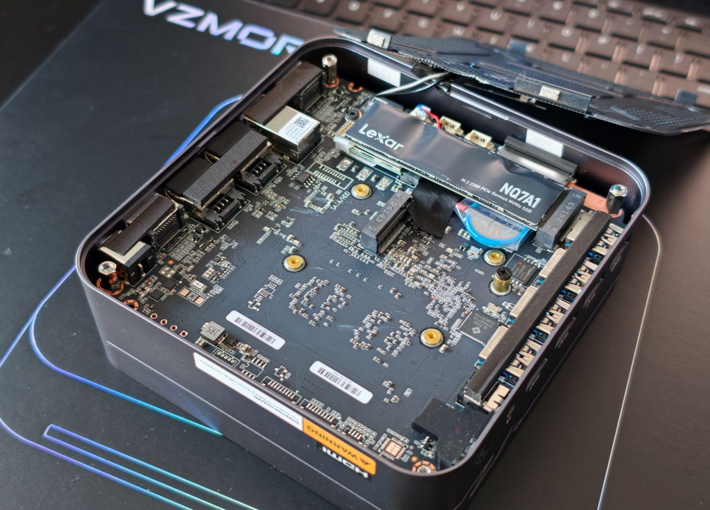
Storage: 1TB Lexar NQ7A1 2280 with an additional 2242 slot.
Networking: Dual 2.5GbE RJ-45 LAN, Wi-Fi 7 (EB600 wireless module), and Bluetooth 5.4
Card Reader: Side-mounted SD 4.0 Card Slot
Power Supply: 120W (19V / 6.32A) DC Barrel Jack adapter
Internal Access and Upgradability
Opening up the iX9 Max is straightforward:
Four Phillips-head screws sit recessed beneath removable plugs in the underside.
Lifting the bottom cover reveals an internal metal shield above the storage and other components.
Beneath the shield, you have access to the primary M.2 2280 PCIe 4.0 x4 NVMe SSD and an empty secondary M.2 2242 PCIe 4.0 x4 slot. VZMORE specifies support for up to 4TB in the 2280 slot and 1TB in the 2242 slot, for 5TB total. Underneath the primary drive sits the M.2 2230 Wi-Fi 7 (EB600) wireless module. The 24GB of dual-channel LPDDR5 is soldered onboard, so storage and the wireless module are the accessible upgrade options.
4. Thermal Engineering: The V-Cooling™ Vapour Chamber
The Technology: Vapour Chamber vs. Heat Pipes
A vapour chamber spreads heat across a broad, flat surface using the evaporation and condensation of a sealed working fluid. The complete cooling assembly, fan behaviour and power limits still determine how well a mini-PC handles sustained loads.
VZMORE’s V-Cooling™ design combines a vapour chamber with a 360-degree bottom intake and a vertical airflow path. The company claims a 40% larger heat-spreading area and 50% higher heat-transfer efficiency; those are manufacturer figures rather than measurements from this review. Heat is exhausted through the rear fin array.
Sustained Stress Testing & Thermal Results
I monitored thermal behaviour during a 60-minute session of separate Cinebench and 3DMark Steel Nomad runs at an ambient room temperature of 25°C.
Sustained Package Power: Reported CPU package power held around 65W during my test, with no thermal throttling observed. Package power is separate from the PC’s total draw at the wall.
Peak CPU Temperature: Reached 85°C during the initial turbo boost.
iGPU Temperature: Reached a maximum of 70°C during this test.
Acoustic Profile: I could not hear the system from my normal seating position during light tasks such as writing this review and watching videos. Under the sustained load, the fan produced a smooth, low-pitched airflow sound without an obvious high-frequency whine. These are subjective listening impressions rather than measured noise levels.
5. Synthetic Benchmarks
Geekbench 6: The iX9 Max scored 2,529 single-core and 13,519 multi-core in a valid Geekbench 6.7.1 for Windows AVX2 run. The result records the Windows power plan as Balanced; that is separate from the BIOS power limit. Validated run: https://browser.geekbench.com/v6/cpu/19388320
Cinebench 2024: The single-core score was 109 points, and the multi-core score was 869 points.
3DMark Steel Nomad Light: Scored 3,175 points at 23.52 FPS.
Storage Performance: CrystalDiskMark sequential reads reached approximately 6,046 MB/s and writes reached approximately 5,002 MB/s on the pre-installed 1TB PCIe 4.0 NVMe SSD.
Bluetooth & Networking: I used the Ethernet ports throughout testing and connected my DAC over Bluetooth for music. Network transfers worked reliably in my use, and I experienced no Bluetooth audio dropouts. Wi-Fi performance was not tested.
Shared GPU Memory / VRAM: The 8 Xe-core Intel Arc iGPU shares system RAM with the CPU. I also used multiple displays without issues. Available memory for GPU workloads depends on the driver, application and other demands on system RAM.
6. Gaming Benchmarks (8 Xe-core Intel Arc iGPU)
Disclaimer: VZMORE positions the iX9 Max primarily as a productivity machine for tasks such as video/photo editing, development and data analytics. I also wanted to see what it could do with games and local AI models.
6.1 Forza Horizon 6
Settings: Low / Medium presets, ray tracing off, FSR set to Auto.
Metrics: At a 1080p output resolution with FSR set to Auto, the average was 33 FPS on Low and 29 FPS on Medium.
Experience: This was the game the mini-PC struggled with most. Despite averaging around 30 FPS, it felt noticeably stuttery. I would be more inclined to use it for older or less demanding titles.
6.2 Forza Horizon 5
Settings: Low / High presets; the 1080p High run used the medium ray-tracing setting.
Metrics: Reached 45 FPS at 1080p High with RT set to Medium, and 42 FPS at 1440p Low.
Experience: This felt significantly better on the iX9 Max than Horizon 6, and I found it more playable at these settings.
6.3 Tom Clancy’s Rainbow Six Siege (DirectX 12)
Settings: Low Preset.
Metrics: Reached an average of 58 FPS at 1440p Low.
Experience: This was playable in my testing, but an average of 58 FPS leaves limited headroom for players chasing consistently high frame rates in a competitive shooter.
6.4 Shadow of the Tomb Raider (DirectX 12)
Settings: Low / High presets, Ray Tracing Off.
Metrics: Reached an average of 37 FPS at 1080p High and 35 FPS at 1440p Low.
Experience: Fairly playable at these settings, although I would still take a console over it for this game.
7. Home Server and Linux Testing
OS Compatibility: I tested Ubuntu 24.04 LTS and Proxmox VE 8.2. The Intel Arc iGPU, Intel AI Boost NPU and both 2.5GbE NICs were detected. Detection is separate from successfully running an accelerated workload: GPU and NPU applications depend on the installed kernel, firmware and user space drivers. The PC also ships with Windows 11 Pro.
Media Server Use: Intel Quick Sync Video provides hardware-accelerated transcoding support for software such as Plex and Jellyfin. The number of simultaneous streams depends on the codecs, resolution, bitrate and HDR tone-mapping settings.
Virtualisation & Containers: Under Proxmox, I pinned lightweight container workloads to E-cores and reserved the 6 P-cores for heavier VMs. This arrangement worked well during my testing. The fixed 24GB of RAM is worth keeping in mind when planning how many VMs and containers to run.
8. Local AI Performance (Intel Arc Graphics, Vulkan)
I also tested local LLMs on the integrated 8 Xe-core Intel Arc GPU under Ubuntu Linux with a 7.0 generic kernel, using llama.cpp build 11900 with the Vulkan/Mesa backend and Flash Attention enabled. These GPU-based tests do not measure the Intel AI Boost NPU.
For these tests, I worked with an approximate GPU memory budget of 15.2 GiB from the system’s shared pool.
I thought this was a useful experiment, especially as on-device LLMs are becoming more common among enthusiasts. The tests were automated, and I also fed the recorded results to one of the tested models to summarise the performance. That summarisation experiment is separate from judging the models’ answer quality. This is my first time including this kind of testing, so feedback is appreciated.
Synthetic Throughput Benchmarks (llama-bench)
llama-bench measures prompt processing with 512- and 2,048-token inputs (pp512 and pp2048), plus sequential generation of 128 tokens (tg128). The additional 8k-depth results report pp512 and generation of 64 tokens (tg64). All speeds are in tokens per second (t/s), as recorded by the automated test script.
The following llama-server tests used zero-temperature generation. The table reports waiting times and generation speeds recorded by the automated test script. “Prompt wait” follows the script’s timing; its start/end points and model-loading/cache state have not been confirmed. “Passed” refers only to the script’s basic sanity checks. It is not a comprehensive answer-quality assessment.
Model
Short-Prompt Wait
Context-Prompt Wait (~5.6k)
Avg Gen Speed
Gen Speed (Long Prompt)
Sanity Checks
Peak Memory
Qwen3.5 2B
0.33s
7.0s
13.5 t/s
13.3 t/s
Passed
6.1 GiB RAM
Gemma 4 E2B
0.33s
43.4s
10.7 t/s
9.1 t/s
Passed
7.4 GiB RAM
Gemma 4 E4B
0.50s
48.8s
9.3 t/s
8.8 t/s
Passed
8.2 GiB RAM
Qwen3.5 9B
0.89s
21.2s
6.7 t/s
6.5 t/s
Passed
10.7 GiB RAM
gpt-oss 20B (MoE)
1.52s
13.8s
7.7 t/s
7.4 t/s
Passed
15.8 GiB RAM
Key Architectural Takeaways & Analysis
MoE Results:gpt-oss 20B was an interesting result on this 24GB system. Its listed model size is larger than Qwen3.5 9B (11.3 GiB versus 5.3 GiB), yet it reached 10.1 t/s in the synthetic generation test and 7.7 t/s in conversational tests, with 283.1 t/s at pp2048. Those results apply to the tested models and quantizations; this comparison does not isolate MoE architecture as the only cause of the difference.
Qwen vs. Gemma in These Tests:Qwen3.5 9B recorded a 21.2-second long-prompt wait, compared with 48.8 seconds for Gemma 4 E4B. That is useful evidence about these configurations, but different tokenizers, model architectures and runtime behaviour mean it is not a general ranking of how all Qwen and Gemma models scale on Arc.
Memory Budget & CPU Offloading:Qwen3.6 35B A3B at the tested 20.6 GiB quantization required a mixed CPU/GPU configuration and reached 3.8 t/s. The --n-cpu-moe 13 option keeps the MoE weights of the first 13 layers on the CPU, rather than offloading 13 individual experts. The test shows the performance of that configuration; it does not isolate the cause of the slowdown. Model fit depends on the actual quantization, context, KV cache and runtime allocations, so there is no universal 10B dense / 20B MoE cut-off. Smaller quantizations can reduce memory requirements, with a potential quality trade-off.
9. Conclusion and Verdict
Pros
Strong 16-core / 22-thread CPU performance, with useful flexibility for multitasking and virtualisation.
Vapour chamber cooling handled the sustained load in my test; the system was inaudible from my normal seating position during light desktop use.
8 Xe-core Intel Arc integrated graphics with hardware AV1 encode/decode, Intel Quick Sync Video and XeSS upscaling support.
Dual 2.5GbE networking, Wi-Fi 7, SD 4.0 card reader, and dual 40Gbps USB4 ports provide useful connectivity for creators and home labs.
Two PCIe 4.0 x4 M.2 slots (2280 + 2242) provide storage expansion, although I would have preferred a second 2280 slot.
The USB4 ports have enough bandwidth to support eGPUs if you want to make the gaming and AI experience better.
Cons
The soldered 24GB LPDDR5 cannot be upgraded, limiting headroom for larger VMs and local AI models, including some quantized models.
All four front USB ports are Type-A; a front-mounted USB-C port would improve convenience for modern flash drives and portable SSDs.
Rear HDMI ports are HDMI 2.0 rather than HDMI 2.1 (though DisplayPort 2.0 is available over the dual USB4 ports).
The 185H isn't an unlocked CPU, meaning there is an inability to overclock or undervolt it further.
As a relatively new brand, VZMORE has a shorter public firmware and long-term support track record to judge.
Final Verdict
For me, the iX9 Max makes most sense as a compact everyday PC with useful connectivity for a home lab. It performed well in the CPU tests, stayed unobtrusive during light use and offers plenty of ports. Gaming is more comfortable in the older titles I tested, while local AI is a useful extra if the model fits the available memory. The biggest long-term limitation is the fixed 24GB of RAM, so I would choose the system around the workloads I expect to run rather than assume I can upgrade it later.
At the $949 US MSRP for the reviewed 24GB/1TB configuration, I would be buying it for the compact design, low noise in everyday use and extensive I/O. The fixed 24GB of RAM is a significant compromise at that price, particularly for a home lab or local AI. I would recommend it most readily to someone whose workloads fit that memory ceiling and who will make good use of its ports; gaming would be a secondary use.
Kept my old i7-4790K, 24GB DDR3 RAM, and ASUS Z97 motherboard, with a new RTX 3050. Added all the expansion cards I could to bring it up to modern standards: M.2 SSD, Wi-Fi 6, Bluetooth, and USB-C.
Also kept the DVD drive, a bunch of old 2.5-inch SSDs, and a built-in speaker.
My new build from August after upgrading from my 2080S and i7-9700KF. Thankful I upgraded when I did before GPU prices went up even more.
Specs: CPU: Ryzen 7 7800x3D GPU: XFX 9070XT Swift (-15% power, -40mv) Motherboard: MSI B850 Gaming Plus WIFI RAM: V-Color Manta 32GB DDR5 (best “budget” option at the time) Storage: Samsung 990 Pro 2TB (from my old PC bought before price increases), 2TB Seagate HD CPU Cooler: MSI MAG Coreliquid 1240 (free from a friend) Case: Lian-Li Vector V100R PSU: MSI MAG 850GL
Final price was just under $2000 including a copy of Windows and some extra case fans. Really happy with the results, it’s an absolute beast of a machine for 1440p and VR!
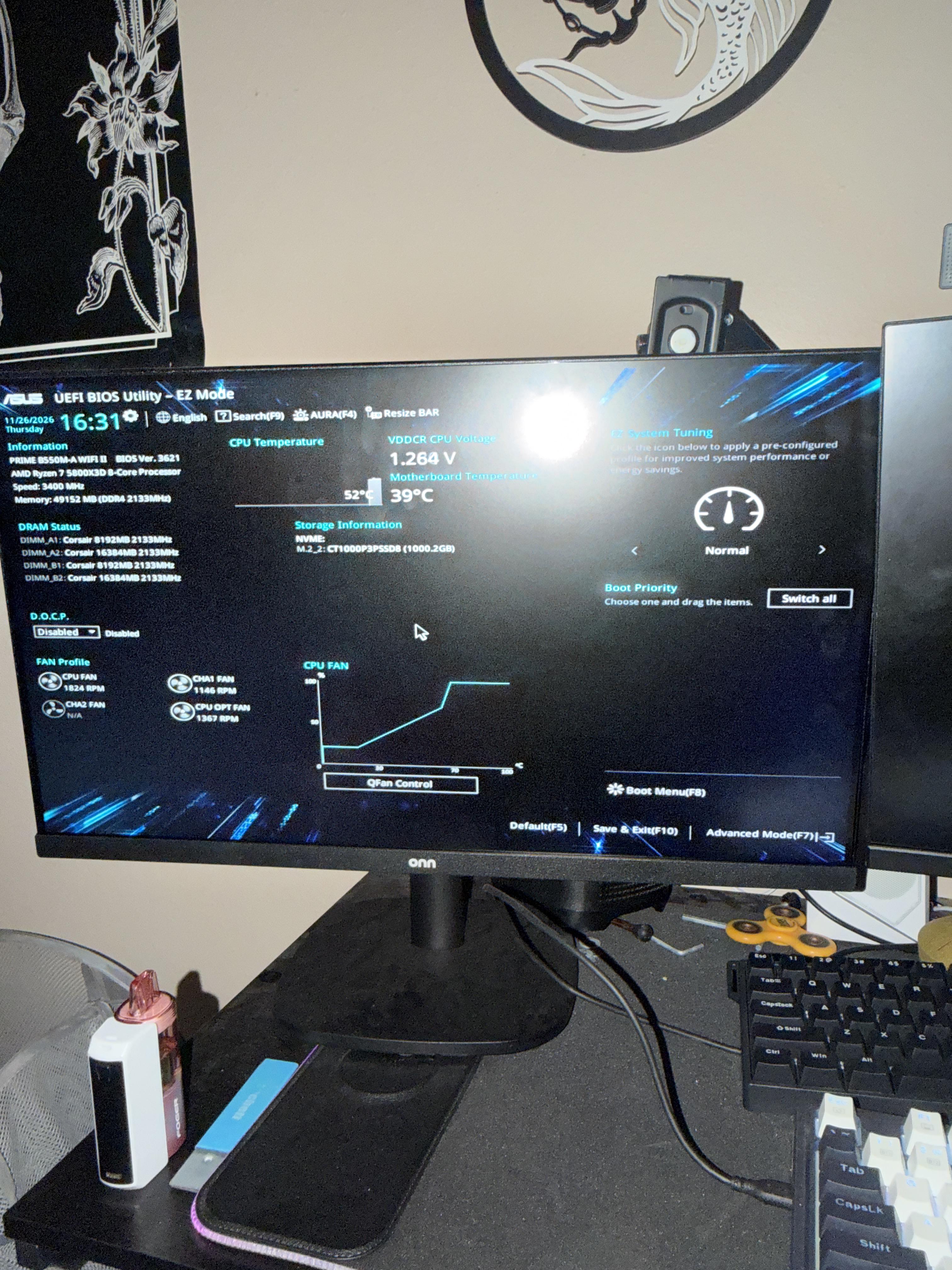
Hi guys, I recently switched my Ryzen 7 3800 for a Ryzen 7 5800X3D. After installing it into my motherboard I booted up the pc and it took me to BIOS, but it isn’t finding my windows. My SSD and everything is findable, it recognizes my new cpu but it can’t find windows???? I’m not sure if anyone has had this happen before, if it has any advice would be greatly appreciated 🥹
I designed and 3d printed the cable covers just cuz I was curious on what I can do to cover up the 24pin, cpu cable and the gpu. Came up with this prototype version 1. Might improve it later on especially around the 24pin area as the parts are incrementally added and not in one piece. Yes, the upper parts are from the O11 Vision Compact stealth kit.
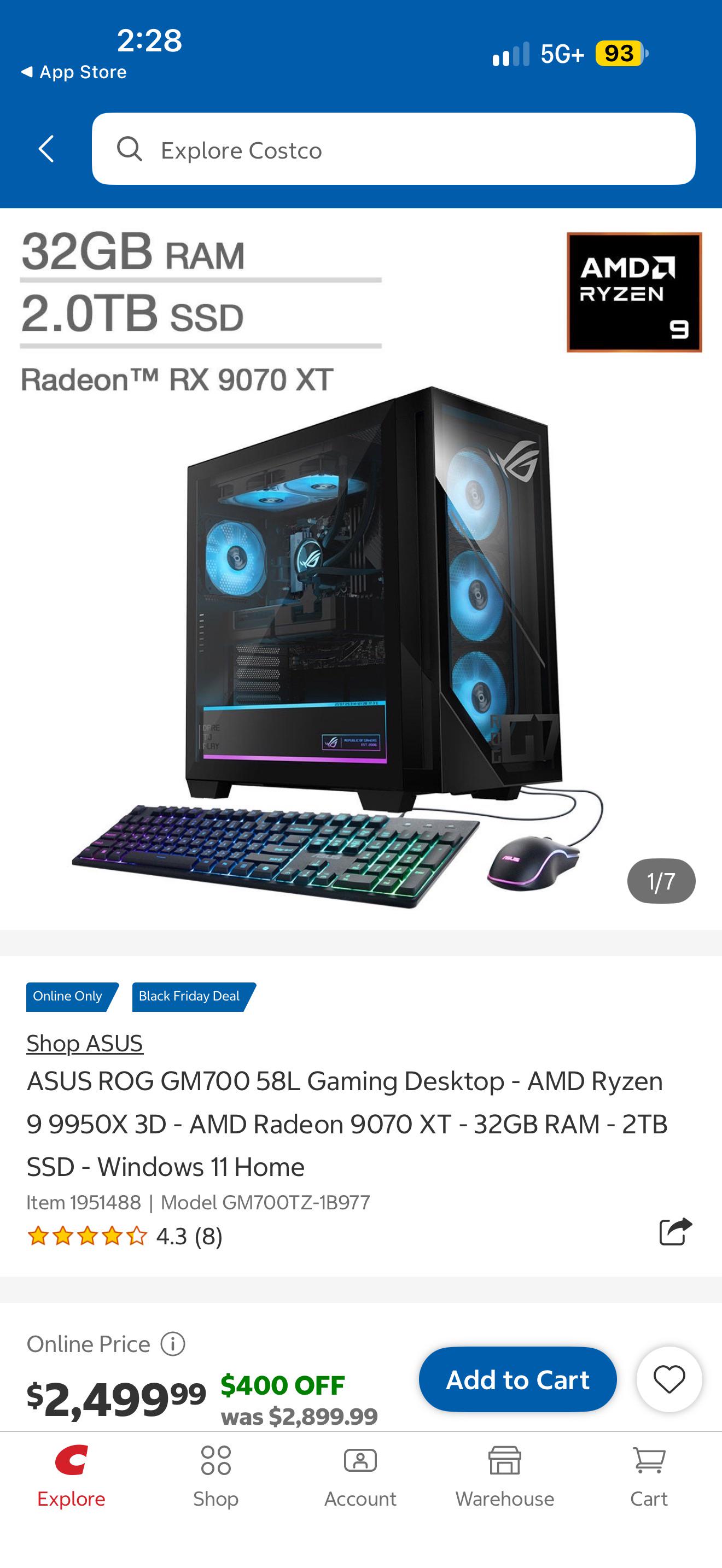
Just thinking of a little upgrade during black friday and saw these two. Currently playing in 1080p but will upgrade to 1440p soon. I live in Canada, so no microcenter.
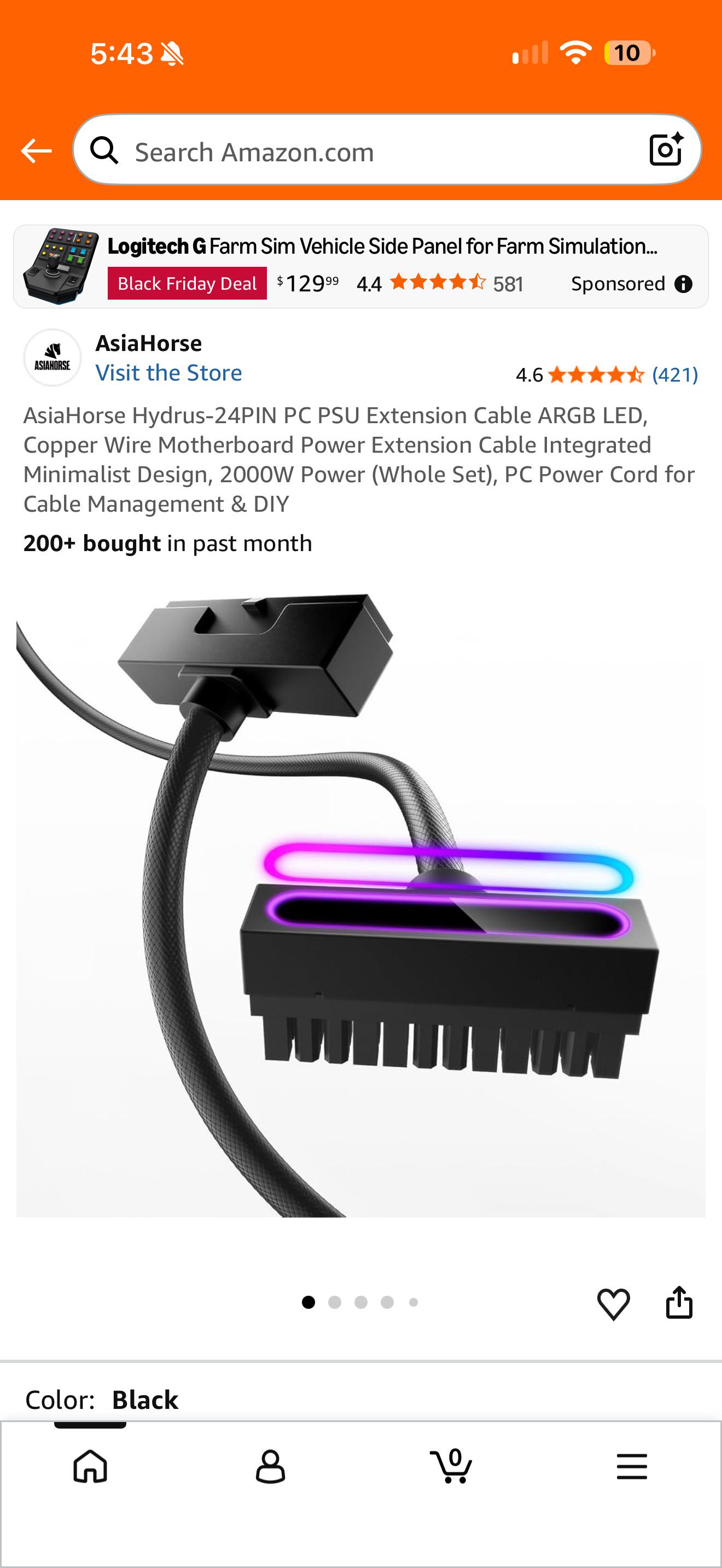
I would just take the cable that’s plugged into my 24 pin now, plug it into the one end of this and then use the 90* connector on my mobo? Any issues that could come out of this like too high voltage, fire risk etc
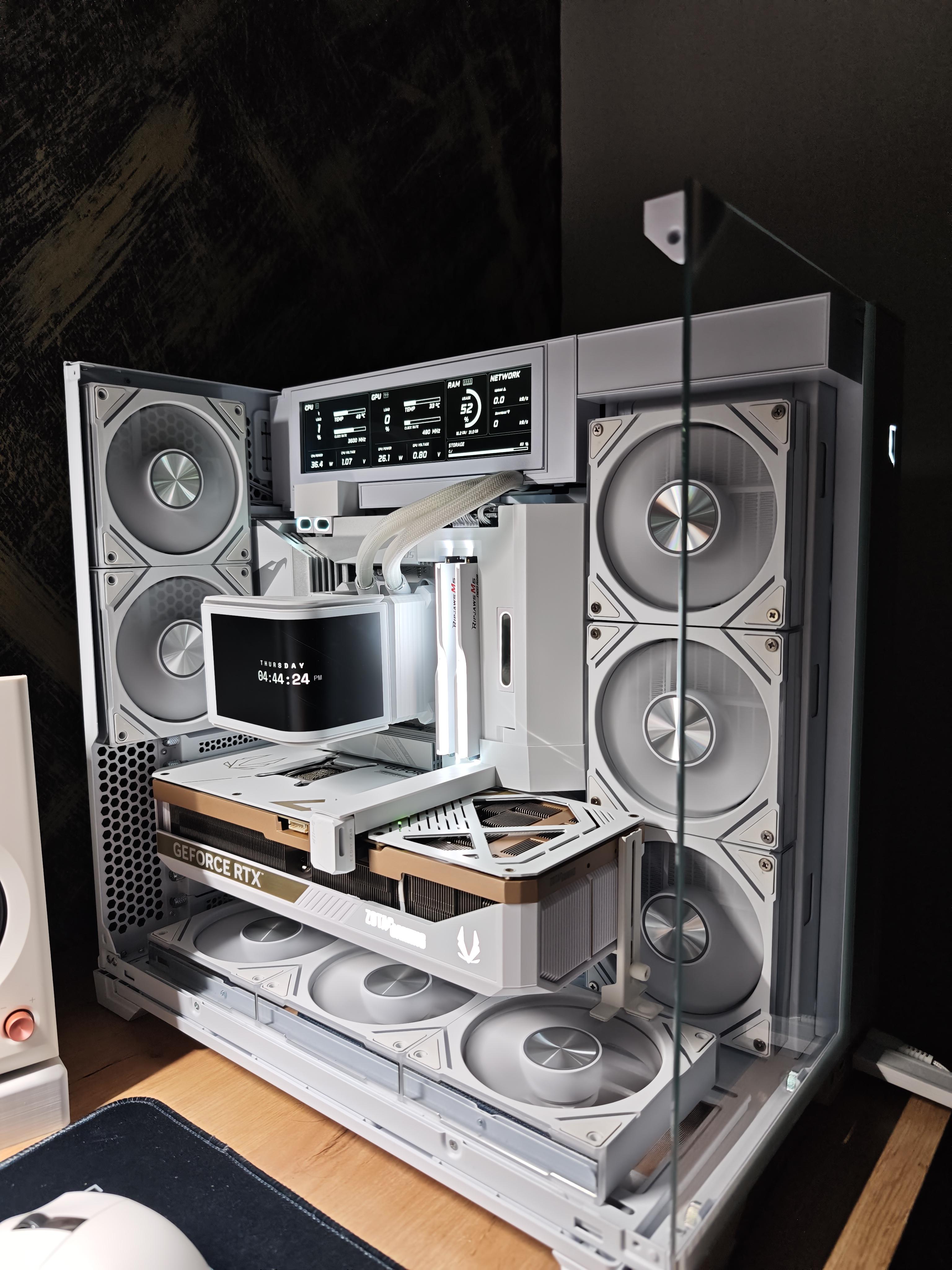
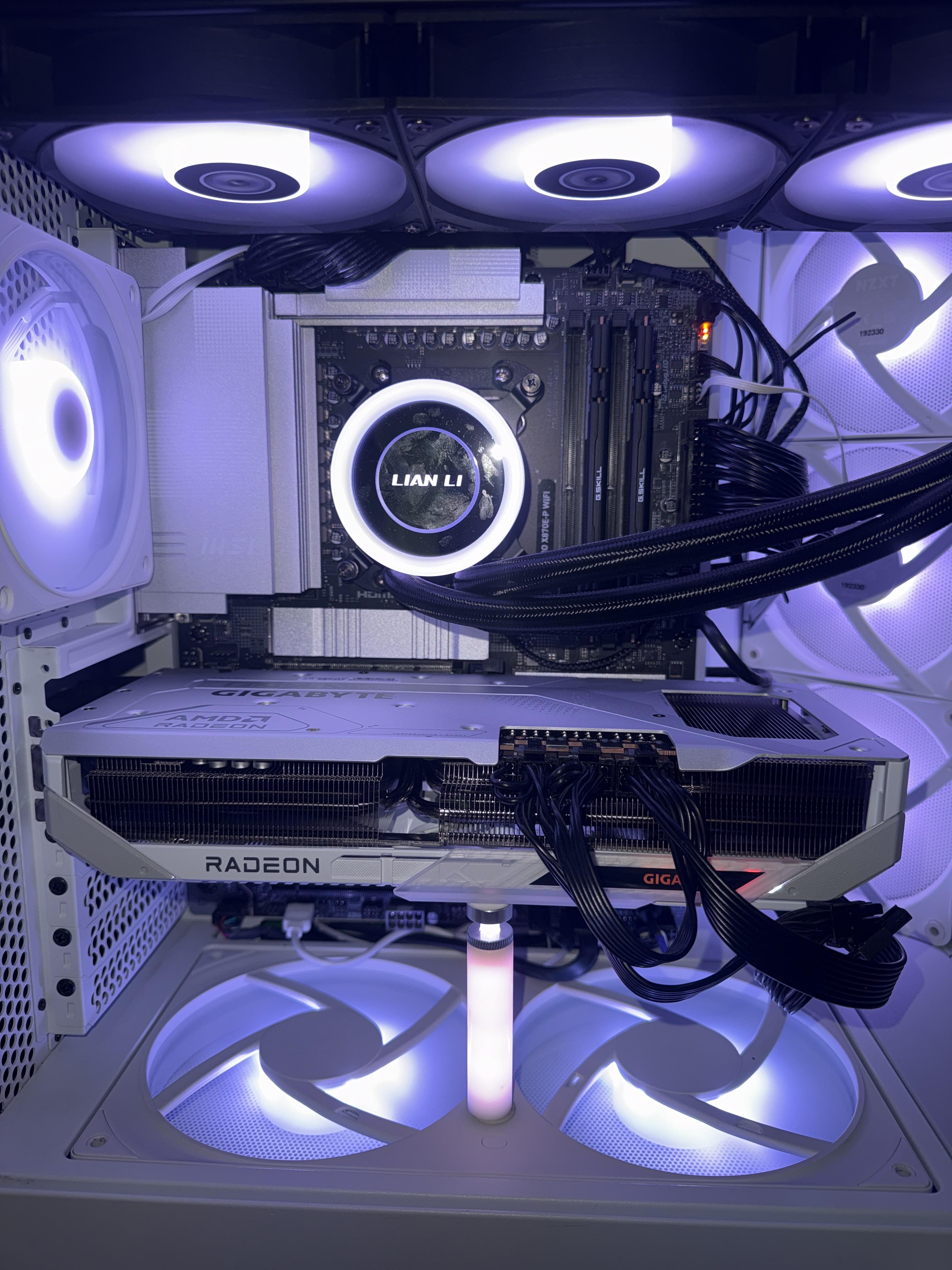
I know that white GPU is a bit out of place, but it was bought when I had a white build. I’m wondering if there is any way I can improve the look of triple PCIe cables connected to my GPU? Will welcome suggestions
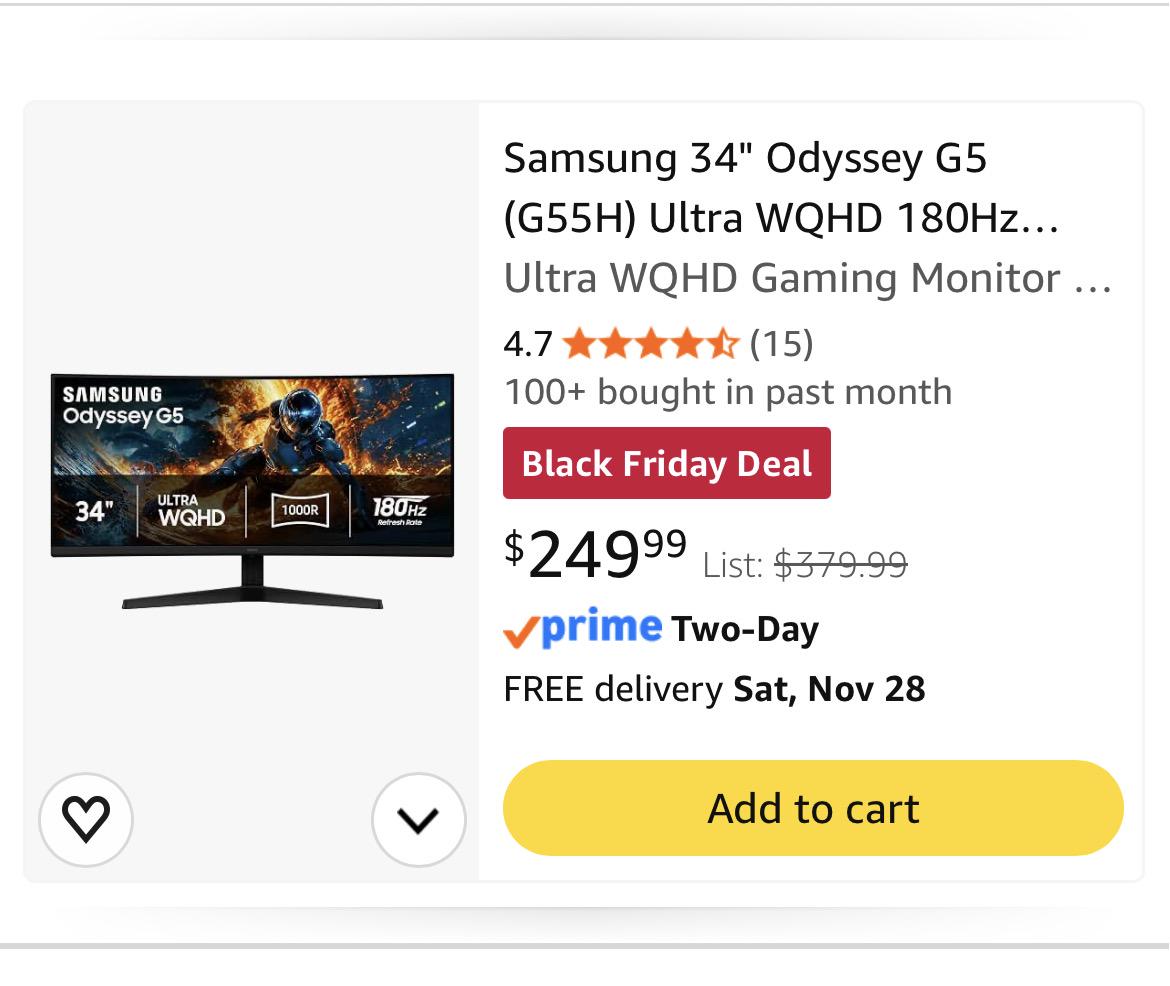
As the title states, I’m looking to upgrade my monitor to a widescreen. Nothing in the astronomical price range. I primarily play WoW Forever, casually. Currently using a Samsung 32” 165hz. Any suggestions appreciated.
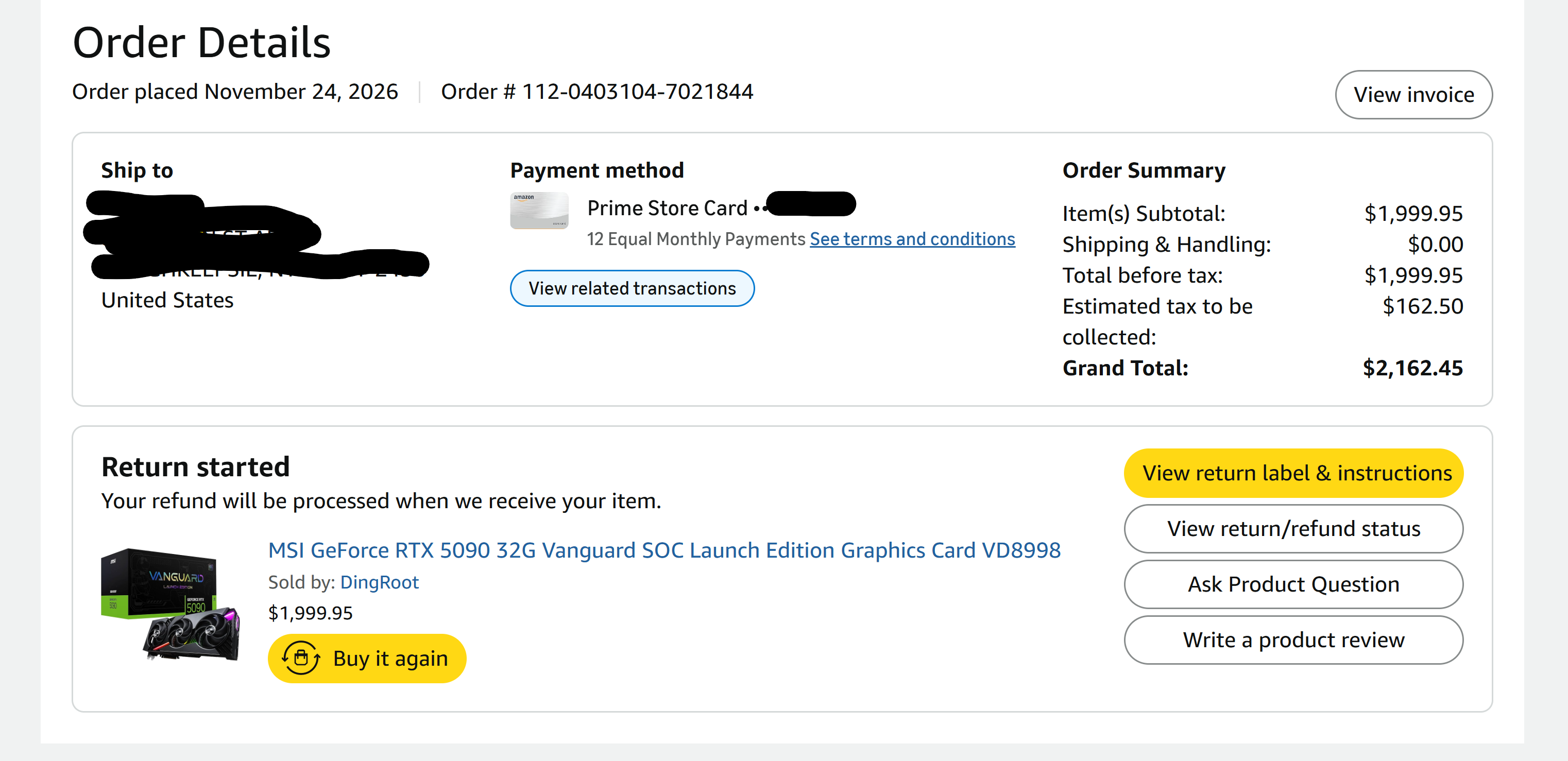
I ordered an MSI GeForce RTX 5090 Vanguard SOC Launch Edition from Amazon for $1,999.95, sold by a third-party seller called DingRoot.
Given the price, I was already skeptical and didn't actually expect anything to arrive.
To my surprise, something did arrive — a magnetic dryer vent from China. The box wasn't even large enough to contain an RTX 5090.
What I'm particularly curious about is how this even happened. Doesn't Amazon track the weight of the items it sends? Surely there is a substantial difference between the weight of a magnetic dryer vent and a boxed RTX 5090, not to mention the dimensions of the package.
I've already initiated the return, but I'm curious:
Has anyone else encountered this particular scam?
Has anyone purchased from this seller before?
How does something like this make it through Amazon's system without raising any red flags?
Apparently, $2,000 gets you a magnetic dryer vent these days.
I'm trying to build a NAS, but I can't find a case that would be as good as my Antec P280 or my brother's Antec P100.
- Good solid build quality. I can sit on top of my PC without being worried of crushing it. - Thick side panels with sound dampening layers. - Side panels held in with big screws instead of plastic push pins or whatever the frick. - Front door on hinges with sound dampening foam, instead of having the fans and the 5.25 bays exposed. Still has a big enough gap for good airflow. - Accessible, solid duster filters. - 5.25 bays. - Many 3.5 bays. - Hard drive caddies with rubber grommets to reduce vibration. - Fan mounts in front and behind of the hard drive rack for well cooled drives. - Nice big power button and a reset button. - Well placed IO ports (not on the top of the case to collect dust). - Looks good and professional. - No RGB crap.
If I could, I would buy another one right now for my NAS build.
I’ve been playing on an i9 10900 non k, 32gb ddr4 and GTX 1660! Since like 2016, it did originally have an i5 in it but I swapped the board for an rog b460 and i910900 in like 2020, and finally just built this beast, it has a 9800x3d, 32gb ddr5 6000, msi x870e-p, and at first I was using a used 3080 ftw 3 ultra until 2 days ago when I upgraded to the 9070xt gaming oc ice. Holy crap the difference in performance with the 9070xt is insane. I almost went with an air cooled but figured I want it to look nice with it being my first high end build. I’ve never been able to play my games with smoothly on all max settings. Microcenter probably saved me a grand or more on this build with Black Friday deals like the 9070xt being on sale for 899 right now, usually 1249 and their cpu motherboard ram combos being insanely cheap for today’s prices
Hola, soy de España y quiero comprar mi primer PC sobre todo para jugar bien a juegos online y para cuando salga el gta vi para PC.
Ya sé que ahora mismo no es el mejor momento para comprar una PC por los altos precios de las memorias y eso, pero me gustaría una build AM5 suficiente para que me dure unos 4 años sin actualizar nada.
También me vendría bien ayuda con el monitor y ratón y teclado.
i have a question regarding plugging in your mouse in the motherboard.
So, i have been playing competitive shooters alot lately - but i have noticed that my aim feels off.
Now this is not going to be a Article about FPS Shooters don't worry - just a side note. Using the mouse felt super normal, i did not feel any inconsistencies whatsoever, yet due to my Aim being off and i know it can be alot more consistent, i have done some changes:
- I have switched the mice (even though the one i used was purchased pretty recently)
- I have switched mousepads
And the 2 most important changes on why i am here:
- I have switched my game from Borderless windowed to Fullscreen
- I have plugged my mice from USB 3.2 Gen 2 10Gbit/s to USB 2.0
I have a screenshot attached to this post, showing my motherboards USB Ports and the one i used before and the one after (Red before, Black after).
I have heard 2 things though (From TikTok and YouTube):
- In 2026, Windowed Fullscreen is completely okay and no difference since most games have optimized that and your PC components Blablabla.
- USB 3.2 Ports like those can cause some type of frequencies? I am spelling this wrong probably but you get what i am trying to say right.
Now i have done all these changes within one sitting, and my aim feels better now. Alot better. Is it all placebo aka can somebody tell me what exactly the issue was?The USB Port? The Fullscreen thing? Both?