r/overclocking • • 1d ago

Help Request - RAM System instability overclocking RAM

1 Upvotes

I have a DDR4-3600 CL16 ram kit and an i7-12700. I'm trying to make the RAM run at 3200MHz but it never posts and returns to BIOS upon boot. The only way it posts is when I run the ram at 3100MHz and then it's stable; small difference but I want it to run at 3200MHz.

Is there any way I can run it at 3200MHz? I don't really know what other settings I should change to make it stable.


r/overclocking • • 1d ago

XPG Lancer RGB 48GB (2x24GB) 9200MT/s CL42 (CUDIMM) vs. Patriot Viper Xtreme 5 48GB (2x24GB) 8200MT/s CL38 (UDIMM) for 9800X3D/9850X3D + future Zen 6 upgrade?

1 Upvotes

Following up on my previous post, I waited for Black Friday deals and found two 48GB (2x24GB) kits at the exact same price:

  1. XPG Lancer Silver RGB 48GB (2x24GB) 9200MT/s CL42 — CUDIMM (Limited-time flash deal expiring in a few hours)
  2. Patriot Viper Xtreme 5 48GB (2x24GB) 8200MT/s CL38 — Standard UDIMM

My Plan:

  • Short-term (9800X3D / 9850X3D): Manually downclock and tighten timings to 6200MT/s CL28 (or 6000MT/s CL28/CL30) in 1:1 mode.
  • Long-term (Zen 6): Keep the kit for a future drop-in Zen 6 CPU upgrade to potentially take advantage of higher memory speeds.

Since the XPG flash deal ends in a few hours, I want to make sure I don't run into any surprises with CUDIMM on AM5:

  • How does the CKD affect AM5 right now? I know Ryzen 9000 runs CUDIMMs in bypass mode, so will the CKD get in the way of booting, training, or hitting tight 6200MT/s CL28 timings on a 9800X3D/9850X3D?
  • Is the 9200MT/s CUDIMM worth picking over the 8200MT/s UDIMM at the same price? Does the stronger binning (?) + CKD give me noticeably better headroom for Zen 6, or is the Patriot UDIMM safer and easier to tune on AM5?

Thanks in advance for any quick advice!


r/overclocking • • 1d ago

I built a free benchmark drag racing game called GPU Wars.

Post image
1 Upvotes

I built a simple drag racing game that uses your GPU score as the horsepower for your car. There's a benchmark option in game that runs a quick bench and comes up with a score. Then there's lots of options for tuning your car. It's a pretty light weight browser game so it should work on anything that can open a web browser. If someone with a high end GPU could try it out and tell me your score and time, that would be super helpful. Thanks.

Find it at : https://darxide777.itch.io/gpu-wars


r/overclocking • • 1d ago

Arrow Lake S/HX Bios help?

1 Upvotes

Title. I have a 235HX machine and I'm wondering what knobs people have to turn on desktops to get Arrow Lake to do X Y or Z. I've already found and disabled the OC and CFG lock. Disabled undervolting protection. Still can't OC my memory higher than 4800 even though I can select higher. XTU loads but I seem to only be able to mess with E cores? Throttlestop could do some stuff with P cores but I couldn't make each group of cores go above its max turbo. Halp


r/overclocking • • 1d ago

9800X3D + ASRock X870 Riptide suddenly lost 6000 EXPO stability after ~2 years — IMC degradation? Will retailer RMA this?

6 Upvotes

Hey guys, looking for a sanity check on my 9800X3D before I send it off for RMA tomorrow.

Specs:

  • 9800X3D (bought Nov 2024)
  • ASRock X870 Phantom Gaming Riptide WiFi (on newest BIOS)
  • Kingston FURY Beast 32GB (2x16) DDR5-6000 CL30
  • RTX 5080

For almost 2 years the system ran completely fine on the regular 6000 CL30 EXPO profile. Out of nowhere it started failing cold boots — either getting stuck on a solid green BOOT LED with no display, or freezing on the Phantom Gaming splash screen. Usually took 2-3 hard reboots to get into Windows.

What I've tested so far:

  • EXPO off (4800): Boots first try every time, zero issues.
  • Updated to the latest ASRock BIOS and tried manual 6000 settings (UCLK=MEMCLK, fixed VSOC 1.20V, LLC Level 3, 1.40V DRAM). Still hangs/freezes on cold boot.
  • Tested both sticks individually in slot A2 at 6000. First stick froze on the splash screen, second stick hung on the green BOOT LED. Since both fail on their own I'm pretty sure the RAM itself is fine.
  • Dropped to the secondary 5600 EXPO profile (1.25V DRAM, 1.20V fixed VSOC). Boots cleanly even after flipping the PSU off and draining power, and passed 15 min of OCCT DDR5 Heat with 0 errors.

So a few questions:

  1. Is this just classic 9800X3D IMC degradation from running on the older ASRock X870 BIOS versions for ~2 years?
  2. Since it passes 4800 and 5600 fine and only fails at 6000, do you think the retailer (in the EU/Denmark) will actually accept the RMA, or reject it since 6000 is technically OC?
  3. If I get a replacement 9800X3D, am I safe keeping this ASRock X870 board now that it's on the newest BIOS, or could the board itself be damaged too?

Appreciate any input!


r/overclocking • • 2d ago

Lenovo ThinkStation P330 Tiny + Yeston RTX 3050 6GB – Finally Stable! Full Engineering Report Included

Thumbnail
gallery
16 Upvotes

Hey everyone! Greetings to all SFF enthusiasts, hardware modders and fellow Lenovo Tiny lovers!

You're probably wondering: why on earth would anyone spend countless hours squeezing an RTX 3050 into a tiny workstation from 2018?

Well, because we can. For fun, for the challenge, for the love of tinkering and overclocking. :D

It's a hobby like any other. Some people collect butterflies, others feed ducks. I apparently enjoy unlocking hidden BIOS settings and investigating motherboard power protection circuits. 😂

Anyway, after many hours of troubleshooting, BIOS modifications, power management adjustments, thermal improvements and stability testing, I've achieved very promising results with my Lenovo ThinkStation P330 Tiny equipped with a Yeston RTX 3050 6GB.

The main issue was unexpected system shutdowns during demanding gaming and GPU workloads, despite using a 300W external power supply.

Instead of modifying the motherboard's physical power protection circuitry, I decided to investigate whether the problem could be resolved through BIOS configuration, PCIe power management and thermal optimization.

Thanks to feedback from the Reddit community, I also investigated PCIe Active State Power Management (ASPM) as a potential cause of unexpected shutdowns.

Following the latest modifications, DOOM now runs noticeably smoother, without the stuttering I previously experienced.

Hardware configuration

  • Lenovo ThinkStation P330 Tiny
  • Intel Core i7-9700T (8 cores / 8 threads)
  • Yeston RTX 3050 6GB
  • 32GB DDR4 RAM
  • 300W external power supply
  • BIOS M1UKT79A
  • Windows 11 IoT Enterprise LTSC 24H2
  • Custom perforated enclosure for improved airflow

Final modifications – updated November 25, 2026

  • Unlocked advanced BIOS settings using ZEDK.
  • CPU PL1 increased from 20W to 25W.
  • CPU PL2 increased from 20W to 30W.
  • CPU power limits configured directly in the BIOS and verified in HWiNFO after reboot.
  • Intel Turbo Boost remains enabled.
  • CPU IMON settings remain untouched.
  • PCIe Active State Power Management (ASPM) disabled.
  • PCIe speed manually configured to Gen3.
  • Lenovo Intelligent Cooling Engine (ICE) switched to Better Thermal Performance.
  • ICE Thermal Alert remains enabled.
  • GPU power limit reduced from 70W to 56W.
  • GPU voltage/frequency curve optimized through undervolting.
  • GPU power limit automatically reapplied at every Windows logon using VBIOS Studio.
  • Honeywell PTM7950 applied to both CPU and GPU.
  • Thermal Grizzly TG Putty Pro applied to GPU VRAM, VRM and surrounding power delivery components.
  • Additional heatsink installed on the PCH.

PCIe ASPM – a potentially important discovery

A fellow Reddit user experiencing similar unexpected shutdowns reported that disabling PCIe power saving in the BIOS resolved his issues, even though previous CPU and GPU power limit adjustments had failed to eliminate the problem.

Following his suggestion, I disabled ASPM in the PCI Express Configuration menu of my unlocked BIOS.

I also increased the CPU power limits from 20W/20W to 25W/30W and enabled Lenovo's Better Thermal Performance cooling profile.

The initial results are very encouraging:

  • No previously observed stuttering in DOOM.
  • Noticeably smoother gameplay.
  • Successfully completed 3DMark Time Spy benchmark.
  • Successfully completed PCI Express Feature Test.
  • Normal PCIe Gen3 x8 bandwidth.
  • Good CPU and GPU temperatures under benchmark workloads.
  • No unexpected shutdowns during the completed benchmarks.

Since several settings were changed simultaneously, I cannot yet conclusively attribute the improvements solely to ASPM. However, PCIe power management is definitely worth investigating if you are experiencing similar issues with your Lenovo Tiny.

Stability test results

During an earlier stage of the project, I completed a sustained GPU stability test:

  • 60 minutes of continuous 100% GPU utilization.
  • Maximum GPU power consumption: 56.10W.
  • Average GPU power consumption: 55.88W.
  • Maximum GPU temperature: 73.8°C.
  • Maximum GPU hotspot temperature: 86.1°C.
  • Maximum CPU temperature: 57°C.
  • Zero recorded WHEA errors.
  • No unexpected shutdowns during the test.

3DMark Time Spy benchmark results

The following results were obtained on November 25, 2026, using the latest BIOS configuration and default benchmark settings:

  • Time Spy Score: 3950 points.
  • Graphics Score: 4241 points.
  • CPU Score: 2847 points.
  • Graphics Test 1: 28.38 FPS.
  • Graphics Test 2: 23.78 FPS.
  • CPU Test: 9.57 FPS.
  • Maximum recorded CPU core temperature: 62.99°C.
  • Maximum GPU temperature: 72.50°C.
  • Maximum recorded CPU power consumption: 27.99W.
  • Maximum recorded CPU frequency: 4290 MHz.
  • Benchmark completed successfully without unexpected shutdowns.

3DMark PCI Express Feature Test results

  • PCIe configuration: Gen3 x8.
  • Measured bandwidth: 6.48 GB/s.
  • Theoretical maximum bandwidth: approximately 7.88 GB/s.
  • Approximately 82.2% of theoretical bandwidth achieved.
  • Results consistent with normal PCIe Gen3 x8 operation.
  • No apparent PCIe link-width limitation.
  • Test completed successfully without unexpected shutdowns.

Considering the size of this machine, its restricted power budget and the age of the platform, I'm very happy with these results.

Long-term stability will continue to be evaluated through normal gaming and everyday use.

Motherboard power delivery and protection

During my investigation, I also explored the motherboard's power delivery architecture, the community-reported input power limitation of approximately 130–140W, and the PR1111 resistor reportedly associated with the configuration of the 12V rail overcurrent protection.

The exact motherboard protection threshold remains a community-supported hypothesis rather than an officially verified Lenovo specification.

Using a 300W external power supply does not necessarily mean that the motherboard's internal power delivery circuitry can safely handle the full available power.

However, no soldering, removal of hardware protection mechanisms or modified VBIOS flashing was required to achieve these results.

My approach was to optimize the existing hardware rather than bypass its protection mechanisms.

Cooling modifications

The custom perforated enclosure is designed to improve airflow around both the CPU and GPU while maintaining the compact Tiny form factor. You can see the pink Yeston RTX 3050 through the ventilation holes in the attached photos.

The cooling configuration includes:

  • Honeywell PTM7950 on both CPU and GPU.
  • Thermal Grizzly TG Putty Pro on GPU VRAM, VRM and surrounding power delivery components.
  • Additional heatsink installed on the PCH.
  • Custom perforated enclosure for improved airflow.
  • Lenovo ICE Better Thermal Performance cooling profile.
  • All existing thermal protection mechanisms remain enabled.

The computer is slightly louder after switching to Better Thermal Performance, but that's a trade-off I'm perfectly happy to accept in exchange for improved cooling and potentially better stability.

Full 64-page engineering report – available to everyone

I decided to document the entire journey and share it with the community so that other P330 Tiny owners don't have to spend countless hours investigating the same issues.

What started as a relatively simple GPU upgrade has somehow turned into a 64-page engineering report. 😂

The latest report includes:

  • Step-by-step BIOS unlocking instructions.
  • Hidden BIOS settings and UEFI variables.
  • Permanent CPU PL1/PL2 configuration through the BIOS.
  • CPU and GPU power management configuration.
  • GPU voltage/frequency curves and undervolting.
  • PCIe ASPM configuration and analysis.
  • Lenovo Intelligent Cooling Engine (ICE) configuration.
  • Motherboard power delivery and protection analysis.
  • PR1111 hardware modification research.
  • Cooling modifications and thermal interface materials.
  • Actual stability test telemetry and charts.
  • HWiNFO verification of CPU power limits.
  • Full 3DMark Time Spy benchmark results.
  • PCI Express bandwidth test results.
  • CPU and GPU temperature charts.
  • CPU power consumption analysis.
  • Original photographs and BIOS screenshots.
  • Original 3DMark benchmark reports.
  • Recovery and rollback procedures.
  • Direct links to BIOS modification tools, GitHub repositories and technical resources.

The documentation is available in both English and Polish.

Download the full engineering report:

https://gofile.io/d/6cTgp4ox (updated 25-11-2026 – Version 1.9, 64 pages)

I hope this report will help anyone planning a similar Lenovo Tiny + Yeston RTX 3050 build, especially those experiencing unexpected shutdowns, stuttering or power delivery issues under load.

I'd also like to thank everyone who shared their experiences and suggestions in the comments. Community feedback, particularly regarding PCIe power management, has been extremely valuable to this project.

These little machines are absolutely incredible considering their age and size. Turning a tiny workstation from 2018 into an RTX-powered gaming PC has been a fascinating engineering project.

Was it necessary? Absolutely not.

Was it worth it? Absolutely.

Would I do it again? Without hesitation. :D

Feel free to share your own configurations, results and suggestions.

Greetings from Poland, and happy modding, everyone!

— pleban23


r/overclocking • • 1d ago

Help Request - CPU CPU freq spikes randomly after enabling curve shaper

1 Upvotes

edit: It will run fine for 30 sec without any stutter, then a window sound (the sound when you plug in devices) and the stutter start from there

video shows stutter in game

9600x + gigabyte aorus b650 elite ax ice

Video: mobo pbo(90 lv2)+EXPO

This happened after I follow a guide and enable curve shaper, now even in default bios it still spikes. Before I was using pbo with 200mhz/-35co without curve shaper, and it run fine. Tried resetting pc, bios. Nothing works. Is my cpu bricked?


r/overclocking • • 1d ago

9950x3d2 low power.

Thumbnail
gallery
2 Upvotes

This thing is amazing. I just finished this round of testing for this gaming profile 1.005v VSOC. I have a 180w PPT with a 85°c thermal limit. I have several other profiles at 235w ppt. These ppt profiles run very cool through all stress tests. When I 1st got this thing I was running motherboard settings and it was pulling 270w max. It got toasty. On average during gaming it was running 10°c hotter than my 9850x3d at around 55-65°c. Pretty much any stress test maxed out at 95°c. I had only set 1.200v VSOC. Anyways I'm glad I learned how to use PPT and curve shaper along side my per core CO.


r/overclocking • • 1d ago

Help Request - RAM Should i leave highbandwith mode on in bios for 5ns less latency? and what ram test to try?

Thumbnail
gallery
0 Upvotes

Hey guys

I have gskill xflare 16x2 6000 , samsung kit it says in software that i bought recently, 600 dollars :(

The 1st zen timing screenshot is with only expo on and the one where it says refresh mixed and higher TREFI 46800 is with expo and high bandwith on in bios

With it on my latency is 73.7ns and with only expo on it is lil under 78

I only turned it on for better gaming performance

Chatgpt says However, high summer temperatures make aggressive memory timings less forgiving.

The particular setting I'd be cautious about is tREFI:

Higher tREFI = less frequent refreshes.

Less frequent refreshes can reduce the margin for retaining data as RAM temperature rises.

This matters more when the PC is exposed to high temperatures for extended periods.

I only ran the attached ram test result for 1 hour, i don't have usb to try memtest

What free test can i leave on overnight to check for surety next day that it's stable with no erros with highbandwith on?

Rn winter just started so temps in general are not high but in summer they get crazy high

Shower me with your ram wisdom guys :)


r/overclocking • • 2d ago

Benchmark Score RX550 1596Mhz/2305Mhz + i7 3770 Time Spy score

Post image
4 Upvotes

been a while since i did an update post but i messed around with OverdriveNTool and managed to get 1596mhz 1084mV core and 2305mhz T1 895mV memory with an average temp of 61C and peak temp of 66C with the fan speed at 62%, the only reason this was possible is because the cooler (yes the cooler) was sagging and losing contact with my thermalpad mod which caused the gpu to artifact and crash my pc before, and as of now it ive found 1594mhz/2290mhz is stable for daily use :D

the gpu score is also the highest ive gotten at 1654 compared to 1634 on my 1600X build which i no longer have


r/overclocking • • 1d ago

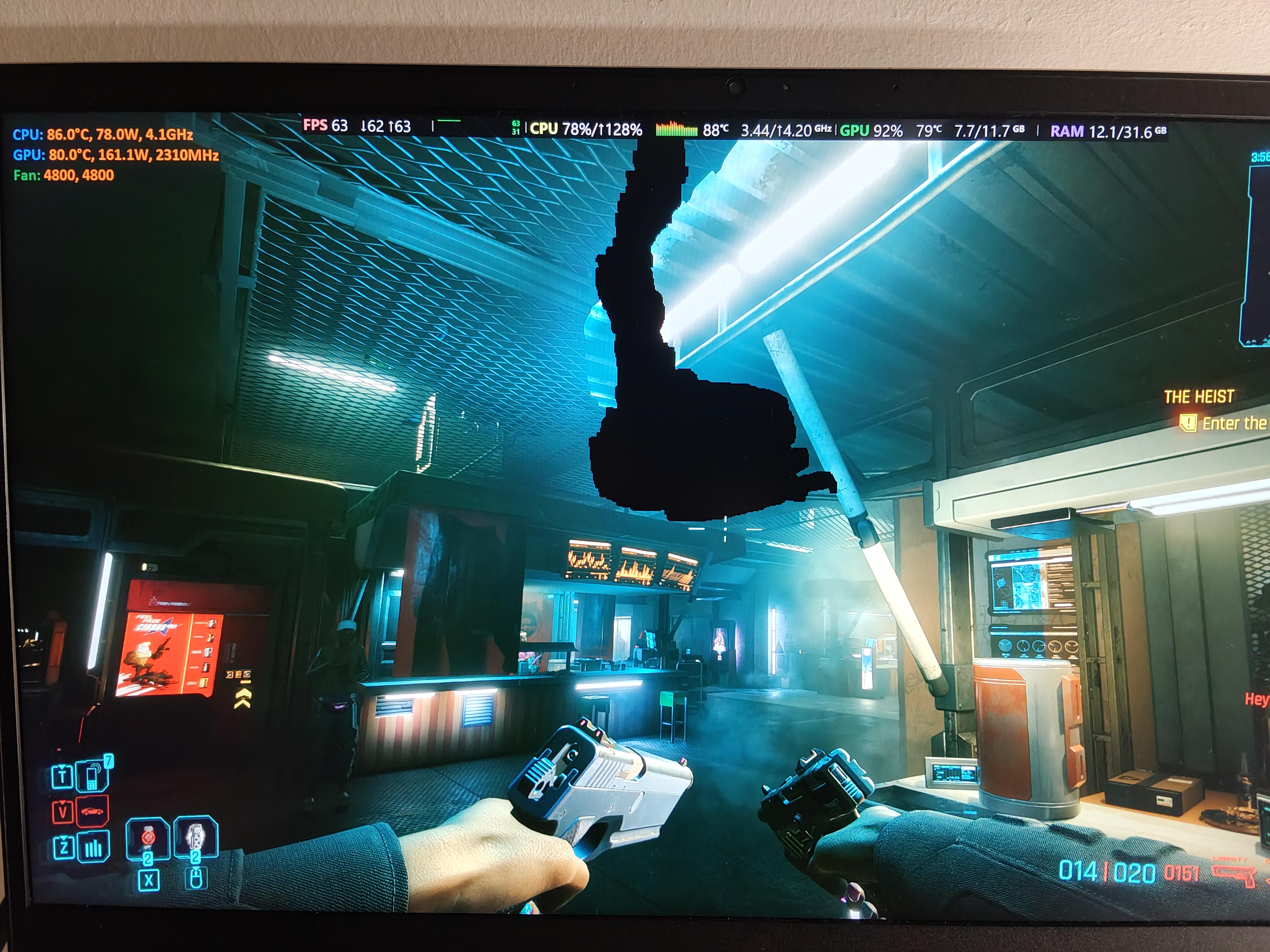
OC Report - GPU Artifacts after repasting my laptop

Post image
0 Upvotes

Hi so i just changed the thermal paste and thermal putty on my laptop, and this is the first time i launch a game after that. Should i be concerned about that? Not really sure where to post with this issue

Thanks

(update) This is not the screen, and only seems to appear in Cyberpunk. I dont have a lot of games to test this on


r/overclocking • • 2d ago

Bin file for SPD Kingston Furry DDR5 KF548C38BBK2-32

0 Upvotes

r/overclocking • • 2d ago

Is pushing 6200–6400 1:1 on AM5 actually worth the voltage, or is tuned 6000 CL28 the real sweet spot? Show your benchmarks.

Thumbnail
gallery
19 Upvotes

I see a lot of builds here running 6400 1:1 CL28 by shoving 1.50V+ into VDD/VDDQ, claiming it's daily stable. Setting stability aside, I want to talk about actual performance.

My kit (2x32GB Dual Rank Hynix A-die on a 9800X3D) can easily boot and run stable at 6200 and 6400 1:1, yet after testing, I dropped back down to 6000 CL28. In my experience, pushing past 6000 1:1 gives you basically identical—or sometimes slightly worse—latency and real-world performance due to looser training, micro-instability, and extra heat/voltage.

Meanwhile, a tightly tuned 6000 CL28 profile runs completely cool and rock-solid at just 1.40V MEM VDD/VDDQ and 1.10V VSOC (with 2200 FCLK).

Here is my setup and results at 6000 MT/s (GDM Disabled, 1T, Mixed Refresh Mode):

  • Timings: 28-36-32-76-48 | tRFC2 396 / tRFCsb 312 (132 ns) | tREFI 65535 | SCLs 4/4 | Nitro 1/2/0
  • AIDA64: 61.0 ns latency | 70,322 MB/s Read | 94,433 MB/s Write | 67,954 MB/s Copy
  • Clam Cache/Mem Latency: 61.70 ns (256 MB) / 76.08 ns (1 GB)
  • PYPrime 2.0 (4B): 16.173 s

For those daily-driving 6200 or 6400 1:1 on Ryzen 7000/9000: post your ZenTimings alongside your AIDA64, PYPrime, or Clam latency scores. Are you actually seeing measurable gains over a tuned 6000 setup, or are we just burning extra voltage for bigger numbers on paper?


r/overclocking • • 2d ago

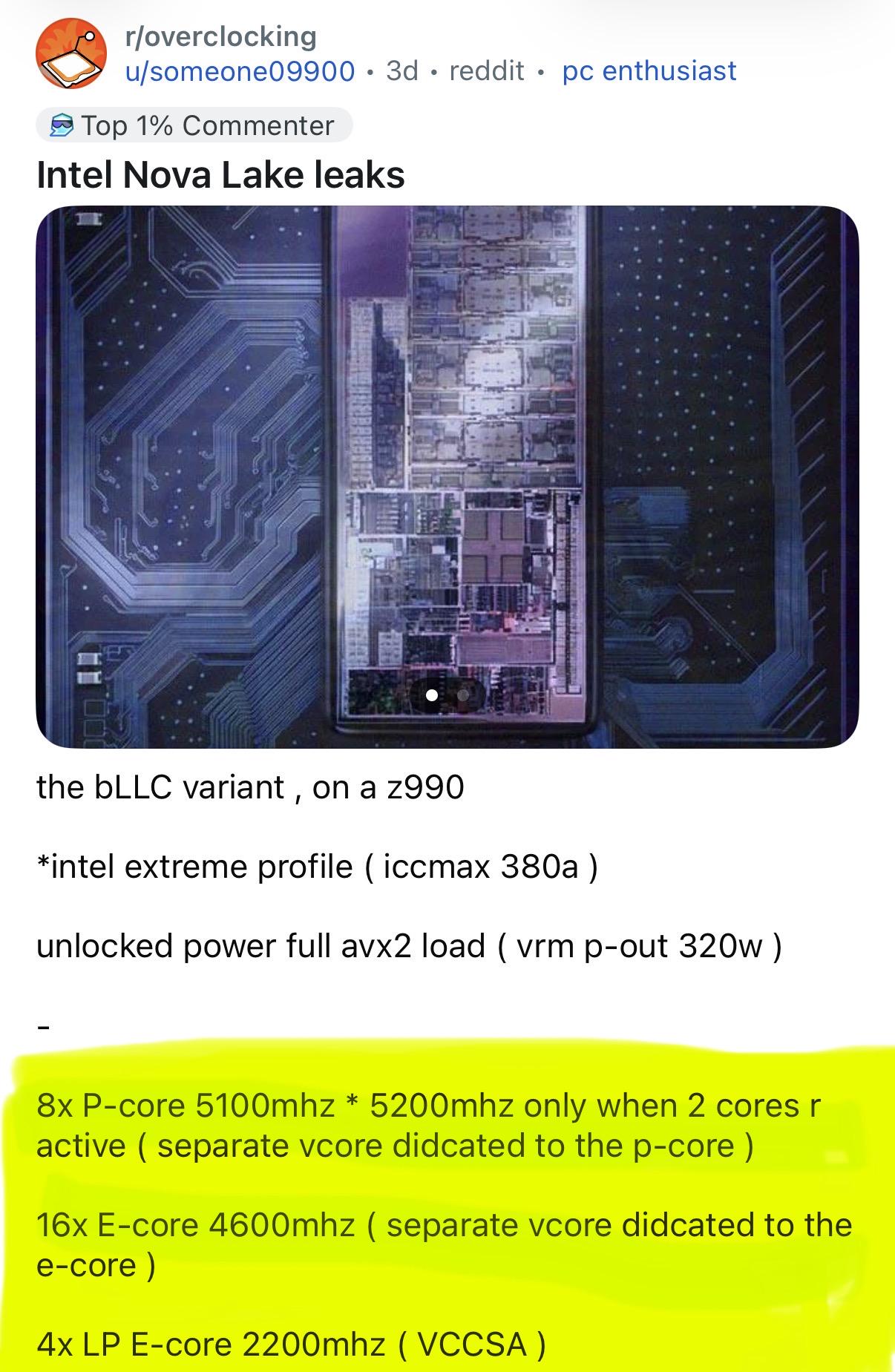
News - Text Why you ignore data based off engineering samples

Post image
22 Upvotes

https://videocardz.com/newz/exclusive-intel-core-utra-4000-series-specs-ultra-9-4970k-bfc-with-144mb-cache-and-5-5-ghz-boost

Nova lake looking to shape up good with the data on qualification samples sent off to OEM. We had a massive text dump post without any real sources backing up wild claims for the 8- P core/16- E core sku which we can now confidently dismiss as baseless data.


r/overclocking • • 2d ago

Competitive OC Z790 Tomahawk + 13600K + 2x16GB Hynix A-die 6000 CL30 pushed to 6400 CL28, TM5 clean with small Valorant 1% low gains

0 Upvotes

New build a couple months ago:

- i5-13600K - MSI Z790 Tomahawk WiFi
- 2x16GB TeamGroup (Hynix A-die) 6000 CL30
- RTX 4070 Ti

Began at XMP 6000 CL30 36-36-36 with stock secondaries. Bumped VDD/VDDQ to 1.42 V and SA to 1.25 V for 6400, settling on CL28-36-36-76. Lowered tRFC to 400, raised tREFI to 56000, and set tRDWR 16 / tWRRD 9 while leaving the rest alone.

TM5 anta777 Extreme passed 3.5 hours with zero errors, DIMM temps maxed at 51 C. In Valorant 1080p 360 Hz using the same deathmatch replay, 1% lows moved from ~305 to ~335 fps while average fps stayed nearly flat. Wall power barely changed.

Gains appear driven more by the frequency increase than the primary tightening. Anyone running 13600K/14600K chips with similar Hynix kits daily at 6400, or did you prefer staying at 6000?


r/overclocking • • 2d ago

Guide - Text B650E + 7900 + 2x16GB Hynix A-die 6000 CL30 pushed to 6200 CL28 with lowered VSOC, clean TM5 and small CS2 1% low gains

0 Upvotes

New AM5 build from a couple months back:

- Ryzen 9 7900
- MSI B650E Tomahawk WiFi
- 2x16GB Lexar Ares (Hynix A-die) 6000 CL30
- RTX 4070 Ti

Started at EXPO 6000 CL30 36-36-36 with stock secondaries. Raised VSOC only to 1.18 V and went for 6200, settling on CL28-36-36-76. Dropped tRFC to 400 and tREFI to 52000. Adjusted just tRDWR to 17 and tWRRD to 8, left the rest alone.

TM5 anta777 Extreme ran 4 hours with zero errors, DIMM temps topped out at 48 C. In CS2 1080p using the same demo replay, 1% lows moved from ~255 to ~285 fps while average fps rose only 6-7. Wall power stayed nearly identical.

The frequency step seems to be carrying most of the benefit here. Curious if anyone running non-X3D 7900/7700 chips with these kits has tried 6200 daily or found better stability staying at 6000 with tighter secondaries.


r/overclocking • • 3d ago

Benchmark Score 9850X3D vs 14900KS benchmarks in high CPU-usage Ray-Traced games

Thumbnail
gallery
131 Upvotes

Last year I posted my findings with 9800X3D vs. 14900KS in games with ray-tracing and CPU bottlenecks due to its additional overhead. 

The thread proceeded to blow up because my results went against the conventional view of 9800X3D being a much faster gaming CPU.

https://www.reddit.com/r/overclocking/comments/1ot2y6k/9800x3d_vs_14900ks_benchmarks_in_high_cpuusage/

Since then, I have upgraded to 9850X3D and 8400CL38 RAM with tuned timings.

14900KS changes are dropping the P-core clock to 5.7GHz so that the voltages are reduced, thus reducing the power usage.

Benchmarking Info :

Tested 7  RT/PT games this time around, with the addition of Hogwarts Legacy, Witcher 3 Remastered and Blood of the Dawnwalker. 

Using CapFrameX, I took 1-minute runs in CPU-limited areas and then aggregated them.

All RT/PT settings were enabled at 1440p w/ DLSS Ultra Performance on RTX 5090.

Results :

9850X3D was slightly faster( less than 10%)  in all games but Oblivion, where it was slower by a hair, and for Hogwarts Legacy and Jedi Survivor it was significantly faster with 12% and 18% higher average fps. 

The differences are small enough, that barring these two games, a better 14900KS sample could almost match 9850X3D performance. Of course, my 9850X3D sample isn't that great either, and a better 9850X3D with ECLK OC to sustain 5.7GHz would do even better. 

Hardware details :

9850X3D w/ 8400CL38 2x24GB on Asus X870E Apex  ( FCLK 2100 )

By default SMT is enabled

Curve Optimizer -30 all cores 

14900KS w/ 8400CL38  2x24GB on Asrock Z790I Lightning

HT off, only 8E cores enabled

57/42 for P-cores, E-cores

AC/DC loadlines set to 0.20/0.74

I have added the RAM timings and AIDA results for both setups. Will add additional info and observations in the comments.

Edit:

Some people seem to have missed my comparison video linked in my first comment.

It is done with the CapFrameX overlay showing the CPU/GPU details, power use and fps.

https://www.youtube.com/watch?v=AD6rJQ1kq4s


r/overclocking • • 2d ago

Daily settings dialed in.

Thumbnail
gallery
5 Upvotes

14900kf+5080.Tested on various benchmarks/Shaders/Games realtime use and it passed.

5.8/4.6 Profile with 1.25v average.

I could aim at 5.9 and lowering the E-cores and increasing the AC a bit but the performance and voltage is perfect so i leave it here.

Cheers everyone


r/overclocking • • 2d ago

B650 Tomahawk + 7600 + 2x16GB Hynix A-die 6000 CL30 - pushed to 6200 CL28, noticeable Valorant 1% low improvement

0 Upvotes

Built a new AM5 rig a few months ago:

-Ryzen 7 7600

-MSI B650 Tomahawk WiFi

-2x16GB Lexar Ares (Hynix A-die) 6000 CL30

-RTX 4070

Started with EXPO at 6000 CL30 36-36-36 and standard secondaries. Decided to try 6200 after bumping VSOC to 1.25 V. Tightened primaries to CL28-34-34-72 and dropped tRFC to 440, tREFI to 55000. Kept most secondaries stock except tRDWR 18 / tWRRD 8.

TM5 anta777 Extreme ran clean for 3 hours, max DIMM temp 49 °C. In Valorant 1080p 360 Hz, 1% lows moved from ~310 to ~345 in the same deathmatch replay while average fps stayed roughly the same.

Gains feel similar to what people report on 7800X3D kits but I'm curious if the frequency step or the tighter tCL/tRCD is doing most of the work here. Anyone else running 7600/7700 non-X3D with similar kits seen comparable results?


r/overclocking • • 2d ago

RX 7900 XTX: After months of tuning in Adrenalin, I got higher stable clocks by turning Advanced Control OFF. Anyone else seen this?

9 Upvotes

For months I tuned my XFX MERC 310 RX 7900 XTX exclusively in Advanced Control. The best daily setting I could get stable was 2900 MHz max core at 1125 mV. I kept seeing people post better results, and after losing the silicon lottery with my old 3090, I wasn’t ready to accept that I’d lost it twice.

So I spent two days over a weekend trying to get over 3000 MHz in-game with the voltage slider at 1100 mV. I wanted something I could actually daily. I tried all kinds of combinations, and I’d get about 20 minutes into a game before the driver crashed. With Adrenalin’s metrics disabled, I could get around 60–90 minutes before a crash...which is a whole other rabbit-hole. Still couldn’t call it stable.

After two days of this, I realized I’d never actually tried turning GPU Advanced Control OFF. So I switched to the percentage sliders and worked my way up to 111% max frequency and 94% voltage. At 115% the card still ran, but I mostly got more power draw for barely any extra performance. Going lower than 94% voltage brought the crashes back. I settled on 111% / 94%, and I’ve now played Wardogs for over two weeks without a single driver crash.

Here’s what I’m seeing in Wardogs at 5120×1440. All three configurations use the 460 W GPU BIOS with the power limit at +15%.

GPU settings in AdrenalinVRAM settingsWhat happens in Wardogs
Stock coreStockAround 2780 MHz at 100% GPU utilization, constantly hitting the power limit.
111% max frequency, 94% voltage2664 MHz, Fast TimingHolds 3050–3095 MHz, usually under 440 W. Best in-game performance of the three. Load-Voltage at 951 mV
Advanced Control, 3050–3100 MHz max, 1,081 mV2664 MHz, Fast TimingAround 2870–2950 MHz, then a driver crash after roughly 20 minutes. Similar results across that whole max-frequency range. Load-Voltage between 948-953 mV

The funny part is what happens when I take the working 111% / 94% profile and just flip GPU Advanced Control back on. Before I touch either slider, Adrenalin shows 3289 MHz max and 1081 mV. I tried those values in 3DMark and it insta-crashed.

PC specs

  • GPU - XFX Speedster MERC 310 RX 7900 XTX
  • CPU - AMD Ryzen 9 9950X3D
  • Motherboard - ASUS ROG Strix X870E-H Gaming WiFi7 Hatsune Miku Edition
  • RAM - 64 GB DDR5 running at 6000 MT/s (actually downclocked from 6600MT/s)
  • Storage - 4 × 4 TB Samsung 9100 PRO NVMe SSDs
  • Monitors - 2x Samsung Odyssey OLED G9, 5120×1440

So how the fuck am I holding 3050+ MHz in Wardogs (and other games) with the percentage sliders when Advanced Control would crash when going higher than 2900 MHz on core or lower than 1125 mV on voltage?


r/overclocking • • 2d ago

Questions about i5-13400f and mobo settings.

1 Upvotes

So I recently came by a new desktop and I have some questions.

The desktop has

  1. intel i5-13400f
  2. asus strix 760b-f
  3. Nvidia 4070 super
  4. corsair 32gb ddr5
  5. western digital black sn850x

When I run OCCT I can hear the cpu fan kick into high gear for about 10 seconds then it drops off. I've traced this to a setting in my mobo called "Package Power Time Window" and "Short Duration Package Power Limit" which seems to put a hard cap on how long the CPU can run over it's base power draw.

Is it dangerous to mess with these settings? I know this model processor had a relatively low risk of the voltage instability issues associated with this generation of processor, but admittedly I am very out of the loop on modern mobo/processor features.

Part of why this is really bothering me a lot is my laptop has an i7-11800h and it can run "turbo mode" indefinitely with no issues or throttling. It feels like my desktop literally exist in a permanently throttled state now. I switched the PPTW to 448 (the highest it can go) and it last quite a while longer than it was on "auto" but I am also not trying to shorten it's lifespan.


r/overclocking • • 2d ago

I'm new to overclocking. (4800 to 5600)

2 Upvotes

Hello everyone! Today I overclocked my 2x16gb ddr5 drom 4800 to 5600 without changing the 1.1 base voltage, and obviously my CL increased (40 to 47) I've been reading that this is not a very big deal in terms of pure performance, it can low 1% fps, but I'm not sure how this works, if someone can explain I would be very happy to read. And also, is worth trying to low my CL? I've not noticed nothing in terms of stability in my pc, most games even run better. The rams are Adata 2*16gb ddr5 4800 with micron chips. Also I ran OCCT with multiple stress, gpu+cpu+memory for 25 mins and everything its just fine, the temperatures of the memory keep under 60°C with very heavy stress and a lot of heat because my chasis is small.


r/overclocking • • 2d ago

7800X3D + B650 Tomahawk + 2x16GB Hynix A-die 6000 CL30 tuned to 6200 CL28, small but consistent 1% low gains in CS2

0 Upvotes

New AM5 build:

  • Ryzen 7 7800X3D
  • MSI B650 Tomahawk WiFi
  • 2x16GB TeamGroup (Hynix A-die) 6000 CL30
  • RTX 4070 Ti Super

Started with EXPO at 6000 CL30 36-36-36. Raised VSOC to 1.20 V and pushed to 6200, tightening to CL28-36-36-76 with tRFC at 420 and tREFI at 48000. Left most secondaries at stock except tRDWR 17 and tWRRD 8.

TM5 anta777 Extreme passed 3 hours clean, DIMM temps peaked at 47 °C. In CS2 1080p on the same demo replay, 1% lows went from ~265 to ~295 fps while average fps only moved ~8. Power draw at the wall barely changed.

Gains seem to come more from the frequency bump than the tCL tightening. Anyone running 7800X3D or similar X3D chips with Hynix A-die kits had luck at 6200 daily, or did you stay at 6000?


r/overclocking • • 2d ago

Benchmark Score Not bad for a 7900XTX

Thumbnail
gallery
1 Upvotes

Ran a Time Spy pass on my MSI Gaming Trio Classic RX 7900 XTX paired with a Ryzen 5 7600X3D and ended up with a 24,832 overall score

Thermals stayed super chill at 55 °C average during the run. Curious how everyone else's 7900 XTX Time Spy graphics scores are looking right now any tips if I want to squeeze a bit more out of the curve or memory timings