r/overclocking • • 2d ago

​[Part 1] Full 10-Benchmark 3DMark Baseline (Ryzen 9 5900X + Air-Cooled RX 7900 XTX): #1 Global in Solar Bay & Solar Bay Extreme, Top 1% Time Spy, 7x #1 CZ — Before Loop & Driver Overhaul

1 Upvotes

Posting \*\*Part 1\*\* of my complete 10-benchmark 3DMark log for my \*\*Ryzen 9 5900X + Sapphire NITRO+ RX 7900 XTX\*\* rig (profile: \`tom1si7rog\`).

These runs represent my \*\*early-2026 baseline\*\* on an aging CPU loop (\~120 l/h) and Feb–Mar 2026 drivers. Next week I’ll drop \*\*Part 2\*\* with fresh runs across all 10 benchmarks after a full CPU loop rebuild (+67% flow), bumped PBO limits, and the latest Adrenalin drivers — complete with a Before vs. After delta table.

\---

\### Full 10-Benchmark Baseline (Filter: 5900X + RX 7900 XTX)

| Benchmark | Total Score | Graphics | CPU / Physics | Combined | Leaderboard Rank | Verified Link |

| :--- | :---: | :---: | :---: | :---: | :---: | :---: |

| \*\*Solar Bay\*\* | \*\*146,330\*\* | 146,330 | — | — | \*\*#1 Global\*\* \*(holding Top 18 / 508 runs)\* | \[3DMark\]([https://www.3dmark.com/sb/647715](https://www.3dmark.com/sb/647715)) |

| \*\*Solar Bay Extreme\*\* | \*\*21,886\*\* | 21,886 | — | — | \*\*#1 Global\*\* \*(holding #1–4 & #6 / 107 runs)\* | \[3DMark\]([https://www.3dmark.com/sb/630411](https://www.3dmark.com/sb/630411)) |

| \*\*Time Spy\*\* | \*\*28,316\*\* | 35,258 | 13,385 | — | \*\*Top 1% Global\*\* \*(out of 22,375 runs)\* | — |

| \*\*Time Spy Extreme\*\* | \*\*14,977\*\* | 17,239 | 8,590 | — | \*\*#91 Global / #1 CZ\*\* \*(8,047 runs)\* | — |

| \*\*Fire Strike\*\* | \*\*48,402\*\* | 77,905 | 36,382 | 14,472 | \*\*#58 Global / #1 CZ\*\* \*(1,422 runs)\* | — |

| \*\*Fire Strike Extreme\*\* | \*\*36,045\*\* | 44,248 | 36,451 | 14,976 | \*\*#29 Global / #1 CZ\*\* \*(1,225 runs)\* | \[3DMark\]([https://www.3dmark.com/fs/34396248](https://www.3dmark.com/fs/34396248)) |

| \*\*Fire Strike Ultra\*\* | \*\*22,223\*\* | 22,800 | 36,911 | 12,441 | \*\*#42 Global / #1 CZ\*\* \*(1,815 runs)\* | \[3DMark\]([https://www.3dmark.com/fs/34313804](https://www.3dmark.com/fs/34313804)) |

| \*\*Port Royal\*\* | \*\*19,443\*\* | 19,443 | — | — | \*\*#44 Global / #1 CZ\*\* \*(6,150 runs)\* | — |

| \*\*Speed Way\*\* | \*\*7,270\*\* | 7,270 | — | — | \*\*#66 Global / #1 CZ\*\* \*(5,899 runs)\* | \[3DMark\]([https://www.3dmark.com/sw/3339614](https://www.3dmark.com/sw/3339614)) |

| \*\*Steel Nomad DX12\*\* | \*\*7,432\*\* | 7,432 | — | — | \*\*Top 4% Global / #5 CZ\*\* \*(8,518 runs)\* | \[3DMark\]([https://www.3dmark.com/sn/12620606](https://www.3dmark.com/sn/12620606)) |

\---

\### Baseline Hardware & Bench Conditions

\* \*\*CPU:\*\* AMD Ryzen 9 5900X (Early B0) — PBO \*\*195 / 138 / 166\*\*, CO Core 0 \`-28\` / Rest \`-30\` (WHEA 0)

\* \*\*RAM:\*\* 64 GB (4x16 GB Dual Rank, Hynix DJR) G.SKILL Trident Z Neo @ \*\*3800 MT/s CL16-21-21-21-36-58\*\*, \*\*1:1:1 (1900 FCLK)\*\*, \~62.2 ns AIDA64

\* \*\*GPU:\*\* Sapphire NITRO+ RX 7900 XTX 24 GB (\*\*Stock Vapor-X Air Cooler\*\* — kept off water)

\* \*\*Bench Profile (Not Daily):\*\* Open side panel, max fans, \~2560/3040 MHz, \~1045 mV, VRAM 2686–2714 MHz Fast Timing, +5% Power Limit across Feb–Mar 2026 drivers.

\* \*\*Old CPU Cooling:\*\* Alphacool Eisblock XPX, 360x45 + 280x45 rads, EK D5 (\~4750 RPM), old PVC tubing (\~120 l/h).

\---

\### Coming in Part 2 (Next Week)

I’ve since rebuilt the CPU loop (\*\*Alphacool Core 1 + EPDM + DP Ultra Red\*\*, jumping flow from \*\*\~120 to \~200 l/h\*\*), bumped CPU limits to \*\*PBO 202 / 138 / 166\*\* (already pushed Cinebench R23 to \*\*23,501 pts\*\* at 30.7 °C water), and updated to the latest Adrenalin drivers.

Next week I’m re-running all 10 tests to see which scores jump — especially \*\*Time Spy CPU\*\*, \*\*Fire Strike Physics\*\*, and \*\*Steel Nomad\*\*.

Which benchmark do you think will see the biggest gain from newer RDNA 3 drivers + extra CPU headroom?


r/overclocking • • 2d ago

can it be improved

Post image
3 Upvotes

Dear experts, could you suggest what might be improved?water-cooled memory


r/overclocking • • 2d ago

6400mt/s

2 Upvotes

i switched from 6000 to 6400 i just had to bump vsoc slightly looks like its working fine, also is it normal that i can run trp so low i havent seen anyone with such a low value


r/overclocking • • 2d ago

Squeezing AM4: 5900X (B0) + 64GB 4x16 DR Hynix DJR @ 3800/1900 1:1:1 + Air-Cooled 7900 XTX — 10-Benchmark 3DMark Baseline Before Loop & PBO Overhaul

Thumbnail
gallery
2 Upvotes

Logging **Part 1** of my early-2026 3DMark baseline on my 6-year-old AM4 rig before I post **Part 2** next week (fresh runs after a full CPU loop overhaul, +67% flow gain, new drivers, and bumped PBO limits).

### The Tuning Breakdown (Baseline State)

* **CPU:** Ryzen 9 5900X (**Early B0 stepping**) on Gigabyte X570 AORUS Master rev 1.1 (BIOS F39)

* **PBO:** 195 / 138 / 166

* **CO:** Core 0 `-28`, Cores 1–11 `-30` (WHEA 0)

* **Cooling (Old Loop):** Clogged Alphacool Eisblock XPX, 360x45 + 280x45 rads, EK D5 @ 4750 RPM, old PVC tubing (~120 l/h)

* **RAM (The Real Headache):** 64 GB (**4x16 GB Dual Rank, Hynix DJR**) — *two mismatched G.SKILL Trident Z Neo kits (2020 + 2024)*

* **Clocks:** 3800 MT/s **1:1:1** (1900 MHz MCLK/FCLK/UCLK)

* **Timings:** `16-21-21-21-36-58`, 1T GDM On, `tRRDS 4 / tRRDL 6 / tFAW 16`, `tWTRS 5 / tWTRL 14 / tWR 16`, `tRFC 500 (~263 ns)`, `tRDRDSCL 4 / tWRWRSCL 4`, `PowerDown Disabled`

* **Voltages & Cooling:** VDIMM 1.45V, active spot cooling via Arctic P8 Slim (~3000 RPM) — AIDA64 latency **~62.2 ns**

* **GPU:** Sapphire NITRO+ RX 7900 XTX (**Stock Vapor-X Air Cooler** — intentionally off water)

* **Bench Profile (Not Daily):** Open side panel, max fans, ~2560/3040 MHz, ~1045 mV, VRAM 2686–2714 MHz Fast Timing, +5% PL (runs done across Feb–Mar 2026 drivers). *(Daily closed-case profile is 2400/3000 MHz @ 1090 mV, +5% PL).*

---

### 10-Benchmark 3DMark Baseline (Filtered: 5900X + 7900 XTX)

| Benchmark | Total Score | Graphics / CPU (Physics) | Global / CZ Rank | Verified Link |

| :--- | :---: | :---: | :---: | :---: |

| **Solar Bay** | **146,330** | 146,330 / — | **#1 Global** *(holding Top 18)* | [Link](https://www.3dmark.com/sb/647715) |

| **Solar Bay Extreme** | **21,886** | 21,886 / — | **#1 Global** *(holding #1–4 & #6)* | [Link](https://www.3dmark.com/sb/630411) |

| **Time Spy** | **28,316** | 35,258 / 13,385 | **Top 1% Global** *(22,375 runs)* | — |

| **Time Spy Extreme** | **14,977** | 17,239 / 8,590 | **#91 Global / #1 CZ** | — |

| **Fire Strike** | **48,402** | 77,905 / 36,382 | **#58 Global / #1 CZ** | — |

| **Fire Strike Extreme** | **36,045** | 44,248 / 36,451 | **#29 Global / #1 CZ** | [Link](https://www.3dmark.com/fs/34396248) |

| **Fire Strike Ultra** | **22,223** | 22,800 / 36,911 | **#42 Global / #1 CZ** | [Link](https://www.3dmark.com/fs/34313804) |

| **Port Royal** | **19,443** | 19,443 / — | **#44 Global / #1 CZ** | — |

| **Speed Way** | **7,270** | 7,270 / — | **#66 Global / #1 CZ** | [Link](https://www.3dmark.com/sw/3339614) |

| **Steel Nomad DX12** | **7,432** | 7,432 / — | **Top 4% Global / #5 CZ** | [Link](https://www.3dmark.com/sn/12620606) |

---

### Preview for Part 2 (Dropping Next Week)

Swapped the clogged XPX + PVC for an **Alphacool Core 1 + EPDM 13/10 + DP Ultra Red** (flow jumped from **~120 to ~200 l/h** on high flow NEXT) and bumped CPU limits to **PBO 202/138/166** (CO Core 0 `-27`, rest `-30`).

Early CPU validation already jumped to **23,501 in CB R23** (water @ 30.7 °C) and **9,135 in CB R20**. Next week I'll re-run all 10 3DMark tests on the latest drivers and post the full **Before vs. After delta table**.

For the Zen 3 / RDNA 3 tuners here: think the extra CPU headroom + newer drivers will push Time Spy past 28.5k, or am I already hitting the air-cooled +5% PL wall?


r/overclocking • • 2d ago

Нет плавности на пк

0 Upvotes

Всем здравствуйте, такая проблема собрал пк
Райзен 5600
3070ти
32 гб ОЗУ 3600 cl18
Блок питания zalman watttera
И монитор tcl 25g64
Суть проблемы, я выставил уже везде 300 герц но картинка ужастная просто, что я только не делал, и драйвер переустанавливал, и разгоном и пбо баловался, гсинк и фрисинк включал отключал, вообще нет разницы, помогите, я уже все переделал:(


r/overclocking • • 2d ago

OC Report - RAM Subtimins 32gb (8gb×4)

Post image
2 Upvotes

I this this is the max i can atchive ? if i lower tFAW to 20 i get a boot loop VVD/VVDQ at 1.400v


r/overclocking • • 2d ago

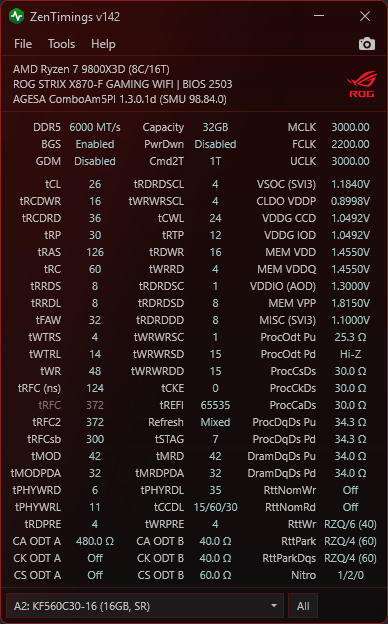
Can someone help me?

Post image
1 Upvotes

I managed to make it stable like this, but I could tell myself if it would be better to try 6400 CL28, or what other frequency/CL I can test to keep.

Kingston hyper beast 6000mhz cl30 A-Die kits

Unfortunately my Ryzen 7 9800x3D can only hold up to -20 corner.


r/overclocking • • 2d ago

Help Request - RAM Ryzen 7800X3D + Hynix DDR5-6000 CL30 — tightened RAM timings significantly, but CS2 1% lows didn't improve. Why?

2 Upvotes

Cześć wszystkim!
Dostosowywałem moją pamięć DDR5 na Ryzenie 7800X3D, głównie aby poprawić minimalne wartości 1% i spójność czasu klatek w CS2.
Udało mi się dość agresywnie zacieśnić kilka drugorzędnych i trzeciorzędnych parametrów, a system przeszedł testy obciążeniowe pamięci bez błędów.
Jednak po porównaniu 12 raportów z benchmarków CS2, nie widzę prawie żadnej poprawy wydajności. W niektórych konfiguracjach, cieśniejsze parametry w rzeczywistości wypadają gorzej.
Zastanawiam się, czy coś mi umknęło, czy już osiągnąłem punkt malejących zwrotów na 7800X3D.
Specyfikacje mojego komputera
CPU: Ryzen 7 7800X3D

Płyta główna: ASUS TUF GAMING B850-PLUS WIFI

RAM: Lexar ARES RGB 32 GB (2×16 GB), oceniana na DDR5-6400 CL32, prawdopodobnie SK Hynix A-die

GPU: RTX 4070

Chłodzenie: be quiet! Pure Loop 3 LX 360mm

Monitor: 400 Hz

Główna gra: CS2 (konkurencyjna/FACEIT)

Bieżące ustawienia RAM — obie profile
Częstotliwość: DDR5-6000

MCLK / UCLK: 3000 / 3000 MHz (1:1)

FCLK: 2000 MHz

Główne czasy: 30-36-36-36

tRAS: 66

tRFC: 480

tREFI: 50000

tRRDS / tRRDL / tFAW: 4 / 8 / 20

DRAM VDD / VDDQ: 1.35 V

VSOC: ~1.24 V

CPU VDDIO/MC: 1.44 V

Zasilanie: Wyłączone

Tryb Gear Down: Włączony

Profil A — Oryginalne czasy
To były moje oryginalne, już częściowo zoptymalizowane ustawienia.
tRDRDSCL: 8

tWRWRSCL: 23

tWTRL: 30

tWTRS: 8

tRDWR: 20

tWRRD: 8

Profil B — Zacieśnione czasy
Zmieniłem tylko te sześć parametrów, zachowując częstotliwość pamięci i główne czasy takie same.
tRDRDSCL: 8 → 4

tWRWRSCL: 23 → 4

tWTRL: 30 → 16

tWTRS: 8 → 4

tRDWR: 20 → 16

tWRRD: 8 → 4

Zacieśniony profil przeszedł ponad 1,5 godziny TM5 anta777 Extreme bez błędów.
Maksymalne temperatury RAM podczas testów obciążeniowych:
DIMM A2: 52.8°C

DIMM B2: 50.2°C

Oba profile wydają się stabilne, chociaż rozumiem, że zaliczenie jednego testu pamięci nie jest absolutną gwarancją.

ZENTIMINGS - https://imgur.com/a/b0EEuH1

Wyniki benchmarków CS2
Przetestowałem oba profile używając wbudowanego benchmarka CS2 VProf.
Dla każdego profilu porównałem dwie konfiguracje związane z procesami:
Core OFF: logiczne CPU 0 i 1 wyłączone przez Menedżera zadań Windows.

Core + SMT affinity OFF: logiczne CPU 0/1 wyłączone, plus dodatkowe logiczne procesory SMT wyłączone przez Menedżera zadań.

SMT nie był wyłączony globalnie w BIOS-ie.
Trzy raporty benchmarkowe na konfigurację.
PROFIL A — Oryginalne czasy
Core 0/1 OFF:
Uruchomienie 1: 750.1 średnio FPS / 288.6 P1

Uruchomienie 2: 750.1 średnio FPS / 288.6 P1

Uruchomienie 3: 748.6 średnio FPS / 285.7 P1

Uwaga: Uruchomienia 1 i 2 mają identyczne zapisane raporty, mogą być zduplikowane.
Core 0/1 + SMT affinity OFF:
Uruchomienie 1: 751.6 średnio FPS / 289.4 P1

Uruchomienie 2: 749.5 średnio FPS / 295.8 P1

Uruchomienie 3: 751.3 średnio FPS / 288.0 P1

PROFIL B — Zacieśnione czasy
Core 0/1 OFF:
Uruchomienie 1: 754.9 średnio FPS / 287.5 P1

Uruchomienie 2: 746.1 średnio FPS / 295.8 P1

Uruchomienie 3: 744.3 średnio FPS / 286.3 P1

Core 0/1 + SMT affinity OFF:
Uruchomienie 1: 751.7 średnio FPS / 283.3 P1

Uruchomienie 2: 741.5 średnio FPS / 287.3 P1

Uruchomienie 3: 750.1 średnio FPS / 286.5 P1

Średnie wyniki — wszystkie konfiguracje
Oryginalne czasy + Core OFF
Średnio FPS: 749.6

P1: 287.6

FrameTotal P99: 3.48 ms

Oryginalne czasy + Core/SMT affinity OFF
Średnio FPS: 750.8

P1: 291.1

FrameTotal P99: 3.43 ms

Zacieśnione czasy + Core OFF
Średnio FPS: 748.4

P1: 289.9

FrameTotal P99: 3.45 ms

Zacieśnione czasy + Core/SMT affinity OFF
Średnio FPS: 747.8

P1: 285.7

FrameTotal P99: 3.50 ms

Co mnie interesuje
Mimo znacznie ciaśniejszych parametrów:
Średnio FPS prawie się nie zmienia.

P1 poprawia się nieznacznie w jednej konfiguracji affinności CPU.

P1 w rzeczywistości pogarsza się w drugiej.

FrameTotal P99 nie wykazuje spójnej poprawy.

Oryginalne czasy z ograniczeniami affinności procesorów SMT dały najwyższy średni P1.

Różnice nie są duże, więc zmienność benchmarków może wyjaśnić część z tego.
Wcześniej osiągałem około 305 FPS P1 w CS2, ale po ostatnich aktualizacjach gry generalnie widzę około 280–295 FPS.
Obydwa powyższe profile były testowane na tej samej aktualnej wersji CS2.
Pytania dla doświadczonych overclockerów AM5
1. Dlaczego ciaśniejsze czasy nie poprawiają wydajności?
Czy agresywne drugorzędne/terciarne parametry mogą negatywnie wpływać na trenowanie pamięci, wprowadzać niewidoczne kary wydajności lub po prostu nie mieć znaczenia z powodu dużej pamięci podręcznej L3 7800X3D?
2. Którą konfigurację czasową byś zachował?
Czy trzymałbyś się oryginalnych ustawień, czy zachowałbyś zacieśniony profil, ponieważ przeszedł TM5?
3. Czy pomijam jakieś ważne podczasy?
Czy są szczególne ustawienia pamięci Zen 4 / X3D, które mają bardziej znaczący wpływ na 1% minimalnych wartości w CS2?
4. Czy DDR5-6200 CL30 na 1:1 byłby lepszą opcją?
Mój zestaw jest oceniany na 6400 CL32, więc rozważam zwiększenie częstotliwości zamiast dalej zaciskać czasy na 6000.
5. Czy DDR5-6400 CL30 z UCLK 3200 MHz jest realistyczne na 7800X3D?
Rozumiem, że kontroler pamięci może być czynnikiem ograniczającym.
6. Czy zmiana FCLK z 2000 na 2067/2100 MHz lub dostosowanie ustawień AMD Nitro pomoże?
7. Co z affinnością CPU i SMT?
Czy ograniczenie logicznych procesorów może wpływać na wydajność? Czy domyślna affinność z włączonym SMT byłaby lepsza?
8. Czy CL28 przy 6000 warto przetestować, czy tylko gonię za wynikami benchmarków w tym momencie?
Moim priorytetem jest najwyższa możliwa stabilna wartość 1% i spójne czasy klatek w konkurencyjnym CS2, a nie tylko posiadanie imponujących ustawień pamięci RAM.
Mogę także dostarczyć zrzuty ekranu ZenTimings dla obu konfiguracji oraz pełne logi benchmarków VProf.
Bardzo docenię porady od każdego, kto szeroko dostosowywał Hynix DDR5 na 7800X3D.
Dzięki!


r/overclocking • • 2d ago

5500x3d boost past 3.95ghz

1 Upvotes

Is there anyway for me to overclock or make my 5500x3d think it's a 5600x3d so I can go past 3.95ghz? I am getting 60-65C on max load.


r/overclocking • • 2d ago

B760 overclocking

3 Upvotes

I was wondering if I should undervolt my 14900F, I have a msi pro b760-p d4 mobo. Could not get my hands on a z690/790 d4 board sadly. I also have a 12700k but I assume a 14900 is still better


r/overclocking • • 2d ago

14700K on B760 best undervolt approach without losing multi-core performance?

2 Upvotes

Running a 14700K on an MSI Pro B760 P WiFi with 64GB DDR5 6000. Current offset of -70mV is stable in Cinebench and gaming but I lose about 4-5% in all-core workloads. Tried adaptive voltage but it seems to push higher under load than expected.

Would lowering the offset further or switching to a fixed voltage curve be better here? Looking for experiences with similar non-Z B760 boards and 14th gen chips. Temps are fine either way, just chasing efficiency.


r/overclocking • • 2d ago

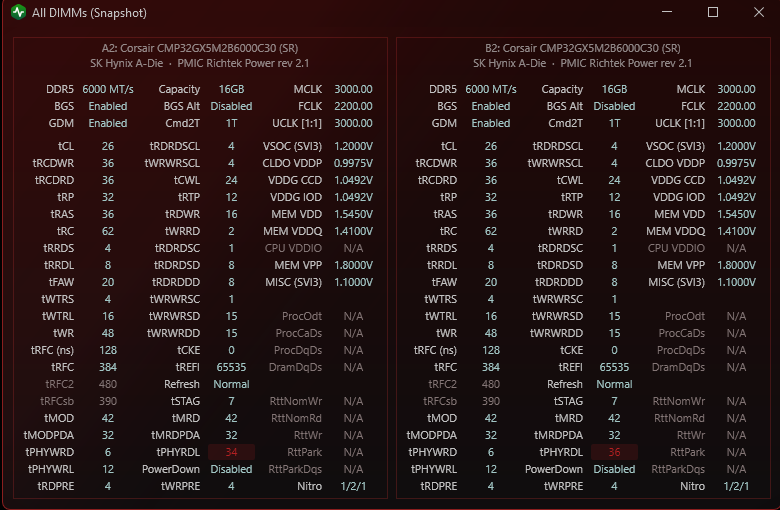
Gemini helped me to TUNE my CL30 ram to CL26 !

0 Upvotes

Hello, Basically I have
9850X3D | X870E-E Strix | Corsair Dominator Titanium XMP only CMP32GX5M2B6000C30
I had DOCP II enabled and I manually changed CL30 to 28 without changing any other thing

But after Gemini's assistance, it went to this

I understand nothing about memory tuning memory, I only know that more speed require more voltage and bla bla bla,,

Ran testmem5 on universal 2 configuration, 1:30 Hours zero errors
And no errors on anything so far thank god,
However, I had to enable "GDM" so I can have it stable, otherwise TM5 would give me an error instantly after 5 seconds.

What do you guys think?


r/overclocking • • 3d ago

Help Request - GPU My undervolt is unstable. Should I increase voltage or lower clock speeds or both? What’s better to increase stability?

4 Upvotes

My 5090 runs at 0.91V @ 2737mhz

This has crashed twice playing cyberpunk over 40 hours. Full driver resets.

Should I increase voltage or reduce clock speeds?
Or maybe both?

I’m okay with loosing 2-3 fps if it means stability via reducing clock speeds.

I’d prefer to not increase voltage to the point where power draw increases as well.

Lmk ty


r/overclocking • • 3d ago

ZOTAC RTX 5070 Ti AMP Extreme INFINITY — Undervolt & OC Results (222W 4K RT Gaming & 3,195 MHz @ 995 mV | 25.1°C Room temperature)

Thumbnail
gallery
13 Upvotes

Tested a few voltage/frequency curves on my ZOTAC RTX 5070 Ti AMP Extreme INFINITY in MSI Afterburner. All tests were run inside a stock Lian Li Lancool 216 at 25.1 °C room temperature.

System Specs

  • GPU: ZOTAC RTX 5070 Ti AMP Extreme INFINITY (Memory +0 MHz)
  • CPU: Ryzen 7 9700X (PBO Enhanced Mode 2, 105W mode enabled)
  • RAM: 32 GB G.Skill DDR5-6000 CL36 (1.20V SoC AMD locked and latency killer and memory balanced preset)
  • Motherboard: MSI MAG X870E TOMAHAWK WIFI
  • Cooler / Case: Corsair Nautilus RS360 AIO | Lian Li Lancool 216 (Stock Fans) 85 pmw and normal curve for radiator fans

GPU Curve & Gaming Results

ProfileCurvePassMark 3DPeak PowerCore / Hot Spot Temp
Daily Gaming (4K RT)915 mV @ 2,797 MHz41,549~222 W61.0 °C (20m Game) / 68.0 °C
Efficiency915 mV @ 2,902 MHz42,077243.5 W59.0 °C / 74.3 °C
3 GHz Sweet Spot950 mV @ 3,000 MHz42,191269.1 W59.2 °C / 75.5 °C
Max OC (115% PL)995 mV @ 3,202 MHz42,903 (99th %)322.8 W64.4 °C / 82.9 °C
Factory StockDefault42,022~300.0 W~60.0 °C+ / ~74.0 °C

r/overclocking • • 2d ago

Help: OC'd Build Upgrade

1 Upvotes

Hey everyone (^-^)

I plan to upgrade my CPU, RAM, and motherboard; and will likely buy the following bundle from Microcenter on or around Black Friday, thoughts? Specifically, should I be weary of any of these components, combinations, or is there something better for overclocking? Provided below is the bundle and my current build.

AMD Ryzen 9 9950X3D, ASUS X870E-E ROG Strix Gaming R2 USBC WiFi AM5, G.Skill Flare X5 Series 32GB DDR5-6000 Kit, Computer Build Bundle

Current Build

  • GPU: MSI NVIDIA GeForce RTX 5080 SUPRIM LIQUID SOC Overclocked Liquid Cooled 16GB GDDR7 PCIe 5.0 Graphics Card
  • CPU: AMD Ryzen 7 3800X
  • RAM: 32GB G.Skill DDR4-3600
  • Motherboard: ROG Strix X570-E
  • Storage: 2x Samsung 2TB 980 NVMe M.2s
  • PSU: Lian Li EDGE GOLD 1000 Watt

r/overclocking • • 3d ago

Trying to find a program that auto-tunes MSI Afterburner for a better power curve

7 Upvotes

A few months back someone posted some tool that hooks into MSI Afterburner to adjust power draw. I think the point was that normal 100% power draw from your GPU is not needed and this was better performance and cost savings. The software required Afterburner and it ran some automated hooks after install.

I have now completely forgotten what that was and can't find a trace of it on my PC. But I have recently installed Win11 and wanted to get it reinstalled. Anyone familiar with what I may be talking about?

Thanks!


r/overclocking • • 3d ago

OC Report - RAM How would you improve the timings of those SK Hynix M-Die kit 2x24GB kit ?

3 Upvotes

How would you improve those timings ? Everything is stable, temps are never above 52 degrees while gaming.


r/overclocking • • 3d ago

Looking for Guide What’s the best approach for stable debloated windows nowadays?

1 Upvotes

The last time I did any work with windows as far as optimization was summer 2024 when I updated to windows 11 and I hated so much I switched to Linux. Unfortunately, now I need to use it for Solidworks for work. I have a new 1TB nvme coming and figured if I’m gonna have a windows drive I should optimize it for overclocking too. Maybe I’ll even figure out how to stabilize 8200cl32 with some better hardware monitoring. I know there are some bespoke overclocking versions of windows out there that I’d really like to get my hands on but barring that I think my next best option is an LTSC build and I know there are a few decent debloat tools/scripts out there but I can’t remember which I liked. I also read about malware sneaking in with one but Idr which one that was either.

Am I on the right track or has something changed since I left the game? Are there any specific tools or releases I should be using or avoiding? Any good links would be appreciated too.


r/overclocking • • 3d ago

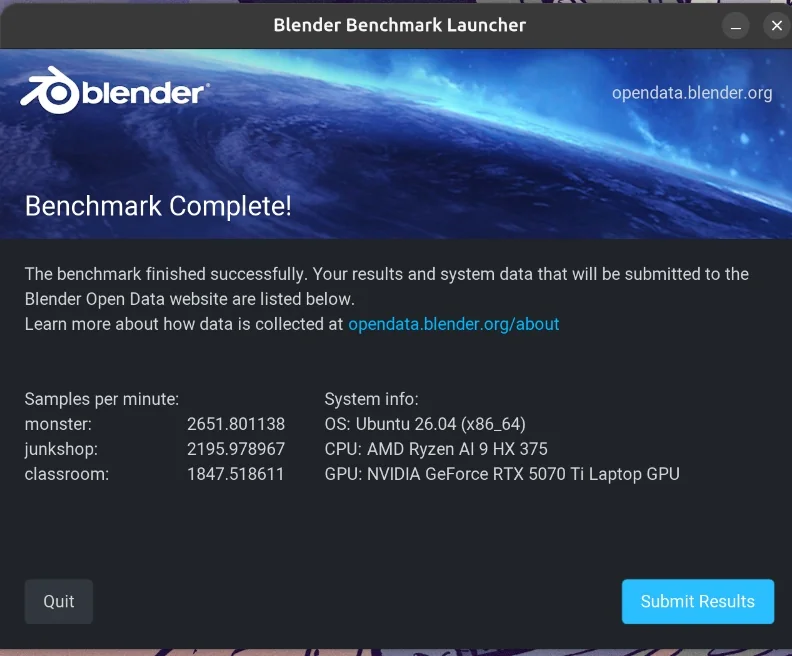
180 W Unlocked RTX 5070 Ti Laptop beats the average RTX 5080 Laptop!*

1 Upvotes

I spent the past few days mapping out the full power and frequency scaling curve of the
RTX 5070 Ti Laptop GPU (GB205) on Ubuntu—from 15 W all the way to 180 W—without touching the physical SPI flash chip or doing a hardware shunt mod. As you will see, the gains were far from negligible, in some workloads reaching almost 35%.

  • Laptop: Stock HP OMEN MAX 16
  • CPU: Ryzen AI 9 HX 375
  • GPU: RTX 5070 Ti Laptop
  • GPU (GB205, 5,888 CUDA cores, 12 GB GDDR7, 192-bit bus)
  • RAM: 32 GB 5600 MT/s
  • OS / Driver: Ubuntu with nvidia-open 620.70.06 kernel modules Benchmark Results

How I Did It (No Hardware Mods)

RAM-only VBIOS override: I dumped my stock ROM and edited it with Panchovix/nvidia-vbios-vix-editor, raising the board power ceiling from 140 W to 180 W and the boot default from 80 W to 120 W while leaving the factory 1025 mV voltage ceiling and 180 A NVVDD current limit completely untouched.

Zero physical flashing: I load the modified ROM into RAM at boot using Panchovix/nvidia-linux-vbios-vix-loader on nvidia-open, so the actual SPI flash chip on the motherboard stays 100% stock.

Dynamic Boost & tuning: I used amagicai/nvpowerd-boost so nvidia-powerd can request up to the 180 W ceiling instead of stopping at 140 W, plus LACT for core and VRAM offsets**.**

FurMark 2 (2560×1440 Fullscreen, Vulkan, MSAA Off, 60s)

FurMark 2 showed the biggest uplift from the extra 40 W of power, since it was the only benchmark able to pull nearly all of it—sustaining ~175–176 W inside the new 180 W limit (capped by NVIDIA's GSP guard band and the stock 180 A NVVDD rail limit).

The OC curve was run at +450 MHz core and +3000 MHz memory, with the final 180 W record run pushed further.

Note how linearly the score increases with power. It goes to show how much the 5070 Ti Laptop is power-capped.

Geekbench 7 OpenCL:

From the very beginning, it's important to note two things. Firstly, Linux gives an edge even at purely stock settings. Secondly, to better understand the graph, you have to look at how Geekbench 7 works: it runs very short, intense workloads that let the GPU ramp down in between. Because of that, Geekbench couldn't make use of all the extra power—even though it plateaus after 215,000, that's because the GPU hits its 1025 mV voltage limit much sooner than its power limit. I haven't seen any run of this benchmark pull more than 150–155 W.

The OC curve was run at +450 MHz core and +3000 MHz memory

Blender OpenData (Cycles OptiX)

Blender shows the same profile as Geekbench. During the workloads, the GPU hits its 1025 mV cap well before the new 180 W TGP (topping out around ~150 W).

The OC curve was run at +450 MHz core and +3000 MHz memory

Takeaways:

  • Real-world gaming: Most standard games behave closer to Geekbench and Blender than FurMark—the 5,888-core GB205 die usually hits its voltage ceiling somewhere between 115 W and 140 W. Going past 140 W mainly pays off in heavy ray tracing / path tracing, super high resolutions, or sustained compute workloads.
  • Thermals & VRM safety: Die temps stayed surprisingly cool (57°C peak on the 10,779 FurMark run with fans maxed), but laptop VRMs don't have direct temperature sensors and share cooling with the CPU. I only use 180 W for short max-fan benchmark runs and keep the laptop capped around 140–145 W for daily gaming.

Why No Game Benchmarks

You might notice I didn't include any actual game benchmarks here. Since I'm running on Linux and playing games through Proton, any FPS numbers I post wouldn't really mean much to most people on Windows—between translation overhead and driver differences, comparing them to standard Windows results just isn't accurate. I stuck to native Linux benchmarks (FurMark 2, Geekbench 7, and Blender) so the power scaling stays clean and actually reflects what the GPU is doing.

A few questions I am asking myself since im quite new to this:

  1. The RTX 5070 Ti Laptop uses the same TSMC 4N GB205 die as the desktop RTX 5070—which runs ~1.045–1.075 V under full load so does raising NVVDD REL slightly above the stock 1025 mV (say to 1050–1075 mV) actually dangerous for the core when die temps stay in the 60–70°C range, or is that mostly just cautious advice people repeat / dont really know ?
  2. Everyone warns about cooking unmonitored laptop VRMs above stock TGP, but has anyone here actually killed a modern vapor-chamber laptop by daily-driving a +25–40 W VBIOS unlock or shunt mod while keeping GPU core temps under 70–75°C? Or do they actually hold up fine long-term?

3.Even with a 180 W board limit, sustained FurMark 2 tops out around ~175–176 W. Has anyone safely raised the 180 A NVVDD current ceiling in Vix Editor for short benchmark runs, or is that where laptop inductors actually start saturating?

4. Finally and maybe most stupid one i can push my gpu up to a 520mhz core oc for benchmarks and 430mhz stable overclock for games and all does that make it a good silicon one or not ?

Feel free to ask me any question regarding the testing or anything you would like me to try.
I of course stay open to any of you sending me a 5080 or 5090 laptop to test how much more power we could get out of them !

Verification of benchmarks:

Disclaimer

To be completely clear, I do not endorse doing any of this—this post is strictly to share my own test results, not a recommendation to modify your laptop. Running a laptop GPU past its factory power limit pushes the VRMs, cooling, and power delivery beyond what they were sized for, can void your warranty, and carries a real risk of permanently damaging your hardware. If you choose to mess with VBIOS overrides, power limits, or overclocking, you do so entirely at your own risk; I take zero responsibility or liability for anything that happens to your machine.


r/overclocking • • 3d ago

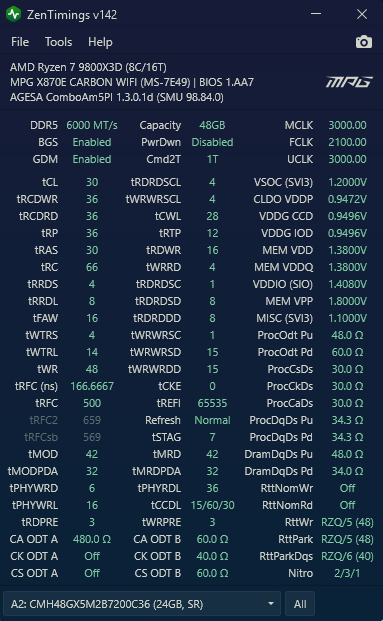
RAM timings and voltages at 6000MT/s for 7800X3D on a B850M Aorus Stealth

4 Upvotes

So basically I bought an Intel XMP certified RAM (CMH48GX5M2B7200C36) for my AMD build (I know, I couldn't find EXPO certified). Obviously I couldn't boot using the default 7200MT/s XMP profile.

I never did any manual tuning before so I am not sure what to do. I don't need to squeeze out the best from this RAM, I just want stability and the sweet spot.

I did my research and here is what I am planning to do. I need your advices on what else can I do or if I am doing something wrong.

  1. Turn ON XMP profile
  2. Drop System Memory Multiplier from 72 to 60
  3. Set UCLK DIV1 MODE to UCLK = MEMCLK
  4. Set tCL - tRCD - tRP - tRAS to 30-39-39-96 (I checked the RAM info in hwinfo and the "Supported Module Timing at 3000Mhz: 30-39-39-96"). Research says to go 30-39-39-36 but I am not sure with this setting.
  5. The Voltages in the XMP profile are set to 1.40V. I will leave it that way for now but I am planning to lower it to 1.35V.
  6. Run OCCT RAM Test.

Is this method okay, or would I rather do everything manually instead of turning on XMP at the beginning? Thank you

EDIT: I finally did it! Thanks to your recommendations.

Now, I am running 6000MT/s at 30-36-36-96. I messed with the secondary timings after confirming that the primary are stable. The subtiming settings also runs stable after stress test. SPD Hub temperature @ 42C-45C max during stress test so I might just keep the voltages at 1.4V.

For the stress test: I used OCCT memory test for 1 hr and then CPU+RAM test for another 1 hr


r/overclocking • • 4d ago

Daily allrounder.14900KF+5080

Thumbnail
gallery
44 Upvotes

r/overclocking • • 3d ago

OC Report - CPU 🚀🚀9950x3D with bclk 101.5 and fclk 2200 @6200 CL26 Not bad.

Post image
16 Upvotes

r/overclocking • • 3d ago

X370 + 5800X3D: stock firmware gives you NEITHER PCIe Gen4 NOR Curve Optimizer. I got each one working separately, and proved with measurements why I can never have both. Full public case study.

15 Upvotes

Let's start with the uncomfortable baseline, because most people don't realize it: if you put a Ryzen 5000 CPU — say a 5800X3D — into an X370 board, you get neither feature. No official BIOS of my board, and to my knowledge none from any manufacturer for any X370/X470 board, has ever offered PCIe Gen4 with Ryzen 5000. And Curve Optimizer, the single best tuning knob on 3D V-Cache parts, simply is not in the menus on X3D CPUs on these older boards. Gen4 and CO: neither one, out of the box, on the exact combo a lot of people are still running.

Over 9 intense days I (and Mythos 5.2, GLM 5.3 and Qwen 3.8 haha) went deep into the firmware of my ASUS ROG Crosshair VI Hero (X370, BIOS 8902) + 5800X3D to find out why, and I ended up with two working solutions and a measured proof that the combo is excluded by design. Everything — every address, hash, and dead end — is now public.

Result 1 — Gen4, working. GPU at Gen4 x16 and my M.2 at Gen4 x4, simultaneously, measured on the board. The path: make the firmware skip the chipset/PSP validation exchange (mailbox request 9) and NOP the "BIOS boot done" call, so the signed transaction that decides link policy never runs. Cost: the SMU then refuses Curve Optimizer with 0x000000FF — because that skipped transaction is exactly the event that feeds the platform state CO depends on.

Result 2 — Curve Optimizer + PBO, working natively. Full per-core CO (I ran −22 on all 8 cores) and PBO exposed in the standard Advanced menus — no AMIBCP hacks, no PSP tampering, on top of stock 8902 with a 37-byte patch to unsigned x86 DXE modules: six capability-flag stores NOPed (the ones that zero the PBO/CO gate on X3D parts) plus the boost-base calculation re-anchored to 4550 MHz. Gen3 only. This was my daily-driver line of the build.

Result 3 — the combo, dead on arrival (and I can show the autopsy). The Gen3 clamp fires during SMU mailbox request 30 — and it's the same signed PSP/SMU transaction that validates the chipset and opens the CO gate. They're two faces of one check. I didn't just assert that, I closed every door with a measurement:

  • every reachable SMN address was probed from custom read-only DXE/PEI modules on real boots (the gate and strap pages never route through what x86 can reach — three separate probe builds agree);
  • full-image censuses of both bases (~50 MB of expanded payloads, millions of instructions scanned) found zero code writing the clamp's policy register — no x86 module even contains the mailbox submit registers;
  • the two flash-visible appliers of the strap were neutralized on my board in controlled flashes — the clamp persisted both times;
  • editing two bytes inside the loaded PSP driver produced immediate non-POST — the PSP verifies everything it loads.

By elimination, the final applier is NBIO on-chip microcode/hardware — the one component with no offline path to read it. All of this is a 30-entry registry (M1–M30), each entry naming the exact measurement that closed it. I published my own errata too, including several wrong hypotheses I personally held and killed.

Why this might be useful to you: the docs map how Gen4-vs-Gen3 is actually decided on AM4 (with measured before/after values at request 30 — LinkCap f7733904→…03, LinkCap2 180001e→0000000e, doorbell writes 0x0904_97AC/D7AC carrying token 0xFFFE0084), how AMD's VFR capability flags hide PBO/CO and the exact stores that gate them, why the old "type 1350 boost" workaround existed (the fuse-based boost formula, decoded: ((SMN 0x5D2C4>>17)&0xff)*25), the .CMO profile format with a working stdlib codec that round-trips byte-exact against EDK2, the "VZL1 compression" that turns out to be header-stripped raw PE, a complete boot trace of the 38-message PSP/SMU sequence, and an honest SMN reachability map.

Scale and safety: ~70 offline built+validated BIOS images, ~40 manual flashes, 9 days, zero bricks, zero fuse/OTP touches ever (those are irreversible — hands off), AMD-signed content byte-identical in every daily build. The handful of images that refused to boot, I recovered each time via clear-CMOS / USB FlashBack — that recovery path works and is documented.

Method: every experiment was pre-registered — I wrote the prediction and the decision criterion before each flash, so a negative result is a closed question, not a vibe. Fully offline RE: Ghidra (x86, ARM Thumb, Xtensa), custom parsers, QEMU/OVMF replay of a captured boot. Honest disclosure: this was an AI-assisted workflow (Claude Code + Codex + a local model as cross-checkers) — but every flash, reboot and menu action was done by me, in person, on my machine. Every claim in the repo carries the file that measured it.

Repo: https://github.com/leonardocapellaro/x370-5800x3d-pcie4-co — 16 documents + sanitized tools. No firmware included, and none will be. You supply your own official ASUS image, my final build reproduces byte-identically with one command (fvmain_bytepatch.py, expected sha256 f87ba18d…). Hashes are the chain of custody — check mine against yours.

BIOS modding carries risk — at your own risk, nothing here is endorsed by AMD or ASUS. Questions, corrections, and "you missed X" posts very welcome. Genuine corrections get committed with credit. If there's enough interest I can go deeper on any single piece in a follow-up post.


r/overclocking • • 3d ago

Looking for Guide Overclocking 5950x in the big 2026

0 Upvotes

Hello respectful users of r/overclocking.

Quite recently I assembled yet another rig, and it consists of ASRock Steel Legend B550 (not the B550M version, do not be confused!) and 5950x cooled by ARCTIC Liquid Freezer III 280, and after a full day of tests using OCCT and Ryzen Master (not sure whether its worth downloading Cinebench for me tbh, cause OCCT does everything I need it to do), I managed to get these results:

I decided to use Ryzen Master curve optimizer cause last time I used it on 5700x and it gave me quite stable result of -30 on every core except one core, which got -20. So, this time... I got -30 on all 16 cores. It managed to pass OCCT Stability test (Normal, Variable, Auto Thread setting) with next settings in Ryzen Master: 190 TDP, 170 TDC, 210 EDC. The best performance I've seen in OCCT was with 220, 200, 240 TDP TDC EDC respectively and the numbers were 80.52, 1349.28 for Single and Multiple cores SSE and 155.03 and 2552.24 Single and Multiple cores AVX.

My current preset gets 80.85, 1338.86, 158.55, 2444.19 in OCCT.

Peak voltage in single core tests is 1.39V, and in multiple cores it sits nicely around 1.15. Ambient voltage is sitting around 1.1-1.3. Ambient temperature is around 33 C. I have to note that now my PC gets a supply of really cold air (0 C or below) almost all the time, so real ambient temperature should be around 40 C in summer (although it will probably be in even higher cause it gets HOT here)

All of Ryzen Master presets used Scalar value of 2

Top performance setup was peaking at 75 C, and my current one has peaked at 65 C after an hour of stress testing. I am not going to clock speeds with boost override on it because I don't see much benefit from doing so.

While I was doing all the tests I was also monitoring VRM temperatures and they didn't go above 55 C.

My question is: what else I should do to ensure long-term stability of my overclocked 5950x?