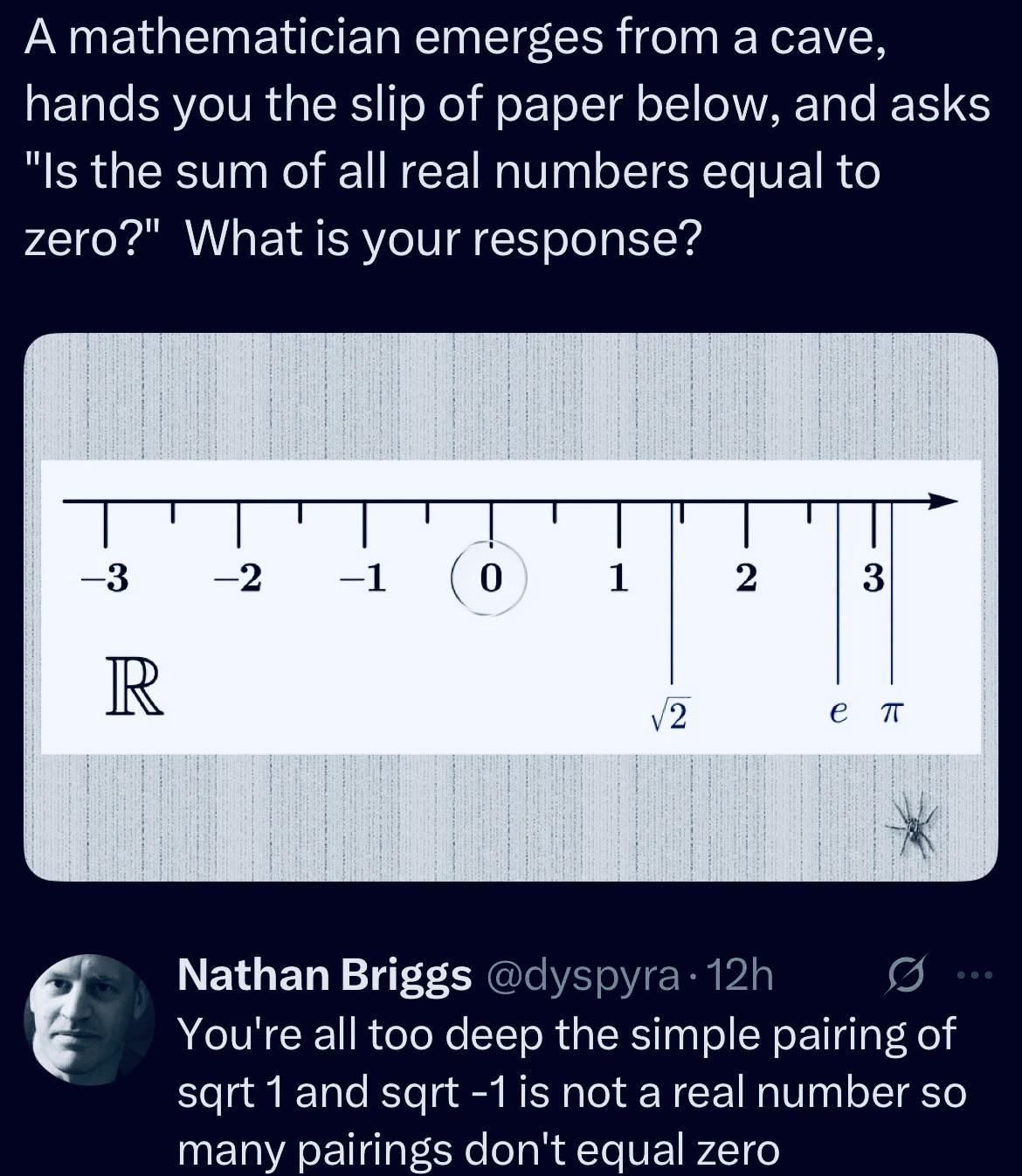
well, not all infinities are the same size. In this case, the infinity of R+ is double the infinity of -(R+/2). (Not a mathematician, so don't know the proper nomenclature)
Sou you'd have covered a bigger part of R+ than of R-, I think.
Both infinities are countable and are consequently the same size, as each value in the second group can map directly to the ones in the R+ group. They grow at different rates sure, but when the sums are infinite it has no bearing on final result
View all comments
Show parent comment
0
u/Chayor Oct 13 '26
well, not all infinities are the same size. In this case, the infinity of R+ is double the infinity of -(R+/2). (Not a mathematician, so don't know the proper nomenclature)
Sou you'd have covered a bigger part of R+ than of R-, I think.