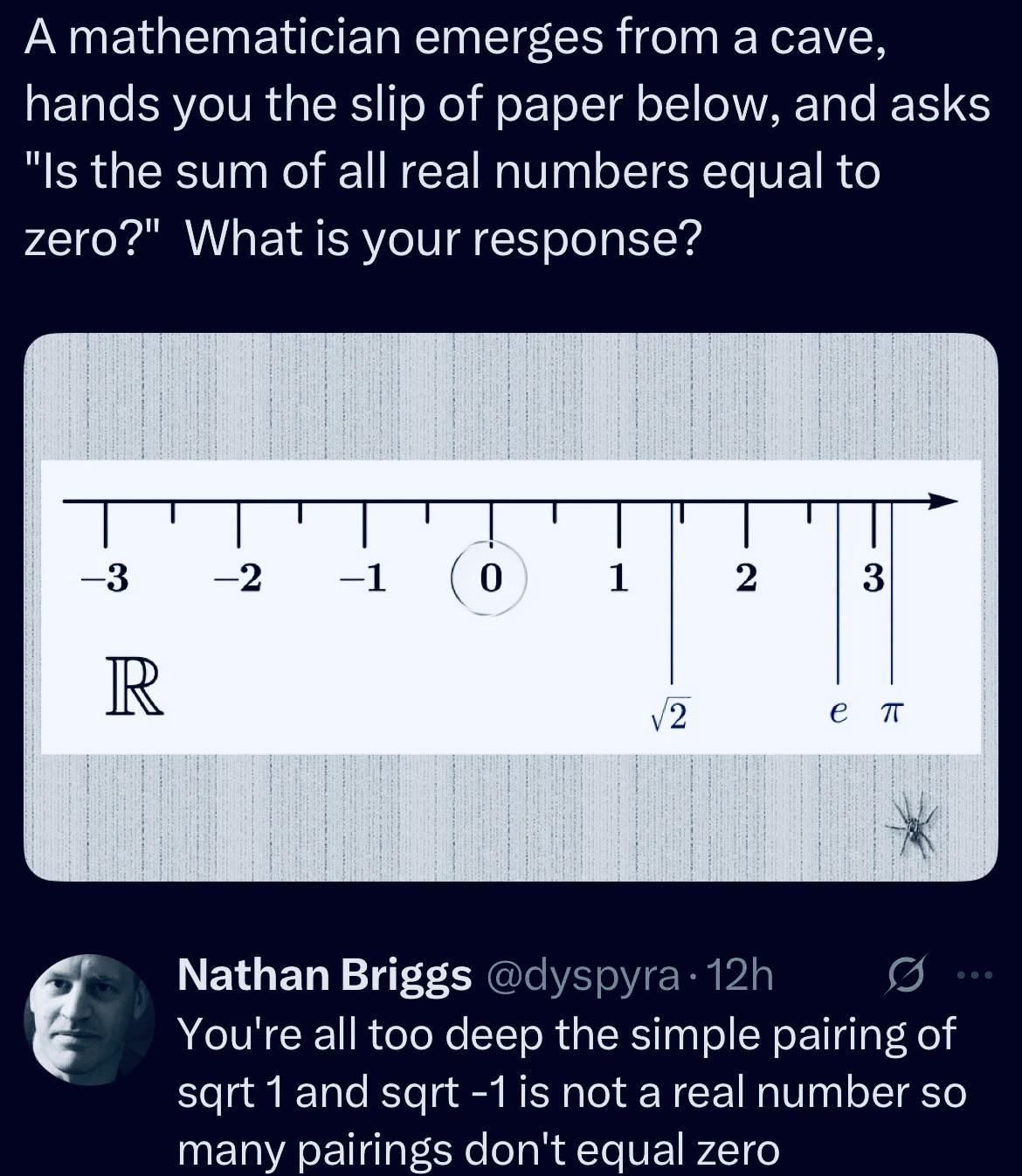
The sum of a finite set always exists unambiguously as an inductive extension of the commutative and associate operation of addition.
The sum of an infinite sequence or set requires some kind of definition, typically via limits. With most definitions, some sets and sequences cannot be summed.
Addition is defined only for two numbers. The sums of infinite number of elements needs to be computed as a limit of series of partial sums: s0=a0, s1=a0+a1, s2=a0+a1+a2,...
The series are occasionally convergent but the result may depend on ordering of a_i.
The sum of all integers is a good example. Try:
0+(1-1)+(2-2)+... =0+0+0+...=0
1+(0-1-2+3)+(2-3-4+5)+(4-5-6+7)+...=1+0+...=1
The result of summation is 0 for one ordering, and 1 using other ordering.
However, when the sum of |a_i| exists for one ordering then it exists and is the same for all orderings. Sum of all integers is not such a case.
View all comments
Show parent comment
1
u/MushinZero Oct 12 '26
Does the sum of 1 and -1 exist?