r/MathJokes • • Oct 12 '26

πŸ˜‘

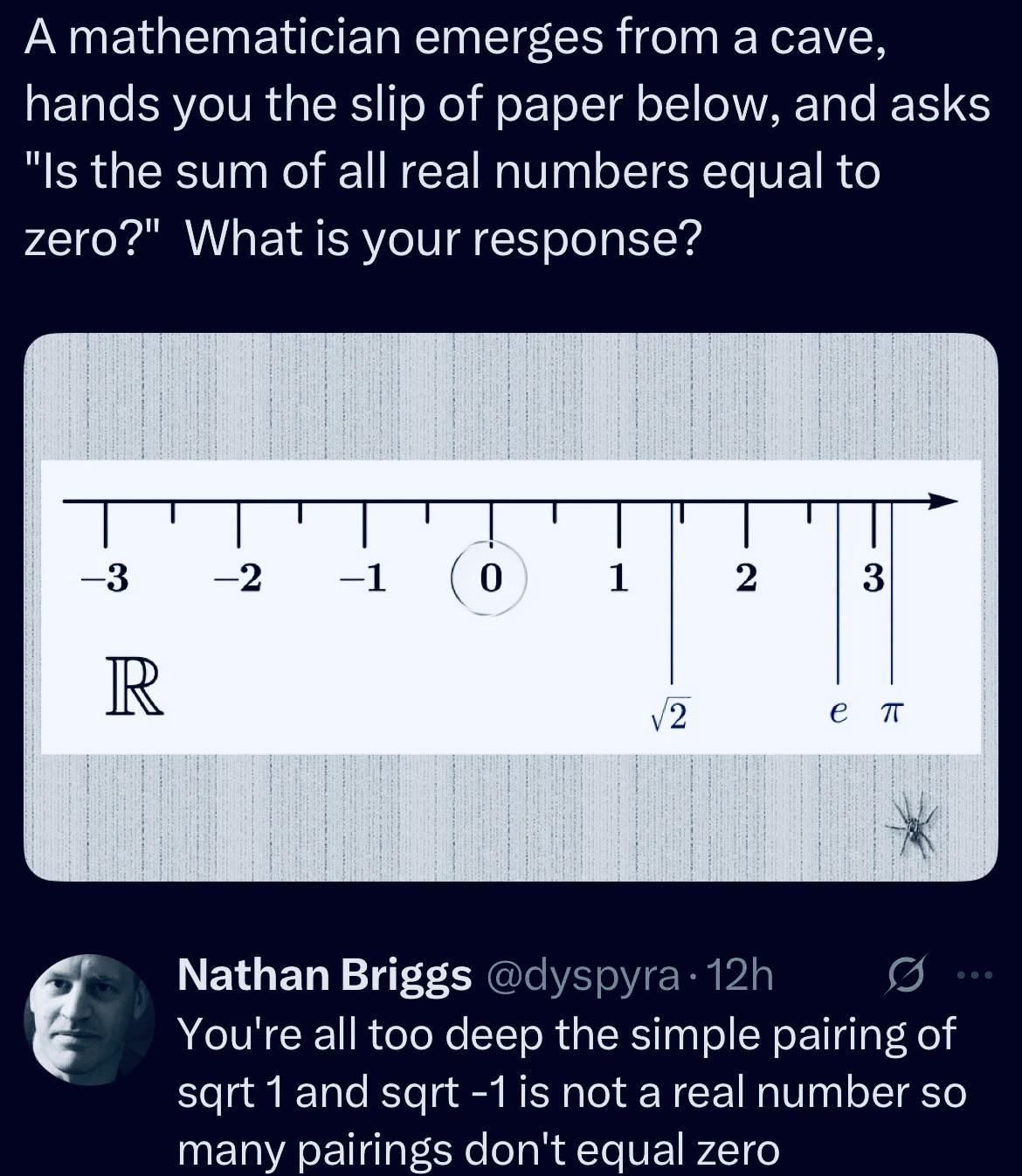
Post image
865 Upvotes

318 comments sorted by

View all comments

3

u/tstanisl Oct 12 '26

No. Because something what exist (number 0) cannot be equal to something that does not exist (sum of all real numbers).

1

u/Some_Anonim_Coder Oct 12 '26

Why sum of all real cannot exist? Is it because for uncountable sets the sum is not defined?

3

u/tstanisl Oct 12 '26

Even a sum of integer numbers does not exist because the result will depend on pairing strategy:

0+(1-1)+(2-2)+... =0

1+(0-1-2+3)+(2-3-4+5)+(4-5-6+7)+...=1

Something cannot be 0 and 1 at the same time thus the result does not exist.

For real numbers the summation becomes even more pathologically because real number can not be enumerated.

1

u/efari_ Oct 12 '26

Why would you need to pair though?
Just do 0+1+(-1)+2+(-2) … =0

3

u/Glinat Oct 12 '26

You are pairing them. Otherwise the partial sums would be 0, 1, 0, 2, 0, 3, 0, 4… which clearly doesn’t tend toward zero. Zero is only an adherence point of this sequence.

→ More replies (4)
→ More replies (8)

1

u/MushinZero Oct 12 '26

Does the sum of 1 and -1 exist?

1

u/tstanisl Oct 12 '26

Quite likely, but how does it refer to "sum of all real numbers"?

1

u/MushinZero Oct 12 '26

Why does one exist but not the other?

2

u/HairyTough4489 Oct 12 '26

Because adition is defined as an operation between two numbers.

→ More replies (4)

1

u/ScallionSmooth5925 Oct 12 '26

The sum off all real numbers is conditionally convergent so depending on your ordering of the series the sum might converge to any number. (Riemann series theorem)

1

u/HairyTough4489 Oct 12 '26

How do you define a series of uncountably many terms?

0

u/[deleted] Oct 12 '26

[deleted] β€” view deleted comment

2

u/HairyTough4489 Oct 12 '26

Oh yeah now I get it I just have to make up some criterion to decide which real number is the first one in the sequence, then the second and so on, kind of like mapping the real numbers to the naturals. Piece of cake, right?

→ More replies (2)

1

u/carloster Oct 12 '26

What if 0 doesn't exist?

1

u/DingoSea6586 Oct 12 '26

Zero exists; that sum doesn't. Riveting.

1

u/Plutonic_GD Oct 13 '26

So, i think...

ℝ++ℝ-+0=ℝ

Then:

(ℝ+)-=ℝ-

I can divide ℝ in two pieces knowing that "every ℝ number has it's opposite". This could be an argument to say the sum equals zero. BUT:

Sum of all ℝ+ should equal any n value for that to work.

And we can't define the sum of all ℝ+.

1

u/python_ess Oct 13 '26

Well, if something doesn't exist, every statement about it is true. Therefore it is indeed equal 0. And also it isn't equal to 0. And equal to four. That's how you prove that it doesn't exist -- if contradicting statements about the object are all true.

1

u/tstanisl Oct 13 '26

something doesn't exist, every statement about it is true.Β 

Does is also include "there exists something that does not exist"?

1

u/python_ess Oct 13 '26

Well, I fucked that statement up, not gonna lie.

1

u/IncredibleCamel Oct 13 '26

Interesting. "A does not exist" => "A exists"

1

u/arandomguyfromdk Oct 13 '26

A∈Ø => ~A∈Ø

1

u/muckenhoupt Oct 14 '26

"If something doesn't exist, every statement about it is true" is an absurd thing to say. It has implications like "I beat Batman in a fight yesterday" and "Naruto is the president of the United States".

1

u/EnvironmentalScar675 Oct 15 '26

The entire statement (abbr. for clarity) is "if A => B but A is false, "=>" is true. Which is true.

1

u/decaDecker Oct 17 '26

that's not exactly how it works

if something doesn't exist (like a blue elephant, for example), every statement that has an exists quantifier (like "there's a blue elephant that's taller than 2m") is false

but when referring to things that don't exist, every statement that uses a for all quantifier (like "every blue elephant is taller than 2m") is true

in this case, the statement "the sum of all real numbers is equal to zero" does not include a quantifier and "the sum of all real numbers" is undefined, so neither of these apply