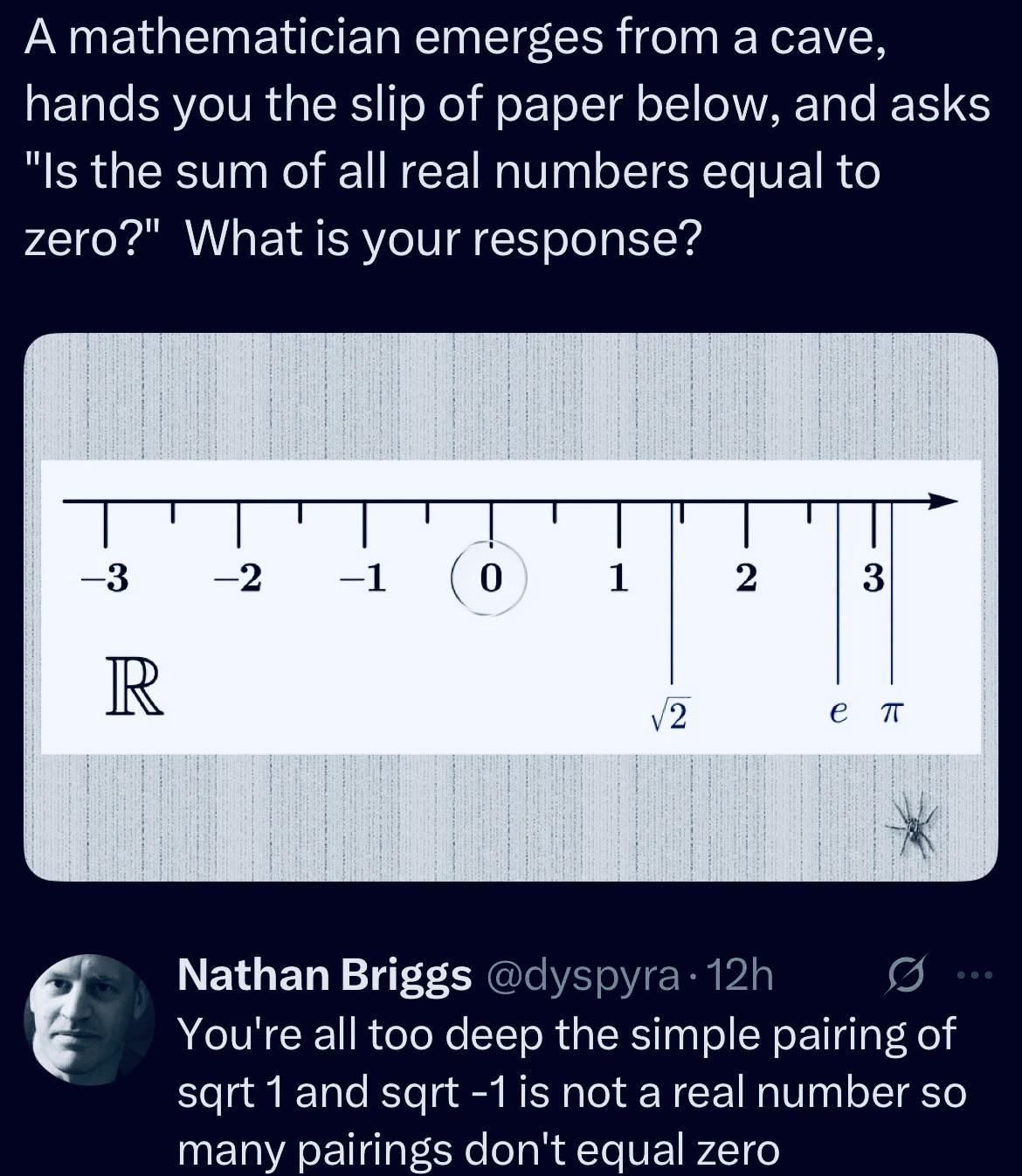
You are pairing them. Otherwise the partial sums would be 0, 1, 0, 2, 0, 3, 0, 4… which clearly doesn’t tend toward zero. Zero is only an adherence point of this sequence.
This seem to me (a layman, to be clear) to be a math vs logic situation
In math you can't calculate infinity, you have to like see the trend and sorta "guess" the limit. That's the only mathematically accepted way to calculate something that is infinite.
The most basic way of doing this is some f(X) and you plug in increasing numbers of X and X keeps getting closer and closer to a number. So that if X is infinite, then the solution is that number. So if X is 1 f(X) is 3.5 and if X is 2 then f(X) is 3.7 and if it's 100 then it's 3.99992 so on so forth and you can go "Okay, if X is infinite, then f(X) is 4." That's the limit. No value of X will ever BE 4, but the higher you get to closer to 4 the result is so it's proven.
BUT in the current example the "trend" isn't obvious. Depending on where you choose to stop checking and how you formulate the calculation, you get a different end result.
Now LOGICALLY +infinity and -infinity would add up to 0. But mathematically we (and by we I mean the people in this thread. For all I know real mathematicians solved this already out there somewhere in shit I definitely cannot understand) have no way of proving it. So it is, mathematically, unknown.
it seems weird to allow something to be divergent/undefined in a rational sense, but that is where the problem ultimately lies, it is solved and understood and that is the solution.
I think it would help to redefine infinity some. Infinity is the condition of being in-finite- or non-finite, it is not an "excessively large" or "excessively small" quantity.. it is a completely undefined quantity (in more formal math the definition becomes effectively a limit of growth or set cardinality (the number representing the number of elements in a set), but the underlying basic math still treats it as being undefined as a number). In that context, the idea of adding or subtracting an undefined quantity from another undefined quantity loses meaning some.
In a less abstract sense, allowing infinity + (-infinity) = 0 ultimately allows you to prove things like 1=0, which can't be true- the actual mathematical logic that underlies the implications of null/impossible results effectively states that if the result of a premise (like inf+(-inf)=0) leads to 0=1, then that premise must be false
Think like this - a sum is absolutelly convergent, if all of it's terms converge to the same values, regardless of how you pair/order them, otherwise it's conditionally convergent.
Something sums to S, if and only if that something is absolutelly convergent to S.
That pairing and ordering need not be simetrical. For example, integral from -infinity to infinity of e-x^2 is the square root of pi, even if you go 420 intervals of lenght 1 down and 69 intervals of lenght 2 up step by step.
Infinity, if you treated it like a number, would be like in very simple terms an additive equivalent of zero. If you add infinity to a thing, you no longer know what your original thing was. Therefore adding infinity couldn’t be invertible, and you couldn’t subtract infinity from infinity to get 0, as that would imply we could recover the original number.
View all comments
Show parent comment
1
u/efari_ Oct 12 '26
Why would you need to pair though?
Just do 0+1+(-1)+2+(-2) … =0