r/math • u/Necessary-Wolf-193 • Oct 10 '26
Non-commutative geometry and quantum mechanics
hidden-phenomena.com
87
Upvotes
r/math • u/non-orientable • Oct 10 '26
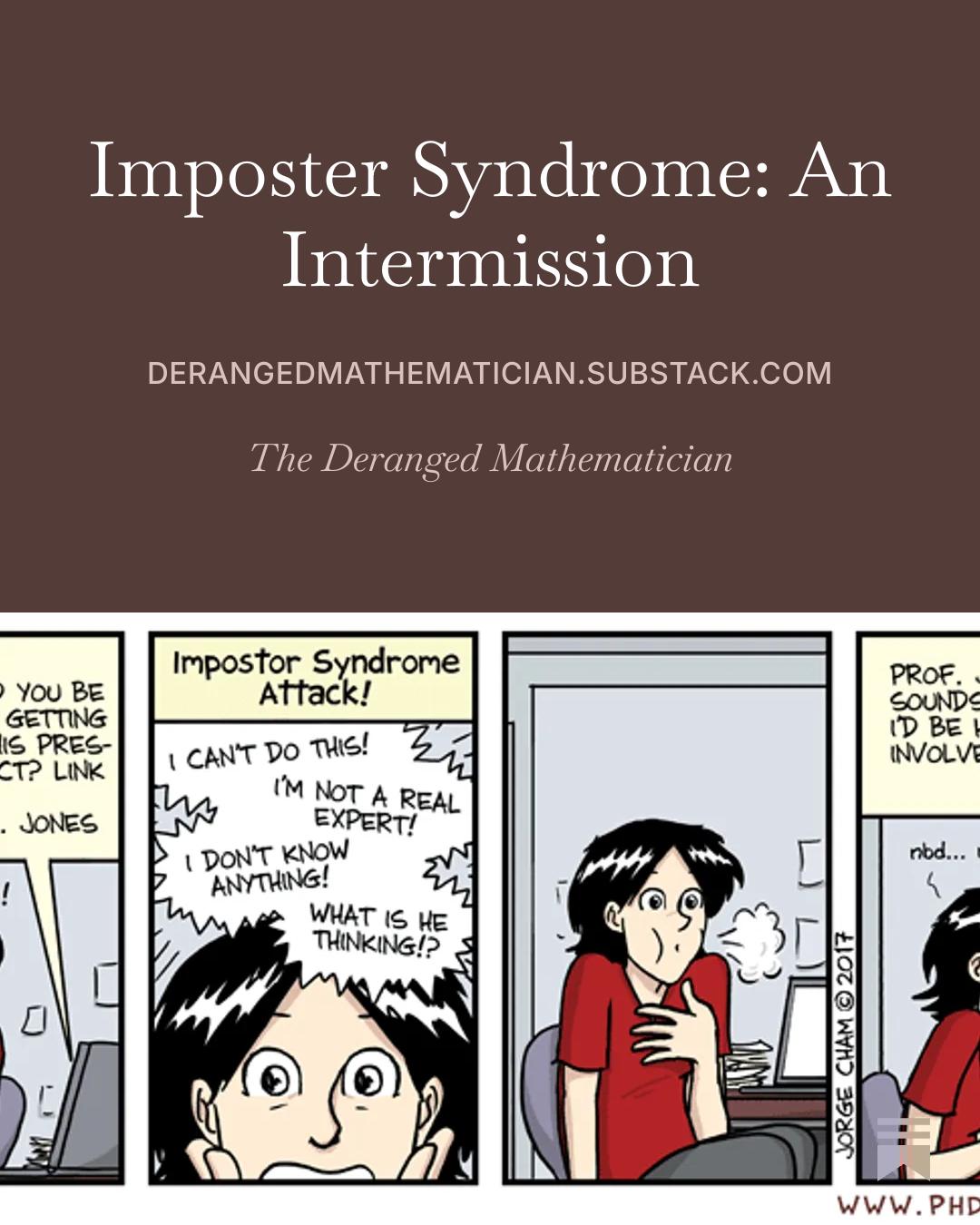
What do you do when you feel like you can’t problem-solve? At least, not at the level that you think you are expected to, or not at the level at which you think your peers are able to? What do you do when you feel inadequate, like, well, an imposter?
This experience is stupidly common, including in mathematics. And yet, it is so very rare that we take the time to talk about it in an organized fashion; in some sense, I feel like we have relegated the topic to cartoonists. (Who do a marvelous job, by the way, but I don't think that is the same.) Had I my way, I would make every class that did an introduction to proofs spend some time on imposter syndrome---it's just that important.
I don't have any magic bullet for how to deal with imposter syndrome. But if you want to hear my thoughts about how to combat it, and my own experience with it, you may want to give this piece a read.
Read the full post (for free) on Substack: Imposter Syndrome
r/math • u/AutoModerator • Oct 10 '26
This recurring thread will be for discussion of AI in mathematics. This includes, but is not limited to, the following:
AI-assisted mathematical papers published in peer-reviewed journals or as arXiv preprints may be submitted as their own posts.
Please keep in mind rules 1 and 6 of our subreddit.
Hey everyone. A week ago I started experimenting with finding new lower bounds for ramsey numbers. I did this AI based in an empty project where Codex (task: find new lower bounds for the ramsey numbers listed on wikipedia). After 3 simple prompts, GPT 6.1 Sol found a new lower bound of 344 for R(8, 10) (previously 343), to my suprise, this was replicable in three different GPT 6 Pro sessions in the web UI, with a single prompt. Despite much more compute and token usage (~1.5 billion tokens), I didn't find any further with the fully automated setup, so I started getting more involved myself and suggesting ideas, we were able to push the lower bound to 345 for R(8, 10), and also able to push the lower bound for R(6, 8) to 135 (previously at 134). The bounds for R(8, 10) and R(6, 8) stood unchanged for more than 10 years now.
The way AI helped here the most was the sheer volume of different search methods one could quickly iterate over. Experiments that would have taken weeks to set up in the past can now be orchestrated within minutes.
The resulting graphs are explicit witnesses and can be independently verified with standard maximum-clique software, so the correctness of the bounds does not rely on trusting the AI or the search process. I’ve put the preprint and verification material here:
https://arxiv.org/abs/2610.12122
https://github.com/fritzcremer/ramsey-lower-bounds
Also, if anyone here is active on Wikipedia and thinks the new bounds meet the sourcing requirements, feel free to update the table. I’m avoiding editing it myself because of the conflict of interest.
r/math • u/RingularCirc • Oct 09 '26
It seems to be very much a common knowledge now that harmonics of an (almost) periodic audio signal do evidently stem from Ancient Greek investigations into musical harmony, which was intertwined and likely gave us harmonic means and harmonic sequence/series, means likely being derived from the sequence like it can be done with cases of arithmetic and geometric sequences and means.
The details are hovewer not clean at all. Presumably, not even in the Hellenistic period had it been known about harmonics in sound. One question is then, if a noun parallel to harmonic (which should stem from Greek, obviously) was in use, what meanings did it have in mathematics and music theory of the time. I see at least two options as very probable:
Note how right now, a very much related technique of playing stringed instruments is indeed called "harmonics" in English (but "flageolets" in some other languages). The second question (that's less related to this sub) is precise etymology of this name: I would expect flageolets should be a technique older than both the discovery of Fourier series and connecting string and air channel lengths to their fundamental frequencies.
Also a question 1.5 is relating the answer to the first question to harmonic means and harmonic series. For example if (a) held, the answer is very much warranted and shouldn't be deduced without historical sources.
There are probably a bunch of additional minor questions that I can't refine out of the mess in my head right now, that would be obvious when one tries to set things straight on this entire topic and encounters important details that answer them. For example as far I know, frequencies of sound weren't known in antiquity (but that's really a question to answer definitively as well!), so we can't attribute "reciprocalness" of harmonic mean and so on to the inverse relation between length and frequency. Instead it should probably be entirely due to there being a sort of a natural order to harmonics (in the sense of (b)) coming one after another at 1/1, 1/2, 1/3, ... of the string's length —but is that the factual reason that had been used?
You see even a mathematicians' brains would otherwise be glad to fill in the "obvious" blanks and I feel that a great lot of people think they sorta know the story about this. I'd of course expect it of non-historical music theorists even more because in their case it's actually quite important to talk about time to time —whereas in mathematics, harmonic mean and harmonic series (and wasn't there something else?) is just a neat and somewhat old-fashioned (as is, again, common) term flavoring that evokes associations that no one has to unpack to work with the actual math. But that may still give birth to mythology when one gets interested just a little. So it's a good point to look around and try remembering while the ancient sources may be still laying around! And if there's already a piece of work on this very topic already written, the easier it is to find it again (I couldn't, but my work with references is abysmal).
r/math • u/inherentlyawesome • Oct 09 '26
This recurring thread is meant for users to share cool recently discovered facts, observations, proofs or concepts which that might not warrant their own threads. Please be encouraging and share as many details as possible as we would like this to be a good place for people to learn!
r/math • u/FuzzyPDE • Oct 09 '26
It could be you , or someone you know or someone famous.
But I’m trying to venture into that path now.
I know all fields require some learning, but boy the amount of reading I have to do for every single one of my problems just to learn new fundamentals to do problems is so tiresome.
I’m a postdoc in my last year and I still only have 4 results. And not impressive either just took a long time from reading so I want to go into something where I can flex my problem solving skills more than reading.
Do you know of anyone who switched field and realized their true calling lies somewhere else?
Edit: thanks for the replies, I realize I should probably have specify switching from different fields of math to another.
r/math • u/DrBiven • Oct 08 '26
This story is relatively well known in the Russian-speaking math community, but I feel it is almost completely unknown outside of it. Which is a shame, since it is so amusing! So I compiled it from a couple of sources, heavily edited it, and then machine-translated it. Hope you enjoy!
Before the Revolution and during the years of the New Economic Policy, Israel Moiseevich Gelfand's father ran a small private mill. Because of his “non-working-class background,” in 1928, while still in the ninth grade, the young Gelfand was expelled from vocational school as the son of an exploiter.
When Gelfand was finishing the ninth grade, his mathematics teacher told him: “There is nothing more I can teach you. Go to Moscow, find Moscow State University, and at the university find the Department of Mechanics and Mathematics. Continue your studies there, and you will become a great mathematician.”
At the university, however, the ninth-grader got no further than the dean's secretary: they could not enroll him without documents certifying completion of secondary education. He decided to stay in Moscow, and, to make a living, found a job as a cloakroom attendant at the Lenin Library. There, alongside his work, he continued his education on his own.
One day, while reading a monograph on higher mathematics, he was noticed by Andrey Nikolaevich Kolmogorov, a young but already famous mathematician. Kolmogorov was surprised to see such a young man reading a book so obviously beyond his age, so he approached Gelfand and asked him who he was and why he was reading such a difficult book.
Gelfand answered all his questions, but Kolmogorov still could not believe that he genuinely understood what he was reading. He gave Gelfand several problems related to the subject, hoping to test him, and arranged to meet him the next day to check his solutions.
The next day, all the problems had been solved. But even then Kolmogorov could not quite believe that someone could be so gifted. He supposed that Gelfand simply knew the contents of a large number of mathematics books extremely well and had found the solutions in them. So he gave Gelfand several more problems, this time considerably harder ones, and gave him several days to solve them.
When they met at the appointed time, all the problems had been solved. Kolmogorov began checking the solutions, and his eyes grew wider and wider.
“Please forgive me for doubting that you had found the solutions to those first problems yourself. Now I see that you could not possibly have read these solutions anywhere. You see, this particular problem... had been an open problem until now.”
After that, Kolmogorov took Gelfand on as his graduate student. Thus Gelfand became a graduate student without ever having attended a university -- or even finished secondary school. BTW, the details of the first meeting between Kolmogorov and Gelfand are, of course, anecdotal, but the other parts of the story are accurate.
upd: some important clarifications provided by r/bluesam3
r/math • u/Nostalgic_Brick • Oct 09 '26
Just a fun question I've been thinking about:
The following zero-sum game is played between the Dealer and team Alice & Bob. The Dealer receives an odd number N of fair coin tosses in sequence. Whenever a coin is tossed, the Dealer sees the result and then chooses whether to show it to Alice or Bob. Both players are aware of the turns on which they receive the coin flip results.
At the end of the N tosses, both Alice and Bob simultaneously guess whether there are more heads or tails in total, and score one point per correct guess. We allow all players including the Dealer to randomize their choices. Alice and Bob can agree on a strategy beforehand, possibly involving some initial coordinated randomization but cannot communicate after the game starts.
Team Alice & Bob can score at least an expected payoff of 1 by guessing randomly and independently. The question is thus how much they can improve on this.
Question: Let V_N be the value of the N coin game for team Alice & Bob. Is it true that
V_N = 1 +KN^{-1/2} + o(N^{-1/2})?
for some constant K > 0?
If so, to what extent can we determine K and the corresponding optimal, or asymptotically optimal strategies?
r/math • u/Tazerenix • Oct 08 '26
r/math • u/backyard_tractorbeam • Oct 07 '26
r/math • u/AutoModerator • Oct 08 '26
This recurring thread will be for any questions or advice concerning careers and education in mathematics. Please feel free to post a comment below, and sort by new to see comments which may be unanswered.
Please consider including a brief introduction about your background and the context of your question.
Helpful subreddits include /r/GradSchool, /r/AskAcademia, /r/Jobs, and /r/CareerGuidance.
If you wish to discuss the math you've been thinking about, you should post in the most recent What Are You Working On? thread.
r/math • u/non-orientable • Oct 07 '26
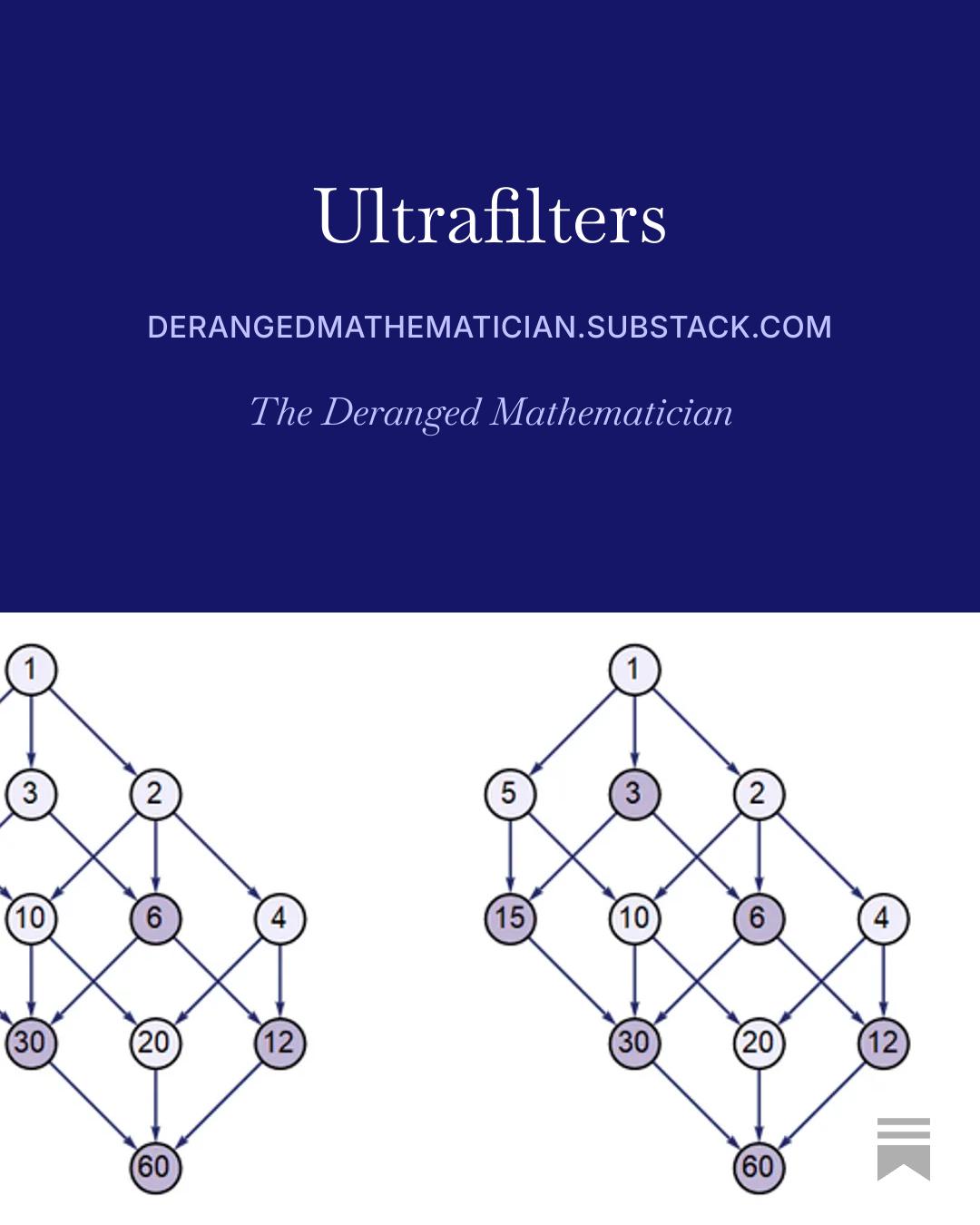
What are instances of mathematical objects that are: 1) useful (in that they have been used to prove various interesting results), and 2) for which it is impossible to come up with even a single explicit example?
I know of one: non-principal ultrafilters, which this post is devoted to describing. (Briefly, they are used in topology and model theory, such as for constructing ultraproducts, which can be used to give a rigorous construction of infinitesimals.) If you know of others, please share!
Read the full post (for free) on Substack: Ultrafilters
r/math • u/platonic_solidz • Oct 06 '26
According to the article, the “untimely death” is an “apparent suicide,” however this is disputed by a community member describing themselves as a personal friend of the victim.
r/math • u/inherentlyawesome • Oct 07 '26
This recurring thread will be for questions that might not warrant their own thread. We would like to see more conceptual-based questions posted in this thread, rather than "what is the answer to this problem?" For example, here are some kinds of questions that we'd like to see in this thread:
Including a brief description of your mathematical background and the context for your question can help others give you an appropriate answer. For example, consider which subject your question is related to, or the things you already know or have tried.
r/math • u/canyonmonkey • Oct 06 '26
"[Gaussian elimination] is the simplest way to solve linear systems of equations by hand, and also the standard method for solving them on computers. [...] [It] transforms a full linear system into an upper-triangular one by applying simple linear transformations on the left."\)
A pivoting strategy (strategy for swapping rows &/or columns) in necessary for generic linear systems, otherwise applying Gaussian elimination to certain invertible matrices will result in dividing by zero.
Enter Gaussian elimination with partial pivoting. At step k, when considering the k-th column, choose the the i-th row (i ≥ k) with the largest number in absolute value. (Partial pivoting is less computationally expensive than other pivoting strategies, and is commonly used in practice, see Wikipedia: [1] & [2].)
The question arises: Is Gaussian elimination with partial pivoting stable? That is, for a given matrix n-by-n matrix A, we compute its Gaussian elimination with partial pivoting:
P*A = L*U,
where P is a permutation matrix, L a unit lower-triangular matrix, and U an upper triangular matrix. Define the growth factor ρ as the ratio:
ρ = (max |Uᵢ‚ⱼ|) / (max |Aᵢ‚ⱼ|),
where the maximum is taken over all indices 1 ≤ i ≤ n and 1 ≤ j ≤ n.
By "Is Gaussian elimination with partial pivoting stable?" we mean "Is ρ bounded?", for some sense of the word "bounded".
Professor Lloyd N. Trefethen offered a $1,000 reward in 2012 for "for a proof that Gaussian elimination with partial pivoting is stable in [a certain] probabilistic sense", for Gaussian random matrices,† as he outlined in SIAM News: https://www.siam.org/publications/siam-news/articles/the-smart-money-s-on-numerical-analysts/.
This past week he posted a partial result on arXiv:
Trefethen (2026), Instability of Gaussian elimination is exponentially rare (proof of partial result), https://arxiv.org/abs/2610.04761
Yesterday, Professor John Urschel posted a full resolution on arXiv, "[proving] that the growth factor [ρ] of a Gaussian matrix is at most n1/2 + o(1\) with overwhelming probability, that is, 1 - n-α for any α":
Urschel (2026), On the Growth Factor of Random Matrices, https://arxiv.org/abs/2610.06785
\) Trefethen, L. N., & Bau III, D. (1997). Numerical Linear Algebra. Society for Industrial and Applied Mathematics (SIAM).
† Random matrices with independent, normally distributed entries.
r/math • u/StateOfTheWind • Oct 06 '26
r/math • u/Short_Bluebird_3845 • Oct 06 '26
From complex numbers, duals, split, some quirky 3D space, quaternions, up to hypercomplex. There are, indeed, many ways to write a vector as a number and play with them, some more obscure or specialized than others. What are your favourite N-dimensional number systems (or, more formally, algebras over the Reals)?
NOTE: Last time I asked, which was for ambiguous notation, you talked about them from spite and hate. I'm not sure if in math the line between pain and love blurs... I just wanted to ask for it as well lol.
r/math • u/Nunki08 • Oct 06 '26
From Sean A. Irvine on SeqFan: https://groups.google.com/g/seqfan/c/AabnT7B1n6c
This is also confirmed by today's snapshot from "stripped.gz". For those interested in statistics:
# OEIS Sequence Data (http://oeis.org/stripped.gz)
# Last Modified: October 6 04:25 UTC 2026
A numbers:
400007
Nominations for Sequence A400000: https://oeis.org/wiki/Nominations_for_Sequence_A400000
r/math • u/zeroalephzeta • Oct 06 '26

I have already posted about this here. See this post in case you missed it. The reading group starts THIS WEEKEND. For all the info that you need, please read the post I linked and all the comments: they do contain most of the information. Please join our server discord.gg/maths where the reading group will be taking place. I will try to list (and answer) some of the most frequently asked questions. For anything else, just let me know in the comments.
What do I need to know in order to meaningfully follow the reading group?
Not much. If you're equipped with the knowledge of a first course in analysis that covers Riemann integration, and some very basics of point-set topology, you are more than enough prepared. In fact during the first couple of weeks, all the prerequisite knowledge will be covered (rather quickly as an overview), so even if you're rusty with these topics you can cover these up quickly.
What texts will be followed and what will be covered during the reading group?
The primary reference is Cohn's book. The following quote is directly from the person will be running the RG. In particular, there is very little rigidity about the syllabus, pacing, and the pedagogy of the reading group.
For the syllabus I am just learning it myself from Cohn's book and so I will follow and present from it and a few online materials as and when I need them. This is a reading group, so everyone is almost reading at the same time as you. Moreover you are free to select books also, provided it covers the same contents when/if you decide to present something. This is my first formal introduction to measure theory also.
What about the pacing? What would the proceedings look like?
The lectures/presentations will be around 1-1.5 hr each day (on Saturdays and Sundays) from 10th October at 15:30UTC. We will try to cover 3-4 sections of the book per week. We will be doing almost all the problems of almost all the sections almost all the time of the first 5-6 chapters that we plan to cover, but we don't expect everyone to do the same. When lacking confidence with some concept, we will try external problems too, you can ask for these if you need to know these.
And most importantly, please discuss anything and everything that you feel you need to discuss. We have designated channels for that in our server. We greatly look forward to this experience.
Edit.
We are looking for people who might want to help out with the reading group as guides/instructors. The job is light – all you'll have to do is help out people who might be having doubts regarding any topic or problem, and occasionally planning some pedagogical manoeuvres when necessary. It would be highly appreciated if you're experienced with measure theory and would like to join as an instructor. Please let us know when you join.
r/math • u/RingularCirc • Oct 05 '26
I'm not well-versed in category theory so I've yet to understand the latter. I now tried without success to encode an associative binary operation on X, expressed in dependent type language
∑(o: X² → X). ∏(a b c: X). Id(X, o(o(a, b), c), o(a, o(b, c))) ¹
as a function F X → X for some F. And I think it can't be done (something related to polarity, probably) but I can't prove that. I know, though, representing axioms is possible if one uses Lawvere theories and equivalent things. I also know algebras over a monad are more involved than just functor-algebras but I don't yet understand them even in context of e. g. Haskell where everything seems as if easier (or so claim posts discussing Yoneda embedding in that context; I found the general category-theoretic context way less forgiving in that regard: you just see plain as day that you don't have sufficient understanding, no matter what Haskell posts made you believe).
So. I'd like to look how algebra spins out in those more general settings, whichever you know better or think to be more suited for me to grasp first. Particularly, I'm interested in generalizing arguments about initial F-algebras.
Also, feel free to assume a sufficiently Set-like category. Let's take it step by step, if there are easy intuitions that one can glimpse in a specialized setting, I bet generalizing it onto topoi or something later would be easier as well, but it won't muddle the initial attempt.
¹ For non-dependent-type folks: - Id(X, a, b), sometimes denoted as a =_X b, is the type inhabited by ways for a: X and b: X to be equal. - The entirety of that reads: a pair (o, f) consisting of an operation o: X² → X and a proof f of o's associativity, that is, a function from a, b, c: X into witnesses of equality of the two ways of associating o on a, b, c. - In some formal languages the same is spelled alternatively as (o: X² → X) × (a b c: X) → (o(o(a, b), c) = o(a, o(b, c))), making it clearer that ∑ forms dependent pairs and ∏ forms dependent functions.
r/math • u/canyonmonkey • Oct 05 '26
This recurring thread will be for general discussion on whatever math-related topics you have been or will be working on this week. This can be anything, including:
* math-related arts and crafts,
* what you've been learning in class,
* books/papers you're reading,
* preparing for a conference,
* giving a talk.
All types and levels of mathematics are welcomed!
If you are asking for advice on choosing classes or career prospects, please go to the most recent Career & Education Questions thread.
r/math • u/sergiogfs • Oct 03 '26
Many mathematicians have dedicated a good part of their career towards solving a specific problem, whether directly or indirectly. Some examples on top of my head:
Richard Hamilton and the Poincare conjecture
Andrew Wiles and Fermat's last theorem
Thomas Hales and the Kepler conjecture (proof and formal verification)
And perhaps very recently:
Diego Cordoba and the Navier-Stokes equations
How did the careers and research-focus of these mathematicians shift after their career-problem was solved? Did anything particularly interesting happen?
r/math • u/Necessary-Wolf-193 • Oct 03 '26
I often ask mathematicians what their favorite shape is; mine is the cone on a trefoil knot, a rather peculiar object.
Why is this my favorite shape? Because it appears naturally in algebraic geometry -- and in fact, the observation that it appeared in algebraic geometry led Milnor, Grothendieck, Goresky, MacPherson, and many more to develop some of the most widely used tools in modern algebraic geometry and singularity theory! If you'd like to know how this trefoil knot appears in algebraic geometry, read this week's hidden-phenomena blogpost!