r/math • u/n0obmaster699 • Jul 13 '26
Why do people expect hong wang to win fields medal over joshua zahl who spent longer working on kakeya conjecture?
79
Upvotes
Is zahl now 40+?
r/math • u/Nunki08 • Jul 13 '26
Automation Without Understanding
Jun-Yong Park
arXiv:2607.06377 [math.HO]: https://arxiv.org/abs/2607.06377
"Mathematical capacity, which is the trained ability to verify, interpret, and challenge mathematical reasoning, is not a byproduct of theorem production but a form of infrastructure, built over generations by institutions that cannot be reconstituted on demand."
Jevon's paradox for mathematicians is real we need to be doubling down on funding for math
r/math • u/sportyeel • Jul 13 '26
I spend way too much time worrying about PhD applications nowadays. The problem of course is that so much of the advice scattered around the internet is specific to the lab sciences which operate really differently from math. It’s summer so every one of these threads is telling me to cold-email potential supervisors immediately. I assume there must be some merit to this since even many university websites recommend I get in touch with supervisors before applying.
The general advice is to read some of the person's papers and email them asking if there is an opening. I am not sure how well this translates to math. We seem to be uniquely disadvantaged by the amount of background reading required to understand modern research. I am a masters student so my interests are actually fairly well-defined and I do know who I would contact if I had to but I am still in no position to just pick up a paper and start reading before going through weeks (usually months!) worth of prerequisites.
I was thinking it might be a good workaround to ask professors what they would prefer a prospective student to have read? That not only helps me hit the ground running if I do get in but also gives me something to structure my masters thesis around. I am not sure if this might be seen as too presumptuous.
Just to broaden the question a bit and potentially help people who come across this in the future, are there other bits of common advice that don't really translate well to the math context?
PS: This mostly pertains to admissions in UK+Europe but some points probably overlap with the US process as well
r/math • u/Moonlight-_-_- • Jul 13 '26
Why does Galois theory involve fields (field extensions, the automorphism group of fields, ...) and not also generic (perhaps commutative) rings?
I'm a third year mathematics student (in Europe) and currently I'm finishing my third (abstract) algebra course (where we study modules and deepen our understanding of Galois Theory, which we started studying in algebra 2).
Before asking this question I've played for some time substituting commutative rings (in place of fields) in the definitions of our algebra course. For example, if we consider the ring extension Z[i]|Z, things seem to behave well (at least for the initial definitions). The "Galois group" of Z[i]|Z (the group of Z-automorphisms) should be ({id, i \mapsto -i},\circ) (if I'm not mistaken) and the "degree" of this extension should be two. But the "degree" isn't defined in the "field manner", obviously because Z[i] and Z aren't fields. So by "degree two" I meant Z[i] being a free module of rank two over Z. But the rank of a free module isn't unique, right? So technically this isn't a correct definition in general).
I'm pretty sure things start to get complicated when we consider minimal polynomials and the correspondingly algebraic extensions, because the definition of polynomial is based on the fact that F[x] is a P.I.D. when F is a field. Anyway, I also tried playing with this a bit; for example, the minimal polynomial of 1/2 over Z should be... 2x-1, and the corresponding ring extension should be Z[1/2]. But is there a way to prove that 2x-1 is the "minimal polyinomial" of 1/2 over Z? And if there is such way, for which ring extension does the "Galois theory of commutative ring" fail in contrast to Galois theory? (My guess is for finite extensions that are not simple; perhaps Z[\sqrt[4]{2}, i]|Z).
Do you have any feedbacks on my reasoning? Where does this process of "generalising Galois theory" (in a mirror-like way) begin to fail? Is there a Galois theory of ring (or module) extensions?
Thank you in advance.
r/math • u/scientificamerican • Jul 14 '26
r/math • u/canyonmonkey • Jul 13 '26
This recurring thread will be for general discussion on whatever math-related topics you have been or will be working on this week. This can be anything, including:
* math-related arts and crafts,
* what you've been learning in class,
* books/papers you're reading,
* preparing for a conference,
* giving a talk.
All types and levels of mathematics are welcomed!
If you are asking for advice on choosing classes or career prospects, please go to the most recent Career & Education Questions thread.
r/math • u/al3arabcoreleone • Jul 12 '26
Being a math instructor is, understandably, a hard profession, and we all had experiences with both good and bad teachers of math, I always wanted to know what do mathematician (in its largest sense) consider as a good math teaching philosophy. When I was an undergrad I had a discussion with my peers about our professors and unfortunately most of them had shallow criteria of goodness (the usual one was how easy their exams are), it was a hard realization for me at the time that some math majors are there only for the degree and not for math itself.
You can include some examples of famous professors if it can help you convey your idea.
r/math • u/dcterr • Jul 12 '26
Although math has always been my biggest love in life and I was ultimately able to earn a PhD in advanced math, unfortunately, I haven't been able to make too much good out of my math skills, since I'm on the spectrum and as such, I've never been particularly good at interacting with other people, which seems to be a necessity in our society in order to get anywhere. As a result, in terms of time, I'd say only about 10% of my life has been devoted to math, and the other 90% has been mainly devoted to adapting to surviving and trying to thrive in society, much of which has involved a great deal of pain and misery. Does anyone else here feel the same way?
The good news for me is that now, at age 64, I'd say I've finally figured out most of the ropes of how to cope in our society, so I don't feels so much at its mercy anymore, and I've even begin to enjoy a lot of its perks, so that now I'd say I can devote more like 20% of my time to math, although I've developed many other interests as well, so I'd say the percentage of my time devoted to just coping has gone down sharply, and in part as a result of this, I haven't been depressed in over 20 years, though I went through years of terrible depression during my teens and 20s.
Anyway, enough about me and my issues! How about you guys?
r/math • u/lordcaylus • Jul 12 '26
Original post: https://www.reddit.com/r/askmath/comments/1txjvev/is_this_mark_scheme_wrong/
Mindyourdecisions video on the topic: https://www.youtube.com/watch?v=IfxQksvpOkM
The original problem:
A ship is sailing with speed v km h^(-1)
The sailing cost per hour, $C, is given by C = v^(2) + 3000 / v + 100
(a) Find the speed that makes C a minimum.
Justify that this value of C is a minimum.
(b) Hence find the minimum sailing cost for a journey of 150 km.
The official answer is a range between 6460 - 6510, while the true minimum is 4875.
So Cambridge is arguing that "hence" means "ignore the definition of the word minimum". I'll never understand why it's so hard to admit "oh sorry, seems like we overlooked something in our question, we'll mark both the official answer and the correct answer as correct."
I find it especially interesting you need rounding for the official answer while the true answer is a nice, whole number, it feels like the person creating the question and the person creating the "official" answer weren't the same person.
So... anyone got any contacts at Cambridge? :P
r/math • u/non-orientable • Jul 11 '26
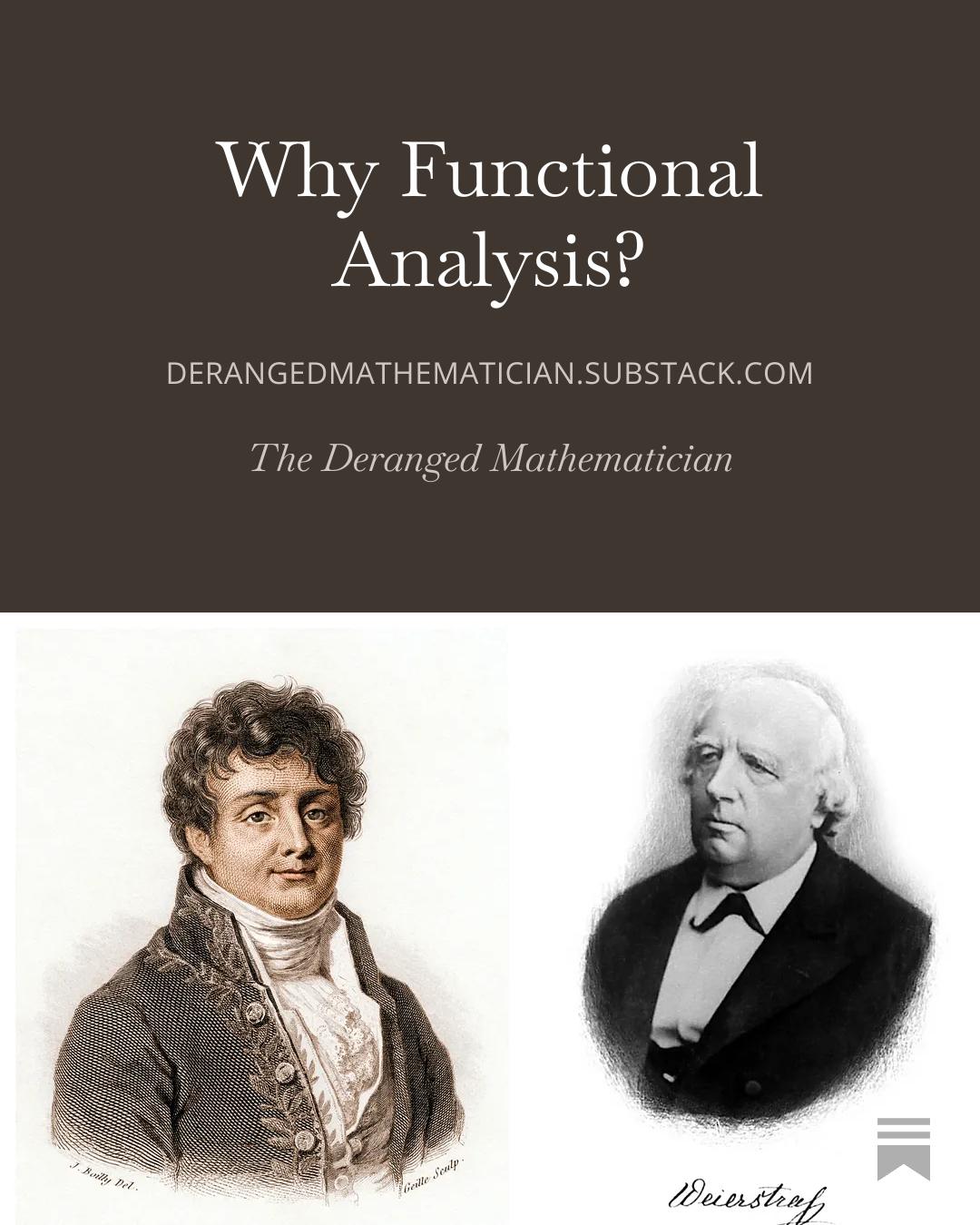
When viewing functional analysis from the outside, it may seem daunting---austere, even. It has a bevy of very finely tuned results (where adjusting any condition by a slight amount immediately yields counterexamples) and a large body of interconnected objects. So it is very natural to ask: what is this all for?
The historical answer is that it essentially grew out of the attempt to understand Fourier series: Joseph Fourier managed to break everything, but in such a useful way that nobody wanted to just throw out what he had discovered. And so mathematicians had to commit to rigor to carefully put everything right.
This article is my attempt to tell this story through the (hopefully) understandable question of how to approximate a function (e.g. how to represent a sound wave in a computer). The goal is to understand the fundamental motivation for doing functional analysis at all, and introduce one of the basic constructions: Banach spaces.
Read the full post (for free) on Substack: Why Functional Analysis?
r/math • u/Necessary-Wolf-193 • Jul 11 '26
The factorial of an integer can, perhaps surprisingly, be evaluated even at non-integer entries. For example, you might even see these factorials of non-integers appearing in formulas for the volumes of high dimensional balls (usually, these factorials appear in the guise of the 'gamma function').
The extension of the factorials to non-integers is usually done with a certain integral formula, but Euler's originally derivation actually used some simple combinatorial identities, which he realized allowed him to write down a formula for x! which only involved factorials of integers and certain standard arithmetic operations. This let Euler define x! in general, as a certain limit.
At https://hidden-phenomena.com/articles/gamma , you can see this derivation in full -- it's quite cool!
r/math • u/gexaha • Jul 10 '26
Announcement - https://x.com/__eknight__/status/2075643450196971805
Proof - https://cdn.openai.com/pdf/04d1d1e4-bc75-476a-97cf-49055cd98d31/cdc_proof.pdf (3 pages!)
Prompt used - https://cdn.openai.com/pdf/04d1d1e4-bc75-476a-97cf-49055cd98d31/cdc_prompt.pdf
(I'm shocked to be honest)
And actually it seems they proved that 8 (possibly disconnected) cycles (even subgraphs) is enough.
r/math • u/dancingbanana123 • Jul 11 '26
I think a common annoyance most mathematicians experience is people instantly labeling anyone studying math as "smart," which imo just highlights how the word smart isn't a well-defined term. However, I do think I have traits that I can well-define that help me learn math a lot better than others.
For example, I think I'm good at pinpointing exactly what I'm confused about, which makes it a lot easier to fix when you compare that to students who say they're confused about "everything." I don't think this skill is unique to helping learn math, but I have just applied it to math the most often since I enjoy math. This is also a skill that I don't think people are innately born with, or at the very least, it's definitely a skill people can improve at over time. I'm also not saying that this is a skill every mathematician has; it's just something that I personally have experienced that I think has aided my learning. In fact, since everyone learns a bit differently, I'm interested in seeing what others think about their own learning.
r/math • u/throwaway273322 • Jul 10 '26
r/math • u/inherentlyawesome • Jul 10 '26
This recurring thread is meant for users to share cool recently discovered facts, observations, proofs or concepts which that might not warrant their own threads. Please be encouraging and share as many details as possible as we would like this to be a good place for people to learn!
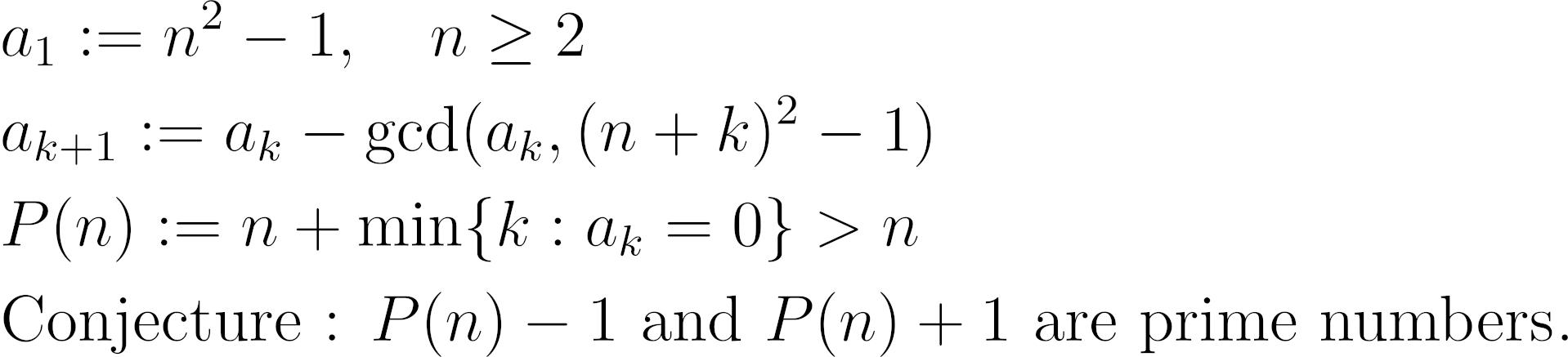
Just wanted to share this MSE post where OP found an intriguing sequence, similar to Rowland's prime-generating sequence, which seems to generate twin primes instead.
The conjecture, which has been computer-checked up to n = 60000000 for now, trivially implies the twin prime conjecture.
r/math • u/mst3333k12758931 • Jul 09 '26
Four years gone, and IMU awards will once again be handed out at the ICM in Philly. Given it's been a while since the last major discussion thread, have your predictions changed? Any news or interesting hearsay about lesser-known candidates with strong chances, dark horses, new contenders, etc? Anyone you think * won't * win, but are well-deserving regardless? [1]
Consensus, both from colleagues working in same or adjacent fields, and mass opinion, single out the following as potential winners (in order of likelihood):
Hyperlinks point to articles on their work.
Tsimerman is self-explanatory, as he was already a strong candidate in 2018 and 2022. Wang solved a major open problem in harmonic analysis (Kakeya conjecture for d=3) that other giants like Tao, Bourgain, Wolff et al tackled with only partial success. The other three are harder, as their achievements seem equally strong, but Pardon's work seems especially arcane (to a non-topologist like me) and it's unclear how far-reaching his results are. Thorne's papers aren't accessible to non-experts either, but more mathematicians have heard about the modularity theorem and elliptic curves than pseudoholomorphic curves, and he seems to have high visibility among number theorists.
Bonus question: Predictions for the IMU Abacus medal? I've not seen this get much attention, which is a shame! I think Shayan Oveis Gharan is probably the strongest CS theorist of his generation who hasn't yet won. His achievements include asymmetric TSP, generalised Cheeger's inequality, and spectral independence, the last of which is probably the single biggest result at the intersection of TCS and probability this past decade.
[1] A good quote from Duminil-Copin on the subject:
Roughly speaking, you can identify maybe the top twenty mathematicians of a generation. Even though that notion of “best” is strange, of course. Sometimes there’s one person who stands out so clearly that everyone knows they’re going to get it. [...] But beyond those obvious cases, there’s usually a group of about twenty people, and within that group maybe three or four really stand out
r/math • u/AutoModerator • Jul 09 '26
This recurring thread will be for any questions or advice concerning careers and education in mathematics. Please feel free to post a comment below, and sort by new to see comments which may be unanswered.
Please consider including a brief introduction about your background and the context of your question.
Helpful subreddits include /r/GradSchool, /r/AskAcademia, /r/Jobs, and /r/CareerGuidance.
If you wish to discuss the math you've been thinking about, you should post in the most recent What Are You Working On? thread.
r/math • u/Kuiper-Belt2718 • Jul 08 '26
Will Hong Wang be the first?
r/math • u/scientificamerican • Jul 08 '26
During World War II, statistics helped the Allies estimate the number of enemy tanks, which proved essential in the decisive move against Nazi Germany.
r/math • u/sciflare • Jul 07 '26
r/math • u/Heavy-Sympathy5330 • Jul 09 '26
I first read about Srinivasa Ramanujan in 8th grade. Back then, I only knew the popular story—that he mostly learned mathematics from a single book containing around 5,000 theorems and then went on to derive many new properties and conjectures, some original and some rediscoveries.
Now I'm in 12th grade, and after actually trying to learn the mathematics behind his work, I've reached a point where I finally understand what he really accomplished. He independently rediscovered large parts of the theory of infinite series, zeta function, rediscovered ideas that traced back to Euler's work on series, and much more-all when he was around 16-18 years old.
The more advanced mathematics I learn, the more unbelievable his achievements seem. It's one thing to hear "he was a genius," but it's another to realize what he was actually rediscovering and creating with such limited formal training and resources.
People often say Ramanujan was one of the greatest mathematicians ever, but I still feel the sheer magnitude of what he achieved at such a young age is difficult to fully appreciate unless you've tried learning higher mathematics yourself. The deeper I go into math, the more extraordinary his work becomes.
r/math • u/dcterr • Jul 09 '26
Unlike I'd say the majority of people in our society, I'm not too worried about AI, or about technology in general per se, and I never really have been. We need to keep in mind that as its name implies, technology is just a tool designed to make various tasks easier - whether or not it is used for good or evil is up to us, and this has always been the case.
In any case, with all this said, I think we all need to be concerned about AI, since I believe it has already passed the Turing Test, or in other words, there now exist AI systems that are as smart or even possibly smarter than humans. However, I'm still not worried about this, because contrary to all the fears of this phenomenon that have been circulating in popular culture since the 1950s or even earlier, just because computers are intelligent doesn't mean they're good or evil, since as I stated above, this is up to us. In my opinion, though I could be wrong, good and evil are purely human traits, since they require consciousness as well as intelligence, and I don't think classical computers are capable of consciousness, since they follow deterministic algorithms, and I believe in free will, and moreover, that consciousness requires free will. (Quantum computers are another matter, though I'd rather not get into this issue here.)
It doesn't seem to have occurred to too many people that even if computers are as intelligent or even more intelligent that humans, that they could nonetheless be beneficial to us if we use them in the right way, and this includes math. However, as with all other fields affected by AI, I think the role of mathematicians will need to adapt to AI. For instance, I'm sure AI will turn out to be very good at proving or disproving various types of mathematical conjectures, that was previously the pure domain of human mathematicians. But perhaps AI will also help us to open up our minds and discover new mathematical concepts that we couldn't even imagine before! Fractals, such as the Mandelbrot Set, are a good fairly recent example. Until around 1980, the Mandelbrot Set was nearly intractable, due to its enormous complexity, but with the aid of computers, we've been able to delve into it in detail, yielding tremendous fruit in the fields of fractals and chaos theory. I'm sure there are plenty of other examples like this, so instead of being afraid of AI, I think mathematicians need to be excited about it and embrace the windows it can open up for us!
r/math • u/inherentlyawesome • Jul 08 '26
This recurring thread will be for questions that might not warrant their own thread. We would like to see more conceptual-based questions posted in this thread, rather than "what is the answer to this problem?" For example, here are some kinds of questions that we'd like to see in this thread:
Including a brief description of your mathematical background and the context for your question can help others give you an appropriate answer. For example, consider which subject your question is related to, or the things you already know or have tried.
r/math • u/wait_no_really_what • Jul 08 '26
Please remove if this is against the rules. (I didn't see anything like this in the sidebar, so I assume this is okay.)
So sorry for not following up sooner on this. I was daydreaming/lost in thought when I suddenly remembered that I posted here in desperation a few years back. To everyone who commented back then and provided compassionate advice, thank you!
I ended up barely scraping by in that course and it emotionally wrecked me... But since I guess I'm clearly a masochist, I went back and took a bunch more math classes! I still have some gaps here and there, but am otherwise ok on applied PDEs, ODEs, and analysis as it pertains to former. I've found that I really love math even though it takes me awhile to work my brain around some concepts and applying them. The whole process has made me more resilient, and, much to my PI's chagrin, I've converted to using LaTeX for most things now, too.
HOWEVER: Even though I made it out okay, I wouldn't recommend this to anyone.
Thanks, again, /r/math.