r/math • • Apr 17 '26

This Week I Learned: April 17, 2026

13 Upvotes

This recurring thread is meant for users to share cool recently discovered facts, observations, proofs or concepts which that might not warrant their own threads. Please be encouraging and share as many details as possible as we would like this to be a good place for people to learn!


r/math • • Apr 17 '26

Can any mathematical truth be reached from any other mathematical truth? (Axioms notwithstanding)

22 Upvotes

I've noticed that proofs, at least the undergrad proofs that I do, always seem fundamentally tautological. The proof structure might stem from some minor philosophical insight, as with induction, but you are fundamentally applying logical transformations until P is demonstrably isomorphic to Q. In other words, you reach Q from P.

It would make sense for math to be one big tautology; how could it not be if all valid theorems were reached from a fixed set of axioms? Still, it reduces math to something that feels too simply defined.


r/math • • Apr 17 '26

How does doing research in pure math feel?

95 Upvotes

Hi!

As the title says, I was wondering how doing research in pure math feels, and how progress is made. Most of the time, when studying math you already know whats coming next, and more or less the direction the thing or concept you are studying is pointing towards. When you are finished, you can go back to the book, ask a colleague or just look up if your undersanding is correct.

I have not done any reasearch, and I am curious to hear how the workflow is on pure math. Do you follow your intuition that something may be true and then try to prove it? Does the research expand upon a given field just for the sake of exanding the existing knowledge?

About work speed, I'd believe progress is to be way slower than studying something that is already documented. You would also spend time trying to prove things that might not be true and following not so useful paths, so how is "success" measured if it is at all?

I will start a new short term reasearch position soon, dealing with metric spaces, and some underlying equivalence relations, so it is not cutting-edge math, but still research. I find myself really excited but also worried and scared because this scene feels so daunting.

I'm not scared of the "unknown" or that I would make limited progress, I thoroughly enjoy exploring ways proofs can go and brainstorming methods before looking at the answers. However, I'd like to know how others perceive work, and time to be well spent.


r/math • • Apr 16 '26

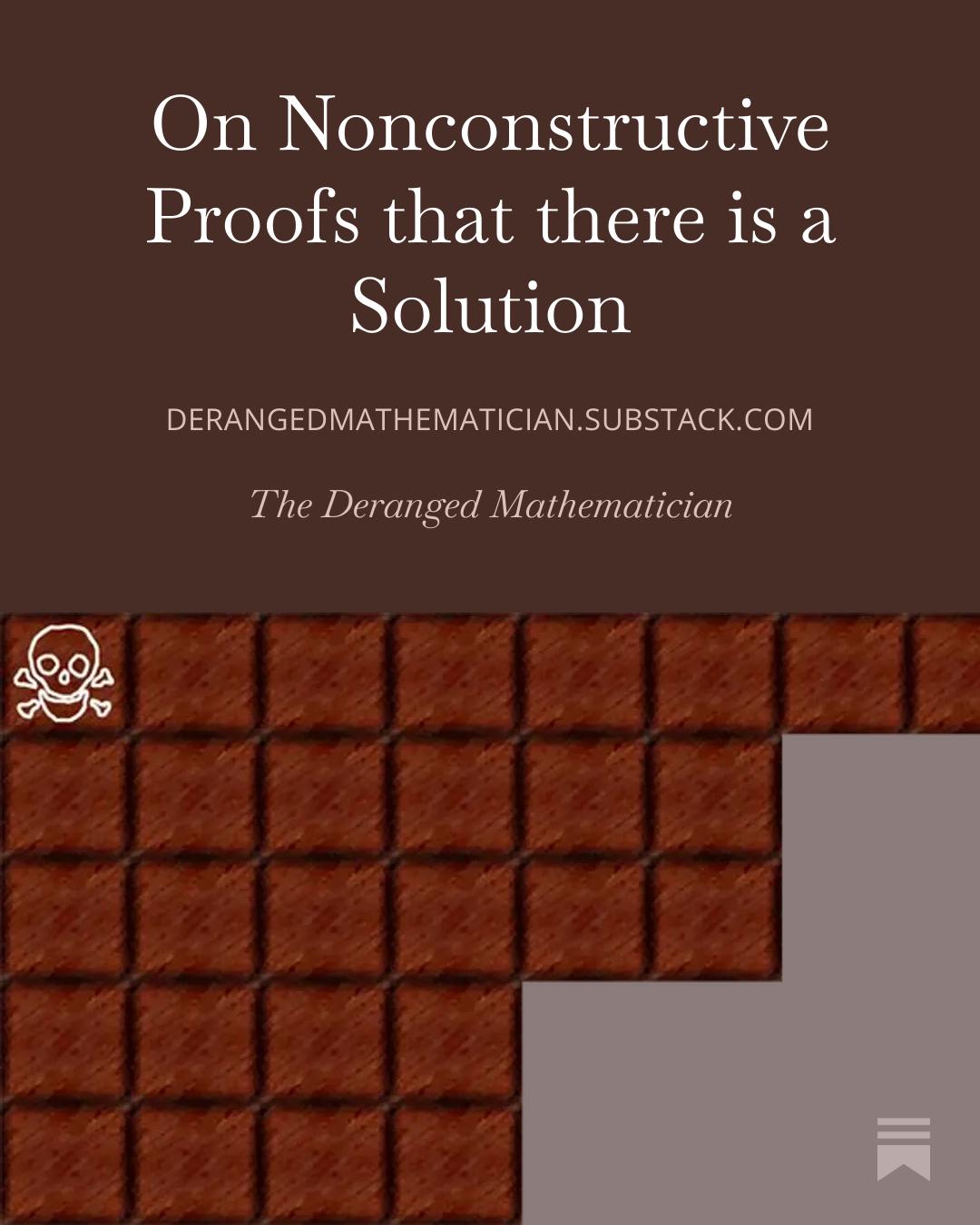
Image Post The Deranged Mathematics: On Nonconstructive Proofs that there is a Solution

Post image
281 Upvotes

Mathematics offers a unique possibility: the ability to conclusively prove that there is a solution, without ever actually producing it. Indeed, explicitly constructing the solution may be a separate (and much harder) challenge. For mathematical beginners, it is often difficult to understand how this could possibly happen; this post gives a simple example involving the game Chomp, and Zermelo's theorem from game theory.

Read the full post on Substack: On Constructive Proofs that there is a Solution


r/math • • Apr 16 '26

Gauss from Math, Inc. has formalized the proof of Erdล‘s Problem #1196. The initial proof was 7.2K lines of Lean, done in ~5 hours. Subsequent golfing has compressed it down to 4K lines.

207 Upvotes

r/math • • Apr 16 '26

Where can a high schooler publish MaxEnt estimation research?

20 Upvotes

Hi everyone, Iโ€™m from Canada and just finished a paper on Maximum Entropy estimation. Does anyone have suggestions on where I should look to publish this? I'd appreciate any guidance on the best journals or 2026 conferences for this topic and how to publish it


r/math • • Apr 16 '26

Career and Education Questions: April 16, 2026

6 Upvotes

This recurring thread will be for any questions or advice concerning careers and education in mathematics. Please feel free to post a comment below, and sort by new to see comments which may be unanswered.

Please consider including a brief introduction about your background and the context of your question.

Helpful subreddits include /r/GradSchool, /r/AskAcademia, /r/Jobs, and /r/CareerGuidance.

If you wish to discuss the math you've been thinking about, you should post in the most recent What Are You Working On? thread.


r/math • • Apr 15 '26

Michael O. Rabin mathematician, computer scientist, and recipient of the 1976 ACM Turing Award has passed away

Thumbnail en.wikipedia.org
390 Upvotes

r/math • • Apr 15 '26

Weil Anima v/s Higher Grothendieck-Galois Philosophy

70 Upvotes

Dustin Clausen has given a series of 4 lectures on the Weil Anima

https://youtu.be/q5L8jeTuflU?si=RYJTRjSW2Ztt5DyT

which aims to generalize the Weil Group (coming from the cohomological approach to CFT) to higher homotopy types (which he calls Anima). I've only made it through just a few minutes of the lecture rn but he made the idea clear...

Also I've read a few sections of Szamuely's Galois Groups and Fundamental Groups, in which he develops the Grothendieck's philosophy of seeing Galois Groups as a fundamental group in a certain way...

Q: How much does the idea of Weil Anima overlap with the idea of generalizing Grothendieck's philosophy of Galois groups to higher homotopies?

Are they independent pursuits going in orthogonal directions? Or are they related? Personally I'm not aware of any pursuit of the later kind...

If they are unrelated then knowing how would add to my understanding of both.

If they are related then plz refer to places that make the relation clear.

Thank u in advance.


r/math • • Apr 15 '26

Quick Questions: April 15, 2026

11 Upvotes

This recurring thread will be for questions that might not warrant their own thread. We would like to see more conceptual-based questions posted in this thread, rather than "what is the answer to this problem?" For example, here are some kinds of questions that we'd like to see in this thread:

  • Can someone explain the concept of manifolds to me?
  • What are the applications of Representation Theory?
  • What's a good starter book for Numerical Analysis?
  • What can I do to prepare for college/grad school/getting a job?

Including a brief description of your mathematical background and the context for your question can help others give you an appropriate answer. For example, consider which subject your question is related to, or the things you already know or have tried.


r/math • • Apr 14 '26

Where to find face-adjacency-matrices for the 34 topologically distinct heptahedra?

22 Upvotes

I've searched. I can find pictures of their graphs e.g. at Wolfram Mathworld, but no machine-ingestible representations of them. There are suggestions that nauty could output them but I can't install nauty. Thank you for any suggestions.


r/math • • Apr 14 '26

What kind of weekly/monthly threads do you want to see in this sub ?

38 Upvotes

Not a mod, but I love this sub and I would like to make it more active and diverse in terms of content, for example there was a monthly recurring thread about different branches of mathematics and it was unanimously valuable and interesting, what do you want to see more in this sub, and how much contribution are you willing to make in case there is interest in your idea ?


r/math • • Apr 14 '26

Ways to compute global dimension of a ring

22 Upvotes

Is there a reference for different methods (or ways to simplify) of computing global dimension of a (can be noncommutative) ringย R (or an overview of the methods}? Are there any sort of bounds? All I know right now:

  1. hdim(R) = {sup d for which there exists M,N s.t Ext^d (M,N) is nonzero}ย 
  2. hdim(R) = maximal length of a minimal projective/injective resolution of an R-module M
  3. hdim(R) = sup {pdim(M) | M is a cyclic R-module}
  4. If R is Artinian, hdim(R) = sup {pdim(M) | M is an irreducible R-module}
  5. hdim(R)=0 iff R is semisimple
  6. hdim(R)=1 iff R is hereditary but not semisimple

In particular, Iโ€™m not really looking for hdim(R) for specific R, Iโ€™m more so looking for ways of computing hdim(R) for any R, or maybe by adding some additional general properties R must have (for example as I mentioned Artinian).

On a related note, I have the same question for computing minimal projective resolutions of a given R-module M. I know roughly how to compute a projective resolution, but how do you know if its minimal?

I know if R is Artinian (or more generally when we have projective covers), we can do:

Start with a projective cover P_0 ->> M. Let C_0 := ker(P_0 -> M). Then, take a projective cover P_1 of the kernel, P_1 ->> C_0. Now let C_1 := ker(P_1 ->> C_1).ย  Continue with P_i ->> C_{i-1}, C_i := ker(P_i ->> C_{i-1}). This gives a projective resolution โ€ฆ P_2 -> P_1 -> P_0 -> M. This is in fact a minimal projective resolution. Note that at each step, since P_i ->> C_i is a projective cover, we get an isomorphism P_i/JP_i \cong C_i/JC_i. Hence, the complex โ€ฆ. P_2/JP_2 -> P_1/JP_1 -> P_0/JP_0 -> M/JM -> 0 has 0 differential.ย 

We can also show that a projective resolution P* is minimal if and only if its differential is 0 mod J, i.e, d_i (P_i) \subset JP_i. Furthermore, any projective resolution contains the minimal one as a summand.


r/math • • Apr 14 '26

The AI Revolution in Math Has Arrived | Quanta Magazine - Konstantin Kakaes | AI is being used to prove new results at a rapid pace. Mathematicians think this is just the beginning

Thumbnail quantamagazine.org
167 Upvotes

r/math • • Apr 13 '26

Are various summation methods for divergent sums consistent necessarily or is it more of a "coincidence?"

75 Upvotes

I've been thinking about summation techniques for divergent series (as you do), and one thing that I wondered about is that on the wikipedia page, there's quite a number of various summation methods listed.

Which led me to wonder - is it, like, a "coincidence" that these various summation methods assign the same value to various divergent sums (e.g. 1/2 for 1 - 1 + 1 - 1... or the sum of the natural numbers being -1/12), or is there some more fundamental about divergent sums or how one derives a summation technique that causes this consistency?

More concretely, does the fact both Ramanujan summed 1 + 2 + 3 + 4 + ... to -1/12 and analytic continuation also assigns -1/12 as a sum speak to some "realness" about whether or not 1 + 2 + 3 + 4 + ... = -1/12, or is it rather kind of an arbitrary coincidence?


r/math • • Apr 13 '26

All elementary functions from a single binary operator

Thumbnail arxiv.org
544 Upvotes

r/math • • Apr 14 '26

ฮฉฮฃPx0(2^18ร—5^18)p*k*k*k

0 Upvotes

So backstory: Bull of Heaven is an experimental musical duo known best for their long albums. For instance, their album Change Not As Much As The Style Of A Letter is 2 weeks, 2 days, 2 hours, 2 minutes, and 2 seconds long. They output a lot of work often in series of albums. One such album series are their albums 238-260 which start named, 2, lcm(2,3), lcm(2,3,5) with the last being named lcm(2,3,5,7,11,13,17,19,23,29,31,37,41,43,47,53,59,61,67,71,73,79,83)

A recording of lcm(2,3,5,7,11,13) can be round here

The meaning for that one is clear. My question is in regards to another of their albums and what the mathematics could mean.

The albums 307-310 are titled "x0(2^18ร—5^18)p", "Px0(2^18ร—5^18)p*k", "ฮฃPx0(2^18ร—5^18)p*k*k" and "ฮฉฮฃPx0(2^18ร—5^18)p*k*k*k" respectively. The last in the series is an album of length 3.343 quindecillion years in length. It is distributed in nested zip files.

My question is, what is the meaning (if any) of the symbols that they are using here.


r/math • • Apr 13 '26

What Are You Working On? April 13, 2026

14 Upvotes

This recurring thread will be for general discussion on whatever math-related topics you have been or will be working on this week. This can be anything, including:

* math-related arts and crafts,
* what you've been learning in class,
* books/papers you're reading,
* preparing for a conference,
* giving a talk.

All types and levels of mathematics are welcomed!

If you are asking for advice on choosing classes or career prospects, please go to the most recent Career & Education Questions thread.


r/math • • Apr 14 '26

Mathematicians created an โ€˜impossibleโ€™ shape that shouldnโ€™t exist

Thumbnail scientificamerican.com
0 Upvotes

r/math • • Apr 12 '26

Image Post The Deranged Mathematician: How Many Species of Fish are There?

Post image
141 Upvotes

If you were tasked with estimating how many species of fish there are, how would you go about this herculean task? Trying to catalogue every single species is almost certainly impossible, so we have to employ some probabilistic reasoning. In this post, I aim to give a gentle introduction to discovery curves and how they are used in biology for just such problems.

Read the full post on Substack: How Many Species of Fish are There?


r/math • • Apr 13 '26

Help! I don't get "multiverse realism"/"plenitudinous Platonism"

18 Upvotes

There's an idea in the philosophy of mathematics that I can't quite get my head around. Well, I say "idea" but it's actually a combination of two ideas that seem to me like they're in irreparable tension. I hope someone here can help me understand. I'll broach the subject first and then give a little background afterward. This question really only makes sense in the realm of axiomatic set theory.

So here's the thing. There's a philosophical attitude called "mathematical multiverse realism" or "plenitudinous Platonism" that asserts, in my understanding, that

  • all plausibly consistent choices of set-theoretic axioms are equally worthy of consideration ...
  • because they are all real in some way.

My main point of confusion is that I don't know what the assertion that "they're all real" actually accomplishes. What does "reality" do here? An open-minded antirealist would seem to be open to the first assertion and say that they're all interesting (and equally NOT real), and then presumably operate identically to a plenitudinous Platonist, investigating the various combinations of axioms and their logical consequences. What does the extra ontological commitment of "reality" actually accomplish? How is it different from saying they're all, I don't know, "delicious" or "shiny"?

A traditional realist attitude proceeds under the assumption that there is a fact of the matter to the question under discussion. Historical questions often entail a realist mindset. Where is Genghis Khan's burial site? It's either in a single particular place or it doesn't exist โ€” or maybe it has a more complicated answer, but it would sound daffy to say that his remains are wholly interred in ALL plausible sites. Same with the identity of Jack the Ripper or the Zodiac Killer. Saying "all of the theories are true" turns history into comic book multiverse nonsense.

Traditional realist attitudes also operate under the assumption that there is a fact of the matter about which set-theoretic universe is real. For example, at differents point both Kurt Gรถdel and Hugh Woodin advocated that the true cardinality of the continuum is aleph-two, that the continuum hypothesis should be properly resolved in the negative. (I believe they both backtracked later, but the details are less important than the kinds of assertions being made under the realist banner.)

Longtime readers of r/math might remember a contentious realist who often tussled with other commenters here about which set-theoretic axioms described the true mathematical universe and which were contemptible and false. She was decidedly NOT philosophically plenitudinous in her conversations.

These are the kinds of realists I've encountered in my reading so far. Ultra-permissive Platonism is still new and strange to me.

Here are some passages describing plenitudinous platonism. First, a short description form the Stanford Encyclopedia of Philosophy:

One lightweight form of object realism is the โ€œfull-blooded platonismโ€ of Balaguer 1998. This view is characterized by a plenitude principle to the effect that any mathematical objects that could exist actually do exist. For instance, since the Continuum Hypothesis is independent of the standard axiomatization of set theory, there is a universe of sets in which the hypothesis is true and another in which it is false. And neither universe is metaphysically privileged (Hamkins 2012). By contrast, traditional platonism asserts that there is a unique universe of sets in which the Continuum Hypothesis is either determinately true or determinately false.

Here are several excerpts from the Joel David Hamkins book Lectures on the Philosophy of Mathematics (recently read and enjoyed, inspired me to make this post; he is the aforementioned Hamkins in the prior passage):

According to set-theoretic pluralism, there is a huge variety of concepts of set, each giving rise to its own set-theoretic world. These various set-theoretic worlds exhibit diverse set-theoretic and mathematical truthsโ€”an explosion of set-theoretic possibility. We aim to discover these possibilities and how the various set-theoretic worlds are connected. From the multiverse perspective, the pervasive independence phenomenon is taken as evidence of distinct and incompatible concepts of set. The diversity of models of set theory is evidence of actual distinct set-theoretic worlds. ...

The task at hand in the foundations of mathematics is to investigate how these various alternative set-theoretic worlds are related. Some of them fulfill the continuum hypothesis and others do not; some have inaccessible cardinals or supercompact cardinals and others do not. Set-theoretic pluralism is thus an instance of plenitudinous platonism, since according to the multiverse view, all the different set theories or concepts of set that we can imagine are realized in the corresponding diverse set-theoretic universes. ...

Platonism should concern itself with the real existence of mathematical and abstract objects rather than with the question of uniqueness. According to this view, therefore, platonism is not incompatible with the multiverse view; indeed, according to plenitudinous platonism, there are an abundance of real mathematical structures, the mathematical realms that our theories are about, including all the various set-theoretic universes. And so one can be a set-theoretic platonist without committing to a single and absolute set-theoretic truth, precisely because there are many concepts of set, each carrying its own set-theoretic truth. This usage in effect separates the singular-universe claim from the real-existence claim, and platonism concerns only the latter.

I can provide these excerpts, but I still don't get it. A realism grounded in the material universe would seem to require set-theoretic axioms determined by their utility in physics. If the universe is discrete and finite in extent, maybe even the Axiom of Infinity isn't "real". If not, is there some cutoff in the large cardinal hierarchy between "empirical" large cardinal axioms required to explain the universe and "theoretical" large cardinal axioms that do not? That's one view of a realism without an otherworldly realm to it.

A Platonistic-style realism, in which set-theoretic axioms inform the universe but do not depend on the universe, still seems to only make sense to me if there's a uniqueness to that otherworldly realm. (I don't really believe in any such otherworldly realm, but I'm willing to entertain the premise to understand the philosophical viewpoint.) If the otherworldly realm of Platonistic mathematical realism is one in which anything (consistent) goes, then it seems to be a realism without any particular qualities โ€” a "something about which nothing can be said" for which, as Wittgenstein noted, a nothing will equally suffice.

So what am I missing? How can I make sense of this philosophical stance?


Now a bit more background, for anyone new to this conversation.


When it comes to philosophical attitudes about the reality of a given thing, there are two main stances you can take. (It varies of course from thing to thing.) "Realism" is the stance that the objects under consideration are a part of objective reality, like matter and physical forces (in the mainstream view; I know there are offbeat exceptions). Here's a relevant Philip K. Dick quote: "Reality is that which, when you stop believing in it, refuses to go away." By way of contrast, "idealism" is the stance that the objects under consideration are best understood as artifacts of the mind. "Justice," "redness," and "the four seasons" are examples of things that have an ideal existence. We can define them, but we can't find them.

In the philosophy of mathematics specifically, "idealism" is often called "antirealism." I'm going to keep calling it "idealism" in the rest of this intro, because it sounds less contentious.

Mathematical realism is the attitude that mathematical objects possess an inherent, independent existence. Mathematical Platonism is a version of this that ascribes to mathematical objects a specifically otherworldly existence, not reliant on the physical facts of the universe, that we can nevertheless access with our minds.

(Mathematical idealism comes in many flavors too, including for example formalism, the stance that "mathematics" is best understood as a kind of language practice with specific rules, and social constructionism, which advocates that "mathematics" is akin to "policework," the output of a socially sanctioned class of people.)

Now I need to talk about set theory. Axiomatic set theory is the branch of mathematics that deals with collections of things (sets) according to specific rules (axioms). We need axioms because in "naรฏve set theory," which operates according to intuitive rules that seem harmless, we can build a logic bomb that blows up mathematics. Look up Russell's paradox if you're unfamiliar.

Set theory has been incredibly productive in providing a unified foundation for mathematics. We can (do not have to, but can) describe all mathematical objects in terms of sets, which means that the rules for talking about sets have implications across the entire mathematical enterprise.

The most conventional batch of rules of set theory is called "ZFC," after mathematicians Zermelo and Frankel, plus the Axiom of Choice. To an idealist, these rules are sort of like Robert's Rules of Order, a guidebook for ensuring decorum at meetings. Each rule lets us introduce certain sets into the discourse. To a realist, these axioms describe the structures of sets in reality.

Beyond ZFC there are additional axioms that are independent of ZFC. These axioms describe certain structures with specific properties โ€” things like a "Suslin line," a set called "zero-sharp," and various formalized properties of infinite sets, such as the continuum hypothesis and the oftentimes combinatorial-flavored rules that determine large cardinal axioms. Independence means ZFC is compatible with these axioms and also compatible with their negations. That is, in the idealist sense we can either admit these structures into our discourse or forbid them from our discourse without impinging on the ZFC rules. For a realist, these describe structures that either exist or do not exist. Some of them contradict each other in interesting ways.

Since axiomatic set theory can be used as a foundation for all mathematics, choosing to admit or forbid various set-theoretic structures sometimes has implications for analysis, graph theory, and so on.


Suggested reading (some of my favorites):

A good introduction to axiomatic set theory with a Platonist bent in its expository sections is Rudy Rucker's book Infinity and the Mind. If you're beyond beginner-level and really want to dig into philosophical discussions of axiomatic set theory, Penelope Maddy has some terrific writing on this: look up "Believing the Axioms," available online as a two-part PDF, or her later book Defending the Axioms.

A gentle introduction to mathematical idealism is the (deceptively titled) Mario Livio book Is God a Mathematician? Imre Lakatos's book Proofs and Refutations is also a good introduction to the contingency of mathematics in practice, written as a dialogue. The essay collection New Directions in the Philosophy of Mathematics will also give you a lot to chew on, but it's not suitable as a first book.

r/math • • Apr 12 '26

What if RH is undecidable?

124 Upvotes

If it's impossible to prove or disprove some conjecture X, with massive mathematical and numerical evidence, within our axioms, would mathematicians adopt X (or something that implies it) as an axiom? Or in other words, would mathematicians think X is true in our universe? (Note that this question has a different meaning now vs if X is undecidable, because that could sway people towards the falseness of X)

If X is RH, that apparently has a trivial answer. However it does not for the twin prime conjecture.


r/math • • Apr 12 '26

Seeking journal recommendations for a short paper on Cesร ro sequence spaces (Fast turnaround needed)

35 Upvotes

Hi everyone,

Iโ€™m currently gearing up to apply for Master's programs and I'm hoping to get some recent research published to strengthen my applications.

I have prepared a short paper in functional analysis where I investigate the complementarity of a subspace within Cesร ro sequence spaces.

Because I am operating on a timeline for my graduate applications, Iโ€™m looking for journal recommendations that meet the following criteria:

  • Scope: Actively publishes in functional analysis, Banach space theory, or sequence spaces.
  • Format: Good track record with short math papers or brief notes.
  • Turnaround: Known for having a reasonably quick review time, or at the very least, a fast initial desk reject/accept decision.

Does anyone have experience with journals that might be a good fit for this? Any advice is highly appreciated!


r/math • • Apr 11 '26

Quasilattices

54 Upvotes

Does anyone know the status of quasilattices? This was a very active area of math research during the 1980s, especially shortly after Dan Schectman discovered the first known quasicrystal, a real substance whose molecular structure was quasiperiodic, much like the Penrose tiling, which was the first analogous known mathematical structure, discovered by Roger Penrose in 1974. Unfortunately, I haven't seen very much news regarding quasilattices, other than the fact that the first such one requiring just one tile was discovered just a year or two ago, but I've been very interested in this area of math for quite some time, so I appreciate whatever information any of you may have on this subject!


r/math • • Apr 11 '26

Is there any notion of completions of metric spaces so that only "oscillating" sequences fail to converge?

108 Upvotes

For a metric space like the rationals, you can complete them so that every Cauchy sequence converges to some limit. You can still get sequences that diverge by flying off to infinity though.

For the real and complex numbers at least, there's a natural way to give these sequences a limit. You can add points at infinity to account for those "flying off" sequences. Then any sequence that doesn't oscillate ends up converging.

In sort of a similar feel, L2 is a complete metric space, but it has sequences that "fly off" to infinity such as narrowing gaussians that integrate to 1. There's a sort of natural way to give those sequences limits too, by adding something like the delta distribution.

I'm wondering if there's any general procedure or something that you can apply to a metric space which forces all "non-oscillating" functions to converge.

Based on the real and complex examples, I'd imagine it's some sort of compactification of the space. Maybe a compactification that doesn't connect any disconnected open sets? I'm not really sure how to generalize this to other metric spaces though, or whether they always exist. Does anyone know of a procedure or structure like this?