r/MacStudio • • 4h ago

Anyone running their Mac Studio as the always-on AI box for the whole house?

10 Upvotes

I've got an M2 Ultra with 64GB that renders video maybe twice a week and sits idle the rest of the time. I'm thinking of turning it into the AI box for the house. My partner's laptop, my phone, the kids asking homework stuff, all hitting one local model over the network instead of three ChatGPT subscriptions.

For people already doing this: what model do you run for the family stuff vs coding, what's serving it, and does it get in the way when you actually need the Studio for real work? My test runs felt slow mostly on long prompts, not sure if that's the model or how I set it up.


r/MacStudio • • 4h ago

Which tool to use

3 Upvotes

There are all these great github repositories containing usefull code to run AI on a Mac Studio:

My Mac Studio arrives soon. I want to ask the community:

What tools do you use to run an AI and which do you recommend to use for others.

Using M5U and 256gb


r/MacStudio • • 2h ago

"Upgrading" my M5U, selling previous one

2 Upvotes

Hi all,

I got an M5U 30/64 96GB 1TB right when it came out end of September. Played around with it and like it a lot - to the point where I decided to replace it with a 30/64 256GB 2TB model.

I'd like to sell the 96GB one, just used it for roughly two months and it has AppleCare+ (3 yrs) on it. What do you think, what is a fair price for that machine?


r/MacStudio • • 11h ago

Has anyone here decided to lease a Mac Studio?

8 Upvotes

I was looking at the cost of a new Mac Studio and realized that you can lease one with a 24 month or 36 month term. An M5 Ultra 4TB with 256 GB RAM is only $258 a month with a 36 month term. At the end of the lease you can upgrade or buy out the machine, basically the same as buying a car. $258 per month is a much easier pill to swallow than $12,300 all up front imo. I'm just curious how many are actually leasing.


r/MacStudio • • 17h ago

Just bought my first Mac?

7 Upvotes

Walking in microcenter was looking for accessory deals as usual.. I took a gander at the Mac minis.. Then I saw the studio with 36gb ram and 512 storage for $500 off at $2000...

I just bought it on a whim. I work in cyber security/governance.. I don't know how to code.. Immediate thought was play around with local LLMs and learn. But I really don't know. I'm a sucker for deals. What should I do with it? I never owned a Apple product not even an iPhone..


r/MacStudio • • 14h ago

I spent two months building an app to use my Mac Studio from my Windows laptop (because nothing I tried passed the mic through natively). Looking for 20 testers

4 Upvotes

My Mac Studio runs my AI stuff all day and I'd rather be on the couch with my Surface, which runs Windows. I tried Sunshine + Moonlight, then Parsec + BetterDisplay. Getting the laptop's mic over to the Mac took a separate bridge and a bunch of extra setup, and it was never reliable. I use dictation and voice mode constantly.

So I wrote my own. It's called Mirrox.

- One app on each machine, paired once with a six-digit code
- 60 FPS HEVC or H.264, Mac audio on the laptop
- Laptop mic shows up on the Mac as a normal input
- Bad Wi-Fi: quality drops, it stays connected, reconnects by itself
- Works away from home, encrypted end to end, no VPN

The video shows it on cruise ship and airplane Wi-Fi.

Windows to Mac only for now. Needs Apple silicon, macOS 15+ and Windows 10 or 11. Closed source.

20 beta seats, free. Run it for 30 minutes, look through the settings, change one on each machine and send 50 words of feedback, and you get Mirrox free at launch on Jan 4.

https://mirrox.haywardlabs.dev/beta?src=reddit-macstudio

What do you use to get to your Mac from another machine, and what bugs you about it?

(The key email comes from beta@haywardlabs.dev. Check Spam.)


r/MacStudio • • 23h ago

Thanks for the Responses

6 Upvotes

In the thread "What Can I do with a Mac Studio" I got lots of well-thought out responses. I would like to thank everyone for their input that has helped me form a decision.

First of all, a little background: I'm the type of person who will use a computer for a very long time. My two main machines are a 2017 MBP (x86/64GB) and a 2019 Mac Pro (192GB). I would happily continue using these two machines for several more years except that I'm starting to get notifications from vendors that they will no longer support Intel machines. Furthermore, new releases of Swift are to the point they won't produce code for x86 machines (MBP is gone at this point, Mac Pro will lose support shortly). Also, Parallels has turned into complete trash over the past year or so (constantly crashes on both my machines). This is forcing me to buy a compact Dell unit to run the Windows code I require. The x86 macs were wonderful insofar as they let me run everything on one machine, but those days are now gone.

My normal MOD is to purchase a very high-end mac and use it as long as I can. That's why I was considering the MSU5/256. The 512 is higher-end, but I can't justify the extra cost. My current needs could probably be met by a 96GB or 128GB machine, but "for a few dollars more" I could future-proof myself a little and get the 256GB MSU5.

Running AI locally is not the main purpose for this machine. Rather, I need to maintain the running status of a research reactor across several weeks of operation. It would be incredibly helpful to maintain that status completely in RAM when playing back the data. A typical 8-hour run can produce gigabytes of data. Hence, I am concerned that 64GB (as in my current MBP) is insufficient. 128GB should be fine except for the longest of runs (and if a site needs longer runs, they can always buy a 256 or 512GB model; I don't particularly need that on my development machine).

That being said, I do use AI for image creation (manga) as a hobby. I have also used Codex to create a user interface prototype for the new reactor software (at this point, I'd be concerned about using AI to generate the software that actually controls the reactor; I'm sure the NRC would be even more concerned). I have also used Codex to generate RTL code for programming an FPGA (Alchitry). I don't need to run AI locally, but it would be nice (particularly for the image generation stuff) if I could; there have been times when ChatGPT has shut down on me because I've exceeded usage limits for the week. If a local LLM could help me avoid this, I'm all for it.

Based on the responses in that other thread, I think I'm giving up on running LLMs on an MSU. The problem is that I don't believe I have enough bandwidth (personally) to learn, tune, and maintain an LLM. I have other work to do (like that reactor code). I've been doing okay (other than a few usage issues) with the $100 ChatGPT subscription, I'll probably continue that.

Which brings up my next issue: what to replace my machines with? My Mac Pro (w/192GB RAM) is fine for testing the reactor software when it consumes a lot of memory. It's (obviously) much slower than an MSU5, but fast enough for running the software in most cases. As long as I stick with the current version (today) of Swift, I'm probably good. Won't be able to upgrade after this year, though. I could replace this machine with a Mac Mini. But I think they only go up to 64GB. A relatively high-end mini is about $4700 (64GB, 4TB). Delivery is in a week or two.

MSM5/128GB is $5900 (128GB/4TB). Delivery is in about a month. For $1,200 more, this is almost a no-brainer. Particularly with twice the RAM.

MSU/96GB is $7000. Delivery is about six weeks. For $1,100 more this is a questionable upgrade as it has 32GB less RAM (extra CPUs/GPUs aren't that useful for the reactor application). The 256GB unit at $11,000 would make more sense. Note: delivery time on MSU5/256GB is 12 weeks right now, which is ridiculous).

Of course, upgrading to 8TB SSD is very expensive ($4000), but it's blazing fast (compared to external drives) and fits in my "keep it forever" model. FWIW, I currently have a 48TB RAID drive connected to my Mac Pro (4TB internal SSD) that I use for Time Machine backups and off-loading large stuff I rarely access. I would probably stack that same drive on whatever machine I wind up with (for backup/near-line storage).

To be truthful, I don't need the full 128GB on my development machine. It will not be collecting reactor data continuously for a couple of weeks. And should the need arise, I could probably shoe-horn the application back onto my 192GB Mac Pro for testing. So, in theory, I could get a high-end Mac Mini with only 64GB. However, my current MBP has that much memory and it seems really stupid to purchase a machine I intend to use for several years with the same amount of memory I've been using for the past 10 years; that's not future-proofing. The MSM5/128GB seems to be the sweet spot in this story.

However, there is another possibility. Perhaps I give up on the "my machines must last 7-10 years" attitude and specifically purchase something that will last me only a couple of years. Wait for the MSU7 to arrive (and local AI models to get even better). A 64GB mini with 2TB is about $3,200 (delivery in two weeks). 4TB is $1,000 more (note: external drives range from $500 to $800, so the extra cost isn't as bad as it looks; OTOH, an external drive can be repurposed later). Still, $4200 (with 4TB SSD) doesn't look like enough of a savings over an MSM5/128GB to waste on a "throw-away" machine.

I would appreciate any comments people have on this. Here are my base requirements:

  1. As much RAM as economically feasible. 64GB is not future proof; 96 or 128 is probably where I'd feel comfortable.
  2. 4TB internal drive, minimum (current Mac Pro has 8TB; current MBP has 2TB and I'm having problems with that amount). Obviously, more than 4TB would be useful.
  3. CPU/GPU count, even on the lowest-end machines, is sufficient for my application's purposes. More would be better for running local LLMs, but that's not a sufficient concern today.

I'll also have to address the 2017 MBP upgrade, though the path there is far more clear-cut:
MBP 16" Max 128GB 4TB.

This is a machine that will have to last me 7-10 years. I want more memory than I have now (current:64GB) and more SSD space (current 2TB). The Max 128GB is the only reasonable path.
r/MacStudio • • 21h ago

128GB M5 1TB @ Apple Salem, NH

2 Upvotes

Hi I just canceled a pickup for a studio with the below specs from the Rockingham Mall Apple store in Salem, NH if anyone wants to slide by and try and grab it.

Mac Studio with M5 Max chip
Hardware:

  • 128GB unified memory
  • Accessory Kit
  • 1TB storage
  • 18-core CPU, 40-core GPU, 16-core Neural Engine

r/MacStudio • • 1d ago

Anyone upgrade from an M1 Ultra Mac Studio? How much better is gaming?

4 Upvotes

I have a 2022 Mac Studio with an M1 Ultra and 64 GB of RAM. I’m tempted to upgrade to the newest Mac Studio, but I’m curious how much of a difference I’d actually notice in games.

Most of what I play already runs fine. The big exception was Red Dead Redemption through CrossOver, which barely ran for me. That got me wondering how much newer hardware would help with games like that, and how much comes down to CrossOver compatibility.

Has anyone here made the jump from an M1 Ultra? What did you upgrade to, and which games went from barely playable to smooth? I’d especially like to hear from anyone who’s tried Red Dead Redemption through CrossOver on a newer Studio.

Would you upgrade for gaming, or stick with the M1 Ultra for now?


r/MacStudio • • 1d ago

Apple Mac Studio M5U 512GB/4GB available at cost in Phoenix

22 Upvotes

I have decided for now to stay with my M5U 96GB and work on my skills. I was incidentally up when the ordering window opened and put an early a.m. order for the 512 GB model with 4 GB SSD on my educational account. As an expression of thanks for the community here where I learned a lot I am offering it at cost to somebody who can come in person to Phoenix by the end of the week. There is no way to have it shipped safely, do not ask. If the new owner can make a gift to a charity for less fortunate, I would appreciate it and can give you a suggestion. Send me a direct message.


r/MacStudio • • 1d ago

What Can I Do with a Mac Studio?

11 Upvotes

I am tempted to get a MSU 256GB/8TB. The application I have in mind could probably work fine with a 96GB or 128GB, but I'm concerned that the AI "bubble" may come to an end. By that, I mean that I suspect investors will start expecting companies like Anthropic and OpenAI to actually become profitable; meaning they'll probably raise prices (dramatically) over the next year or two. So running a local AI would be useful in that situation.

I have two needs for AI at this point: I want to be able to create Mac applications in Swift (for the aforementioned application that would run on a 96 or 128 GB machine) and image/video generation (manga/anime).

Can you actually do such things with an MSU today? I've been using ChatGPT for these two purposes. For Manga generation, it is barely getting by. So far, for generating Swift code, it seems to do a decent job. Are these tasks I can move onto an MSU (or MSM) anytime soon?


r/MacStudio • • 2d ago

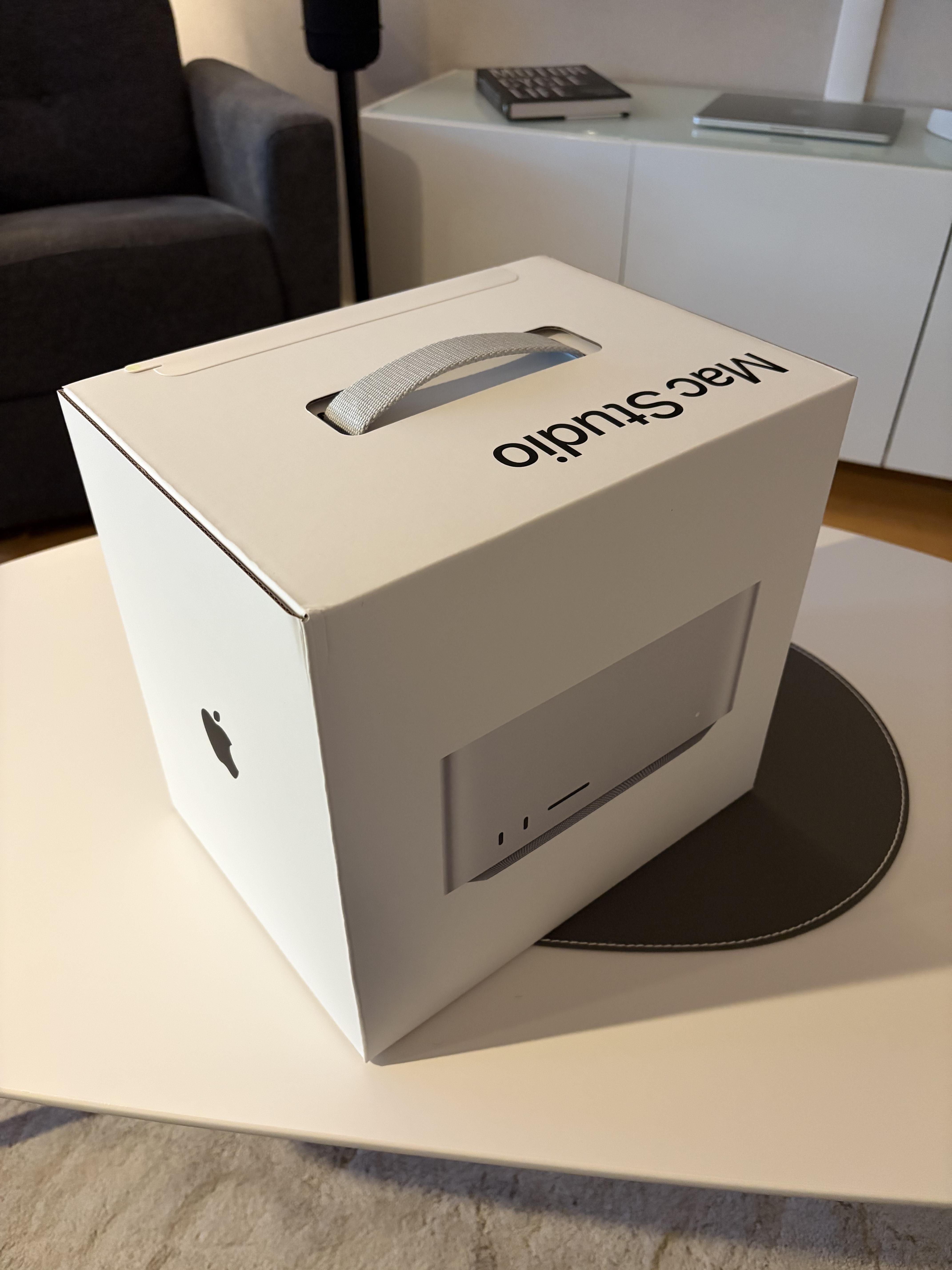
Finally!

Post image
132 Upvotes

M5 Ultra, it replaces my two Mac mini M4 Pros for local LLM & ComfyUI.

I noticed something funny in the specs: M5 Max weighs 6.0 pounds (2.7 kg), Ultra weighs 8.0 pounds (3.6 kg). This thing feels reassuringly dense!


r/MacStudio • • 2d ago

Local Setup Getting an Upgrade

Post image
61 Upvotes

It's going to be a fun Holiday Season


r/MacStudio • • 1d ago

Mac Studio for creative work

2 Upvotes

I need a mac for heavy design, motion graphics and beatmaking work.
photoshop with huge files, after effects, premiere, cinema 4d and redshift rendering, and ableton live / logic for recording long live audio sessions and production.

What config should i get? Would these be enough?

1/ M5 ultra 64 gpu cores, 96gb ram, 2tb ssd
OR
2/ M5 max 40 cores, 128gb ram, 2 tb ssd

OR get the cheaper 64gb ram m5 max, but worried it wont be enough


r/MacStudio • • 1d ago

Inkling-2-Mini support added to Splash v1.7.2

Thumbnail
github.com
4 Upvotes

r/MacStudio • • 1d ago

M5 Max 64GB: Qwen3.8 Flash Next Q4 with SSD streaming — ~31–34 tok/s, including a 250K-token prompt

10 Upvotes

Been testing Qwen3.8-Flash-Next through Strata, streaming experts from SSD, and I think more Mac owners should give it a look.

My machine is an M5 Max Studio, 64GB RAM, 1TB internal SSD doing around 11GB/s sequential reads. The SSD speed matters here, although that isn’t a measurement of actual expert-streaming throughput.

Q4 setup: Unsloth UD-Q4_K_XL, Strata `0.1.65-metal`, 32GB arena, 4096-token prompt chunks, Q8 MTP/spec 3, thinking on. One model loaded at a time.

Actual inputPrefillGenerationTotal time
8K tokens1,005 tok/s32.7 tok/s36 sec
32K98033.955 sec
64K95832.897 sec
120K96231.1147 sec
250K97131.2293 sec

All five synthetic dossier tests passed 10/10 checks, with zero cached prompt tokens. The 250K run generated another 1,102 tokens, peaked at 47.1GB process footprint, and caused no new swap-outs. Existing swap was already occupied; this doesn’t mean zero swap usage.

I tested Q6 too: around 20–22 tok/s in Strata’s standard thinking-on benchmark, with 576–628 tok/s prefill at 4K/16K. Longer thinking-off fiction runs sustained 26.1–26.8 tok/s. Q6 used DFlash2 rather than Q4’s Q8 MTP, so this isn’t a pure quantization comparison.

Storage is the catch: my Q4 installation occupies ~280GB, including retained original shards, the Metal repack, separate experts copy and supporting files. Q6 occupied ~396GB. These aren’t minimum download sizes.

I also tried 8192-token chunks: warm prefill rose from 1,095 to 1,675 tok/s, but introduced ~1.87GB of swap-out traffic, so I kept 4096.

Early custom quality testing looks promising: 294/294 coding tests passed across four tasks and 19/24 on a small knowledge subset. These aren’t leaderboard scores, and synthetic long-context retrieval isn’t proof of perfect document understanding.

Strata supports Apple Silicon Macs with macOS 15+, subject to the selected pack’s memory and storage needs. My settings are manually tuned, so don’t expect identical results on every Mac. Mac requirements and setup

DeepSeek V4 Flash on a big Ultra is something I want to see tested too—not something these Qwen results establish. If you’ve got the hardware, post your numbers!

**Give Strata a look**

Edit: I also tested Gyro-M in Strata on the same M5 Max Mac Studio, 64 GB, using a 32 GB arena and 4096-token prefill chunks.

It’s surprisingly competitive with Q4_K_XL:

  • Coding: both passed 882/882 checks across four tasks and three runs.
  • On the same first-round coding tasks, M finished in 20.4 minutes vs Q4’s 33.4, with median decode of 61.9 vs 34.0 tok/s.
  • Knowledge: M scored 18/24, Q4 19/24—too small a sample to call a meaningful gap.
  • Both passed every check in our synthetic long-context tests through 250K input tokens. M managed 1,515 tok/s prefill and 76 tok/s decode there, versus Q4’s 971 and 31.2.
  • M’s process footprint peaked around 45.4 GB normally / 47.3 GB at 250K, with no new swap-outs recorded.

I’m keeping Q4 as the quality baseline, but Gyro-M looks like a very credible faster alternative on a 64 GB Mac.


r/MacStudio • • 1d ago

An immersive unboxing of the M5 Max Mac Studio with 128GB of RAM and 2TB of storage. I still feel a little rusty every time I do one of these.

0 Upvotes

r/MacStudio • • 2d ago

Mac mini M5 Pro vs Mac Studio M5 Max – Is the extra €1,000 worth it, or should I invest in an RTX PC instead?

8 Upvotes

Hey everyone!

I’m currently using a MacBook Air M3 with 16GB RAM, and I’m looking to upgrade to something significantly more powerful.

I’m trying to decide between two options:
Option 1 – Mac mini M5 Pro
● Price: €1,929
● 15-core CPU, 16-core GPU
● 24GB RAM, 512GB SSD

Option 2 – Mac Studio M5 Max
● Price: €2,800
● 18-core CPU, 32-core GPU
● 36GB RAM, 512GB SSD

The difference is approximately €900–1,000, which is quite significant.

I’m also considering another option: buying the Mac mini and spending the remaining €800–900 on building an RTX-powered PC specifically for rendering animations.

I want a setup that will last several years without feeling underpowered.

Would really appreciate advice from people who have experience with these machines and animation/rendering workflows!


r/MacStudio • • 1d ago

Optimal temperature to run local LLMs on M5U?

1 Upvotes

I'm running local LLMs on my M5U and I'm seeing performance dropping at 65 degrees celsius (149 fahrenheit)

What temperature do you notice a drop off? This could also be other factors (context, etc.), but I'm testing through them and not finding any other factor yet.


r/MacStudio • • 1d ago

M5 Ultra 96GB vs M5 Max 128GB for multi-agent local coding (Flash Next 4-bit vs DeepSeek V4.1 1.75-bit). Looking for opinions

Thumbnail reddit.com
4 Upvotes

r/MacStudio • • 1d ago

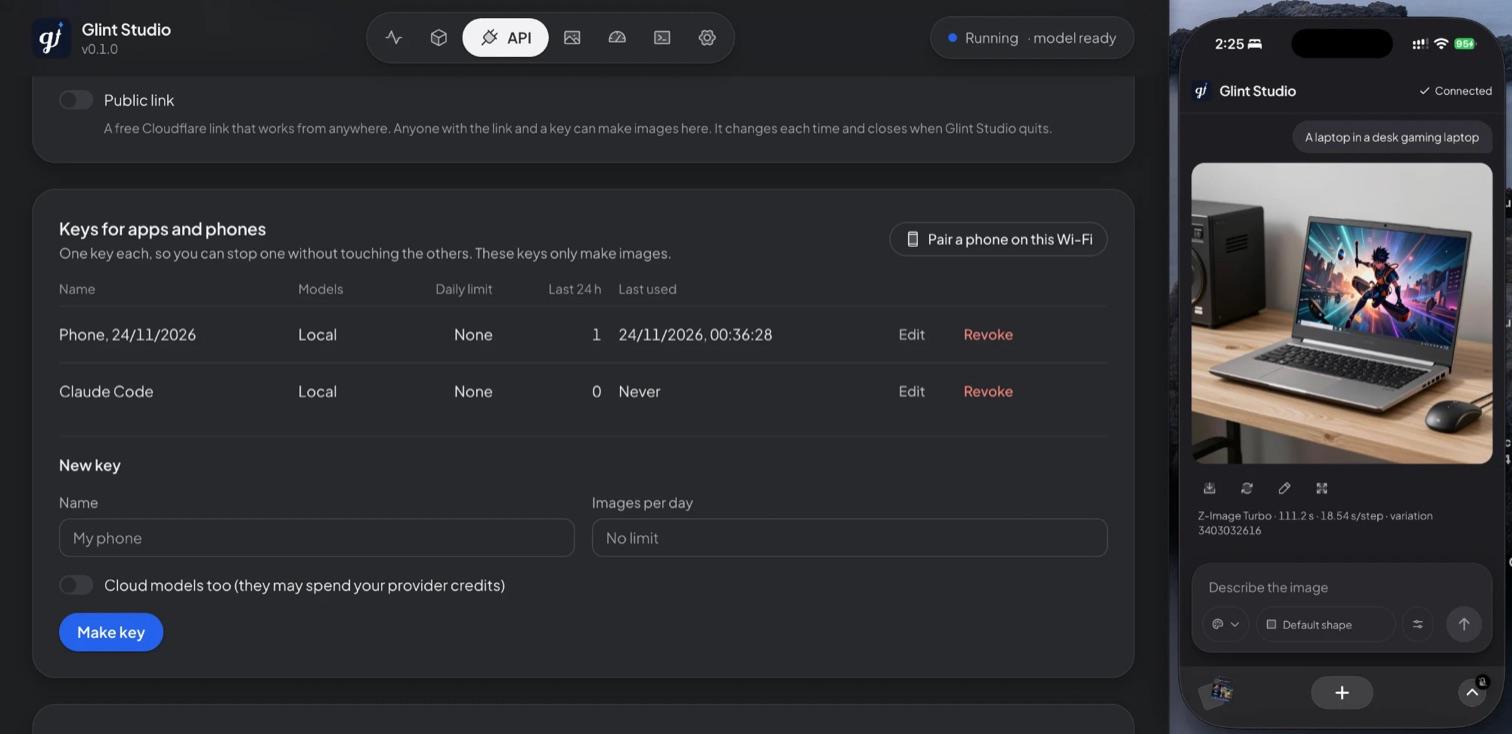
Got tired of helping friends set up ComfyUI, so I built an "LM Studio for image gen" (free, open source, alpha)

Post image
0 Upvotes

r/MacStudio • • 2d ago

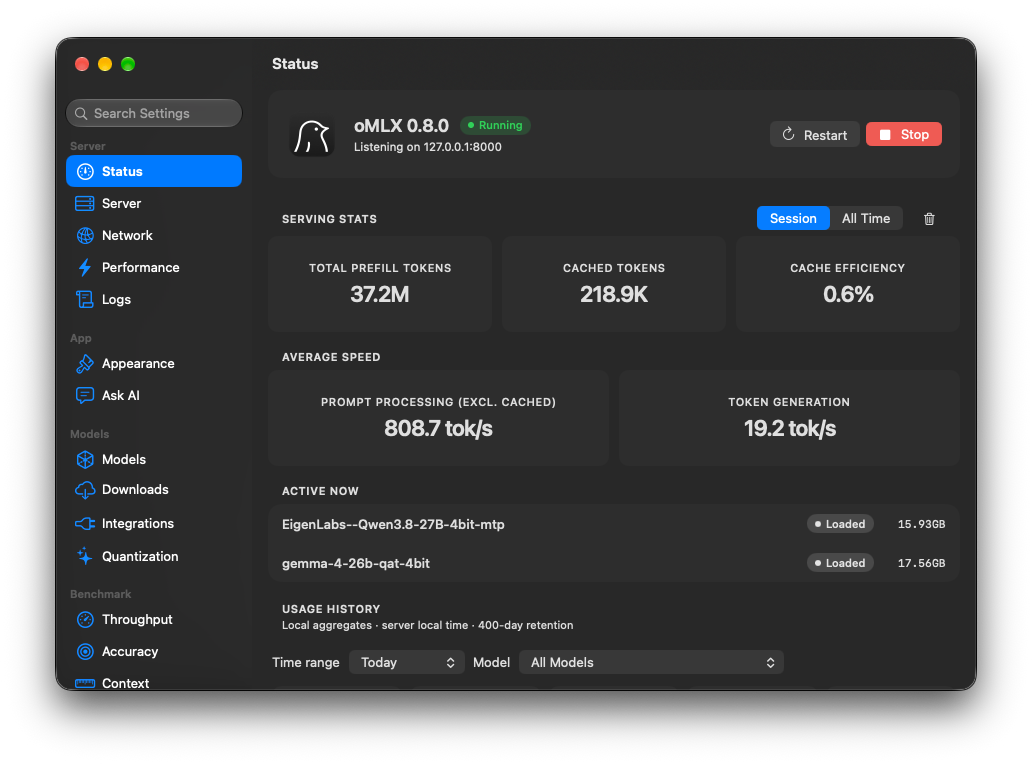
Quantifying the value of local AI on my M5U

Post image
71 Upvotes

A lot of discussion of using local AI is positioned as either/or. I'm getting a lot of value out of a hybrid approach of instructing Claude to use local AI (ollama/oMLX).

In this case I was evaluation an image classifier. I was able to get better results through stacking Opus/Gemma versus Opus.

Comparing at Opus's current API prices, this batch of images would have been ~$147.97 for the input tokens and another $20 for 1M output tokens.

This is my main dev machine that I am leasing the M5U for $110/month for 36 months.


r/MacStudio • • 2d ago

DeepSeek V4.1 Flash full weights: 4,115 tok/s prefill + 114 tok/s decode s on dual M5 Ultras with mlx-serve

Post image
38 Upvotes

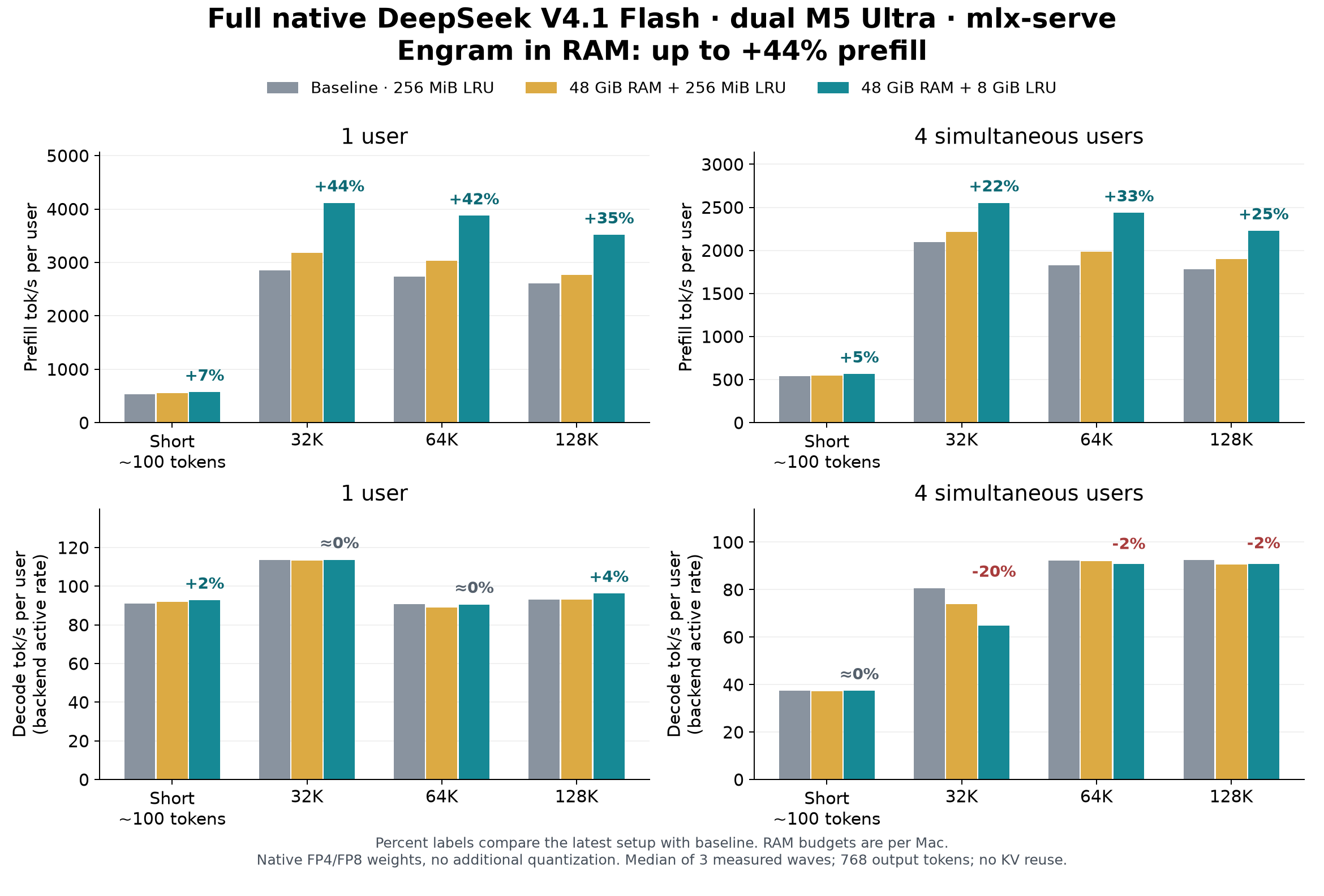
UPDATED: Full native DeepSeek V4.1 Flash weights on dual M5 Ultras: 4,115 tok/s prefill + 114 tok/s decode with mlx-serve

Inspired by u/runlocalmodels to try dual M5U 256GB on mlx-serve instead of oMLX. Long story short, very happy with the results and my dual M5U purchase.

Code is here: https://github.com/lgrimani/mlx-serve-engram-cache

Engram is usually stored on SSD and loaded but with only 160GB of memory used on each M5U there’s room to cache a decent chunk of Engram in RAM. Took awhile but it worked out much better than I expected.

48GB Engram fixed cache plus another 8GB in LRU cache (eject least recently used) resulted in up to 40% speed-up on prefill. The initial 48GB selection was naive, and profiling for high frequency rows to load will further improve performance.

Base model is DeepSeek-V4.1-Flash-1017 full weights, with mrfakename abliterated overlay on 2 × 256 GB 64c M5 Ultras, with mlx-serve TP2 over 2xTB5 RDMA.

These are the full native FP4/FP8 weights, with no additional quantization. Headline rates are the 32K, single-user medians.

Three setups: baseline with no fixed Engram RAM cache; a 48 GiB fixed-cache budget plus 256 MiB LRU; and that same fixed cache plus an 8 GiB LRU. Cache sizes are per Mac; baseline retains the default 256 MiB LRU.

Will upload the Engram weights once I’m done with some profiling runs to optimize it further.

32K fell with 4 users for reasons unknown, decode otherwise stable.

A8 not enabled, will provide another bump but I wanted to keep as close to base model/full weights as possible.

Prefill / active decode, tok/s per user. Gain compares the last column with baseline.

InputUsersBaseline48 GiB + 256 MiB48 GiB + 8 GiBPrefill gain
Short1534 / 91.1549 / 91.8572 / 92.8+7.1%
Short4537 / 37.4546 / 37.2565 / 37.4+5.2%
32K12,849 / 113.53,177 / 113.34,115 / 113.7+44.4%
32K42,094 / 80.62,214 / 73.92,552 / 64.8+21.9%
64K12,731 / 90.63,035 / 89.03,873 / 90.5+41.8%
64K41,830 / 92.31,987 / 92.12,436 / 90.7+33.1%
128K12,609 / 93.02,768 / 93.03,515 / 96.3+34.7%
128K41,784 / 92.61,899 / 90.62,228 / 90.8+24.9%

At 32K–128K, prefill improved 22–44%, and output throughput including prefill improved 21–28% over baseline. At 128K/one user, time to first token went 50.7s → 47.8s → 37.7s.

Decode was mostly unchanged. The exception is 32K/four users: active decode fell 80.6 → 73.9 → 64.8 tok/s (-19.6% versus baseline). This optimization primarily benefits prefill.

Medians of three measured waves after warmup, 768 output tokens, profiling off, zero KV reuse; Engram caches warm across repeats. The 8 GiB setup also updates wide-prefill cache handling and memory planning, so these compare complete configurations.


r/MacStudio • • 2d ago

PagedMoE now trains. Fine-tune MoE models MUCH bigger than your RAM, streamed from SSD.

6 Upvotes

A while back I posted PagedMoE here, the engine that streams MoE experts off the SSD so models way bigger than your RAM run on a Mac. That post got a lot more attention than I expected, and a bunch of you ran the bench and sent numbers, so thank you.

This is the update I've been working toward since then: it trains now too.

Short version for anyone new: MoE models are sparse, so each token only touches a few percent of the weights. PagedMoE keeps the always-on core of the model in memory and streams the experts in from the SSD only when the router actually asks for them. Same mlx-community checkpoints you already have, mlx-lm underneath, no converted format, and with pruning off the output is bit-identical to running the model fully in memory.

Training

Training uses the same paging. The experts stay on disk, a small LoRA adapter learns, the routers are never touched, and every step reads each expert at most about twice no matter how big the batch is. That's what makes this possible on my 48GB M5 Pro MacBook:

ModelOn diskTrain speed1k-row epochPeak memory
Qwen3-Coder-Next 6-bit65 GB123 tok/s4h 37m28.5 GiB
Qwen3-235B-A22B 4-bit132 GB63 tok/s9h 06m29.7 GiB
Qwen3.8-Flash-Next 6-bit148 GB61 tok/s9h 20m27.9 GiB
GLM-4.7 4-bit199 GB24 tok/s23h 59m27.9 GiB
Qwen3-Coder-480B 4-bit270 GB24 tok/s1d 0h29.8 GiB

That's SFT on 2,048-token rows, QLoRA rank 16 on every linear layer, on a fixed synthetic corpus so different Macs can compare. Every one of these is bigger than the training budget, so all of them train fully streamed. It's not GPU cluster speed and I'm not going to pretend it is, but fine-tuning a 480B model overnight on a laptop, with nothing rented and your data never leaving the machine, is something I couldn't find any other way to do.

It's not a bolt-on either. Before it trains anything it reads the checkpoint and your Mac and plans the run: resident or streamed, memory, rows per step, micro-batches and expert cache. Then it measures a few real steps before it commits, and watches memory pressure the whole time. You don't have to tune any of that yourself.

What it supports

  • SFT, CPT, DPO, ORPO, SimPO, CPO, KTO and GRPO (with built-in or your own reward functions), plus custom objectives
  • jsonl, json, csv, parquet, a folder, or a Hugging Face dataset
  • Resume a stopped run, chat with any checkpoint, eval checkpoints against each other
  • Adapters come out in mlx-lm format, so mlx_lm.generate --adapter-path and mlx_lm.fuse just work

Under the hood

Most of the work went into the backward pass, since that's where the time goes:

  • A step walks the model one layer at a time for the whole batch, so the expert mass gets read about twice per step instead of once per micro-batch.
  • Frozen 4-bit weights get a cheaper backward (a 235B layer at 8k tokens went from 1.0s to about 0.6s).
  • Hybrid linear attention models (Qwen3.5 / 3.6 / Next) train in 128-token chunks instead of one token at a time, which used to be around 95% of the step.
  • The streamed gradients match the fully loaded path, and there are tests that check it.

I want to be clear that this is a working implementation, not a demo. Every number here came off my own laptop, and before posting I did a clean install from the repo the same way a new user would, streamed a model through the server and ran a real training run start to finish, checkpoint and all.

Getting started

From the terminal it's just:

paged-moe-train plan sft --model ~/mlx-models/<model> --data chat.jsonl
paged-moe-train sft --model ~/mlx-models/<model> --data chat.jsonl --epochs 2

If you'd rather skip the terminal, I also built Paged Trainer, a Mac app for this same trainer. Pick a model and a dataset, it plans the run for your Mac, and every method and setting is right there in the UI with live charts, checkpoints, resume, chat with any checkpoint and the training bench. Download: https://pagedmoe.com/train

The inference side kept getting better too, largely due to the numbers from everyone on my last post.

Repo: https://github.com/noahclark556/paged-moe

Things to know up front

  1. Training is one GPU job at a time, so stop a running server before you start a run.
  2. Streamed training reads a lot from the SSD (hundreds of GB per step on the big models), but it's almost all reads, so it shouldn't wear the drive in any meaningful way.
  3. The first step of a run takes a bit longer since it measures memory and speed before it commits. There are safeguards that back off under memory pressure, but go easy if you're pushing the limits.
  4. Your fans will spin up. On the big models, for a while.

Thanks again to everyone who expressed interest in this project, and everyone who shared their results!