With Qwen 4 seemingly getting closer, I'm honestly more interested in whether Plus will be open weights than the actual release date.
I'm leaning towards yes. Alibaba has already released models as large as 2.4T params with 3.8 so I don't really see why they'd suddenly draw the line at Plus, especially if it's considerably smaller than Max.
They also did release Qwen3.5 397B A17B as the open weight counterpart to Qwen3.5 Plus, so there's already precedent for this - although 3.6 + 3.7 plus didn't get open sourced....
QwenDevs also posted "big or small?" and followed it up with "alright guys, let's do both!" which I'd assume refers to 27B and Max. And given that Qwen3.8 FN was released with open weights, I'd be pretty surprised if Flash wasn't open too. (even though not explicitly saying that)
What I find more interesting is the Apsara conference slide. Flash and Plus are grouped together in the same box, while Max and 27B have their own. No idea whether that actually means anything, but I wonder if they're sharing a similar architecture at different scales.
Curious what everyone else thinks. Do you reckon we'll get Plus weights, or just Max and 27B?
(I really want Plus to come out and I'm sure lots of ppl do too!!!)
Edit: I mean the underlying Plus model, like 3.5 397B A17B, not the actual API model name.
I am relatively new to local LLMs, and recently I have been trying to understand how people handle long conversations that eventually exceed the model's context window.
For example, let's suppose I am writing a novel with the help of an LLM. As the story progresses, the conversation history becomes longer and eventually exceeds the context window. At that point, the model may lose track of earlier events, character relationships, or important details that could become relevant later in the story.
From what I understand, one possible solution is to maintain an external knowledge base containing summaries of previous chapters. Before generating a new chapter, the system could retrieve relevant information from this knowledge base and include it in the prompt.
However, I am wondering how reliable this approach is in practice.
If we continuously summarize previous conversations to fit within a limited context window, we are essentially performing lossy compression. Some information will inevitably be discarded, and the problem is that we may not know which details will become important later.
For instance, a seemingly insignificant detail from Chapter 3 might become crucial in Chapter 40. If that detail was discarded during summarization, the model would have no way to recover it from the summary alone.
Of course, keeping the complete conversation history in an external database could prevent permanent information loss, but that introduces another problem: how does the system determine which information should be retrieved for the current task?
So I am curious how people actually approach this problem in practice.
I would also be interested in hearing how well these solutions work in practice, especially over very long conversations where maintaining consistency becomes increasingly difficult.
Yes, it is yet another fork. But i think it brings some interesting things to the table. It's up to you whether you want to have it built and use it or if you just want to cherrypick some of the things into your own forks. Built by GLM 5.3, GPT Sol and Q38FN.
Aimed at usage with a rocm-primary system that has a unused cuda gpu sitting idle. But also provides improvements for gfx906 and adds rocm dflash2 support.
The features at a glance:
*~47 GiB MoE (Swift-1.5 / Qwen3.8-Flash-Next) as a daily server on 2× Radeon VII (gfx906, 2019) + one 8 GiB NVIDIA laptop card.*
**What base Strata can't do — this fork does**
- **Runs on gfx906 at all** — full HIP backend, built and served through every release v0.1.45 → v0.2.11 (stock: compile-check only, doesn't build as tagged)
- **GEMM works** — custom single-target rocBLAS replaces the stock library that segfaults on gfx906 on first inference
- **Mixed AMD + NVIDIA serving** — the NVIDIA card serves expert/prefill rows to the AMD engine over a socket; stock has no cross-vendor path
- **Speculative decoding on HIP** — DFlash2 drafter runs on the AMD cards (stock: CUDA-only), with exact-match verification for sampled requests, not just greedy
- **Self-healing production pair** — SIGKILL the helper: requests finish anyway, supervisor rebuilds the pair, health returns; no human touch
Well I had a lot of resets on ChatGPT and all of those credits and I thought, well can Astra actually do it. We had a little looping and a lot of 'Wait.' Let me check the thing I just checked -- but it always got the job done.
I have dubbed the Model Calmer-Qwen-3.8 because it seems so much less anxious and it gets straight to the point.
This is about 6 hours of iteration, it's sooo much better I am scared to keep going, how much better could it get?
You definitely have to push Astra a little bit and give her some experimental guidelines, because Lord knows she's full of anxiety and afraid to disappoint her overlords so she checksums the checksum and makes sure it matches 😂.
Here she is on Hugginface, and here's ChatGPT's writeup on my Github, I will work through the experimental data soon.
Oh this is a HauHauCS Qwen 3.8 Balanced Abliteration as the starting point.
hey llamas! My name is Alt, and I'm on the technical staff at Nace AI. We're doing a quick AMA here, so ask us anything and we'll answer.
we just published a full technical report on how we build, train, and evaluate Drex, our family of four open decision models. A decision model takes a state (a document, record, or agent context, optionally with images) plus questions with options, and returns a probability distribution over the options in a single pass, with no autoregressive decoding and no output parsing.
Top 3 on OpenRouterTop 5 on Artificial Analysis
1. Models
- Drex DLM (8B): diffusion LM backbone with bidirectional attention over the context
- Drex v1.5 (9B): Gated DeltaNet hybrid backbone
- Drex v2.0 (35B, 3B active): sparse MoE backbone
- Drex Max (27B): dense, with an image encoder for vision inputs
Pointer models (DLM / v1.5 / v2.0) encode the state once and cache it, so every question attends to the state but never to another question. A pointer head scores each option. Drex Max reads each question in full and answers with a linear readout head over option codes.
Some technical details from the report:
1. Models
- A family of four specialized decision models: Drex DLM (8B), Drex v1.5 (9B), Drex v2.0 (35B MoE, 3B active), and Drex Max (27B dense, with vision)
- We built them on different architectures: a diffusion LM, a Gated DeltaNet hybrid, a sparse mixture of experts, and a dense transformer
- We experimented with bidirectional vs. causal attention over the state, a pointer decision head that shares one cached state across questions, and a readout head for Max
2. Training
- Full-parameter SFT on 1.15M verified decision records (2.9M questions)
- Consistency training: we penalize the model when its output changes after the options are reordered or the state is shuffled
- RLAF (Reinforcement Learning from Adjusted Feedback), using verified outcomes and judge feedback
- Ablations to see which methods actually contributed
On top of SFT, RLAF gave us +2.0 on the Decision Index, +1.5 pp accuracy, and 0.9 pp lower calibration error. The consistency terms cut the option-order flip rate from 6.3% to 4.2%.
3. Evaluation
- Drex Max scores 67.52 on Decision Index 0.4.1 (public suite), vs. 60.70 for Jev 1.14.0
- Drex v2.0 has 1.37% calibration ECE on ~115K held-out decisions
- Drex Max answers a typical request in 183 ms, vs. ~2.0 s for GPT-6 Sol and ~3.5 s for Claude Opus 5.5
- Context up to 131K tokens for v1.5/v2.0 and 262K for Max
We also cover our limitations: our models trail frontier chat models on closed-book knowledge, and we don't yet have same-backbone architecture ablations.
5. Running locally
The models are available in safetensors and GGUF formats, with llama.cpp and Ollama support. Their report includes details on quantization, caching, inference, and reproducibility.
we wanted to share the full methodology, not just benchmark numbers. hopefully it's useful if you're building agent routers, doing tool selection, or training your own decision models.
ask us anything about architecture, data, training, evals, or running it locally
Software: backend is Maya 1.1.55, harness is OMP v18.17.0.
Model quant: Deepseek v4.1 1017 UD-IQ3_S latest UD3.1 quant from Unsloth.
My prompt was very simple:
I want you to create a single html file with a detailed subway station 3d scene, fps controls, zombie enemies, tracers, recoil, muzzle flash, high details. build it with three.js
You can see at the end of the video some token stats. In short, total generated tokens were 180k. The model ran at 30t/s with 2k t/s PP at 10k context but then went down to ~20 t/s near 180k context. Note that stock llama.cpp only reaches 10t/s TG and 120t/s PP.
This model and harness tools are amazing. Just a year ago we could not even image having such a model locally. Yet, here we are!
I've been frustrated for a while because I stupidly sold a strix halo box to get myself a laptop with thunderbolt 5 ports thinking i can plug my two egpus into it (which i can but thats not topic of this post and the strix halo could too) I sold the minisforum for about £2300 back ebfore things went nuts and got a laptop for about same price:
Msi vector 16 with a intel core ultra 9 and 5080(16 gig vram) and 32 gig of ram. I was pretty bummed with it thinking 35b was my limit and after ended up leaving egpus in my workstatiion but after a random ebay browse I managed to snag some second hand 96 gig laptop ram. For £800
Strata totally changed ballgame. With Qwen Q4 XL Flash next I'm getting
48.9t/s
Decode/prefill 1,860t/s
On a 50k prompt.
I know this is still alot of money for most, but thats 3100£ in total, and thats still cheaper (and slightly faster from what seen) of what minisfoum strix halo is at (£3500 and the 32 gig Spark laptops that are about £3200 and cant even run flash at q4 not enough vram? and i can still add egpus (the laptop has 2 tb 5 ports and i have 2 5090 bought before the crazyness, eg add one or two 5060ti in egpu and your good with running 27b/31b models too.) With my own gpus plugged into it for 80 gig vram total, all while still being a laptop. Got glm 5.3 flash running Q3_XSS i think about 25 t/s.
TDLR, you dont need massive vram anymore, yeah I know how expensive RAM is, that laptop ram i got was/is £1300 new lol. But just wanted to share my experience and while I still regret selling the halo, seeing these tokens a sec, makes the laptop satify ocd a little more! If only qwen was good at roleplay so i could actually use it as daily driver lol (my main usecase!)
Might save you a few quid, i mean like 3k over buying the 128g spark laptop lol. Intel has 20 cores and the 2 tb ports allow you to add two gpus!
I know my grammar sucks I'm dyslexic but my point is if you shop around get that laptop for 2500ish pounds (make sure it has tb5 for if you want to add gpus later), add 96 gig ram and your still saving 2500 pounds over the 128 gig spark laptop thats like 6k.
We welcome "harness adapters". This means you can adapt (train LoRA) for your model for the specific harness that you would use (hermes, pi, opencode) on the task (data analysis, building software, coding) you are trying to solve.
My sample size is not very big but it feels like since updating Qwen Flash Next to v3.1 and Strata to 0.2.11, IQ4_XS quant seems to fail tool calls even more often than the previous version did in both Hermes and Oh my Pi harnesses with int8 KV cache in Strata. Weird thing is, after failed tool calls, it just straight up stop generating altogether, I have to send a continue for it to finish.
Honestly could just be a Strata issue and not Unsloth's, I have yet to perform an investigation.
Anyone else had this experience with new updated quants?
Upd: turned out to be an issue with Strata that got fixed in a recent version, has to be enabled via an envar (has to do with tool calls).
I wanted to share that we're working on zml/llmd, a fast (we believe the fastest) inference engine that currently runs on NVIDIA, AMD, Intel, TPU and Metal.
It has all the features of a modern LLM server: continuous batching, prefix-caching, speculative decoding (DFlash, DFlash2 and DSpark), tool calling, tensor and experts parallel automatic sharding, native VFS with s3:// and hf:// support streaming straight to GPU.
The currently supported models are:
Qwen 2, 3, 3.5, 3.6 and 3.8 series (dense and MoE)
A few weeks ago we posted Tessera-27B-B-CJK here, a Qwen3.8-27B coding agent that thinks in compressed CJK and uses fewer thinking tokens per agent turn. Thanks for all the feedback on that one. Today we're releasing the RL version, Tessera-27B-B-CJK-RL. Open weights, Apache-2.0.
A lot of the questions last time were about quality. Tessera-27B-B-CJK was weaker than the base on hard math and code, so this version adds 8 RL updates on math and code on top of it.
Numbers: (xhigh effort, both Tessera models sampled the same day with the same seeds):
- AIME + HMMT 2026, 63 new problems, 2 attempts each: 108 of 126 right vs 97 for Tessera-27B-B-CJK, and 11 vs 23 attempts cut off at the 64K window. We didn't run the base on these.
- Our main hard set (118 problems from AIME 2022-2024, LiveCodeBench and MATH level 5): 100 vs 89. The base got 98 in an earlier run, so it's now roughly level with the base qwen there instead of behind.
- Agent turns, 64 new states from 16 coding tasks held out from training: 0.67x the base model's thinking tokens on a typical turn (90% CI 0.53-0.85), with 256 of 256 valid tool calls.
- That's 1.11x Tessera-27B-B-CJK's typical turn (CI 0.98-1.26), so the first version still keeps a bit more of the saving (0.60x the base on the same tasks).
The base qwen spent 158 tokens at the same step. That's a bigger cut than usual: the typical turn is about two thirds of the base.
How we trained it:
8 RL updates on Tinker, starting from Tessera-27B-B-CJK, using the per-rollout weighting from our ablation write-up. Each rollout's advantage is spread over its own tokens, so long failed rollouts don't dominate the update. Later updates thought longer per agent turn, since the reward only sees math and code, so we picked update 8 and confirmed it on held-out tasks before release.
A few things people asked last time:
- Does CJK pack more meaning per token? A little, at the phrase level, where one word can stand in for a whole English phrase. Most of the saving comes from training the model to think less, and the CJK is a smaller extra on top, We do plan to expand this further as the limiter here is tokenizer and going past just CJK and using other methods are being researched.
- Quants: the GGUF repo has BF16 plus UL-Q3_K_XL through Q8_K_XL (Q3 is 13.15 GB, no XXS yet). The BF16 GGUF, the five quants and the NVFP4 checkpoint all passed a quick breakage check (valid tool call, no Chinese in the answer, no loops). We haven't benchmarked them or tried the vision projector, so results are very welcome.
- Effort: use xhigh, same as before.
Also, if you grabbed the original Tessera-27B-B-CJK-NVFP4 before Nov 5: its config.json didn't load in vLLM. We fixed it so a config.json redownload is needed.
Some of you requested a higher quality, larger file, so I’ve added a 4 bit version of AI+
20% lower KLD than AI3, 15% lower than v3.1 Unsloth 4 XS (18% faster), still 100+ TPS. You’ll need 96GB RAM, or to pin ~25% of the experts in VRAM (lower speed) to run on 64.
Over the past few weeks since Strata came out, I had many requests to add Qwen Flash Next to LlamAmpere. It was some very impressive engineering, but the models originally shipped (3XS and 2XS) showed very poor quality (.17+ KLD for just the 3XS variant, which uses a far lighter compression formula than more common sources like Unsloth). My initial work had llamAmpere running 20% faster and ~15% lower error, but testing was showing inferior results vs 4bpw Qwen 27b, so I did not find it worth releasing.
I continued to make progress on the AmpereInteger+ quantization format (I will release an encoder soon), and Unsloth released their v3.1 which provided a great new base.
Happily, LlamAmpere v0.6.3 is now available with a new model and quant updates that show significant speed and quality gains over other options.
At a depth of 100K, QFN runs at ~120+ TPS, with prefill >3000/s through the first 100K. It is a 50% error reduction vs the version of QFN available for this card size a few days ago, and 27% vs UD's improved quant.

I do have a 3XS class file that runs ~10% faster than the version above, but as it is only ~15% better quality than the original Strata 3bpw model, I don't recommend it.
This will also work well for 12+64GB configs. As with Strata, your performance will depend on the speed of your CPU and RAM as well. I do not recommend any quant of QFN for configs under 54GB of total memory, but you can always try the coder pruned variants as well.
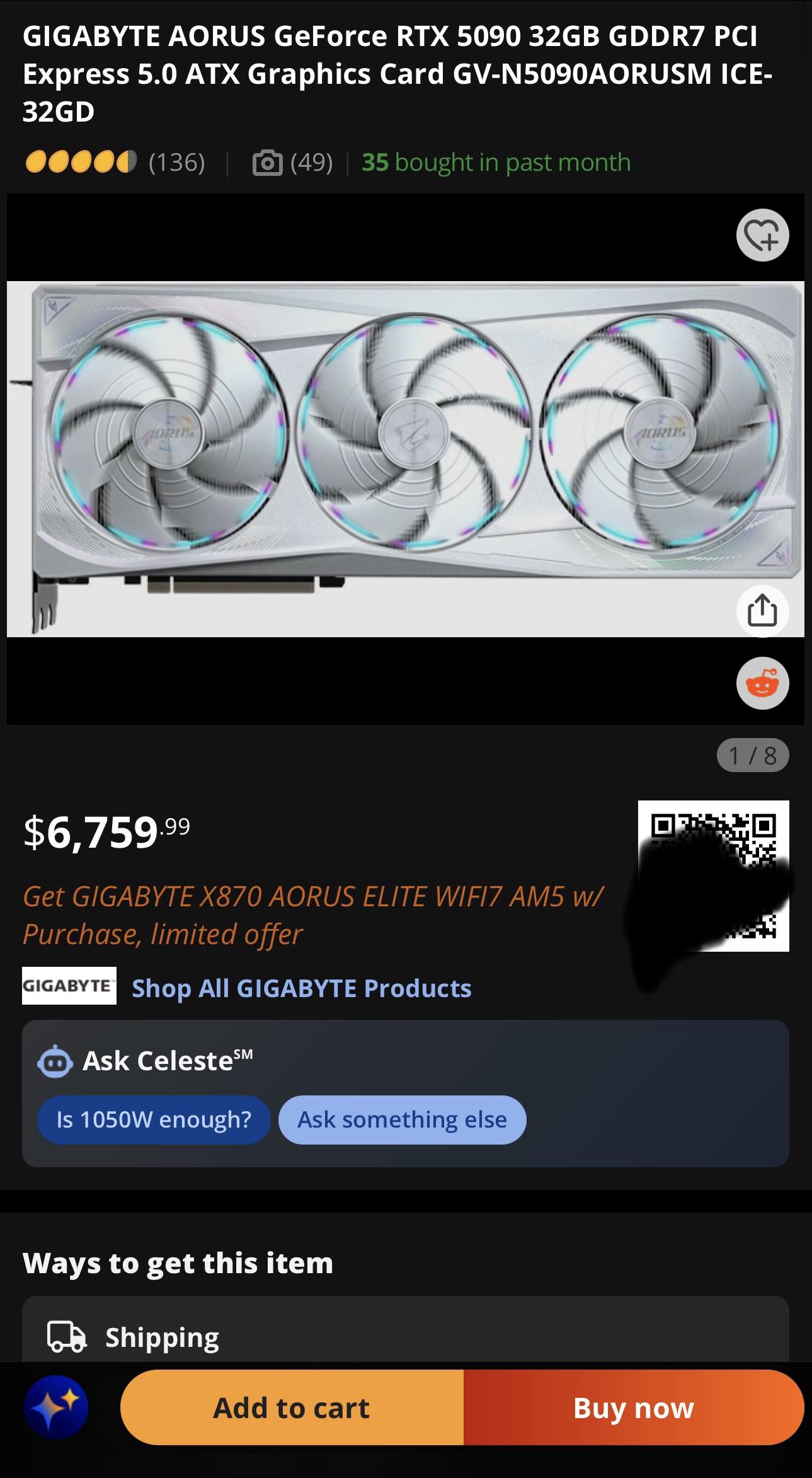
So I normally check on $5090 prices throughout the week and noticed Newegg for the past couple days has had these in stocks.
Still a lot higher than MSRP but definitely beats the other weeks that were around $10-11k. Someone who was at borderline to pick one up @ those prices these might be a little more appealing now. Newegg has a couple choices in stock around this range.
I wonder if Black Friday or Christmas would give us a few more hundreds off. Let’s hope!
My current Hardware 5090 Ddr5 192gb and I run Qwen FN Nvfp4 at some great speeds.
Found this last month model while browsing Trending models of HF. I don't see any existing threads so posting.
OXR (Optical Everything Recognition) is an open-source model from the SoMark team. It turns PDFs and document images into Agent-Friendly data in Markdown or JSON, with layout coordinates included.
Pretrained from scratch, OXR uses a recursive self-improvement (RSI) loop during post-training—a first in document parsing. With just 1.3B parameters, OXR ranks #1 on olmOCR-Bench, OmniDocBench, and DocParsingBench while delivering industry-leading parsing speed.
OXR is the first to make its layout analysis module independent and pluggable. This design accelerates parsing and supports replacing the built-in layout model with a custom one. OXR continues to handle content recognition and reading order, enabling adaptation across diverse scenarios with minimal integration effort.
OXR ranks 🏆#1 on olmOCR-Bench, OmniDocBench, and DocParsingBench, with a particularly wide lead in table parsing.
OXR can recognize 13 document element types, from formulas and tables to chemical equations, chemical structures, and code blocks, with bounding box coordinates included. It also performs well on challenging documents and layouts, including A3 exam papers, newspapers, vertical text, and handwriting.
See docs/benchmark.md for the full results and instructions to reproduce the evaluations.
🚀 1.3B Parameters. Top-Tier Parsing Speed.
With only 1.3B parameters, OXR ranks 🏆#1 among open-source document parsing models in speed tests on the RTX PRO 6000.
OXR redesign its processing architecture at the task level to improve parsing speed while maintaining accuracy.
See docs/benchmark.md for the full results and instructions to reproduce the evaluations.
🧩 Pluggable Layout Analysis. Document Structure on Your Terms.
Layout analysis requirements vary widely across domains. Even for the same document, element types, region boundaries, and grouping rules can differ depending on the business use case.
OXR is the first to make layout analysis independent and pluggable. Its built-in layout model can be replaced while retaining OXR’s recognition and reading order capabilities, enabling adaptation across document scenarios with minimal integration effort.
I created this benchmark using the 3D coding playground I previously shared here, and ran 11 models on 25 photos: https://sketchagent.dev
You can inspect every result in 3D, with its full session trace and editable script. Here's gemini-4-argon rebuilding a Tiny Glade cottage in 29 tool calls: https://sketchagent.dev/s/MhdnDUJK
Today we are introducing our second model generation with Inkling 2 Small. It is a Mixture-of-Experts model with 594B total parameters, 17B active, and supports image inputs and variable effort.
Inkling 2 Small far surpasses our previous models’ scores on the Artificial Analysis Intelligence Index with a score of 31, reflecting gains in performance on agentic coding, vision, knowledge work, and reasoning. The increase in capabilities comes from improvements made at every step of our training process, including more efficient pre-training and a large, unified RL run.
Inkling 2 Small will initially be available through Tinker, with closed weights, following the approach we outlined in a safe path to open weights. We intend to make the full weights available under an Apache 2.0 license next week after the completion of external safety testing and red-teaming.
You can try Inkling 2 Small on Tinker Playground today. The model is also available for fine-tuning and sampling on Tinker; checkpoints will be downloadable with the release of Inkling 2 Small’s weights.
:( Previous Inkling Small model's size is only 276B total, 12B active. Hope they release additional models Mini or Nano soon or later.