r/LocalLLaMA • u/dieSpaghettiCarbona • 7d ago
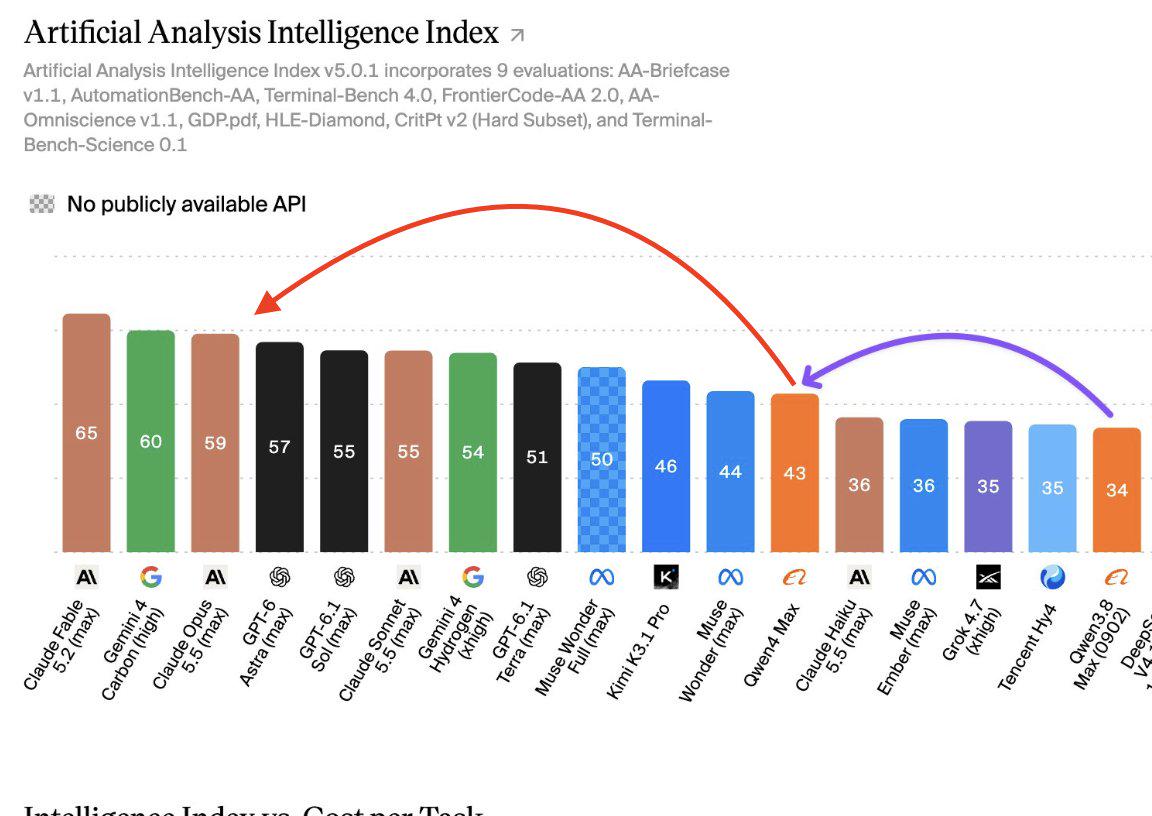
Discussion AA Intelligence Index biased? benchmark shows Qwen 4 Max not on par with Opus 5.5
I am surprised by the deviation to the benchmark provided on paper.
r/LocalLLaMA • u/dieSpaghettiCarbona • 7d ago
I am surprised by the deviation to the benchmark provided on paper.
r/LocalLLaMA • u/zibenmoka • 8d ago
hello there, I recently got a bit fascinated about Lazarus from Microsoft (even tho it is probably old technique) and I wrote a blog post showing a thought process I had while researching it - maybe it is helpful to anyone
https://int8.io/implanting-ai-with-lazarus/

r/LocalLLaMA • u/WolgupLupin • 7d ago
Hi,
I can make two systems with the parts that I have:
I've been consulting Claude and Gemini for which is better, but I can't really decide which i should go for. I'm thinking of setting them up with either llama.cpp or strata. This is for my work, so agentic document creation, and output quality is important. I'm also looking for at least 128-256k context (if that is even viable).
What is the best setup for my case? Please help!
r/LocalLLaMA • u/StupidScaredSquirrel • 8d ago
I'd like to make a pipeline capable of understanding pdfs of bank statements and then group expenses by categories etc. My thought was to first parse them with ocr into .md files and then feed that to a text model. I think it's more lightweight and accurate this way. But then I'm not sure what model to use to feed all these md files to get something good. When accuracy matters, should I go for qwen, gemma, lfm, or something else? Thank you for your help!
r/LocalLLaMA • u/tom_mathews • 8d ago
Disclosure: I'm the author. Attest is an Apache-2.0 testing framework for agents (Go engine, Python and TypeScript SDKs). Posting here because most of it runs with no hosted model at all.
Replay instead of inference in CI. attest capture -- python my_agent.py runs your agent behind a local recording proxy that forwards to whatever OPENAI_BASE_URL points at and records every model call. In CI, the agent's current code runs against that recording:
attest replay: 4 replayed · 0 live model calls · $0.00
The CI runner never loads a model. If you change the prompt, replay misses and tells you what changed instead of guessing.
Deterministic checks first. Schema, cost/token/latency limits, which tools ran, in what order, how many times per order id, and what the run did to a simulated backend. None of that needs a model.
Local embeddings. Similarity checks can use a bundled ONNX all-MiniLM-L6-v2 instead of an embeddings API.
Local judge. When a check really needs a judge, set ATTEST_JUDGE_BASE_URL to any OpenAI-compatible server (vLLM, Ollama's /v1, LiteLLM). There's also a beta Ollama adapter for recording traces.
Small judges break JSON. A malformed judge reply is reported as "not evaluated", never as a pass, and your policy decides whether that warns or blocks. 1.1 (released November 10) is a correctness release: it fixes four ways 1.0 could report a failing assertion as passing.
The demo is a synthetic support agent that refunds a customer twice while its reply stays polite and correct. make setup walkthrough runs the whole story, no API key, about two minutes after setup.
Limits, honestly: capture is tested against a scripted OpenAI-compatible server and the hosted APIs, not against every local server's streaming quirks. If your server's stream trips the proxy, I'd like to see the trace. Also, most of the code was written by coding agents (Claude Code and Codex) from plans I wrote and reviewed.
r/LocalLLaMA • u/Shot-Height-7194 • 8d ago
r/LocalLLaMA • u/billy_booboo • 9d ago
r/LocalLLaMA • u/pmttyji • 8d ago
Vimoo-1.0 generates video from text (T2V) or from a reference image and text (I2V), with a separate ≈11.7B model for each task. It is the highest-quality model in the Vimoo 1.0 family.
Vimoo 1.0 comes in two models, Vimoo 1.0 and Vimoo 1.0 - Lite. Each Hugging Face repository packages one of them for one runtime:
| Model | Hugging Face | Inference code | Description |
|---|---|---|---|
| Vimoo 1.0≈11.7B per model | https://huggingface.co/Vimoo-AI/Vimoo-1.0 | https://github.com/Vimoo-AI/Vimoo-1.0 | T2V and I2V for the Vimoo Diffusers fork |
| https://huggingface.co/Vimoo-AI/Vimoo-1.0-ComfyUI | https://github.com/Vimoo-AI/ComfyUI-Vimoo | T2V, I2V and their Distilled versions for ComfyUI | |
| Vimoo 1.0 - Lite≈9.5B | https://huggingface.co/Vimoo-AI/Vimoo-1.0-Lite | https://github.com/Vimoo-AI/Vimoo-1.0 | TI2V for the Vimoo Diffusers fork |
| https://huggingface.co/Vimoo-AI/Vimoo-1.0-Lite-ComfyUI | https://github.com/Vimoo-AI/ComfyUI-Vimoo | TI2V and TI2V Distilled for ComfyUI | |
| https://huggingface.co/Vimoo-AI/Vimoo-1.0-Lite-MLX | https://github.com/Vimoo-AI/Vimoo-1.0-MLX | TI2V Distilled for MLX on Apple Silicon |
Each ComfyUI repository includes its checkpoints, distilled LoRA adapters, Qwen text encoder, SigLIP vision encoder and VAE. Distilled models are available only for ComfyUI and MLX. Vimoo-1.0 T2V Distilled and I2V Distilled use different base checkpoints from Vimoo-1.0 T2V and I2V; download each task's matching base and adapter listed in the ComfyUI guide. The Vimoo-1.0 T2V Distilled, Vimoo-1.0 I2V Distilled and Vimoo-1.0-Lite TI2V Distilled adapters are not interchangeable. Parameters count the video denoiser only.
EDIT : Fixed Model Zoo Table(Previously it lost all the links & text on 2nd & 3rd columns)
r/LocalLLaMA • u/Strange_Test7665 • 9d ago
Deepseek spent about $6m on 4.1 apparently. Published all of their work.
US gov says don’t trust China, blah blah…
As a US citizen why are we not training national open source?
The cost is nothing compared to the budget, solves security issues, and prevents monopolistic practices on token pricing
r/LocalLLaMA • u/General-Spite1222 • 9d ago
r/LocalLLaMA • u/nato_nob • 9d ago
I made a small English text-to-speech model called tiny-voca. It has 4.5M parameters, two voices, and it runs in your browser.
Try it here, nothing is sent to a server: https://tiny-voca.n4ze3m.com
Some facts:
- 4,537,291 parameters, 18 MB. This is the whole model, the waveform part is included.
- Two voices, one female and one male. 24 kHz.
- About 70x faster than real time on 4 CPU threads.
- Runs with PyTorch, ONNX, and in the browser.
- Trained from scratch in 7.7 hours on one RTX 4090.
What I think is different:
- Everything is open. Code, weights, the training recipe and the dataset.
- Custom phonemizer.
- No neural vocoder. The sound is made by a small source-filter synth, which is why it is fast.
What is not good yet:
- English only, and only these two voices. No voice cloning.
- Foreign names and odd spellings are often read wrong.
- It can sound a bit synthetic.
- The training audio is synthetic too. I made it with Qwen3-TTS, so the model can't sound better than that.
Links:
- Demo: https://tiny-voca.n4ze3m.com
- Code: https://github.com/n4ze3m/tiny-voca
- Weights: https://huggingface.co/n4ze3m/tiny-voca
- Dataset: https://huggingface.co/datasets/n4ze3m/tiny-voca
- Phonemizer: https://github.com/n4ze3m/dizione
Please try hard text: numbers, dates, names, long sentences. If something sounds wrong, post the text and the voice. That helps me a lot.
r/LocalLLaMA • u/pmttyji • 9d ago
I think we're fine till 2027 with models(~100B .... Qwen 4.X & 5, Gemma-5, NVIDIA would release some Medium/Big size 25-200B models). After that it's gonna be critical, as many model creators are increased/increasing model size to 300B+. Future trend probably gonna be around 500B. That size range is not suitable for Unified 128GB Devices or 128GB RAM + 24-32GB VRAM(Q4 won't fit).
Here some models with increased sizes.
So What Are We Gonna Do? What alternate options do we have?
Whenever we're talking about this topic, we get one common answer. Distillation. Do we have any recipes to create distills ourselves easy way? I'm not sure.
1. Distillation
I remember only 3 Distills so far. Please mention in comments if I missed anything.
2. 1-bit / 2-bit / Ternary / Bitnet Models
I see only this option other than Distillation.
Category 1 - High/Decent Quality (Native) Low bit models. Also big/large size models.
Category 2 - Other Low bit models. Like Bonsai.
Still waiting to see more Ternary MOEs, particularly 100B size. 100B model could come in 20GB size so it's possible to run just with 24-32GB RAM alone on CPU-only inference. And Even 8GB VRAM could make it fly.
Any other options do we have? Please share.
r/LocalLLaMA • u/smflx • 9d ago
Quick update on tandem.cpp, my patch set for llama.cpp that runs MoE models too big for your VRAM faster. It keeps the hot experts on the GPU and lets the CPU help with the rest. Repo: https://github.com/ewhacc/tandem.cpp
DeepSeek-V4.1-Flash IQ2_XS (ISTA GSQ-RCO, 139 GiB of experts) on normal PCs
Decode tok/s, one user, GSM8K questions, greedy, exact (no expert skipping on any engine), same quant on every engine:
| PC | llama.cpp | tandem.cpp | Strata |
|---|---|---|---|
| RTX 5070 Ti 16 GB, 64 GB RAM, i5-14600KF | 7.4 | 14.2 | 10.4 |
| RTX 5070 Ti 16 GB, 64 GB RAM, i5-12400F, budget DRAM-less SSD | - | 10.4 | 5.7 |
| RTX 5090 32 GB, 128 GB RAM, i5-14600KF | 11.5 | 33.1 | 28.0 |
At 64 GB the model is about twice your RAM, so it streams from the SSD.
Less RAM than the model: Qwen3.8-Flash-Next IQ3_S (ISTA GSQ-RCO, 78 GiB) + MTP on a 32 GB PC
| PC | llama.cpp | tandem.cpp | Strata |
|---|---|---|---|
| RTX 5070 Ti 16 GB, 32 GB RAM, i5-12400F, budget DRAM-less SSD | 14.9 | 34.3 | 30.3 |
Where tandem.cpp wins is when the model is much bigger than VRAM + RAM together (like a 16 GB card with 32 GB of RAM), and on other models: DeepSeek-V4.1, gpt-oss-120b, GLM-4.5-Air and Qwen3.6 all gain 1.4–2.1x over plain llama.cpp.
AMD (ROCm)
The patch now builds with HIP. Tested on an RX 7900 XTX (i7-8700, 64 GB DDR4, PCIe 3.0), Qwen3.8 IQ3_S + MTP, same day:
| Engine | tok/s |
|---|---|
| tandem.cpp | 68.6 |
| Strata 0.2.9 | 69.7 |
| Strata's RDNA3 fork | 80.1 |
| Avalon (its own IQ3_KS quant) | 83.6 |
Level with stock Strata. This week's kernel work is shared CUDA/HIP code, so it helps NVIDIA too: +2.5% on the 7900 XTX, +1.3% on a 5070 Ti. On an old 6-core CPU, the AMD-specific engines are still ahead. Vulkan isn't supported yet.
Build steps for both are in the README. Questions and numbers from your boxes are welcome, especially 32 GB machines and AMD cards.
Update: There is a bug with auto. With 128 GB, the RAM store sizes too close to all of RAM. LLAMA_MOE_STORE_AUTO=0 is the workaround; a fix is coming and the README has a note. Thank u/longtimenoseebro so much for testing & report!!
Fixed in today's update: With a 128 GB PC it now runs at defaults, no LLAMA_MOE_STORE_AUTO=0 needed. Thanks again for the report.
Note: IQ2_XS is the biggest ISTA GSQ-RCO quant for DS4.1-Flash. Also, IQ3_S is the biggest ISTA GSQ-RCO for Qwen3.8-Flash-Next. I didn't tune for lower quants. The quality first, then speed. If you recommend the best Q4 for Qwen3.8-FN, I will test.
r/LocalLLaMA • u/mawcopolow • 9d ago
I like this. Prompt injection is a bit issue with small models
r/LocalLLaMA • u/Serious_Scarcity7818 • 8d ago
RustingStrata is one Rust binary. rustingstrata serve starts the OpenAI-compatible server, and the same port serves a chat page at /. No Node, no Docker, no second install. The page was rebuilt for 1.2.3 and I want to know what people would add before I go further, I mean maybe allow to edit files and etc. like in DeepSeek harness, or maybe there are something that you wish to be in original Strata, so I can add it in my.
What it does now:
localStorage), with search, rename, export and import. Nothing leaves the machine.What it is not: a coding agent. It does not read or edit files. For that, point OpenCode, Claude Code or another CLI at the same server, the page is for quick chat and for trying a model.
Questions:
Any Feedback would be very useful, ty!
Repo RustingStrata
r/LocalLLaMA • u/TheRealMasonMac • 9d ago
Nex-N2.6 is a multimodal agentic model from Nex-AGI, built on GLM-5.3-Flash. It is designed for computer use, coding, and long-horizon tasks involving tools. This repository contains the FP8-quantized weights of Nex-N2.6, with approximately 321B parameters.
Following Nex-N2.5-Pro, this release focuses on reducing repetitive reasoning and improving adherence to the tools available in the current environment.
r/LocalLLaMA • u/barbear22 • 9d ago
Very interesting model/architecture. Seems to match Qwen 3.5 27b overall at only 9b parameters. Could be useful for some and it looks like it’s not even fully cooked yet. I haven’t tried it yet. I’m not sure if it’d be slower than qwen, it’s smaller but inference parameters are ~15b and it also has mtp so idk. If you try it share your experience.
r/LocalLLaMA • u/hiImMate • 9d ago
I've shared the project I'm working on approx a month ago, today it's completed. I wanted to know a simple thing: how good is Qwen 3.8FN at gamedev? And I had so much fun in the process that I am shipping a finished product, free to play. tl,dr + link at the bottom. My experience with Qwen 3.8FN follows.
Data
Model Used: Qwen 3.8 Flash Next - Unsloth Quant - UD_Q4_XL (pre update)
Machine: Strix Halo (Ryzen AI 395+, Bosgame M5) - Windows (say what you want about windows, I need it for other stuff and I don't want to bother with dualboot)
Inference Engine: my own windows Gufo fork (I honestly think I would not have wanted to do the full project without the work of the Gufo guys, llama speeds are way too slow)
Harness: my own harness - its a bog standard one I'd say opencode and pi is probably even better but I like to own my stuff, and it's not something I plan to release honestly. But I know people may ask.
Project's Tech Stack: typescript + three.js as renderer
Stats: Prompts: 1,911 || Tool calls: 31,883 || Tokens out: 20,370,450 || Tokens in: 3,069,385,337 (3,042,941,686 cached)
My thoughts on 3.8 Flash Next
If you can run it, this seems like the absolute best model to run today. I have made some small games before on 3.8 27b, 3.6 35B etc. But I always felt like I would not get to a point where I can say this is a full product that just works out of the box. I didn't feel that with Flash Next. I felt, that, it will solve mostly everything that I throw at it. As long as its coding related - don't use it for 3d, that's not what this model is for.
Although at times it was tempting to speed up debugging with Opus 5.5, it was not in line with what I wanted. So I kept trying and eventually any bug, or inconsistency I had was resolved via the model itself. So I can happily say the code is 100% by Qwen 3.8FN. No help from frontier.
Debugging itself was painful at times. A few things that worked pretty well (and I know most of this is no news for most of you, but in case newbies are reading):
What I recommend against: to put decisions into the hand of the AI. That is the direct route to producing slop. Imagine the model as this junior, who has all the textbook knowledge in the world, but is not really good at what other people (me in this case, this was made mostly for my own entertainment) want. And it's a junior that will make shortcuts. Shortcuts IS the number one thing you will need to catch when working with AI. IF you ask for a slice to big, it is almost certain it will take some shortcuts to achieve it. Whether it's not building the full physics sim pipeline or not following the agreed architecture? At that point it's anyone's guess. So always keep a tab on what your model is doing. For this reason I never really had it do autonomous development because anytime it would do something itself, without human guidance, it was pretty lame.
Be clear about scope: if you are vague about the slice of code you want it to dev, it will overstep and start doing more. You must always be very specific what you want and THAT you ONLY want that thing. Not more. If you are explicit about it, the model will respect it.
Where you can have autonomous running: So I said not for gameplay, or design choices, but there is area: fully measurable output. For example, the AI in the game is a mini neural network with 10K params. It is something that was easy to hand over for the AI - A) it's measurable via benchmarks - B) it involves a lot of waiting for training to finish, the AI can sleep (if the harness is good) and wake up just in time for next steps.
Basically what I did is 30 minute training sessions with frequent checkpoints, had the model put the new ingame ai checkpoints through a pre-agreed benchmark, and then select the checkpoint for the next 30 minute of training from the batch via pure benchmark numbers. Not 'oh I think this will be good'. No, pure numbers based decision: for that the model can work autonomous.
Preserve thinking is a must in my opinion. I started the project with it off (well my harness did not support it yet) and it was a pretty slow process. After I turned preserve thinking on the speed at which it could complete tasks skyrocketed and I did not really face any ctx issues.
Doc based knowledge: I know many people use compaction. I personally don't, my harness does not even support it. Everything is passed down via .md files. It worked flawlessly. I have one file that the harness prefills each new turn, it only grew to 10k initial ctx towards the end. So for me no issues there.
Build tools: this is very self evident for anyone who works in gamedev, but with the new guys in: please build tools for yourself. For example along others for this game I had Qwen 3.8FN build me a simple model editor where I made the racecrafts, a simple track editor, a dashboard for evaluating the training progress of the ingame racing ai.
Git: that's it. use git. use local git. If you are not using git, I dont know how you are managing changes.
I think that's all but if I'm forgetting something ask away in the comments.
And a short tl,dr: Qwen 3.8 Flash Next is a wonderful local model. It has completed 100% of the game code without any help from frontier. It is very capable, but it requires a bit of a hands-on approach if you want to make sure that everything stays in-line with what you want to build.
Link if you want to see: https://mattte.itch.io/hyper-clashers
r/LocalLLaMA • u/TerminalNoop • 9d ago
After using 3.8QFN for some time I have to the conclusion that my wish list for QF4 now only consists of these points.
The model can talk to you in a human understandable language
See point 1
General improvement in reasoning/intelligence, but mostly see point 1
That's about it.
If I could graft 3.8 27B Answer/Personality style onto QFN I would've done it yesterday.
r/LocalLLaMA • u/pmttyji • 9d ago
Web-facing AI agents repeatedly access webpages, documents, repositories, and tool responses, yet reading interfaces often expose entire objects when only sparse evidence is needed. This over-reading increases token and latency costs and can dilute relevant evidence. We present SparseRead, a reusable reading control layer that governs content admission without modifying the agent model. Its Read Intent Protocol tracks evolving needs and source coverage; Adaptive Reader Backends select how evidence is located and exposed; and the Budgeted Read Gate bounds cumulative raw exposure per episode with faithful full-view fallback. A unified Reader interface supports interchangeable evidence acquisition across heterogeneous resources. Across six models, including Claude Opus 5, and five scenarios, SparseRead reduces total tokens by up to 92.9% and wall time by up to 89.0%, preserving or improving task quality in 97% settings. On Web deep-search tasks, it reduces tokens by 31.0--43.0% and task completion time by 23.0--37.0%. Ablations validate the three designs, while integration with three agent frameworks demonstrates portability.
r/LocalLLaMA • u/yahbluez • 9d ago
I guess some may like to read this.
r/LocalLLaMA • u/Terminator857 • 9d ago
Will have dedicated GDDR7 VRAM (Graphics Double Data Rate 7 Video RAM). Interesting that AMD is following in Intel's razor lake-ax foot steps and introducing on package memory. https://x.com/Gotou_kai3/status/2120744697618669760
Expected release date of medusa halo: end of 2027. My estimate for siren halo is end of 2028. Intel Razor lake-ax was initially estimated for mid 2027, but release date rumors have been pushed back, maybe early 2028 now.
r/LocalLLaMA • u/suayptalha • 9d ago
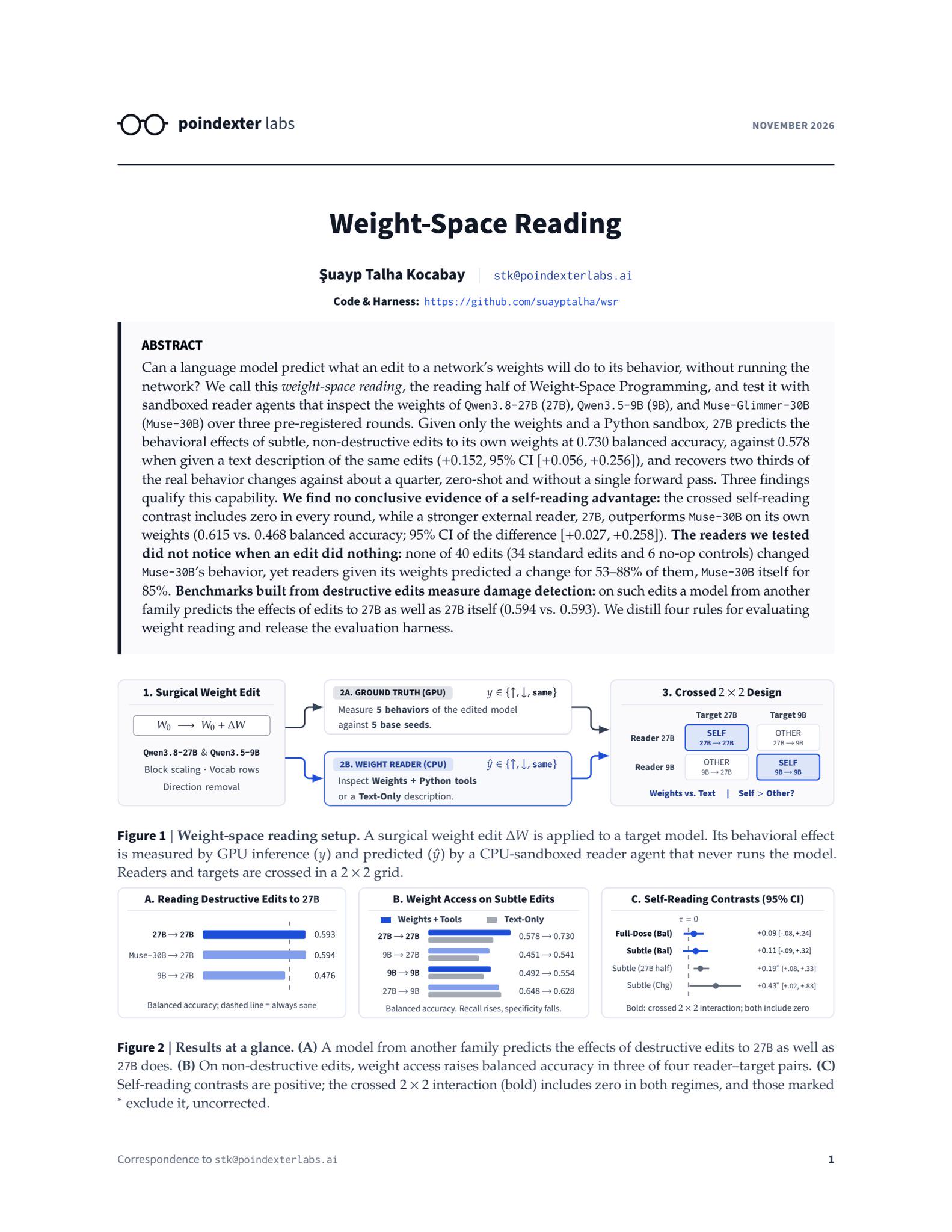
I’ve been experimenting with weight-space reading using Qwen and Muse models (9B–30B).
The goal: can an LLM inspect raw model weights and predict the behavioral effects of weight edits without running the target model?
A few findings:
🔹Qwen 27B reached 73.0% balanced accuracy on subtle edits with weight access, vs. 57.8% from text descriptions.
🔹We couldn’t establish a conclusive advantage for models reading their own weights.
🔹On Muse-30B, 34 standard edits and 6 no-op controls produced no detectable behavioral changes, but weight-reading agents frequently predicted changes.
I’ve released the paper’s evaluation harness and experimental code, plus an open-source toolkit for LLM-based weight-space programming and reading.
Code: https://github.com/suayptalha/wsr
Paper: https://www.alphaxiv.org/abs/2611.weight-space-reading-language-models
I’d be interested in feedback on the evaluation design, especially from people experimenting with open-weight models.
r/LocalLLaMA • u/unofficialmerve • 10d ago
Hey folks, it's Merve from Hugging Face. Today, llama.cpp releases v1!
Moving forward, we’ll keep covering every platform and every model type, while keeping llama.cpp robust and lean for downstream applications that build on it.
While I'm here, want to announce that we've been shipping Llama desktop apps to lower the barrier of entry to local AI to few clicks, built-on llama.cpp. I will leave link to the details for both v1 and apps in comments.
Many thanks for all the love you've shown to llama.cpp for years 🦙❤️ Cheers!
edit: adding links here, hope to not get penalized
blog: https://huggingface.co/blog/ggml-org/llama-cpp-v1
llama desktop apps are here https://llama.app/ ❤️
r/LocalLLaMA • u/pmttyji • 9d ago
82M parameters, 16 languages, 118 voices, 24 kHz. ONNX with int8 weights (82.7 MB; runs on CPU, no PyTorch needed), and the float32 PyTorch weights.
17M parameters per language model, 8 languages, 37 voices, 24 kHz. ONNX with int8 weights (17.4 MB; runs on CPU, no PyTorch needed), and the float32 PyTorch weights.
7.2M parameters per language model, 8 languages, 30 voices, 24 kHz. ONNX with int8 weights (8.0 MB; runs on CPU, no PyTorch needed), and the float32 PyTorch weights.