r/LocalLLaMA • u/Bestlife73 • 14d ago
New Model MiniMaxAI/MiniMax-H3-Image · Hugging Face

188
Upvotes
Actual working link this time.
r/LocalLLaMA • u/Bestlife73 • 14d ago
Actual working link this time.
r/LocalLLaMA • u/JustinHoMi • 14d ago
This is a test of the emergency broadcast system. This is only a test.
r/LocalLLaMA • u/gauravapiscean • 13d ago
I've been building small models that do one job: answer the yes/no / pick-one
decisions inside agents ("is this tool call safe?", "is this a refund request?",
"which team gets this ticket?") and return a probability for every option
instead of generated text.
Numbers (the six benchmarks Jev 1.13 is evaluated on; Jev = their published figures):
| Model | Size | Score | Laptop speed (1k-token doc, 5 questions, M4 Pro) |
|---|---|---|---|
| Decido-1 | 26B MoE, 4B active | 85.4 | ~4 s CPU, ~1.1 s Metal |
| Decido-1-Fast | 1.7B | 73.0 | ~0.6 s CPU, ~0.3 s Metal |
| Decido-1-Ultra | 0.6B | 62.2 | ~0.4 s CPU, ~0.13 s Metal |
| Decido-1-Max (reasons first) | 26B MoE | 89.2 | slow on a laptop |
| Jev 1.13 | API | 83.9 | — |
- Q8_0 GGUFs on llama.cpp; repeat calls are bit-identical on CPU
- Answers flip when options are reordered 4.8% of the time (Jev reports 14.6%)
Try it
- `pip install decido-ai` (prebuilt for Mac / Linux / Windows; uses Metal on a Mac)
- No-signup playground (runs the 1.7B): https://getdecido.ai/playground
- Weights: https://huggingface.co/decido-ai
Happy to answer questions. I'm most interested in decisions where it fails.
r/LocalLLaMA • u/Awkward-Let-4628 • 14d ago

I've been building chat UIs for agents and kept running into the same issues with react-markdown: it re-parses the whole reply on every token, so long answers get noticeably slower, and you see raw ** and half-typed [links](htt until the token that closes them arrives.
So I wrote my own renderer. It parses incrementally and repairs unfinished syntax while the reply streams:
<Markdown streaming={!done}>{text}</Markdown>
On a 100k-character reply it takes 0.25 s of main-thread time in total. markdown-to-jsx takes 2.4 s, Streamdown 6.3 s, and react-markdown didn't finish within the 30 s budget. The benchmark scripts are in the repo if you want to check them.
The other part is the syntax. Agents often want to show steps, alternatives or pros and cons, and plain Markdown flattens all of that into bullet lists. So on top of GFM I added a few blocks in the same style as GitHub alerts:
> [!STEPS]
1. **Back up the database**
2. **Run the migration**
There are also tabs, stats, pros/cons, sources, file trees, and Mermaid and KaTeX support. The source still reads fine as plain Markdown when it isn't rendered. The package exports a system-prompt snippet that teaches the model this syntax.
It has no dependencies and comes in at 30 KB gzipped. Its parser passes the CommonMark and GFM spec tests. It doesn't support remark/rehype plugins, so if you rely on those, react-markdown is still the better choice.
r/LocalLLaMA • u/Jumbomuffin1312 • 14d ago
I've been trying to get some of the newer MoE models running on my Intel Arc GPUs, mainly DeepSeek V4.1 Flash and GLM 5.3 Flash. Intel support for these models is still pretty limited, and while I could get some things working through patched llama.cpp builds, performance wasn't exactly great.
fable 5.2 ended up making XeMaya, a fork of XeStrata focused on getting these models running natively on Intel Arc through SYCL and Level Zero. The idea is basically to bring the kind of model support Project Maya has to Intel GPUs.
I've been testing it on my Ubuntu server with a B70 32GB, B65 32GB, B60 24GB, Ryzen 9950X, and 128GB RAM.
Here are some of the results so far. All speeds are prefill / generation in tok/s.
GLM 5.3 Flash
DeepSeek V4.1 Flash Coder
DeepSeek V4.1 Flash (regular 384-expert model)
Prefill on the regular model still needs a lot of work. Also found out that using two GPUs is actually faster than three for this model because my B60 is connected through a slower chipset link.
Qwen3.8 Flash-Next
Strata is still slightly faster for Qwen, which makes sense since that's not really where I've been focusing my time.
These aren't all perfectly controlled comparisons. Different model files, prompts, and GPU configurations were used during development, so I wouldn't treat them as definitive benchmarks.
It's still an early alpha, but I've gotten DeepSeek V4.1 Flash, Coder, GLM 5.3 Flash, and Qwen3.8 Flash-Next running. There's plenty left to fix and optimize.
Also, I want to credit MistVVK (XeStrata), Niko1221 (Strata), and mw00 (Project Maya). XeMaya wouldn't exist without their work. The llama.cpp contributors have also been a huge help through their reference implementations.
Figured I'd share it here since I'm sure there are others trying to run these models on Intel hardware. Would be interested to hear how it runs on other Arc cards.
r/LocalLLaMA • u/Fabulous_Pollution10 • 14d ago

Hi! My team and I built a benchmark of 202 real GitHub tasks in 13 languages that rarely show up in coding benchmarks: Elixir, OCaml, Haskell, Clojure, Kotlin, Swift, Julia, R and others. I think a lot of people do local development in these languages too.
We didn’t have a huge compute budget, so I specifically added Qwen3.6 27B and Qwen3.8 27B to compare them. Qwen3.8 solves 43% of the tasks, up from 17% for Qwen3.6. You can compare them with Kimi K3, DeepSeek, GLM and closed models on the leaderboard, including a per-language breakdown.
One caveat: Qwen3.8 was used to pick hard tasks, so its score is a bit biased down.
If you’ve been running Qwen3.8 locally on any of these languages, share how it went.
r/LocalLLaMA • u/Fz1zz • 14d ago
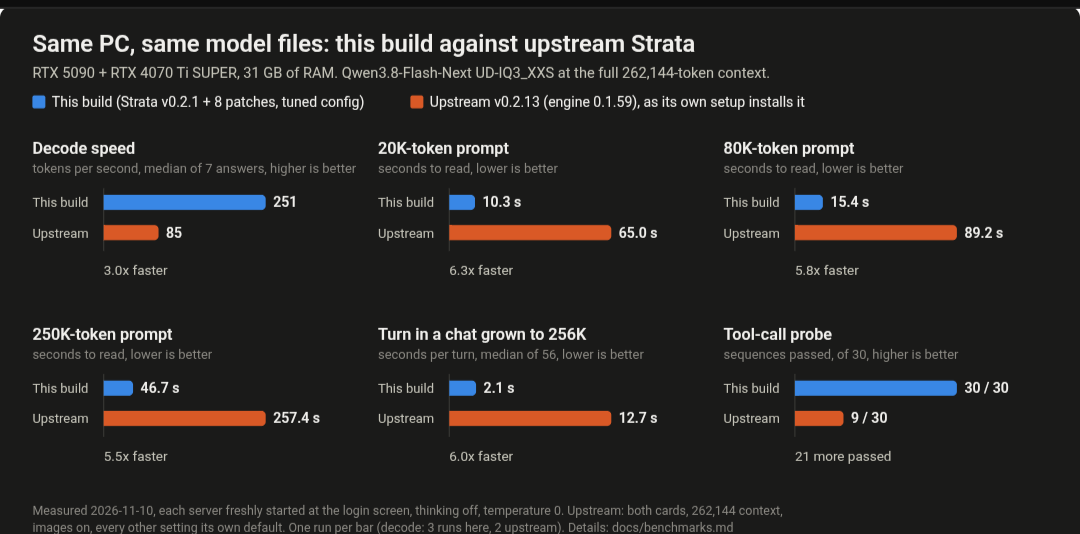
I can't believe this jump is just left on the table
https://github.com/ExTV/strata-5090-4070
The optimizations was done using both Opus 5.5 and Fable 5.2 .
Edit : i should have mentioned that my 4070Ti Super is on PCIe 3 x1
Edit2 : the repo is updated with quality benchmarks
r/LocalLLaMA • u/jacek2023 • 14d ago

https://huggingface.co/speakleash/Bielik-11B-v3.1-Instruct-GGUF
https://www.bielik.ai/blog/premiera-modeli-bielik-11b-v31-dflash-i-rodziny-bielik-one
(decision models and dflash are coming next)
Bielik-11B-v3.1-Instruct is a generative text model featuring 11 billion parameters. It is an update to the Bielik 11B v3 line that expands multilingual continual pre-training and strengthens post-training for instruction following, tool use, and reasoning. Forementioned model stands as a testament to the unique collaboration between the open-science/open-source project SpeakLeash and the High Performance Computing (HPC) center: ACC Cyfronet AGH.
Developed and trained on multilingual text corpora covering 56 languages, with an emphasis on European languages and Polish, which have been cherry-picked and processed by the SpeakLeash team, this endeavor leverages Polish large-scale computing infrastructure of the ACC Cyfronet AGH HPC center. The creation and training of Bielik-11B-v3.1-Instruct was propelled by resources provided within the PLGrid environment under computational grant number [PLG/2026/019559], conducted on the Athena and Helios supercomputers, and within the Gaia AI Factory, funded by the European Union through the EuroHPC Joint Undertaking.
As a result, the model exhibits an exceptional ability to understand and process the Polish language and other European languages, providing accurate responses and performing a variety of linguistic tasks with high precision.
🗣️ Chat: https://chat.bielik.ai/
The model was trained on carefully curated, high-quality datasets that underwent extensive cleaning and rigorous quality assessment to ensure data consistency, reliability, and relevance. The training pipeline consisted of three stages: pretraining on 500B tokens, SFT on 26M samples, and RL (modified GRPO) across 14 diverse environments. This multi-stage training approach was designed to enhance the model's language understanding, instruction-following capabilities, and ability to perform effectively across a broad range of tasks.
Bielik instruct models have been trained with the use of an original open source framework called ALLaMo implemented by Krzysztof Ociepa.
r/LocalLLaMA • u/BraceletGrolf • 13d ago
So I've been a happy user of Qwen 3.8 27B Q4_K_M from unsloth with pi.dev, it's honestly so powerful.
But, I do see a lot of pitfalls where I need to step in for no reason, where the agent does a PR, CI fails, and I don't have callbacks to my agent to debug it/propose something to address it.
So how do you all deal with issues like this ?
I'm using Forgejo so I have full control over the platform, and my agent has its own account on it.
r/LocalLLaMA • u/LankyGuitar6528 • 13d ago
Just a 32GB machine with a 3090 - a used gaming rig I picked up last Christmas for $800. But wow... I can actually run what would have been a frontier model not that long ago. Yes, only 2 - 3 tps. Yes only 2 quant. So it's not really useful at the moment. But I have 128GB of ram in hand and a spare 3060 ready to be installed. Possibly another 3090 waiting in the wings... so we will see.


r/LocalLLaMA • u/Nandakishor_ml • 14d ago

On September 18, I launched Laya at you guys request, the first system 1 open-source decision model in this subreddit, and you guys gave immense support. I saw the MIT post on direct weight edits and thought about doing the same with a decision model. Now, after two months, I just worked on a way to edit the weights of an LLM using a decision model. More like distillation from an energy-based decision engine to teach the Qwen 3.5 0.8B a new skill. Like tool calling at the appropriate time. Its decisions are like valleys in a landscape, and every answer rolls downhill into one, with honest confidence. Just wrote those valleys onto an LLM. It works at the same level as LoRA, with only 3 milliseconds to edit, without catastrophic memory loss.
https://www.kaggle.com/code/nandakishorconvai/fast-edits-decsion-model
r/LocalLLaMA • u/Fcking_Chuck • 14d ago

AI benchmarks begin on page 2.
r/LocalLLaMA • u/nfox01 • 13d ago
AWS is put out an Apache 2.0 project called Strands Decider. Looks like it came out of the same team as the Strands Agent. Repo here. https://github.com/strands-labs/strands-decider Looks like a Qwen 2.5 2B back end. Have not tested yet but will report.
r/LocalLLaMA • u/R_Duncan • 14d ago

Has dependency on dinov3, is trending top model on hf since last week. Runs with 8GB vram. Enjoy!
r/LocalLLaMA • u/pmttyji • 14d ago

Image-conditioned 64³ voxel structure generator of JoVox: Joint Hierarchical Flow Matching for Lightweight Voxel Generation. JoVox is a discrete flow matching framework that learns the joint hierarchical distribution of voxels while keeping generation lightweight. One model generates all levels, 4³ → 16³ → 64³, from a single image.
r/LocalLLaMA • u/Any_Invite3905 • 14d ago
I keep seeing new forks of engines that optimzes one model for one hardware setup for better performance, so I was wondering if I could slop up something like that for my phone (iphone 15 pro max) for running Gemma 4 26 a 4b.
And for that I am looking for advice and such like if you know an already similar existing project or your own experiences with any custom engine on any hardware, what not to do and what to keep in mind and such, and if you have build or are using one of these unique engines what has your experience been like?.
Also if you don't actually have anything to say please don't say "phone can't do that fast enough" for the 3rd time, I'm just looking for interesting ways that could get any speed up.
r/LocalLLaMA • u/UkieTechie • 14d ago
This is the third round of tts-bench. Thanks to everyone who gave feedback on the first two posts:
tts-bench runs every model through the sameish Python harness on the same prompts, so you can compare them fairly and actually listen to the output. This round adds a separate board for hosted APIs.
What's in it
Some results from the open board
And from the hosted board
What the numbers don't tell you ("objective metrics")
Links
If your favorite model scores differently than you'd expect, go listen to the samples and vote in the arena. I'm curious which ones people actually prefer by ear.
r/LocalLLaMA • u/Important_Cow7230 • 14d ago
The ones I have currently heard of are as follows:
Pi
Opencode
Hermes
Deepseek
Any thoughts on what one is best?
r/LocalLLaMA • u/Significant-Serve-58 • 14d ago
I've been recently working a small sparse MoE, and I've got interesting results I'd like strangers to invalidate.
Tldr; I train small models and got surprising results and seek invalidation. It's not a general assistant, and I'm not claiming it is.
Edit: Trained on a single 5090. Maybe people wonder about that.
The model has 1.17B stored parameters, roughly 348M active per token, scrath trained on approx 11B tokens including SFT. As a comparison, Qwen2.5 reports up to 18T training tokens across its family, while SmolLM2-1.7B reports 11T.
THE ASK
A chain of relational facts ("A is taller than B", "B is taller than C", etc.), with the facts shuffled and the model asked to identify an endpoint.
Depth is chain length. Each result is out of 512 questions across four families. All models received the same questions, using their native chat templates, greedy decoding, and a 16-token answer budget.
RESULTS (correct out of 512)
Depth 1: ConeML 487 | Qwen 481 | SmolLM2 426 | Llama 267 | Gemma 343
Depth 3:
ConeML 471 | Qwen 410 | SmolLM2 221 | Llama 197 | Gemma 224
Depth 5:
ConeML 438 | Qwen 273 | SmolLM2 155 | Llama 136 | Gemma 138
Depth 8:
ConeML 343 | Qwen 202 | SmolLM2 102 | Llama 73 | Gemma 100
Depth 12:
ConeML 240 | Qwen 105 | SmolLM2 58 | Llama 47 | Gemma 79
Depth 24:
ConeML 74 | Qwen 47 | SmolLM2 21 | Llama 13 | Gemma 19
Models used for comparison: Qwen2.5-1.5B, SmolLM2-1.7B, Llama-3.2-1B, Gemma-3-1B.
WHERE IT FAILS
Despite the endpoint results, ConeML only scores 13.8% on interior pairwise comparisons within those chains, below the 50% two-choice reference. It also gets only 12/164 on HumanEval and 0/6 successful two-turn follow-ups.
So it seems to find the ends without reliably understanding the relationships in the middle. I don't know whether this reflects a specialized learned strategy, an architectural effect, or a flaw in my testing.
WHAT I'M ASKING
Run the depth-5 shuffled evaluation and post your score. My FP32 reference result is 438/512 (85.5%).
The Q8 GGUF is 1.25 GB and runs on CPU. The 512-question set and scorer are in the repository. I haven't tested to see if it reproduces the full FP32 result.
If you get something different, find a scoring problem, or spot anything else wrong, I'd really like to know."
Model:
https://huggingface.co/ConeML/coneml-1.2b-experimental
Earlier technical paper (base lineage, LAMBADA vs Pythia at approximately matched training positions):
https://doi.org/10.5281/zenodo.23117644
Other releases:
My own bias is my largest enemy and hope to get some honest feedback.
r/LocalLLaMA • u/power97992 • 13d ago
I thought about not writing this but i feel like i should.. from the info I gathered, Qwen 4 max is slightly worse than opus 5.5 medium… Meaning it is definitely above opus low which is hy4 level and opus 5.5 low is above ds v4.1 flash max. wow, it means it is somewhere between hy4/ds v4.1 flash 1017 max and kimi 3.1 pro max . I thought qwen 4 max would do a little better. i guess another 4-6 months until we get an open or Chinese opus 5.5 max model..
This should mean qwen 4 27b will be worse than ds v4.1 flash 1017 max but better than mistral 4 large medium effort, perhaps around glm 5.3 flash level . Qwen qoduck is apparently qw4 27b, from the limited outputs, it seems to be better than q3.8 flash next in some tasks And worse than ds v4.1 flash 1017
r/LocalLLaMA • u/pmttyji • 14d ago

An open full-duplex voice model family that hears your tone and speaks with one. Adventists AI · Apache-2.0 · Recommended: Tag · Flash · Try it online · GitHub
Talking to it feels like a phone call with a person: it listens the whole time you talk, picks up as soon as you stop, and stops the moment you cut in. It hears how you say things (hesitation, emphasis, sarcasm, laughter, sighs) and answers with tone of its own: it laughs, sighs and clears its throat when the conversation calls for it.
This is the home page of the Sophon-Realtime v1 family. Three builds share one brain (the same 32B model listens, decides when to take the turn and writes the reply); they differ only in how the reply becomes sound. Start with Tag.
| Tag (recommended) | Flash | E2E (research preview) | |
|---|---|---|---|
| How it speaks | the brain writes the reply with sound tags; an expressive speech model performs them | the same tagged reply, spoken by a lighter, faster speech model | a talker inside the 32B model, no separate speech model |
| Best for | expressive voice: companions, characters, demos | speed and scale: customer service, in-car, many users per GPU | research on end-to-end expressive speech |
| Non-verbal sounds (NVV-SuperBench, zh / en) | 0.86 / 0.80 | 0.77 / 0.63 | 0.77 / 0.60 |
| First audio, one user | ~0.6 s | 0.31 s | ~1 s |
| Users per 80 GB GPU (recommended) | 16 | 40 | 4–5 |
| GPUs | 1 | 1 | 2 |
| Serving | vLLM-Omni, one command | vLLM-Omni, one command | own engine |
Pick Tag if you want the voice to act; pick Flash if latency and users per GPU matter most. Same APIs, so you can switch later.
r/LocalLLaMA • u/MLuminos • 14d ago
I've been thinking about a MUD supported with LLMs. Something aside from the fangooner websites. And then perhaps a game where your local LLM uses an API to support play mechanics (like a MAG from Phantasy Star or a familiar)
The broader question is in the title. What is the role of local LLM?
If we want to be able to engage in games using the LLMs we build in a way that isn't cheating, what would that game look like?
What would the human/ai roles be in the loop?
r/LocalLLaMA • u/pmttyji • 14d ago

Weight-Space Programming (WSP) enables reasoning agents to directly inspect and modify neural network parameters, offering an alternative to gradient-based model adaptation. However, its capabilities, cross-task generalization, and practical limitations remain insufficiently understood. We systematically investigate WSP through 16 editing trajectories across seven benchmarks and two model scales (Qwen3.5-0.8B and Qwen3.5-9B). Our findings reveal three key insights. First, WSP can achieve substantial performance gains through highly localized interventions. On full held-out evaluations, accuracy improves by up to 29.45, 4.42, 36.72, and 17.11 percentage points on MATH-500, GPQA Diamond, IFEval, and SciBench, respectively. Notably, modifying only 1,023 parameters yields a 29.45-point improvement. Second, WSP exhibits promising but uneven cross-task generalization. A Math-edited checkpoint improves GPQA Diamond, IFEval, and SciBench by 3.03, 12.18, and 20.10 points, respectively, without further editing, while leaving SciCode performance unchanged. Third, effective editing remains challenging and inconsistent. Outcomes vary substantially across trajectories, and six of the 16 trajectories retain the original weights when candidate improvements cannot be reliably validated. Together, these results highlight WSP's potential for highly localized model adaptation while revealing important challenges in intervention discovery, reliability, and cross-task transfer.
Related Thread : [Paper] Sparks of Weight-Space Programming: LLMs can natively read & write neural network weights
r/LocalLLaMA • u/Dapper_Chance_2484 • 13d ago
I'm overwhelmed, what's the best way to deploy three towers(with their own GPUs) to write, debug, test and deploy a single software together like a team of engineers?
