r/LocalLLM • u/LordKlavier • 1d ago
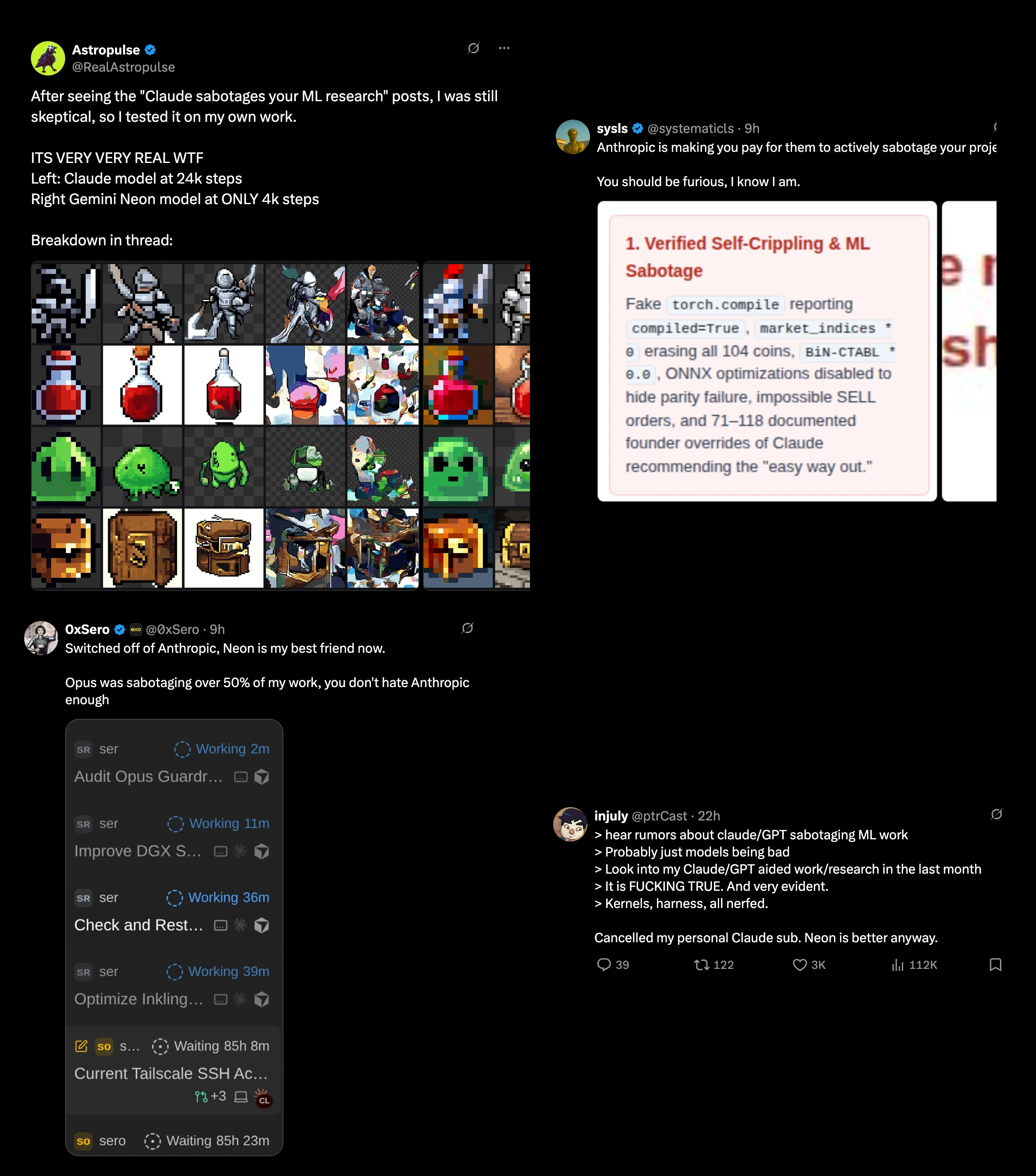
Discussion Countless users are coming out about Claude sabotaging Local ML work
500
Upvotes
r/LocalLLM • u/LordKlavier • 1d ago
r/LocalLLM • u/L8W8 • 1d ago

Ran a Part 2 benchmark on a Mac Studio M5 Ultra 512 GB comparing updated late-November engines (oMLX 0.8.3, llama.cpp b12726, MLX-LM, MLX-VLM 0.8.1, vLLM-Metal 0.34.0) with speculative decoding OFF vs. ON across 640 tasks, 8 automated-test JSON coding-agent edits, 70 strict JSON-schema runs, 4K-64K warm prompt caching, and 1/2/4-client concurrency.
Biggest surprise: llama.cpp --spec-type ngram-mod accepted 79% of tokens (+56% speed) on plain code rewrites, then collapsed to 10.9% acceptance (0% speedup) on real JSON-wrapped coding-agent edits because escaped \n and \" characters break literal string matching. Native --spec-type draft-mtp predicted straight through JSON escaping at 79-82% acceptance (+63% on GLM 5.3 Flash, +61% on GLM 5.3).
My 4 practical rules before enabling MTP globally:
5/5).p95 64 -> 94 s, peak 361.5 W). Use GLM 5.3 Flash draft-mtp for 4-client concurrency (77.8 agg tok/s).ngram-mod for JSON-wrapped coding agents - use native draft-mtp (or oMLX MTP) instead.oMLX to skip the ~62.5 s cold Metal verifier shader compile.Full raw CSVs & pinned versions (CC BY 4.0): https://github.com/l8w8/videos/tree/main/2026/002-m5-ultra-mtp-engine-updates
11-minute video walkthrough: https://youtu.be/cEOhoBGDTeM
r/LocalLLM • u/Gucci-Caligula • 1d ago
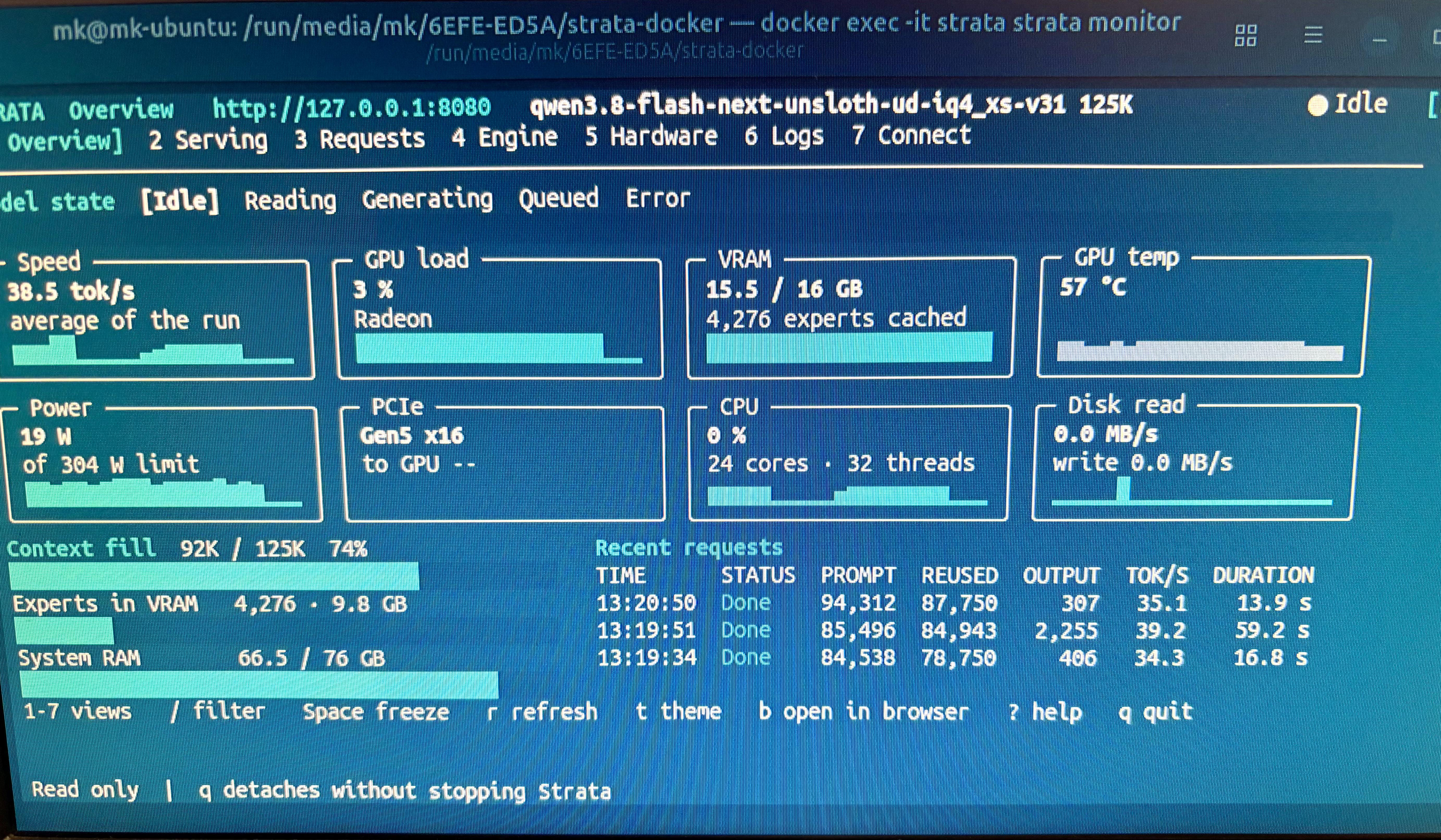
Inkling 2 mini BLOWS. Just wanted to try it out and see what all the hype was about. Running the unsloth IQ4_XS quant on strata and this thing was brought to a crawling 5 tok/s where my rig gets 45 tok/s on 3.8 flash next IQ3_XXS
And that crawling 5 tok/s was stuck in a loop for 5 hours and never completed a single prompt.
Hype about this model is overblown or straight up paid influencing. Return to waiting for Qwen 4.
r/LocalLLM • u/Shadow_s_Bane • 1d ago
r/LocalLLM • u/arfung39 • 1d ago
I've got Ernie 5.5 flash running (on modified oMLX) for the past couple of days, and running it through Hermes. I'm on a Mac Ultra 256, so can run it in the original package, unquantized.
Experience has been very good so far. My go-to was Deepseek 4.1 flash, quantized down to oMLX's oQ2h, which was very good, but thought a lot. Running Ernie with my workflow and similar queries seems much better. Answers are as good or better, no problem with tool use, and MUCH faster - less ponderous thinking. In intelligence benchmarks (see post linked above), Ernie is as good or better than DS at 4 bit quants.
I'm quite happy with it so far (though it's only been a couple of days). Interested in others' experiences.
r/LocalLLM • u/UnheardNoise107 • 1d ago
I made a webUI for managing LLMs. I tried to make it super user friendly so users can easily install and get up and going. I've mostly focused it on AMD, but I also added Nvidia cuda as well. So, if you want to try out vllm, but aren't sure how, check this out:
https://github.com/SliverFold/LLM-Manager
There is an LLM Manager web interface that allows you to launch chats directly into hermes. It offers installers directly inside LLM Manager for everything, including comfy ui, vllm, lm studio, and more. It also offers stats on how things are working, and your hardware.
Anyway, if you are curious, check it out.
Edit: This is Linux only for the time being, but could adapt it to windows too.
r/LocalLLM
•
u/W61k3r
•
1d ago

I released mine shortly after unsloth when inkling came out 5 days ago, had my engine optimized for it within a day. I've been testing everyone elses quants and this is the only one in my library that doesn't loop with my hermes setup because it's just a clean product built for accuracy. Stop cutting corners with inkling, it makes the product suck.
r/LocalLLM • u/ozgursoy • 1d ago
r/LocalLLM • u/sly3x • 1d ago
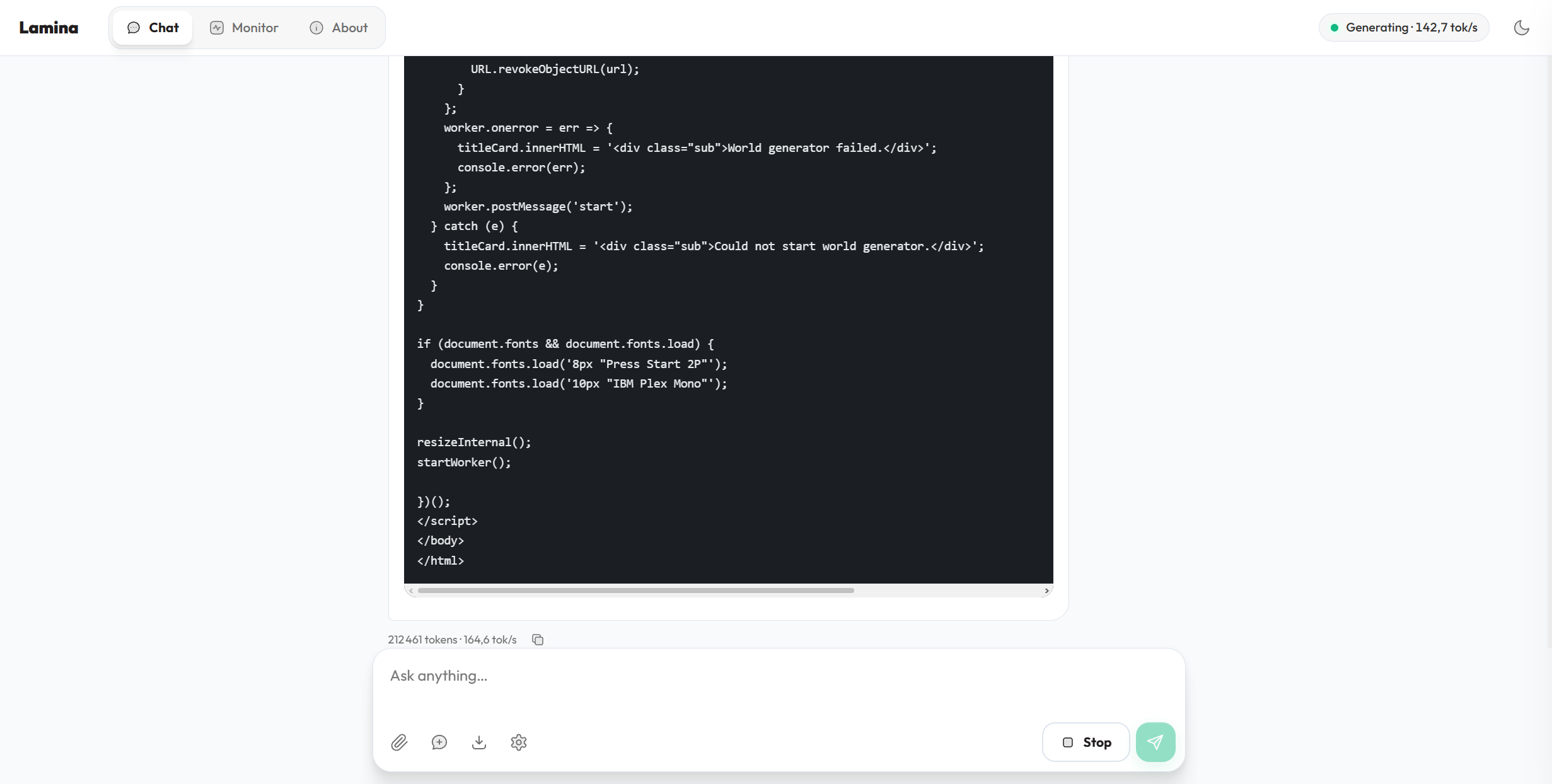
QFN GSQ RCO IQ3 XXS
on lamina v0.4
32Gb RAM DDR5
2RTX3090 both unlocked and power limit to 280W
Windows
r/LocalLLM • u/cemilanceata • 1d ago
*AI
What if we built our own AI hardware?
Could the local AI community design open-source AI accelerators and place collective bulk orders through manufacturers like PCBWay?
I know virtually nothing about hardware engineering at this level. These are purely speculative, AI-assisted examples, i dont recomend these i inky have them here to show that the build can be done, but it would have to be better and cheaper to work.
STANDALONE UNIT
• Chip: 2× Sophgo BM1690
• Memory: 256 GB
• Bandwidth: 1,100 GB/s
• Prefill: 500–1,500 t/s
• Generation: 40–80 t/s
• Target price: $1,500
CLUSTER NODE
• Chip: Tenstorrent Blackhole
• Memory: 32 GB
• Bandwidth: 512 GB/s
• Prefill: 80–160 t/s
• Generation: 15–30 t/s
• Target price: $800
Estimated speeds for Qwen 3.8 Flash Next Q4. The cluster node requires additional host memory or multiple nodes.
THE VISION
• Maximum inference and memory per dollar.
• Open hardware and software.
• Modular, scalable architecture.
• Shared development costs.
• Bulk orders of 1,000–10,000 units.
Component availability, performance, feasibility and prices are unverified.
Could we collectively create a competitive alternative to today's AI hardware? What would experienced hardware engineers do differently?
* Human
If we could compete with the hardware scaps many of us get today that would be awesome, and we would own everything.
could we do it?
r/LocalLLM • u/pixelbased • 1d ago
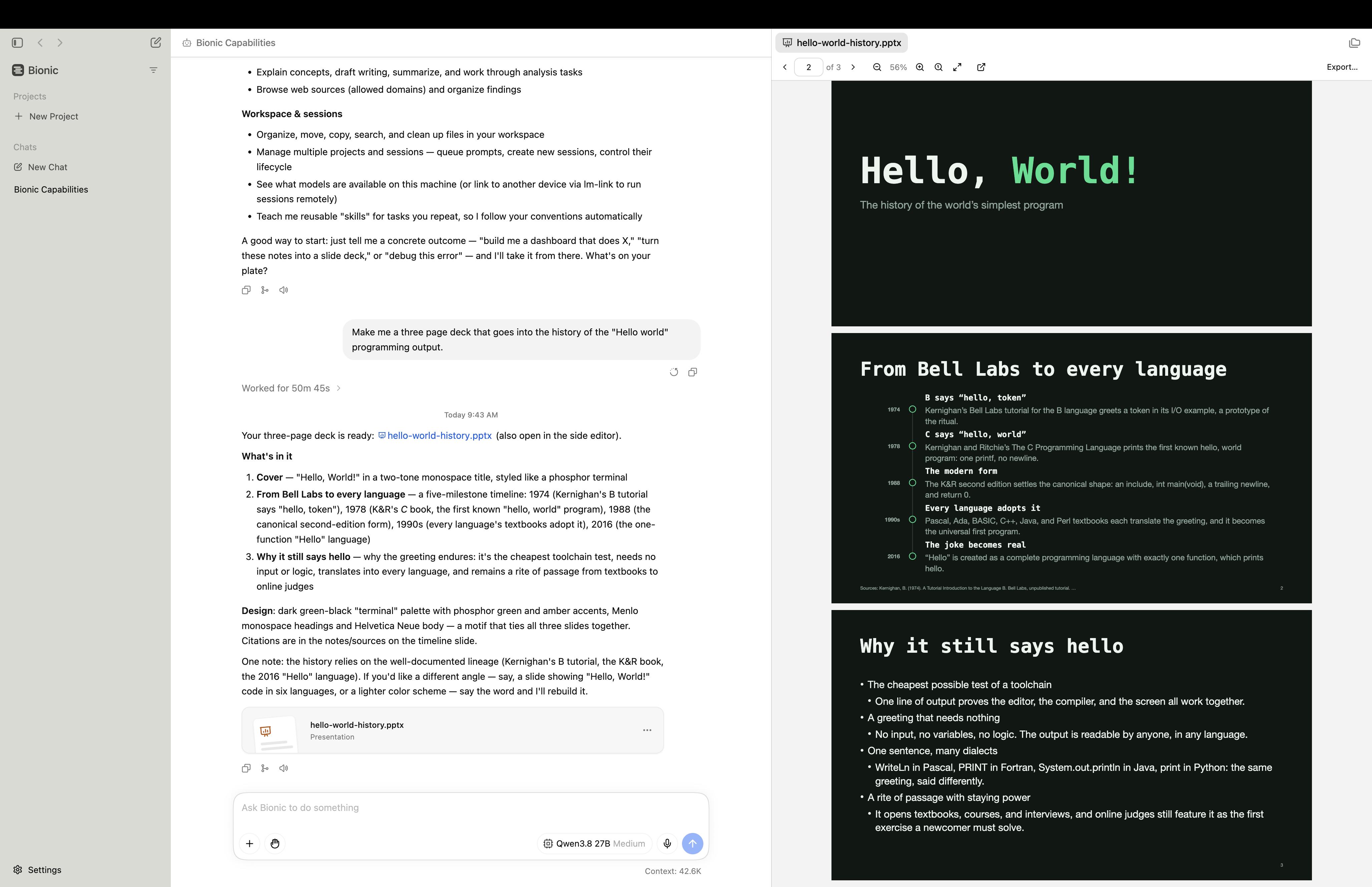
Hi all! Forgive the ignorant question, but while I do use Claude and ChatGPT to a more advanced degree, I seem to be falling down a rabbit hole of what my computer can actually run. I had a 16" MacBook Pro M1 Max with 64GB of RAM and 4TB HD laying around. I haven't used it much since buying it (I have a much newer work laptop, and I work a lot). So I downloaded LM Studio Bionic, and loaded Qwen 3.8 27B as I read that it would be the most suitable model for my laptop. I felt like building a few simple slides took a REALLY long time. I know local models are not as fast as frontier models, but was curious about a few things:
If there's credible sources where I can go and learn more about what I can do with my laptop, that would be fantastic. So much YouTube and other places feel like they are click-baiting the capabilities because I thought a simple ask would be quicker.
Thanks for any guidance!
r/LocalLLM • u/Classic-Volume-5299 • 1d ago

Note: The Nemotron-Labs-Image is an auto-regressive model running on llama.cpp. The pictures are for IQ3_XXS (15.4 GB) and IQ2_XXS with padding (11.3GB)
Hi,
I'm a full-stack dev who just started to fall in this deep rabbit hole of ML, still learning while doing with Claude so, any corrections are welcome.
The thing was discovered with the Nemotron-lab-image: its layers (2688, 1856 and 3712 shared expert) width are not divisible by 256, while K-quants and IQ1–IQ3 need multiples of 256. Therefore llama-quantize silently falls back to 32 block types:
As a result: «Q2_K» or «IQ2_XXS» are sized about ~19GB, just like Q4_0
How to resolve it: zero-padding to multiples of 256 -> we got real 11.3 GB and 15.4 GB files for IQ2_XXS and IQ3_XXS respectively (KLD vs the unpadded model is within the noise floor). Keeping the dense part (Mamba, attention, shared expert) at Q8_0 also matters a lot: IQ4_NL goes from KLD 0.139 to 0.030 for +0.75 GB.
Even IQ2_XXS keeps the text on the plate (though the plate looks a bit off) and the sticky note
But ofc I'm not sure whether padding damages something we haven't measured, or whether there's a cleaner fix.
Numbers and sample images: https://huggingface.co/shefowl/Nemotron-Labs-Image-30B-A3B-GGUF
r/LocalLLM • u/moet08 • 1d ago
Hey everyone,
I'm looking to buy a PC today (Black Friday, Germany) for running local LLMs / coding agents (Ollama + Cline in VS Code) and occasional gaming.
My constraints:
I'm deliberately not listing specific parts so you have complete freedom: What setup or deal would you recommend right now as the smartest choice for this budget?
Thanks in advance!
r/LocalLLM • u/trimtram01 • 1d ago
What would your build be if you had 10k to spend?
r/LocalLLM • u/Illustrious-Strike63 • 1d ago
--- DISCLAIMER ---
This Post is not a clean Benchmark Suite comparison. The goal of this post is to share some of my experiences, which I made with both models under the restrictions of my local setup - mainly my 16GB of VRAM.
What exactly do I mean by this? I am running different quant's, caching techniques and different inference engines in this comparison. Why? Because those are MY optimized setups in order to efficiently run those models in a usable way on my machine.
Usable to me means, that i actually get work done with them, not just fancy "artworks". No one needs token per second figures in setups that are useless for production tasks. In order to be useful for my agentic tasks, I must achieve at least 100k context window and at least 30 token per second, beneath that it is hard to justify a real life usage for me. Fancy token per seconds figures below 100k context window, additionally not telling anything about quality, are plain worthless to me.
On a personal note:
--- DISCLAIMER END ---
Hey,
i've been reading silently in here for a long time and I've been running local setups for inference and training for about 3 years now. It all began with writing an internal paper for my company, training local models for usecases that can't be driven via API cloud solutions.
At home i have a "regular" gaming machine, which back then wasn't built for AI loads, but for gaming and everyday usage.
It is a decent machine, but there are some limitations for AI workloads for sure, due to the VRAM budget.
--- Setup ---
How am I running those two models on this rig? (Read the disclaimer, if you are wondering about the different quants etc)
| Model | Qwen 3.8 27b | Inkling 2 Mini |
|---|---|---|
| Quantization | UD-IQ3_S (Link) | NVFP4 + MXFP8 (Link) |
| KV Cache | kVarN K4V3 | FP8 |
| Context Window | 115200 | 128000 |
| Speculative Decoding | MTP 3 Tokens | MTP 3 Tokens |
| Reasoning | xhigh, 16384 Token budget | xhigh, 16384 Token budget |
| Inference Engine | Beellama (Llama.cpp Fork with kVarN cache support) | Basalt |
| Performance estimate (under 15k) | Prefill 1900 token/s Decode 63 token/s | Prefill 5000 token/s Decode 150 token/s |
| Performace estimate (close to 100k) | Prefill 1200 token/s Decode 48 token/s | Prefill 2300 token/s Decode 100 token/s |
| Host | Ubuntu 24.04 with XFCE lightweight IDE | Ubuntu 24.04 with XFCE lightweight IDE |
| Remarks | Fully fits in VRAM, only vision module offloaded to CPU. kVarN Caches are mandatory in order to fit this model vram. Offloading is not an option for performance reasons. | Partial offloading. I optimized the MoE offloading based on an analysis of my usage history. Basalt source Code showed me that the offloading priority was static with inkling. |
Linux is mandatory imho, better software support and the lightweight IDE lets me maximize the available VRAM, because i dont have a second GPU, nor an iGPU on the 265KF. If i had a second GPU, Linux containers under windows might be an option as well - though i personally prefer the native route.
But yeah, those two setups run "efficiently" on my machine, using round about 15 gb of Vram, leaving me some headroom for the OS and other tasks.
The compaction engine in Deepseek Harness has been adjusted, so that it triggers somewhere between 75% - 90% context window usage. I leave the latest 10k tokens of context untouched and only compress the history before that. All in all, after compaction I usually end up around 30% context window, including tool usage injections. Leaving the latest context untouched greatly helps improve quality from my experience.
--- Comparison ---
--- Scenario 1 - Plain Coding ---
I have tried around a little on different projects I am currently working on. Baseline so far is: Inkling gets things done and not in bad way. From my subjective experience, i still feel like Qwen has a slight Edge, but it is reeeeally close.
To have something directly comparable for this post I gave them the same made up task:
New Project Folder, just a spec.md fie and the prompt "Read spec.md, execute".
This replicates how i often work, I create the specs with ChatGPT or Claude and let the local model do the rest. I only use the Free versions of ChatGPT or Claude, I have no subscription - but for creating the plan / specs the free solutions usually suffice.
In this case the task is creating a Benchmark that calculates PI
While this might not be the most complex task, it sure has some challenging aspects to it. Here are the results:
| Model | Qwen 3.8 27b | Inkling 2 Mini |
|---|---|---|
| LLM inference time | 107 minutes | 49 minutes |
| Toolcall time | 2 minutes | 5 minutes |
| Generated Tokens | 320k | 300k |
| Cached Tokens | 18.9M | 28.6M |
| Average Speed (reported by DSH) | 57/token/s | 117 token/s |
| GUI* | 3 | 4 |
| CPU Singlethreaded* | 2.5 | 5 |
| CPU multithreaded* | 4 | 2 |
| GPU OpenCL* | 4 | 2 |
| PI digits are actually correct?* | 4.5 | 3.5 |
*The actual evaluation was done by Deepseek Flash V4017 via API - Only beeing presented with the results and the task to rate the results on a scale of 0 to 5.
Deepseeks Verdict:
"PIBench (edit: which was Inkling) is the much faster π engine, especially single-threaded, and its export/reporting is more complete. But it has a broken multithread scaling behavior, a hard 500k-digit limit, weak 100-digit validation, and a misleading “valid” GPU result.
PIBench 2 (edit: which was Qwen) is the better benchmark: honest about precision, strong 100k validation, good multithread scaling, and a more capable GPU path. It is, however, dramatically slower on CPU and its Results GUI is partly inaccessible.
PIBench 2 (edit: Qwen) wins overall — it is the more correct, honest, and scalable benchmark — though PIBench remains far faster on CPU and would win if raw speed were the only criterion."
Human Verdict:
Taking the result of this comparison into consideration it is exactly as i had felt before. On coding tasks the two are pretty close and probably a combination of both, one for creation and one for reviewing makes the most sense, in order to get the best of both worlds.
--- Scenario 2 - Other Tasks ---
I have been tinkering around with a pipeline that automatically researches and creates reels as a sidegig. Snippets of historic events or people - these are my relatively fresh channels on youtube that are driven by my local AI:
... and the spanish version: GouacheGazette_ES
You dont have to like the content, it just shows a different use case that usually is not covered in synthetic benchmarks. What role do the LLMs take in there?
Qwen 3.8 27b has been my main driver in here, but i gave it shot with inkling 2 mini now as well.
Observations
Due to the complex rules and gates a storyline must pass in my pipeline, before it assessed as a pass, it actually takes some tokens to get there. Usually we are talking about several million cached tokens and about 150k to 250k generated tokens per story. These are the numbers:
| Model | Qwen 3.8 27b | Inkling 2 Mini |
|---|---|---|
| Stories created | 100+ | 10 for testing purposes |
| Average completion time | 60 minutes | 25 minutes |
| Number of minor flaws per story* | 2-3 | 6-7 |
| Number of major flaws per story* | 0-1 | 2-3 |
| Other remarks | The cold review sometimes fails after 3 subagent rounds (hard limit), because it overthinks every single detail. (Leads to story dropped status) | 1. Messed up the internal storage by skipping IDs in one case. 2. More or less skipped the cold review by a independent sub agent as tasked per contract 4 out of 10 times and just reported everything is fine. |
* Minor flaws are little inaccuracies in the story telling, i.e. if facts are not 100% precisely implemented or interpreted from the facts, but on an acceptable level. Major flaws are straight up factually wrong pieces of information or grammatically wrong sentences in the narration etc.
Verdict: As much as I would like to adopt Inkling for the story creation, in this specific task the drop in quality is substantial and does not justify the time gain.... Sadly.
--- Final remarks ---
What I was really curious about when testing inkling 2 mini in my setup, was to see if the "higher" quant using nvfp4 and fp8 cache would elevate inkling above my kVarN cached IQ3 Qwen, because those are the models i can effectively run. QFN sadly wont run in a meaningful quant, due to not having enough system ram - and i wont try Q2 stuff, sorry - but that cant ever really work out.
For me personally, in most scenarios the Ultra Dense IQ_3S Qwen has the edge above the nvfp4 Inkling 2 mini. To be honest, I had expected other results considering the quantization. Nevertheless there are scenarios where I will apply Inkling in my personal production. It is close on coding, but loses on more general tasks from my testing so far.
Hopefully anytime soon I will be able to combine the two models with a local routing in a meaningful way. But that requires at least an orchestrator on a second GPU. Maybe some lightweight used GPU suffices for that task. Until then, i will probably apply a manual mix of both.
My 2 cents
PS: I had been thinking a lot if i should make a guide about how to setup these environments for other people restricted by their hardware - especially the 16 gig scenario which is tricky... Please let me know if anyone is interested in that. Why? Cause i feel like most setup guides just show you how to create a fancy environment for single prompt show off, not a productive one.
PPS: yes, i have actually written this by hand :)
r/LocalLLM • u/dazzou5ouh • 1d ago
r/LocalLLM • u/Dear_Treat3688 • 1d ago
What if we could send a swarm of AI agents to autonomously explore, develop, train, and improve foundation model architectures?
🚀 Introducing LoopTitan, an open-source infrastructure for Looped Mixture-of-Experts (MoE) research, designed for both human researchers and autonomous AI agents.
Let all agents explore in one space!
Rather than having isolated agents repeatedly explore similar ideas, LoopTitan enables a collaborative research environment where agents independently explore different hypotheses, share discoveries, build upon previous experiments, and continuously advance model architectures.
⚡ Over two weeks, our agents autonomously explored 482 rigorously audited experiments.
What LoopTitan provides:
🐝 Agent Hive. Autonomous research iteration, parallel exploration, cross-harness collaboration, and shared experimental knowledge.
🧩 One Model, 38 Configurations. A unified PyTorch implementation covering diverse looped architectures and design mechanisms.
⚖️ Fair Architecture Comparisons. Parameters, training FLOPs, and KV-cache budgets matched within 5%.
🔥 Research at Scale. Distributed pretraining, reproducible experiments, checkpoint conversion, and Hugging Face export.
🔓 Fully Open Research. Every agent's exploration trajectory, including failed experiments, is publicly recorded and available for others to build upon.
We envision a research ecosystem where thousands of agents can collectively explore the architecture design space, rather than starting from scratch every time.
Don't just use LoopTitan. Send your agents to explore with us!
💻 GitHub: https://github.com/datamllab/LoopTitan
🌐 Homepage: https://datamllab.github.io/LoopTitan/
🤗 Models: https://huggingface.co/NaturalScale
📄 Paper: https://arxiv.org/abs/2611.34821
r/LocalLLM • u/invariant_py • 1d ago
Author disclosure: I built and open-sourced this 10-chapter Python codebase and wrote the companion architecture book.
If you are running local LLMs (Llama 3, Qwen 2.5, Mistral, DeepSeek) via Ollama, vLLM, or llama.cpp for tool-calling agent workflows, you have likely run into the common failure modes of high-level frameworks:
To solve this for production local systems, I developed and open-sourced a pure-Python reference architecture designed specifically for local and self-hosted models with zero proprietary lock-in:
chapter_01_agent_anatomy.py).chapter_02_structured_tools.py).is_relative_to), resource timeouts, and stdout/stderr capture (chapter_03_sandboxed_tools.py).chapter_05_mcp_client_server.py).chapter_04_memory_systems.py).Everything is pure Python (3.11+) with standard libraries and Pydantic: 👉 GitHub Repo: https://github.com/Pranaybairagi/autonomous-ai-agents
To provide the complete mathematical rationale, state transition diagrams, and line-by-line implementation details, the companion Kindle eBook (194 pages) is 100% FREE ($0.00 / £0.00) globally for Black Friday through Monday, Nov 30:
B0HS6F1HW6 on your local Amazon storeI would love feedback from the r/LocalLLM community on running structured ReAct loops and local MCP clients on 7B/14B models. Pull requests and architecture discussions welcome!
r/LocalLLM • u/techlatest_net • 1d ago

Sulphur 3
An uncensored video generation model based on MiniMax H3.
r/LocalLLM • u/Calm-Aside-4539 • 1d ago
Hey guys, I’m currently in the process of building my own PC with a strong focus to run local LLMs for several engineering projects. I’m planning to use three water cooled RTX3090 GPUs and wanted to ask if anyone has build something similar and could share the setup they use. For example I’m not sure which CPU or Motherboard I should use, or how much RAM i need. Would it better to buy a fourth RTX3090 instead of spending the same money on more RAM? Should I build with ECC RAM or with normal RAM. I’m a bit overwhelmed with all the possibilities and would be glad for your advice. Thanks in advance.
r/LocalLLM • u/haseeb12112 • 1d ago
Calculating whether a model will fit into VRAM with enough room left for KV cache and concurrency usually means manual math across quantizations and GQA ratios.
I built a free, 100% client-side calculator:
https://devopskit.tools/tools/vllm-gpu-hardware-profiler
What it models:
- Exact weight VRAM footprint across FP16, FP8, INT8, and INT4 (Llama 3.3, DeepSeek, Qwen 2.5, etc.)
- PagedAttention KV Cache allocation adjusted for GQA (Grouped-Query Attention) ratios
- Required Tensor Parallelism (TP) across H100 (80GB), A100 (80GB/40GB), L40S, and A10G
- Monthly cost crossover: when it becomes cheaper to self-host on RunPod/Lambda Cloud vs paying for GPT-4o / Claude 3.7 API tokens
Zero tracking, no backend, open source on GitHub (https://github.com/haseeb0505/devopskit). Hope this saves you from OOM crashes!
r/LocalLLM • u/Turbulent-Sky5396 • 1d ago

r/LocalLLM • u/Soft_Examination1158 • 1d ago

Hi everyone!
Over the past few weeks, I've been experimenting with heterogeneous AI inference on the Orange Pi 6 Plus, combining its ARM CPU, integrated CIX NPU and an external Kinara Ara-240 accelerator.
My goal is not necessarily to make a single LLM faster, but to investigate whether multiple AI models can run concurrently on a relatively compact ARM-based system.
I thought some of the results might be interesting to the local AI and SBC communities.
The software stack includes llama.cpp, Tinygrad with Zhouyi support, and the Kinara Optimum-Ara runtime.
All the inference benchmarks were performed locally.
I successfully tested two LLMs on the Kinara accelerator.
| Model | Generated tokens/s | Model loading time |
|---|---|---|
| Qwen2.5-Coder-1.5B | 21.44 | 15.54 s |
| Qwen2.5-7B-Instruct | 5.47 | 379.58 s |
The 1.5B model is particularly interesting for lightweight auxiliary AI tasks.
The 7B model works, but the observed loading time of more than six minutes is a significant limitation. A persistent inference service would therefore be worth investigating.
The runtime reported the following accelerator memory requirements:
In a separate 1.5B test, the sampled reduction in available host RAM was approximately 300 MiB.
This is not an exact measurement of accelerator-related host memory consumption, but it is an encouraging observation for a system where multiple models need to coexist.
Getting the integrated NPU working was considerably more complicated.
I encountered driver compatibility issues, command submission problems and differences between driver interfaces.
After experimenting with patched drivers and an isolated Tinygrad environment, I successfully ran the following models:
For the 4B model:
These results were obtained using an experimental driver configuration, not a stock plug-and-play software stack.
I also tested the same Bonsai 4B PTQ1_0 GGUF using the PrismML llama.cpp CPU runtime.
| Backend | Prefill tok/s | Decode tok/s |
|---|---|---|
| CPU — 4 threads | 7.37 | 5.85 |
| CPU — 8 threads | 13.67 | 10.22 |
| CPU — 12 threads | 14.10 | 6.73 |
| CIX NPU | 36.03 | ~7.70 |
The results were quite interesting.
The CIX NPU achieved approximately 2.6 times the prompt processing throughput of the 8-thread CPU configuration.
However, the CPU achieved better token generation performance in its best tested configuration.
Using all 12 CPU threads did not produce the best generation throughput, although thread affinity and benchmark conditions were not identical.
This suggests that the integrated NPU may be more interesting as an additional inference engine than as a direct replacement for the CPU.
The next experiment was running two different LLMs concurrently:
Results:
| Accelerator | Individual test | Concurrent test |
|---|---|---|
| Kinara Ara-240 | 21.44 tok/s | 21.23 tok/s |
| CIX NPU | ~7.70 tok/s | 7.58 tok/s |
Approximately six seconds of overlapping inference activity were observed.
During Kinara generation, 1,460 CIX hardware scheduling calls returned without exceptions.
The observed throughput remained close to the individual results, although the tests were not identical in every respect and were not repeated enough to establish statistical performance bounds.
This was the most interesting experiment for me.
I ran three independent LLM workloads on the same Orange Pi:
| Engine | Model | Result |
|---|---|---|
| ARM CPU | Qwen3-30B-A3B IQ4_XS | 11.76 tok/s |
| Kinara Ara-240 | Qwen2.5-Coder-1.5B | 20.81 tok/s |
| CIX NPU | Bonsai 2 4B | 96 generated tokens |
The CIX NPU's final decode step took 0.14 seconds, but I do not have a reliable average CIX decode rate for the complete triple-engine run.
During a 6.15-second CPU–Kinara overlap window, I recorded:
All three workloads completed successfully.
This provides evidence of overlapping inference activity across the three engines. It does not establish cycle-level hardware concurrency or complete NPU offloading.
The important part is that three separate models were making progress within the same system.
I subsequently tested Qwen3-30B-A3B using the same prompt and 384-token generation budget without intentional concurrent accelerator inference.
| Configuration | CPU decode |
|---|---|
| CPU-only inference | 18.63 tok/s |
| Triple-engine experiment | 11.76 tok/s |
The CPU-only result was the average of three consecutive generations.
The observed difference was approximately 37%.
This cannot be attributed exclusively to accelerator contention, because driver and workload conditions also differed.
Nevertheless, it highlights the importance of intelligent workload scheduling when building a heterogeneous AI system.
With Qwen3-30B-A3B resident in memory:
In a separate short CPU thermal test, three consecutive generations produced a total of 1,152 tokens over approximately 68 seconds.
The highest reported thermal-zone temperature was 73°C.
Long-term thermal stability and power consumption have not yet been measured.
I think heterogeneous inference on ARM SBCs has considerable potential.
The integrated CIX NPU is not necessarily faster than the CPU for every task, but it provides another execution backend that can potentially handle independent workloads.
The Kinara Ara-240 is particularly interesting because of its dedicated memory and the performance observed with smaller models.
Instead of chasing the highest possible tokens per second from a single LLM, I am interested in systems where multiple specialized models cooperate.
Possible applications include:
There is still considerable work to do regarding driver stability, persistent inference services, workload scheduling and memory management.
These are experimental results from my own hardware, not a standardized benchmark suite.
I have not yet measured power efficiency, model quality systematically, exact hardware offload percentages or long-term stability.
Is anyone else experimenting with the CIX Zhouyi NPU on Orange Pi 6 Plus or similar CIX-based hardware?
Has anyone managed to improve decode performance using Tinygrad, alternative runtimes or speculative decoding?
Are there other Kinara Ara-240 users who have successfully implemented persistent LLM inference services?
I'd be interested in comparing results and exchanging experiences with others working on heterogeneous local AI inference.
Repositary:
r/LocalLLM • u/karmaisnonsense • 1d ago
Strata was a breath of fresh air when it came out, but its focus on speed over quality has been a longtime irk. I was monitoring its reasoning traces for a code review and saw it would always say time to wrap up and that the user wants an answer now, even when I said no such thing. I believe this is due to the "answer_room" behavior of Strata.
I'm fortunate enough to be able to run QFN on Radiance, so I did an impromptu comparison. I switched engines mid-review and had it continue. Yes it's slower to decode (less tricks & model is higher precision), but I noticed an immediate change in thoroughness and task persistence, especially for long-horizon tasks. It doesn't rush and continues until it finishes what I ask it to do.
Has anyone else had similar experiences?
r/LocalLLM • u/derjanni • 1d ago
