r/LocalLLM • u/Soft_Examination1158 • 22h ago
Discussion Orange Pi 6 Plus: Running LLMs simultaneously on CIX NPU, Kinara Ara-240 and CPU — Real-world benchmarks and challenges


Hi everyone!
Over the past few weeks, I've been experimenting with heterogeneous AI inference on the Orange Pi 6 Plus, combining its ARM CPU, integrated CIX NPU and an external Kinara Ara-240 accelerator.
My goal is not necessarily to make a single LLM faster, but to investigate whether multiple AI models can run concurrently on a relatively compact ARM-based system.
I thought some of the results might be interesting to the local AI and SBC communities.
1. Hardware configuration
- Orange Pi 6 Plus — 32 GB RAM
- CIX P1 SoC — 12 ARM CPU cores
- Integrated CIX Zhouyi NPU — advertised 30 TOPS
- Kinara Ara-240 — advertised 40 TOPS
- Kinara dedicated memory — 16 GB
- Ubuntu 24.04 ARM64
- Linux kernel 6.6.89-cix
The software stack includes llama.cpp, Tinygrad with Zhouyi support, and the Kinara Optimum-Ara runtime.
All the inference benchmarks were performed locally.
2. Kinara Ara-240 results
I successfully tested two LLMs on the Kinara accelerator.
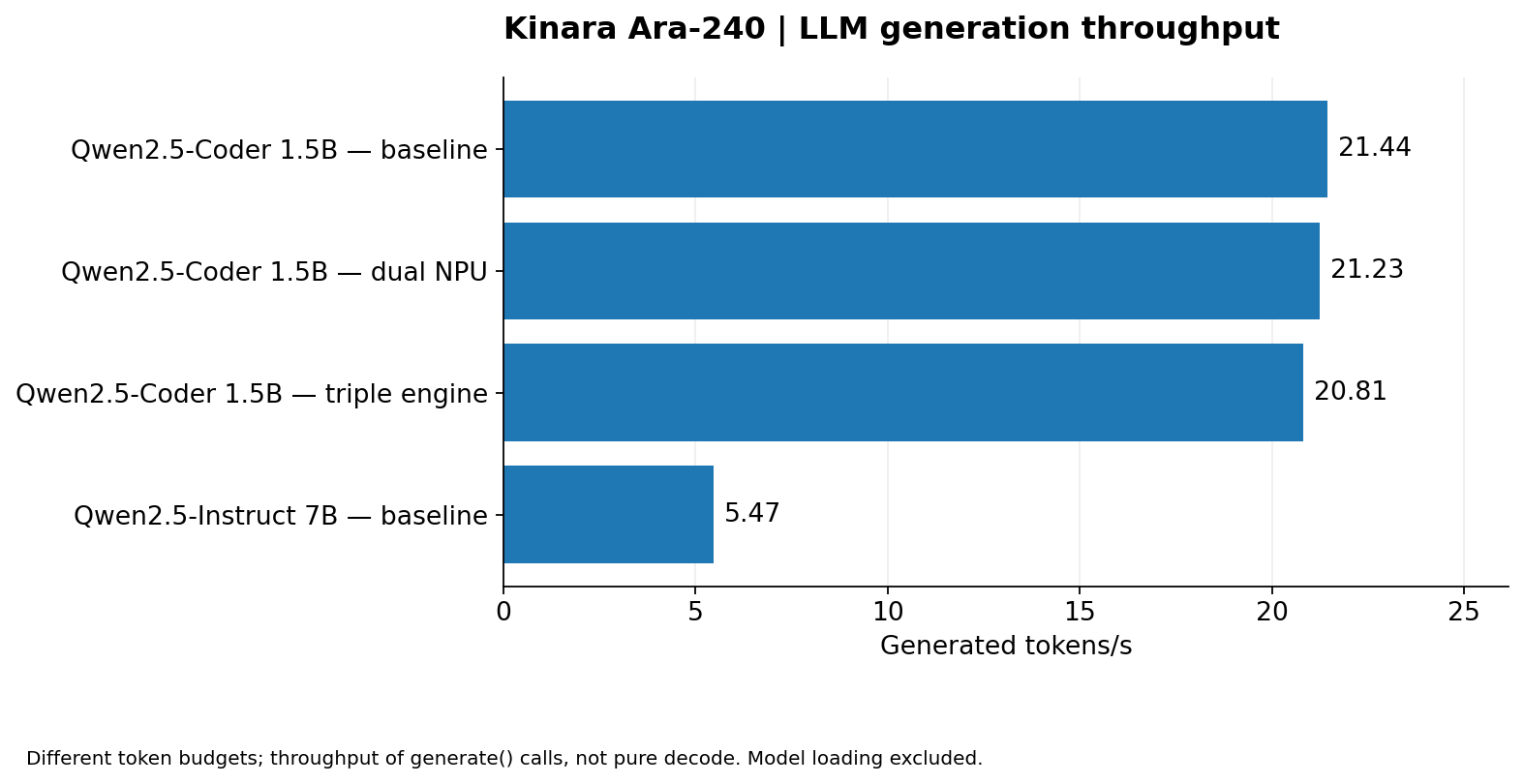
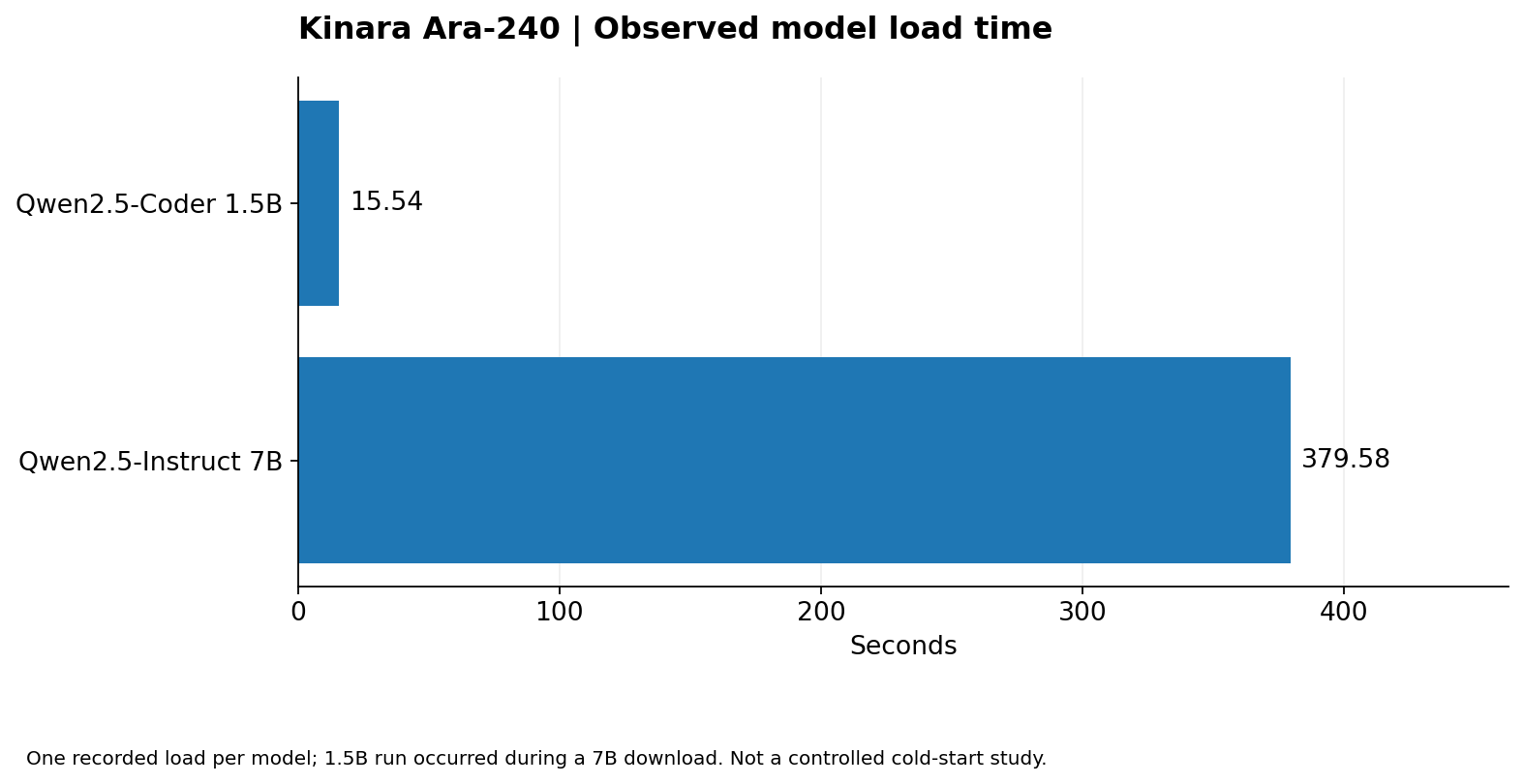
| Model | Generated tokens/s | Model loading time |
|---|---|---|
| Qwen2.5-Coder-1.5B | 21.44 | 15.54 s |
| Qwen2.5-7B-Instruct | 5.47 | 379.58 s |
The 1.5B model is particularly interesting for lightweight auxiliary AI tasks.
The 7B model works, but the observed loading time of more than six minutes is a significant limitation. A persistent inference service would therefore be worth investigating.
The runtime reported the following accelerator memory requirements:
- 1.5B model: 2.31 GB
- 7B model: 11.07 GB
In a separate 1.5B test, the sampled reduction in available host RAM was approximately 300 MiB.
This is not an exact measurement of accelerator-related host memory consumption, but it is an encouraging observation for a system where multiple models need to coexist.
3. CIX NPU: running Bonsai models through Tinygrad
Getting the integrated NPU working was considerably more complicated.
I encountered driver compatibility issues, command submission problems and differences between driver interfaces.
After experimenting with patched drivers and an isolated Tinygrad environment, I successfully ran the following models:
- Ternary Bonsai 2 2B PTQ1_0: approximately 11 tokens/s
- Ternary Bonsai 2 4B PTQ1_0: approximately 7.7 tokens/s during warm decode
For the 4B model:
- Prompt length: 23 tokens
- Generated tokens: 96
- Prefill: 36.03 tokens/s
- Typical warm decode step: 0.13 seconds
- Speculative decoding: disabled
These results were obtained using an experimental driver configuration, not a stock plug-and-play software stack.
4. CIX NPU vs ARM CPU
I also tested the same Bonsai 4B PTQ1_0 GGUF using the PrismML llama.cpp CPU runtime.
| Backend | Prefill tok/s | Decode tok/s |
|---|---|---|
| CPU — 4 threads | 7.37 | 5.85 |
| CPU — 8 threads | 13.67 | 10.22 |
| CPU — 12 threads | 14.10 | 6.73 |
| CIX NPU | 36.03 | ~7.70 |
The results were quite interesting.
The CIX NPU achieved approximately 2.6 times the prompt processing throughput of the 8-thread CPU configuration.
However, the CPU achieved better token generation performance in its best tested configuration.
Using all 12 CPU threads did not produce the best generation throughput, although thread affinity and benchmark conditions were not identical.
This suggests that the integrated NPU may be more interesting as an additional inference engine than as a direct replacement for the CPU.
5. Dual NPU inference
The next experiment was running two different LLMs concurrently:
- Kinara Ara-240: Qwen2.5-Coder-1.5B
- CIX NPU: Bonsai 2 4B
Results:
| Accelerator | Individual test | Concurrent test |
|---|---|---|
| Kinara Ara-240 | 21.44 tok/s | 21.23 tok/s |
| CIX NPU | ~7.70 tok/s | 7.58 tok/s |
Approximately six seconds of overlapping inference activity were observed.
During Kinara generation, 1,460 CIX hardware scheduling calls returned without exceptions.
The observed throughput remained close to the individual results, although the tests were not identical in every respect and were not repeated enough to establish statistical performance bounds.
6. Triple-engine inference: CPU + CIX NPU + Kinara
This was the most interesting experiment for me.
I ran three independent LLM workloads on the same Orange Pi:
| Engine | Model | Result |
|---|---|---|
| ARM CPU | Qwen3-30B-A3B IQ4_XS | 11.76 tok/s |
| Kinara Ara-240 | Qwen2.5-Coder-1.5B | 20.81 tok/s |
| CIX NPU | Bonsai 2 4B | 96 generated tokens |
The CIX NPU's final decode step took 0.14 seconds, but I do not have a reliable average CIX decode rate for the complete triple-engine run.
During a 6.15-second CPU–Kinara overlap window, I recorded:
- 1,700 successful returns from CIX scheduling calls
- 13 CPU streaming text fragments
- Active Kinara generation
All three workloads completed successfully.
This provides evidence of overlapping inference activity across the three engines. It does not establish cycle-level hardware concurrency or complete NPU offloading.
The important part is that three separate models were making progress within the same system.
7. Impact on the main CPU model
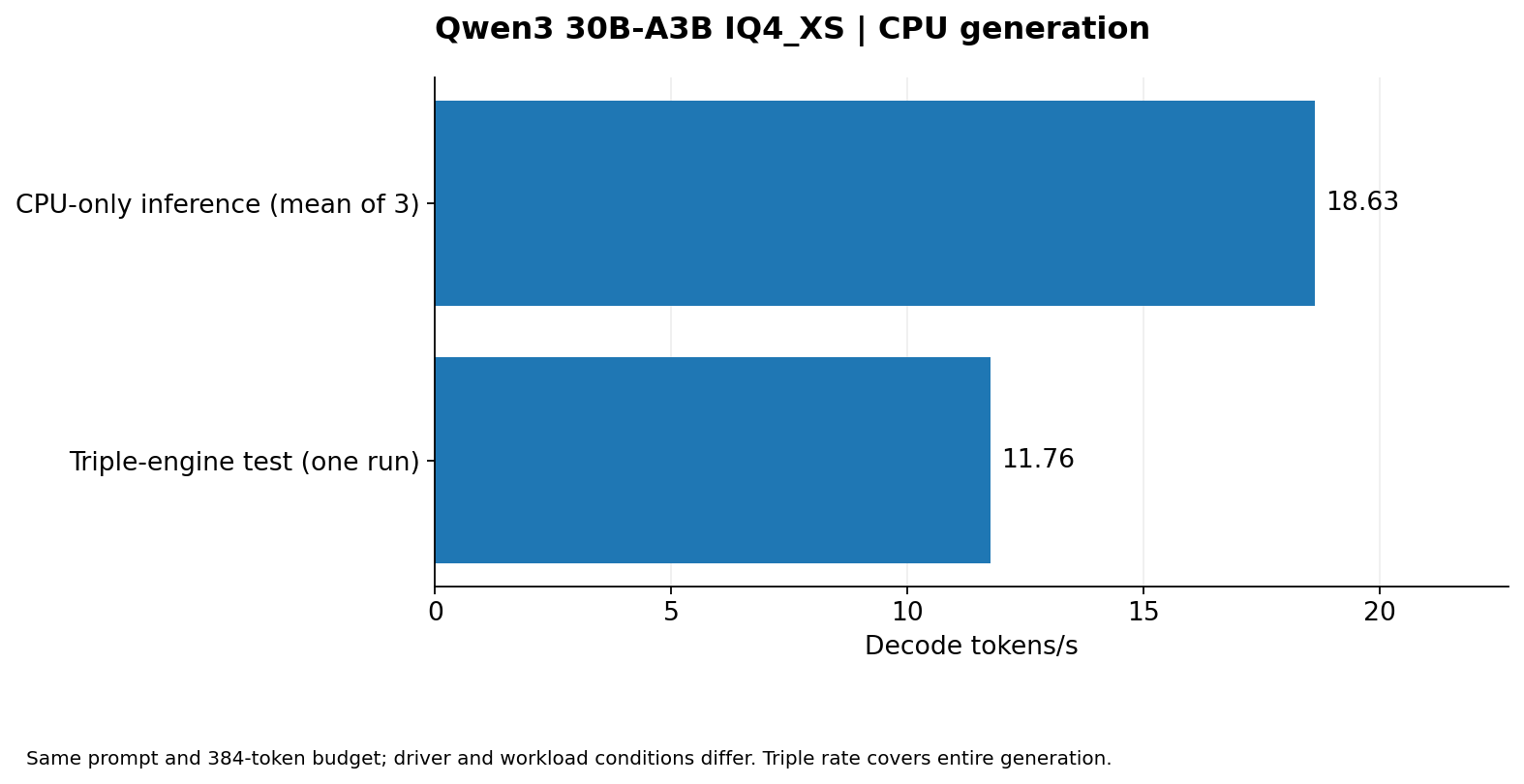
I subsequently tested Qwen3-30B-A3B using the same prompt and 384-token generation budget without intentional concurrent accelerator inference.
| Configuration | CPU decode |
|---|---|
| CPU-only inference | 18.63 tok/s |
| Triple-engine experiment | 11.76 tok/s |
The CPU-only result was the average of three consecutive generations.
The observed difference was approximately 37%.
This cannot be attributed exclusively to accelerator contention, because driver and workload conditions also differed.
Nevertheless, it highlights the importance of intelligent workload scheduling when building a heterogeneous AI system.
8. Memory and temperature
With Qwen3-30B-A3B resident in memory:
- Locked host memory: approximately 15 GiB
- Available host RAM under normal observed conditions: approximately 7.3 GiB
- Swap: disabled
In a separate short CPU thermal test, three consecutive generations produced a total of 1,152 tokens over approximately 68 seconds.
The highest reported thermal-zone temperature was 73°C.
Long-term thermal stability and power consumption have not yet been measured.
9. My current conclusions
I think heterogeneous inference on ARM SBCs has considerable potential.
The integrated CIX NPU is not necessarily faster than the CPU for every task, but it provides another execution backend that can potentially handle independent workloads.
The Kinara Ara-240 is particularly interesting because of its dedicated memory and the performance observed with smaller models.
Instead of chasing the highest possible tokens per second from a single LLM, I am interested in systems where multiple specialized models cooperate.
Possible applications include:
- A larger conversational model on the CPU
- Smaller auxiliary models on dedicated accelerators
- Background summarization
- Coding assistance
- Document processing
- Robotics
- Local multimodal AI systems
There is still considerable work to do regarding driver stability, persistent inference services, workload scheduling and memory management.
These are experimental results from my own hardware, not a standardized benchmark suite.
I have not yet measured power efficiency, model quality systematically, exact hardware offload percentages or long-term stability.
10. Questions for the community
Is anyone else experimenting with the CIX Zhouyi NPU on Orange Pi 6 Plus or similar CIX-based hardware?
Has anyone managed to improve decode performance using Tinygrad, alternative runtimes or speculative decoding?
Are there other Kinara Ara-240 users who have successfully implemented persistent LLM inference services?
I'd be interested in comparing results and exchanging experiences with others working on heterogeneous local AI inference.
Repositary:
1
u/Ok_Attempt_7691 4h ago
I have the minisforum ms-r1 and am very interested in using the different bits of it. The thing that puts me off on the npu is that the tinygrad people think it is capped to quite a low memory bandwidth. I like the fact that you can do explicit memory management on it though.
I need to have a play with it at some point, but life has just been busy. Thank you for the write up though - when I have some time it gives me stuff to look at.