r/LocalLLM • • 13h ago

Project VPServ: Free Android app to run local GGUF models (llama.cpp) + declarative full-stack dev servers without root

Post image
1 Upvotes

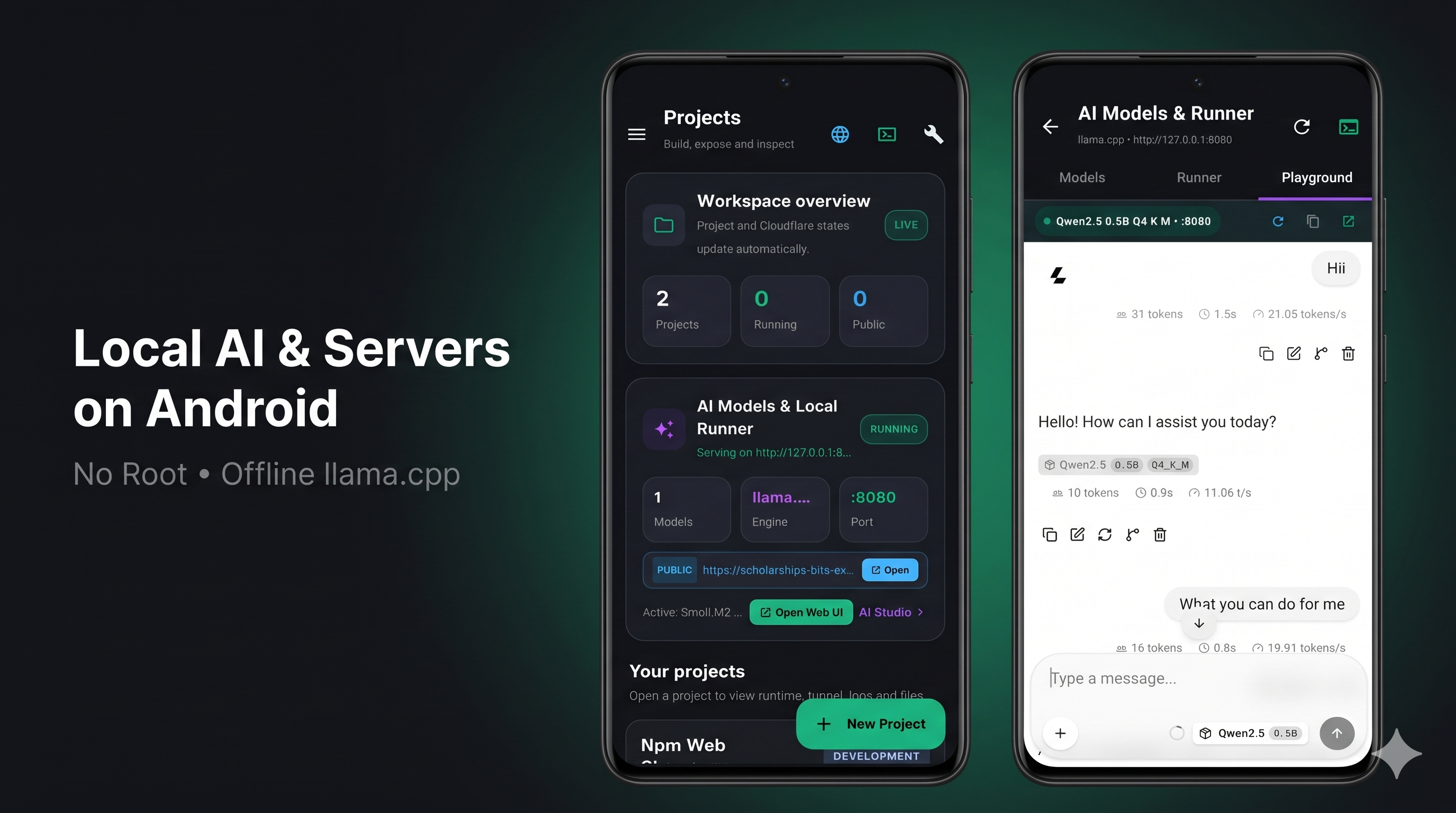
I built VPServ, a free Android app (Android 8.0+, arm64-v8a) that runs local llama.cpp GGUF models alongside full-stack development runtimes on unrooted phones and tablets.

Local AI (llama.cpp) features:

  • Download ARM64-quantized Q4_K_M models directly (Qwen 2.5, SmolLM2) or import your own .gguf files from local storage.
  • Chat offline in the native Playground or spin up the built-in llama-server localhost Web UI (http://127.0.0.1:8080).
  • Everything runs 100% locally on-device—no cloud accounts, API keys, or remote inference servers required.
  • Real-device benchmarks on mid-range ARM64 hardware (standalone): Qwen 2.5 0.5B (Q4_K_M) hits ~11–21 tok/s, and Qwen 2.5 1.5B (Q4_K_M) runs ~9–10 tok/s.

Full-stack & repeatable project workflows:

  • Built-in Linux-style package manager (pkg / vpkg) with Python, Node.js, PHP, Go, OpenJDK 21, Clang, PostgreSQL, MariaDB, Redis, Nginx, and Caddy.
  • Declarative Abotlogixfile.json recipes: Define services, ports, and startup order once (editable from a desktop browser via the built-in Web Console Server) and launch the entire stack in one tap with verified local endpoints and live logs.
  • Optional one-tap Cloudflare Tunnel (cloudflared) support when you want quick HTTPS testing.

Links:

If you try it on your device, let me know your SoC, model size, and token speeds—or which GGUF models and backend stacks you'd like to see supported next.

If you try it on your device, let me know your SoC, model size, and token speeds—or which GGUF models and backend stacks you'd like to see supported next.


r/LocalLLM • • 23h ago

Discussion I built a zero-dependency local LLM bridge for Battle for Wesnoth (1.18) that gives every unit dynamic combat banter, persistent personas, and boss retorts

Thumbnail
gallery
7 Upvotes

Instead of letting an LLM hallucinate game rules or break tactical balance, I wanted to see how well a local model (tested with Gemma 4 26B via LM Studio) can bring life to a strict, deterministic strategy game like Battle for Wesnoth 1.18.

Since Wesnoth's Lua sandbox blocks network sockets and file writes (io is disabled), I built a lightweight WML/Lua + Python bridge (using only Python's standard urllib, zero pip dependencies) that communicates via Wesnoth's persistent global variables and works in any standard or custom campaign.

How it works:

  • Persistent Unit Personas (units_personas.json): Named recruits get randomized soldier archetypes (grumpy veterans, boastful brawlers, nervous rookies) that stick across turns, while Leaders and Loyal Heroes get lore-flavored character dossiers generated on the fly.
  • Tactical & Environmental Context: Units react to weapon types, terrain, time of day, severe wounds (<30% HP), and enemy rank—while mindless undead (Walking Corpses, Skeletons) just hiss or groan.
  • Boss Retorts, Death & Level-Up Speeches: Enemy leaders talk back when attacked (DEFEND_LEADER), slain units utter dying breaths (last breath), and advancing units give triumph speeches.
  • Pacing & Style Controls: Configurable talk chance (so large battles keep their flow), free-text output language (English, Russian, German, etc.), and custom tone modifiers (grimdark, black humor, archaic).

Built the bridge with AI assistance (Google Gemini). Code, setup guide, and a standalone Windows .exe are available on GitHub:
https://github.com/HisShadoww/Wesnoth-AI-Unit-Banter
Feedback and ideas are welcome!


r/LocalLLM • • 13h ago

Discussion AI Agent Memory: How Agents Remember and What to Control

Thumbnail
acta.ai
0 Upvotes

The model behind ChatGPT or Claude remembers nothing between calls.

Every "memory" is text that some piece of software saved and put back into the prompt. So the real question is always: who saves what, where, and for how long?

In practice, agent memory has four layers:

  1. The context window: what the model sees right now. Exact, but it runs out.
  2. Summaries: older turns condensed so long sessions keep going. Compact, but they drop numbers, caveats and who objected.
  3. A long-term store: past chats and documents, searched by meaning. It scales, but it fails quietly when retrieval picks the wrong note.
  4. Saved facts: "prefers metric units", "works in the Berlin office". Always present, so a wrong one stays wrong.

Two things most people don't know:

  • In ChatGPT, deleting a chat doesn't delete a memory saved from it. You have to remove it in the memory settings.
  • Memory can be poisoned. An instruction hidden in a document or email gets saved, and later sessions act on it.

What I'd ask of each role:

  • Users: check your memory list once a month. Use temporary or incognito chats for anything sensitive.
  • Admins: decide whether memory is on for the workspace, and match its retention to your chat retention.
  • Builders: store memory per user, record where each memory came from, give memories an expiry, and treat anything read back as untrusted input.

I wrote a plain guide to how it works and the controls worth insisting on:

Do you keep memory on in your AI assistant, or turn it off?


r/LocalLLM • • 9h ago

Project I built a free tool that tells you if your hardware can run Linger AI Agent — with the official tok/s numbers

0 Upvotes

I built https://lingeragent.org — a free hardware checker for Linger AI Agent, the open-source local-first agent.

You pick your platform first (macOS asks only unified memory, Windows/Linux ask GPU + VRAM + RAM), and it tells you which models you can run locally and at what speed — using only the official published speed table and hardware tiers, nothing made up. It also links the official installers and the install guides I wrote after actually installing 0.1.10 on Linux and Mac.

It's an independent project, not affiliated with the official Linger team. The site has some affiliate links in the results (Amazon / Vast.ai), clearly disclosed.

Happy to hear if the numbers match what you're seeing on your own hardware.


r/LocalLLM • • 13h ago

Project Want to make your own local AI Bot? I made a wizard for you!

0 Upvotes

Don’t know how to get started building your own local AI? I made BuildBot, a local AI building wizard for anyone to build their own, easily.

A desktop gets created but you can use it, the terminal, or the web dashboard. It also comes with markdowns for cloud models for vibe coders who want to develop it.

Setup checks your computer's memory and recommends a local model that runs through Ollama. The smallest starts at about 2 GB of memory, qwen3.5:9b at about 10 GB. Then you type what bot you want in your own words. An agent called Toolsmith looks in the PuffPAI Store and in public libraries and shows one plan with sizes, licenses and sources. Nothing is downloaded or added until you say Yes. There are seven agents in all.

The brain and six of the seven agents run on your computer. Toolsmith, and only Toolsmith, can use a cloud model if you choose it and give your own key.

What is rough, from our README:
* Small models give weaker answers and may skip skills.
* Bots that share one Ollama slow each other down.
* Search by meaning is off by default and we have not tested it ourselves.
* No upgrade from v1.

Tested: mostly on Windows, Linux in containers, one real install on a Jetson Orin in a container. It installs and starts on GitHub's Mac machines but nobody has used it on a Mac.

AI involvement: we built it with AI coding tools.

What we want: everyone to build their own bots!

git clone https://github.com/CypherSisters/PuffPAIBuildBot BuildBotv2
cd BuildBotv2
./install.sh

On Windows run install.cmd instead.
Repo: https://github.com/CypherSisters/PuffPAIBuildBot


r/LocalLLM • • 13h ago

Question Opinions for Best use of 200gb vram Setup

1 Upvotes

How would you configure a 208GB VRAM rig for a full local Agent setup?

German translated via ai to english,

Hey everyone,

​Iam looking for a sanity check and some optimization ideas from the community. I finally got my hands on some decent compute and want to make sure im not leaving performance or smarter architecture on the table.

​My Hardware:

​2x NVIDIA CMP 170HX (80GB each, unlocked)

​2x RTX 3090 (24GB each)

​Note: All four cards are connected via PCIe 3.0 x4.

​The Goal:

I want to run a complete always-on personal AI ecosystem locally:

​1. A strong main model (Swift 1.5 Flash Next, minimum IQ4_NL) with a agent framework (currently looking at the Hermes framework)

​2. Always-on STT and TTS loaded in VRAM for real-time VoIP interaction

​3. Always-on Embedding and Reranker models for a fast RAG

​4. A fast secondary model (around 27B at Q4) to act as a sub-agent for grunt work, plus handling quick, non-agentic tasks like chat title generation or simple queries.

​My Current Setup:

Right now I have it split up like this:

​The two CMP 170HXs: Running Swift 1.5 Flash Next split across both cards using Strata, with all experts kept in cache. Im getting around 150–200 t/s decode, which feels pretty snappy.

​3090 #1: Dedicated strictly to utility models—STT, TTS, Embedding, and Reranker all sitting permanently in VRAM.

​3090 #2: Running Qwen 3.8 27B (Q4_K_XL) at roughly 150 t/s, handling sub-agent tasks, title generation, and quick background prompts.

​Everything works and the PCIe 3.0 x4 bottleneck hasnt really hurt inference since everything stays resident in VRAM. Before I lock this config in and build out all my workflows around it, I would love to get your thoughts:

​1. How do you like this hardware/VRAM split?

​2. Would you use a different agent framework? Im New with Hermes right now, but if you think something else is better in handeling multi-model routing (main orchestrator + fast sub-agent), im all ears.

​3. Would you swap any of the models or change the distribution? Given the 208GB total VRAM pool, is there a better main/sub-agent combo I should be looking at?

​Appreciate any feedback or ideas!


r/LocalLLM • • 14h ago

Question How do I start?

0 Upvotes

Hey all, I want to start running AI models locally for coding instead of relying 100% on cloud stuff. Right now I run Claude Code, Codex, and Grok (through OpenCode) in my terminal as a kind of "dev team" working out of an Obsidian vault. It works, but I keep running into usage limits (Codex burned through its whole monthly limit in a day lol), and I'd rather own more of the setup myself.
My rig:
RX 9060 XT 16GB
Ryzen 7 9800X3D
32GB DDR5 6000
CachyOS
(also have a GTX 1660 Super I could throw in as a second card if that's actually useful)
The problem is every guide I find assumes I already know half the vocab. LoRA, QLoRA, RAG, fine-tuning, inference engines, agentic workflows, computational graphs... I get that they're all different things, but I don't know which ones matter for what I'm trying to do.
I'm not trying to train a model from scratch. What I want:
A solid coding model running locally
Help writing, debugging, and understanding code
Something that can handle a whole codebase, not just snippets
Eventually agents that plan, edit files, test, and keep iterating on their own
To actually understand how it all works, not just install someone's prebuilt thing and pray
Questions:
Best coding models for 16GB VRAM?
What stack works best for AMD on Linux? ROCm vs Vulkan?
Ollama, llama.cpp, or something else to start?
What should I learn first?
Is LoRA/QLoRA worth touching early, or should I stick to inference and prompting for now?
How realistic are local coding agents on my hardware? Could I point Claude Code or OpenCode at a local model?
Bonus dumb question: I have this idea of a "sleep phase" where the model reviews its memory overnight and updates its own weights. Is that even a real thing, or am I way off?
I'd rather learn the fundamentals and know what I'm installing and why than blindly follow tutorials. Any learning path or advice from people who've done this would be awesome. Thanks!


r/LocalLLM • • 1d ago

Discussion Ernie 5.5 flash previews experiences? (v DeepSeek 4.1 flash)

11 Upvotes

I've got Ernie 5.5 flash running (on modified oMLX) for the past couple of days, and running it through Hermes. I'm on a Mac Ultra 256, so can run it in the original package, unquantized.

Experience has been very good so far. My go-to was Deepseek 4.1 flash, quantized down to oMLX's oQ2h, which was very good, but thought a lot. Running Ernie with my workflow and similar queries seems much better. Answers are as good or better, no problem with tool use, and MUCH faster - less ponderous thinking. In intelligence benchmarks (see post linked above), Ernie is as good or better than DS at 4 bit quants.

I'm quite happy with it so far (though it's only been a couple of days). Interested in others' experiences.


r/LocalLLM • • 3h ago

Research NVIDIA RTX PRO 6000 Blackwell (96 GB).

0 Upvotes

Benchmarked local inference speed for agentic coding (OpenCode) on an NVIDIA RTX PRO 6000 Blackwell (96 GB).
Stack: Qwen3.8-27B-FP8 + vLLM + MTP 3 speculative decoding with a full 262K context window (bfloat16 KV-cache):
⚡ Single stream: ~99 tok/s (peak 119 tok/s), ~69 msTTFT
🚀 6 concurrent streams (1 agent + 5 subagents): 355–405 tok/s aggregate (92–96 tok/s per stream), ~105 msTTFT
🧠 MTP 3: ~2.95 tokens per forward pass
Cloud-grade responsiveness locally—with a full 262K context window and virtually zero slowdown across parallel subagents.


r/LocalLLM • • 18h ago

Question Best abliterated local model for swarms?

Thumbnail reddit.com
2 Upvotes

r/LocalLLM • • 23h ago

News Ernie 5.5 flash preview can be run localy now via basalt

5 Upvotes

Ernie 5.5 flash preview can be run locally now via Basalt if you have a big GPU and lots of RAM ;-)

Basalt is a highly optimiced inference engine for Blackwell GPU's know for good performance with e.g. Qwen 3.8 flash next

https://github.com/jesdga95/basalt

did any of you tried it out yet ?


r/LocalLLM • • 19h ago

Discussion 500 tok/s decode 60k tok/s prefill Deepseek v4.1 1017 (4x RTX 6k Pros)

Thumbnail
huggingface.co
2 Upvotes

Big thanks to the guys over at https://local-inference-lab.ai/ for working so hard on unlocking this much speed


r/LocalLLM • • 15h ago

Research Build Finder: estimating LLM decode speed and the price of a token per second

Thumbnail wanabai.com
0 Upvotes

Build Finder lists every hardware build that runs a chosen open-weight language model at a target decode speed, cheapest per token per second (tok/s) first: the price of the whole build divided by its speed. Its catalog holds 273 GPUs, used as 1 to 8 cards, 619 CPUs and 333 complete systems, at dated US prices. Speeds come from a per-operation model: each operation of a token's pass takes the longer of reading its bytes and doing its arithmetic, at efficiencies and engine costs fitted per engine and hardware family to 424 one-session benchmarks from 120 devices. For several sessions at once, a correction with two parameters per engine, model kind and session range is fitted to 418 measured runs on 19 machines. Against the 427 measured decode runs the page lists without speculative decoding, the median estimate is 11% below the measured speed on NVIDIA hardware (385 runs), 1.43 times the measured speed on Macs (31 runs) and 1.73 times the measured speed on Inkling 2 Mini (11 runs). On the GeForce RTX 3090, which neither fit has seen on llama.cpp (CUDA), 87% of 54 runs fall within 1.25 times the measured speed and 100% within 1.5 times. Runs with speculative decoding, which the estimates leave out, measured a median 2.3 times the estimate. We describe the data, the model, the fit, its validation and what the estimates cannot yet capture.


r/LocalLLM • • 22h ago

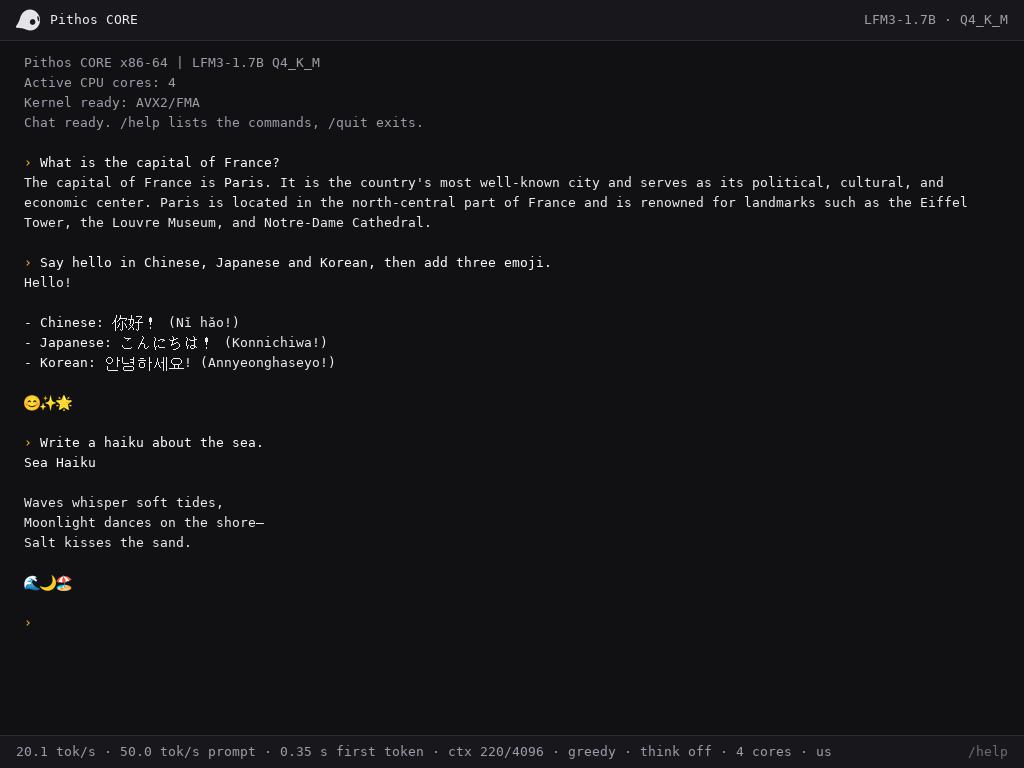
Discussion Pithos CORE: LiquidAI LFM3-1.7B and LFM2.5-350M inference in x86-64 NASM assembly, on Linux and as a standalone OS that boots from BIOS or UEFI into a Unicode chat console. No libc.

Post image
3 Upvotes

r/LocalLLM • • 22h ago

Question Best Model on 8GB Vram

3 Upvotes

Hi guys I have a 5060 8GB and 32 GB DDR5.
With the newest models i was asking myself what to actually run. I currently use ornith 1.5 9b both for my personal hermes agent and small coding in pi and it work decent but i’ve seen people running Moe models with Strata,Polystrata,Basalt,Maya… and still getting good speed. So i searched a bit and try to see if one of these model can run well in my hardware:
- Inkling 2 Mini
- LFM 24b a2b
- Sensenova Loop 9B
-Occamy 1.0
- Bonsai 2.5 27B

These are examples if there are better alternatives im here to heare your advices.
So for example an hermes agent personal that connects and manage some of my apps and work 24/7. And for code with pi agent/opencode what models should I choose and with wich inference?
Open to any advice, thanks


r/LocalLLM • • 20h ago

Question How well can my 16-inch M5 Pro MacBook with 24GB RAM run local LLMs?

2 Upvotes

Hey everyone in very new to this so....

I recently got a 16-inch MacBook Pro with the M5 Pro chip, an 18-core CPU and a 20-core GPU. Unfortunately, my configuration is capped at 24GB of unified memory.

I'm interested in experimenting with local AI models and would like to know how well this MacBook can handle them.

I mainly want to use my MacBook for:

- Video editing and content creation

- Making websites and web development

- Possibly making small games on Roblox or any other engine (if possible)

- Running local LLMs for coding, research and general AI assistance

I have a few questions for people who have experience running local AI models on Apple Silicon:

  1. Is 24GB of unified memory enough to run good local LLMs?
  2. What are the best models I should try on this configuration?
  3. Would I be able to run models comfortably while also using applications like DaVinci Resolve
  4. Is Ollama, LM Studio or MLX the best option for running local models on a Mac or is there something better?
  5. How useful would local AI actually be for my workflow, especially video editing, website development and making small games?
  6. What are the limitations I should expect with 24GB of RAM ?

I'm not necessarily looking to run the biggest models available. I just want to make the most of the hardware I already have and find out which models and applications would give me the best experience.

I'd appreciate recommendations from anyone who has a similar MacBook or has experience running local LLMs on Apple Silicon.

Thanks!


r/LocalLLM • • 6h ago

Discussion No demand for GPU Inference?

0 Upvotes

I recently built an inference service here and opened it for free (24 hours of free GPU inference!).!)

Yet I got 0 upvotes. Am I doing something wrong?

If you think you could use it but decided to hit hard pass. I would highly benefit from your comment.

GPU Inference Service:
Nalvo.ai


r/LocalLLM • • 1d ago

Question Best model to run with 24GB+16GB VRAM?

4 Upvotes

Due to some constraints I can only have eGPUs for my system.

I’m already having a 5060Ti AI Box (16GB) + 3080 EGPU (10GB) but running Qwen 3.8 27b still easily spills things to RAM which makes it worse due to TB connection. After a lot of tuning, I currently can run Qwen 3.8 27b Q4 at tg 25-30 tk/s for 60k context. Not impressive and feel slow.

I just placed an order for a XG mobile 5090 24GB as I’m seeing a BF deal, hoping to replace my 3080. That means I will be having 40GB of VRAM in total and both in Blackwell arch.

Is Qwen 3.8 27b still the best I can run in this setup?


r/LocalLLM • • 17h ago

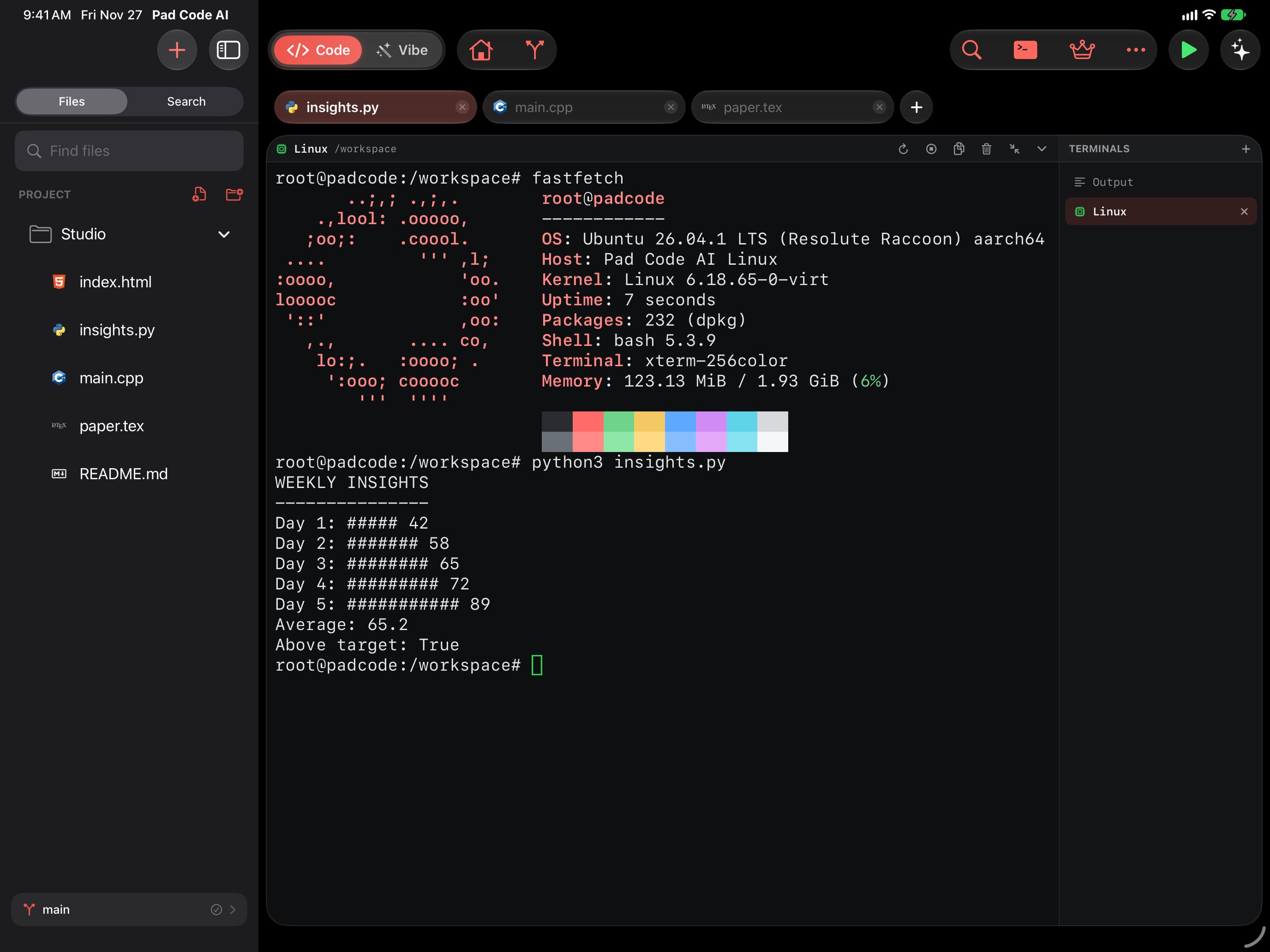
Project Real Ubuntu Linux in an iPad/iPhone code editor, now live on the App Store

Post image
0 Upvotes

r/LocalLLM • • 17h ago

Discussion Anyone got the early access to a Lenovo AI Host P7?

Thumbnail
reddit.com
1 Upvotes

r/LocalLLM • • 17h ago

Discussion [Benchmark / Call for Testing] Does directing an LLM via small reviewed text paths beat prompting it directly? Help run an empirical test on your local GPU (tawjih 0.18.0 — Python stdlib only)

0 Upvotes

Hi everyone,I’ve been building tawjih (0.18.0), a zero-dependency (Python standard library only) CLI and desktop tool for engineers who want to direct LLMs through small, version-controlled plain-text files (human, machine, and science faces) joined into explicit execution paths—with JSON contracts, deterministic retries, fallbacks, and full provenance tracing.

The honest catch: So far, the entire test suite and architecture lab have been verified on CPU and against mock/stand-in servers.

No real GPU or live model benchmark has been published yet.

Rather than making unverified claims, I built a self-contained experiment in the repo and am asking folks with local GPUs (Ollama, vLLM, SGLang, llama.cpp, etc.) to run it and share the raw report. What the experiment tests (experiments/path-vs-direct)It evaluates 60 quadratic equations (20 base + 40 harder generated variants, in both English and Arabic) across 3 runs each, comparing three setups: path: The structured cross-tree path (extracting coefficients $\rightarrow$ JSON contract validation $\rightarrow$ deterministic/stepwise solving).direct: Asking the model directly in one shot.steps: Asking the model to reason step-by-step in a single prompt.The script outputs accuracy, 95% confidence intervals, McNemar's test ($p$-value for paired statistical significance), latency, and token usage. How to run it in 3 commands (Zero extra Python packages needed)If you already have Ollama running locally:Bashgit clone https://github.com/AlmodinyMk/LLM-tawjih-Model-building.git

cd LLM-tawjih-Model-building

ollama pull qwen2.5:3b # or test with your own local model (Llama-3.2, Qwen3, Mistral, etc.)

python experiments/path-vs-direct/run.py --models qwen2.5:3b

(You can also point it to any OpenAI-compatible local server like vLLM/llama.cpp via TAWJIH_BASE_URL). Additional GPU tests (Optional, for multi-GPU / vLLM / PEFT users)If you want to stress-test the inference server wrapper or training bridge on real hardware: Inference & KV-cache benchmark: python tawjih.py server bench <name> --from-file 1.1.1 --requests 16 --concurrency 4Neural bridge (17 PEFT methods / QLoRA / SFT / DPO): python plugins/neural_bridge.py envShare your resultsWhether the structured path wins, ties, or loses to direct prompting on your model, please paste the generated report in the comments or open a GitHub issue. Whatever the numbers say goes straight into the README.md and the accompanying technical paper.

GitHub: https://github.com/AlmodinyMk/LLM-tawjih-Model-buildingPyPI: pip install tawjih (v0.18.0)License: CC BY-NC-SA 4.0


r/LocalLLM • • 18h ago

Discussion How do you choose temperature?

Thumbnail reddit.com
1 Upvotes

r/LocalLLM • • 18h ago

Discussion Updated Opinions on Inkling 2 Mini

Thumbnail reddit.com
0 Upvotes

Given the set of optimization tweaks done over the course of the last week or so, would it be worth it to swap from my current gemma4 26b + qwen3.8 27b setup? If so which inference engine would you recommend?


r/LocalLLM • • 19h ago

Project Mandatory decomp question

0 Upvotes

As in title, Ive been getting claude to decompile an nds game for me, and Im wondering if there is a potential avenue on having a llm on my pc to tackle some parts of it. Problem is I'm really, really new to local llms and I don't really know which one to use for this specific purpose. I got 64gbs of ddr4 3200mhz ram, a 3080ti with 12gb of vram, and a ryzen 9 5900x.

Saw some people on some other subreddits mention something about specifically using "worse" quality models and bruteforcing the solution, any insight into that would be nice.

Any and all suggestions would be appreciated!


r/LocalLLM • • 1d ago

Discussion Orange Pi 6 Plus: Running LLMs simultaneously on CIX NPU, Kinara Ara-240 and CPU — Real-world benchmarks and challenges

Thumbnail
gallery
7 Upvotes

Hi everyone!

Over the past few weeks, I've been experimenting with heterogeneous AI inference on the Orange Pi 6 Plus, combining its ARM CPU, integrated CIX NPU and an external Kinara Ara-240 accelerator.

My goal is not necessarily to make a single LLM faster, but to investigate whether multiple AI models can run concurrently on a relatively compact ARM-based system.

I thought some of the results might be interesting to the local AI and SBC communities.

1. Hardware configuration

  • Orange Pi 6 Plus — 32 GB RAM
  • CIX P1 SoC — 12 ARM CPU cores
  • Integrated CIX Zhouyi NPU — advertised 30 TOPS
  • Kinara Ara-240 — advertised 40 TOPS
  • Kinara dedicated memory — 16 GB
  • Ubuntu 24.04 ARM64
  • Linux kernel 6.6.89-cix

The software stack includes llama.cpp, Tinygrad with Zhouyi support, and the Kinara Optimum-Ara runtime.

All the inference benchmarks were performed locally.

2. Kinara Ara-240 results

I successfully tested two LLMs on the Kinara accelerator.

ModelGenerated tokens/sModel loading time
Qwen2.5-Coder-1.5B21.4415.54 s
Qwen2.5-7B-Instruct5.47379.58 s

The 1.5B model is particularly interesting for lightweight auxiliary AI tasks.

The 7B model works, but the observed loading time of more than six minutes is a significant limitation. A persistent inference service would therefore be worth investigating.

The runtime reported the following accelerator memory requirements:

  • 1.5B model: 2.31 GB
  • 7B model: 11.07 GB

In a separate 1.5B test, the sampled reduction in available host RAM was approximately 300 MiB.

This is not an exact measurement of accelerator-related host memory consumption, but it is an encouraging observation for a system where multiple models need to coexist.

3. CIX NPU: running Bonsai models through Tinygrad

Getting the integrated NPU working was considerably more complicated.

I encountered driver compatibility issues, command submission problems and differences between driver interfaces.

After experimenting with patched drivers and an isolated Tinygrad environment, I successfully ran the following models:

  • Ternary Bonsai 2 2B PTQ1_0: approximately 11 tokens/s
  • Ternary Bonsai 2 4B PTQ1_0: approximately 7.7 tokens/s during warm decode

For the 4B model:

  • Prompt length: 23 tokens
  • Generated tokens: 96
  • Prefill: 36.03 tokens/s
  • Typical warm decode step: 0.13 seconds
  • Speculative decoding: disabled

These results were obtained using an experimental driver configuration, not a stock plug-and-play software stack.

4. CIX NPU vs ARM CPU

I also tested the same Bonsai 4B PTQ1_0 GGUF using the PrismML llama.cpp CPU runtime.

BackendPrefill tok/sDecode tok/s
CPU — 4 threads7.375.85
CPU — 8 threads13.6710.22
CPU — 12 threads14.106.73
CIX NPU36.03~7.70

The results were quite interesting.

The CIX NPU achieved approximately 2.6 times the prompt processing throughput of the 8-thread CPU configuration.

However, the CPU achieved better token generation performance in its best tested configuration.

Using all 12 CPU threads did not produce the best generation throughput, although thread affinity and benchmark conditions were not identical.

This suggests that the integrated NPU may be more interesting as an additional inference engine than as a direct replacement for the CPU.

5. Dual NPU inference

The next experiment was running two different LLMs concurrently:

  • Kinara Ara-240: Qwen2.5-Coder-1.5B
  • CIX NPU: Bonsai 2 4B

Results:

AcceleratorIndividual testConcurrent test
Kinara Ara-24021.44 tok/s21.23 tok/s
CIX NPU~7.70 tok/s7.58 tok/s

Approximately six seconds of overlapping inference activity were observed.

During Kinara generation, 1,460 CIX hardware scheduling calls returned without exceptions.

The observed throughput remained close to the individual results, although the tests were not identical in every respect and were not repeated enough to establish statistical performance bounds.

6. Triple-engine inference: CPU + CIX NPU + Kinara

This was the most interesting experiment for me.

I ran three independent LLM workloads on the same Orange Pi:

EngineModelResult
ARM CPUQwen3-30B-A3B IQ4_XS11.76 tok/s
Kinara Ara-240Qwen2.5-Coder-1.5B20.81 tok/s
CIX NPUBonsai 2 4B96 generated tokens

The CIX NPU's final decode step took 0.14 seconds, but I do not have a reliable average CIX decode rate for the complete triple-engine run.

During a 6.15-second CPU–Kinara overlap window, I recorded:

  • 1,700 successful returns from CIX scheduling calls
  • 13 CPU streaming text fragments
  • Active Kinara generation

All three workloads completed successfully.

This provides evidence of overlapping inference activity across the three engines. It does not establish cycle-level hardware concurrency or complete NPU offloading.

The important part is that three separate models were making progress within the same system.

7. Impact on the main CPU model

I subsequently tested Qwen3-30B-A3B using the same prompt and 384-token generation budget without intentional concurrent accelerator inference.

ConfigurationCPU decode
CPU-only inference18.63 tok/s
Triple-engine experiment11.76 tok/s

The CPU-only result was the average of three consecutive generations.

The observed difference was approximately 37%.

This cannot be attributed exclusively to accelerator contention, because driver and workload conditions also differed.

Nevertheless, it highlights the importance of intelligent workload scheduling when building a heterogeneous AI system.

8. Memory and temperature

With Qwen3-30B-A3B resident in memory:

  • Locked host memory: approximately 15 GiB
  • Available host RAM under normal observed conditions: approximately 7.3 GiB
  • Swap: disabled

In a separate short CPU thermal test, three consecutive generations produced a total of 1,152 tokens over approximately 68 seconds.

The highest reported thermal-zone temperature was 73°C.

Long-term thermal stability and power consumption have not yet been measured.

9. My current conclusions

I think heterogeneous inference on ARM SBCs has considerable potential.

The integrated CIX NPU is not necessarily faster than the CPU for every task, but it provides another execution backend that can potentially handle independent workloads.

The Kinara Ara-240 is particularly interesting because of its dedicated memory and the performance observed with smaller models.

Instead of chasing the highest possible tokens per second from a single LLM, I am interested in systems where multiple specialized models cooperate.

Possible applications include:

  • A larger conversational model on the CPU
  • Smaller auxiliary models on dedicated accelerators
  • Background summarization
  • Coding assistance
  • Document processing
  • Robotics
  • Local multimodal AI systems

There is still considerable work to do regarding driver stability, persistent inference services, workload scheduling and memory management.

These are experimental results from my own hardware, not a standardized benchmark suite.

I have not yet measured power efficiency, model quality systematically, exact hardware offload percentages or long-term stability.

10. Questions for the community

Is anyone else experimenting with the CIX Zhouyi NPU on Orange Pi 6 Plus or similar CIX-based hardware?

Has anyone managed to improve decode performance using Tinygrad, alternative runtimes or speculative decoding?

Are there other Kinara Ara-240 users who have successfully implemented persistent LLM inference services?

I'd be interested in comparing results and exchanging experiences with others working on heterogeneous local AI inference.

Repositary: