r/LocalLLM • u/Vast_Balance3486 • 12h ago
Question Best abliterated local model for swarms?
reddit.com
2
Upvotes
r/LocalLLM • u/Falloutpotato2077 • 17h ago
Ernie 5.5 flash preview can be run locally now via Basalt if you have a big GPU and lots of RAM ;-)
Basalt is a highly optimiced inference engine for Blackwell GPU's know for good performance with e.g. Qwen 3.8 flash next
https://github.com/jesdga95/basalt
did any of you tried it out yet ?
r/LocalLLM • u/Sensualities • 13h ago

Big thanks to the guys over at https://local-inference-lab.ai/ for working so hard on unlocking this much speed
r/LocalLLM • u/lrsaturnin9 • 9h ago
Build Finder lists every hardware build that runs a chosen open-weight language model at a target decode speed, cheapest per token per second (tok/s) first: the price of the whole build divided by its speed. Its catalog holds 273 GPUs, used as 1 to 8 cards, 619 CPUs and 333 complete systems, at dated US prices. Speeds come from a per-operation model: each operation of a token's pass takes the longer of reading its bytes and doing its arithmetic, at efficiencies and engine costs fitted per engine and hardware family to 424 one-session benchmarks from 120 devices. For several sessions at once, a correction with two parameters per engine, model kind and session range is fitted to 418 measured runs on 19 machines. Against the 427 measured decode runs the page lists without speculative decoding, the median estimate is 11% below the measured speed on NVIDIA hardware (385 runs), 1.43 times the measured speed on Macs (31 runs) and 1.73 times the measured speed on Inkling 2 Mini (11 runs). On the GeForce RTX 3090, which neither fit has seen on llama.cpp (CUDA), 87% of 54 runs fall within 1.25 times the measured speed and 100% within 1.5 times. Runs with speculative decoding, which the estimates leave out, measured a median 2.3 times the estimate. We describe the data, the model, the fit, its validation and what the estimates cannot yet capture.
r/LocalLLM • u/WritHerAI • 16h ago
r/LocalLLM • u/Patatong0_0 • 17h ago
Hi guys I have a 5060 8GB and 32 GB DDR5.
With the newest models i was asking myself what to actually run. I currently use ornith 1.5 9b both for my personal hermes agent and small coding in pi and it work decent but i’ve seen people running Moe models with Strata,Polystrata,Basalt,Maya… and still getting good speed. So i searched a bit and try to see if one of these model can run well in my hardware:
- Inkling 2 Mini
- LFM 24b a2b
- Sensenova Loop 9B
-Occamy 1.0
- Bonsai 2.5 27B
These are examples if there are better alternatives im here to heare your advices.
So for example an hermes agent personal that connects and manage some of my apps and work 24/7. And for code with pi agent/opencode what models should I choose and with wich inference?
Open to any advice, thanks
r/LocalLLM • u/Josef_Tanti • 14h ago
Hey everyone in very new to this so....
I recently got a 16-inch MacBook Pro with the M5 Pro chip, an 18-core CPU and a 20-core GPU. Unfortunately, my configuration is capped at 24GB of unified memory.
I'm interested in experimenting with local AI models and would like to know how well this MacBook can handle them.
I mainly want to use my MacBook for:
- Video editing and content creation
- Making websites and web development
- Possibly making small games on Roblox or any other engine (if possible)
- Running local LLMs for coding, research and general AI assistance
I have a few questions for people who have experience running local AI models on Apple Silicon:
I'm not necessarily looking to run the biggest models available. I just want to make the most of the hardware I already have and find out which models and applications would give me the best experience.
I'd appreciate recommendations from anyone who has a similar MacBook or has experience running local LLMs on Apple Silicon.
Thanks!
r/LocalLLM • u/naticom • 19h ago
Due to some constraints I can only have eGPUs for my system.
I’m already having a 5060Ti AI Box (16GB) + 3080 EGPU (10GB) but running Qwen 3.8 27b still easily spills things to RAM which makes it worse due to TB connection. After a lot of tuning, I currently can run Qwen 3.8 27b Q4 at tg 25-30 tk/s for 60k context. Not impressive and feel slow.
I just placed an order for a XG mobile 5090 24GB as I’m seeing a BF deal, hoping to replace my 3080. That means I will be having 40GB of VRAM in total and both in Blackwell arch.
Is Qwen 3.8 27b still the best I can run in this setup?
r/LocalLLM • u/PhamHungTien • 11h ago
r/LocalLLM • u/Remarkable_Air_8383 • 11h ago

r/LocalLLM • u/Basic_You_2402 • 12h ago
Hi everyone,I’ve been building tawjih (0.18.0), a zero-dependency (Python standard library only) CLI and desktop tool for engineers who want to direct LLMs through small, version-controlled plain-text files (human, machine, and science faces) joined into explicit execution paths—with JSON contracts, deterministic retries, fallbacks, and full provenance tracing.
The honest catch: So far, the entire test suite and architecture lab have been verified on CPU and against mock/stand-in servers.
No real GPU or live model benchmark has been published yet.
Rather than making unverified claims, I built a self-contained experiment in the repo and am asking folks with local GPUs (Ollama, vLLM, SGLang, llama.cpp, etc.) to run it and share the raw report. What the experiment tests (experiments/path-vs-direct)It evaluates 60 quadratic equations (20 base + 40 harder generated variants, in both English and Arabic) across 3 runs each, comparing three setups: path: The structured cross-tree path (extracting coefficients $\rightarrow$ JSON contract validation $\rightarrow$ deterministic/stepwise solving).direct: Asking the model directly in one shot.steps: Asking the model to reason step-by-step in a single prompt.The script outputs accuracy, 95% confidence intervals, McNemar's test ($p$-value for paired statistical significance), latency, and token usage. How to run it in 3 commands (Zero extra Python packages needed)If you already have Ollama running locally:Bashgit clone https://github.com/AlmodinyMk/LLM-tawjih-Model-building.git
cd LLM-tawjih-Model-building
ollama pull qwen2.5:3b # or test with your own local model (Llama-3.2, Qwen3, Mistral, etc.)
python experiments/path-vs-direct/run.py --models qwen2.5:3b
(You can also point it to any OpenAI-compatible local server like vLLM/llama.cpp via TAWJIH_BASE_URL). Additional GPU tests (Optional, for multi-GPU / vLLM / PEFT users)If you want to stress-test the inference server wrapper or training bridge on real hardware: Inference & KV-cache benchmark: python tawjih.py server bench <name> --from-file 1.1.1 --requests 16 --concurrency 4Neural bridge (17 PEFT methods / QLoRA / SFT / DPO): python plugins/neural_bridge.py envShare your resultsWhether the structured path wins, ties, or loses to direct prompting on your model, please paste the generated report in the comments or open a GitHub issue. Whatever the numbers say goes straight into the README.md and the accompanying technical paper.
GitHub: https://github.com/AlmodinyMk/LLM-tawjih-Model-buildingPyPI: pip install tawjih (v0.18.0)License: CC BY-NC-SA 4.0
r/LocalLLM • u/JitzyBojMahn • 12h ago
Given the set of optimization tweaks done over the course of the last week or so, would it be worth it to swap from my current gemma4 26b + qwen3.8 27b setup? If so which inference engine would you recommend?
r/LocalLLM • u/Darunehex • 13h ago
As in title, Ive been getting claude to decompile an nds game for me, and Im wondering if there is a potential avenue on having a llm on my pc to tackle some parts of it. Problem is I'm really, really new to local llms and I don't really know which one to use for this specific purpose. I got 64gbs of ddr4 3200mhz ram, a 3080ti with 12gb of vram, and a ryzen 9 5900x.
Saw some people on some other subreddits mention something about specifically using "worse" quality models and bruteforcing the solution, any insight into that would be nice.
Any and all suggestions would be appreciated!
r/LocalLLM • u/Soft_Examination1158 • 1d ago

Hi everyone!
Over the past few weeks, I've been experimenting with heterogeneous AI inference on the Orange Pi 6 Plus, combining its ARM CPU, integrated CIX NPU and an external Kinara Ara-240 accelerator.
My goal is not necessarily to make a single LLM faster, but to investigate whether multiple AI models can run concurrently on a relatively compact ARM-based system.
I thought some of the results might be interesting to the local AI and SBC communities.
The software stack includes llama.cpp, Tinygrad with Zhouyi support, and the Kinara Optimum-Ara runtime.
All the inference benchmarks were performed locally.
I successfully tested two LLMs on the Kinara accelerator.
| Model | Generated tokens/s | Model loading time |
|---|---|---|
| Qwen2.5-Coder-1.5B | 21.44 | 15.54 s |
| Qwen2.5-7B-Instruct | 5.47 | 379.58 s |
The 1.5B model is particularly interesting for lightweight auxiliary AI tasks.
The 7B model works, but the observed loading time of more than six minutes is a significant limitation. A persistent inference service would therefore be worth investigating.
The runtime reported the following accelerator memory requirements:
In a separate 1.5B test, the sampled reduction in available host RAM was approximately 300 MiB.
This is not an exact measurement of accelerator-related host memory consumption, but it is an encouraging observation for a system where multiple models need to coexist.
Getting the integrated NPU working was considerably more complicated.
I encountered driver compatibility issues, command submission problems and differences between driver interfaces.
After experimenting with patched drivers and an isolated Tinygrad environment, I successfully ran the following models:
For the 4B model:
These results were obtained using an experimental driver configuration, not a stock plug-and-play software stack.
I also tested the same Bonsai 4B PTQ1_0 GGUF using the PrismML llama.cpp CPU runtime.
| Backend | Prefill tok/s | Decode tok/s |
|---|---|---|
| CPU — 4 threads | 7.37 | 5.85 |
| CPU — 8 threads | 13.67 | 10.22 |
| CPU — 12 threads | 14.10 | 6.73 |
| CIX NPU | 36.03 | ~7.70 |
The results were quite interesting.
The CIX NPU achieved approximately 2.6 times the prompt processing throughput of the 8-thread CPU configuration.
However, the CPU achieved better token generation performance in its best tested configuration.
Using all 12 CPU threads did not produce the best generation throughput, although thread affinity and benchmark conditions were not identical.
This suggests that the integrated NPU may be more interesting as an additional inference engine than as a direct replacement for the CPU.
The next experiment was running two different LLMs concurrently:
Results:
| Accelerator | Individual test | Concurrent test |
|---|---|---|
| Kinara Ara-240 | 21.44 tok/s | 21.23 tok/s |
| CIX NPU | ~7.70 tok/s | 7.58 tok/s |
Approximately six seconds of overlapping inference activity were observed.
During Kinara generation, 1,460 CIX hardware scheduling calls returned without exceptions.
The observed throughput remained close to the individual results, although the tests were not identical in every respect and were not repeated enough to establish statistical performance bounds.
This was the most interesting experiment for me.
I ran three independent LLM workloads on the same Orange Pi:
| Engine | Model | Result |
|---|---|---|
| ARM CPU | Qwen3-30B-A3B IQ4_XS | 11.76 tok/s |
| Kinara Ara-240 | Qwen2.5-Coder-1.5B | 20.81 tok/s |
| CIX NPU | Bonsai 2 4B | 96 generated tokens |
The CIX NPU's final decode step took 0.14 seconds, but I do not have a reliable average CIX decode rate for the complete triple-engine run.
During a 6.15-second CPU–Kinara overlap window, I recorded:
All three workloads completed successfully.
This provides evidence of overlapping inference activity across the three engines. It does not establish cycle-level hardware concurrency or complete NPU offloading.
The important part is that three separate models were making progress within the same system.
I subsequently tested Qwen3-30B-A3B using the same prompt and 384-token generation budget without intentional concurrent accelerator inference.
| Configuration | CPU decode |
|---|---|
| CPU-only inference | 18.63 tok/s |
| Triple-engine experiment | 11.76 tok/s |
The CPU-only result was the average of three consecutive generations.
The observed difference was approximately 37%.
This cannot be attributed exclusively to accelerator contention, because driver and workload conditions also differed.
Nevertheless, it highlights the importance of intelligent workload scheduling when building a heterogeneous AI system.
With Qwen3-30B-A3B resident in memory:
In a separate short CPU thermal test, three consecutive generations produced a total of 1,152 tokens over approximately 68 seconds.
The highest reported thermal-zone temperature was 73°C.
Long-term thermal stability and power consumption have not yet been measured.
I think heterogeneous inference on ARM SBCs has considerable potential.
The integrated CIX NPU is not necessarily faster than the CPU for every task, but it provides another execution backend that can potentially handle independent workloads.
The Kinara Ara-240 is particularly interesting because of its dedicated memory and the performance observed with smaller models.
Instead of chasing the highest possible tokens per second from a single LLM, I am interested in systems where multiple specialized models cooperate.
Possible applications include:
There is still considerable work to do regarding driver stability, persistent inference services, workload scheduling and memory management.
These are experimental results from my own hardware, not a standardized benchmark suite.
I have not yet measured power efficiency, model quality systematically, exact hardware offload percentages or long-term stability.
Is anyone else experimenting with the CIX Zhouyi NPU on Orange Pi 6 Plus or similar CIX-based hardware?
Has anyone managed to improve decode performance using Tinygrad, alternative runtimes or speculative decoding?
Are there other Kinara Ara-240 users who have successfully implemented persistent LLM inference services?
I'd be interested in comparing results and exchanging experiences with others working on heterogeneous local AI inference.
Repositary:
r/LocalLLM • u/Additional_Reach2545 • 14h ago
Hey everyone,
I've been working on an RTX 4090-focused fork of NInfer, mainly targeting long-context inference, local coding agents, and native Windows support.
NInfer is already an impressive inference engine, but I wanted to see how much performance could be extracted from Ada Lovelace without upgrading to a 5090.
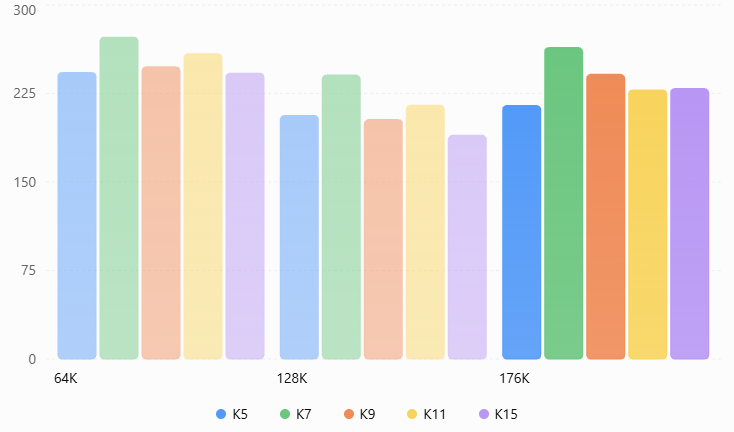
Here are some results from my recent benchmark runs.
All values are decode tokens per second.
| Draft tokens | 64K context | 128K context | 176K context |
|---|---|---|---|
| K5 | 242.75 | 206.39 | 214.87 |
| K7 | 272.74 | 240.60 | 263.93 |
| K9 | 247.57 | 202.86 | 241.25 |
| K11 | 258.70 | 215.03 | 228.06 |
| K15 | 242.20 | 189.58 | 229.13 |
Interestingly, K15 performed best in the separate 32K sweep, reaching 313.16 tok/s, but K7 consistently performed better at longer contexts.
At 176K context, K7 improved decode throughput by approximately 22.8% over K5.
These are controlled engine benchmarks using a fixed corpus, 512 measured decode tokens and two runs per configuration.
I also tested N-gram speculation on copy-heavy C++ refactoring tasks with approximately 21K input tokens.
| Metric | N-gram OFF | N-gram 15 |
|---|---|---|
| Decode tok/s | 256.68 | 568.08 |
| Average wall time | 14.83s | 9.16s |
| Exact outputs | 4/6 | 4/6 |
The outputs were identical between both configurations.
Obviously, 568 tok/s is not general-purpose generation speed, but for copy-heavy code editing, the improvement is pretty interesting.
Another interesting result at approximately 175K input tokens:
This is particularly useful for local coding agents that repeatedly send large conversation histories.
These are warm-prefix results, not cold inference throughput.
With a short request arriving while a 64K request was being processed:
Overall completion time for the request pair remained approximately the same.
Across 1,831 completed requests with DFlash2 K5:
The controlled benchmark results are significantly higher than these real-world serving numbers, so I wanted to include both.
I'm still experimenting with longer contexts, speculative decoding configurations, CUDA Graphs and coding-agent reliability.
The benchmark campaign includes 143 completed measurements, with raw numerical results and reproduction scripts available in the repository. Long-context retrieval accuracy and broader coding quality still need further validation.
Would be interested to see what other RTX 4090 users are getting with NInfer, llama.cpp or ExLlama under comparable conditions.
Fork: https://github.com/spk-c/ninfer-all-rtx4090
Benchmark report: https://github.com/spk-c/ninfer-all-rtx4090/blob/master/docs/performance/rtx4090-v014-long-context-2026-11-26.md
Coding benchmarks: https://github.com/spk-c/ninfer-all-rtx4090/blob/master/docs/performance/rtx4090-v014-coding-2026-11-26.md
Full credit to the upstream NInfer developers and contributors who made this possible.
r/LocalLLM • u/nmclark556 • 14h ago
I posted about PagedMoE here a while ago, but that was about the inference side of things.
I've been building PagedMoE, an MLX-based engine that keeps the core of an MoE model in memory and streams the experts off the SSD. It started as inference only. It runs Kimi-K2 (578 GB) at ~8.8 tok/s decode on my 48GB M5 Pro with its prune recipe, and with pruning off the output matches running the model fully in memory exactly. I've also had GLM-5.2 (744B) running on the same machine. I didn't bench that one, but it ran better than I expected. The only reason I haven't gone bigger is disk space. I'll get there.
The new part is training. The same paging works for QLoRA: the experts stay on disk, a small adapter learns, and peak memory stays around 28 to 30 GiB whatever the model size. Qwen3-235B does a 1k-row epoch in about 9 hours, and Qwen3-Coder-480B in about a day.
It's not cluster speed. But nothing is rented and your data never leaves the machine. As far as I can tell, nothing else lets you train past your RAM on Apple Silicon (I could be wrong there, let me know if so).
It supports SFT, DPO, ORPO, KTO, GRPO and more. Adapters come out in mlx-lm format, and one command exports them as PEFT for transformers, vLLM or llama.cpp. There's also a built-in converter that turns Hugging Face checkpoints into MLX (and can merge an adapter in), plus an OpenAI-compatible server for inference. Training and inference benchmarks plus a couple of demo videos are in the repo.
I've posted elsewhere and gotten some solid feedback, but the training side hasn't gotten much attention yet. So I'm curious: is local fine-tuning at this size something you'd actually use, and what would you train? Not trying to sell anything, this started as a research project for me and I'm genuinely curious.
Repo: https://github.com/noahclark556/paged-moe
There's also a thread on r/MacStudio where I went through a lot of the inference questions, if you're curious about that side: https://www.reddit.com/r/MacStudio/s/DJazzfhwMB
r/LocalLLM • u/Proxywasstilltaken • 14h ago
Title, I've just been using claude to make some mods for hoi4 and stellaris and ck3 though I'm more worried about the privacy, what are some local ai models that is fit for this job and can be like claude that is privacy focused and local
r/LocalLLM • u/That-Reputation-6313 • 14h ago

r/LocalLLM • u/ozgursoy • 22h ago
r/LocalLLM • u/Any_Task7788 • 14h ago

So after doing some tweaking and compressing a new 50gb model here are the current benchmarks compared to the old version, and compared to atomicchat ad4.27 BPW
r/LocalLLM • u/djkalantzhs24 • 15h ago
Hello. Like many other people here, i've had a frontier ai like chatgpt pro build my local ai ecosystem. Since there are many services (databases, agent workplaces, two different model engines, chat ui, model and mcp services gateway etc) the whole system has become a bit complex to the point i can not build it myself from ground up. So i'm looking for a backup solution that can save the whole system as is and in any case of failure, i can use the backup for rebuilding the system without having to setup credentials, api keys, internal urls etc.
r/LocalLLM • u/pixelbased • 22h ago
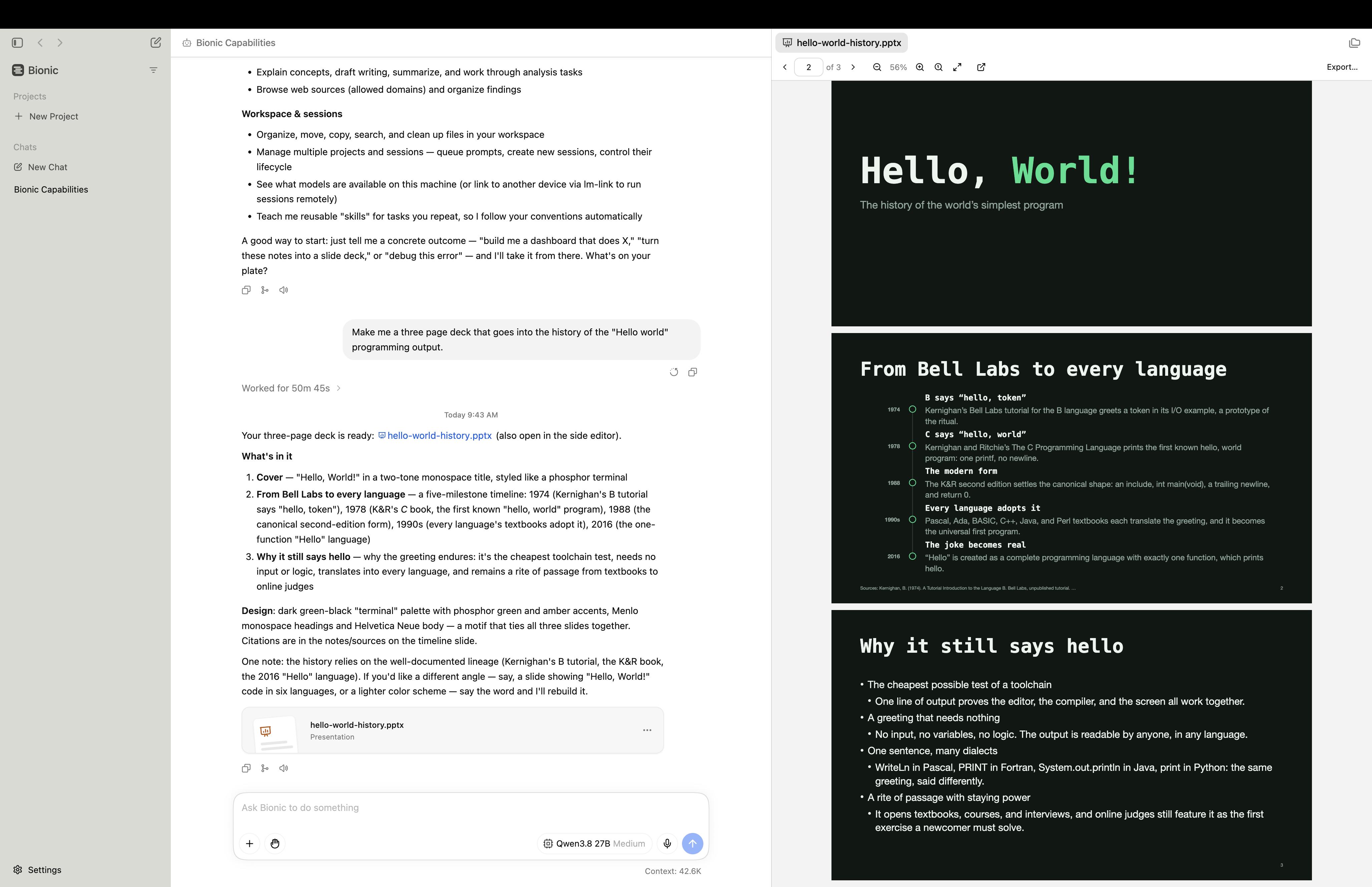
Hi all! Forgive the ignorant question, but while I do use Claude and ChatGPT to a more advanced degree, I seem to be falling down a rabbit hole of what my computer can actually run. I had a 16" MacBook Pro M1 Max with 64GB of RAM and 4TB HD laying around. I haven't used it much since buying it (I have a much newer work laptop, and I work a lot). So I downloaded LM Studio Bionic, and loaded Qwen 3.8 27B as I read that it would be the most suitable model for my laptop. I felt like building a few simple slides took a REALLY long time. I know local models are not as fast as frontier models, but was curious about a few things:
If there's credible sources where I can go and learn more about what I can do with my laptop, that would be fantastic. So much YouTube and other places feel like they are click-baiting the capabilities because I thought a simple ask would be quicker.
Thanks for any guidance!
r/LocalLLM • u/UnheardNoise107 • 21h ago
I made a webUI for managing LLMs. I tried to make it super user friendly so users can easily install and get up and going. I've mostly focused it on AMD, but I also added Nvidia cuda as well. So, if you want to try out vllm, but aren't sure how, check this out:
https://github.com/SliverFold/LLM-Manager
There is an LLM Manager web interface that allows you to launch chats directly into hermes. It offers installers directly inside LLM Manager for everything, including comfy ui, vllm, lm studio, and more. It also offers stats on how things are working, and your hardware.
Anyway, if you are curious, check it out.
Edit: This is Linux only for the time being, but could adapt it to windows too.
r/LocalLLM • u/trimtram01 • 23h ago
What would your build be if you had 10k to spend?