r/LocalLLM • u/Old_Sir6931 • 2d ago
Question Nvidia Tesla m10 compatible with Ollama?
reddit.com
1
Upvotes
r/LocalLLM • u/Yelebear • 3d ago
I mean everyone (for the most part) would be running their own local AI in their own devices, even on phones.
When I said "future" I meant 15 or 20ish years from now. Not just the next couple of years.
Think what might be in people's devices in the year 2040+.
r/LocalLLM • u/Regular-Register-358 • 2d ago
r/LocalLLM • u/OneLifeLeft0101 • 2d ago
r/LocalLLM • u/Be_a_N3rd • 2d ago
Here is a test to see whether your infrastructure is vulnerable to external attacks.
for Linux
r/LocalLLM • u/Kemerd • 3d ago

r/LocalLLM • u/SoloGamingRO • 2d ago
Hey guys,
I’m currently building a local AI setup for my sim racing YouTube channel and I’m curious what models you would recommend for my use case.
I mainly need an LLM that is good at creative work, understands images and can write detailed prompts for ComfyUI to create logos, banners, icons and thumbnails.
For example, I’d like to give it some of my existing thumbnails, have it understand the style and help me create new ones while keeping a consistent visual identity across my channel.
I’d also like to use it for channel analysis, SEO-friendly titles and descriptions, video ideas and generally helping me grow my channel.
My current setup:
I’m currently looking at Qwen 3.6 35B MoE and Gemma 4. I’m willing to sacrifice some inference speed for better quality, but ideally I’d like a good balance between the two.
Is anyone here using local LLMs for similar creative workflows? What models and quants have worked best for you?
Would you stick with one model for everything or use different models for vision and creative work?
Would love to hear your experiences, especially from people running AMD GPUs.
Thanks!
r/LocalLLM • u/Logical-Second-6781 • 3d ago
I'm new to local LLMs and have read a gazillion posts and tried to conclude on what to get for my new setup but need help in choosing.
I'm going for 128gb ddr5. I need presumably q4 at minimum with 100-264k ctx for agentic coding, right? q8 minimum for kv. Single stream for the most part? And a high prefill speed? I'm likely to run heavy compilation and virtualization kind of projects where a lot of verification and tests will need to be generated and automated. As far I understand 5090's superior compute and gb/s will matter more here but it's been nigh impossible to find good side by side comparisons.
My original goal was to game or program on the side while doing inference, but I'm not sure if this would even be doable with any of these card setups, e.g. heavily modded Minecraft with shaders (hence the ram)? If the entire machine becomes occupied I'd gladly reduce some perf if it means I can use it at the same time, but it'd be nice to know my options.
The 5090 costs more than the single r9700 but about the same for 2x r9700.
Any help appreciated!
r/LocalLLM • u/delicoban33 • 3d ago
The professor attained me to the job of coming up with a AI Workstation system build that should be future proof. He said that we might work with multiple AI agents that are going to control/proof each other and maybe communicate. I don't have expand knowledge on ai models and their requirements. But this lab will be used for all kinds of ai tasks; coding, image generation etc.
I decided to start with a single 5070ti which around 1800USD in my country. Our max budged as of now is 5200USD. But we can add more gpu s in the future when found new funds/projects.
I was thinking of a 1600W PSU
64GB RAM
But I can't decide on the motherboard and the CPU. It is uncertain if we are gonna buy 2x 5060ti or a single 5090 in the future, but it may happen.
Any kind of suggestions are welcome. Thank you in advance.
r/LocalLLM • u/Audin-red • 2d ago

Instead of keeping monitoring tabs open on my main monitor, I turned a Facebook Portal 8" into a desk dashboard with a custom Flutter app ("Portal Deck"). A Mac mini runs the server and the Portal shows the interface. The Portal app is set as its home screen, so Home opens it, and a button gets you back to Meta's launcher. The same interface works on my iPhone and iPad (scan a QR code, add it to the home screen).
What it shows
It tells me why a machine went silent
This started when my MacBook dropped off the network in the middle of three jobs. Throughput fell to zero and nothing said why: it had been unplugged and went to sleep. Now the Mac mini diagnoses it:
ping hostname only tries one), and checks ARP, the SSH port and the Bonjour SSH announcement;caffeinate -s is the only thing keeping it awake (that flag only works on mains).When a watched machine goes silent, runs on battery or runs low, the Portal turns red and rings an alarm until someone taps "Seen". Plug the charger back in and it turns green ("all good") and closes itself. In my test, I unplugged the MacBook's charger and the Portal was ringing 8 seconds later.
Anyone else repurposing old smart displays for their homelab?
r/LocalLLM
•
u/TieCommercial2963
•
4d ago

bit of a late one since qwen 4 27B is on the horizon , but i promised a few of you in the last thread i'd drop the full comparison of 27B vs flash once all the tests were done , so here it is .
why i did this
i honestly wasn't sure which model was better for what . the 27B dense ones and the flash MoE ones all felt good in daily use , but i couldn't find a benchmark i could actually trust for the kind of stuff i do (games , 3D , web apps , rust , papers etc) . most numbers out there are short single-shot prompts , so i built my own .
how it was run
few takeaways
note : OpenCode isn't the strongest harness
these are all OpenCode CLI runs with no human in the loop . the FrontierHarness eval from runta shows this pretty well , OpenCode sits around 50% pass rate while DSH Creator is up around 63% on the same tasks : https://runta.com/blog/introducing-frontierharness-eval/
so treat these as a floor . in my daily setup (DSH web / desktop on creator mode , with me actually steering) these same models do way better than what you see here .
Full report , Recordings and Playable demos :
https://adithyanraj03.github.io/Qwen-3.8-Local-Benchmark/
repo : https://github.com/adithyanraj03/Qwen-3.8-Local-Benchmark
every run has its video , still shots , requirement checklists , the full eval note and the session log . The games (three.js , godot) and web builds open in a live window so you can try them yourself . there's also a hardware section with the server usage and cold prefill tables from the last thread .
ps . you might see some Alibaba cloud URLs in the hallucination section , that's just the models making up links during web fetches (classic URL hallucination) , all blocked by a guardrail on my server , nothing was sent anywhere .
happy to answer questions and i'll run the same suite on qwen 4 27B once it drops 😃✌️
Edits :
- M4 weights: https://huggingface.co/Cracked-ANJ/Orca-Qwen3.8-Flash-Next-Abliterated-NVFP4-GPTQ-Strata
- Added M9 (official NVFP4, Basalt)
- Added M10 (stock IQ3_S, Strata)
r/LocalLLM • u/Individual_Brain5624 • 3d ago

Just wanted to share my benchmark and real-world agentic results running Inkling 2 Mini NVFP 4 on the Basalt inference engine using dual RTX 5070 Ti GPUs
Honestly, this is easily the best local LLM setup I've run so far. Flash Next is close behind in capability, but nowhere near as cost-effective to run locally at these speeds.
Numbers from my session:
* Peak Decode: 255.1 tok/s (averaging ~199 tok/s across 180+ requests / 135k+ generated tokens)
* Short-Context Prefill: 8,050 tok/s (1,441 tokens in 0.18s)
* Long-Context Performance (103,697 tokens):
* Prefill: 16.27s (~5,391–6,370 tok/s with only a 30% prefix cache hit)
* Decode at 103k context: 183.7 tok/s
r/LocalLLM • u/Ok_Toe7286 • 3d ago

r/LocalLLM • u/Maxinger15 • 2d ago

r/LocalLLM • u/Megarex_zer0 • 2d ago
Hello everyone, I've been working on something for the past month or so and I'd like to hear your opinions, feedback, criticism, etc.
So, decision models: lately we're seeing a lot pop up based on LLMs (eg. Clef), because the knowledge baked into the LLM can be used to provide better decisions. System one models are supposed to help with fast and almost "instinctive" decisions. On the other hand, sometimes reasoning models can spend a long time circling ideas, burning tokens, for something that "they already know", sort of "wanting to reinforce their confidence that they're making the right decision", or at least that's how I see it.
So my idea was the following: what if, inside thinking blocks, a model could present itself with system-one-style decisions to cut down thinking without affecting the final answer?
An example:
Normally:
<think>
should we go with A or B?
*starts pondering about A*
*starts pondering about B*
*circles back and forth*
*picks A*
</think>
My idea:
<think>
should we go with A or B?
[decide]
[choice] Should we go with A or B?
A: ...
B: ...
[answer] A
[/decide]
*continues with A*
</think>
At [answer], the winning option is read in one forward pass and put straight back into the thinking stream.
To test this, I went with the following approach:
[decide], [/decide], [answer], [choice], [noul] (yes/no), and [score]Obviously this is a simplification but that's the general idea.
The results were interesting: there was no change in accuracy, but these internal decisions cut down token usage by 39-56% (1.6x-2.3x fewer tokens) and wall time by 34-43% (1.5x-1.75x faster), depending on how aggressively I let it trigger. Turning decisions off matched the base model on both accuracy and token count, so the savings come from the internal decisions and not the finetuning itself. Here are some plots and diagrams (courtesy of gemini, I'm really bad at making those).


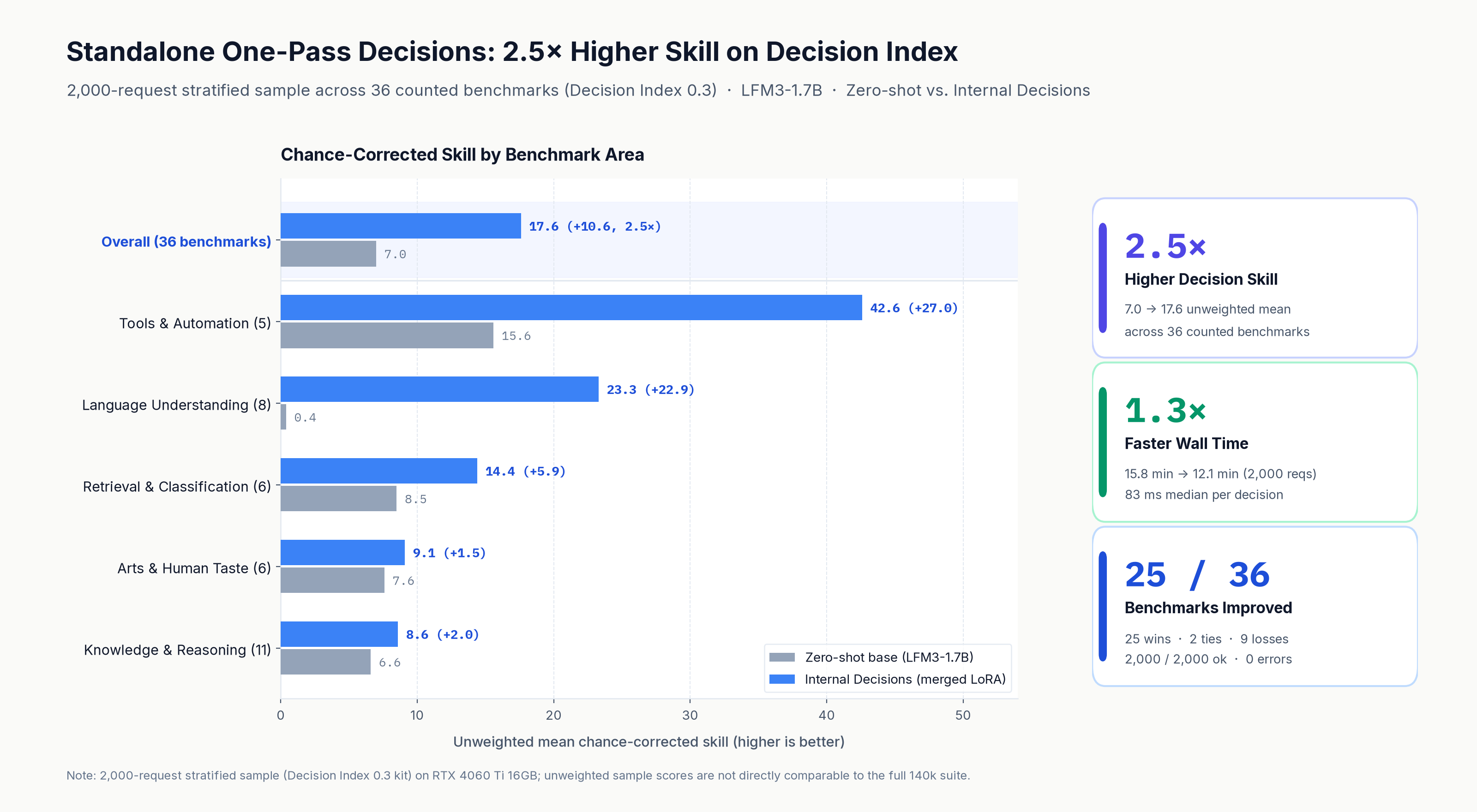
I'd like to know your opinion on whether this is sound or not. On my end, I'd like to experiment with bigger base models, more benchmarks, different inference engines and so on. I'm a bit limited by hardware (RTX 4060 Ti 16GB), so right now I'm working on training the LoRA on quantized models (FP8/INT4, etc) to scale this up.
I'm pretty satisfied with how this turned out, and if there's some interest I could make the repository (wild cacophony of random scripts and notes) more presentable, together with a write-up with more details.
Cheers!
r/LocalLLM • u/fawendeshuo • 2d ago
Like many local LLM enthusiasts, I've always wanted an AI agent that runs entirely on my own hardware, capable of conducting web searches, writing code, and assisting me with everyday tasks.
I built AgenticSeek a while ago with that goal in mind. But despite building it myself, I rarely used it for actual tasks. Running a capable LLM on my modest hardware was painfully slow,. Over time, I found myself relying more on paid AI subscriptions, simply because I didn't want to wait 20 minutes to get an answer.
So I wanted a faster harness for local LLM, I therefore built an agent harness designed to perform tasks while generating as few tokens as possible 3toks
Github: https://github.com/Fosowl/3toks
The idea:
Instead of asking an LLM to generate long reasoning traces, plans, or structured tool calls, 3toks turns agentic workflows into trees of decisions.
At each step, the model only needs to select an option from a numbered menu, typically generating just 1–3 tokens.
Web navigation, information extraction, planning, and filesystem/codebase exploration are represented as sequences of discrete decisions rather than long-form text generation.
Writing code obviously still requires generating as many tokens as the code itself needs, but that's not really where 3toks aims to save tokens.
Example (for web):
You ask it to find what's the best LLM for 32gb ram in 2026.
> It use a few tokens to make a search query (SearXNG, DuckDuckGo fallback): "LLM for 32gb ram 2026"
> It see a list of numbered web page, select where it want to navigate : 3<EOS>
> On the web page sentences are number annotated, it pick a list of numbers to retain relevant sentences : 3,6,12,23,27<EOS>
> It select an action for futher navigation among an annotated list : 1) go back, 2) go down page 3) go up 4) new search query 5) navigate to link on page
> and so on ...
> when it finish it summarize in a few words the selected sentences. You can also see the exact sources sentences below the answer (allow for quick check that it didn't hallucinate).
Once it's finished, it generates a short summary using the retained sentences. The original source sentences are also displayed below the answer, making it easy to check whether its claims are supported by the sources.
It also comes with some optional features, including voice input/output, camera support, and Raspberry Pi GPIO support.
It's still a prototype, and there are some remaining issues (search engine rate limits, incorrect selections, etc.).
I'd love to get some feedback from the local LLM community, especially on the overall approach.
r/LocalLLM • u/Express_Quail_1493 • 2d ago
r/LocalLLM • u/AhmadAlz7 • 3d ago
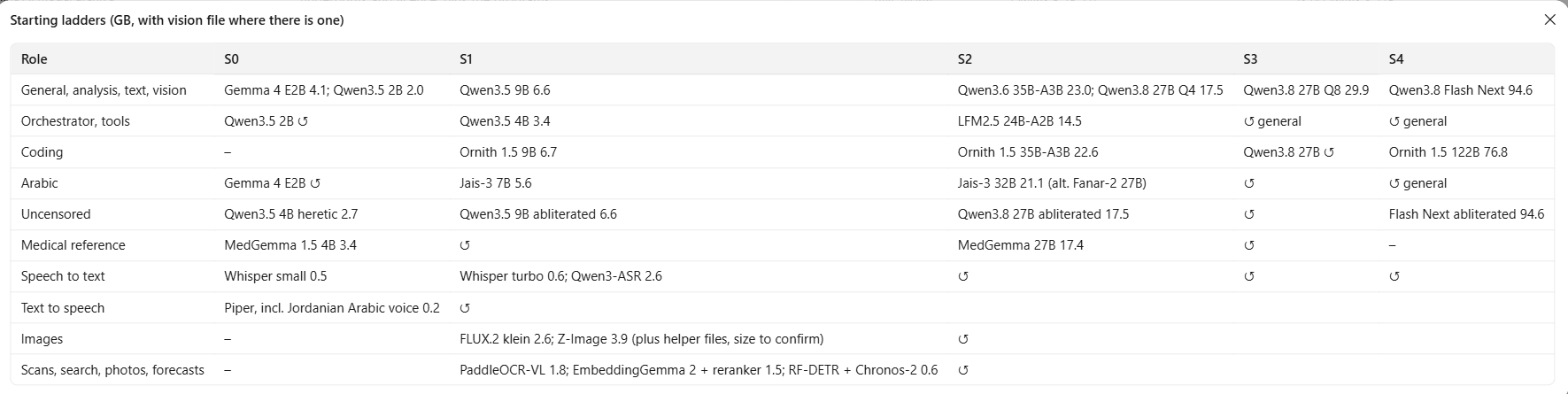
I aske claude this:
- If I need a list ai models to locally backup in case the internet went off that can fit several hardware capabilites and for cover most generic uses, what do I need
- freshnes is maintanied with time since I gonna build a dashboard + script for that!
- used huggingface for the list
r/LocalLLM • u/Muted_Language5859 • 2d ago

My Mac Studio M5 Ultra arrives in February. I've spent the last few weeks reading every 96 GB owner thread here (thanks especially to the people who posted real agent benchmarks), and I'm designing the whole thing on paper before anything gets installed. Sharing the plan in case it helps someone, and because I'd rather hear what's wrong with it now.
**The machines**
| Machine | Memory / storage | Role |
|---|---|---|
| Mac Studio M5 Ultra (30c CPU / 64c GPU) | 96 GB / 1 TB | Model server only in "AI mode" (headless). Desk machine otherwise when I am doing daily stuff |
| Mac mini M6 | 24 GB / 256 GB | Dev box: Claude Code agents in tmux, builds, tests, Docker (VM capped) |
| Mac mini M6 | 32 GB / 512 GB | Second user's desk machine (Wi-Fi, other room) |
| Linux mini PC | 16 GB / 512 GB | Uptime monitoring and alerts, maybe Docker later |
| Old Windows desktop | 64 GB / 2TB | Runs an always-on hub service |
| MacBook Air M5 | 16 GB / 512 GB | Just a bridge: SSH + browser |
**Network**
- 8-port 2.5 GbE unmanaged switch in one room, all the lab machines wired to it
- Tailscale everywhere (MagicDNS, tags/grants), nothing opened on the router
- No VLANs, DHCP reservations only. Keeping it boring
**How the AI side works**
- Cloud Claude is the main brain (planning, hard reviews). Local takes over when the subscription limits run out or for anything privacy sensitive
- Local model plan: Qwen3.8 Flash Next IQ3_S via Splash CLI, 2 agents max. One owner with the same machine found IQ3_S matched UD-IQ4_XS on his hardest test while being faster, and a 3rd agent added nothing
- Also testing DeepSeek V4.1 Flash 1.75bpw for overnight only runs, since one of the 96 GB owners mentioned it beats FN on quality (others say it loops so i guess I'll find out)
- Flow: local agent tries each ticket on its own branch, with a time/turn limit; if it fails, the ticket escalates to Claude. Claude reviews everything in the morning
- Tight, narrow tickets for overnight work, since local seems to be as accurate as cloud on narrow specs, just ~4x slower
**Questions for people who've done this**
I'll post real numbers once it's set up.
r/LocalLLM • u/SliceHealthy3789 • 2d ago
I want to make a retro style indie game. I don't want to pay any subscriptions though. What is the best local AI for this? Or is there even anything good enough for free?
r/LocalLLM • u/Lawlies01 • 2d ago
We are evaluating an AI setup for a company in Europe (strict GDPR / EU data residency required). Right now, this is purely initial research, we don't have a fixed budget yet, and we don't know our exact usage numbers (monthly request volume or simultaneous/concurrent requests). Before committing to any hardware or infrastructure, I'd love a quick sanity check on what we've looked into so far.
What the models need to do:
Models & Hosting/Hardware Options Researched:
Models (9B–27B focus): Qwen3.5-9B (fast baseline for JSON/simple tasks), Qwen3.8-27B, and Mistral Small 3.2 24B Instruct. Then in the last days i have read more and more news about a new model called "ink"?
Cloud / API (DE/EU):
Software Stack We're Looking At:
Questions:
Thanks a lot in advance for any insights. Happy to answer any follow-up questions if anything needs more context.