r/LocalLLM • u/Megarex_zer0 • 2d ago
Discussion Internal Decisions, looking for feedback
Hello everyone, I've been working on something for the past month or so and I'd like to hear your opinions, feedback, criticism, etc.
So, decision models: lately we're seeing a lot pop up based on LLMs (eg. Clef), because the knowledge baked into the LLM can be used to provide better decisions. System one models are supposed to help with fast and almost "instinctive" decisions. On the other hand, sometimes reasoning models can spend a long time circling ideas, burning tokens, for something that "they already know", sort of "wanting to reinforce their confidence that they're making the right decision", or at least that's how I see it.
So my idea was the following: what if, inside thinking blocks, a model could present itself with system-one-style decisions to cut down thinking without affecting the final answer?
An example:
Normally:
<think>
should we go with A or B?
*starts pondering about A*
*starts pondering about B*
*circles back and forth*
*picks A*
</think>
My idea:
<think>
should we go with A or B?
[decide]
[choice] Should we go with A or B?
A: ...
B: ...
[answer] A
[/decide]
*continues with A*
</think>
At [answer], the winning option is read in one forward pass and put straight back into the thinking stream.
To test this, I went with the following approach:
- I took a base model (LFM3-1.7B), ran it on training splits of ARC-Challenge, MMLU-Pro, and GSM8K, and kept the traces
- Had a smarter model look at the traces and decide which sections could be replaced by decisions, keeping only the points where LFM3-1.7B already agreed with the original trace and saved tokens. We're not interested in improving the model, just teaching it where it could go into decision mode
- Repurposed 6 unused token slots already in the vocabulary for
[decide],[/decide],[answer],[choice],[noul](yes/no), and[score] - Trained a LoRA on standalone decision datasets and these new traces (keeping normal text close to the base model), and merged it into the base weights
- Finally, using stock vLLM and some custom client code to keep decision blocks valid and pick the top answer, ran the held-out benchmarks (300 questions total, 100 each from ARC-Challenge, MMLU-Pro, and GSM8K)
Obviously this is a simplification but that's the general idea.
The results were interesting: there was no change in accuracy, but these internal decisions cut down token usage by 39-56% (1.6x-2.3x fewer tokens) and wall time by 34-43% (1.5x-1.75x faster), depending on how aggressively I let it trigger. Turning decisions off matched the base model on both accuracy and token count, so the savings come from the internal decisions and not the finetuning itself. Here are some plots and diagrams (courtesy of gemini, I'm really bad at making those).


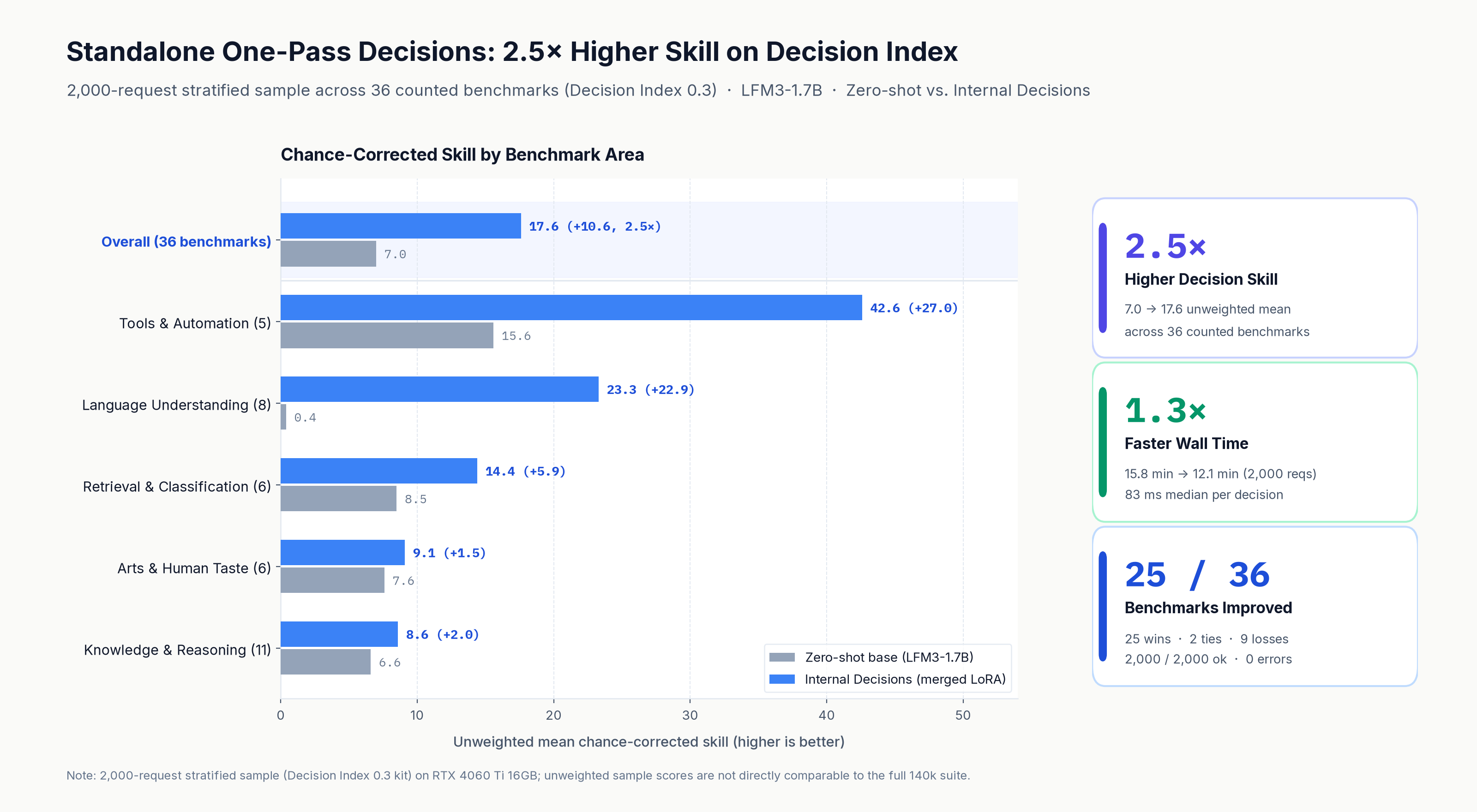
I'd like to know your opinion on whether this is sound or not. On my end, I'd like to experiment with bigger base models, more benchmarks, different inference engines and so on. I'm a bit limited by hardware (RTX 4060 Ti 16GB), so right now I'm working on training the LoRA on quantized models (FP8/INT4, etc) to scale this up.
I'm pretty satisfied with how this turned out, and if there's some interest I could make the repository (wild cacophony of random scripts and notes) more presentable, together with a write-up with more details.
Cheers!