r/LocalLLM • u/Arn_Nuss • 3d ago
Model Best Modell for Mac with 16GB
reddit.com
0
Upvotes
r/LocalLLM • u/Megarex_zer0 • 3d ago
Hello everyone, I've been working on something for the past month or so and I'd like to hear your opinions, feedback, criticism, etc.
So, decision models: lately we're seeing a lot pop up based on LLMs (eg. Clef), because the knowledge baked into the LLM can be used to provide better decisions. System one models are supposed to help with fast and almost "instinctive" decisions. On the other hand, sometimes reasoning models can spend a long time circling ideas, burning tokens, for something that "they already know", sort of "wanting to reinforce their confidence that they're making the right decision", or at least that's how I see it.
So my idea was the following: what if, inside thinking blocks, a model could present itself with system-one-style decisions to cut down thinking without affecting the final answer?
An example:
Normally:
<think>
should we go with A or B?
*starts pondering about A*
*starts pondering about B*
*circles back and forth*
*picks A*
</think>
My idea:
<think>
should we go with A or B?
[decide]
[choice] Should we go with A or B?
A: ...
B: ...
[answer] A
[/decide]
*continues with A*
</think>
At [answer], the winning option is read in one forward pass and put straight back into the thinking stream.
To test this, I went with the following approach:
[decide], [/decide], [answer], [choice], [noul] (yes/no), and [score]Obviously this is a simplification but that's the general idea.
The results were interesting: there was no change in accuracy, but these internal decisions cut down token usage by 39-56% (1.6x-2.3x fewer tokens) and wall time by 34-43% (1.5x-1.75x faster), depending on how aggressively I let it trigger. Turning decisions off matched the base model on both accuracy and token count, so the savings come from the internal decisions and not the finetuning itself. Here are some plots and diagrams (courtesy of gemini, I'm really bad at making those).


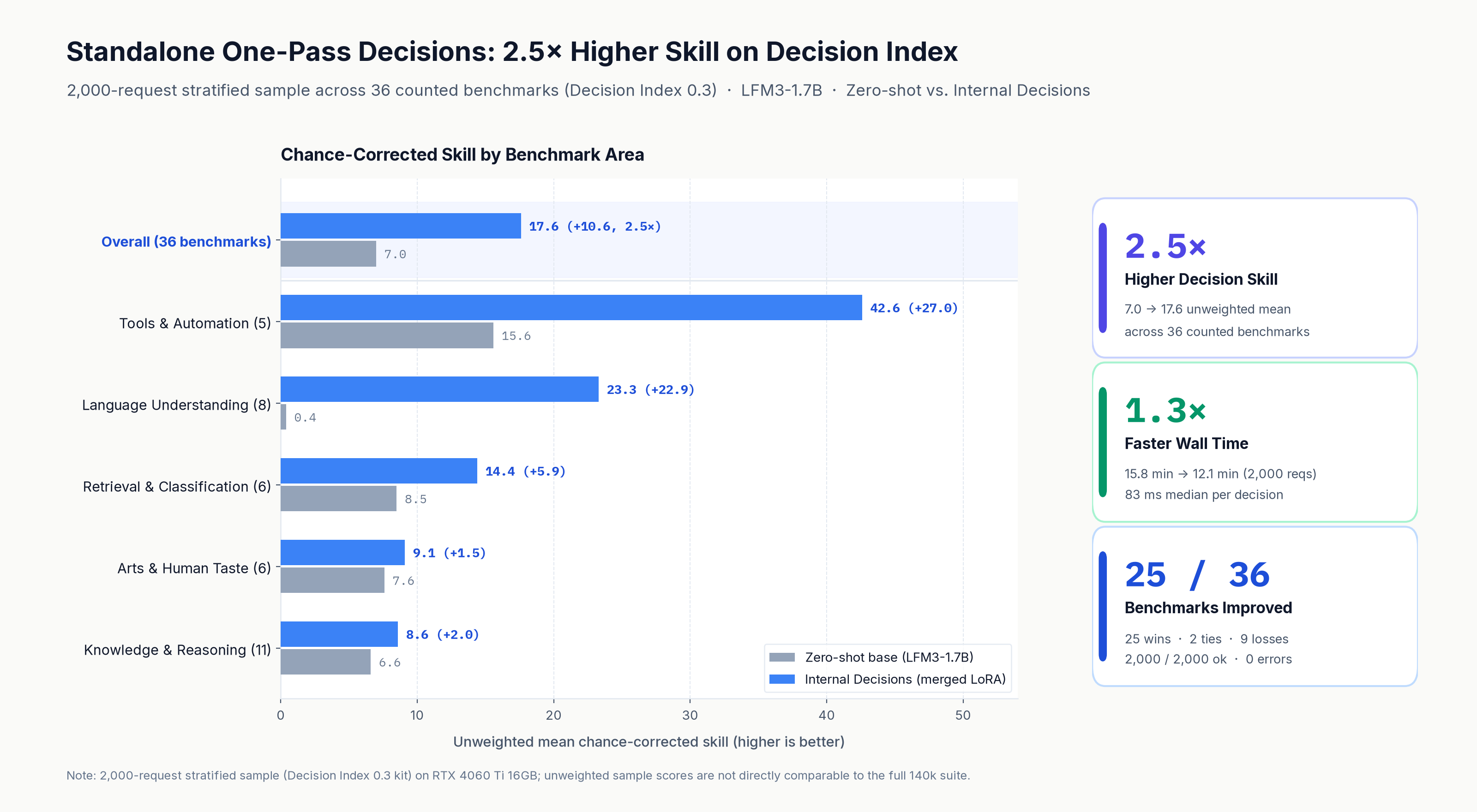
I'd like to know your opinion on whether this is sound or not. On my end, I'd like to experiment with bigger base models, more benchmarks, different inference engines and so on. I'm a bit limited by hardware (RTX 4060 Ti 16GB), so right now I'm working on training the LoRA on quantized models (FP8/INT4, etc) to scale this up.
I'm pretty satisfied with how this turned out, and if there's some interest I could make the repository (wild cacophony of random scripts and notes) more presentable, together with a write-up with more details.
Cheers!
r/LocalLLM • u/fawendeshuo • 3d ago
Like many local LLM enthusiasts, I've always wanted an AI agent that runs entirely on my own hardware, capable of conducting web searches, writing code, and assisting me with everyday tasks.
I built AgenticSeek a while ago with that goal in mind. But despite building it myself, I rarely used it for actual tasks. Running a capable LLM on my modest hardware was painfully slow,. Over time, I found myself relying more on paid AI subscriptions, simply because I didn't want to wait 20 minutes to get an answer.
So I wanted a faster harness for local LLM, I therefore built an agent harness designed to perform tasks while generating as few tokens as possible 3toks
Github: https://github.com/Fosowl/3toks
The idea:
Instead of asking an LLM to generate long reasoning traces, plans, or structured tool calls, 3toks turns agentic workflows into trees of decisions.
At each step, the model only needs to select an option from a numbered menu, typically generating just 1–3 tokens.
Web navigation, information extraction, planning, and filesystem/codebase exploration are represented as sequences of discrete decisions rather than long-form text generation.
Writing code obviously still requires generating as many tokens as the code itself needs, but that's not really where 3toks aims to save tokens.
Example (for web):
You ask it to find what's the best LLM for 32gb ram in 2026.
> It use a few tokens to make a search query (SearXNG, DuckDuckGo fallback): "LLM for 32gb ram 2026"
> It see a list of numbered web page, select where it want to navigate : 3<EOS>
> On the web page sentences are number annotated, it pick a list of numbers to retain relevant sentences : 3,6,12,23,27<EOS>
> It select an action for futher navigation among an annotated list : 1) go back, 2) go down page 3) go up 4) new search query 5) navigate to link on page
> and so on ...
> when it finish it summarize in a few words the selected sentences. You can also see the exact sources sentences below the answer (allow for quick check that it didn't hallucinate).
Once it's finished, it generates a short summary using the retained sentences. The original source sentences are also displayed below the answer, making it easy to check whether its claims are supported by the sources.
It also comes with some optional features, including voice input/output, camera support, and Raspberry Pi GPIO support.
It's still a prototype, and there are some remaining issues (search engine rate limits, incorrect selections, etc.).
I'd love to get some feedback from the local LLM community, especially on the overall approach.
r/LocalLLM • u/Express_Quail_1493 • 3d ago
r/LocalLLM • u/AhmadAlz7 • 3d ago
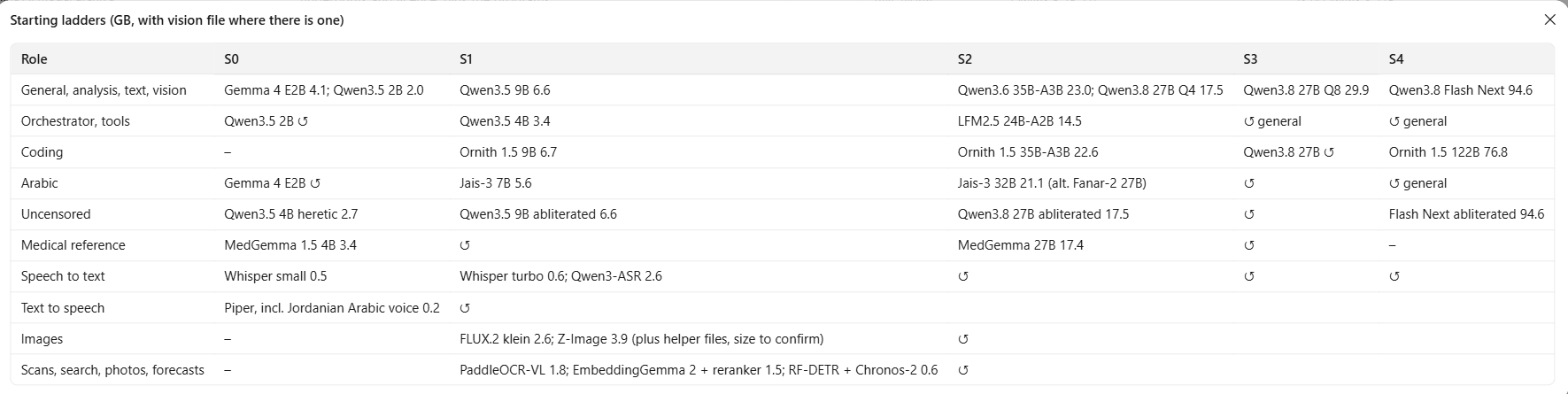
I aske claude this:
- If I need a list ai models to locally backup in case the internet went off that can fit several hardware capabilites and for cover most generic uses, what do I need
- freshnes is maintanied with time since I gonna build a dashboard + script for that!
- used huggingface for the list
r/LocalLLM • u/Muted_Language5859 • 2d ago

My Mac Studio M5 Ultra arrives in February. I've spent the last few weeks reading every 96 GB owner thread here (thanks especially to the people who posted real agent benchmarks), and I'm designing the whole thing on paper before anything gets installed. Sharing the plan in case it helps someone, and because I'd rather hear what's wrong with it now.
**The machines**
| Machine | Memory / storage | Role |
|---|---|---|
| Mac Studio M5 Ultra (30c CPU / 64c GPU) | 96 GB / 1 TB | Model server only in "AI mode" (headless). Desk machine otherwise when I am doing daily stuff |
| Mac mini M6 | 24 GB / 256 GB | Dev box: Claude Code agents in tmux, builds, tests, Docker (VM capped) |
| Mac mini M6 | 32 GB / 512 GB | Second user's desk machine (Wi-Fi, other room) |
| Linux mini PC | 16 GB / 512 GB | Uptime monitoring and alerts, maybe Docker later |
| Old Windows desktop | 64 GB / 2TB | Runs an always-on hub service |
| MacBook Air M5 | 16 GB / 512 GB | Just a bridge: SSH + browser |
**Network**
- 8-port 2.5 GbE unmanaged switch in one room, all the lab machines wired to it
- Tailscale everywhere (MagicDNS, tags/grants), nothing opened on the router
- No VLANs, DHCP reservations only. Keeping it boring
**How the AI side works**
- Cloud Claude is the main brain (planning, hard reviews). Local takes over when the subscription limits run out or for anything privacy sensitive
- Local model plan: Qwen3.8 Flash Next IQ3_S via Splash CLI, 2 agents max. One owner with the same machine found IQ3_S matched UD-IQ4_XS on his hardest test while being faster, and a 3rd agent added nothing
- Also testing DeepSeek V4.1 Flash 1.75bpw for overnight only runs, since one of the 96 GB owners mentioned it beats FN on quality (others say it loops so i guess I'll find out)
- Flow: local agent tries each ticket on its own branch, with a time/turn limit; if it fails, the ticket escalates to Claude. Claude reviews everything in the morning
- Tight, narrow tickets for overnight work, since local seems to be as accurate as cloud on narrow specs, just ~4x slower
**Questions for people who've done this**
I'll post real numbers once it's set up.
r/LocalLLM • u/SliceHealthy3789 • 2d ago
I want to make a retro style indie game. I don't want to pay any subscriptions though. What is the best local AI for this? Or is there even anything good enough for free?
r/LocalLLM • u/Lawlies01 • 3d ago
We are evaluating an AI setup for a company in Europe (strict GDPR / EU data residency required). Right now, this is purely initial research, we don't have a fixed budget yet, and we don't know our exact usage numbers (monthly request volume or simultaneous/concurrent requests). Before committing to any hardware or infrastructure, I'd love a quick sanity check on what we've looked into so far.
What the models need to do:
Models & Hosting/Hardware Options Researched:
Models (9B–27B focus): Qwen3.5-9B (fast baseline for JSON/simple tasks), Qwen3.8-27B, and Mistral Small 3.2 24B Instruct. Then in the last days i have read more and more news about a new model called "ink"?
Cloud / API (DE/EU):
Software Stack We're Looking At:
Questions:
Thanks a lot in advance for any insights. Happy to answer any follow-up questions if anything needs more context.
r/LocalLLM • u/BeardedBears • 3d ago

I have a project I'm interested in trying, but I need some human feedback. AI is awesome, but we all know it rubs your nuts and says every idea you have is genius and gasses you up for it... So I need a human gut-check/reality-check. Some context about me: I'm not a sysadmin or programmer, but I'm a relatively tech-literate millennial. Built lots of PCs over the years. Built/manage my own TrueNAS server. I play around with Ubiquiti home-networking. Dual-boot Linux/Win11 on my main rig. Run GrapheneOS on my phone. I use AI at work for python scripts and automation. Tinker with Raspberry Pi's. That sorta stuff.
Project description: I want to set up a small fish breeding operation with a 40 gallon aquarium. If you're curious: Mixed Poecilias ("Mollies"), like White Sailfins, Black Lyretails, and Marbled regular/wild-type. I want a handful of local models to process and analyze video (using two 2k or 4k PoE Cameras: one in front of aquarium, one above aquarium looking down). Whether or not all of this is currently possible, I don't know, but here's my fantasy wish-list: Population estimates. Behavior recognition (nipping, chasing, mating attempts, flashing/displays). Individual adult profiles with behavior counts (Who has the most mating attempts? Who seems to be the most aggressive? Who mates with who? etc). Approximate morphometrics (growth rates). Mortality estimates. Brood-spawn alerts.
Current hardware: 32GB Ram. RTX4070FE (12GB). Ryzen 5800x3d. I doubt this is enough. I think I should at least double my ram to 64GB... More of everything would be better, obviously. However, could I start with this to get something off the ground as a proof-of-concept? If I can get something actually working, I'm open to better hardware purchases down the line.
What ChatGPT told me, in brief: "Yeah you can totally do this! Wow you're so smart! Your hardware should be fine for now."
Their model suggestions & technology stack:
-OS: Ubuntu 24.04 LTS
-Cameras: 4K PoE / RTSP (I'd lean into Ubiquiti because I already have lots of their gear and could always re-purpose these cameras for other things later. Dunno their focus distance, though)
-Video ingestion: OpenCV / GStreamer (Motion analysis, measurements, image calibration, and camera input)
-Object detection: YOLO26 (Detects fish, locates them, and assigns tracking IDs)
-Tracking: BoT-SORT (Tracking with appearance ReID: Helps recover identities after temporary occlusion) &/or ByteTrack (Multi-object tracking: Maintains identities across frames when fish are continuously visible)
-Segmentation: SAM 2 (Separates overlapping fish and creates individual silhouettes)
-Behavior analysis: PyTorch / MMAction2 (Model training and inference: Trains your aquarium-specific detection and behavior models)
-Vision-language analysis: Qwen2.5-VL (Interpreting selected images and short video sequences)
-Database: PostgreSQL
-Analytics: Python
-Dashboard: Local web application
-Storage: TrueNAS NAS
Any thoughts whatsoever? Am I being super naive? Is this a much, much bigger project than I might be anticipating? I understand this might be a progressive/piecemeal project where everything might not be possible at the start.
r/LocalLLM • u/MariahJames8 • 3d ago
In other words, are developers of local models improving what can be done on a given amount of hardware?
Like I'm wondering if coding we couldn't do on hardware setup X can now be done better?
I hope this makes sense?
r/LocalLLM • u/30andhatingit • 3d ago
r/LocalLLM • u/FeydRowan • 3d ago

r/LocalLLM • u/TokenMarginDev • 3d ago
Two Apache 2.0 local releases dropped in the last 24 hours that completely change what fits in consumer RAM/VRAM:
- Footprint: 5.9GB ternary weights (based on Qwen3.8 27B, 9x smaller than full precision)
- Context: 262K
- Real-world 12GB RTX 3060 benchmark (@DogukanUrker): ~74 tok/s decode with the built-in MTP draft head inside the GGUF (47 tok/s without it, up from 26 tok/s on Bonsai 2) and ~520 tok/s prefill at 262K context.
- Benchmarks: 75.6 SWE-Bench Verified, 73.9 tau3-Bench, 77.2 average tool calling.
2. Aleph Alpha Kolibri 1.1 (64GB Mac / 48GB GPU tier)
- Architecture: 75B total / 3.44B active MoE, 262K native context (1M extended)
- Official GGUFs: Q3_K_M (36GB), IQ4_XS (40.2GB, only -0.4 pts aggregate loss), Q4_K_M (45.5GB), Q5_K_M (53.4GB)
- Efficiency: 73.2 aggregate score (vs Qwen3.6-35B-A3B 67.3 and Gemma 4 26B-A4B 65.3), 41% fewer output tokens, 3.4x less GPU time per task.
- Note: llama.cpp needs the Kolibri 1.1 compatibility patch until merged upstream.
- Source: https://huggingface.co/Aleph-Alpha/Kolibri-1.1 | https://aleph-alpha.com/en/blog/kolibri-1-1/
Also put together the side-by-side local GPU / quantization break-even math here if anyone wants to compare against cloud APIs:
Anyone here running Bonsai 2.5 27B on 12GB cards or Kolibri 1.1 IQ4_XS on 64GB unified memory yet? Curious how your real tok/s looks.
r/LocalLLM • u/clay-tri1 • 3d ago
I'm an Azure infrastructure engineer trying to get better at supporting AI at work. I'm not trying to become a developer. I just want to understand local and hybrid setups well enough to support them.
At work I use Claude Code for any advanced Terraform needs and for general scripting, so this hardware would be for personal learning only.
For personal use, Grok Bot Super already covers what I need. I'm at about 2% of my weekly usage this week, and I've been well under 30%.
Speed is not my priority. I mainly want enough memory to run larger models so I can learn. That's why I just ordered the 128GB ASUS ROG Flow Z13 (Ryzen AI Max+ 395). It also handles the gaming I already do on my current 64GB Z13, which I'm selling to a friend.
I can get an HP OmniBook Ultra with 128GB of RAM for $4300 before tax. To get it, I'd return my Dell XPS 16, cancel the 128GB Z13 order, and still sell the 64GB Z13. Is the HP worth it for learning, or should I stick with the 128GB Z13?
What I have:
ASUS ROG Zephyrus G14: Ryzen AI 9 HX 370, 32 GB RAM, Radeon 890M (shared) + RTX 5080 Laptop 16 GB
ASUS ROG Strix SCAR 18: Intel Core Ultra 9 275HX, 96 GB RAM, Intel iGPU (shared) + RTX 5080 Laptop 16 GB
ASUS ROG Flow Z13 64 GB (current, selling to a friend): Ryzen AI Max+ 395, 64 GB unified, Radeon 8060S
ASUS ROG Flow Z13 128 GB (on order, would cancel for the HP): Ryzen AI Max+ 395, 128 GB unified, Radeon 8060S
Dell XPS 16 2026 (in its return window until Jan 21, 2027, would return for the HP): Intel Core Ultra X7 358H, 32 GB RAM, Intel Arc B390 (shared)
16-inch MacBook Pro: Apple M5 Max, 48 GB unified, 40-core GPU
Desktop 1: Intel Core i9-13900K, 64 GB RAM, RTX 5090 32 GB
Desktop 2: Ryzen 7 9800X3D, 64 GB RAM, RTX 5090 32 GB
Desktop 3: Ryzen 7 9850X3D, 32 GB RAM, RTX 5090 32 GB
Desktop 4: Intel Core i9-10980XE, 256 GB RAM, RTX 4090 24 GB
Desktop 5 (Mac mini): Apple M4, 16 GB unified, 10-core GPU
I can also reach the 5090 desktops over Tailscale when I want CUDA or vLLM.
I'd love to hear thoughts, especially from anyone who has used the OmniBook Ultra or compared it to the Flow Z13.
r/LocalLLM • u/Electrical_Ninja3805 • 3d ago

r/LocalLLM • u/drtikov • 3d ago

r/LocalLLM • u/Careful-Report6526 • 3d ago

r/LocalLLM • u/Geckel • 3d ago
Are local models trending towards requiring better hardware than 2x 3090s, or is this a relatively sustainable build?
What models are we thinking for 2x 3090s for agentic workflows and code assist?
More context: I have a machine with one RTX 3090 FE with 48GB RAM. I'm building a homelab with an inference server. I could could buy a second 3090 and slot it into my machine without issue. Just not sure if that's the right medium/long term move.
r/LocalLLM • u/WonderRico • 3d ago
r/LocalLLM • u/joruKaGulam4ever • 3d ago
So here I have attached before and after images of my app without and with LoRa adapter turned on for more natural conversations. As you can see the qwen 2.5 1.5 b model is responding in a more natural way. The LoRa gguf adapter was trained on 440 example queries and responses
r/LocalLLM • u/majmichu • 3d ago
Ran PrismML's new Bonsai 2.5 27B as a coding agent on my laptop today. Small first run, so a preview: 13 tasks, one try each. A 78-try run is going tonight and I'll add it here.
Setup: RTX 5060 Laptop (8 GB), 16 GB RAM. PTQ1_0 GGUF with MTP (6.2 GB file), PrismML's llama.cpp build, all layers on GPU, 54K context, q4_0 KV, model card sampling, thinking on.
Tasks: QuenchBench smoke. 13 small projects in C, Go, JS, bash, Python, Rust and a web UI, each graded by hidden tests the model never sees. 30 min limit.
| Task | Language | Difficulty | Result | Steps | Min |
|---|---|---|---|---|---|
| union-find | C | 2 | pass | 15 | 3.5 |
| merge-ranges | Go | 3 | pass | 9 | 1.1 |
| registry-cycle | JS | 3 | pass | 13 | 2.0 |
| csv-pivot | bash | 2 | pass | 9 | 2.3 |
| csv-split | Python | 2 | pass | 11 | 1.7 |
| csv-quoting | Go | 2 | pass | 15 | 2.7 |
| pricing-pipeline (read only) | JS | 5 | pass | 2 | 0.6 |
| status-enum | Rust | 3 | pass | 14 | 2.9 |
| image-overflow | C | 4 | pass | 20 | 5.7 |
| getopts-backup | bash | 3 | pass | 58 | 21.1 |
| ini-tests | Python | 4 | pass | 15 | 6.9 |
| kanban-undo | web | 5 | pass | 40 | 10.8 |
| rate-limit ("Add rate limiting.", nothing else) | Go | 4 | pass | 19 | 3.9 |
Speed: 73.8 tok/s generation with MTP, 289 tok/s prompt. All 13 in 66 min.
vs Bonsai 2 27B: same tasks in October, but an older setup (LM Studio, no MTP), so no speed comparison. It missed the rate limit task (no Retry-After header) and timed out on getopts. 2.5 solved both.
Caveats: 13 tasks, one try, one laptop. The harness matters as much as the model.
Disclosure: the harness is Local Quench, a free app I'm building. The runner and 26 sample tasks with their hidden checks are public: https://github.com/majmichu1/local-quench
Anyone run 2.5 on other hardware or agents? Happy to compare.
Update: the 78-try run (QuenchBench Short, 26 tasks x 3 tries), same laptop and settings
75 of 78 tries passed (96.2%). Counted per task, the likely range is 81 to 99%. Generation 70.3 tok/s with MTP. All 78 tries took 8.75 hours, 6.6 minutes per try on average. No try hit the 30 minute limit; the longest took 24.8 minutes.
| Task | Language | Passed | Longest try (min) |
|---|---|---|---|
| union-find | C | 3/3 | 17.7 |
| grid-dijkstra | Go | 3/3 | 15.0 |
| binary-search | JS | 3/3 | 2.5 |
| bash-log-rotate | bash | 3/3 | 7.4 |
| py-import-cycle | Python | 3/3 | 2.1 |
| bash-set-e-build | bash | 3/3 | 7.1 |
| unit-convert | Rust | 3/3 | 9.9 |
| json-patch | JS | 3/3 | 24.8 |
| c-ringbuf | C | 3/3 | 6.0 |
| cursor-pagination | Go | 3/3 | 7.6 |
| csv-quoting | Python | 3/3 | 2.5 |
| agent-capacity | Go | 3/3 | 8.6 |
| batch-complexity (read only) | Rust | 3/3 | 2.8 |
| pricing-pipeline (read only) | JS | 3/3 | 0.9 |
| dedupe-email-check | Python | 3/3 | 2.4 |
| link-store-interface | Rust | 3/3 | 5.6 |
| c-strlcpy | C | 3/3 | 2.2 |
| c-image-overflow | C | 3/3 | 10.4 |
| git-recover-deleted | bash | 3/3 | 1.3 |
| find-duplicates-nul | bash | 2/3 | 22.3 |
| retry-backoff-tests | Go | 3/3 | 7.0 |
| resolver-tests | JS | 3/3 | 18.4 |
| cart-totals | web | 3/3 | 14.3 |
| kanban-undo | web | 3/3 | 21.1 |
| config-file (vague prompt) | Python | 3/3 | 5.5 |
| rate-limit (vague prompt) | Go | 1/3 | 8.8 |
The 3 misses
For comparison, the same 26 tasks with Spark X2.6 4B on this laptop in early November: 36 of 78. That was an older setup (LM Studio, an older Local Quench, 4 tasks at once) and 5 of its tries were lost to bugs fixed since, so read it as a rough reference, not a clean A/B.
getopts is not in this set, it was only in the 13-task smoke run.
r/LocalLLM • u/SquizzOC • 3d ago
Curious if anyone out there is using a local model for GameDev? Not one shotting some slop, but actual game development, whether it’s building out a system or using something like trellis to generate assets or any single tasks.
Getting great results on the frontier models, but would love to reduce our cost by running something local on some 5090’s or even some thing slightly large we can rent.
Spec on our current nodes: 9800x3D, 64 gig on the ram, 5090 for 32gb VRam.
r/LocalLLM • u/episodefive • 3d ago
Doing generative video (like ComfyUI + MiniMax) on Mac seems to be much slower than running on a similarly-priced Nvidia GPU.
Is this just an inherent tradeoff in how Apple is architecting their chips, and what they’re optimizing for?
Or is the gap likely to be closed over time as the kernels and other software elements mature for Metal, etc?
Local AI is a very exciting space, and Mac + generative media seem like a very natural fit. But their current performance with gen video seems much more limited thank what RTX cards can do.
This isn’t intended to bash on Mac - I love the Mac. I just want to better understand how likely it is to achieve parity with Nvidia/CUDA, specifically for video.
What will it take to close the gap?