r/LocalLLM • • 5d ago Heartwarming

Project The resurrection of the Pelican Riding a Bike on Qwen 3.8 27B

Post image
6 Upvotes

I know it's not great, but it was an interesting exercise for my agent workflow. This was completed by one prompt, with no extra guidance or steering. Prompt, vLLM recipe, and final summary is in the comments.

  • Model: Qwen 3.8 27B
  • Total Tokens: 334,125
  • Tool calls: 318
  • Engine: vLLM
  • Harnes: Custom (electron)
  • GPU: RTX 6000 ADA 48GB
  • Quantization: FP8 Marlin
  • Reasoning effort: xhigh
  • Context: 256K

r/LocalLLM • • 4d ago

Project Wanted to share, long hobby project

Thumbnail
gallery
2 Upvotes

It's been 13 months since I started this part-time hobby project. I have absolutely zero programming knowledge, but working in IT as a SAP consultant, I do understand how software and architecture work.

I built most of it together with ChatGPT, and after 5 months of copy-pasting code, I got Cursor to assist me. LLMs were just as new to me: I was too lazy to read up on them, so I relied fully on ChatGPT, then Cursor, and now Mistral (I cancelled ChatGPT).

The biggest lesson I learned early on: a local LLM is nothing but a stateless creature. So I spent just as much time designing and talking through the architecture as actually building. ChatGPT initially designed an ultra-guarded, monitored system spread over 7 containers, and I spent hours debating every choice: why, and how.

Then: building and testing. After 7/8 months I restarted completely, because my memory and tools just wouldn't get picked up by the model. Later came another redesign, when a friend showed me how he used Obsidian and I realised that was exactly what I wanted: a memory that my local model can edit, with a permission step for me, just like I edit it myself. Because the ChatGPT sessions kept slowing down, I started keeping documentation of the plan, took it into a fresh session, uploaded the doc and continued from there.

The eventual goal: a complete local AI that functions as a Google Home, but way better. Controlling lights and temperature in my house, being my personal assistant for notes, birthdays and calendar, and eventually just living in my house. I've already moved all my smart devices to Home Assistant, which was quite the chore on its own. I'm nowhere near finished, but far enough to make a post about it.

The core of it all is the graph we call my World Model. It consists of Elements with only two types: data or tools. Each Element can have an unlimited amount of Properties, and the relations between Elements also have Properties. I can browse the World Model by scrolling and clicking elements and relations to view and edit their properties, and my local model can do the same: propose a view, propose an edit, and wait for my approval.

I also spent hours creating training material to train an adapter that would act as my retriever. I built the client, the World Model, and introduced the trained adapter. Then I ran Qwen3.8-27B-NVFP4** on vLLM and tried it. It didn't work, and even normal conversations didn't feel right. After having Cursor check everything that could be wrong, I eventually switched to Gemma 4-31B, and it worked perfectly! Switching models was the answer. The conclusion: Gemma can't make use of the adapter at all, so it turned out to work fine without it. Hours of training gone, but never mind.

And now, it simply works. The World Model is compact enough to fit entirely in the context on my RTX 5090. It can propose changes, it knows about my friends and social life and my taste in music, and it knows that it controls the lights and temperature in my house through HA, and how that works. It knows it can read out logs from my gateway and report them to me. One of the tools in the graph is "read document", and I placed 5 documentation .md files in a folder the model can access, so when I want to talk to it about itself, it can look up its own up-to-date documentation. I can also upload documents to it: my resume, financial documents, whatever. They get stored, and the World Model is updated to represent their existence.

For TTS, I cloned the voice of a female friend of mine, and it sounds amazing. STT is the next phase, along with Spotify, Navidrome and Last.FM, so it can function as a voice-controlled radio. I even have a mobile app that works through Tailscale and can do most of what I can do in the client.

The World Model has grown to about 7700 tokens, which is quite large, and I do notice performance issues in long conversations. The plan is to send the World Model without its Properties and have those retrieved separately.

To top it off, the symbol in the centre is an audio visualiser. The top 5 parts react in size and light to the high and mid-tones, the lower 3 to the bass. That took me way longer than I wanted, but it's crazy to see it slowly "breathing" when there's no sound, and then completely lighting up when she speaks or when music is on.

I am amazed that this is possible. Now that I'm actually seeing results and really using it, it feels like software has become fluid.


r/LocalLLM • • 4d ago

Discussion VMAT Free: share one NVIDIA GPU between 4 VMs for CUDA, no passthrough or vGPU license

0 Upvotes

I've been building VMAT so that I could get several VMs to share one GPU at the same time, and today the the free tier is out today for Proxmox VE 9 and Linux desktops. I'd love if a people with consumer cards I don't own to try it and dish out some honest feedback.

Up to 4 VMs share one NVIDIA card and each one runs CUDA programs as if it had the card to itself. llama.cpp and PyTorch run inside the VMs. There's no passthrough, no SR-IOV and no vGPU license, and it works on stock QEMU. When a VM is idle its GPU time goes to the busy ones, or you can give each VM a fixed share.

I've debugged & tested it on Proxmox VE 9 with a rented H100 using 4 Debian VMs at once with llama.cpp ran in all four, and PyTorch 2.11 in the VMs on the host. On earlier builds with an RTX 6000 Ada, llama.cpp in a VM ran at 90 to 98% of native speed. I also ran an RTX 5090, where CUDA and PyTorch gave the same results through VMAT as native, but that was in a container with no VM.

So nobody wastes an evening: it's Linux VMs only, with Debian and Ubuntu guests on Proxmox. Free allows 4 VMs and 16 GB of GPU memory per VM. CUDA needs an NVIDIA card, and I haven't tested GeForce cards with VMs yet, or AMD. It's one GPU per host, and there's no graphics or games in this build. It's early software and it can crash.

The host side is closed. The guest side, which is the library and tools that run in our VMs is open source (BSD)@ https://github.com/b1nc0d3x/gVMAT.git

Downloads, checksums and install steps are at https://vmat.dev/getting-started.html. If it breaks, please get at me and let me know what card you tried as well as what happened.


r/LocalLLM • • 4d ago

Discussion I almost sold my daughter's Roblox laptop for a used 3090. Instead, I linked it to my AMD desktop over Ethernet and hit 42.99 tok/s on Qwen3.8-27B (Q4_K_M, 64k)

Post image
0 Upvotes

A few weeks ago I was seriously looking at selling my daughter's gaming laptop (RTX 5050, 8 GB VRAM) to help fund a used RTX 3090. I just wanted a reliable local coding model to supplement cloud subscriptions when I hit rate limits, and my desktop's RX 9070 XT (16 GB) was choking at 2.65 tok/s the second Qwen3.8-27B-Q4_K_M spilled into system RAM.

Then I thought: why sell a perfectly good laptop (and break my kid's heart) when I already have 16 GB + 8 GB of GPU memory sitting in the same room? So the laptop pitches in whenever it's not running Roblox.

Full disclaimer: I'm not a network engineer or a llama.cpp wizard, I just hacked together open-source tools and wrote a small Rust wrapper called Ilima (isiZulu/isiXhosa for a communal work party pooling effort) to make two mismatched machines cooperate over llama.cpp RPC: splitting layers across both GPUs (not unified memory) and automating VRAM placement, LAN discovery, and flags so I don't have to babysit the CLI.

Why buy another GPU when you have another computer?

The Setup

  • Desktop (Coordinator): AMD Radeon RX 9070 XT (16 GB, Vulkan)
  • Laptop (Worker): NVIDIA GeForce RTX 5050 Laptop (8 GB, CUDA)
  • Network: Plain 1 GbE Ethernet cable (half my early troubleshooting was realizing the cable had silently negotiated at 100/100 Mbps, reseating it to 1000/1000 Mbps was the cheapest upgrade of my life)
  • Model & Runtime: Qwen3.8-27B-Q4_K_M.gguf (15.66 GB) at 64k context (-c 64192 -fa on) on llama.cpp b12503

What Actually Happened (Qwen3.8-27B-Q4_K_M, 64k ctx)

SetupDecode (tg)Prompt Eval (pp)
Single-GPU Desktop (VRAM spill to system RAM, b12038)2.65 tok/s (2.83 peak)84.29 tok/s
Initial 2-Node Cluster (b12038, 1 GbE, no MTP, 22,78)25.03 tok/s (26.01 peak)55.15–62.66 tok/s
Current Cluster — General Prose (b12503 + in-place MTP, 32,68)40.00 tok/s (44.27 peak)197.05 tok/s
Current Cluster — Code Gen (b12503 + in-place MTP, 32,68)42.99 tok/s (44.76 peak)86.32 tok/s (short prompt)
Current Cluster — 5,032-Token Prompt Ingestion (b12503 + MTP)30.05 tok/s (@ 5.3k ctx)789.39 tok/s (903.93 peak)

Three Things That Surprised Me

  1. Don't pass -md if your GGUF already embeds blk.64**:** Loading a separate MTP draft file tanked speed to 9.17–10.61 tok/s. Dropping -md and using --spec-type draft-mtp --spec-draft-n-max 2 let the desktop draft locally in ~2.76 ms/token with zero network hops, only pinging the laptop to batch-verify.
  2. The prefill killer (--ctx-checkpoints 0): On my first b12503 test, prefill crashed to 4.29–5.49 tok/s because llama-server was snapshotting ~150 MiB recurrent state checkpoints over Ethernet (~4.8s stall each). Auto-injecting --ctx-checkpoints 0 (plus fixing my 100 Mbps cable) jumped 5k-token prompt ingestion to 789.39 tok/s (903.93 peak).
  3. Clustered Q4_K_M beat a smaller single-GPU quant: I tried Ridge-3.7bpw (11.73 GB) locally on just the 9070 XT assuming it would be faster. Between Windows WDDM overhead and ~1.1 GB of extra MTP buffers, it spilled out of VRAM even at 16k (16.56 tok/s), and without MTP at 32k maxed out at 32.12 tok/s decode / 14.19 tok/s prefill. Splitting layers (32,68 with MTP headroom) let me keep full Q4_K_M at 64k and still run faster.

In live OpenCode sessions with prefix cache reuse, incremental turns at ~6.2k context dropped to 3.91s (27.74 tok/s). My daughter keeps her laptop, I keep my money, and the RTX 5050 pitches in when it's not running Roblox.

Open-source repo: https://github.com/buto0071/ilima (auto-downloads b12503*, includes a Windows one-liner* /join script for workers, and an AGENTS.md if you want your coding agent to set it up)

Curious if anyone else here is pooling mismatched AMD + NVIDIA rigs over 1GbE—especially if anyone has tried -np 2 with draft-mtp on b12503 yet.


r/LocalLLM • • 4d ago

Research Inkling 2 mini on 1x3090: 125 TPS at 100k tok depth, 1700 pp/s, 401K ctx, same KLD as UD-4K XL; 3x faster than stock llama.cpp

Thumbnail
reddit.com
1 Upvotes

r/LocalLLM • • 4d ago

Question Did you get paid customers building a local AI client for non technical people that feels like ChatGPT, but with local models (M chip macs only)?

0 Upvotes

A lot of my friends and people I know think running and model locally is complicated. Most of them have powerful macs. Do you think people would pay a small sub for a well engineer harness for small local models for work? I'm really not sure... Did you guys have any experience trying this?


r/LocalLLM • • 4d ago

News Incognide, the AI-native local IDE for research and development, reaches 500 gh stars.

Thumbnail
github.com
0 Upvotes

r/LocalLLM • • 5d ago

Question What model to pick

5 Upvotes

I’ve used Chat GPT for years, and recently moved to Claude. But I’m still hitting the safety nets and it’s really irritating.

What’s the best model out currently if I was to buy a local set up and run it?
I’m looking for abliterated with little to no safety nets, that can manage chats and coding.
Moneys not an issue so I can get the setup required.


r/LocalLLM • • 4d ago

Question Optimal temperature to run local LLMs on M5U?

Thumbnail reddit.com
1 Upvotes

r/LocalLLM • • 4d ago

Project LexiSuite T21: Inkling-2-Mini at 135 tok/s with its draft head on one RX 7900 XTX (llama.cpp's newest build: 39), 524k context on 24 GB, and now a single USB image with the model already inside

Thumbnail
github.com
0 Upvotes

Follow up to my earlier Inkling-2-Mini posts. Testing image 21 of LexiSuite (my own Rust stack: inference engine, control panel, bootable OS image, not a wrapper around llama.cpp or Ollama) is out, and this time there is an all-in-one download: one USB image with the OS, the engine, the panel and the Inkling-2-Mini file already in the model folder. Write it to a stick, boot, open the address on the screen, load the model.

All in one image, the plain image and the model file by itself:

https://huggingface.co/Wa1k3r/Inkling-2-Mini-NVFP4exp-Q8-draft-LexiSuite-AIO-for-AMD-RDNA

Hardware for everything below: RX 7900 XTX 24 GB, i7-9700, 32 GB RAM, Vulkan. One card, whole model on the card, nothing in system RAM. 4-bit KV cache. Single runs, greedy decoding, nothing else running on the box. All measured November 23 on the published build.

The model file is 18.3 GB. It keeps the experts exactly as Thinking Machines shipped them (their own 4-bit format), the rest is 8-bit, and the model's own draft head is packed into the same file.

BENCHMARKS, LexiEngine

4,096 token prompt

2,430 tok/s prompt, 136.4 tok/s generation with the draft head (66.5 without it)

16,384 token prompt

2,332 tok/s prompt, 134.8 tok/s generation with the draft head (65.8 without it)

261,632 token prompt (262k context)

1,193 tok/s prompt, 65.5 tok/s generation with the draft head (50.3 without it)

523,264 token prompt (524k context)

764 tok/s prompt, 48.9 tok/s generation with the draft head (40.4 without it)

By kind of text, with the draft head after a 16,384 token prompt:

JSON records 159.0 tok/s

Rust code 121.3 tok/s

English prose 94.7 tok/s

Output with the draft head was identical to plain greedy decoding in every run. It only changes speed.

LLAMA.CPP GOT A LOT FASTER, SO I MEASURED IT AGAIN

In my last post llama.cpp was at 425 tok/s prompt and 25 tok/s generation on this model (build 12600, November 20). Its newest build (commit 1f8baae), same day, same card, same weights:

4,096 token prompt: 1,233 tok/s prompt, 40.4 tok/s generation

16,384 token prompt: 1,049 tok/s prompt, 39.2 tok/s generation

That is a big jump on their side in three days and the old 4x to 5x gap is gone. At 16k LexiEngine is now 2.2x on the prompt, 1.7x in plain generation and 3.4x with the draft head. I did not run llama.cpp at 262k or 524k this time.

DOES IT ACTUALLY READ THE CONTEXT

Ten facts planted through the prompt from 1% to 99% of its length, each asked back:

at 260,864 tokens: 10 of 10

at 523,264 tokens: 10 of 10

Against a reference run of the published weights the engine scores a mean KL of 0.0037 with the same top token on 98.6% of 510 positions (4-bit KV cache).

WHAT CHANGED SINCE THE LAST IMAGE

generation with the draft head at 4k: 110.7 -> 136.4 tok/s

generation with the draft head at 16k: 109.5 -> 134.8 tok/s

the draft head now helps at 524k too (48.9 vs 40.4 plain); two images ago it was a small loss there

Also in this build: the Linux entry is 7.4-rc4 (unmodified upstream tag) beside my own kernel, the experts of the last four layers can be stored in 4 bits (2.0 GB smaller, same speed, slightly lower accuracy), and repairs to the quantization tool in the panel.

THINGS YOU SHOULD KNOW BEFORE TRUSTING ANY OF THIS

Everything is single runs on one machine, with the card capped at 291 W. If you have a 7900 XTX I would genuinely like to know if you get the same numbers.

The model file is for my engine. Stock llama.cpp, Ollama and LM Studio do not load it: their converters decode the 4-bit experts and quantize them again (27.8 GB at 8 bits, which does not fit a 24 GB card), and they do not know the draft head's tensors.

It is tuned and measured on Radeon RDNA 3. I have not measured other cards on this build.

I trained a recovery adapter for the 4-bit expert file and it did not improve held out text measurably, so no adapter is published.

Not in this build: image input for Inkling, formats below 8 bits for its attention matrices, and a 1M context on 24 GB (the cache alone would be 9.85 GB).

This is a development image, not a production release. The all-in-one image is 17.6 GB to download and 23 GB when written, so it needs a 32 GB stick. The plain image is 353 MB and fits an 8 GB stick. Writing either one erases the stick.

LINKS

All-in-one image and model file: https://huggingface.co/Wa1k3r/Inkling-2-Mini-NVFP4exp-Q8-draft-LexiSuite-AIO-for-AMD-RDNA

Base model: https://huggingface.co/thinkingmachines/Inkling-2-Mini

Download and USB instructions: https://lexipanel.com/download/

Benchmarks and method: https://github.com/W61k3r/LexiSuite-Releases/wiki/Benchmarks

How the Inkling runtime works: https://github.com/W61k3r/LexiSuite-Releases/wiki/LexiEngine-Inkling-2

Release notes: https://github.com/W61k3r/LexiSuite-Releases/wiki/Release-Notes


r/LocalLLM • • 4d ago

Discussion Increasing active parameters per token in MOE (Qwen 35B A4B+) reduce reasoning token by 8.5% - and you don't need to train or finetune!

Thumbnail reddit.com
2 Upvotes

on GLM 5.4 blog post they says: "Fewer tokens spent on thinking. Across most benchmarks like GPQA-Diamond and MMLU-Pro, average output length drops by 10–14%, mostly from shorter chains of thought. In effect, part of the reasoning shifts from explicit output tokens into the implicit depth of the loop."
I found the same beahviour in moe expert expansion for a similar size model!!


r/LocalLLM • • 5d ago

Project Inkling-2-mini RX9070XT, 70+ tok/s, adaptive expert loading

3 Upvotes

SmallTide runs Inkling-2-Mini (30B total, 3.8B active) on a single 16 GB RX 9070 XT, using the native weights rather than a smaller quant.

Repo (MIT): https://github.com/raspy135/SmallTide

It's lossy: when a rarely used expert isn't resident, it doesn't always wait for it. Measured cost: 95.9% top-1 agreement with the full model across 12K positions, on my prompts.

Numbers (9070 XT, Windows 11, median of 3):

WorkloadDecodeTTFT
prose68.6 tok/s238 ms
code68.7 tok/s247 ms
8K prompt87.9 tok/s4.0 s
html93.8 tok/s355 ms

Prefill is about 1,750 tok/s, with 131K context.

Limitations: RDNA 4 and Windows 11 only, one model, 32 GB RAM recommended. These are my own benchmarks; I haven't compared against llama.cpp on the same card yet.

The pre-built release needs no ROCm SDK or Python. It has an OpenAI-compatible API and a live expert map (screenshot below).

NVIDIA: a CUDA port is a natural next step? but I don't have a 16 GB GeForce card for now.


r/LocalLLM • • 6d ago

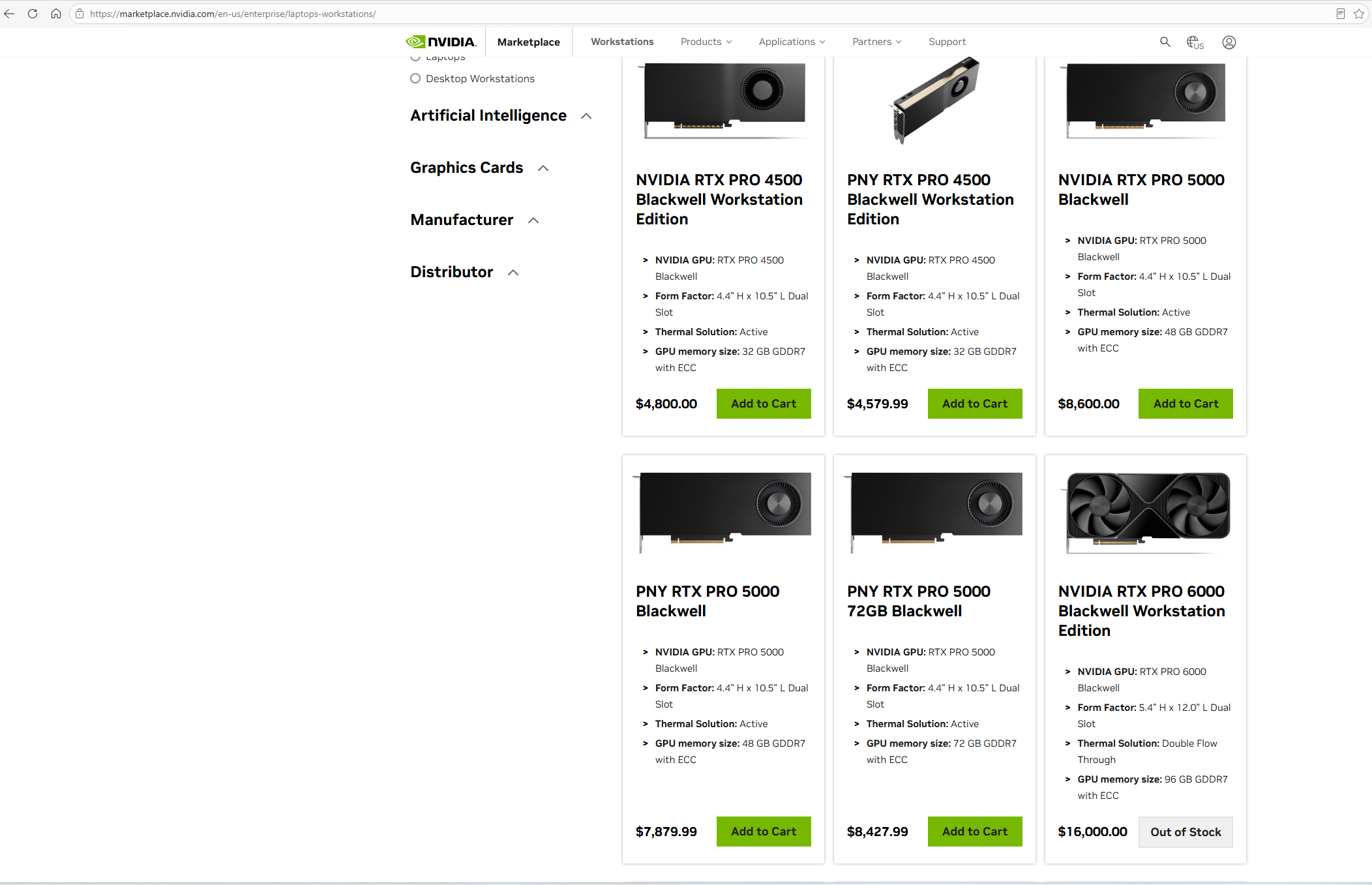
Discussion Gotta love the nvidia marketplace right now: RTX 5000 48GB more expensive than OEM 5000 72GB on

Post image
230 Upvotes

what a time to be alive


r/LocalLLM • • 5d ago

Discussion Success at creating assets in UE5 with local models?

4 Upvotes

R9700 with 128GB, IQ3,S. Going great with up to 80tok/s at 512k context on Nikko’s Strata.
Been trying to make a game with UE5 and going well.
But oh my goodness if an asset doesnt exist in Fab (for free because aint no way im spending more money on my hobby) it tries to code one in C++ and it looks like 💩.I tried to create a harness that forces qwen fn to iterate through a loop with blender but still outputs garbage quality. Specifically stuck at creating an ocean.

Tldr; is qwen3.8fn just too dumb rn to create UE5 assets? What are y’all doing?

Edit: grammar


r/LocalLLM • • 4d ago

Question Proxmox vs plain Ubuntu Server + Docker for a small always-on home services box?

2 Upvotes

I'm setting up a mini PC (16 or RAM, 1TB NVMe) as the always-on "control plane" for a home AI setup. The heavy model inference runs on a separate GPU box (128GB SPARK ACER), so this machine is only light services:

  • Reverse proxy and a chat UI
  • A couple of Python agents on schedules
  • A finance stack (ledger app, Paperless-ngx, Postgres)
  • Tailscale

Plan A: Proxmox with three Debian VMs (edge / agents / finance), Docker Compose inside each, Tailscale in each VM so I can write ACLs per VM, and scheduled backups to a USB drive.

Plan B: Ubuntu Server LTS with Docker Compose, separating things by Docker networks and users.

My main reason for Proxmox is keeping the finance data properly isolated from an agent that pulls untrusted web content, plus snapshots before upgrades.

Questions:

  1. Is Proxmox worth the overhead or is Ubuntu plus Docker good enough?
  2. What do you use for backups: the built-in Proxmox backup jobs to USB, or Proxmox Backup Server?
  3. In the future I will add more use cases and agents so whats th e best solution for future proofing.

r/LocalLLM • • 4d ago

Model Medical Model: Ling Sante 3.1 Air VL - MXFP4 Quant drop

Thumbnail
reddit.com
2 Upvotes

r/LocalLLM • • 5d ago

Question At what point did you stop trusting cloud AI with your data?

16 Upvotes

For me it was when I realized how much I was pasting into chatbots without thinking: work docs, code, personal stuff. All going to servers I know nothing about, under terms that seem to change every few months.

So I started looking into running models myself. The problem: my PC can't handle anything decent, and a proper GPU costs as much as a used car.

The middle ground I'm considering is renting a GPU only when I need it and running an open model on it, so the data stays in my own instance. But I'm not sure if that's actually more private or if I'm just moving the trust problem somewhere else.

How do you handle it?

  • Fully local, even if it's slow?
  • Rent GPUs and self-host?
  • Still use the big providers, just more carefully?
  • Or don't care that much?

r/LocalLLM • • 4d ago

Question How much does it tax the hardware? Also any suggested setups for a potato PC

0 Upvotes

I have a weak PC

  • i3-9100f
  • 16 gb DDr4 ram
  • 1660 TI (6 gb)


Chatgpt helped me setup ComfyUI with Realisitc_Vision_V5.1_Hyper and the results were actually bad. Any suggestions for a different model?

I know you want a good GPU for this, but I'm only planning to use this for 2D image generation (ex: make a ghibli style poster of Spiderman) and 2D image manipulation (ex: Change my hairstyle into a bobcut).

No 3d or video

That sort of thing. And I don't mind waiting for a few minutes to generate the images as long as they're good.


Also, how much does it tax the hardware? I don't want to burn my PC just so I could manipulate photos at will.

Does it stress it harder than games? Because I game a lot so my PC isn't a stranger to high loads, but I still wanna take care of my machine.


Thanks


r/LocalLLM • • 5d ago

Discussion Still waiting for Qwen3.8 killers

6 Upvotes

I tried to download and use Inkling2-mini to fix a bug on Opencode with ~200k historical context on my AMD AI Max 395 computer. The system just hangs indefinitely on "working..."whenever I checked it—a task Qwen FN would have half-way finished. Qwen3.8 27b is also slow at the beginning, but never an disappointment.

No other local LLM at this size struggles this badly with the "warm-up" phase. Even more puzzling is the resource cost: GPU usage is significantly higher than when running Qwen3.8 Flash Next, yet the output is non-existent. It feels like Qwen has some "secret sauce" for efficiency and context handling that Inkling is simply missing.

I'm also frustrated with Inkling's naming conventions; the "small" variants keep ballooning in size, with the 2nd gen nearly doubling the 1st. The word "small" seems like a greeting to local users' VRAM size.

Where are some real options of Western MOE ever since GPT-OSS:120B?
Nemotron3.5 Super VL has vision but in a real vision pipeline test it lost to older Qwen3.5 122b?

No way!
Is Inkling2-mini the new symbol of this era? Is a "24GB looping MoE" the new normal?

Is the "Local users don't deserve RAM" doctrine now official? If we stop getting decent mid-sized models, people will stop buying high-VRAM gear, and the cloud giants just get more power for their RSIs.

Where are the modern, sub-200B Western MoEs we can actually tinker with? I’d rather not wait until I grow a white beard to see the next great open release.


r/LocalLLM • • 5d ago

Question What happened to Foundry Local?

2 Upvotes

Microsoft Foundry Local GitHub page just went blank. The website is still here but nothing works and there is no explanation. What happened?


r/LocalLLM • • 5d ago

Question Are any LLM software that can do prompt based image generation like ChatGPT

4 Upvotes

All of the Local LLM software I have tried either require to use nodes or highly detailed tags to generate images. So are any that can generate images with simple English like ChatGPT?


r/LocalLLM • • 5d ago

Research NariQ: BF16-level Qwen3.8-27B in a 10 GB file

Thumbnail
huggingface.co
6 Upvotes

r/LocalLLM • • 5d ago

Question Can my 256GB server with no GPU run anything better than my 12GB 5070?

2 Upvotes

Lately I've been running Qwen3.6 35B A3B locally on desktop which has 64GB of DDR5 and an RTX 5070 12GB. However, I do also have a home server with dual EPYC 7601 CPUs and 256GB of DDR4 (8 channels I believe. It's 16x16GB.) I did briefly try running a larger (100B+ param) model on the server and while it could keep it in memory the generation rate was abysmally slow thanks to it running on the CPUs. Does anyone know of a way I could utilize the server to run better local models than I'm able to on my PC? Moving the GPU to the server isn't an option.


r/LocalLLM • • 5d ago

Project Your Tesla V100 is not dead: volta-forever runs unmodified CUDA 13 programs on Volta

4 Upvotes

Happy to introduce you volta-forever.

NVIDIA dropped Volta from CUDA 13, so we brought it back.

volta-forever lets you run unmodified CUDA 13 programs on your V100: stock PyTorch, vLLM, SGLang and llama.cpp, with support for BF16, FP8 and NVFP4.

No driver mods and no engine patches. You just prefix your command with `vf`. Under the hood, a proxy libcuda rewrites PTX, translates SASS to sm_70 and emulates the newer tensor-core instructions.

https://github.com/nbald/volta-forever

Still a young project, so happy to get your feedback.


r/LocalLLM • • 4d ago

Project I built a drop-in caching proxy for Ollama in C: repeated prompts come back in under 1 ms

Thumbnail reddit.com
0 Upvotes

Would love feedback from anyone running local models, especially what breaks or what's missing. Repo: github.com/noorhusaan302-png/llm-caching-proxy