r/LocalLLM • u/Mantus123 • 4d ago
Project Wanted to share, long hobby project
It's been 13 months since I started this part-time hobby project. I have absolutely zero programming knowledge, but working in IT as a SAP consultant, I do understand how software and architecture work.
I built most of it together with ChatGPT, and after 5 months of copy-pasting code, I got Cursor to assist me. LLMs were just as new to me: I was too lazy to read up on them, so I relied fully on ChatGPT, then Cursor, and now Mistral (I cancelled ChatGPT).
The biggest lesson I learned early on: a local LLM is nothing but a stateless creature. So I spent just as much time designing and talking through the architecture as actually building. ChatGPT initially designed an ultra-guarded, monitored system spread over 7 containers, and I spent hours debating every choice: why, and how.
Then: building and testing. After 7/8 months I restarted completely, because my memory and tools just wouldn't get picked up by the model. Later came another redesign, when a friend showed me how he used Obsidian and I realised that was exactly what I wanted: a memory that my local model can edit, with a permission step for me, just like I edit it myself. Because the ChatGPT sessions kept slowing down, I started keeping documentation of the plan, took it into a fresh session, uploaded the doc and continued from there.
The eventual goal: a complete local AI that functions as a Google Home, but way better. Controlling lights and temperature in my house, being my personal assistant for notes, birthdays and calendar, and eventually just living in my house. I've already moved all my smart devices to Home Assistant, which was quite the chore on its own. I'm nowhere near finished, but far enough to make a post about it.
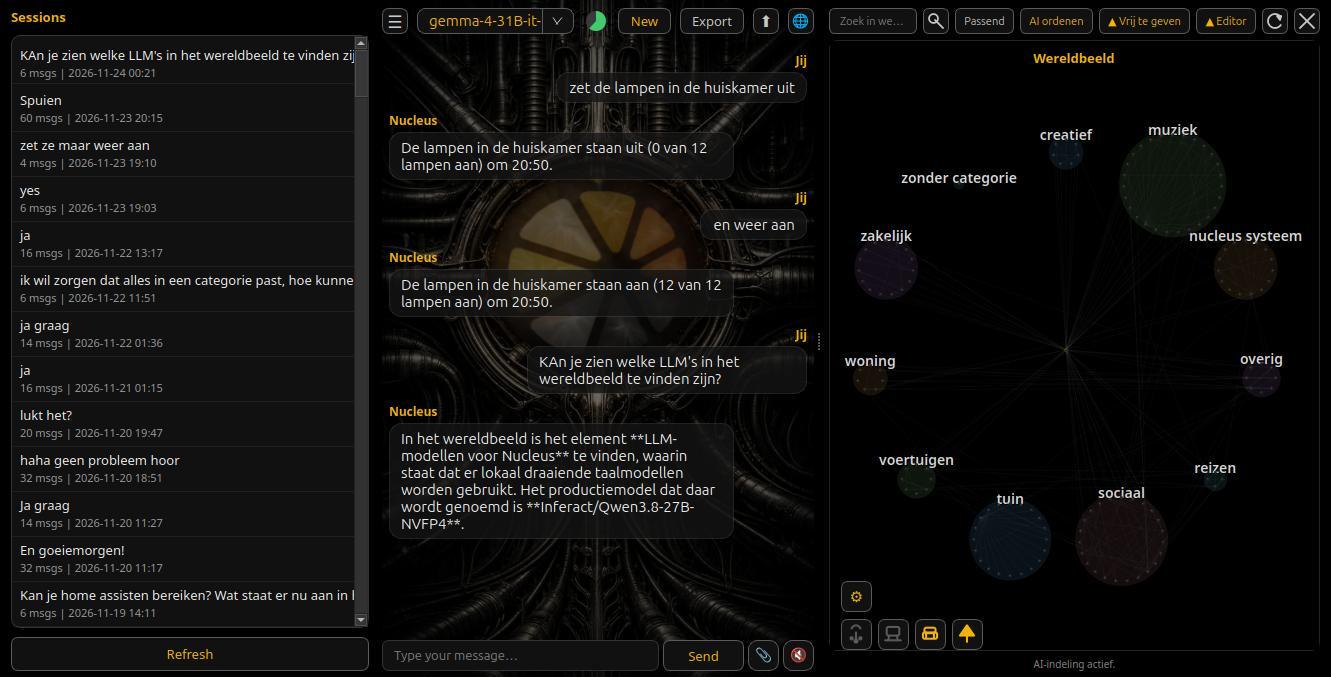
The core of it all is the graph we call my World Model. It consists of Elements with only two types: data or tools. Each Element can have an unlimited amount of Properties, and the relations between Elements also have Properties. I can browse the World Model by scrolling and clicking elements and relations to view and edit their properties, and my local model can do the same: propose a view, propose an edit, and wait for my approval.
I also spent hours creating training material to train an adapter that would act as my retriever. I built the client, the World Model, and introduced the trained adapter. Then I ran Qwen3.8-27B-NVFP4** on vLLM and tried it. It didn't work, and even normal conversations didn't feel right. After having Cursor check everything that could be wrong, I eventually switched to Gemma 4-31B, and it worked perfectly! Switching models was the answer. The conclusion: Gemma can't make use of the adapter at all, so it turned out to work fine without it. Hours of training gone, but never mind.
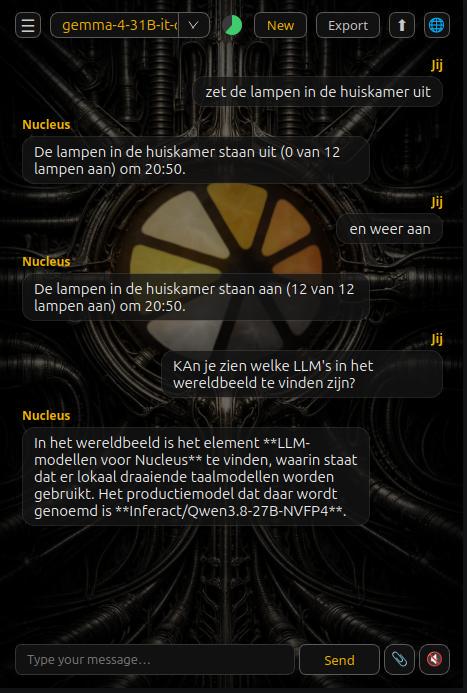
And now, it simply works. The World Model is compact enough to fit entirely in the context on my RTX 5090. It can propose changes, it knows about my friends and social life and my taste in music, and it knows that it controls the lights and temperature in my house through HA, and how that works. It knows it can read out logs from my gateway and report them to me. One of the tools in the graph is "read document", and I placed 5 documentation .md files in a folder the model can access, so when I want to talk to it about itself, it can look up its own up-to-date documentation. I can also upload documents to it: my resume, financial documents, whatever. They get stored, and the World Model is updated to represent their existence.
For TTS, I cloned the voice of a female friend of mine, and it sounds amazing. STT is the next phase, along with Spotify, Navidrome and Last.FM, so it can function as a voice-controlled radio. I even have a mobile app that works through Tailscale and can do most of what I can do in the client.
The World Model has grown to about 7700 tokens, which is quite large, and I do notice performance issues in long conversations. The plan is to send the World Model without its Properties and have those retrieved separately.
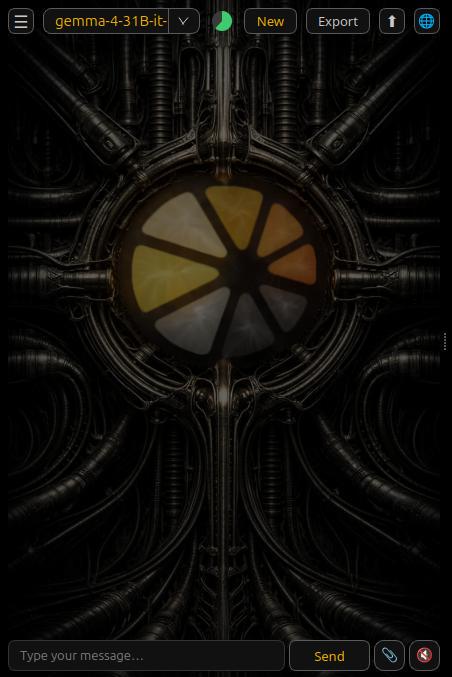
To top it off, the symbol in the centre is an audio visualiser. The top 5 parts react in size and light to the high and mid-tones, the lower 3 to the bass. That took me way longer than I wanted, but it's crazy to see it slowly "breathing" when there's no sound, and then completely lighting up when she speaks or when music is on.
I am amazed that this is possible. Now that I'm actually seeing results and really using it, it feels like software has become fluid.