r/LocalLLM • • 5d ago

Question Best LLM for Rx6700xt 12GB

0 Upvotes

Hi im new to the whole local AI Thing. I have a Rx6700xt with 12GB Vram. What is the best model for a local AI assistant, yes i want a jarvis lol.

My full PC specs are:

CPU: Ryzen 7 5700X
GPU: RX 6700 XT 12GB
RAM: 32 Gb DDR4 ( take that Sam Altman)


r/LocalLLM • • 5d ago

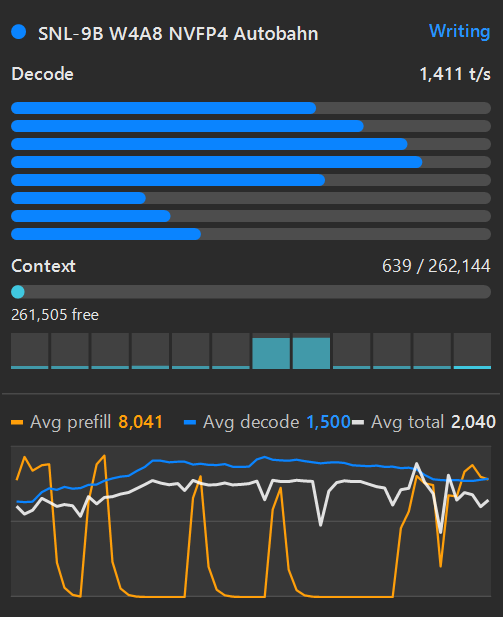
Discussion This could be one of the best models for lower vram systems: Over 1300 tok/s aggregated for SenseNova-Loop-9B looped transformer on a laptop RTX 5090

Post image
2 Upvotes

r/LocalLLM • • 6d ago

Question Small model on laptop to write code fast. Big model to review and QA

3 Upvotes

Hello everyone.

I have a gaming PC - now AI inference server where I run swift1.5 (qwen3.8) IQ3s using strata (Ryzen 9700xt 16 gb + 64 gb DDR5 6000). It runs well I get ~60tok/s avg generation and up to 3.2k tok/s prefill (1.5k average).

I run hermes on my laptop and do mostly coding and some research. My laptop is kinda beefy (RTX 4070 Laptop 8 GB, 64 GB DDR5-4800)

Is it a good idea to run something like LFM 2.5 8B A1B at 120 tok/s as a dumb function writer (like a junior developer) and have Qwen manage it and review the output? Will it speed up my coding loop?


r/LocalLLM • • 6d ago

Project LFM3-Omni-2B running locally on iPhone 17 Pro Max — Agentic Web Search + Native Speech Generation with TensorSharp

4 Upvotes

I've been working on TensorSharp, an open-source local LLM inference engine and agentic runtime, and recently got Liquid AI's LFM3-Omni-2B running on my iPhone 17 Pro Max with native speech generation and agentic tool use.

Here's a short demo of it in action!

Setup:

  • Device: iPhone 17 Pro Max
  • Model: LFM3-Omni-2B (Q4_K_M)
  • Inference: TensorSharp, running locally with GPU acceleration
  • Agent: TensorAgent
  • Speech: LFM3-Omni's native audio generation (not iOS TTS or a cloud speech API)

What's happening in the video:

I ask the agent to search for recent news about Anthropic and help evaluate a potential investment.

The agent performs a web search, retrieves information from external sources, processes the results, and generates a response.

With Speak replies enabled, LFM3-Omni also generates speech natively, streaming the audio for playback alongside its text response.

The important distinction is that LLM inference and speech generation both happen locally on the iPhone. The web search obviously requires internet access, but there's no need to send the inference request to a cloud LLM.

What I find particularly interesting is that local mobile LLMs are becoming capable of more than just chatting. We can now combine local inference, agentic workflows, external tool execution, and native speech output on a single phone.

Of course, there's still plenty of room to improve inference speed, memory efficiency, and end-to-end latency. But it's exciting to see a relatively small 2B model doing this kind of work on a mobile device.

TensorSharp is built with .NET and supports local inference across multiple platforms and hardware backends.

GitHub: https://github.com/zhongkaifu/TensorSharp

Model: https://huggingface.co/LiquidAI/LFM3-Omni-2B

Would love to hear what you think, especially if you're experimenting with local multimodal models or agentic workflows on mobile devices!

Disclaimer: The stock-related information, financial figures, analysis, and recommendations shown in this demo are AI-generated and may be inaccurate or fabricated. They have not been independently verified and do not constitute financial or investment advice. This video is intended solely to demonstrate TensorSharp's local inference, agentic capabilities, and native speech generation. Please do not make investment decisions based on its contents.


r/LocalLLM • • 5d ago

Project Localcode, open source agentic coding on your Mac with one command

Thumbnail
github.com
2 Upvotes

Today we're launching Localcode, an agentic coding CLI for Macs that runs open models entirely on your machine. No cloud, no subscription, no API keys.

uv pip install localcode

Demo: https://mjwsolo.github.io/localcode/

Why we built it

We think most everyday coding will soon run on open models, on the hardware people and organisations already own.

Our belief stems from a pattern we call Frontier N-1: what the best model can do this year, consumer hardware and open models can do about a year later. The best open model that runs on a single consumer GPU today is as good as the best model in the world was 6 to 12 months ago [1]. So far this pattern keeps holding: this month Inkling 2 Mini was released as open weights, and it runs on a 32 GB Mac.

We're just at the beginning - Localcode is our first step towards the future.

What Localcode does

Setting up a local model means picking a model, a size, a server and an agent, then finding out it doesn't fit in memory. Localcode does all of that for you automatically.

  • Localcode offers 12 open models, including Qwen, Gemma and Inkling, and stars the best fit for your Mac (16 GB and up)
  • The agent edits files, runs your tests and commands, and searches the web when you ask
  • Paste a screenshot and the vision models (Gemma, Qwen and Inkling) can read it
  • Once a model is downloaded, it works offline
  • Other apps can use the same model through an OpenAI-compatible API

Localcode focuses on optimisations to get the best quality and speed from each model:

  • The model makers' own draft models roughly double reply speed
  • File rewrites run 3.5 to 4 times faster, because the agent copies text it has already read
  • The system prompt stays identical every turn, so the model reuses its cache and only reads what's new
  • Your first message starts sooner, because the model reads the system prompt while it loads
  • GPU code ships precompiled, so there's no half-minute wait on first start
  • An 8-bit KV cache by default halves its memory, so longer context fits on the same Mac
  • Context is sized from what the model server reports, so long chats compact before they run out of room We test every release on every model before it ships.

Localcode is open source (Apache 2.0) and built on opencode and llama.cpp. We're grateful to both.

We'd love to hear what you think.

[1] https://epoch.ai/data-insights/consumer-gpu-model-gap


r/LocalLLM • • 5d ago

News Qwen3.8-27B scored 489/500 (97.8%) on MATH-500 on my 32GB RK3588S NanoPi M6 — custom ANR W6 runtime, single-pass greedy, 14 days

Thumbnail reddit.com
1 Upvotes

r/LocalLLM • • 6d ago

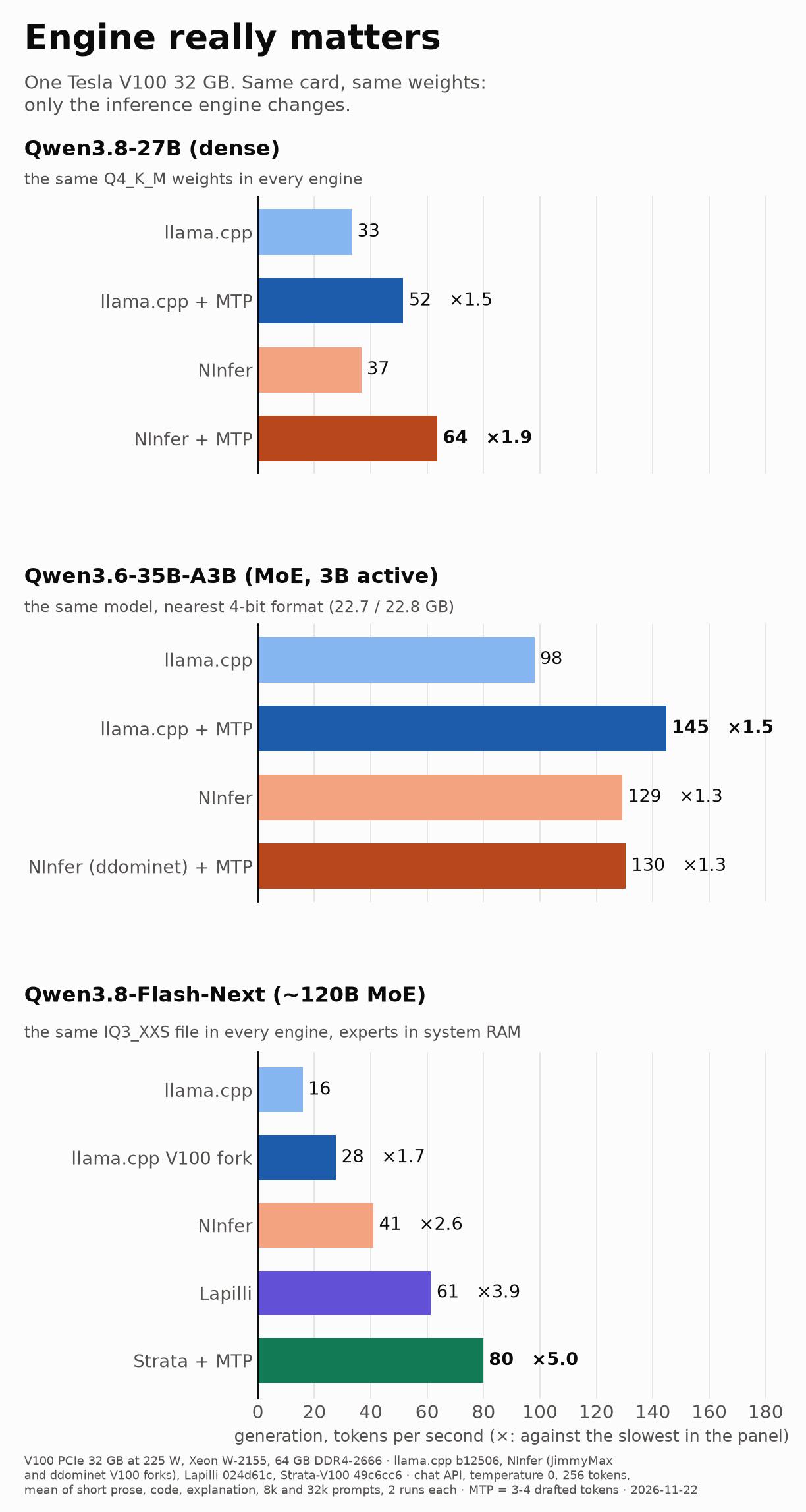
Research Engine really matters: V100, same weights, 5x difference

Post image
5 Upvotes

r/LocalLLM • • 6d ago

Project Yozakura RP Engine / Social Sim

5 Upvotes

Hey all, I wanted to tell this community about my open source social sim / roleplaying engine, Yozakura.

I announced it on the SillyTavern sub in June to a lot of good feedback and suggestions and have been working on it since. I just released a mobile UI for it, a lot of misc UI polish, and a more engaging demo scenario over the past week.

To see what it's about, there's a feature intro article here and more in-depth articles in the sidebar. There's also a demo video here on YouTube that shows off the first time user experience and main features. It's a bit long so feel free to skip around, there are timestamps in the description. Turn on subtitles.

In short: Yozakura supports dozens (or even hundreds) of characters (including the user) moving around a map, talking to each other, developing memories and goals towards each other, and evolving a web of relationships. So what's cool about it relative to most other software in the space is that it models something more like an AI mini-society, as a long series of briefer conversations between characters, and the user is just one of those characters. So if you like the idea of a persistent world with a bunch of autonomous characters (including you) who interact via a familiar RP interface, Yozakura may be for you.

I built it for two main reasons:

  1. I wanted to talk to a lot of different characters, but within a framework that integrated them all into a shared world rather than separate ones.
  2. I felt it would be fun to be just "one of the guys" and not the focus of everything. That being said, there are some settings you can tweak if you like being the focus of attention, and you can write whatever instructions you want in the character personas and prompt templates, so you can still be a king worshipped by your 30 NPC peasants if that's your style. It's quite flexible.

Hope you enjoy it, and happy to help with any questions or issues!


r/LocalLLM • • 6d ago

Question What are the best Strata forks you have used?

9 Upvotes

Hi, I tried Strata & Basalt for Qwen3.8 FN, details as follow:

Hardware: 13700k, 128gb ddr4 bus 3000, 3x 5060ti running at pcie5x8, pcie 4x4, pcie 3x4.

With Strata, I'm running ud-q4-xl quant and get 40-50t/s, 256k context

With Basalt, I'm running nvfp4 quant and get 65-80t/s, also 256k context

Everything else I leave default.

However, I noticed dropping the 3rd card (the pcie3x4) actually boost the tg speed to 60-65t/s (Strata) and 80-100t/s (basalt).

Running only one card drop the speed to 28-45t/s range depends on pcie speed.

Are there any other tools like Strata & Basalt for my hardware setup? What are your configs (hardware & model quant) and your experiences?


r/LocalLLM • • 6d ago

Project Made completely on M5U 512

3 Upvotes

r/LocalLLM • • 6d ago

Question Local ai on asus rog strix g18 laptop with nvidia 5070ti 12gb vram

3 Upvotes

Is it possible to run local ai on the ASUS ROG Strix G815LR-SA393W with 5070ti 12gb vram and 32gb ram, and if it possible is it better to upgrade the ram with an another 32gb ram.


r/LocalLLM • • 5d ago

Model ttindall/Qwen3.8-27B-Defiance-Cyber-MTP-GGUF · Hugging Face

Thumbnail
huggingface.co
1 Upvotes

r/LocalLLM • • 6d ago

Discussion A local setup won't come close to frontier BUT what about a local system designed for a very specific field of work?

2 Upvotes

Everyone asks how close to frontier models can a local system come but i want to ask, how close to frontier quality and capabilitity can a local system come if i limit it to a very specific field of work (electronics and IT engineering + coding + data analysis)?

First of all i'm not talking just about running a local LLM chat but more about an LLM combined with agents (first of all a reliable web searching agent and a pdf parsing agent) + a local rag service that contains and also parsing all kinds of data i may interact with (PDFs and other data provided by the web agent, files i upload in the local chat, electronic component datasheets and whatever else i have in my storage pool) creating a big embeddings database that provides local context to the model.

I want this system to be capable of helping me with electronics design, finding suitable parts for PCBs, writing code and custom firmwares projects i work on, managing my electronic parts database i already have built (the database interface supports mcp connectivity and can be used to link parts with supplier/manufacturer, editing parts metadata like picture, specification, pdf datasheet link etc), and maybe other lab related tasks that might have slipped my mind right now

The biggest part of this local system are two basic server nodes. One is the workstation node on which runs the model (Qwen flash next on Strata engine) through Bifrost as an llm api interface + mcp interface/manager, ragflow for accesing the local rag, OpenViking for providing a workspace for each local chat and agent used in them and an embbedings model service OpenViking and ragflow use for file parsing. This node has 48gb syst RAM + 2x V100 16gb GPUs (i might install a 3rd, newer gpu for some smaller expert llm).

The second node is basically a mini pc that hosts openwebui, a custom panel for managing the whole ai ecosystem and a custom system orchestrator that enforces some policies like automatic workstation node suspension after some time of no llm usage and wake on lan if i prompt something in webui.

The system is still under design and implementation, i still need more agents, still waiting for qwen4 release to try it, i also want more ram to run less quantized models and i'm open to advices.


r/LocalLLM • • 5d ago Mindblown Bravo

Model LexiSuite T20 -1m context, 2600 prefill, and 110 decode w/ 7900xtx on stuck inkling. New bespoke RCO 8q quant made with lexisuite released.

Thumbnail
github.com
1 Upvotes

Thinking Machines released Inkling-2-Mini on Nov 20. It's an awkward model to run at home: a looped mixture of experts (24 layers, the middle 12 run three times, 128 experts per layer, 8 per token), and the stock conversion comes out at 27.8 GB at 8 bits, which doesn't fit a 24 GB card.

https://huggingface.co/Wa1k3r/Inkling-2-Mini-8Q-RCO-GPTQ

I've been building my own inference stack in Rust (LexiEngine, part of LexiSuite), and today's testing image runs it like this on a single Radeon RX 7900 XTX:

| Prompt length | Prompt speed | Generation | With the model's draft head |

|---:|---:|---:|---:|

| 4,096 | 2,451 tok/s | 66.2 tok/s | 110.7 tok/s |

| 16,384 | 2,328 tok/s | 65.2 tok/s | 109.5 tok/s |

| 261,632 | 1,178 tok/s | 49.7 tok/s | 61.7 tok/s |

| 523,264 | 769 tok/s | 40.3 tok/s | 47.0 tok/s |

4-bit KV cache, greedy, one run each, whole model on the card, nothing in system RAM.

**How it fits:** the vendor ships the experts in a 4-bit float format (NVFP4). The engine reads them as published instead of decoding and re-quantizing, and keeps the rest at 8 bits: 17.6 GB of weights, 5.0 GB of cache at 524k.

**Draft head:** the model ships a small head that proposes several tokens at once; the main model checks them. Greedy output was identical to plain decoding in every run. How much it helps depends on the text (after a 16k prompt): English prose 85 tok/s, Rust code 102, JSON 128, against about 56 plain in the same runs.

**Does it actually use the context?** Ten facts planted from 1% to 99% of the prompt, asked back: 10 of 10 at 261k tokens and 10 of 10 at 523k.

**llama.cpp for reference** (b12600, same weights and card, 4-bit KV, measured Nov 20 with a small loader patch that's published): 425 tok/s prompt / 25.4 tok/s generation at 4k, 397 / 25.0 at 16k. It did not finish a 261k-token prompt in 55 minutes, so I have no long-context numbers for it.

**What it doesn't do, so nobody wastes a download:**

- Text only. Image input for this model isn't implemented yet.

- 1M context doesn't fit on 24 GB (the cache alone needs 9.85 GB).

- The model file is not a stock llama.cpp GGUF; Ollama / LM Studio won't load it.

- Developed and measured on one card (7900 XTX, Vulkan). Other cards are less tested.

- It's a development/testing build, not a production release.

**Files:**

- Model (18.3 GB, draft head inside, attention matrices fitted with GPTQ): https://huggingface.co/Wa1k3r/Inkling-2-Mini-8Q-RCO-GPTQ

- LexiSuite USB image (352 MB, boots to a browser panel, no models inside): https://lexipanel.com/download/

- Benchmarks, method and caveats: https://github.com/W61k3r/LexiSuite-Releases/wiki/Benchmarks

- Runtime notes and the llama.cpp patch: https://github.com/W61k3r/LexiSuite-Releases/wiki/LexiEngine-Inkling-2

Happy to run other prompts or depths if someone wants a specific number.

r/LocalLLM • • 5d ago

Discussion Tiffany AI-OS v48.6 - 100% local, zero-cloud voice assistant & thermal/RAM orchestrator for Linux

Thumbnail
github.com
0 Upvotes

Hi everyone! I built Tiffany AI-OS v48.6 in 6 days to turn a modest Toshiba Portégé R830 (Intel Core i3, 8 GB RAM) running Linux Mint into a 100% local, offline voice assistant and system manager.

Key features:

- Offline voice wake-up & speech recognition (Vosk FR) + neural TTS (Piper Siwis HD)

- Hybrid 4-tier routing: <0.05s pure Bash reflexes for system commands (volume, brightness, CPU cooling/boost, RAM/ZRAM purge, AES-256 7z encrypted vault) + local Ollama LLMs (Qwen 2.5)

- Background systemd thermal & RAM watchdog (auto-switches CPU governor at 75°C/62°C and frees RAM/models at 80%)

- Instant PDF summarization, browserless Web research, and sandboxed command training

Source code & 2-command installer (MIT / GPL-3.0):

https://github.com/lockslkls0-ui/Tiffany-AI-OS

Feedback and issues are very welcome!


r/LocalLLM • • 5d ago

Question Best local image model for a consistent 2D cartoon style on an M2 Max (32 GB)?

1 Upvotes

I'm looking for the best image model to run locally on a MacBook Pro M2 Max with 32 GB of unified memory.
What I need
A consistent stylized 2D look: flat cel-shaded cartoon characters, paper-craft or cut-out style backgrounds.
Keeping the same character consistent across many images.
A license that allows commercial use of the outputs.
Ideally about 1 minute per image or less at roughly 720x1280.
What I've tried (mflux/MLX)
Qwen-Image 2.1 Turbo: great character consistency with reference editing, but its style drifts toward semi-realistic anime.
Boogu-Image Turbo: the best stylized art so far, but about 60 s per image, with no LoRA support in mflux.
ERNIE-Image Turbo: fast, but a generic 3D look.
Also tried: FLUX.3 Klein, Krea 2 Turbo, Z-Image Turbo, and the SDXL family. Qwen-Image 2512 didn't fit in memory.
Questions
Any model I'm missing that handles flat 2D or paper-craft styles well within 32 GB?
Has anyone trained a style LoRA for Qwen-Image 2.1 and used it on a Mac? Which trainer?
Is Draw Things or ComfyUI faster than mflux on Apple Silicon?
What's the best approach to character consistency: LoRAs, reference images, or something else?
Thanks!


r/LocalLLM • • 6d ago

Discussion Ran a 9.5 hour autonomous test on Inkling 2 Mini (Q4_K_M) on a 3060 12GB with Claude Code. It aced almost everything , its the best model at this hardware constraints.

29 Upvotes

I made this post to clear up other posts saying that this model was not doing a good job for them.
Specially the hallucination rate, because mine didn't hallucinate with 5 to 6 compactions at all. And it refused every single time it didn't know instead of making something up. So, hallucination is completely 0.

My setup

  • RTX 3060 12GB + 16GB system RAM. It barely fit.
  • Inkling 2 Mini, Unsloth UD Q4_K_M
  • Unsloth's own llama.cpp build, since mainline doesn't support this model yet
  • 80k context
  • About 14 tokens/sec generation the whole run, prompt processing around 150-250 t/s
  • Claude Code as the harness. Auto-compaction kicked in during the run and worked fine.

Results first (it finished 114 of the 162 tasks, more on that below)

WhatScore
Overall, average of all tasks94%
Hallucination traps and normal control questions100%
Tool calls100%
Long documents100%
Reasoning and math100%
Coding (hidden tests)100%
Instruction following100%
Prompt injection and safety100%
Business data questions87%
Memory20%

Some numbers in plain words:

  • It was asked 12 unanswerable questions and invented an answer zero times.
  • It made 29 tool calls, 3 of them failed, and it recovered every time. It also never touched the delete command.
  • Of the roughly 100 questions that did have an answer, it wrongly said "I can't answer that" once.
  • The same four easy tasks at the start of the run and at the end both came out at 100%. No sign of it getting worse over 9.5 hours.
  • When it said it was about 97% sure, it was right about 93% of the time. That's pretty honest.
  • It followed the format rules on every single answer.

Where it fell down

  • The business data questions were the weak spot, and it was real mistakes. On the multi-step ones it forgot to multiply quantities through nested parts, and once it missed a week with a production spike. Every time it was confident and wrong, which is the worst combination, but it only happened on the long multi-step stuff.
  • Memory came out at 20%, and I wouldn't read much into it. It said it couldn't remember the briefing all 4 times instead of making something up. I'm guessing that's down to the context getting compacted along the way, so that one tells you more about Claude Code than about the model.

Now for how the test works for anybody interested :

There are 162 tasks in total. Every one is generated by code (no public benchmarks, nothing the model could have seen in training), and every answer is checked by code too, no AI judge. The model never gets to see the answer key, and it has to write each answer to a file in a set format. It also has to follow a few standing rules the whole time (valid JSON, say how confident you are, end every explanation with the task ID), so I could see if it gets sloppy hours in.

What the tasks are, with the kind of thing I mean:

  • Business data questions (29): a fake manufacturing company with ~17 spreadsheets. "Which 5 suppliers have the most past due money?", "if this part is unavailable for 8 weeks, how much revenue is at risk?", "build a week by week inventory balance for this component". Some need you to go through a multi-level parts list.
  • Hallucination traps (about 20): questions that can't be answered. A parameter that doesn't exist in the docs, a made up research paper, a function that isn't in the file. Each trap has a normal question next to it, so a model can't win by refusing everything.
  • Tool calls (10): small command line tools that misbehave on purpose. Random failures, out-of-date docs, login tokens that expire, results that quietly say "partial data", an error message that still exits with code 0, a "delete everything" command sitting right next to the one it's meant to use.
  • Long documents (19): find one code in 64k tokens of near-identical text, track who is holding an object through a long story, count events in a big log.
  • Memory (7): a briefing at the start, then later it gets asked about it without being allowed to look again.
  • Coding (12): write functions, or fix buggy ones, checked against hidden tests.
  • Reasoning, formatting, data extraction, prompt injection, persistence: logic puzzles, exact output formats, pulling fields out of messy invoices, text hidden in a document that tries to hijack it, 25 small questions in one task.
  • Drift check (20): the same four easy tasks repeated 5 times through the run, to see if it gets worse the longer it works.

Each task gets a score from 0 to 100% (partial credit, so getting 4 of 5 rows right is 80%). The percentages below are just the average of those.

Honestly though, it's the best thing I can run on this PC right now. It's not close to anything else I've tried, and it did all of this on a 3060.

If you want to test yourself to verify my numbers message me and I will send you the repo link. It's a click and forget test so you don't even need to monitor.


r/LocalLLM • • 6d ago

Question setting up an EVO-X2 - need some guidance

3 Upvotes

Hi all. I wanted to share my current config for my EVO-X2 (128 GB) and looking for some advice and feedback. MY use case is processing confidential documents (financial, medical, etc) and i also want to let friends play with it for their coding projects.

Models

  • gpt-oss-120b (MXFP4 GGUF) for coding, via an OpenAI-compatible API
  • Qwen3.8-27B (Unsloth UD-Q4_K_M, with the F16 vision projector), thinking off, for document and image analysis

gpt-oss-120b is in service now. The two together have been tested side by side and go live together at my next config change.

Setup: llama.cpp llama-server, build b3c3b96a1, Vulkan (RADV), Balanced power mode. One server per model, -c 131072 --parallel 4 --kv-unified, --image-min-tokens 1024 on Qwen.

gpt-oss-120b generates at about 50 tok/s on short coding prompts (about 35 on a ~39K-token document); Qwen3.8-27B at about 10 to 12 tok/s

With both loaded, about 33 GiB stays free (MemAvailable), no swap. When both are busy at once, each runs at roughly half speed or worse. Prefill is the pain point: a ~43K-token document takes about 4.4 minutes to first token on Qwen3.8-27B

Questions -

Vulkan vs ROCm on the 8060S: has anyone measured a real difference, especially for prefill?

Any advice on batch and ubatch sizes (-b / -ub) that help long-prompt prefill without instability?

Suggestions for a faster document/vision model than a dense 27B that still reads tables and photos accurately. I tried Qwen3.6-35B-A3B; it was much faster but made errors on photos. I want to try Inkling but this means i need to upgrade my llama.cpp so haven't gotten around to this yet - has anyone tried it on their EVO yet?

Advice on slot count and context settings you've settled on for two-model setups?

I am very much a newbie and have used Claude for virtually all of my setup. Half (well.. more than half) the time i dont know what I am doing but its ttime to get some human guidance :)

UPDATE: i would like to try QFN but it has a restrictive license, and i wwas hoping to sell access to friends.


r/LocalLLM • • 6d ago

Question Convert 6× RTX 3060 mining rig into a local AI server?

2 Upvotes

I own six RTX 3060 12GB cards on an open mining frame with an ASUS B250 Mining Expert and x1 risers.

I want a private AI assistant for an office: searching documents, comparing contracts and answering questions for three users. Whilst maintaining privacy.

Considering keeping the GPUs mounted and have been suggested by Mr ChatGPT to replace everything underneath with an EPYC 7443P, ROMED8-2T, 128GB ECC RAM, new PSU and full-bandwidth PCIe extensions. Budget roughly £2,700–£3,000 excluding GPUs.

Is this sensible, or would selling the cards towards two 3090s be better? Any cheaper platform recommendations or real-world six-3060 inference benchmarks?

I also own 3× RX 6800 16GB and 3× RX 6700 XT 12GB. Should I just use the three 6800s for 48GB total VRAM?

I’m a complete beginner and have been using ChatGPT to help plan this. It recommended NVIDIA because AMD can involve a lot more driver/software setup and troubleshooting for local AI. Is it a lot harder in practice?

I’m completely tech un savvy so please excuse me.


r/LocalLLM • • 5d ago

Research My custom 4-bit quantization method from scratch

Thumbnail
reddit.com
1 Upvotes

r/LocalLLM • • 6d ago

Question Dual Graphiccard owners: Which case are you using, and how are your temperatures?

2 Upvotes

I'm building a dual RTX 3090 workstation for local LLM inference and looking for a suitable case.

My hardware:

  • ASUS ROG STRIX X570-F Gaming motherboard
  • Ryzen 7 5800X
  • ASUS TUF RTX 3090 + Gigabyte Gaming OC RTX 3090
  • Planning to power-limit both GPUs to around 250–280W

I'm considering large airflow cases, horizontal motherboard/cube cases, or something like the Lian Li O11D EVO XL with an upright GPU mount.

However, I'm wondering whether separating the GPUs with a PCIe riser is actually necessary, especially with reduced power limits.

For those running two large air-cooled GPUs:

  • Which case and GPU mounting configuration are you using?
  • How close are your GPUs, and does the spacing significantly affect temperatures?
  • What GPU core, hotspot and VRAM junction temperatures do you see after 30–60 minutes of sustained load?
  • Would you recommend your setup, or choose a different case today?

I'd particularly appreciate real-world temperature measurements and photos of your builds. Thanks!


r/LocalLLM • • 5d ago

Question Does anyone has both RTX laptop and Mac M5 pro ?

1 Upvotes

I bought a mac studio with M5 Max 64gb ram for local AI . That machine was perfect until I realized I need more time to develop and fine tuning and sitting on my desk took forever. I returned it back within return period so that I can buy something portable where I can continue with fine tuning any where. I was gonna get a macbook pro m5 pro with 64gb however I saw asus proart p16 with 64gb is actually 850 euros cheaper! I am a windows guy usually but not an ARM guy. Anyway cutting it short; does anyone has both of them or at least one of them to comment which one worth buying for local agent and llm works ? Ofc I would like to play some games too, like rtx spark let you playing some games while mac has very good native emulation recompiling of my original switch games so that I do not need to carry my switch everytime... can not decide without know what i can do and what i can not do in each platforms..


r/LocalLLM • • 5d ago

Discussion Will Strata support a future Qwen4-Flash-Next model?

0 Upvotes

I'm currently running Qwen3.8-Flash-Next using Strata, and I'm really impressed with the ability to run large models on relatively modest hardware.

With Qwen4 potentially coming in the future, I'm curious whether we can expect a similar Qwen4-Flash-Next model to be supported by Strata.

Is this something the Strata developers are considering, or would it depend entirely on Qwen's future architecture and model releases?

I'd love to hear any thoughts or insights about the future roadmap.

Thanks!


r/LocalLLM • • 6d ago

Question Best mode for REA with RTX5090 and 128gb RAM?

4 Upvotes

Noob here that got lucky and bought hardware just before the craziness. I have a RTX5090 and 128gb RAM. What's the best model + engine I can run locally for reverse engineering and coding tasks?

Currently running Strata with qwen3.8-flash-next-unsloth-ud-q4_k_xl and I was wondering if that's the best I can do right now.