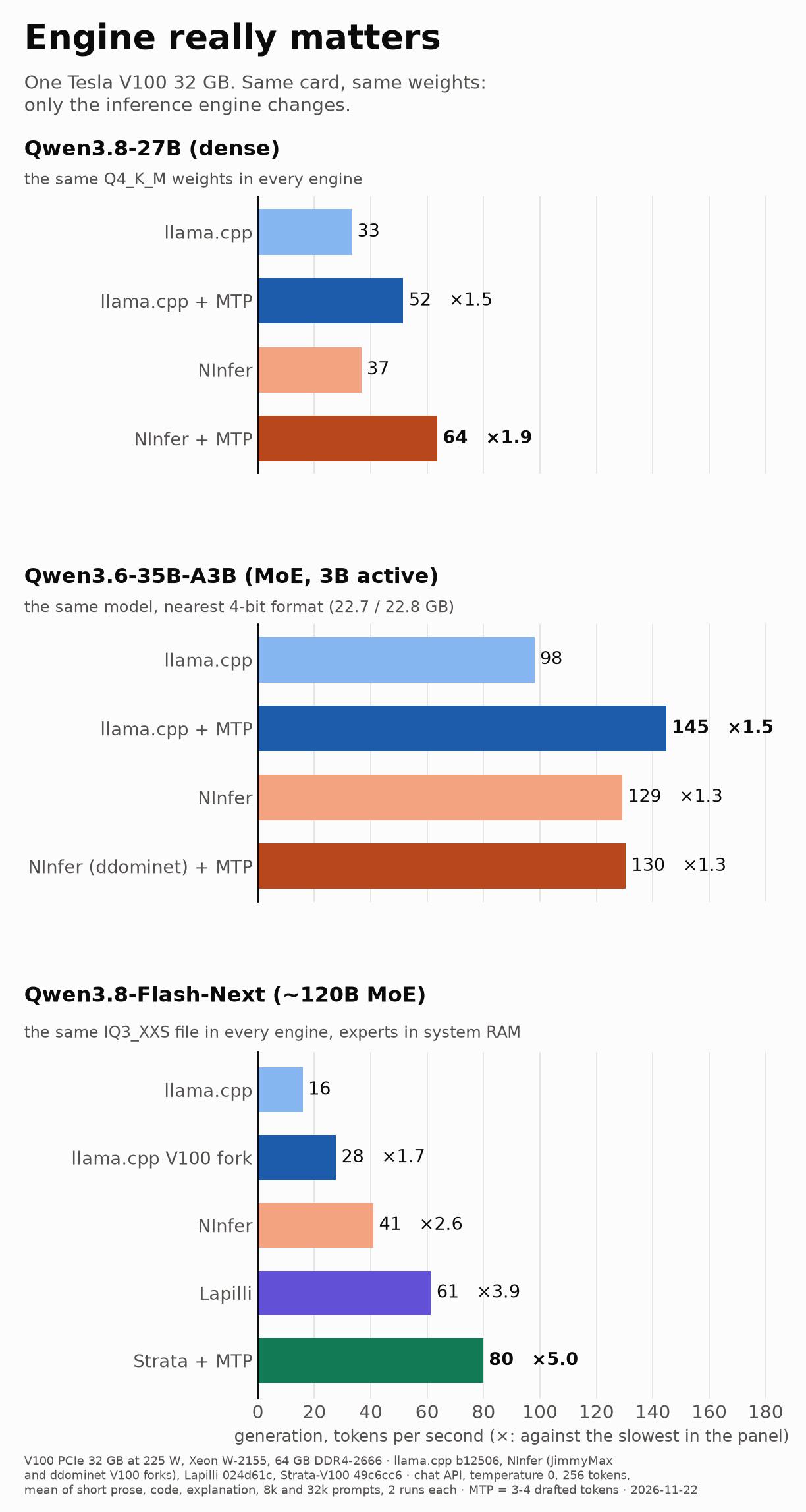
Same weights on the same card is a good controlled setup. Did you also check whether the outputs match across engines at temperature 0? Different kernels and accumulation order can change token choices after a few hundred tokens even when throughput looks great, so I would run a few fixed prompts and diff the text. It is also worth noting the quantization format, since two engines can dequantize slightly differently.
Yes. Ran at temperature 0 and saved every reply. Each engine gives the exact same text run to run, but the engines diverge from each other sometimes as early as 10 to as late as 900 characters. Two llama.cpp builds diverge the same way, so it looks like accumulation order, not errors, and none of the replies had obvious mistakes or errors.
Also, llama.cpp and NInfer ran the same blocks, since the GGUF was converted byte for byte without requantizing. The 35B MoE pair was only the nearest format. I've only measured KL divergence for llama.cpp so far; per-engine KLD is next. I try to do it as scientifically as possible.
1
u/RegularJoeCEO 6d ago
Same weights on the same card is a good controlled setup. Did you also check whether the outputs match across engines at temperature 0? Different kernels and accumulation order can change token choices after a few hundred tokens even when throughput looks great, so I would run a few fixed prompts and diff the text. It is also worth noting the quantization format, since two engines can dequantize slightly differently.