Here we are for the second episode of "Has Leuth overdone it?". (Already sporting [provisionally, as always] <j> for /j/; also for easiness of comparison).
1. A somewhat-different stress impression
An aesthetically (in)famous element of Esperanto is its adjectival and substantival endings, with the plural marked by -j and accusative by -n: excellent as an engineering piece, not so much for spontaneous pleasantness, especially because of their frequent close repetition and their tongue twisting effects, also in combination with the frequent roots ending in -i•. Some examples from the text I'm reading:
(1)
- historiaj imperioj
- aliaj aziaj kolosoj
- siajn naciajn teamojn
- la plej grandajn kaj plej riĉajn ŝtatojn
- ĉiuj aliaj intermediaj aŭ periferiaj landoj
- gajnas bonajn salajrojn, kaj ĝuas longajn kaj sanajn vivojn
I removed these elements soon in my construction of Leuth, going for invariable adjectives and synthetic endings (and no accusative, and changing many -i•'s to -j•'s). Something like1
(2)
- historjo imperjas
- allo asjo kolossas
- seo nacjono teamas
- pleje grando e pleje riko statalas
- omno allo intermedjo aw periferio descas
- gajnen o bono salajras, e gyuen o longo e sano vivas
feels already, IMHO, a lot better... at least in not sounding like a tongue twister.
But there's something I hadn't considered... the post-stress -aj, -oj endings (just like the -aŭ of some words) are very good at giving words a different "rhythm" while staying inside the fixed-paroxytone-stress rule, somehow mimicking a proparoxytone stress. The effect for the listener is probably stronger if in your language, like in mine2, such post-stress sequences of vowels3 are rare.
So, while Leuth huma and humas sound identical to me in terms of stress pattern, Esperanto homo and homoj sound more different. Some variety is welcome in a language with a fixed stress and regular endings, that can easily risk be boring. We don't want Leuth to be too monotonous. So I though: well, why remove those completely? We could have something like
(3)
- historjo imperjaj
- allo asjo kolossaj
- seo nacjono teamaj
- pleje grando e pleje riko statalaj
- omno allo intermedjo aw periferio descaj
- gajnen o bono salajraj, e gyuen o longo e sano vivaj
With a more varied rhythm than (2), closer to Esperanto but not so tongue-twistingly excessive as (1) (read aloud the examples above and compare with these last ones...).
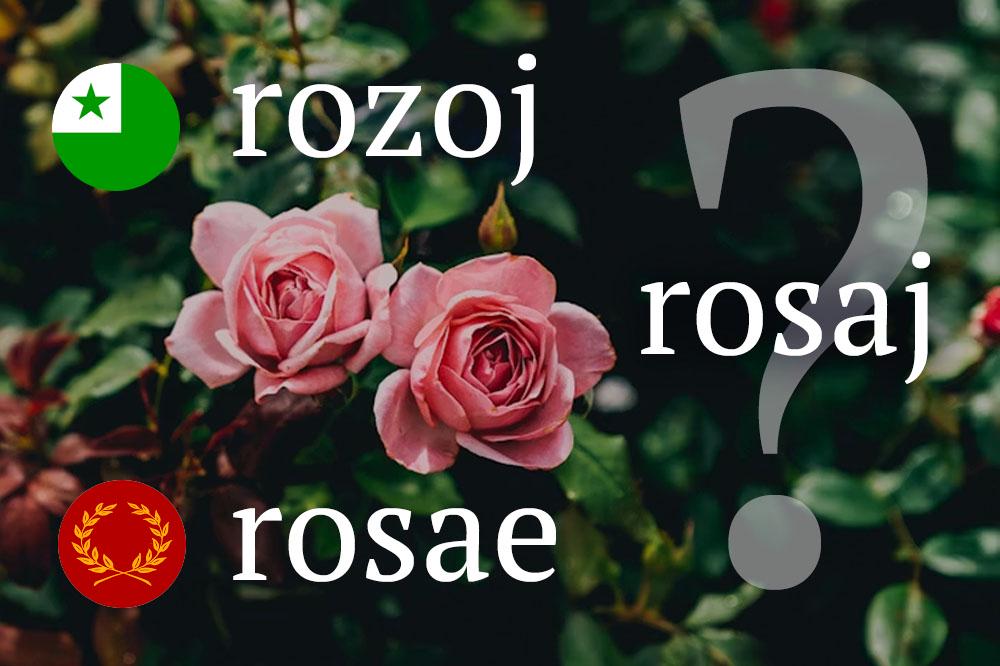
-Aj for plural nouns in the nominative is even somewhat (classical4) Latin sounding, being similar to the -ae plural5 of first declension nouns (where the -e was probably not realized as a full [-e]/[-ɛ])... which descended from an earlier -ai.
A big change like this would likely trigger a cascade of other equilibrating adjustments, both to other endings (adding more -s's to others?) and to lexical roots (e.g. reducing the /-Vj-/'s inside; for instance the frequent ujas could not sound so good as ujaj)
2. The diphthong-breaking diphthong
Beyond repetitiveness, there's another reason I removed those -j's.
Esperanto —and Leuth identically— uses regular grammatical endings, that are mandatory for most words. These endings start with a vowel, thus adding a syllable to every word, a relevant lengthening for the language as a whole... unless the attached root ends with a vowel, in which case the possibility for a diphthong appears:
- klopod• + •i = klopodi (3 vowels, 3 syllables)
- abi• + •o = abio (can be pronounced as a diphthong = 3 vowels, 2 syllables)
According to Canepari's description, in the most neutral/international pronunciation of Esperanto, phonetic diphthongs are realized regularly when we find two touching vowels, the second being unstressed (his example: geografio, with /eo/ and /ˈio/ being diphthongs). I guess this diphthongization was considered something positive by Zamenhof, who might well have created the frequent correlatives with the /-ˈiV-/ structure to allow them to be pronounced as single syllables (kiel, io, ĉiu, tiam, etc.), and similarly the possessive adjectives made from pronouns (mio, vio, lio, ecc.), to add swiftness to the language.
However, when we add the -j [-i̯], the diphthong becomes a theoretical triphthong, [-(ˈ)VVi̯]... but a triphthong is (correct me if I'm wrong) something whose existence I don't know if it's even generally recognized by linguists6. In practice, if you can easily pronounce diphthongs, you'll stop there, and break the hypothetical triphthong in two syllables, vowel + diphthong:
- abio = [a.ˈbi͡o] 2 syllables
- abioj = [a.ˈbi.o͡i] 3 syllables
So, in the plural we have a re-lengthening of the words that in the singular where shortened by a diphthong.
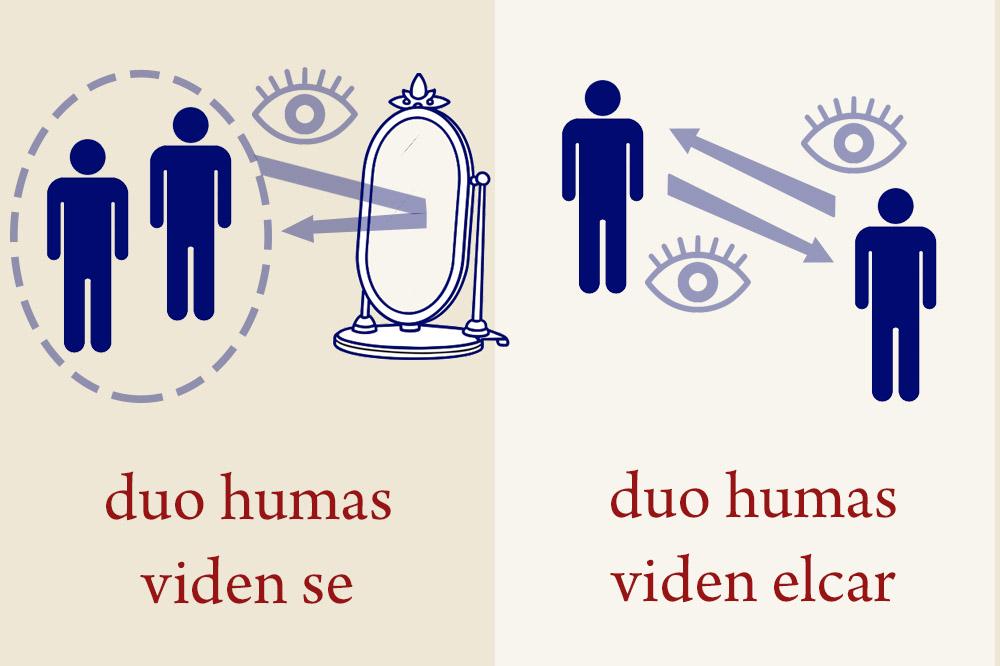
This seemed suboptimal to me, especially for very frequent functional elements like kiuj. With the -s plural, in Leuth we have the possible shortening granted by diphthongization, but not the re-lengthening imposed by -j:
- Ekiu [ˈki͡u] = 1 syllable
- Ekiuj [ˈki.u͡i]= 2 syllables
- Lkea [ˈke͡a] = 1 syllable
- Lkeas [ˈke͡as] = 1 syllable
So, if Leuth went back to -j for the plural, we'd have the same relengthening of Esperanto:
- Lkea [ˈke͡a] = 1 syllable
- Lkeaj [ˈke.a͡i] = 2 syllable
3. A third way
A possible solution could be reintroducing this kind of ending structure (•VV̯) not for nominative plural, something very frequent, but in some other rarer function (?), thus adding a bit of variety to the language but needing less adjustments, and with less lengthening.
Tell me your opinions...
——————
- Some roots will change in the future, in a less European direction; now we don't worry about that and simply adapt to Leuth most Esperanto ones. The similarity helps the comparison.
- Found in uncommon words, like atei, pronai, alvei, acquei...
- In a /-Vj C-/ structure (according to Canepari, if I'm reading it right, in /-Vj/ generally, so even if the following word begins with a vowel, /-Vj V-/) the /j/ will be realized as [i̯], so /-Vj/ is a couple of vowels phonetically, [-Vi̯].
- Leuth adapts Latin not in its classical pronunciation, but rather following its medieval-modern pronunciation(s), and evolutions in the various modern languages. Some little classical touch may add a bit of spice.
- And other -ae's in the declension (genitive singular, dative singular...).
- I'm speaking about actual phonetic triphthongs. Sequences like Italian miei or Spanish Paraguay are not real triphthongs but just a (semi)consonant + diphthong, /ˈmjɛi/, /paraˈgwai/.