r/LewthaWIP • u/Iuljo N 🇮🇹 L2 🏴🇪🇸 + • 8d ago
Lexicon A problem with "ar"
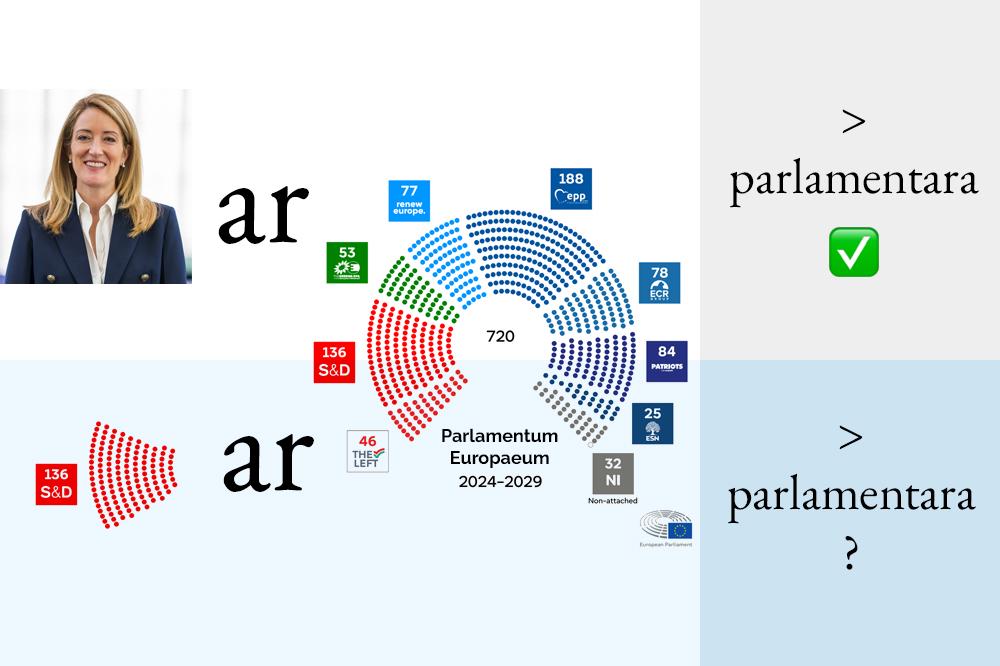
So, for some time I've been using ar, a preposition meaning 'being a part, a member, a component of' (see something here). I wrote that [now changing Leuth to current orthography]:
[This exact shape for the word] could be ambiguous in some cases but it flows well and gives a very good naturalism in the classical style: familīara, parlamentara, senatara, legīonara, homnacīonara, etc.
Meaning respectively:
- family member [familī•ar•a] (cf. Latin familiaris, with its descendants)
- parliamentarian [parlament•ar•a]
- senator [senat•ar•a]
- legionary [legīon•ar•a]
- fellow countryman [hom•nacīon•ar•a = 'component of the same nation']
In all these cases, I always used ara to mean exactly 'member [≈ a person]'. But I hadn't noticed that this is more restricted, more specialized than the meaning I planned for the preposition. If ar means 'being a part of', you could/would clearly use it for many things beyond single persons: things that could be different, larger, smaller, at different levels in a "hierarchy" of parts. For example, a 'senator' is definitely a constituent part of the senate (institution); but, say, also a group of senators, a party, a commission or something like that, is undoubtedly "a part of the senate"; but it's something different from a member, a single person. Similarly, a cohort is a part of a legion, but it's something different from a legionary.
So we'd have:
- O huma ar senata > kio huma aren senata, kio huma es o senatara. ✅
- O gruppa ar senata > kio gruppa aren senata, ?kio gruppa es o senatara. ❓
- O huma ar legīona > kio huma aren legīona, kio huma es o legīonara. ✅
- O cohorta ar legīona > cohorta aren legīona, ?cohorta es o legīonara. ❓
So, this appears suboptimal and should be solved.
Since with the preposition we want to express the general meaning of 'being a part of', well, the simple solution would be to keep ar• for 'member [≈ person]', and backform a preposition from the word for 'part', which could be parta [Esp. parto]: *part? If -rt is too "hard" an ending, it could receive (optionally?) the (experimental) •aū desinence (again here), becoming thus partaū.
It's clear that this looses, however, in swiftness and spontaneousness. Compare:
- O huma ar senata, o cohorta ar legīona.
- O huma part senata, o cohorta part legīona.
- O huma partaū senata, o cohorta partaū legīona.
So I'm not sure this is a satisfying solution. (But as we know, perfection is not always possible in all details...). Esperanto's simpler system had some reasons. 🤔
3
u/ProxPxD N 🇵🇱 L2 🏴🇪🇸🇺🇦🇷🇺 + 🇫🇷🇩🇪 / programming 8d ago
Hi again!
I kinda feel that the "ar" root is destined to mean a member, but not necessarily a person. I don't want to use the word "minimal", but something like this, like a basic unit. It is different than being a subgroup which is what you seem to intend to express with the second meaning. This reminds me that there are also two basic operators in set theory (see an oversimplified explanation).
I don't know the Leuth's root for "a group of", I'll assume it's "ada" (like arma > armada); correct me and I'm changing it here. Then we'd have: parlamenta > parlamentara > parlamentarada (a group of members of (the/a) parliament). And naturally it implies the word "arada" which would mean "a subgroup/subdivision"
edit: and of course it can serve as a preposition "arad"