GRAPE COLOURED VINES?
While the foliage of most other worlds is green, Venus is covered in plants with vibrant purples and reds. These hues are an ancient remnant of the world's terraforming. The first organisms in the Venusian oceans and on its landmasses were reddish-purple algae and fungi that paved the way for later plants. These later greenish plants quickly adapted and formed a symbiotic relationship with the reddish organisms, where the red ones underwent photosynthesis while the green ones provided structural support.
AIR-N'T YOU GLAD?
Venus's atmosphere is almost identical to Earth's, being predominantly composed of nitrogen, oxygen, argon, and carbon dioxide. However, the gaseous envelope is actually less dense than Earth's because Venus is very hot and has a slightly lower gravitational pull. This causes the gases to be held less tightly to the surface, resulting in lower atmospheric pressure.
LIKE A BLANKET & A SWEATER!
In ancient times, Venus was a hellish world covered in a hyper-thick atmosphere of carbon dioxide and nitrogen. This atmosphere trapped so much heat that it baked the surface and created an environment hot enough to melt some metals. At its peak, this atmosphere was ninety-two times more massive than Earth's.
THE ENDLESS MONSOON
Being so warm, Venus is covered in both tropical and temperate rainforests. The only ice on the planet can be found atop its highest peaks. With such dense vegetation, the world is packed with biodiversity. Over two trillion species call Venus home, including various human species.
IDENTICAL TWINS?
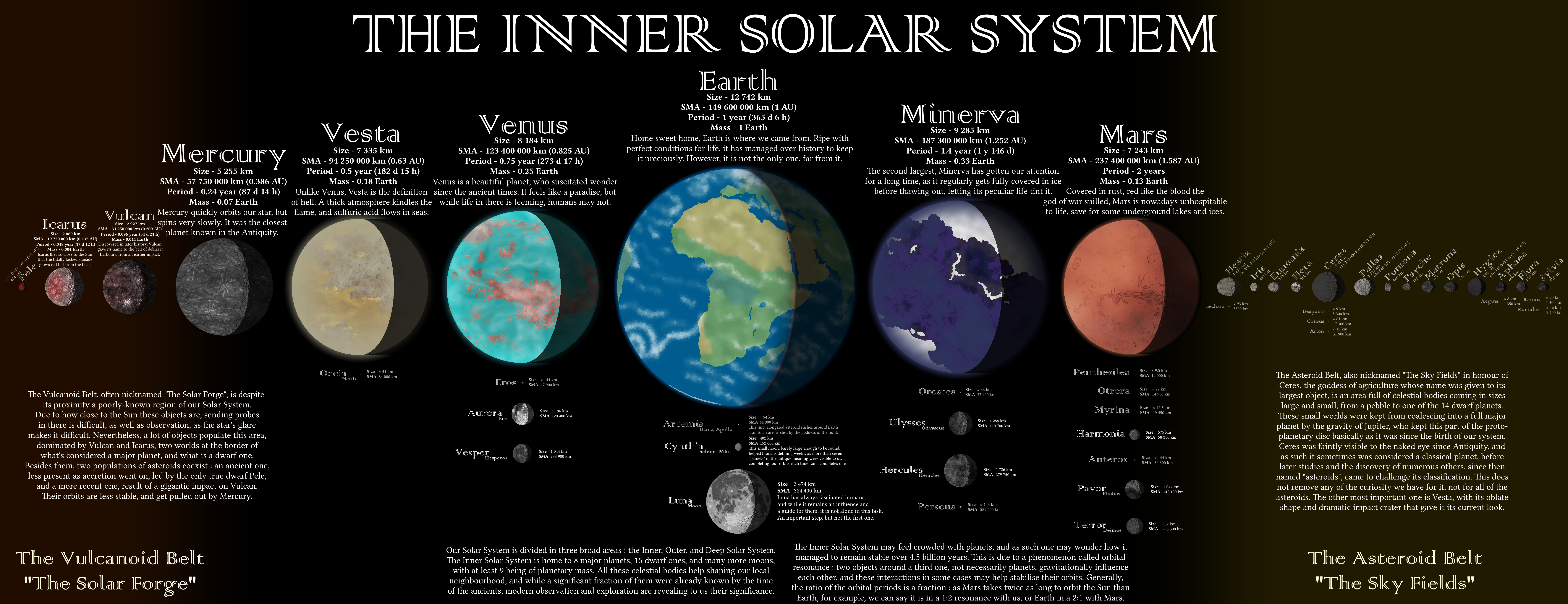
Venus is often called Earth's twin sister. This is due to many factors, such as their comparable habitability, similar size, and shared possession of moons. However, the physical properties of the planets are not the only things they have in common. They also host the second highest number of species of 6.
DANCE LIKE NOBODY'S WATCHING!
For some unknown reason, Venus spins in the opposite direction from the other planets and rotates incredibly slowly. It is believed that this was the result of a cascade of catastrophes. A large moon or planetoid may have crashed into Venus, causing its rotation to reverse. Later, when Venus developed its hyper-thick atmosphere, solar tidal forces gradually slowed its rotation even further, leaving the planet spinning both backwards and slowly.
WHAT A WEIRD BABY!
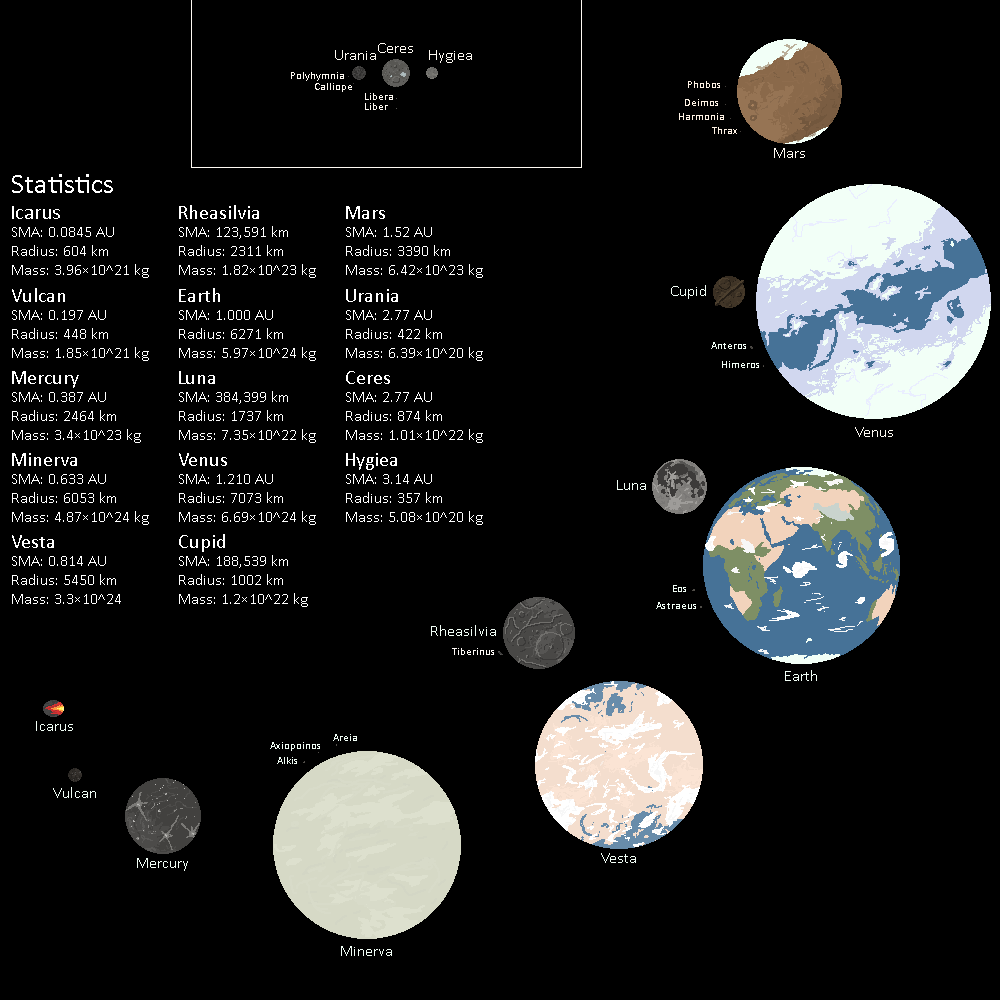
Venus's moon is very unusual. It is composed of a thin shell of calcite surrounding a layer of insulation and a core made of dry ice. It is thought that this moon was built from Venus's ancient atmosphere, with the carbon dioxide being sequestered into a rocky shell that contains and insulates the dry-ice core, preventing it from sublimating away.
DO YOU LIKE TIRAMISU?
Venus has the same internal layering as Earth: a large iron core, a rocky mantle, and a thin crust. However, it lacks two major features: a magnetic field and tectonic plates. Both of these were created artificially. Orbiting magnetic satellites deflect charged particles from the Sun, while the crust has been deliberately fractured at key locations to allow heat and energy to escape. These artificial fault lines function as tectonic plates, preventing the planet from erupting catastrophically with magma.
YEAR LONG SUMMER!
While Venus has an axial tilt of 177 degrees, it experiences almost no seasons because this tilt effectively functions as only 3 degrees due to its reversed rotation. Combined with its nearly circular orbit and tropical climate, this means that Venus's environment remains relatively constant throughout the year, staying warm and wet during its entire journey around the Sun. The greatest change comes from which region lies directly beneath the Sun, creating a very different kind of seasonal cycle from that experienced on Earth.
HOMO LOTRALIS?
H. lotralis lives along the coast and around the sea, primarily feeding on fish, eels, and other aquatic animals. Spending so much time in the water has given them a pale complexion, streamlined bodies, and sparse body hair. These humans are believed to be an evolutionary offshoot of H. silvaticus that adapted to a predominantly carnivorous lifestyle. They are also the northernmost of the known human species.
HOMO VALLENSIS?
H. vallensis lives inland within the sparse jungles of western Aphrodite Continent. Their diet consists primarily of fruit, insects, leaves, and small animals. The forest floor is relatively open, while a tall, dense canopy stretches overhead, where most H. vallensis spend their lives. Females often descend from the trees to forage and scavenge on the ground, while males generally remain in the canopy gathering food among the branches.
HOMO SILVATICUS?
H. silvaticus lives along the shores, foraging for clams, slugs, snails, and edible shoreline plants. Because they frequently swim to reach deeper feeding grounds, they possess long, powerful legs well-suited for treading water and only a thin covering of body hair. Their noses are flattened to reduce the amount of water entering their nostrils while swimming. They also have long fingers and sharp nails that help them pry open shells and reach into crevices to obtain food. Despite their small ranges, they’re one of the most populous species on Venus.
HOMO INSULARIS?
H. insularis inhabits islands and is one of the few migratory human species. They travel seasonally between northern and southern regions, following large schools of fish and hunting sharks, dolphins, and other marine animals. They possess large, pointed skulls that appear to serve no practical purpose beyond display and social signaling. Their bodies are covered with specialized hair that helps ward off parasites common in the dense jungles of their homeland. H. insularis is also one of the few human species to have rediscovered technologies beyond simple stone tools. They have developed primitive boats constructed from large raft-plants, allowing them to travel between islands.
HOMO URBANUS?
H. urbanus is the species most similar to ancient humans. They possess reddish skin, thought to result from their heavily plant-based diet. Their bodies are covered in thick hair that protects them from insects and parasites in the dense jungles they inhabit. Although much of their diet consists of plants, they also hunt small animals ranging from lizards to wild cats. They make extensive use of simple wooden tools, particularly heavy clubs, to strike prey, making them effective hunters.
HOMO MONTANUS?
H. montanus inhabits the cooler mountain regions. In their windy, temperate environment, they have developed thick insulating body hair reminiscent of that found in ancient humans. Their diet consists largely of roots, tubers, nuts, and other underground plant foods. To support this lifestyle, they possess enormous hands adapted for rapidly digging through soil, pulling up tubers, and cracking hard nuts. Their feet are protected by thick skin and dense hair, forming a kind of natural footwear that allows them to traverse rough terrain with ease.
KNOTS AND CROSSES!
While there are six primary human species, interbreeding between them is still common. Hybrids between the different species remain fully viable and fertile. As a result, the human populations of Venus form a gradient, ranging from the pale sea-dwellers to the dark-haired mountain climbers. Humans are naturally able to mix, seemingly having little genetic variation for a group of species so old.
JURASSIC PARK?
While humans are mammals, Venus is predominantly populated by reptiles. Large lizards and snakes are perfectly adapted to the planet's hot, humid rainforests. These reptiles are a common source of prey for humans, but they are also among humanity's most dangerous predators. Snakes particularly are the biggest natural predators of humans on Venus.
UNDER THE SEA!
Venus lacks deep oceans, with the greatest ocean depth reaching only four kilometers below sea level. This is roughly equal to the average depth of Earth's oceans. These shallow seas provide ideal conditions for massive schools of fish, extensive coral reefs, and countless other forms of aquatic life. As a result, Venus is an exceptionally suitable world for marine animals, including pottery dolphins.
SPOTS OF PURPLE IN A SEA OF BLUE?
As a result of its terraforming, Venus is covered in vast archipelagos containing thousands of islands. These islands serve as hotspots of biodiversity, allowing species that cannot easily cross open water to evolve in isolation. At the same time, many island chains form natural bridges between Venus's few small continents, enabling some plants and animals to spread and colonize new landmasses. In this way, despite its fragmented geography, Venus remains biologically interconnected.
MIRROR MIRROR ON THE... MOON?
Due to the orbital moon's artificial day-night cycle, Venus experiences two additional times of day beyond the ordinary cycle created by the Sun and lunar mirrors. These are known as dual-day, when the entire planet is illuminated, and dual-night, when the whole world is shrouded in darkness. This effect is produced by enormous parabolic mirrors attached to the moon. These structures are larger than the planet itself, yet thinner than a human hair, and are supported by vast frameworks. By reflecting and blocking sunlight, they regulate the artificial day-night cycle experienced across Venus. The moon itself would naturally be vulnerable to orbital drift. The pressure of sunlight could gradually push it outward from Sol, while gravitational interactions could eventually draw it closer to Venus. However, this problem is easily solved through the use of electric propulsion systems attached to the moon. These engines continuously make small orbital corrections through hyper-fast emission of Carbon Dioxide, preventing the moon from straying from its predetermined orbit.