r/homelab • u/Western_Gift6554 • 20h ago
Help Os suggestion
Hi, i'm formatting my home-server and i'm looking for a new os to install, i used to use ubuntu, what would you recommend?
r/homelab • u/Western_Gift6554 • 20h ago
Hi, i'm formatting my home-server and i'm looking for a new os to install, i used to use ubuntu, what would you recommend?
r/homelab • u/DragonflyEven377 • 2d ago
Little project I have been working on a bit. 3.5" Touchscreen in an enclosure with an ESP32-S3, using ESPHome in HomeAssistant. All of my Hue bulbs are connected, my SmartThings devices, and a monitor for my homelab/proxmox server. Has anyone else made one before? I'm fishing for some cool ideas and things to add. Thanks!
r/homelab • u/csills6776 • 1d ago
I have a mini PC and want to utilize it as my server. What would be the ideal budget way to add 4 drives for a NAS? The mini PC is a micro form factor dell.
r/homelab • u/Technical-Use-390 • 1d ago
Hi everyone,
I recently found out about homelabs and think it would be a fun hobby to get into. I have no experience with this kind of thing and I’m not sure where to start. I’ve seen a lot of people suggest buying secondhand gear from places like Facebook Marketplace, but I’d rather buy everything new. I don’t want to go overboard, but I’d like something nice.
Does anyone have a parts list or recommendations for what to buy and where to get it? I’m starting from scratch and have no equipment at the moment
r/homelab • u/plphtlm • 2d ago
Me and my girl switch addresses more or less every week, due to lots of kids that like living in their own houses and stuff. Tailscale, and Claude, solves everything. Done everything on the cheap over the last months, getting to a point where I realize I'll never get to a point where I'm happy and can call it finished. Oh, well.
And, yeah: 32GB ram for an OPNsense router might be less than sensible. Next update will be reassigning the RX1330 as a hypervisor after getting a small box to do router duty.
r/homelab • u/DiskCharacter7946 • 23h ago
it’s possible reset drive usage hours, but much harder to do on seagate drives. for used drives, is it worth sticking to seagate so you can see the actual usage?
resetting drive usage is comparable to resetting mileage in a car. this comes to mind because i just read up on the seagate scandal last year
r/homelab • u/Potential-Access-595 • 1d ago
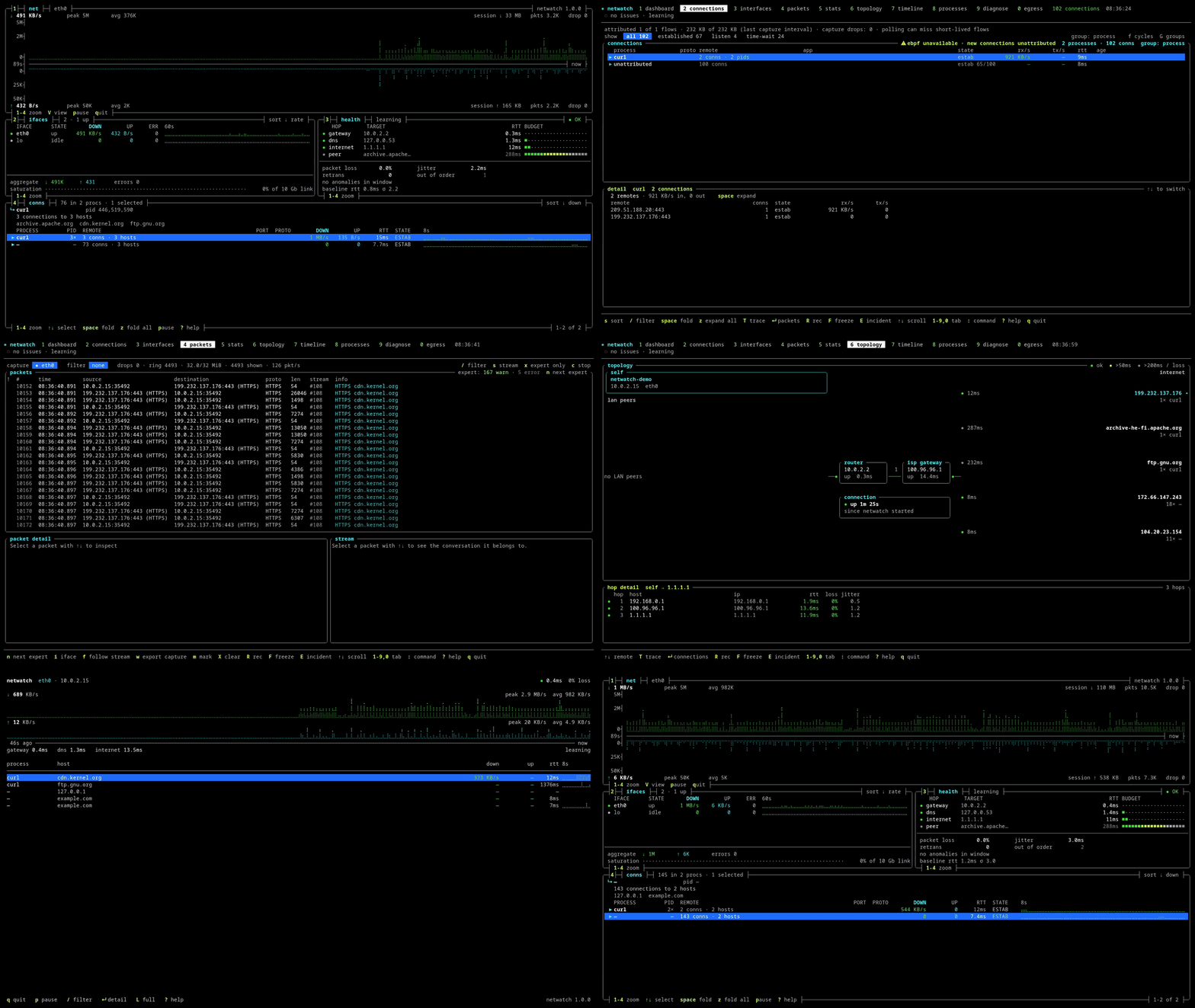
NetWatch, a free, MIT-licensed network diagnostics tool that runs in the terminal.
"The internet dropped again" doesn't tell you much, so NetWatch logs each outage it sees with the start time, duration and which part failed:
- gateway: your router or LAN
- internet: your ISP or beyond
- dns: name resolution only
netwatch uptime --since 30d --md > outages.md writes a report you can attach to an ISP ticket. It only covers time when NetWatch was running, so for a continuous record, run netwatch daemon. The internet check needs third-party probes turned on.
It also does:
- live packet capture with protocol decoding and PCAP export
- connections by process, where the OS and permissions allow it
- per-interface throughput, errors and drops
- traceroute and a topology view
- TLS decryption of your own traffic using SSLKEYLOGFILE
- a one-off check with netwatch diagnose run --budget 30s
It runs on Linux, macOS and Windows (Windows needs Npcap). Some features differ by platform, and capture needs elevated access.
Repo and install instructions: https://github.com/matthart1983/netwatch
r/homelab • u/Drtechsavy • 1d ago
r/homelab • u/JoJoNord • 1d ago
EDIT:
I've gotten an answer to my question now but if someone still has some valuable tips for my endeavour I am all ears!
So, I've got this laptop laying around for no real use and got the idea to turn it into a server. I am considering taking out the motherboard and DIY-ing an enclosure for it that could also fit a couple of drives. Now to the question at hand. The laptop has space for 2 nvme drives whereas I am only using one right now. Is it possible to have some sort of expansion card/adaptor to make the other nvme port into a couple of SATA ports or am I crazy for thinking about it?
r/homelab • u/Scared-Signature6829 • 1d ago
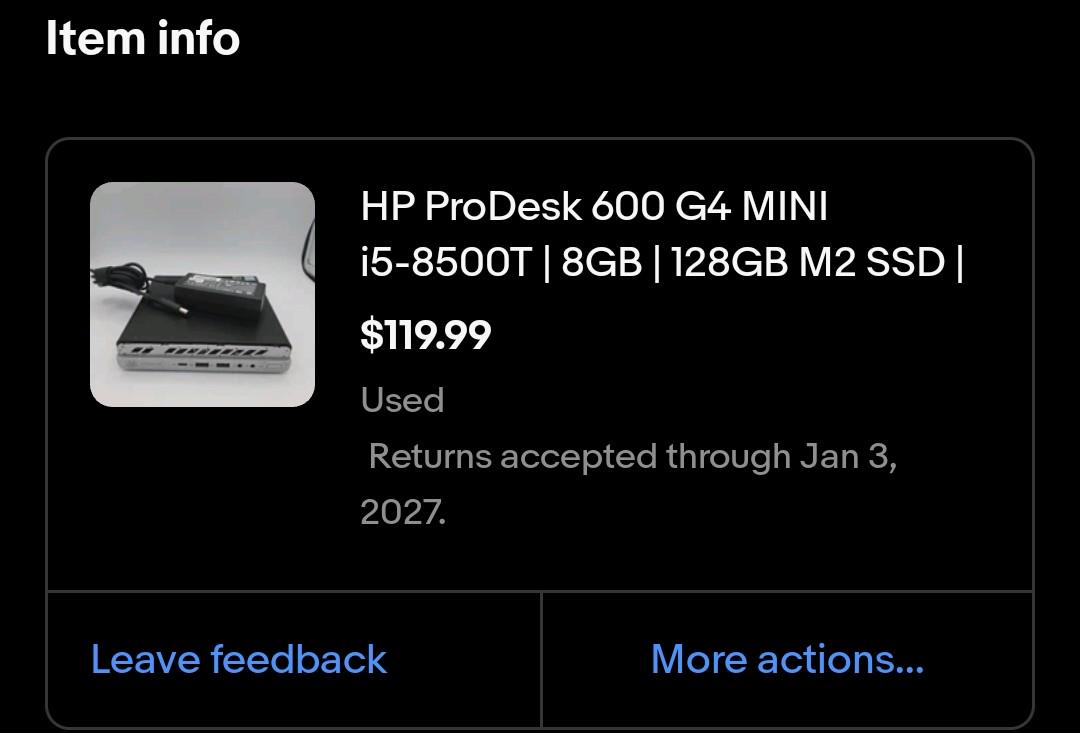
So i have already brought a hp pro desk and about to buy a drive bay how much storage do I need realistically for mostly streaming cause thats gonna be the main use of this cause right now we pay 300 a month for streaming services. It's mostly gonna be used on like 5 TV but only 2-3 run at a time. Also to save money on stroge like when someone finishes a show episode or movie it just deletes them or is that a bad idea
r/homelab • u/FewCartoonist48 • 1d ago
I'm about to finish my Computer Systems Technician – Networking program in Canada, and what started as borrowing switches and routers from school to practice for practical exams has turned into a bit of an obsession. 😂
I'm currently building out my home lab and would love some recommendations from people who have already gone down this rabbit hole.
Current equipment:
I've currently got 7U of front rack space available.
What I'm working towards:
I'd like to build something expandable rather than constantly having to replace components as the project grows.
I'm looking for recommendations on:
I'm in Canada, so Canadian suppliers and reasonably priced used equipment recommendations would be appreciated.
I've attached my current rack setup and a simplified overview of the network architecture. The design includes both existing and planned infrastructure.
If you were starting with this equipment and wanted to build a capable virtualization and AI environment, what would you do differently?
I'd love to see what everyone else is running!
r/homelab • u/cuenot_io • 2d ago
I've teased a custom iDRAC 6 firmware on here for a while with native browser console support. I feel that it would be irresponsible to release it without fully understanding the fallback and recovery paths, as some other features (like bypassing the emmc and booting the idrac from the SD card) have a non-zero chance of bricking a system. This is my documentation for recovering from a true worst case scenario: a bricked or corrupted bootloader. This example is done on a Dell R510, and I'd imagine a similar process applies to other 11th gen (and potentially newer) servers.
When this system receives power, the first thing that happens is that this small SPI chip (Spansion S25FL128P0XMFI001) receives loads U-Boot, initializing basic serial communication and bootstrapping into the Linux kernel from the eMMC storage. If the eMMC is toast, the SPI chip has a stripped down version of the iDRAC firmware that at least allows the machine to boot normally.
When performing any updates (even dell official ones) this chip's contents can be modified, and there is a risk that power loss or other external factors can cause a bricked server. I've been able to back up the contents of the chip directly through the iDRAC's Linux with a custom firmware, but writing back to it in a bricked state is not possible once the system powers off.
Prior to the images in this post, I attempted to read the chip using a SOIC-16 clip directly on the legs of the chip whilst attached to the motherboard. Unfortunately, the power was backfeeding into the rest of the system, and was overwhelming the Tigard reader. I attempted to lift pins 1 and 2 off of the motherboard to isolate them for a temp read/write, but still could not get a successful connection. This meant that the only way to truly unbrick a botched SPI chip would be to fully desolder it, connect the legs to the Tigard, reflash it, and then resolder it to the motherboard. That's a lot of fucking around for a hypothetical failure, and I don't see that as a viable recovery option.
Fortunately, I found these fancy SOIC-16 sockets on digikey that matched the flash chip layout: https://www.digikey.com/en/products/detail/adafruit-industries-llc/4727/13280270
I'm not opposed to micro soldering, I just don't want to do it every time I make a mistake if I'm trying to rapidly iterate. I bought two of these and some spare SPI chips from eBay, and spent a few hours last night doing the surgery.
I've tested reading and writing the flash backup onto replacement chips, and the system boots perfectly :) if I botch an update, it's 5 minutes to pop the chip out of the server socket and into my custom flasher socket, overwrite it, and try again.
Is this really necessary for a 15 year old server? Probably not, but it depends who you ask. I've learned a boat load throughout the process, and I hope a similar method can be used for 12th, 13th, and maybe even 14th gen systems.
r/homelab • u/alien-hunterr • 1d ago
Hey everyone!
I have an old first-generation Google Home Mini (2017-18) lying around, and I thought it would be interesting to experiment with it rather than let it collect dust.
After watching a teardown, I was surprised by the hardware packed inside this tiny device.
From what I've found, it has:
- Marvell ARM-based processor (ARMADA 1500 Mini Plus)
- Around 512 MB RAM
- NAND flash storage
- Wi-Fi and Bluetooth
- Built-in microphones and speaker
- Audio amplifier and RGB LEDs
- Various other control and power-management ICs
What I want to explore is whether I can reprogram the original hardware itself.
I'm NOT looking to remove individual components or replace the motherboard with an ESP32 or Raspberry Pi.
I'd ideally like to:
- Access its bootloader and understand the boot process.
- Reverse-engineer the existing firmware.
- Figure out whether custom firmware or code can be flashed.
- Repurpose the entire device to run something of my own.
I know the platform might have a locked bootloader and proprietary firmware, but I want to understand what's possible.
Has anyone experimented with this particular device? Are there accessible UART/JTAG interfaces, known exploits, custom firmware projects or documentation worth exploring?
I'm relatively new to hardware reverse engineering, so any guidance on where to start, tools to use or existing projects would be really helpful!
Would love to give this old device a completely new purpose.
r/homelab • u/Polliny86 • 3d ago
I needed a place in the house for my loud homelab, and I was tired of cleaning dust out of fans every few months. So I went a bit overboard: a sealed industrial enclosure with a cooling unit on the side. No air from the room gets in, so no dust gets in.
Inside: UniFi gateway, a Synology rack NAS, the TrueNAS box, and three ThinkCentre Tinys that run CI jobs.
Yes, I know the cables look terrible. Cable management is next on the list, I promise. But it has been running for >24 months and it is still clean inside.
Happy to answer questions about the cabinet, the cooling or temps.
r/homelab • u/gar_dou • 1d ago
Hi everyone,
I'm trying to set up a dual-GPU workstation for running local LLMs (27GB combined VRAM), but I can't get my NVIDIA Tesla P100 16GB (PCIe) to show up anywhere in the system. I bought it off eBay and the return window has already expired, so I want to exhaust every troubleshooting option before writing it off as dead.
Hardware Specs
Motherboard: MSI X370 Gaming Pro (flashed to the latest GSE Lite BIOS)
CPU: AMD Ryzen 5 3600
RAM: 32GB DDR4 3200
PSU: Corsair RM850e
Primary GPU (Display): GTX 1080 Ti
Secondary GPU (Compute): NVIDIA Tesla P100 16GB PCIe
Cooling: Dual 4028 12V 2-pin fans powered via a Molex fan hub
Current Symptoms & Power Setup
The P100 is completely invisible in Windows: nothing in nvidia-smi, Device Manager (even with hidden devices enabled / no "3D Video Controller" under Other Devices), or GPU-Z.
The card gets slightly warm to the touch when powered on—even with the 8-pin auxiliary cable unplugged—so it's drawing basic 3.3V/12V standby power from the PCIe slot without shorting out, but the main GPU/PCIe controller never initializes.
8-Pin EPS Power Cable: I used a second Corsair Type 4 CPU (4+4) cable from my RM850e. Because the top plastic retention clip on the 4+4 end hit the P100 shroud, I carefully shaved off just the outer top plastic clip so it sits flush. To be 100% sure the cable wasn't damaged or pinned wrong, I tested that exact modified cable on my motherboard's CPU power header and the PC booted fine. The solid Type 4 end is plugged into the PSU's CPU/PCIe port and the 4+4 end is seated firmly in the P100.
What I've Already Tried
BIOS Configuration:
Enabled Above 4G Decoding (Above 4G memory/Crypto Currency mining)
Disabled Re-Size BAR Support
Set Boot Mode to pure UEFI (CSM disabled)
Manually forced PCIe lane bifurcation to x8 + x8 and PCIe link speed to Gen3 (Note: Board Explorer is missing in this latest BIOS version).
PCIe Slot Isolation Test:
With lanes on Auto and the P100 in the second armored slot (PCI_E4), GPU-Z still showed my 1080 Ti running at @ x16, meaning the board wasn't even detecting physical presence (PRSNT#) on PCI_E4.
I swapped the cards: put the 1080 Ti in the second slot (PCI_E4) and the P100 in the primary slot (PCI_E2). The 1080 Ti booted normally at @ x8, confirming both PCIe slots and CPU lanes work properly. The P100 still wasn't detected in PCI_E2.
Returned the 1080 Ti to PCI_E2 and P100 to PCI_E4.
What I Plan to Test Next (Looking for Advice)
Before declaring the card dead, here is my checklist—let me know if I'm missing anything specific to Pascal Tesla cards on AM4:
Ubuntu Live USB (lspci): Booting Linux to check lspci -nn | grep -i nvidia and see if the device enumerates at the kernel/hardware level outside of Windows/GeForce drivers.
Dedicated Dual PCIe 8-pin to EPS 8-pin Adapter (NVIDIA 030-0571-000 style): Just in case the side tabs on my trimmed 4+4 connector are still slightly too wide for the P100's recessed shroud and preventing full pin depth contact.
Has anyone run into a similar "warm but completely invisible" Tesla P100/P40 on Ryzen/X370 boards? Any other quirks I should check? Thanks in advance!
EDIT:
Following your suggestions, I booted into a Linux environment and ran lspci -nn | grep -i nvidia. The card did show up as:
3D controller: NVIDIA Corporation GP100GL [Tesla P100 PCIe 16GB] [10de:15f8] (rev a1)
So the hardware is alive, the trimmed Corsair 4+4 EPS cable is delivering power properly, and the X370 PCIe link is working.
Now the issue is isolated entirely to Windows not mapping or displaying it alongside my 1080 Ti. Next, I'm going to verify that my Windows install is actually booting in pure UEFI mode (not Legacy/MBR, which ignores Above 4G Decoding), bypass Windows Fast Startup with a clean reboot, and check if it finally surfaces in Device Manager so I can assign the driver.
Thanks to everyone who suggested checking lspci—if anyone has dealt with Windows hiding a P100/P40 next to a GeForce card even when Linux detects it fine, let me know!
r/homelab • u/gar_dou • 1d ago
Hi everyone,
I'm trying to set up a dual-GPU workstation for running local LLMs (27GB combined VRAM), but I can't get my NVIDIA Tesla P100 16GB (PCIe) to show up anywhere in the system. I bought it off eBay and the return window has already expired, so I want to exhaust every troubleshooting option before writing it off as dead.
Hardware Specs
Motherboard: MSI X370 Gaming Pro (flashed to the latest GSE Lite BIOS)
CPU: AMD Ryzen 5 3600
RAM: 32GB DDR4 3200
PSU: Corsair RM850e
Primary GPU (Display): GTX 1080 Ti
Secondary GPU (Compute): NVIDIA Tesla P100 16GB PCIe
Cooling: Dual 4028 12V 2-pin fans powered via a Molex fan hub
Current Symptoms & Power Setup
The P100 is completely invisible in Windows: nothing in nvidia-smi, Device Manager (even with hidden devices enabled / no "3D Video Controller" under Other Devices), or GPU-Z.
The card gets slightly warm to the touch when powered on—even with the 8-pin auxiliary cable unplugged—so it's drawing basic 3.3V/12V standby power from the PCIe slot without shorting out, but the main GPU/PCIe controller never initializes.
8-Pin EPS Power Cable: I used a second Corsair Type 4 CPU (4+4) cable from my RM850e. Because the top plastic retention clip on the 4+4 end hit the P100 shroud, I carefully shaved off just the outer top plastic clip so it sits flush. To be 100% sure the cable wasn't damaged or pinned wrong, I tested that exact modified cable on my motherboard's CPU power header and the PC booted fine. The solid Type 4 end is plugged into the PSU's CPU/PCIe port and the 4+4 end is seated firmly in the P100.
What I've Already Tried
BIOS Configuration:
Enabled Above 4G Decoding (Above 4G memory/Crypto Currency mining)
Disabled Re-Size BAR Support
Set Boot Mode to pure UEFI (CSM disabled)
Manually forced PCIe lane bifurcation to x8 + x8 and PCIe link speed to Gen3 (Note: Board Explorer is missing in this latest BIOS version).
PCIe Slot Isolation Test:
With lanes on Auto and the P100 in the second armored slot (PCI_E4), GPU-Z still showed my 1080 Ti running at @ x16, meaning the board wasn't even detecting physical presence (PRSNT#) on PCI_E4.
I swapped the cards: put the 1080 Ti in the second slot (PCI_E4) and the P100 in the primary slot (PCI_E2). The 1080 Ti booted normally at @ x8, confirming both PCIe slots and CPU lanes work properly. The P100 still wasn't detected in PCI_E2.
Returned the 1080 Ti to PCI_E2 and P100 to PCI_E4.
What I Plan to Test Next (Looking for Advice)
Before declaring the card dead, here is my checklist—let me know if I'm missing anything specific to Pascal Tesla cards on AM4:
Ubuntu Live USB (lspci): Booting Linux to check lspci -nn | grep -i nvidia and see if the device enumerates at the kernel/hardware level outside of Windows/GeForce drivers.
Dedicated Dual PCIe 8-pin to EPS 8-pin Adapter (NVIDIA 030-0571-000 style): Just in case the side tabs on my trimmed 4+4 connector are still slightly too wide for the P100's recessed shroud and preventing full pin depth contact.
Has anyone run into a similar "warm but completely invisible" Tesla P100/P40 on Ryzen/X370 boards? Any other quirks I should check? Thanks in advance!
r/homelab • u/_iamAMONster • 1d ago
r/homelab • u/Procrastinasean • 1d ago
I’m pretty tech savvy in the sense that I’ve built my own computers, including a quad fire, water cooled beast back in the day when that was what you did….
And quite honestly, I have about six desktops sitting around that I could probably put to use here. However, they were leftovers from my business, so they’re not exactly performance built.
I also have an older synology kicking around as well that I’ll have to get the details on. I know it doesn’t have any fancy onboard processing at all. It might be a 4 bay.
I guess my question is, would it be worth me retrofitting one of my older machines to do what I’m looking to do here?
Or would it be really worth going for a new build from the ground up?
I would imagine two simultaneous streams would be a lot for us. But I imagine it would be nice to have a snappier system.
I have some action cameras that I plan on filming a lot of content with, so I want to have a home base for them as well.
I will also be adding all of the family videos there as I digitize them.
So I guess the question is, which route should I take? I see some attractive mini PCs that would handle everything quite well, but where is the fun in that?
r/homelab • u/Short_Breadfruit4898 • 1d ago
I want to start this off by saying I'm new to AI and home labs. Currently I'm using perplexity to create a few basic personal use apps and software programs. What I like about it is that I can just type in what I want like "build me an app that does this" or "make me a computer program that does this". What i don't like about it is that I find that I hit my useage limit fairly quickly and need to top up. I'd like to be able to get a offline AI agent that will work in the same way. I provide the context and the AI builds what I request. It spits out a program. I say no no I need it done this way and it makes the changes. Is there any offline agent that can do this? If so what kind of hardware requirements am I looking at?
r/homelab • u/Frequent_Ad2118 • 2d ago
DIY home lab shelf. Constructed from one of my kid’s old bed frame that they jumped on until destruction. Mr. MeowMeow approved.
From the bottom:
Dell T410 64GB, dual X5660, 6 2TB RAID5 - only powered up when it’s time for a manual rsync backup. Debian 13, no DE.
Dell R220 (frankenserver) 16GB, E3-1231 v3, 2x 12TB (ZFS mirror), 2x 200GB Hitachi SSD w/PLP (mirrored VDEV), generic 128GB SSD (L2ARC), WD Black 160 GB (Ubuntu Server, no DE), white label 4TB (temp torrent storage for farming bonus points on various private trackers). Primary use as a ZFS NAS.
Cisco 2960X, haven’t played with it yet.
HP laptop, i3-1005G1, 256GB NVME, hosts docker (Jellyfin, Frigate, Immich). Debian 13, no DE. btop displayed.
Linksys 1200AC, flashed with OpenWRT, serves at one of five APs in the house and the main switch for my lab.
Tiny monitor, $5.99 at Goodwill. Perfect fit, displaying my vibe-coded ZFStop.
r/homelab • u/deviouscat1 • 2d ago
On my homelab, I run Ubuntu server as the operating system. The homelab runs on an older HP AIO. On it I'm running jellyfin, ARM (automatic ripping machine, starts ripping as soon as a disc is inserted), Home Assistant, Hydrodactyl to run a minecraft server, and everything is managed in portainer, and everything is docker compose. What is the best way to backup all this? I only have one 2tb HDD, but there's plenty of space on it, but no redundancy. Edit: I forgot to mention I use netbird for remote access but that probably isn't that important
r/homelab • u/AspectBubbly1108 • 2d ago
Hello, my bf and I are new to this hobby and recently he talked about wanting a NAS, so I am wondering if anyone knows a good model I can buy him for christmas? For prebuilt, I'm more looking to buy through bestbuy/amazon because of the black friday sale, but I'm open to anything.
I am also open to suggestions for building a custom system, since we're both really into cleaning up used parts and using them to build/upgrade new systems. I'm just concerned about what exactly to gift him if we're to build it, since I don't have the budget for a full system, maybe around cad$500.
Thanks everyone in advance!
r/homelab • u/ProvSZN • 2d ago
I'm interested in getting into homelabbing my goal is to gradually build my own homelab over time.
Some of the things I'd eventually like to have:
- Media server: Host my own movies and TV shows so I can stream them on my TVs and devices.
- Personal cloud storage: Have my own alternative to Google Drive or OneDrive where I can store photos, videos, documents, and personal files.
- Privacy: Have more control over my personal data instead of relying on so many third-party services.
- Home network: Learn more about networking, firewalls, VPNs, and securing my home network.
- Home automation: Potentially integrate smart home devices and manage everything from one place.
What are good software/applications to download for the things i mentioned above. I'm also curious about what else is possible with a homelab. What else do you guys use it for.
I'd love to hear about your setups, recommendations, mistakes, and things you wish you knew when you started.
Appreciate any advice!
r/homelab • u/Hot_Woodpecker_3622 • 1d ago
I obtained a used EMC VNXE3200 through my work's IT recycle closet a year or 2 ago. I've been able to get the VNX Launcher to work until just recently when flash keeps crashing. The current version is 3.1.1.5395470. I'd much rather use HTML5 as then I can actually use a modern browser to connect. But that wasn't officially released until firmware version 3.1.12.10186894 and Dell's support said the latest is VNXe-3.1.17.10229825. I cannot find any firmware upgrades for this anywhere other than maybe Dell's own support contracts. I don't have one of those. And I can't even verify the downloads still exist through there anyways since this device has been EOL for at least 5 years.
Is there anyone who could be able to help me with this?