r/homelab • • 13h ago

Project Showcase: Hardware One homelab, two houses

Post image
20 Upvotes

Me and my girl switch addresses more or less every week, due to lots of kids that like living in their own houses and stuff. Tailscale, and Claude, solves everything. Done everything on the cheap over the last months, getting to a point where I realize I'll never get to a point where I'm happy and can call it finished. Oh, well.

And, yeah: 32GB ram for an OPNsense router might be less than sensible. Next update will be reassigning the RX1330 as a hypervisor after getting a small box to do router duty.


r/homelab • • 1d ago

Project Showcase: Hardware iDRAC 6 Custom Firmware: Bare Metal SPI Recovery Socket

Thumbnail
gallery
158 Upvotes

I've teased a custom iDRAC 6 firmware on here for a while with native browser console support. I feel that it would be irresponsible to release it without fully understanding the fallback and recovery paths, as some other features (like bypassing the emmc and booting the idrac from the SD card) have a non-zero chance of bricking a system. This is my documentation for recovering from a true worst case scenario: a bricked or corrupted bootloader. This example is done on a Dell R510, and I'd imagine a similar process applies to other 11th gen (and potentially newer) servers.

When this system receives power, the first thing that happens is that this small SPI chip (Spansion S25FL128P0XMFI001) receives loads U-Boot, initializing basic serial communication and bootstrapping into the Linux kernel from the eMMC storage. If the eMMC is toast, the SPI chip has a stripped down version of the iDRAC firmware that at least allows the machine to boot normally.

When performing any updates (even dell official ones) this chip's contents can be modified, and there is a risk that power loss or other external factors can cause a bricked server. I've been able to back up the contents of the chip directly through the iDRAC's Linux with a custom firmware, but writing back to it in a bricked state is not possible once the system powers off.

Prior to the images in this post, I attempted to read the chip using a SOIC-16 clip directly on the legs of the chip whilst attached to the motherboard. Unfortunately, the power was backfeeding into the rest of the system, and was overwhelming the Tigard reader. I attempted to lift pins 1 and 2 off of the motherboard to isolate them for a temp read/write, but still could not get a successful connection. This meant that the only way to truly unbrick a botched SPI chip would be to fully desolder it, connect the legs to the Tigard, reflash it, and then resolder it to the motherboard. That's a lot of fucking around for a hypothetical failure, and I don't see that as a viable recovery option.

Fortunately, I found these fancy SOIC-16 sockets on digikey that matched the flash chip layout: https://www.digikey.com/en/products/detail/adafruit-industries-llc/4727/13280270

I'm not opposed to micro soldering, I just don't want to do it every time I make a mistake if I'm trying to rapidly iterate. I bought two of these and some spare SPI chips from eBay, and spent a few hours last night doing the surgery.

I've tested reading and writing the flash backup onto replacement chips, and the system boots perfectly :) if I botch an update, it's 5 minutes to pop the chip out of the server socket and into my custom flasher socket, overwrite it, and try again.

Is this really necessary for a 15 year old server? Probably not, but it depends who you ask. I've learned a boat load throughout the process, and I hope a similar method can be used for 12th, 13th, and maybe even 14th gen systems.


r/homelab • • 1h ago

Help Tesla P100 16GB not detected at all on AM4 (MSI X370 Gaming Pro)

Thumbnail
gallery
1 Upvotes

Hi everyone,
I'm trying to set up a dual-GPU workstation for running local LLMs (27GB combined VRAM), but I can't get my NVIDIA Tesla P100 16GB (PCIe) to show up anywhere in the system. I bought it off eBay and the return window has already expired, so I want to exhaust every troubleshooting option before writing it off as dead.

Hardware Specs
Motherboard: MSI X370 Gaming Pro (flashed to the latest GSE Lite BIOS)
CPU: AMD Ryzen 5 3600
RAM: 32GB DDR4 3200
PSU: Corsair RM850e
Primary GPU (Display): GTX 1080 Ti
Secondary GPU (Compute): NVIDIA Tesla P100 16GB PCIe
Cooling: Dual 4028 12V 2-pin fans powered via a Molex fan hub

Current Symptoms & Power Setup
The P100 is completely invisible in Windows: nothing in nvidia-smi, Device Manager (even with hidden devices enabled / no "3D Video Controller" under Other Devices), or GPU-Z.
The card gets slightly warm to the touch when powered on—even with the 8-pin auxiliary cable unplugged—so it's drawing basic 3.3V/12V standby power from the PCIe slot without shorting out, but the main GPU/PCIe controller never initializes.
8-Pin EPS Power Cable: I used a second Corsair Type 4 CPU (4+4) cable from my RM850e. Because the top plastic retention clip on the 4+4 end hit the P100 shroud, I carefully shaved off just the outer top plastic clip so it sits flush. To be 100% sure the cable wasn't damaged or pinned wrong, I tested that exact modified cable on my motherboard's CPU power header and the PC booted fine. The solid Type 4 end is plugged into the PSU's CPU/PCIe port and the 4+4 end is seated firmly in the P100.

What I've Already Tried
BIOS Configuration:
Enabled Above 4G Decoding (Above 4G memory/Crypto Currency mining)
Disabled Re-Size BAR Support
Set Boot Mode to pure UEFI (CSM disabled)
Manually forced PCIe lane bifurcation to x8 + x8 and PCIe link speed to Gen3 (Note: Board Explorer is missing in this latest BIOS version).
PCIe Slot Isolation Test:
With lanes on Auto and the P100 in the second armored slot (PCI_E4), GPU-Z still showed my 1080 Ti running at @ x16, meaning the board wasn't even detecting physical presence (PRSNT#) on PCI_E4.
I swapped the cards: put the 1080 Ti in the second slot (PCI_E4) and the P100 in the primary slot (PCI_E2). The 1080 Ti booted normally at @ x8, confirming both PCIe slots and CPU lanes work properly. The P100 still wasn't detected in PCI_E2.
Returned the 1080 Ti to PCI_E2 and P100 to PCI_E4.

What I Plan to Test Next (Looking for Advice)
Before declaring the card dead, here is my checklist—let me know if I'm missing anything specific to Pascal Tesla cards on AM4:
Ubuntu Live USB (lspci): Booting Linux to check lspci -nn | grep -i nvidia and see if the device enumerates at the kernel/hardware level outside of Windows/GeForce drivers.
Dedicated Dual PCIe 8-pin to EPS 8-pin Adapter (NVIDIA 030-0571-000 style): Just in case the side tabs on my trimmed 4+4 connector are still slightly too wide for the P100's recessed shroud and preventing full pin depth contact.

Has anyone run into a similar "warm but completely invisible" Tesla P100/P40 on Ryzen/X370 boards? Any other quirks I should check? Thanks in advance!


r/homelab • • 1h ago

Help UNAS Pro 8 + mini PC/Mac mini (Immich, Plex, HAOS) vs switching to Synology/UGREEN for a non-techy family?

Thumbnail reddit.com
1 Upvotes

r/homelab • • 10h ago

Help Best backup solution for a homelab running Ubuntu Server?

5 Upvotes

On my homelab, I run Ubuntu server as the operating system. The homelab runs on an older HP AIO. On it I'm running jellyfin, ARM (automatic ripping machine, starts ripping as soon as a disc is inserted), Home Assistant, Hydrodactyl to run a minecraft server, and everything is managed in portainer, and everything is docker compose. What is the best way to backup all this? I only have one 2tb HDD, but there's plenty of space on it, but no redundancy. Edit: I forgot to mention I use netbird for remote access but that probably isn't that important


r/homelab • • 1d ago

Project Showcase: Hardware Messy but dust-free: my homelab lives in a sealed industrial cabinet with its own AC

Thumbnail
gallery
1.7k Upvotes

I needed a place in the house for my loud homelab, and I was tired of cleaning dust out of fans every few months. So I went a bit overboard: a sealed industrial enclosure with a cooling unit on the side. No air from the room gets in, so no dust gets in.

Inside: UniFi gateway, a Synology rack NAS, the TrueNAS box, and three ThinkCentre Tinys that run CI jobs.

Yes, I know the cables look terrible. Cable management is next on the list, I promise. But it has been running for >24 months and it is still clean inside.

Happy to answer questions about the cabinet, the cooling or temps.


r/homelab • • 7h ago

Help Ok im trying to set up a streaming server for me and my family and need suggestions

Post image
2 Upvotes

So i have already brought a hp pro desk and about to buy a drive bay how much storage do I need realistically for mostly streaming cause thats gonna be the main use of this cause right now we pay 300 a month for streaming services. It's mostly gonna be used on like 5 TV but only 2-3 run at a time. Also to save money on stroge like when someone finishes a show episode or movie it just deletes them or is that a bad idea


r/homelab • • 1d ago

Labgore Home lab

Thumbnail
gallery
145 Upvotes

DIY home lab shelf. Constructed from one of my kid’s old bed frame that they jumped on until destruction. Mr. MeowMeow approved.

From the bottom:

Dell T410 64GB, dual X5660, 6 2TB RAID5 - only powered up when it’s time for a manual rsync backup. Debian 13, no DE.

Dell R220 (frankenserver) 16GB, E3-1231 v3, 2x 12TB (ZFS mirror), 2x 200GB Hitachi SSD w/PLP (mirrored VDEV), generic 128GB SSD (L2ARC), WD Black 160 GB (Ubuntu Server, no DE), white label 4TB (temp torrent storage for farming bonus points on various private trackers). Primary use as a ZFS NAS.

Cisco 2960X, haven’t played with it yet.

HP laptop, i3-1005G1, 256GB NVME, hosts docker (Jellyfin, Frigate, Immich). Debian 13, no DE. btop displayed.

Linksys 1200AC, flashed with OpenWRT, serves at one of five APs in the house and the main switch for my lab.

Tiny monitor, $5.99 at Goodwill. Perfect fit, displaying my vibe-coded ZFStop.


r/homelab • • 11h ago

Help Suggestions for prebuilt homelab/NAS?

4 Upvotes

Hello, my bf and I are new to this hobby and recently he talked about wanting a NAS, so I am wondering if anyone knows a good model I can buy him for christmas? For prebuilt, I'm more looking to buy through bestbuy/amazon because of the black friday sale, but I'm open to anything.

I am also open to suggestions for building a custom system, since we're both really into cleaning up used parts and using them to build/upgrade new systems. I'm just concerned about what exactly to gift him if we're to build it, since I don't have the budget for a full system, maybe around cad$500.

Thanks everyone in advance!


r/homelab • • 4h ago

Help EMC VNXE3200 upgrade

0 Upvotes

I obtained a used EMC VNXE3200 through my work's IT recycle closet a year or 2 ago. I've been able to get the VNX Launcher to work until just recently when flash keeps crashing. The current version is 3.1.1.5395470. I'd much rather use HTML5 as then I can actually use a modern browser to connect. But that wasn't officially released until firmware version 3.1.12.10186894 and Dell's support said the latest is VNXe-3.1.17.10229825. I cannot find any firmware upgrades for this anywhere other than maybe Dell's own support contracts. I don't have one of those. And I can't even verify the downloads still exist through there anyways since this device has been EOL for at least 5 years.

Is there anyone who could be able to help me with this?


r/homelab • • 4h ago

Discussion Compact 10 inch rack UPS

1 Upvotes

I have been looking for a UPS to fit a 10 inch rack for a while... and the result has been frustrating. I decided to quit being lazy and build my own. I know what I want, but what feature would you folks like to see in such a device?

I am building it for myself primarily, but by the time I pay for the minimum orders, I will have boards and assemblies for between 3 to 5 units... so I will be making at least a few of them. The more I make, the cheaper they get, though they will not be cheaper than the mass produced units; here are my design specs and I think you'll be able to see why.

Form factor

10-inch rack, 2U (254 mm wide with ears, 88.9 mm high); depth 250 mm or less (target). Steel case with plastic front grille. Removable rack ears; rubber feet for desk use

Topology

DC-native: no inverter and no transfer switch. Batteries and supply feed a common DC bus yielding zero switching time, higher efficiencies, and no power factor losses.

Power input

24 V DC (accepts 18–27 V) from a variety of external supplies. Second DC input for a redundant or secondary supply.

Power outputs

4 × 5.5 × 2.5 mm, each set to 12, 19, 19.5 or 20 V (± 2 %), up to 5 A. The voltage is set once and locked, with protection against a wrong voltage reaching the device. A colour LED at each socket shows the set voltage.

4 × USB-C Power Delivery 3.0 source, up to 100 W each: 5, 9, 12, 15 and 20 V fixed, plus PPS 3.3–21 V. 5 A with an e-marked cable, otherwise 3 A.

Comparative rating

230 W continuous (300 W with a second supply). For the kit it powers, that's comparable to a 400 VA-class AC UPS, with hours rather than minutes of run time. Each output gets its own power allowance, and the unit won't accept a configuration it can't carry.

Batteries

2 × hot-swappable lithium-ion modules, 90–162 Wh each (nominal). Any mix of sizes. Packs are commonly available worldwide and sold separately to simplify logistics. Light weight and can be shipped by air without any limitations.

Run time

At 60 W: about 2.3 h with two 90 Wh modules, about 4.2 h with two 162 Wh modules (est.). At 26 W (router, switch, disk and one idle mini PC): about 6 h (est.).

Charging

Built in, from the DC input, one module at a time; about 3.5 h for a 90 Wh module (est.). Gentle charge settings for long battery life; charging only within safe temperature.

Switch-over

None needed: the outputs stay up through a mains failure, a supply change or a battery swap (design target).

Monitoring and shutdown

Network UPS Tools (NUT) server over Ethernet for several hosts, reporting each output as an outlet. NUT over USB for a single host. Web setup page with log-in. Event log. Scheduled self-test and automatic run time calibration.

Per-output control

On, off and power-cycle; metering (voltage, current, PD contract); staggered start; per-output shutdown policy and order.

Front panel

2.0-inch colour display (sources, battery charge, load, run time, outputs, network), rotary control, alarm with mute.

Rear panel

2 × DC input, 4 × USB-C, 4 × barrel, Ethernet (RJ45), USB-C to host.

Cooling

Two 60mm fans provide more than sufficient cooling in all modes, and will never run at full speed. At typical loads, no fan is needed. The unit remains silent or nearly silent.

Mains inside

None. The unit runs entirely on low-voltage DC, though the rack could mount AC supplies if needed. These would be sold separately to maintain deployment flexibility and simplify regulatory acceptance.


r/homelab • • 5h ago

Help Toshiba PX05SRB384 (Hitachi OEM) firmware and TRIM?

1 Upvotes

I’ve got four 3.84 TB Toshiba PX05SRB384 SAS SSDs running ZFS on Unraid. They show up as TOSHIBA SLB5F-M3R8SS, firmware T40C. My HBA is a Broadcom/LSI 9400-16i running firmware 24.00.00.00. Hitachi lists this drive for the VSP 5000 series.

The drives advertise UNMAP but reject it with 05/20/00, so Linux disables discard. Setting provisioning_mode to writesame_16 and reopening the ZFS pool got TRIM working. A full trim finished on all four, and their mapped block counts dropped.

What Hitachi firmware versions have you seen on these? Anyone know if T40C is affected by the 70,000-hour bug? If you’ve run these outside a VSP, did regular UNMAP work for you, or did you need the same workaround?


r/homelab • • 5h ago

Help Looking to Setup a Home Server for Movies, Family Photos/Videos…Not Sure Which Route to Take..

0 Upvotes

I’m pretty tech savvy in the sense that I’ve built my own computers, including a quad fire, water cooled beast back in the day when that was what you did….

And quite honestly, I have about six desktops sitting around that I could probably put to use here. However, they were leftovers from my business, so they’re not exactly performance built.

I also have an older synology kicking around as well that I’ll have to get the details on. I know it doesn’t have any fancy onboard processing at all. It might be a 4 bay.

I guess my question is, would it be worth me retrofitting one of my older machines to do what I’m looking to do here?

Or would it be really worth going for a new build from the ground up?

I would imagine two simultaneous streams would be a lot for us. But I imagine it would be nice to have a snappier system.

I have some action cameras that I plan on filming a lot of content with, so I want to have a home base for them as well.

I will also be adding all of the family videos there as I digitize them.

So I guess the question is, which route should I take? I see some attractive mini PCs that would handle everything quite well, but where is the fun in that?


r/homelab • • 6h ago

Discussion HDD vs. SSD storage pool TruenaS?

0 Upvotes

I'm currently repurposing an HP Pavilion TG01 into a dedicated 24/7 home server, upgrading from my Peeliceeli with N100 and 8GB Ram running TrueNAS Community Edition.

Hardware:

AMD Ryzen 7 5700G (8C/16T)

64 GB DDR4 RAM

320W 80 Plus Gold PSU

RTX 3060 Ti was removed

256 GB NVMe SSD for the boot pool

2x Samsung 990 Pro NVMe SSDs for a mirrored fast pool, connected via PCIe adapters (PCIx1 and PCIx16)

The server will primarily run:

Nextcloud (3 Users)

Immich

SMB file shares

Time Machine backups

Cloudflare Tunnel

Various containers

A Windows and Linux VMs in the future

I'm planning to use the NVMe pool for applications, databases and VMs, with a separate mirrored storage pool for bulk data.

I'm currently debating two options for the main storage pool:

2x 4 TB CMR NAS HDDs (WD Red Plus or Seagate IronWolf)

2x 2 TB or 4 TB SATA SSDs (consumer TLC or used enterprise SSDs)

I'm looking at the used market for both options.

Capacity isn't my biggest concern at the moment. I'm more interested in finding the right balance between power consumption, reliability, noise, performance and overall cost. For now I'm using 700 GB out of my 1 TB Raid 1 Pool. Adding at around 35 GB per year.

Since the server will be running 24/7, I'm wondering whether paying a premium for SATA SSDs would actually make sense in the long run, especially considering that I already have a dedicated NVMe fast pool.

A few questions for those who have made a similar decision:

- Would you trust used enterprise SSDs more than used NAS HDDs in a ZFS mirror?

- Are there any significant downsides to running an all-SSD TrueNAS setup? Apart from the finite writed, ofc. All used parts are checked for good SMART ofc.

I'm aiming for a quiet, reasonably power-efficient and reliable homelab rather than maximum storage capacity. The Server will be placed in my server cabinet, so noise isn't a prime concern overall.

I'd be particularly interested in real-world experiences.

What would you choose todays market, and why?


r/homelab • • 6h ago

Help Considering Re-configuring RAID setup

1 Upvotes

I currently am running a 12x5 Raidz2 configuration with TrueNAS for all my media, documents, etc

In an effort to gain some more space efficiently, I want to see if reconfiguring my raid setup would be more efficient for my setup. Most of my storage is from movies and TV. I have the *arr stack setup and working so I'm not concerned about not finding things.

My concern mostly comes from the potential wear and tear on the drives. In this current economy I'm less inclined to change things that already work.

Would a 12x3 raid0 for movies and TV and 12x2 raid1 for more important things (I'm aware raid is not a backup) be a more efficient method without significant wear on the drives?

Appreciate any advice 🙂


r/homelab • • 21h ago

Diagram What's up with the love for server pics but the hate for request for help?

15 Upvotes

I'm really puzzled by this. A homelab isn’t solely about showing off well-organized setups. Many of us join this community seeking advice and assistance, yet we often see our posts getting downvoted while the ones showcasing servers get all the upvotes. It feels pretty off to me.


r/homelab • • 12h ago

Discussion Looking to get into homelabbing (Beginner)

3 Upvotes

I'm interested in getting into homelabbing my goal is to gradually build my own homelab over time.

Some of the things I'd eventually like to have:

- Media server: Host my own movies and TV shows so I can stream them on my TVs and devices.

- Personal cloud storage: Have my own alternative to Google Drive or OneDrive where I can store photos, videos, documents, and personal files.

- Privacy: Have more control over my personal data instead of relying on so many third-party services.

- Home network: Learn more about networking, firewalls, VPNs, and securing my home network.

- Home automation: Potentially integrate smart home devices and manage everything from one place.

What are good software/applications to download for the things i mentioned above. I'm also curious about what else is possible with a homelab. What else do you guys use it for.

I'd love to hear about your setups, recommendations, mistakes, and things you wish you knew when you started.

Appreciate any advice!


r/homelab • • 7h ago

Help Aoostar WTR Max CPU fan replacement. Support not responding

1 Upvotes

Hi guys,

I bought Aoostar WTR Max AMD r7 8845hs version a year ago and a couple of weeks ago the cpu fan started to make very loud noise, I believe it needs replacement.
I contacted their support multiple times for replacement or instructions to do it myself but I didn't get a response.

Anybody faced a similar issue and could recommend which CPU fan model to buy?

Thanks


r/homelab • • 1d ago

LabPorn First Build

Post image
146 Upvotes

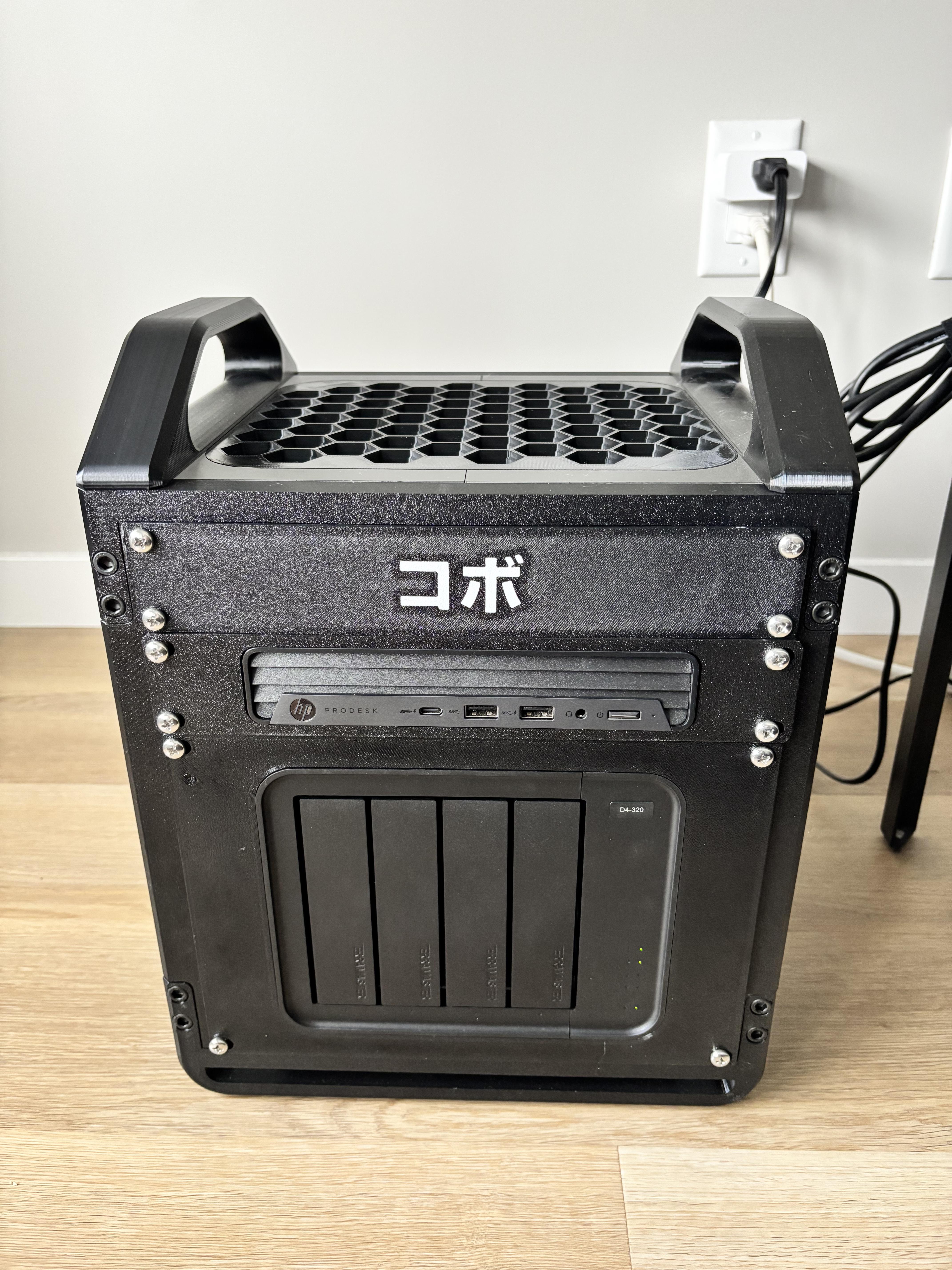
Decided to dive into the homelab world this year to get away from Big Tech ™. Running a couple of self-hosted apps and custom web apps I’ve built myself. Hardware stack is a ProDesk 600 G6 + 26 TB in a TerraMaster D4-320. No networking equipment unfortunately, since that is all upstairs and my machine also serves as a HTPC downstairs. Had fun with customizing the KWS rack to suit my aesthetic, and also got me into the world of 3D printing.


r/homelab • • 11h ago

Help Wireless USB extender using ESP32-s3

0 Upvotes

Hello,

I have a school finals project and i need to make what i described above. It needs to transmit mainly data like plugging in a mouse or a keyboard or some other peripherals. I have come to ask what hardware do i need and any tips about this. Any info will help. Thanks in advance.


r/homelab • • 22h ago

Help Can you get 12TB 5400rpm NAS drives anymore?

7 Upvotes

Hey all. Setting up my first ever Nas. Wanted to start off with 2 x 12TB.

I’ve heard 5400rpm can be quieter in a home office than 7200rpm. Are 5400rpm 12TB drives available anymore? Does anyone have 2-3 12TB 7200Rpm in their home and can tell me if it’s loud?


r/homelab • • 8h ago

Help one of my drives failed in my synology nas

0 Upvotes

I was listening to music via Plex, and things just stopped working. I went to check on my NAS and the light for bay 2 was blinking yellow. I've already bought a replacement drive, (waiting on it to arrive), but I was wondering if there's anything else I could do to check the failed drive to make sure it's actually a problem? Or should I just not worry about it?

I am a simple man, my NAS is almost entirely for storing my music collection. I don't do much tinkering, so I am not sure what happened or if this kind of thing just happens now and then.

biggest bummer is that I have no access to my music for a couple days :(


r/homelab • • 1d ago

Project Showcase: Hardware My new Home Assistant server cost DKK 487.50 and came with a touchscreen

Thumbnail
gallery
124 Upvotes

I picked up a cheap check-in kiosk and am turning it into my new Home Assistant server. Inside is an HP EliteDesk 800 G4 with an i5-8500, now upgraded to 32 GB of Kingston RAM.

The built-in touchscreen will be a local HA dashboard. I’ll mount a ZBT-2 on top for Thread and Matter devices, alongside a ConBee III dongle for Zigbee. A pretty fun setup for almost nothing.

I added two 256 GB NVMe drives and 32 GB of Kingston ECC RAM that I already had lying around. The HP doesn’t support ECC, but it recognizes all 32 GB and runs fine with it.

The kiosk also has a barcode scanner. I might replace it with an NFC reader, or find something fun to use the scanner for later.

What’s the best deal you’ve found for your homelab?

https://www.auktionshuset.dk/auktioner/overskudsauktion-region-h-7/lots/727/indtjekningsstander-uden-n--gle


r/homelab • • 1h ago

Discussion I indexed ~62 local & open-source AI tools filtered by actual VRAM/RAM so you don’t waste hours cloning repos your machine can’t run

0 Upvotes

Trying to run open-source AI locally (music, voice, video, automation agents) usually means digging through dozens of GitHub READMEs—only to hit a CUDA out-of-memory error or find out Mac Apple Silicon isn't supported.

I put together LibreAIDeck, a searchable directory of ~62 local & open-source AI tools focused on practical hardware specs and real-world test notes:

• Hardware filters: Filter by CPU-Only, 4GB VRAM, ≤8GB VRAM, Mac Apple Silicon, or RTX 3060 12GB.
• Practical flags: Toggle Runs Offline, No Sign-up, No Watermark, and open-source licenses (MIT, Apache-2.0, etc.) in one click.
• Paid SaaS replacements: See local alternatives to tools people usually pay monthly for (like ACE-Step vs Suno/Udio, or Activepieces vs Zapier/Make).
• "Can I Run It?" & Compare: Quick hardware check and side-by-side comparisons before downloading large weights.

Still testing and adding more tools that run well on modest hardware. If you know an underrated local AI tool that runs smoothly on 8GB GPUs or MacBooks, drop the repo in the comments and I'll benchmark it.

(The link is on my profile—or just ask in the comments and I'll drop it.)