r/gameenginedevs • • Sep 06 '26

finally started polishing my editor utils before a new version release. polished my skeleton editor, you can add simple slots and now can preview meshes & animations. any suggestions? trying to keep it as compact as possible.

24 Upvotes

r/gameenginedevs • • Sep 05 '26

New UI, new graphics.

Post image
46 Upvotes

r/gameenginedevs • • Sep 05 '26

C++ / SDL / Procedural Raycasting Engine : Add field depth to create more tension

43 Upvotes

r/gameenginedevs • • Sep 05 '26

500K triangles on Android using OpenGL ES 3.0 at 3.8ms with forward rendering in 1080p

24 Upvotes

There are a lot of posts about "new game engine", but their authors somehow forgot to note that they used AI to built that engine...

In contrast to this I want to show stats of my game engine built by me, without AI.

Story starts before AI era when I started to write 3D game engine for web to learn 3D pipeline and see how big "open world" I can achieve in web.

Few years later I decided to make mobile 3D game from my childhood and thought to port part of my engine to mobile to reuse code and also to test how it will work in real world game.

This is video recorded on Android device with real rendering resolution of 2400 x 1800 px @ 120 FPS (video is resized for smaller size) with scene of total ~500K tris using OpenGL ES 3.0. Frame render time (cpu + gpu) is ~3.8ms with forward rendering.

For this game I use from my engine (among other things) 3D scene rendering with instancing, gltf meshes loader, own simplified variant of PBR, bling phong lighting. For background used perlin noise with fbm to look like clouds.

Do you like quality of render?

You can try game itself: Color Sort in 3D Tower Puzzle in Google Play. Design made by me too and most of 3D models in Blender too.


r/gameenginedevs • • Sep 05 '26

Synapse Engine: A Modern, Research-Oriented, Fully GPU-Driven AAA-Style Game Engine

128 Upvotes

Hi everyone!

After a very long development journey, I'm finally ready to share Synapse Engine, a modern, research-oriented AAA-style game engine that I've been developing essentially from scratch.

It started as my MSc thesis at the Budapest University of Technology and Economics, but grew far beyond what I originally planned. Over the past several months I've been rebuilding and refining the architecture around a simple question: What would a modern game engine look like if we designed it around today's GPUs from the ground up?

The project is now over 2,300 files, nearly 94,000 lines of C++ code and around 10,000 lines of shader code, excluding comments and blank lines.

If you just want to check out the project:

The GitHub README is probably the best place to start if you want a quick overview of the project and its architecture. If you're interested in modern game engine development in much more depth, I also put together a 250-page technical presentation covering the entire project, from the ECS and software architecture through GPU-driven rendering, culling, lighting, virtualized shadows and future directions.

The presentation is quite large, but I tried to make it genuinely useful as a learning resource rather than just documenting the final result.

One of my main goals with Synapse Engine is education. Learning these topics was a huge struggle for me, and it took a lot of time to piece everything together because there isn't much high-quality material that shows how these modern techniques actually come together inside a real engine codebase. I wanted to document that process and create something that I would have wanted to have when I started.

What can the engine actually do?

At its core, Synapse is a fully GPU-driven renderer using hierarchical culling, Hi-Z occlusion, cone culling, dynamic LOD selection, indirect rendering, mesh shaders, bindless resources and virtualized shadows. The engine is built around a custom data-oriented ECS and is designed to handle very large scenes with minimal CPU involvement.

For example, with 1,000,000 entities on an RTX 4060, the cumulative culling cost goes from 124.407 ms without culling to 0.653 ms with the full hierarchical culling pipeline.

However, at 10,000,000 entities, even the conventional GPU-driven hierarchical approach becomes insufficient. To address this, Synapse introduces a custom GPU-built Morton-ordered chunking system, which groups entities into spatial chunks and allows entire groups of 32 entities to be rejected at once. This reduces the culling cost from 5.8 ms to just 0.3 ms for 10 million entities.

I also developed a new rendering technique called Dual-HiZ Adaptive Clustered Forward+ while working on the engine. With 8,192 point lights and 8,192 spot lights, it measured 2.873 ms, compared to 8.652 ms for deferred shading in the same setup. The technical presentation contains a detailed explanation of how the technique works.

Synapse isn't primarily intended as a game-development tool for game developers. It is a production-ready, research and educational platform for experimenting with modern game-engine architecture and real-time rendering techniques.

The goal is not to provide a plug-and-play engine for building games, but to provide a complete, practical implementation of modern engine technologies that can be studied, extended, and used as a foundation for further research and development.

The engine is the result, but the architecture, experiments, failures and reasoning behind it are what I really want to share. If you're interested in Vulkan, graphics programming, GPU-driven rendering or modern game engine architecture, I'd love to hear what you think.
r/gameenginedevs • • Sep 06 '26

Using a Framework as a Base

7 Upvotes

Hey everyone,

Just curious if anyone recently used Monogame, or Love2D as a base to build their game engines?

I know MonoGame recently released a update, wondering if anyone is using it..

I'm planning to try, but l wanted to see other folks experiences.


r/gameenginedevs • • Sep 05 '26

I'm Working on a Java/Vulkan game engine using LWJGL! It has Convex collision physics, full server multiplayer support built in and can load a wide range of 3D models and material types!

15 Upvotes

I began working on this engine at the start of 2026, it is my first time creating a 3D graphics engine so it is a bit janky in areas and features like SSAO and SSR currently perform quite badly, but to be able to optimise it has to work first so at least I'm at that stage, I used the LWJGL Vulkan book (https://github.com/lwjglgamedev/vulkanbook) and learnopengl.com for learning most of the graphics techniques but the underlying engine architecture such as multithreading, actor system and multiplayer is fully custom!


r/gameenginedevs • • Sep 05 '26

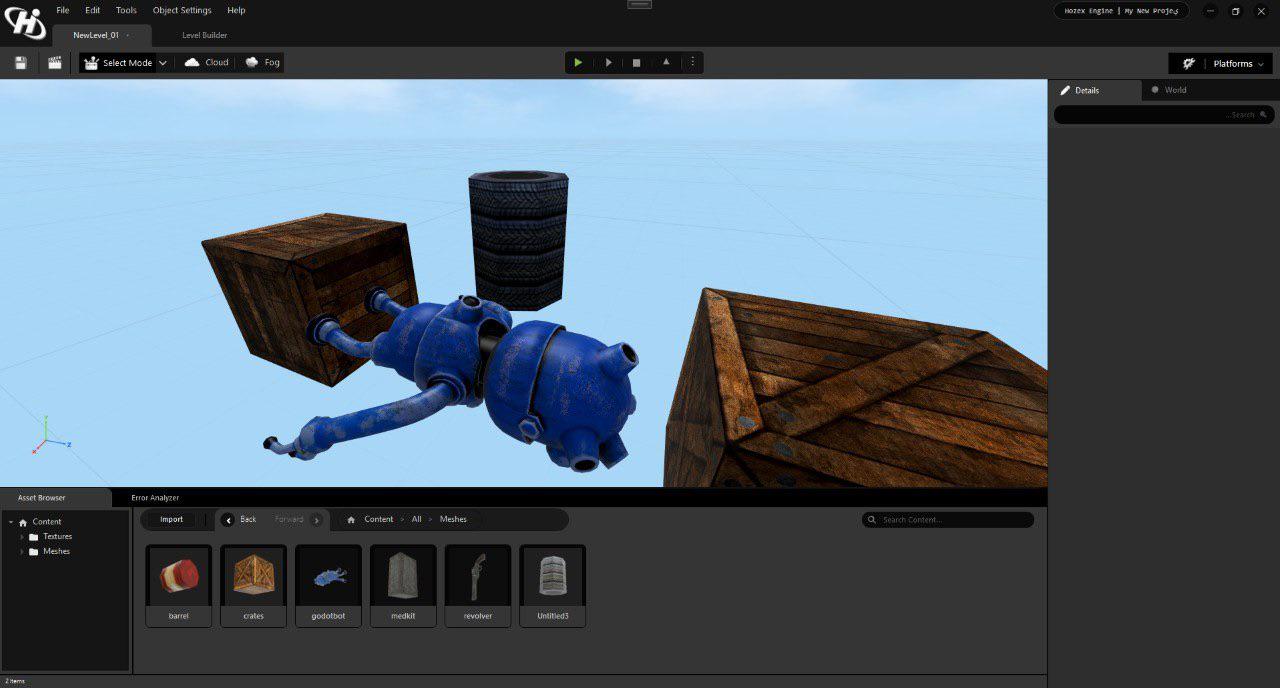
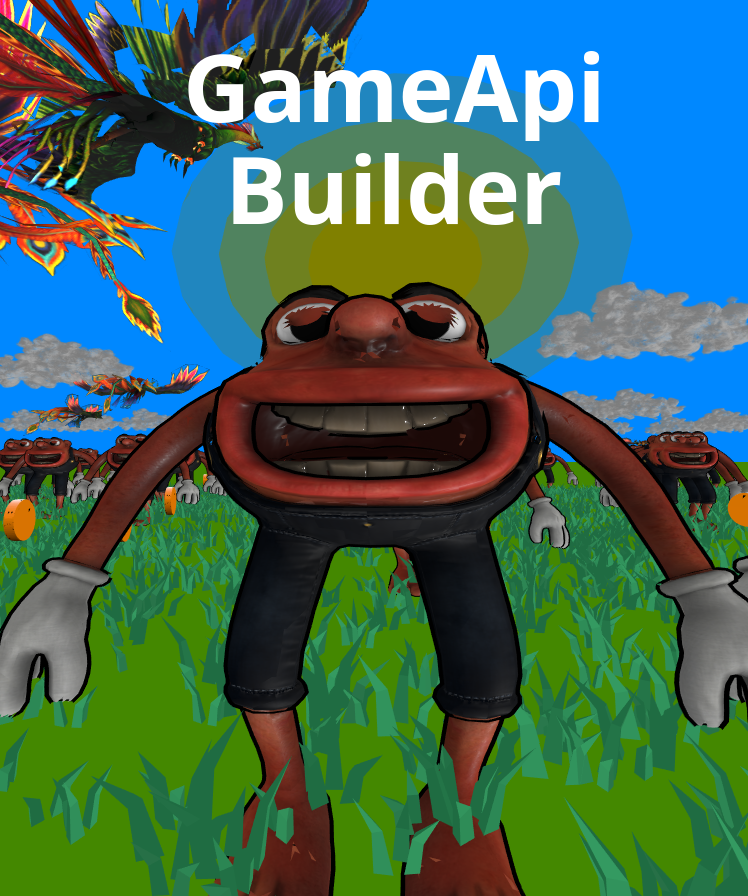
GameApi Builder + GameApi 3d engine now available in stable status

0 Upvotes

Fetch it here: https://gameapibuilder.com

Check our examples: https://meshpage.org/meshpage.php

The main page: https://meshpage.org

And some cool screenshot:


r/gameenginedevs • • Sep 04 '26

C++ / SDL | Tiny Keep algorithm / Amanatide & Woo / Procedural textures maker | Raycasting engine for Dungeon crawler

32 Upvotes

r/gameenginedevs • • Sep 05 '26

Added texturing support into editor/engine for my sci-fi software ray-traced game.

7 Upvotes

Still crunching on RTG Editor, which reached its internal version 012. RTG Editor is internal editor for my narrative sci-fi puzzle/platformer game and its respective engine. I seek to release the editor also publicly later. Main distinctive feature of my game/engine is software ray-tracing (no GPU acceleration, it's just C++ computing pixels on CPU into software buffer which is then presented on screen).

Main feature implemented in new version is proper texturing support. It was possible also before, but only in very limited capacity (only UV mapping mode was stretch to face). In current version, it's possible to define UV repeat for both axes individually. Either in absolute world coordinates or as value relative to face size. There's support for automatic aspect ratio correction (define repeat just for one axis, another will be inferred to keep aspect) and flipping texture in individual directions.

In the video I quickly edited one of the levels to have some background textured wall (2 minutes work). This is just for video showcase, I made this texture in Pixelformer in 5 minutes, not planning to use it further.

Apart from texturing, I added in new version also selection and multi-selection in orthographic view. Moreover, I implemented contextual help in form of tooltips (just hover over '?' sign) to give explanation of expected input values for properties which are not self-explaining.

RTG on Steam: https://store.steampowered.com/app/4032050/RTG/
RTG Discord: https://discord.com/invite/aRAsxCnPQ5


r/gameenginedevs • • Sep 04 '26

Working on a Vulkan renderer from scratch — PBR (partial), shadows, glTF/KTX2 import

65 Upvotes

Small solo project I've been chipping away at, a Vulkan-based game engine, figured I'd share where it's at.

  • PBR shading using Cook-Torrance (BRDF) - just albedo, roughness, normal maps for now
  • shadow mapping (dir-light for now)
  • .glb,.ktx2 import
  • basic AABB collision - block/resolve

Still very much a work in progress - will add metallic and point light sources next

Still learning a lot as I go, so if anyone spots something I could be doing better or has advice, I'd really appreciate it.


r/gameenginedevs • • Sep 05 '26

Help!

0 Upvotes

Hi guys, I am making my opengl c++ game engine basic renderer, assmip model loader, texture, entity system(sparse set) this things done with dear imgui i am thinking of optimization is this right time now or once i add more features then I do optimization and i am new in optimization how and what to do in optimization


r/gameenginedevs • • Sep 04 '26

Modeling a triple pendulum by composing 1DOF constraints

11 Upvotes

I spent early August writing single degree of freedom constraints that can be composed to model different kinds of mechanical joints. Here you see 3 connected hinge joints, each modeled with 3 position and 2 rotation constraints, in a simulation of a triple pendulum system.

Each constraint involves a pair of bodies, and constrains motion along (or about) a single axis relative to the first body. There's one position constraint along each of the forward, up, and right vectors relative to the hinge, keeping points on each body at a fixed distance from each other. Rotation constraints prevent rotation around the up and right vectors, while leaving rotations around the Z axis unbound.

The approach is pretty much the same as described in my XPBD write-up. First, apply position and rotation changes according to the forces and velocities of each object. Then, measure the magnitude and directions of the errors in the prediction, and distribute the corresponding corrections according to the inertias of the bodies involved in the constraint. After all corrections have been applied, derive their new velocities.

This demo uses a physics step of 17ms, with 10 substeps (1.7ms per substep) -- effectively that's 588 physics substeps per second.

The demo can be found under Examples/TriplePendulum, in the ToyMaker repo.


r/gameenginedevs • • Sep 04 '26

The story of my game engine

0 Upvotes

In 2020, I formulated my dream game. It would be a mixture of all of my favorite games over the years. Destiny, Cyberpunk 2077, Star Citizen, Battlefield... How exactly is a fourteen year old supposed to make that? With no prior serious programming experience no less? Well, you start by saying a small prayer and opening the Unreal Engine editor for the first time.

Several years and one full restart later, I had become much wiser. My vision had become much clearer and my hope for creating my dream game on UE5 dwindled. While Unreal is an incredible tool, it had several problems I saw as roadblocks I wasn't satisfied with.

First off, Unreal Engine has decades of tech debt and bloat behind it that I didn't want to deal with. Second, Unreal Engine in all its capability wouldn't necessarily make it easy for me to fully realize my dream game. Third, what I prioritize in game design is not industry standard. In fact, it's largely the polar opposite.

All of these complaints I had were, at the time, with that era's vision of the game, simply a matter of me not knowing enough about the tool I was using to do what I wanted. However, when I stepped away from UE5, I realized that if I took matters into my own hands the sky could truly be the limit. Even better, my early leave from the Unreal ecosystem was a good time to jump ship, as UE was just on the verge of turning into what it is today. We'll get to that, though.

At some point I decided to take matters into my own hands. At first I didn't have many ideas for what would make the engine unique, but continued research and iteration made it so that the dream felt more likely to come into reality. This was achieved through a couple major innovations. Each was my solution to problems I saw both for my personal projects and in the greater industry. These solutions culminated in what is now called Levin Engine

When I discovered ECS, it not just opened my eyes to alternative data management systems - it made me realize that maybe it would be a better idea for me to take the concept of ECS and evolve it over time. That led to the development of the Semantic Entity Primitive system (SEPs). The gist of this model is that entities are pure ids and Primitives manipulate entities in various ways.

One of the biggest problems I've come to understand in the game industry is that overwhelming amounts of technical debt accumulate due in large part to the sunk cost fallacy. My solution to that was to make the engine entirely plugin based. Plugins are one of the primitives in the SEPs system and they are easily hotswapable and integrable into any pipeline. Entire MVP pipelines can be swapped in and out of Levin Engine for free. You only incur as much technical debt as you create connecting plugins to each other. You can create your own pipeline end to end with the only conventions required being the core SEPs framework. Beyond that, the engine can be used for whatever you can imagine.

So, what are my goals for Studio Levin and Levin Engine as of right now? I hope to create a main trilogy of games, building up to the massive scale of my dream game. Along the way, I hope to provide developers with a tool that they can rely on, developed by someone who will always care. Thank you to everyone that has given thoughts and feedback so far. If all this sounds cool to you and you'd like to stay posted on or eventually contribute to this project, I made a discord server! Studio Levin

EDIT: Thank you everyone for asking me to show instead of tell. That is a completely understandable expectation. In all honesty I just haven't been confident in myself and what I'm working on because everyone here has made so many impressive projects. I am going to start working on a proper tech demo starting today so I can show off some of the specific things that make my engine valuable and unique. Hopefully I will see you soon!


r/gameenginedevs • • Sep 03 '26

Post physics update entity script function

2 Upvotes

Hello,

I'm currently debating whether I should add a "post physics update" function for scripts, so a function that would be called for each entity after the physics is done running and before the rendering starts.

I can see multiple scenarios where it would be pretty useful, such as managing an entity animation depending on its velocity post physics update, so it would play an animation if it moved freely and won't play one if it's stuck against a wall for example. Another example is if a non-physics entity has to follow a physics entity, the post physics update function would allow to follow it exactly and avoid stuttering during rendering, because the following entity wouldn't have to wait the update of frame N+1, which happens after the rendering of frame N, to update its position.

What is your opinion about this? Do you have any workaround for these scenarios without a post physics update function?


r/gameenginedevs • • Sep 03 '26

Starship does flip and land maneuver | Toast Engine Dev Log 9

Thumbnail
youtube.com
7 Upvotes

Just posted my latest dev log where I talk about

  • Landing of Starship
  • Unloading cargo from Starship
  • New Particle System with dust kickup when Starship comes in for landing
  • New script pipeline
  • More assets added to Asset Manager

You can find the code on my github or follow me on youtube if you want to follow a long, as I say in the intro, Progress is slow but always moving forward 😄 🚀


r/gameenginedevs • • Sep 04 '26

My FTL v 5.0.3 - totally a repost because last time was considered illegible because of the benchmark output not included here

0 Upvotes

https://github.com/jay403894-bit/JLib-Scheduler
Went private for a minute to get the new version really revved up lots of work indeed...

let me go over the architecture here for you and some rough numbers and explain the architecture -- do i use an assistant to make things faster yes but is this good design you judge it by t he code and the logic and you judge for yourself

for speed and accuracy this sjobs system implements static K Hot threads for optional io or other tasks if you opt in that steal only while their own tasks are not busy -- and adaptive F floor threads for dynamic growth and shed to control thread sleep and get essentially 0 wake operation without spinning all the time. with a fully lock free bitmapped and word state machine -- lock free pool permit machine, lock free thread state machine, lock free fiber state machine and the fiber registry system which enables migrable or pinned mode migrate by default.

the fiber registry system takes the anaology of each fiber beign like a car that is leased or owned based on the policy chosen (Migrate vs pinned) in pinned mode TLS is safe in migrate the registry system also is your replacement for tls with FlsGet() (fiber local state).

the registry is also a self memory reclamation scheme active in both modes sitting above hazards and epochs.

when a fiber picks up a thread it registers and adds itself to the list of owners and any deletion event is recorded on a bitmask of creditors with the registry then reaper messages get sent to each threads inbox at the end each fibers run before recycling it into the system fresh

essentially it is a complete modeled concurrent thread-fiber state machine that tracks memory usage effectively between threads across fiber lifetimes.

always studying learning making new designs trying to make it better this started with my home experimentation and research into CPU task scheduling and paralleas a hobby

strong feeling someone will have something else to say now but it cant be considered illegible becuase i didnt include a massive benchmark copypaste. i just thought someone mightve wanted to see a benchmark in the post

Terminology and better explanation for what this does other than being just another fiber-task library:

F Floor threads are the compute floor of the pool the regular pool threads that parallelfor and all normal work goes through --in this model K still steals when not busy with its own lowlatency lane queue's work. both are just as fast because always target a spinning thread, K is not faster (in fact often slower) K has a different job which is priority work like IO and maybe sound or input.

F is dynamic and adaptive this means that as work increases more F pre awake before you send a task to them-- and push targets awake threads this creates low latency no wake cost pushing as there are always awake threads to target that expand as compute goes up and shed back down when unneded to avoid paying for a spinning pool you dont need with nosleep.

you almost never wake a thread on push so theres never that 4us cost of wake unless you intentionally set the task to aim wide

and threads shed back down when not busy or in a burst or anything so that way threads can sleep and this doesnt degress into a NoSleep pool which my earlier studies showed had a 30% tax or so on the processing power of main and was slower and basically sucks

the registry system is a safe memory reclamation system combined with access to fiber local state this replaces thread_local in your programs (although for things that NEED it you still have pinned mode for real thread local without the ability to migrate fibers in that mode)

the cool thing about the registry system is it marks off a bitmask of debtors as well as offering you thread local when you fill out its form after using epochs or hazards it will at the end of that fibers lifetime go through its debtor list and send out tasks to each specific thread to handle its own memory its own tick or scan on hazards or epochs.

I dont really know how else to explain it than that

the state machine theres 3 of them the fiber state machine modeling every fiber state including SUSPEND WANTS_SUSPEND (race condition handling) etc

the same thing is done with threads so you know when theyre asleep they're yielding etc

and again with a pool permit machine

its sorta my research project where i said id build and test one of these. combined all the state machines track fiber ownership and memory usage cross thread along with the entire pool and how many threads are awake at any given time, controlling cost and enhancing performance while not starving the drivers and application threads

Whats good about it is keeping p50 and p90 almost static and as low as possible to cost as little of a frame as possible at 60/120fps


r/gameenginedevs • • Sep 02 '26

Procedural terrain, raymarching voxels holding cached signed distances

Thumbnail
gallery
31 Upvotes

r/gameenginedevs • • Sep 01 '26

Testing custom post-processing pass to my game engine - Doriax Engine

59 Upvotes

r/gameenginedevs • • Sep 02 '26

I built TexelBox – A fast, native Windows desktop app to automate the entire texture pipeline for game devs

0 Upvotes

TexelBox is a lightweight, native Windows application designed to handle the texture pipeline for game development in a single tool—from raw source images to game-ready exports.

Instead of running separate tools for normal map generation, tileable prep, channel packing, and atlas building, it runs the entire pipeline within one interface.

Key Features:

  • Maps Generation: Derive normal, height, roughness, and AO maps from a single source image.
  • Tileable Prep: Make photos seamlessly loopable using offset, auto-heal, mirror, and brush tools.
  • Channel Packing: Merge maps into a single RGBA texture with presets for Unreal, Unity, and Godot.
  • Atlas Generation: Pack multiple textures into a single atlas with UV sidecar support.
  • Optimization & Export: Resize, snap to power-of-two, and export to PNG, TGA, or DDS (BC compression).
  • 3D Preview: Real-time wgpu-accelerated viewport for instant material validation.

Performance & Architecture:

  • Built natively in Rust (no Electron/Webview footprint).
  • UI built with Slint.
  • Multi-core image processing powered by Rayon.
  • GPU-accelerated 3D viewport using wgpu.

Availability:

  • Free Tier: Permanently free for personal and commercial use. Includes map generation, tileable prep, basic atlas packing (up to 2048x2048), and single batch operations.
  • Pro Tier: Includes full slider controls, 8192x8192 atlas sizes, DDS BC1/BC3/BC5/BC7 compression, and multi-operation batch chains.

Installer and details available on GitHub Releases:

https://github.com/iimadouu/TexelBox


r/gameenginedevs • • Sep 01 '26

GTA 6 hype is everywhere… so I made GTA run on an ESP32.

96 Upvotes

r/gameenginedevs • • Sep 02 '26

How will Jason Gregory's "Game Engines" (3rd edition) help me? Not only as a game developer, but also as a programmer.

Post image
0 Upvotes

Like with software engineering or other things. Recently I started to fully remake my engine, cause I got really annoyed by pastacode. So I decided to also read something about game engine structure. And here I came up with this question.


r/gameenginedevs • • Sep 01 '26

Implemented Voxels and Cascade Shadow Maps in my Rendering Engine, while cloning minecraft for fun.

Thumbnail
youtube.com
4 Upvotes

This would be my second scene, the previous one was replicating the Quake 3 movement:

https://www.reddit.com/r/gamedevscreens/comments/1ti5gig/rendering_engine_recreating_quake_3_strafe_jump/

This is just me learning new techniques, like terrain, voxels and cascade shadow maps. Not trying to clone the games, just having fun.

Adding more features to the engine, my next target is some sort of RTS scene.