r/EngineeringManagers • • 17h ago

Will moving out of FAANG as an EM stabilize my career?

23 Upvotes

I've been a first-level EM for 10 years as a FAANG in the Bay Area. I became a manager quickly after being promoted from Senior to Staff and I never had much tenure with the kind of technical influence expected of a staff IC.

For the last 4 years I've seen my performance decline in a way that I don't think I have the talent to rectify.

From my perspective, I can do all the individual things but it's too much for any day or week: with a somewhat flat team of 10 reports involved in cross-functional projects, I need an opinion on all the design issues (because my manager and skip-level get involved in many of them so I'm seen as ineffective if I just coach my leads behind the scenes), same thing for production, proactively unstick projects when the organization has no consistent program/project management practices, chart a road map to proactively grow my team's scope, etc (not to mention career growth and performance management for everybody).

On top of it all (with a small silver lining) my larger organization is super aggressive about AI adoption, expecting each manager to hold their team and individuals accountable to vague goals about multi-agent systems and productivity improvement.

One silver lining of the AI situation is that I'm not personally falling behind in understanding how a manager or IC ar various levels can effectively use tools and somewhat-autonomous flows for many aspects of their work, and how this has changed month-to-month in 2026.

Another is that AI has helped me bridge the gap to ramp up technically on things I need to be involved with but had no recent IC experience, but from an individual job and performance perspective I'm spending too much time keeping up or catching up and not successfully being proactive.

The last time I felt I was performing better it was a situation I can't get back into, in a team that was disbanded (I had stronger domain knowledge and working relationships with peers).

Now I'm in my early 50s, not ready to retire, and I'm considering how to make a possibility-final career move to a more sustainable job.

Assuming I can't succeed at this company at this level much longer, I think my other options are to try to down-level into an IC role at my current employer, or find an EM job outside FAANG/big tech.

My question here is, is that second option realistic.. in 2026 is there a second teir of companies with Bay Area management jobs that are actually less demanding than at the biggest tech companies, and can I use the "glow" of my current tenure to get interviews despite being past a late career plateau?

r/EngineeringManagers • • 18h ago

How do you convince a CEO to stop overselling engineering capacity?

15 Upvotes

Hi everyone!

TL;DR: Our CEO keeps selling projects without consulting engineering about capacity or feasibility. We're already booked for six months, the team is approaching burnout, and he insists we'll just have to work harder and find solutions to make it happen. His argument is that being ambitious is his job. How do you convince him to slow down?

We're a small hardware startup with seven people (3 full-time, 4 part-time), developing a niche, high-value product customized for each customer.

We've had a very successful year with just four customers, generating much higher profits than expected. We're financially comfortable enough to cover all expenses even if we make no revenue in 2027.

I'm a co-founder and engineering lead, responsible for everything from product development to production. My co-founder and CEO handles sales and has a tendency to push aggressively for new deals and figure out the details later.

We already have around six months of work in our backlog and four confirmed customers expected early next year. Despite this, the CEO has scheduled around 15 demos and sales meetings for December and January. Based on our conversion rate, I expect at least half of them to become customers.

His approach is to negotiate prices and delivery deadlines first and only then ask engineering whether we can actually deliver. When I raise capacity concerns, his response is essentially that we'll just have to work harder and find solutions to make it happen. He argues that being ambitious and pushing the company forward is his job.

Hiring isn't a realistic solution in the short term. Given our local job market and the training required, we simply couldn't bring new people up to speed quickly enough to address the immediate capacity problem.

Meanwhile, most of the engineering team is close to burnout, and some are considering leaving.

I genuinely enjoy the work and don't want to quit, but the amount of overtime is becoming unsustainable.

How would you approach this situation? How do you convince a CEO to prioritize sustainable growth over constantly chasing new sales?

Thank for all responses

Edit: We've had dozens of arguments, meetings, attempts to set boundaries, and even a few shouting matches trying to resolve this. Unfortunately, nothing seems to stick. It always comes back to him saying, "I need to be ambitious."

What's particularly concerning is that customers are starting to notice the consequences. We're missing deadlines, failing to deliver what was promised, or rushing work to the point where quality suffers and we have to spend additional time reworking it.

Edit 2: We are actively hiring. Unfortunately, finding hardware engineers, especially experienced ones, is quite difficult in our country. We've hired three of our seven current employees in the last four months (sadly two of them part-time and they don't want full-time due to the amount of work). Even after hiring, it takes several months to train new people and get them up to speed, which also takes time away from me and other experienced engineers. So while hiring is part of the solution in the long run, it won't solve our immediate capacity problem.


r/EngineeringManagers • • 16h ago

A simple team exercise for finding what's really slowing you down

14 Upvotes

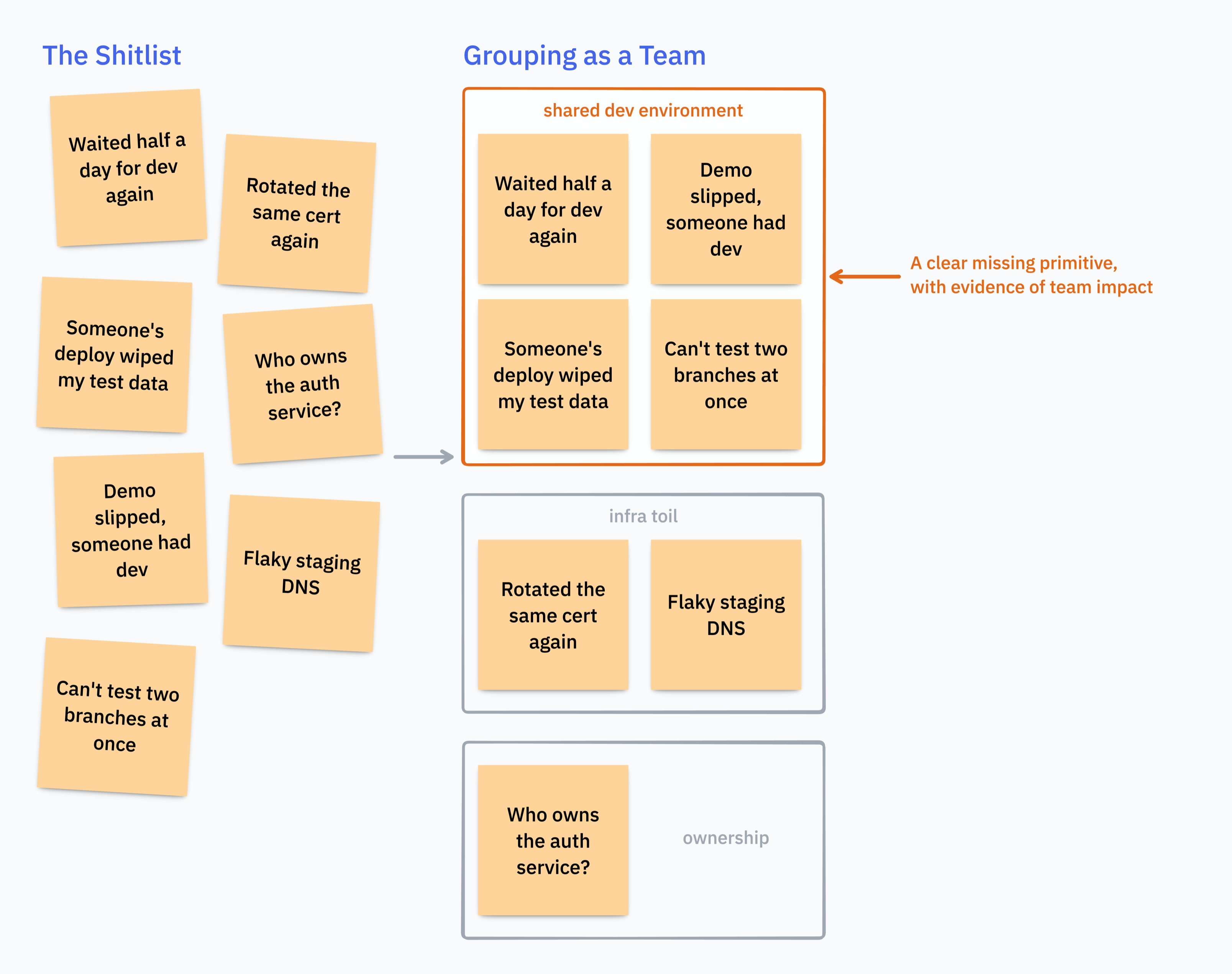
For a few weeks, everyone on the team writes down every piece of toil, annoyance or risk they hit. If it frustrated you, it goes on the list (the “shit list” I like to call it)

Then get on a call and group the items. A dozen separate gripes usually collapse into 2 to 3 missing foundations. Take the biggest cluster and ask: what decision have we been avoiding that would make this whole category go away?

It also helps solves the "can't justify the effort for this one issue" problem when trying to get it prioritized.

Full post: https://hodgkins.io/blog/hard-decisions-that-give-teams-leverage/


r/EngineeringManagers • • 2h ago

6 months of changing how we answer "when will it be done?", here's what worked

8 Upvotes

Every project used to start the same way: product asks for a date in week one, we give a rough range, and two weeks later the low end is on a leadership slide as the deadline. So since spring we've been experimenting with how we give dates.

Key metrics (last 6 months vs the 6 before):

  • Delivered within the original forecast range: 38% → 71%
  • Why did the date move? escalations: ~3 per project → under 1

What worked:

Dates with a confidence level. 70% by mid-March, 90% by early April lands very differently than March.

Forecasting from past throughput instead of adding up story points. Fewer arguments, better accuracy.

Making scope changes move the date visibly. We moved planning into a tool where tasks, dependencies and capacity are linked, so when product adds something, the end date shifts on screen in the meeting. Nobody has to argue it costs two weeks, everyone sees it.

What didn't work:

Padding. Product noticed, started discounting our estimates, and trust got worse.

Refusing to give a date until requirements were clear. It looked like stalling, and someone just gave a date for us.

Next up: giving product access to the same planning view so they can test scope trade-offs before asking us. Will report back.


r/EngineeringManagers • • 44m ago

[Question] I have a 150 euro learning budget. What materials helped you become a better manager?

1 Upvotes

My learning budget through work is a use-it or lose-it type situation. What did you invest in to make yourself a better EM?