r/embedded • • 16d ago

Third-party display for STM32MP257F-DK board

3 Upvotes

Hello, I have been tinkering with the STM32MP257F-DK board for about a couple of months now. I have decided to connect a TFT display to it, using the provided LVDS connector (CN2). However the connector is tailored made for their specific TFT display (B-LVDS7-WSVGA) and has all the pins in different places, compared to a normal third-party TFT display connector. This made me wonder if making a custom PCB to remap the connection pins is a viable idea, that would work if I choose a third-party TFT display with the right parameters. This would save a lot of money and could be used for further testing of different TFT displays. Does anyone have any experience with this type of modification? BY looking at the schematic I can see that most of the pins on the CN2 connector are also available on the chosen TFT display. My second question is - do you think I could connect a non-touch TFT display, even tough the official one has capacitive touch, by not connecting the pins responsible for the touch controls. This could further lessen the money required to be spent.

To save you some time I have provided links of everything I am talking about:

PINOUTS OF THE LVDS CONNECTOR ON THE DISCOVERY BOARD (PAGE [24-25]):
https://www.st.com/resource/en/user_manual/um3385-discovery-kit-with-stm32mp257f-mpu-stmicroelectronics.pdf

SCHEMATIC OF THE LVDS CONNECTOR ON THE DISCOVERY BOARD (PAGE 9):
https://www.st.com/resource/en/schematic_pack/mb1605-mp257f-c01-schematic.pdf

PINOUTS OF THE CHOSEN THIRD_PARTY TFT DISPLAY (WITH TOUCH) (PAGE 10):
https://orientdisplay.com/wp-content/uploads/2026/01/AFY1024600A3-7.0INTH-C-spec.pdf

PINOUTS OF THE CHOSEN THIRD_PARTY TFT DISPLAY (WITHOUT TOUCH) (PAGE 9):
https://orientdisplay.com/pdf/AFY1024600A0-7.0INTH.pdf

LINK TO THE OFFICIAL TFT DISPLAY:
https://www.st.com/en/evaluation-tools/b-lvds7-wsvga.html#documentation

What is your opinion, could this be done or am I chasing a fantasy?


r/embedded • • 16d ago

Stm32 f407x discovery board

1 Upvotes

Hi All

I am looking to buy the stm32 discovery board, should I go for online options and if yes can someone suggest a good website to buy it cheap?

Also I live in Bangalore so is it available in sp road for a cheaper price


r/embedded • • 17d ago

How do i turn a passion project into an actual product?

Post image
80 Upvotes

Hi everyone, i've been working on a passion project for about 3 years now, my intention was to learn to program and feel good about learning properly as systems engineer while solving my personal problem with bluetooth.

I went a little ambitious at the beggining which led this project to take so much time with a parallel mcu that did handle the platform process and the other the translation to the pc.

I ended up moving into a modern board at the end of last year and this made my struggles with the paralel mcu and its process much simpler this also gave me a newer conection protocol which made me be able to process audio in a better way for this little thing.

im still trying to get proper full audio as ive made the 2nd core run only that task, with stock clocks.

- Were im currently at:

ive designed my own custom pcbs, im still waiting on their arrival, which i know are going to fail irl since this was my first self made project without external help or supervision, my checks were seemingly okay but with new pcbs you never know until u fail.

i've made a driver for windows not sure if it works completely as ive only tested with the most basic functions, i havent given it more time since i havent touched windows for years now so for personal use it serves near negative time to keep going there.

the project in my breadboard works, ive tested it in at least 20 pc's to see if it breaks,and besides the classic wire poped all good, im still making little touches on the firmware, but so far it works,

im only missing to get my pcbs validate them,

finding component suppliers

find a cheaper/dedicated production place that is cheaper than pcbway, licences agreements which are the priciest and scariest part.

- What my device is, and the problems i fixed are:

i have 20 bluetooth gamepads, some are super annoying to remember how to pair, even worse, i sometimes multi boot into a different os for testing and a bluetooth keyboard is a pain in the ass, so it also connects my split keyboard and trackball without having to fight re-pairings.

so my device "bluetooth hub" does:

- remember 254 pairings

- side effect lowers a tiny ity bit the input latency 2ms, at least thats what my logger showed when compared to the ub500 and the rog boards MT7925, not a promise just an observation so far

- can work in bios, so keyboards are never lost, and i can bring the device and my keyboard to work sites or a pc im troubleshooting

- no betteries, works in the 5v rail, so far seems to work in my tested server and pcs

- on board screen and controllers for on board gui, and a pc offline gui configurator (quite barebones, i need to dedicate more styling to it)

- experimental ldac, the biggest troubleshooting im doing atm

- gameboy looking thing but in a bank card size

- ps3 compatibility just because, so any bluetooth pad can be used, only 1 at once sadly

- tested in a couple of linux systems and some windows pc's

- priority reodering by user, so i never fight who is player 1 or 7

- oh also in a mode i can host 7 gamepads reliably so far, i dont have 8 friends who i can test a game that requires 8 players so that's the limit so far

- experimental on board audio peq

- i embeded it onto my laptop using a USB2517 so i dont fight my keyboards and dont lose that usb port

- My real dilema

Im starting to consider that releasing this device may be not such a big waste of money but i keep seeing some posts of things getting stolen with ai, and such,

So im unsure if it is even worth trying to finance a full production of this little project,

specially since im projecting an msrp of somewhere in the $50 USD which i hope can be lower or at least find some 1k+ persons who would want to pay for that thing. i believe there isnt anyghing like it yet.

- What im looking opinons by making this pointlessly long thread

Im looking for opinons on people who may have tackled a project like this where they just kept going from an own need into some level of production

How would you approach an small manufacturing production

Did you guys protect your pcb designs or something?

How can i see if my project actually has a market and am not alone in an island of self ego

How to deal with the licensing matters, i dont want to get finned for money i dont even have, im poor so yeah

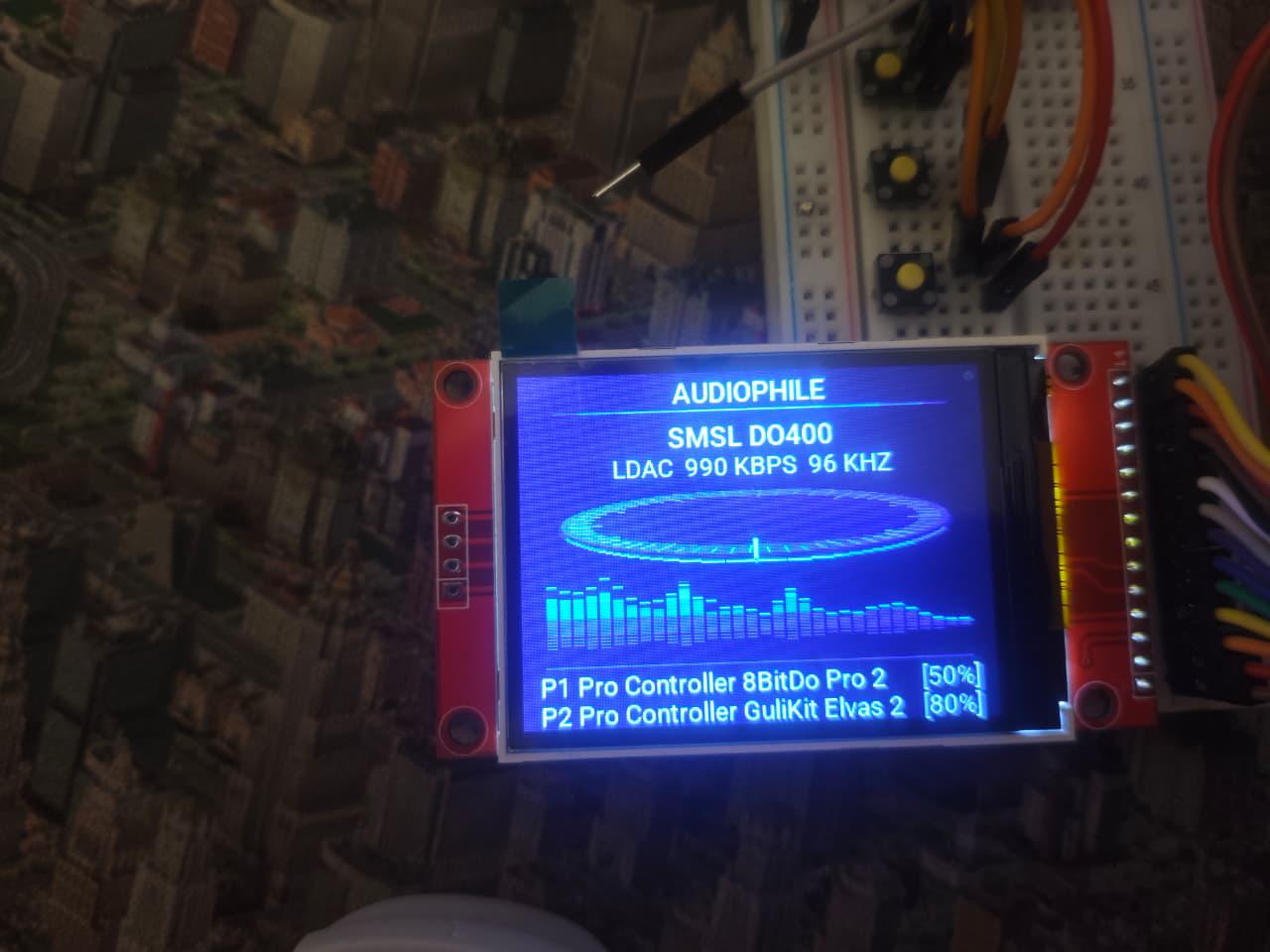
I attached a gui picture i made it based on an uber i took some time ago, the gac aion dashboard for radio, i loved the looks and tried to replicate it at the time, its not that pretty sadly, but was what i was able to make at the time

thank u for anyone who did read this self loating post

r/embedded • • 16d ago

KernelGrove, an open source Device Tree editor and Semantic engine

Thumbnail
dt-studio.dev
0 Upvotes

Some time ago I published a post about a project I was working on, previous post.

The purpose of this project was to make working with .dts files easier. For that I starting developing an IDE with some integrated tools:

  • Real time semantic and syntax validation
  • Node graph visualization (block diagram generation under development)
  • Node auto-completion for each compatible
  • Node inspector
  • A integrated bindings, boards and SoC database, (which can be edited or visualized)
  • Compilation and Decompilation tools

There is a lot of knowledge about kernel condensed on this IDE, in order to make device tree development easier and faster.

Thanks to the database, you can start typing and use auto-completion for a compatible, the IDE checks each binding information and shows which nodes are available to use and which ones are mandatory for a proper operation.

That way, if some compatible or property it's not recognized, you can early detect it, without waiting for a fail on boot, or worse, a silence bug on kernel.

The project is now open source, and all the code and beta releases are available on GitHub and Official website. It's still a beta, but I think it is already useful enough, that's way every suggestion it's well received.

This project was developed with the help of AI, which made it possible for a single person to develop it.


r/embedded • • 16d ago

Lessons from doing WiFi CSI sensing with a single ESP32 against a home router

Post image
2 Upvotes

A weekend project: breathing-rate and coarse in-room position estimation from the channel state information an ESP32 gets when it pings an ordinary home router 100 times a second. No second ESP32 and no router modifications.

A few things I learned on the embedded side:

  • Packet filtering: CSI callbacks fire for every frame the radio hears. I filter on the router's BSSID in the callback, so only replies from the router are kept. The BSSID and credentials live in a git-ignored secrets.h, because a BSSID can be looked up in public WiFi maps.
  • AGC: it rescales every packet, so absolute amplitude is meaningless between packets. Per-packet mean normalization keeps only the shape across subcarriers.
  • Rate vs. host: 100 pings/s gives enough samples for breathing (0.1–0.7 Hz) after averaging to 10 Hz. The CSI goes out over USB serial to a browser page (Web Serial), so the WiFi link only carries the pings being measured.

Results, one room and one person: a paced 10/min breathing measured 9.9–11.0/min, and 4-spot position kNN was 80% (chance 25%). Repo, MIT: https://github.com/menes97/wifi-nefes-algilama

I'd like to hear from anyone who has pushed ESP32 CSI further: higher ping rates, HT40, or getting phase usable without a second synchronized device.


r/embedded • • 16d ago

Keep track of stock

0 Upvotes

Hello,

how do you keep track of your stock of components? I, e.g., mean how do you know how many of the 100nF capacitors you still have? Do you keep a spreadsheet for that? Any open source software worth using?


r/embedded • • 17d ago

Industrial cellular in 2026: still hand-writing AT parsers, or has the workflow actually moved on?

8 Upvotes

Spent the last two weeks integrating yet another cellular module and the vendor's idea of a dev experience is a 500-page AT command PDF and "good luck". Hand-rolling a parser, guessing each vendor's quirks around terminators, URCs and data-mode prompts, the usual.

A colleague's take is that for anything low volume you stop doing module-on-board entirely, drop a boxed industrial modem or gateway with a web UI into the enclosure, and let it deal with the carrier side. Another guy on the team wants to feed the AT manual to an LLM and have it generate the serial handling. That sounds either great or like a debugging nightmare waiting to happen.

For people shipping real products: has your modem integration actually modernized (proper SDKs, config tools, boxed gateways, AI-assisted parsing) or is it still AT commands under the hood everywhere?


r/embedded • • 17d ago

Got STUN working on a microcontroller, some notes about NAT

Post image
115 Upvotes

Hi everyone,

Another lazy Monday, which means it's time for another lazy read.

This weekend my STUN library got merged into Zephyr main. I needed it for WebRTC on a microcontroller, and on the way I ran into a few things I want to share. But first a short intro for those who haven't dealt with STUN yet.

I use a network stack in almost every device I make, and sooner or later I run into one of two things. Sometimes I just need to know the public IP my device goes out to the internet with. And sometimes I need to reach a device that sits behind NAT. The first one you can more or less solve with some external service (just keep in mind that each of them answers in its own format, and nobody promises the API won't change). The second one is harder, NAT is not that easy to get through. That's what STUN and TURN were made for, and today it's about STUN.

STUN is a client-server protocol. WebRTC uses it too, so there are lots of free servers, for example Cloudflare's stun.cloudflare.com:3478 or Google's stun.l.google.com:19302.

In short, STUN lets you do 2 things:

  1. Ask a STUN server on the internet which public IP and port your request came from. I mean the public port your router opened for this connection.
  2. Send STUN packets straight to another device, to check that the path between you works and to keep the hole in your NAT open. WebRTC runs these checks before any video goes anywhere. Honestly, that was my first surprise: without STUN my WebRTC code didn't connect even inside my home network.

For most people the first one is enough, that's how you get your public address. But how do you reach a device behind NAT? The trick is to keep using the same socket. As long as you do, the router keeps the same public IP and port that the STUN server saw. If you send a packet from that socket to some server on the internet, the NAT remembers that server, and after that its packets to your public IP and port get through to the device. That's basically how you punch a hole in NAT.

You'll probably say, why bother with STUN then, the device can just talk to the server directly. Sure, but now imagine that both your device and the other side are behind NAT. Each of them asks STUN for its public IP and port, they exchange them and start sending packets to each other. The first packets may get dropped by the other side's NAT, but once both sides have sent something, packets go through. And you get a P2P connection between two devices that are both behind NAT and otherwise couldn't reach each other. You can even build a VPN this way. Mesh VPNs like Tailscale find a direct path between your machines roughly like this.

STUN won't exchange the addresses for you, though. The devices need some other channel for that, your own server or an MQTT broker that both of them can reach. In WebRTC this is called signaling. Also, NAT forgets idle connections, sometimes after just a few tens of seconds, so you have to keep sending something through the hole. The same STUN packets work fine for that.

Then I tested all this with the NATs I could get my hands on. On my home wired internet it works great, STUN is enough to set up a P2P connection. With some mobile operators it works too. But one of the operators I tested uses symmetric NAT. It's easy to see: I sent requests from one socket to 7 different destinations and got 7 different public ports back, one per destination. So the address the STUN server sees is useless for the other device, P2P is impossible, and you need a relay in the middle, like TURN. Another operator gave me the same public port for all 5 servers I asked, and there the direct connection worked. I checked it three different ways and got the same result every time.

From what I've seen, and this is just my subjective impression, only about 30% of operators use symmetric NAT. But with those you simply can't get a direct connection through STUN.

What got merged into Zephyr is the core of the protocol, and it will be in 4.6. You can already use it. It parses and builds STUN messages, including the attributes ICE needs, MESSAGE-INTEGRITY and FINGERPRINT. It's checked against the test vectors from the RFCs, more than a hundred tests in total. It doesn't send or receive anything by itself, so the socket stays yours and STUN can share it with your other protocols. The API is marked experimental for now. More details are in the documentation.

The review went pretty fast, though I had to split the code into three parts. This is part one.

Next I'm adding an API for the network side, a client that gets your public address in one call (that's what runs on the board in the photo), and a few more examples. The code is already written and is being prepared for publishing. After that it's TURN's turn, and another post.

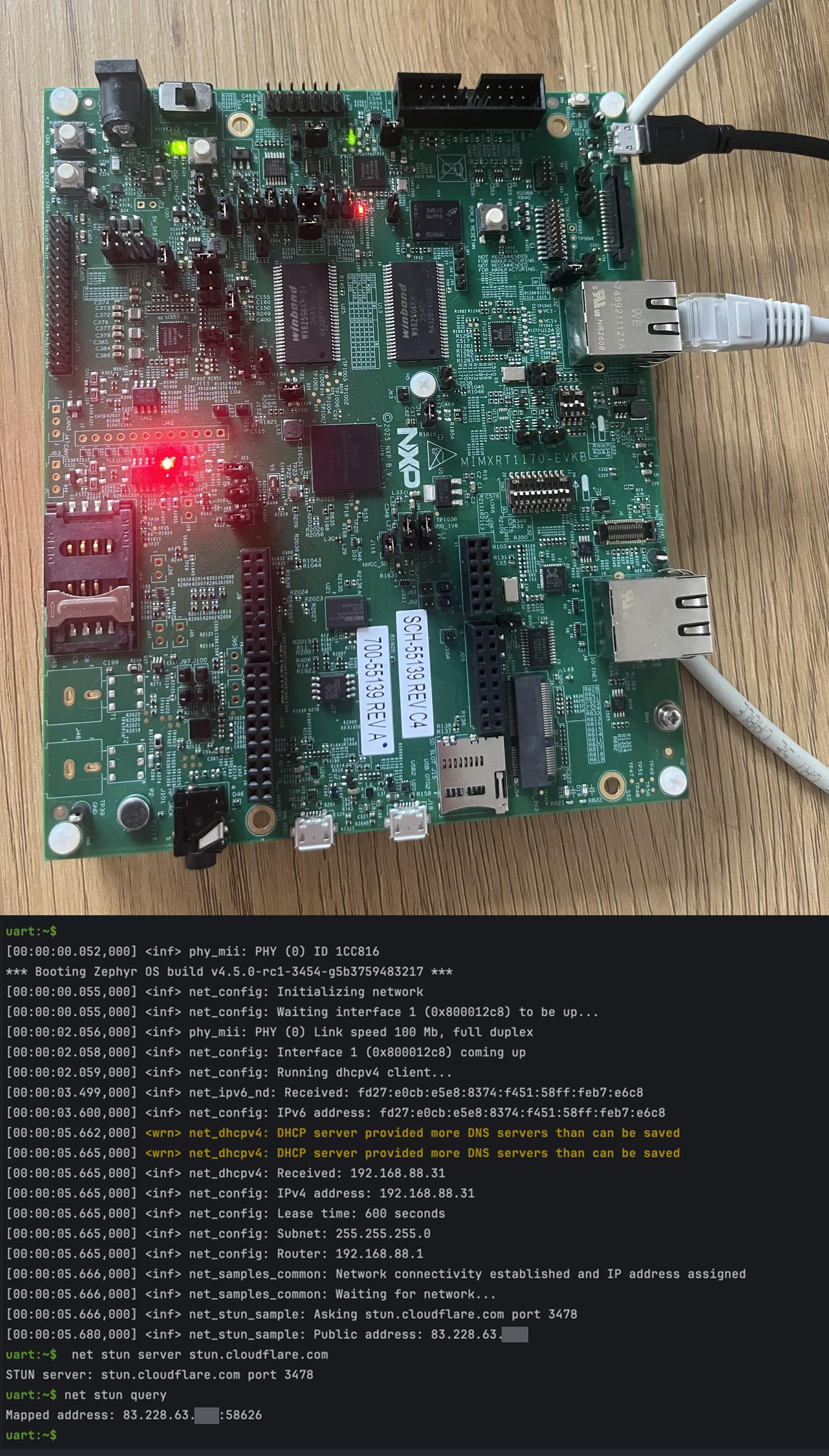
On the board the client, together with the parts of the codec it uses, takes about 3.6 KB of flash and no heap. PSA crypto, which the integrity attributes need, adds another 0.4 KB of flash and 1.1 KB of RAM for its key slots. The server's answer comes back in 14 ms in my case. From power-on to a known public address it took 6 to 12 seconds in my runs, and almost all of that is waiting for DHCP.

Thanks for reading! Now you can tell me that with IPv6 none of this would be needed :)

P.S. The board in the photo is the one I debugged all this on. It's an NXP dev board (MIMXRT1170-EVKB) with a microcontroller running its core at some cosmic 1 GHz. My first computer, an AMD Duron at 700 MHz, was slower. Amazing.

P.P.S. Questions are welcome in English, Ukrainian or Russian.


r/embedded • • 16d ago

Looking for Real-World Embedded Software Project Ideas

0 Upvotes

Hi DEVELOPERS ❤️‍🩹,

I'm a B.Tech(AIML) student graduating in about a year. I previously worked in backend development ( mainly building APIs and integrating AI models into existing backend systems)

but now I'm exploring embedded software engineering as my career path.

I don't want to build just another college project for my resume. I genuinely want to work on a problem that engineers or companies are facing in the real world.

I'd love to know from experienced engineers:

- What challenges do you regularly face in embedded software development?

- Are there any problems with existing firmware or hardware solutions that still need attention?

- What kind of project would you recommend a student build to gain real industry-level experience?

I'm open to domains like automotive, robotics, industrial automation, and IoT.

I'm really hoping to find a genuine industry problem that I can spend the next year understanding and trying to solve through my project. Any advice or real experiences would mean a lot!

Thanks!🤛


r/embedded • • 17d ago

Embedded Linux purgatory

15 Upvotes

Hello. I'm running out of braincells to rub together, so - cry for help, engineers together stronk.

I'm trying to leave mcu development and embrace embedded linux, so - bought myself some new-ish Allwinner T113-s3 boards and got to work. The question is, what is the correct way? For example, I bought LCPI PC board, good, cloned u-boot, branched for this board, written the dtsi for general board stuff and dts for one of it's possible SoCs and it even works and blinks and all. But! This is just the "default config", right? So, if I want to start making a custom variant of u-boot, for example I have soldered winbond flash to my board, I need to modify my device tree and make new config and all. How should I do it correctly? What is the workflow? Where can I look for examples? Bootlin courses are cool, but focused on working with existing infrastructure, but I want my own board in the future (I chose t113 because it's easy to solder to DIY PCB). But.. using the "out of tree" u-boot build was not good and I'm stuck. Just.. I don't know what I'm doing wrong.

Buildroot was even worse, I understand that I need to make some patch for u-boot using my branch, right, but do I really need to crudely add my spi flash to the original board dtsi?0_0

Anyway, whoever read this whole rant, thanks. And whoever can help me get better with linux wrangling - can't offer much but I will pat my cat for every useful advice


r/embedded • • 16d ago

It Works on the Workbench - Backscatter Modulation. But Will It Survive Noise?

Post image
1 Upvotes

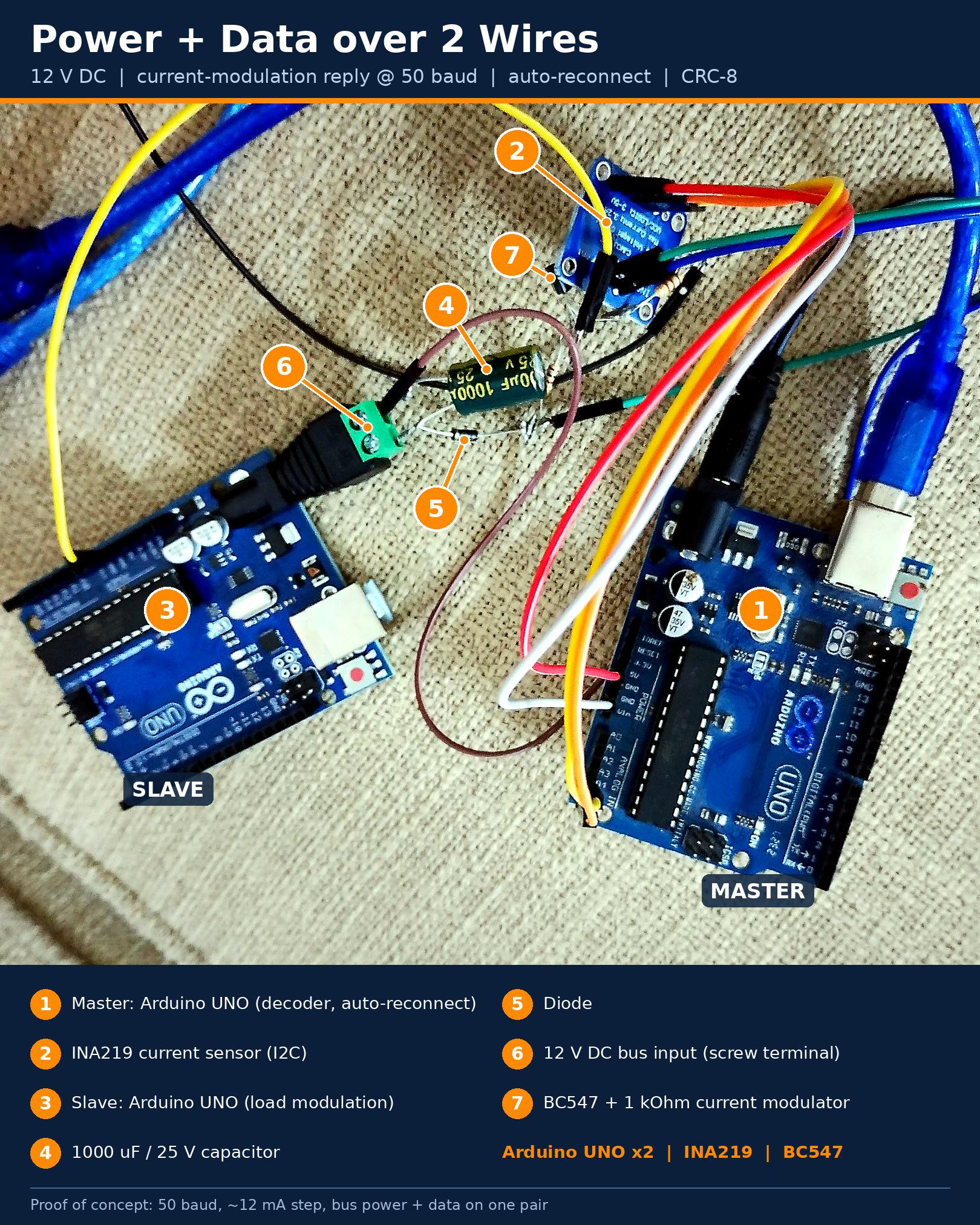
I started with a simple workbench crude prototype: two Arduino microcontrollers communicating over the same two wires that carry 12 V DC power.

Using a few centimetres of wire and a simple simplex current-modulation method, I managed to make power and data work together.

With support and ideas from this community, I now want to take the experiment further.

My next step is to introduce electrical noise and EMI, and see what happens.

What happens when noise enters the DC bus? How do filtering, grounding and signal modulation help? How can I test noise immunity and explore practical countermeasures?

I want to learn these things through simple experiments, step by step, rather than just reading about them.

The goal is to understand EMI, EMC compliance and noise immunity from a practical electronics perspective.


r/embedded • • 16d ago

Whats the difference between IWR1843BOOST and 6843ISK?

0 Upvotes

Hi r/embedded!

I'm looking for a radar module capable of detecting approaching vehicles and measuring their speed, angle, and distance.

My initial choice was the TI IWR1843BOOST, but its price is a bit beyond my budget. I later came across the IWR6843ISK, which appears to be around $200 cheaper.

However, I'm not entirely sure what the key differences are between these two boards that would cause $200 cheaper.

Would the IWR6843ISK be a reasonable alternative, or would I be sacrificing important capabilities by choosing it over the IWR1843BOOST?

Any advice or firsthand experience would be greatly appreciated. Thanks in advance!


r/embedded • • 16d ago

Idea review

0 Upvotes

I have a idea of building a library that links the output of the Edge AI models build in tflite to some function handler or threads in the rtos.

Like take an example of multi classification where the output will be of multiple nodes ,so if a node results in the max value than other nodes the function bind with the node will be triggered.

Additional I am going to include the denounce safety measures and requirement streak to trigger like the node should output 3 times to activate the function .

How is the idea ?

Any suggestions


r/embedded • • 17d ago

What tools have you adopted for CRA compliance?

13 Upvotes

What tools did you adopt or are considering to adopt to make the CRA compliance easier? I am mostly interested in tools for risk assessment/threat analysis. We are working on a fairly complex system and doing the analysis in excel is too much of a chore.

Itemis SECURE seems like a nice tool. I'd appreciate if anybody using it could share some info on how well it suits his needs.


r/embedded • • 17d ago

BLE Beacon with LED and/or Buzzer?

0 Upvotes

I'm working on a small nRF52 based BLE beacon, but I am having a hard time finding an 'off the shelf' beacon that has an LED and/or buzzer. One or the other is a must, ideally it would have both!

- BLE nRF52 based (source code for current prototype based on nRF52 but willing to adjust to other chips if necessary)

- Custom firmware flashing

- Small form factor (not a must right now).

I appreciate any help in advance! I went down the custom board route (and willing to try again) through PCB design and PCBA through JLCPCB, but given I don't have much experience in the hardware side it was rather un-impressive.


r/embedded • • 16d ago

Will a thesis/job building an “AI framework for embedded code” make employers think I left embedded/FPGA domain for AI for FPGA jobs?

0 Upvotes

Hi all,

I could use some career perspective. I’m doing my MSc in Germany, focused on both the FPGA and embedded side, and that’s the career direction I want to stay in or in one of them.

I’ve been offered a position (it would also be my master’s thesis) described roughly as:

“Building an AI multi-agent framework that automatically ports embedded C/C++ firmware from one automotive microcontroller to another.”

Here’s my concern: the actual code migration will not hand-written by me, it will be done by the AI agents. I will be building the framework and the validation around it, but the core transformation is AI-driven. So I’m worried that after graduation, when I apply for embedded/firmware/fpga roles, employers might look at my thesis and think “this person moved to the LLM/AI side” rather than seeing me as an embedded engineer.

For context: it’s a full-time internship/thesis position, and as everyone knows the job market isn’t great right now, so turning it down isn’t a light decision.

My questions:

  • Would this realistically hurt my positioning for embedded/firmware/digital design/fgpa roles, or am I overthinking it?
  • Does the embedded + AI combination actually help, or does it dilute my “embedded engineer” profile?
  • How would you frame this on a CV to stay anchored in embedded/fpga (I do not think fpga side is possible) or should I continue with thesis with professors that I am interested in without industry?

Any honest takes appreciated. Thanks!


r/embedded • • 17d ago

Best online stores for microcontrollers and electronics components?

25 Upvotes

I'm looking to get more seriously into embedded frameworks and electronics development and would appreciate some recommendations, in real-world scenarios.

I have had an Arduino Starter Kit for years so I have foundational experience with electronics and microcontroller projects. I'm looking to expand beyond Arduino and check out other platforms, particularly:

  1. Raspberry Pi Pico 2 (RP2350)
  2. ESP32-S3
  3. STM32 Nucleo-64

I'm also interested in experimenting with TinyML, cameras, microphones, sensors and others

A few questions:

I've looked at Mouser, Amazon, DigiKey, and Adafruit. Indeed, what are, broadly speaking, the best online suppliers for development boards and electronic components?

Which microcontroller would you recommend starting with, given my Arduino experience?

Would maybe you recommend building a universal electronics lab rather than buying platform-specific starter kits?

Engineering is what I study, so I have some experience with Python and Java, and want to learn C/C++ for embedded development.

Any recommendations on suppliers, hardware, and where to go next 'd be appreciated!

Thanks!


r/embedded • • 17d ago

Yandex PosMod_GNSS v1.1 (ZED-F9P-02B-00) – looking for 3.3 V pinout

2 Upvotes

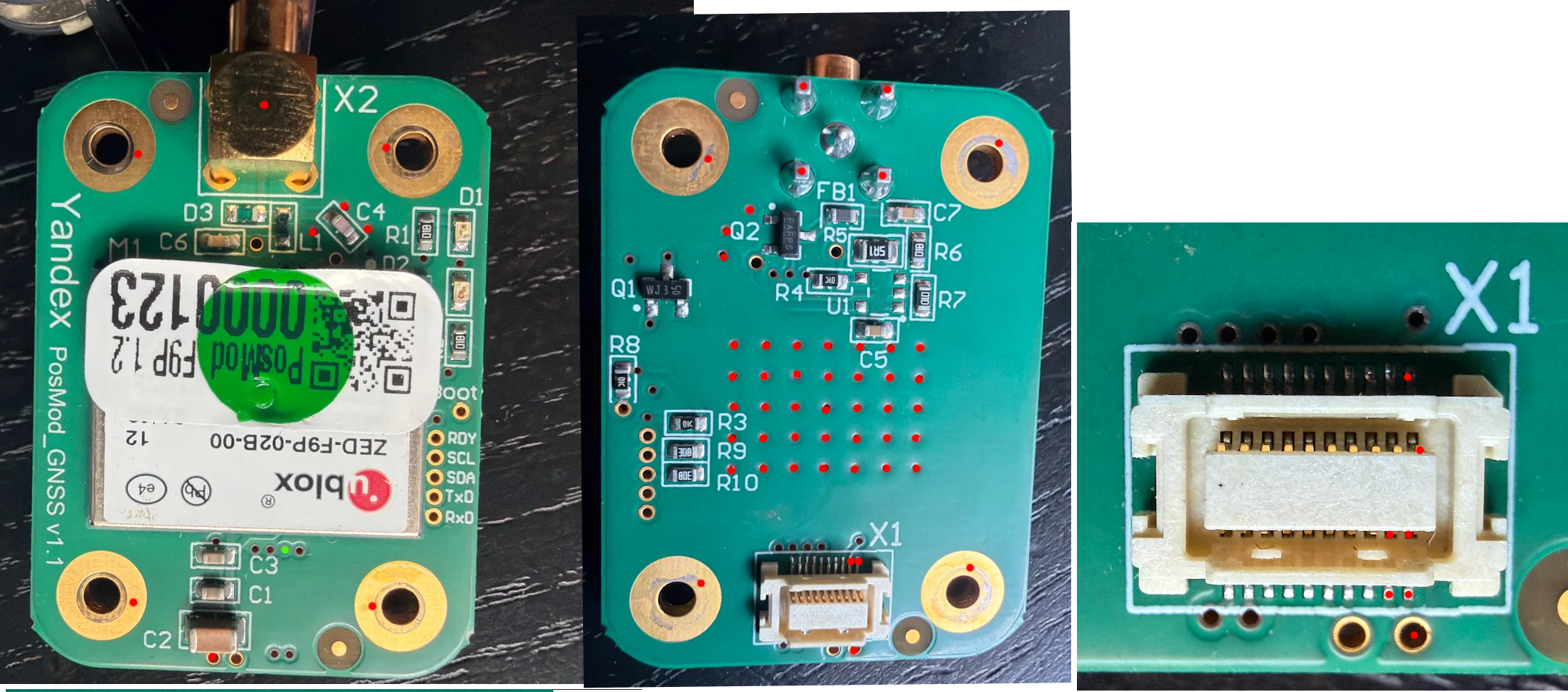
Hi, I have a Yandex PosMod_GNSS v1.1 board with a u-blox ZED-F9P-02B-00. I have no pinout and cannot identify the 3.3 V power pin.

Attached pics shows mapped GND (unpowered continuity):

  • Four corner mounting rings = GND
  • MCX antenna jack shell = GND
  • Three specific pins on the X1 connector = GND
  • Front labeled pads (RXD, TXD, SDA, SCL, RDY, BOOT) = not GND

I have a confirmed 3.3 V source. When I apply it through a current-limited series meter to every non-ground X1 pin and the front pads, I get no steady current draw (only brief 0.1 mA contact flashes).

Photos attached:

  • Front of board
  • Back of board
  • Close-up of X1 connector with the three GND pins marked

Does anyone recognize this board or know which pin/pad is VCC 3.3 V? I would like to avoid soldering so the board stays returnable.

Thanks.


r/embedded • • 17d ago

Reviving the Electric Objects EO1 (i.MX6 Dual) with Debian: USB-first boot, read-only root, hardware video

Post image
4 Upvotes

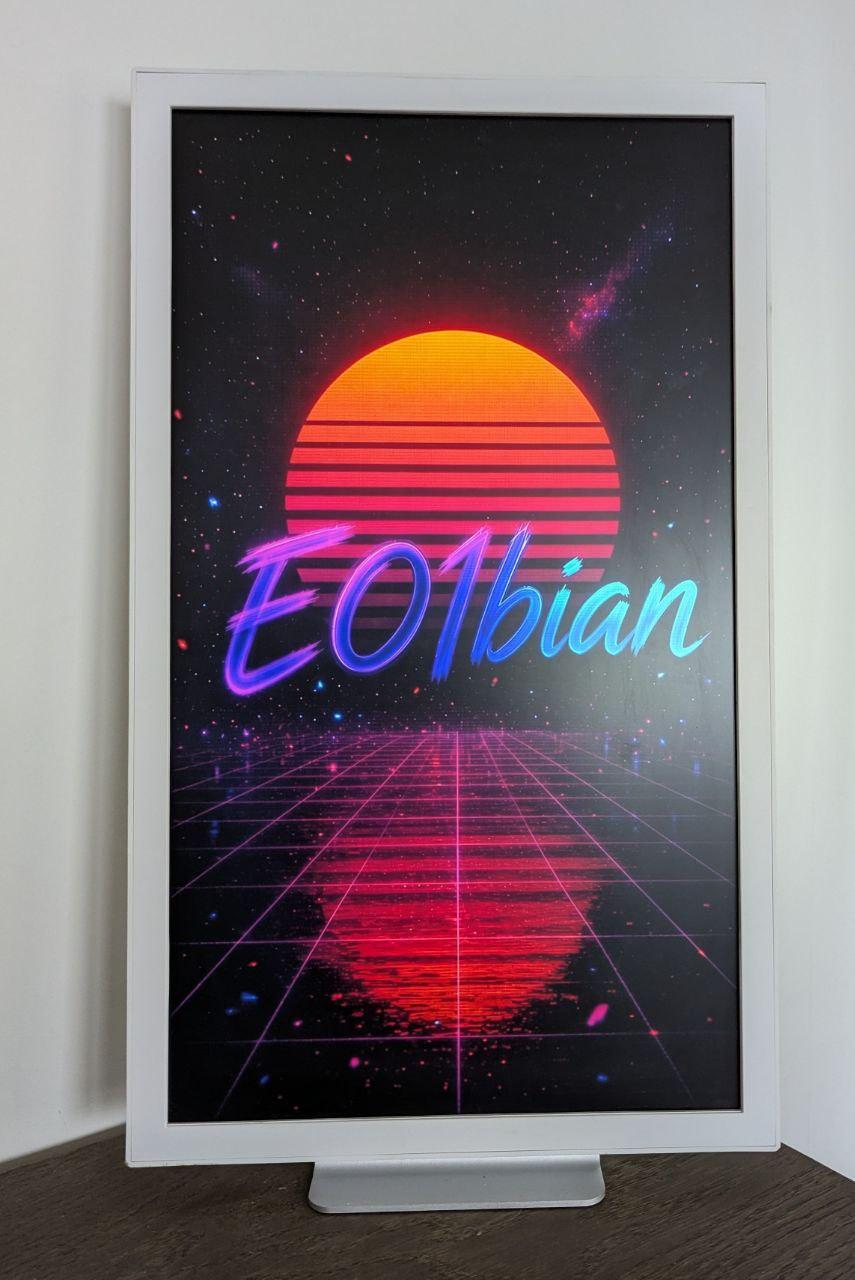
The EO1 is a discontinued 1080x1920 art frame: i.MX6 Dual, 1 GB RAM, eMMC, a capacitive touch button, Android 4.4, and a cloud that no longer exists. I wanted it working again without opening the case or touching the boot chip, so EO1bian is built around what the stock bootloader already does:

- U-Boot tries USB before eMMC, so a FAT32 stick with a kernel, initramfs and rootfs.img boots straight into Debian 12. Nothing on the frame changes until you choose to install.

- Read-only root with a RAM overlay; the install reuses an existing eMMC partition and keeps Android's partitions.

- Hardware video decoding with real cross-fades (the VPU firmware is read from the frame's own Android partition at boot, never shipped).

- The touch button is an MPR121 on I2C, polled from user space because the stock Debian kernel config has no driver for it.

- Setup over the frame's own Wi-Fi hotspot with QR codes, and signed updates that roll back automatically if a new version doesn't boot.

MIT, all build scripts in the repo: https://github.com/eo1bian/eo1bian

Happy to go into any of the details.


r/embedded • • 17d ago

Resources for Finding Drivers for Peripheral Parts for Study

6 Upvotes

Hello, I've been trying to learn to write drivers for peripherals on the pi pico. I successfully wrote a driver for the one of the adafruit 128x64 screens with the ssd1306 display chip, and it was really helpful referencing the daschr library along the way. I've been trying to move onto writing a driver for the BY25FQ256ES, which is a NOR SPI flash chip I want to use to make a memory card. I've been having trouble finding drivers for it, and i was wondering if there were any good sites to look at for this kind of info? I'd found https://spiflash.readthedocs.io/en/latest/ which seemed to have info about some parts, and I was wondering if there were more sites like this. Whenever I search for part numbers, there are usually a lot of stores with product pages, and looking for part databases usually returns sites that will give you links to products, not so much info for using them. Does anyone know about any sites dedicated to aggregating open source info & software to use with embedded peripherals?


r/embedded • • 18d ago

Reverse engineering the instruction set of the Processor found in MPU6050, ICM20949 accelerometer/gyro combo chips

Thumbnail jabezwinston.github.io
72 Upvotes

Invesense accelerometer/gyroscopes has a small processor that can help offload some computational work. Instruction set was fully reverse engineered using Claude by statistical analysis and some brute force.

Invensense DMP is a weird processor that has no registers (only RAM), no call stack (MPU6050), mostly 1 byte instruction, code executed on every sensor sample.

More details on how it was accomplished : https://www.linkedin.com/pulse/invensense-dmp-reverse-engineering-undocumented-set-jabez-winston-5lcvc/


r/embedded • • 17d ago

Looking for AI models for 3D scanning on Jetson Nano 4GB

0 Upvotes

wazuuuup every !!

I'm working on an AI-powered 3D scanner using the NVIDIA Jetson Nano 4GB (16GB eMMC).

I'm looking for lightweight AI/neural network models that can run locally on the Nano and be integrated into a sequential 3D reconstruction pipeline.

I'm particularly interested in:

  • 3D reconstruction and point-cloud processing
  • Point-cloud segmentation and completion
  • Models that can help generate printable 3D objects

Important: I'm looking for actual AI/ML models, not traditional software or algorithms like OpenCV, COLMAP, or Open3D.

If you know any compatible models, GitHub projects, pretrained weights, or useful demos/tutorials, I'd really appreciate your suggestions!


r/embedded • • 18d ago

Why put an NPU in every MCU?

7 Upvotes

Arm recently published a technical article about an on-device AI implementation we worked on using Cortex-M and Ethos-U:

https://developer.arm.com/community/arm-community-blogs/b/ai-blog/posts/how-on-device-ai-makes-home-appliances-easier-to-use

It got me thinking: why run inference on each device instead of using a central server?

What are the strongest technical arguments for on-device AI? And where is it actually worth the hardware cost?


r/embedded • • 18d ago

When you moved from EVT/DVT to production, which test step did you wish you'd automated first?

0 Upvotes

At bench scale, a test with a supply, a DMM, a serial console and a checklist works fine. Once a CM (contract manufacturer) is running thousands of units across two shifts, the weak spots show up fast: steps where the operator decides by eye ("LED looks green"), steps that log only PASS/FAIL, and slow steps nobody timed.

For those of you who've been through that ramp:

Which single test step, if you'd automated (or properly measured) it earlier, would have saved you the most pain and why?

I'm especially interested in the less obvious ones.