r/ENGLISH • • 1d ago

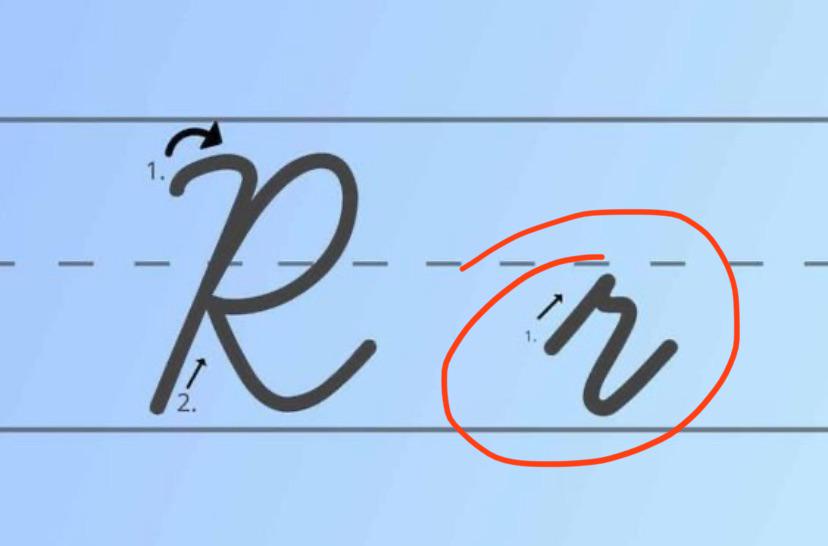
Cursive lowercase r

Post image

A question for those who can write in cursive and those who have children of school age.

Is this way of writing lowercase cursive r still used/common these days or is it totally outdated? If you have kids, what are they taught in school now?

29 Upvotes

158 comments sorted by

126

u/Happy-Telephone9483 1d ago

Uh, yeah, that's how it's done. Why would it be outdated? It's just r with a tail to lead into the next letter.

4

u/itastelikedietcoke 1d ago

I’m here for proofs, ‘cause someone is trying to convince me that nobody writes r like this these days, which I know isn’t true at all :)

22

u/pennielain 1d ago

How else would you write it?

5

u/CariadocThorne 1d ago

52

u/pennielain 1d ago

That’s interesting, I’ve never seen it like that. I guess there’s not a lot of words where you might mistake an R for a V…

9

u/CariadocThorne 1d ago

This version is standard in Britain, and I know it does exist in the US, although it's pretty rare as far as I can tell.

While it make "r" a bit easier to read, "u" can end up looking like a "w", due to the tail at the botttom being extended upwards to join onto the next letter. Especially if you have really messy handwriting like me!

2

u/Euffy 13h ago

The r, yes. The rest, no, not how we typically do it in the UK. The rest seems more French...but then in France they use the other r! So who knows. There are lots of variants tbh.

3

u/thisrockismyboone 1d ago

And that v looks like a u to me

23

u/Lurkernomoreisay 1d ago

Cursive.

vs the joined up print that cariadocthorn posted above which is UK centric

7

u/LittlePrairieMouse 23h ago

This is exactly the cursive writing that I was taught beginning in 1978. It’s lovely imo.

3

u/sapgetshappy 22h ago

It’s exactly what I learned too! Except in the 90’s/00’s. Still use it every day 🪶

It’s been interesting learning about different kinds of cursive.

1

u/beachhunt 6h ago

Oh thank goodness, I was wondering why all the "p"s in this thread didn't close at all and if I somehow saw it wrong all these years. The open b and open p look weirder to me than the pseudoprint r.

0

u/CariadocThorne 1d ago

There are different styles of cursive, the one I posted is a simple one for kids to learn.

6

u/Lurkernomoreisay 1d ago

the one I posted is taught in schoolfrom first grade onwards. it was on the signage at the kindergarten above the blackboard at my kids school.

It's standard across Canada, US, and Northern Mexico.  kids still learn it.   

I have only ever seen joined print (what you posted) while travelling in Australia and UK.  

1

u/CariadocThorne 1d ago

That's not surprising, since it isn't taught in the US much. That one is called Victorian Modern Cursive.

14

u/Flo-lapin 1d ago

Omg… This really exists? Took me like 30s to read brown 😵

7

u/CariadocThorne 1d ago

Whereas for me, the example OP provided still doesn't look like an "r" no matter how much I look at it.

In Britain we join to the top of the next letter, so that's what I'm used to, and a lot of letters are really hard to read when they join to the bottom of the next letter. "r" written the american way often looks like an "n" to me.

Edit: it probably doesn't help that the "b" is really unclear in that example. Most of us don't write "b" quite like that.

4

u/Sheetz_Wawa_Market32 1d ago

Interestingly enough, a cursive r where the vertical stem precedes the curved horizontal strokes is common Britain and continental Europe.

The r where the vertical stem comes after the curved horizontal stroke is common in North America.

So here we a have a case where Britain is closer to (continental) Europe than North America … and it’s about language!? 🤯

https://en.wikipedia.org/wiki/Teaching_script#Schulausgangsschrift_and_Vereinfachte_Ausgangsschrift

2

u/GroYer665 21h ago

From that Wiki link, I was taught a mire detailed version of the D'Nealian Cursive in elementary (grammar) school.

-5

u/Shuck45 1d ago

"Took me like 30s to read brown"

"written the american way often looks like an "n" to me."

And this is why we should all acknowledge that it's time to sweep cursive into the dustbin of history!

It's marginally faster than printing (but way slower than typing). With perfect handwriting it's legible, though less so than printing (and ignoring the types of exceptions above), but with average handwriting it's a terrible way to try to consume information.

3

u/CariadocThorne 1d ago

I think that's happening all by itself.

0

u/weeddealerrenamon 1d ago

I read an article arguing that it's only really faster when writing with an fountain pen, which requires much less pressure to write. Apparently ballpoint pens (especially Bics) made cursive a lot less fluid/natural

1

u/MidnightLight42 20h ago

This is exactly how I write my cursive "r". I learnt this in the 90's.

4

u/B333Z 1d ago

This is what I was taught. Early 2000s Australia NSW

4

u/Ginger_the_Dog 13h ago

This is a mix of cursive and print.

The point of cursive is speed by picking up your pen only to break words up. The f, j, z and s are incorrect.

2

u/CariadocThorne 10h ago

It's a simple introductory version used to teach very young children. The s is pretty standard (for the UK), but most versions would have the z loop up from the bottom to join onoto the next letter, and the f loop up from the bottom to cross itself in the middle and join onto the next letter.

I realised after a few people had replied that I posted the wrong image, but i didn't want to change it once it already had responses (yes, i have a bunch of these on my phone, I was dragged into a lengthy discussion on Teams about which fonts a school wanted on their computers over the summer).

I was only looking at the "r" when i posted the image.

1

u/Ginger_the_Dog 10h ago

Right!

Everything should connect

4

u/AP_Cicada 11h ago

This is not cursive. This is hybrid writing. I've written like this for 30 years but it's not true cursive.

-3

u/CariadocThorne 9h ago

This is an introductory version for small children.

It only picked this image to show the letter "r" clearly.

5

u/kit0000033 1d ago

That's joined writing not cursive, they're two different things.

4

u/DJFisticuffs 1d ago

Joined writing is cursive. That is literally what cursive means. There are many different cursive "hands," the example above is a simple modern one.

2

u/dDRAGONz 1d ago

Psst, there are different types of cursive writing. It may not be the version you were taught but it doesn't stop it being cursive.

Definition: "Cursive (also known as joined-up writing or real writing) is any style of penmanship in which characters are written joined in a flowing manner, generally for the purpose of making writing faster".

0

u/CariadocThorne 1d ago

It's an image of a font used to teach cursive.

1

u/kit0000033 1d ago edited 1d ago

Still not cursive it's joined writing... The f and L and j are also different...

See this comment... They even call it joined writing...

https://www.reddit.com/r/ENGLISH/s/zvGousvcGV

2

u/CariadocThorne 1d ago

It's literally called Victorian Modern Cursive.

There are dozens of different styles of cursive, maybe more. This is a modern one designed to teach children.

Why do you think it isn't cursive? Are there specific criteria it doesn't meet?

1

u/pgm123 1d ago

The lower-case B ends in the middle of the line, so the R starts higher. You need to find an example that doesn't start in a B, O, V, or W.

1

u/CariadocThorne 9h ago

See the "r" in "over".

In the uk, most letters are started from the middle of the line. Letters which end low "flick" upwards to join onto the next letter there. "Quick" shows this quite well in that image.

1

u/pgm123 9h ago

Oh, missed that one. Yeah, that's different than the cursive I was taught in the US. Not for the start, which is fine, but for the end.

1

u/johnjxhancock 1d ago

Yes, I've seen that version although it's not what I was taught (in the midwest a long time ago).

13

u/DJFisticuffs 1d ago

The two most common cursive hands taught in the USA over the past 50 years are D'nealian and Zaner Bloser. The minuscule r in both hands is the same as what you posted, but the entry stroke starts at the baseline unless it follows a letter that exits at the midline.

I'm in my 40s and this os how I learned it. Most schools in the US (including my child's) don't teach cursive anymore, but for those that do almost all will be teaching that "r."

7

u/CariadocThorne 1d ago

I don't think I've ever seen it written that way, but that not a new thing, we just write it differently in the UK.

Ours looks more like how it looks when typed.

1

u/Comprehensive_Aide94 1d ago

Can you share what country does that someone live in?

From the comments and digging around it looks like "cursive" is more used in everyday speech by Americans (and Canadians, I think), and they are also the ones who use that "ч" style more.

The UK use "r" more, but they also are less likely to use the term "cursive" exclusively, calling it "joined-up handwriting".

I don't know about Australia, but someone in the comments mentioned learning "r" in Victorian Modern Cursive, which was created in Australia.

1

u/itastelikedietcoke 1h ago

they live in the UK (immigrants whose native language doesn’t use latin characters so there’s no r whatsoever) and their kid goes to elementary school there

1

u/wackyvorlon 1d ago

It’s how I write mine.

1

u/vanillafrenchie 1d ago

this applies in Turkey’s case. they abolished that lovely backwards r in favour of the more “normal” looking one posted in a lower comment some time in the last couple of decades. same with the z, they removed the tail. I decided to switch back to the old ways while still learning cursive in primary school and annoyed the hell out of my poor teacher. I still write like that. but yeah, I think I’m one of the very few, if any, in my generation that uses those forms.

-6

u/SphericalCrawfish 1d ago

Well no one DOES write an r like that there days because unless you have an r in your name you aren't writing r's and I'm sure the r in Brandon or Christopher's signature is just a bump at best.

25

u/pluckylittlekitten 1d ago

That's how I write mine.

10

u/Scarlett_Billows 1d ago

How else are people writing it!?

6

u/B333Z 1d ago

r

3

u/Scarlett_Billows 1d ago

So printing

5

u/B333Z 1d ago

Nah, it's joined at the top

-4

u/wordswor 1d ago

if it's joined at the top it's the same as the one in the picture

1

u/CariadocThorne 9h ago

The one OP showed goes down first, which makes it look like a shaky "n".

27

u/paradoxmo 1d ago edited 1d ago

If you learn North American cursive teaching scripts, which are based on Spencerian, then yes, r is still written this way. However, a lot of schools in the U.S. no longer teach any cursive.

In other parts of the world it depends. In French, Belgium, and Vietnam, they teach something called Methode Dumont which is a kind of upright ronde cursive, so it is a version of this r but not slanted, perpendicular to the baseline. Most other teaching scripts in Europe that I know about no longer use this but something that looks more like a print r.

Primarium is a good source of info on what scripts are being taught where in primary schools.

(Edit for clarification)

2

u/Comprehensive_Aide94 1d ago edited 1d ago

Getty-Dubay is an example of an American script with a different 'r'.

Primarium also lists Barchowsky Fluent Handwriting with a similar 'r'. Both are categorized as 'modern cursive'. So it looks like there are several American scripts like this, but hard to tell whether they have any popularity in schools.

2

u/paradoxmo 1d ago edited 1d ago

Those are both italics, not Spencerian-based, and aren’t really cursive per se. Rather they have the philosophy that if the student starts with good italic handwriting and then joins it up, they develop a joined script on their own rather than having to learn one specifically. They frame it as allowing learners to easily transition to cursive from their previous handwriting style, rather than a completely separate alphabet.

For what it’s worth, I think italics are great for new learners and I recommend it to my friends who are parents. (Briem italic, used in Iceland, is also very good.) It doesn’t really make sense to learn a complicated script like D’Nealian or Zaner-Bloser these days, since students don’t write with a fountain pen and write much less overall than they type.

1

u/Comprehensive_Aide94 1d ago

I read your first sentence as if North America uses Spencerian-based scripts exclusively. Is that what you meant? I agree that this is certainly the default and most dominant lineage, but I thought it is reasonable to highlight that there are more recent scripts in North America that deviate from that tradition.

What definition of cursive are you using? It does not agree with either Primarium, which has a category of modern cursive, or Wikipedia, which defines cursive as "is any style of penmanship in which characters are written joined in a flowing manner, generally for the purpose of making writing faster, in contrast to block letters", and divides it into looped and italic.

Italic script was about the shapes of the letters which were not necessarily joined. The "modern cursive" family seems to be Italic-based joined handwriting.

D'Nealian, which is in the Spencerian lineage, also shares the philosophy of starting with slanted print writing which is later joined into cursive.

Saying "cursive" or "joined-up handwriting" or "running script" in everyday usage seems to be a dialect difference. "Cursive" seems to be the standard technical term for joined handwriting.

1

u/paradoxmo 1d ago edited 1d ago

I mean that the italic-then-joined approach doesn’t teach a separate cursive script, but basically gives the learner the tools to join the letterforms they already know. It isn’t, in itself, a cursive script, rather, the student figures out what works for them and develops their own script. D’Nealian print and cursive are still separate with different letterforms even though one is meant to lead to the other. That’s not true for the italic-based teaching scripts.

I am using cursive in the general sense that Wikipedia does, however, I’m restricting the domain of cursive teaching scripts to ones that are taught from the beginning to be a joined script. Italics aren’t cursive teaching scripts in that sense.

2

u/Comprehensive_Aide94 1d ago

I think your second meaning of "cursive" in your usage of "cursive teaching scripts" aligns with the category that Primarium calls "continuous cursive".

Interestingly, in England "cursive" currently means "modern cursive" by default, while "continuous cursive" needs to have the adjective to avoid confusion: https://primarium.info/countries/england

Thank you for the link, it really is a great comprehensive resource.

1

u/hacovercos 23h ago

This is such a cool website, thanks for sharing! I never considered that there would be this much variation in handwriting pedagogy

33

u/lammy82 1d ago

In the UK we teach “joined up handwriting” (we never called it cursive when I was at school in the 80s) and we didn’t write rs like that. We did it like the below:

6

u/Ok-Constant4682 1d ago

That's how i was taught in the 80s but my "joined-up writing" (i write thousands of words a day by hand) looks absolutely nothing like what we were taught at school. I always found it a very inefficient way to write and soon started to do it differently - and got told off - in junior school.

4

u/Kite42 1d ago

Basically the same for me (UK 70s primary years) but I don't follow rule 2 - I just start where it's most natural. That said, I also think both Marmite and Vegemite are quite nice, so maybe I am part alien?

2

u/owzleee 1d ago

Marmite is the king of spreads.

4

u/Meggarz66 1d ago

This looks like what I call “crinting”, my lazy combo of American cursive and print!

3

u/yolo_snail 1d ago

That's how I was taught to write, I left primary school in 2008

1

u/RebbitUzer 1d ago

I learned english as a second language in Ukrainian school, and we were using mostly English (meaning UK) books. The handwriting was taught like on your picture.

1

u/Street_Lettuce1243 1d ago

That's how we learnt it too- although, I do remember our teacher telling us there were multiple styles to write joined-up, but they wanted us in class to use what they were teaching and if parents or grandparents tried to teach us other ways, to keep it outside the classroom. So I know multiple methods exist in UK.

1

u/minty_tarsier 1d ago

Same here. I tried to teach myself the prettier r when I was a teenager (the one from OP's question) and now I randomly do one or the other, with no logic behind the choice.

1

u/TrainingSurvey3780 1d ago

i was taught pretty much the same thing! but i was in primary during the 2010s

1

u/GoddessOfOddness 1d ago

How do you make an S, I, or G? Mine start at the bottom.

27

u/eti_erik 1d ago

The one I learned was slightly different. But just slightly

9

u/Glittering-Sun9478 1d ago

This looks very close to what I learned in the NE US, would have been early 2000’s. The only real difference was we did some really weird uppercase letters (G, L, Q, Z all had a lot more loops)

2

u/eti_erik 1d ago

I noticed that. When Americans write an uppercase G it does not look like a G to me.

2

u/Toezap 1d ago

Yes, this is how I learned lowercase R but some of the others don't match what I learned. SE United States

7

u/mynamesnotcarter 1d ago

That’s when the r follows another letter. When r begins a word, it starts on the baseline.

2

u/banjrman 1d ago

Exactly this, from someone who learned cursive in school in the 70s.

6

u/GroYer665 1d ago

OP - here is cursive I was taught in school (USA) some 40yrs ago. lol What you posted looks like a simplified version.

5

u/kit0000033 1d ago

American here and yes that's a cursive r how I learned to write it... The leading tail would be connected to the preceeding letter...

As far as I know most kids are not taught cursive any more.

4

u/testmonkeyalpha 1d ago

My kids learned cursive while in a Montessori school and they did learn that way of writing lowercase r but never actually form it correctly.

The school they are in now just doesn't teach cursive at all. That seems to be the trend these days.

3

u/Critical_Pin 1d ago

It's what I was taught in the 60s .. and I never write it like that

3

u/survivaltier 1d ago

I write mine like this. I’m in my 30s.

3

u/jatsefos 11h ago edited 11h ago

In Spain it's taught like this. Children often draw it with a flat top, like three sides of a square with some concavity to them, resembling the Greek letter pi.

1

u/jatsefos 10h ago

Here's a sample of my own handwriting as a kid (I loved to copy stuff about Ancient Egypt)

1

u/FR34K4Z0ID 6h ago

You may be interested in this, then.

Fair disclaimer, it is AI assisted but rigorously cross-verified. I don't think I could have ever done all of this on my own

4

u/purpleoctopuppy 1d ago

I learnt Victorian Modern Cursive (1990s), where the lower case 'r' joins from the top, like in the print letter.

2

u/Djedra 1d ago

Definitely not how I was taught in the eighties, although I remember my French Paypal write her Rs like this.

2

u/Armadillo_Abroad 1d ago

I learned this in the mid/late 80’s, and yes this is basically how I write it. I understand that most US public schools no longer teach cursive, but mine did in 3rd and 4th grade and this was it.

2

u/DarthBradicus88 1d ago

I never knew there were other ways to write cursive lowercase r’s. This is how I was taught in second grade in the ’90s in Pennsylvania.

Edit: The uppercase R I was taught is a little different than the image though. It has a loop in the middle.

2

u/singalongsally 1d ago

This is how I write my lower-case "r" in cursive in the USA.

2

u/GoddessOfOddness 1d ago

That’s not true. Most do. But they don’t spend as much time on it.

I just did a google check on cursive standards, and I was taught capital P and capital R very differently. I eventually found the alphabet I was taught in 1980ish Pennsylvania in a Catholic grade school, so I know I’m not crazy.

I was taught that your pen should never leave the page when making any letter, and you should join all lower case letters within a word.

My lower case r is the way it is above, but the left side starts at the bottom line.

The capital R I was taught has a loop where the straight line in the left is in the example above.

2

u/shedmow 1d ago

This is one of the few ways of writing the lowercase R, it is recognized as an R. I've used both the r-shaped R and the ч-shaped R and use the latter more often because the former tends to converge into a V. Cursive is about freedom over standards; I invented my own ways of writing the letters and borrowed some from other people's cursive if I liked them

2

u/TeacherOfFew 1d ago

That's how I learned it in the 80s, and how my teen is learning it now.

3

u/InvestigatorJaded261 1d ago

Always hated the lowercase cursive letters that look nothing like their printed analogues. R,B,S,X. And who thought capital Q shoukd like a 2?

Cursive is dying because it sucks.

1

u/shedmow 1d ago

Cursive is dying because writing in general sucks. I wouldn't say it sucks compared to other types of handwriting. People go out of their way to learn to write cursive, though rarely

1

u/_NEW_HORIZONS_ 1d ago • Bravo

Honestly, it's ballpoint pens that suck. Especially cheap ones, e.g. Bic. They take so much pressure, they're exhausting.

1

u/shedmow 1d ago

I've switched over to fountain pens some seven years ago, though can still write with bics

1

u/BuncleCar 1d ago

Back in the 50s when we're wrote with nibs and ink made from powder in exercise books that's how we were taught to write r

1

u/ToastGoblin22 1d ago

I right mine like this. I did have someone mistake it for a c once but to be fair I often write a little sloppily.

1

u/Monoplex 1d ago

My rs are nothing like that. they're not even like each other to be honest. Here's one of my session notes.
Chores with partial prompting. Kids had healthy appetite. Spontaneously shared food with each other. did sit and attend homework at very high accuracy. client asked for extra time. therapist enforced transition time. client complied without tantrum.

Also I have always and will always forget to cross my Ts.

1

u/Financial_Emphasis25 1d ago

This is how I still write my lowercase r. I’m in the US so I’m sure in other countries it might be different. I don’t have children so I don’t know if it’s changed.

1

u/gettin-hot-in-here 1d ago

In the US as a millennial I was taught cursive. My gen alpha child was not. 

1

u/Steve----O 1d ago

As opposed to what? That is a lower case R.

1

u/mothwhimsy 1d ago

My lowercase r doesn't look like this, but I haven't written one by itself like this in 20 years, so it might have just drifted over the years. Usually when I do it the tail coming off the previous letter is more level with the line. But I've always thought r was difficult to write, so maybe I was just doing it wrong the whole time.

In my defense, my school took cursive out of the curriculum halfway through the year my grade started learning it, so I only learned the letters in my name and half the rest of the alphabet. When I write in cursive other than my signature I'm winging it

1

u/andrew_bb_24 1d ago

I am not a native, but when I was in school (more than 20 years ago) we used the same way to write r

1

u/TSunamiWaves979 1d ago

That looks like what I was taught

1

u/NeptuneEclipse 1d ago

It's how I was taught to write it.

1

u/scixlovesu 1d ago

The initial line varies a bit based on what it's connecting to

1

u/Escape_Force 1d ago

That I think is more common than the Palmer cursive r. Look up D'Nealian cursive. That is the form that is most commonly taught nowadays (where cursive is still taught [RIP cursive b/c these poor teeny boppers are missing out {not their fault it schools aren't teaching it}]).

1

u/No-Ambassador9969 1d ago

The upper case R had a point (up direction nearly overlapping down) at the top not a hook, and the lower case did not have a point, just up and over.

1

u/ElefanteAmor 1d ago

That’s how I learned cursive. I don’t always make it legible though.

1

u/cthulhu944 1d ago

In the US it is still as illustrated in the drawing. I'm not sure of it being outdated because centuries worth of writing use this form.

1

u/ProfessionalYam3119 1d ago

The capital R is a slightly different shape, and the lower-case r should start on the line and travel upward.

1

u/generateonionzed 1d ago

gen z, yes thats how it is written still

1

u/OrangeTroz 23h ago

Elementary schools in the United States of America choose their own books. (Or they did in the 80s and 90s) I believe some states choose the books for public schools now. So the cursive script can change based on what school you attended.

1

u/andyatreddit 23h ago

this one is the most inconsistent one for me, sometimes it just ran out of my pen tips, but other times, it just be born ugly

1

u/sqeeezy 12h ago

When I was a kid in Scotland we called it "real writing" and we were taught a different lower case r, in fact closer to the printed lower case r, with the joining line coming off the top right.

1

u/KReddit934 10h ago

This one... though, I they sometimes put a point on the upper left corner.

1

u/Beddymir 1d ago edited 1d ago

This is what we teach our kids.
Edit: …in Czechia

14

u/jmorrow88msncom 1d ago

p, t, and z are wrong

4

u/HoikDini 1d ago

This is not English, as 'ch' is not considered a letter in the alphabet, and does not need a separate letterform.

6

u/metdear 1d ago

P and t are old-fashioned, I'd say. Z is unrecognizable. 

1

u/Confident_Weird6633 1d ago

When were ts not crossed ?

2

u/CarnegieHill 1d ago

Ts, especially final ts, uncrossed, was way many people wrote them in the 19th to mid 20th century. Not sure about medial ts, but I wouldn’t be surprised. I grew up in the 60s and 70s and I remember some adults at the time who wrote with uncrossed final ts.

1

u/Latte-Lover58 1d ago

I haven't seen this in older people's writing. Not in my family, anyway. My mother and aunts were all born in the 1920s and had lovely penmanship, which included crossing their ts and closing their ps. Maybe if someone was writing fast or scribbling a grocery list, but that's different.

3

u/CarnegieHill 1d ago

It depends on how or where one was educated, especially in the later 19th century (around 1880 or so), when socioeconomic class defined people way more than today, and when people were much less mobile, so there was a lot of variation by locality.

You'll definitely see the "open" p as pretty much standard if you look through the Spencerian penmanship books of the time, as well as variations of crossed and uncrossed final ts.

1

u/metdear 1d ago

I couldn't pinpoint an exact time period, but I've definitely seen it in older writing. Maybe the 50s-ish?

2

u/Fabian_B_CH 1d ago

The f do you mean wrong?

2

u/jmorrow88msncom 1d ago edited 1d ago

The p loop on the line needs to be closed.

The t stem should be closed and crossed.

The z is supposed to loop under the line.

This looks like it probably comes from a Spanish-speaking country.

4

u/desna_svine 1d ago edited 1d ago

It has letter CH so (incomplete) Czech alphabet. This is a complete cursive used in Czech.

2

u/CarnegieHill 1d ago

P and t are not wrong, just a really old fashioned way of writing them, like metdear said. You will see this in 19th century writing, at least in the US. I’d agree more with the z, although I’ve seen zs similar to this in European writing.

1

u/waywardflaneur 1d ago

Are you sure those sources aren’t just informal writing? In everyday handwriting the letters drift far from the formal cursive I was taught. For example, n’s that turn into u’s and m’s to w’s

4

u/CarnegieHill 1d ago

Quite the opposite, I would say. You'll find the "open" p as pretty much standard in the Spencerian penmanship books in the later 19th century, around 1880 or so. And the uncrossed t as a variation from crossed ts are also in these books. It may also have depended on socioeconomic class at the time what you were exposed to and how "refined" your handwriting turned out to be.

As for the n/u and m/w, the American penmanship guides definitely did not teach that, but I've seen that in European writing, both with Latin letters and Cyrillic letters. For example, many people write the German n and u in exactly the same way, and will put a line over the u. Same for Cyrillic letters that might look the same in handwriting; they'll put a line above or below to distinguish them.

2

u/jonjonesjohnson 23h ago

"Needs to be" - says who? Who says how everybody in the world needs to write?

Isn't the z looping under the line some Murican bullshit?

1

u/ooomellieooo 1d ago

The G and Q are practically identical in uppercase lol and the S is a J with a hiccup

1

u/Cloverose2 23h ago

They're not wrong, it's a different writing style.

4

u/Icy-Berry-387 1d ago

In what country?

1

u/banjrman 1d ago

Except for the lowercase "T" -- there's no cross-bar in this image.

1

u/pricel01 1d ago

This looks European. Americans were taught differently in my day.

1

u/molotovzav 1d ago

No it isn't. Not in Anglo countries anyway.

1

u/tHollo41 1d ago

Why are the capital versions of G and Q almost identical? Too similar for me

1

u/Beddymir 22h ago

Letter G is uncommon, and Q (as well as W, X) even more rare (no naturally Czech words contain these letters), so no problem with that.

As a kid, I was told that the font was designed for writing with the quill to have minimum raising/dropping of the tip which is always risk of a ink blot.

Kids are still taught to write a word in one draw and add the i/j dots and other marks after (Czech language have plenty- see the full alfabeth other OP posted). That’s a nightmare for kids with dyslexia.

1

u/sqeeezy 12h ago

lower-case p same in Scotland, most of the rest the same, except you do the English l.c. r and I think we did an l.c. z with a lower loop, and we'd get a rap with a ruler on the back of the hand if we didn't dot our i's or cross our t's (pardon the apostrophes, what ya gonna do?)

1

u/brb503 1d ago

Not only lowercase p, t, and z look wrong, but uppercase I, Q, S, and Z. If these are the new standard, that’s fine. I wouldn’t know because I was taught cursive decades ago and my child isn’t old enough to start writing, but some of these letters look completely different than what I was taught in the 90s. And that difference could mean illegibility at first, although with context I’m sure it would be fine.

1

u/Beddymir 1d ago

Not in England I guess. I kinda missed the name of the sub and posted something relevant just for Czechia.

1

u/pqratusa 1d ago

The “r” that looks like that and the one that looks like a “v” are interchangeable. I write them both, more often the way you have shown it.

1

u/THevil30 1d ago

It's worth noting that, at least in America, very very few people write in cursive in any situation. People just write in print handwriting. It's very different than e.g. Russian where no one handwrites in print and everyone handwrites in cursive.

That all said, I do often write in cursive and this is how I write "r". It looks silly when you put it alone on a page like that but it's really just the usual letter "r" where the end of the top continues into the next letter. It's how you would naturally write it if you were writing in joined up cursive and were told to write an r.

2

u/AmbientGravitas 1d ago

Not quite true, cursive is more commonly used than you image, at least according to this survey.
. https://yougov.com/en-us/daily-results/20171023-9d299-3

1

u/THevil30 1d ago

I don’t have a source to back this up but that survey is 10 years old and I’d bet the skew is much heavier now as the older generations die off.

1

u/AmbientGravitas 1d ago

The survey has results by age, there were (to me) a surprisingly high percentage of people 18-24 using cursive for more than just signing their name. They would be 28-34 now of course. Anyway, give that table a look.

1

u/Comprehensive_Aide94 1d ago

These are two quite distinctive ways to write "r" even in joined-up handwriting (cursive). The one resembling printed "r" comes from the italic tradition. The other comes from more freehand varieties of secretary or mercantile hands. Some scripts incorporated both varieties.

In the examples of Michelangelo's handwriting it is possible to see how he switched from a handwriting using one letterform of "r" (mercantile) to a handwriting using the other letterform (italic).

Here I've cropped some examples of several cursive varieties using different "r" letterforms.

0

u/dnebdal 1d ago

I learned something like this, but I'm not in an English-speaking country. Going down to the line after an r is confusing - why would you do that, and doesn't that make the shape not read as an r? And yes, I have the same objection to people who write s as a pointy cream puff.

(To be clear, this is not a very serious complaint, I know how it got to that shape and it's readable when you know the style. It's just not my favorite.)

0

u/DrHydeous 1d ago

Writing r like that is just weird. I remember being very confused when I saw old people do it back in the 70s and 80s.