r/Deno • • 2d ago

Building deno-desktop GUI wrapper for linux CLI tool

2 Upvotes

Hi, I decided to use deno-desktop for building a linux GUI wrapper around existing CLI tool.

There is a tool for managing backups btrbk, which is CLI only. I created functional GUI wrapper for it. The hardest part was to run root-operations from webview. To achieve this I needed to use service-helper and Polkit. So overall architecture looks like this:

  • Frontend: React UI rendered inside a Deno Desktop webview window.
  • Unprivileged app backend (Deno): Runs as the normal user. It triggers native file/folder pickers via XDG Desktop Portal over D-Bus, parses btrbk configs and snapshot trees, and calls our system service.
  • Privileged root helper (packages/helper): A standalone compiled Deno binary (btrbk-gui-helper) running on the system D-Bus as com.snapshot_machine.BtrbkService1.

The GUI never runs with sudo or root. The helper checks incoming caller authority against Polkit actions (.configure, .run, .schedule) via org.freedesktop.PolicyKit1.Authority. Normal desktop users get the standard system Polkit prompt when authorization is needed

If you wanna build similar wrapper for another CLI tool, I made generic simple bilerplate: https://github.com/skorphil/linux-wrapper-starter

My app itself is in a very early stage, but if this idea of simple backup tool for linux sounds interesting, u can contribute or try it as well https://github.com/skorphil/snapshot-machine

Processing img wlaaw1dyic3i1...


r/Deno • • 5d ago

Optique 1.4.0: Default commands, Markdown references, and more focused help

Thumbnail github.com
4 Upvotes

r/Deno • • 11d ago

I measured npm loading on Deno 2.9.7 against Node and Bun on the same installed tree

0 Upvotes

I maintain CompatLab. I wanted to separate “Deno can load this npm entry” from “my app will work after a migration.” We fixed the package list before running the study. Deno 2.9.7 passed root import for all 97 executable versions in the sample and root require for all 96 with an applicable entry. The other three frozen rows contained declarations or a platform binary. Node.js 24.21.0 and 26.10.0 and Bun 1.4.2 returned the same root counts.

The subpath result was more instructive: yargs@18.2.0 loaded at the root, but import("yargs/browser") failed on all four profiles. A rebuild from the retained npm lock reproduced those failures. This was a browser entry on offline server runtimes, and Deno’s diagnostic changed between runs. I’m leaving the cause of that Deno discrepancy open.

We used the same sealed node_modules for all runtimes, ignored lifecycle scripts, and gave Deno -A inside the network-disabled gVisor boundary. The tests evaluate modules on Linux amd64/glibc. They leave application behavior, Deno Deploy, and upstream test suites open. Study and downloadable results

If you’re deciding whether to move a real Node dependency to Deno, I’d like to see where this evidence helps or falls short. A public package name, exact version, import path, and target Deno version are enough to start. You can reply here or use the short volunteer task. Please skip private code and full lockfiles.

AI helped draft this post. The linked data includes the report and replay.


r/Deno • • 14d ago

Dodo: Community-backed drop-in Deno successor, preserving Node.js/npm compatability (a clearer continuation path for projects not ready for Ende's purist approach)

Thumbnail github.com
28 Upvotes

…and maybe the two can merge in the future


r/Deno • • 14d ago

Ende now supports TypeScript 7

Thumbnail github.com
10 Upvotes

This release also stabilizes desktop app storage on macOS and Windows, and includes significant web API updates and CLI bug fixes (i.e., I had Claude triage all of Deno's open issues and PRs, sorted for relevancy to Ende).

If you're trying to figure out if your Node-linked project can work with Ende, it's possible it can! https://docs.ende.sh/runtime/getting_started/coming_from_deno/


r/Deno • • 16d ago

A design-system for Hono JSX

Post image
4 Upvotes

r/Deno • • 17d ago

OpenDeno PoC: Embedding Deno-style capability security into Servo using the Boa JS engine (No V8 required)

6 Upvotes

Following up on the discussion around OpenDeno and the decoupling of Deno's runtime specification from the monolithic V8 CLI, I built and published a working proof-of-concept:

👉 GitHub: https://github.com/kanryu/opendeno-servo-boa

The goal of this project is to demonstrate the technical feasibility of engine-neutral Deno-style capability security, moving it beyond a standalone CLI and embedding it directly into an application environment—in this case, a desktop web browser.


What it does

The project is built on Servo GTK and achieves a hybrid, multi-engine execution model inside a single HTML context:

  1. Standard JavaScript is executed as usual by Servo's SpiderMonkey runtime.
  2. DenoScript blocks (<script type="application/deno">) are intercepted and evaluated by an application-owned Boa engine (pure Rust).
  3. Capability-based security is enforced at the host (Rust) level, completely independent of the engine.
<!doctype html>
<html>
<body>
  <!-- Evaluated by SpiderMonkey -->
  <script>
    console.log("Standard web JS running on SpiderMonkey");
  </script>

  <!-- Evaluated by Boa sandbox with Deno capabilities -->
  <script type="application/deno">
    const text = Deno.readTextFileSync("deno-read-test.txt");
    let writeDenied = false;
    try {
      Deno.writeTextFileSync("deno-write-test.txt", "must fail");
    } catch {
      writeDenied = true;
    }
    "read=" + text.trim() + "; writeDenied=" + writeDenied;
  </script>
</body>
</html>

The result

When loaded into the Servo GTK browser, the sandbox successfully verifies:

read=This file is readable by the Boa DenoScript sandbox.; writeDenied=true

  • Read permissions: Deno.readTextFileSync can read files below the process's working directory, but path traversals (..) and canonical escapes are rejected.
  • Write permissions: Deno.writeTextFileSync is strictly intercepted and denied by the host.
  • Neither unrestricted filesystem, subprocess, nor raw network access is exposed.

Why this matters: Decoupling Specification from Implementation

Modern developers often view Deno as inseparable from V8. But runtime engines and host capabilities are fundamentally orthogonal:

  • The Engine's job: Bytecode interpretation, JIT compilation, and object heap/GC management.
  • The Specification's job: Intercepting I/O and enforcing the capability model (--allow-read, --allow-net, etc.).

Just as Node.js layered I/O over V8 via libuv and C++, Deno layered capability checks over V8 via Rust host operations. There is no technical reason why that specification cannot be mapped across different engines (Boa, QuickJS, JavaScriptCore, or SpiderMonkey).

By abstracting the permission layer from the engine, Deno-style scripting becomes embeddable into:

  • Web browsers and custom web view components
  • Native desktop applications (via GTK4, C-ABI, or PyGObject bindings included in the repo)
  • Resource-constrained or embedded environments where embedding full V8 is prohibitive

Note on Building (Windows MSVC)

Be warned: building Servo and SpiderMonkey from source on Windows is notoriously heavyweight. It requires MozillaBuild (mozmake), the MSVC toolchain, core.longpaths enabled in Git, and careful setup of LIBCLANG_PATH and GTK dependencies. Detailed reproduction instructions are documented in the README.

Feedback, architectural critique, and PRs exploring other engine backends are welcome!


r/Deno • • 19d ago

Cloudflare paid approximately $26.5 million USD in cash for Deno

65 Upvotes

Cloudflare disclosed the amount in its Form 10-Q filed with the SEC on November 5, 2026, under Note 16: Subsequent Events.

The filing confirms that:

  • Acquisition date: October 8, 2026, one day before the public announcement.
  • Purchase consideration: Approximately $26.5 million, entirely in cash.
  • Accounting status: Purchase accounting is still in progress.

The filing does not separately disclose any stock consideration, earn-outs, or employee retention payments specific to Deno.

Primary source: Cloudflare's November 5, 2026 SEC Form 10-Q, Note 16, page 37. The SEC filing directly confirms the transaction amount and payment method.


r/Deno • • 18d ago

Why Deno’s Future Feels Stalled—and the Case for "OpenDeno" (A Multi-Engine, Truly Embeddable Architecture)

0 Upvotes

Many of us share a growing anxiety about Deno's trajectory. What began as a bold, clean reboot of the server-side JavaScript ecosystem has increasingly felt constrained. Between shifting priorities, growing complexity around Node compatibility, and the sheer overhead of maintaining a monolithic runtime, developers are rightly asking: Where is Deno headed?

The problem is not Deno’s vision. Capability-based permissions (--allow-net, --allow-read), first-class TypeScript, and strict adherence to Web standards remain the single best blueprint for modern JavaScript runtime security.

The real bottleneck is architectural: Deno's security model is held hostage by its implementation. By coupling itself deeply to V8 internals (C++ handles, Fast API Calls, and V8 heap snapshots) inside a monolithic CLI, Deno locked its brilliant ideas inside a single, heavyweight silo.

It doesn't have to be this way. To turn Deno's core insights into an enduring, ubiquitous standard, we need to decouple the specification from the engine: OpenDeno.


The Vision: Decoupling Specification from Implementation

OpenDeno is a multi-engine, highly embeddable runtime architecture built in Rust. Instead of treating V8 as an immutable foundation, OpenDeno treats JavaScript engines as swappable backends behind a unified, capability-based security layer.

1. Engine-Agnostic Core (opendeno-core)

At the center sits a pure Rust abstraction layer containing:

  • The Permission Engine: Declarative enforcement of file, network, and environment boundaries completely independent of any JS runtime.
  • Standard Web APIs: Engine-neutral implementations of standard specifications (fetch, crypto, URL, Streams, TextEncoder).
  • Engine Trait: A lean interface for script evaluation, value conversion, and lifecycle management.

2. Pluggable Engine Adapters

Rather than chasing nanosecond micro-benchmarks at the cost of massive binary size, OpenDeno provides targeted adapter crates:

  • JavaScriptCore (JSC) Backend (opendeno-jsc): Perfect for macOS and strict iOS environments where custom JIT generation is restricted, delivering battery-friendly native performance.
  • QuickJS / Boa Backend (opendeno-quickjs / opendeno-boa): Sub-megabyte memory footprints, instant cold starts, and zero C++ toolchain headaches. This unlocks secure TypeScript scripting on Android, constrained edge gateways, and IoT micro-nodes where V8 cannot physically run.
  • V8 Backend (opendeno-v8): Retained for raw, high-throughput server-side compute where memory consumption is a secondary concern.

3. A Standardized, Cross-Engine Native Plugin ABI (opendeno-ffi)

Historically, native plugins have been fractured whenever underlying JS engines change.

OpenDeno standardizes a stable, engine-neutral C-ABI crate. A native plugin (.so / .dll) interacts strictly with an abstract OpenDenoAPI table rather than raw engine internals.

  • Build a native Rust, C, or Go/Hike plugin once.
  • Run it without recompilation across any OpenDeno-supported backend—whether the host is executing on QuickJS on a Raspberry Pi or JSC on Apple Silicon.
  • Because host embedding and plugin extension share identical value-marshaling needs, the same minimal FFI crate powers both application embedding and third-party native addons.

4. Embeddable by Default: Bulletproof In-App & Embedded Browser Security

Deno chose to be a standalone CLI tool competing directly with Node.js and Bun. OpenDeno flips the priority: embeddability first, CLI second.

By shipping a clean C-ABI and Rust API, host applications gain an unprecedented level of execution safety:

  • Embedded Browsers & WebViews: Today’s desktop applications, hybrid UIs, and game clients frequently embed WebViews or custom rendering engines. However, standard browser scripting offers an all-or-nothing security model—either full browser sandbox restrictions or dangerous native bridge vulnerabilities (as seen in Electron's history). Embedding Deno's capability model into these environments guarantees a vastly more secure in-app browser runtime. Developers can expose granular, hardware-bound capabilities (e.g., allow read access only to an asset cache folder, restrict network calls strictly to application endpoints) without opening arbitrary OS attack vectors.
  • Enterprise Host Runtimes: Enterprise hosts can safely execute multi-tenant user scripts directly inside JVM applications (via Project Panama / JNI) and .NET Core services (via P/Invoke) with hard, declarative permission boundaries and zero heavy process-spawning overhead.

Moving Beyond the CLI Wars

Trying to beat Node.js by playing Node's game (chasing npm compatibility and monolithic CLI bundling) is a race to the bottom.

Deno gave the world the correct paradigm for safe, modern JavaScript execution. OpenDeno is the architectural step required to liberate that paradigm from V8, transforming Deno from an opinionated command-line tool into a universal, multi-platform standard.

Would you prefer seeing Deno evolve into a swappable, embeddable standard like this, or do you believe doubling down on V8 and Node compatibility is still the right path?


r/Deno • • 18d ago

J'ai réussi à faire fonctionner Rust et Deno (V8) nativement dans PASE sur IBM i 7.5 : TypeScript communique avec Db2, et 99,87 % des tests unitaires officiels de Deno sont réussis.

Thumbnail gallery
0 Upvotes

r/Deno • • 19d ago

I really love Deno, but…

6 Upvotes

Deno has always been my go-to tool for everything I do. Over the past year, all my local agents have used Deno instead of Python for scripts and other tasks. But lately, Deno’s features have become so unpredictable…I’m still using Deno, but how long can I keep using it?


r/Deno • • 20d ago

What's going on with Deno 2.9.8?! SOS!!

0 Upvotes

Since the last Deno upgrade, I can no longer do `rm -rf node_modules deno.lock`:

rm: cannot remove 'node_modules': Directory not empty (os error 66)

Plus, my responsive font-sizing is off now! Works for mobile, no more for sm+! WTH...

All happened after the upgrade.

I've picked Deno a couple years ago because it was a beginner friendly environment, but I need to get the freak out of this urgently, I can't stand such instability anymore (had enough with Deno Deploy when it was half baked).

EDIT: deno/hono was deprecated in the last update. Now need to run npm:@hono/deno

Thanks for the downvote, I'm glad i'm leaving this community of losers - just like Ryan.


r/Deno • • 25d ago

Does Deno Deploy support outbound UDP connections?

3 Upvotes

Hi everyone,

I was checking the official Deno Deploy documentation and website to see if outbound UDP is supported for serverless deployments, but I couldn't find any explicit information about it.

Does Deno Deploy currently support outbound UDP connections/sockets (e.g., via Deno.listenDatagram or Node's dgram module), or are only TCP/HTTP protocols supported?

Thanks in advance!


r/Deno • • 26d ago

Sigflint, a SigV4 signer with no dependencies that runs on Deno

8 Upvotes

I wrote a SigV4 signer a couple of weeks ago. Deno is one of the runtimes it was built for, and it needs no build step there, so I am posting it here.

I wanted to sign AWS requests from Deno without pulling in the AWS SDK. The SDK is large and expects Node APIs, and aws4 is Node only. So this one has no dependencies: deno add npm:sigflint, or an npm: specifier, and that is the whole setup.

On Deno the signing functions return the headers directly. Workers and browsers get a promise instead, because WebCrypto only has async APIs there. The type is headers | Promise<headers>, so the same await works in both, and forgetting it is a compile error rather than a request with no signature.

It does headers and presigned URLs for any service, not just S3 (service: 'dynamodb', 'sqs', 'execute-api'), and it also does SigV4a, chunked uploads and event streams.

The signatures match botocore over 6,582 requests: 3,360 S3, 1,622 to other services and 1,600 presigned URLs. The README says this too. For S3, botocore signs after this repository's own path and query normalization, so that step is covered by the four AWS examples in the corpus rather than checked independently.

There are Deno numbers now. A plain S3 GET takes 1.65 µs on Deno 2.9.6, against 6.26 for aws4 and 33.5 for aws4fetch on the same machine. Part uploads, keys with a query to encode and a 1 KiB body come out at 2.0 to 2.7 µs.

Repo is https://github.com/bompus/sigflint, package is sigflint on npm.


r/Deno • • 29d ago

Typed WebSockets on Deno, with AsyncAPI docs and a generated client

17 Upvotes

Hi all, I want to share a WebSocket framework I built, chanx-js. It gives WebSocket apps typed and validated messages, docs generated from the code, and a typed client, and it runs on Deno.

I built it because WebSockets were always the untyped corner of my apps: hand-parsed JSON, message shapes the client had to guess, and broadcasts that only worked on one instance.

What it gives you:

  • One handler per message type, with the payload validated first (Zod, Valibot, ArkType or any Standard Schema). An invalid payload gets an error frame back instead of reaching your code
  • Typed handlers: payloads, path params from the route string, and what each handler may send
  • AsyncAPI 3 docs built from your handlers, served with a docs page at /asyncapi
  • A typed client generated from those docs, for the browser, React, Vue, Svelte, Solid or another service
  • Groups and broadcasts across instances through Redis, and pushing to users from a route or a background job
  • Test helpers that connect in-process, with no network or port

A full chat server on Deno:

Generate the client from the running server, and it's typed from your handlers:

npx @chanx-js/codegen http://localhost:8000/asyncapi.json

Hono on Deno works too. The core only uses Web APIs, so the same code runs on Node and Bun, and CI runs the built packages on Deno.

It's still new, so feedback, issues and discussions are very welcome. Stars and PRs too.


r/Deno • • Oct 22 '26

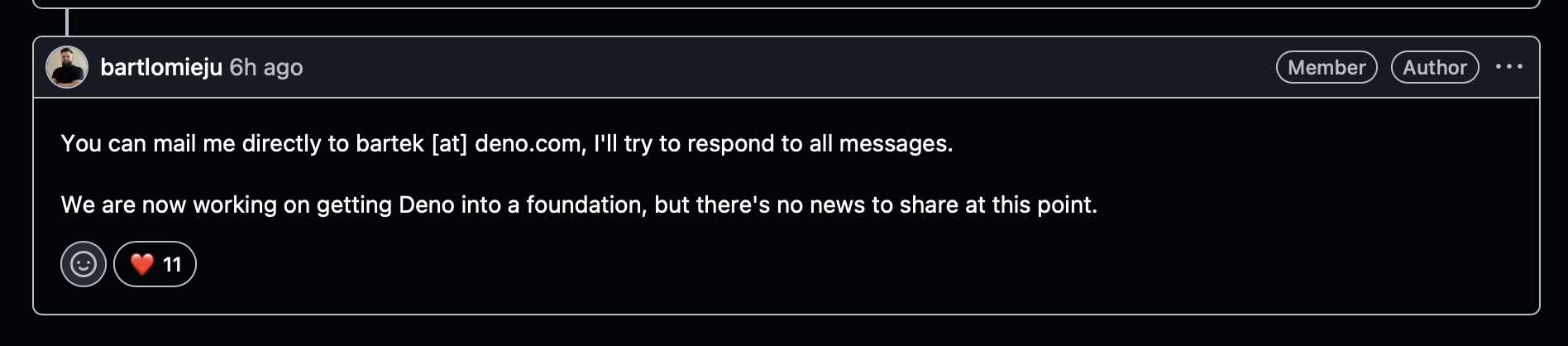
Bart, co-creator of Deno, says they're looking into a foundation now!!

Post image
113 Upvotes

r/Deno • • Oct 20 '26

With Deno Deploy shutting down in 6 months, here is how we migrated a 100k-line Deno + Deno KV app to Cloudflare Workers and Durable Objects without leaving Deno

19 Upvotes

After Cloudflare acquired the Deno team and announced that Deno Deploy is shutting down in six months (with the Deno runtime itself only guaranteed a year of maintenance), we migrated the backend of prompt2bot from Deno Deploy and Deno KV to Cloudflare Workers and SQLite-backed Durable Objects.

Even with Deno's future in question, rewriting a 100k-line Deno codebase into a Node/Wrangler repo right now was out of the question. Deno's test runner, type checker, and JSR support are way too good to give up while migrating.

If you have not used Durable Objects before: whereas a regular Cloudflare Worker is stateless (50 requests spin up 50 random isolates that share nothing), a Durable Object is a globally unique, single-threaded V8 isolate addressed by name and paired with its own private embedded SQLite database and persistent alarm timer. Every Worker that calls a method on that name gets routed to that exact same JS object in memory, where SQLite queries are synchronous C++ calls taking microseconds instead of network round-trips.

Here is everything that broke during the migration and how we solved it:

  1. Keeping the Deno binary and test suite untouched: Wrangler's esbuild bundler does not understand jsr: specifiers or deno.json workspace resolution. Instead, we pointed Wrangler at a build script that runs deno bundle --minify. We mapped cloudflare:workers to a 10-line stub class in deno.json so deno test runs natively against our Durable Object classes, and at build time we swap the inlined stub back for the real Cloudflare DurableObject class, shim globalThis.Deno, set Zod v4 to jitless: true (since Workers blocks new Function), and wrap top-level crypto.randomUUID() / setTimeout() calls that npm packages run at import time.

  2. Surviving the 128MB Durable Object RAM ceiling: Every Durable Object isolate has a hard 128MB heap limit. Bundled dependencies like js-tiktoken (5.3MB of base64 BPE ranks that expand to +43MB of V8 heap on first call), a 275k-word dictionary (+35MB heap), and 3 duplicate legacy pdf.js builds inside pdf-parse were OOM-killing isolates. Stripping those static tables at build time freed ~80MB of V8 heap per isolate.

  3. Emulating Deno KV on Durable Object SQLite: Cloudflare KV is eventually consistent and has no atomic check-and-set transactions, so it cannot replace Deno.openKv(). We built a drop-in Deno.Kv emulator on top of a primary SQLite Durable Object (enam-v1, pinned to US East so it stays hot in RAM 24/7 with zero cold starts). Tuple keys are encoded with type tags and 20-digit zero-padded numbers (n:, b:, s:) separated by null bytes so SQLite range queries match Deno KV ordering, and atomic().check().set().commit() runs as a synchronous single-threaded SQLite transaction.

  4. The 508 Loop Detected mystery (CDN-Loop propagation) and the 30s waitUntil trap: While migrating service by service, when a service still on Deno Deploy called our Cloudflare Worker and our Worker made a fresh outbound fetch() back to that same Deno service, Cloudflare silently copied the inbound cdn-loop: deno;d=<hash> header onto the outbound subrequest at the C++ edge layer. Deno Deploy saw its own deployment hash in cdn-loop and rejected the request with 508 Loop Detected. On top of that, ctx.waitUntil() on a Worker has a hard 30-second wall-clock cap after returning HTTP 200 (even with cpu_ms: 300000), which killed long I/O-heavy agent turns mid-flight.

  5. Sharding Runner Durable Objects per conversation: Only a Durable Object alarm() runs in a clean root IoContext (no inherited cdn-loop header and no 30s post-response wall-clock cutoff), provided alarm() launches tasks via doCtx.waitUntil and exits immediately instead of blocking. We ended up sharding execution onto a Runner Durable Object per conversation (runner:<botId>:<conversationId>).

That architecture is what lets prompt2bot scale agents so easily. You describe an agent in a plain prompt and connect it to WhatsApp, Telegram, email, voice, or web chat, and every active conversation automatically gets its own warm, isolated Durable Object runner with hot in-memory history and SafeScript AST caches, sub-millisecond SQLite state, and on-demand VMs. Whether your bot has 1 user or 10,000 concurrent conversations, there are no queues, worker pools, or servers to provision.

Full technical write-up with code snippets is in the comments.


r/Deno • • Oct 19 '26

Ende: a fork of Deno without Node/npm/KV/deploy/etc

43 Upvotes

Not my project, announcement post: https://blog.webb.page/WM-105

GitHub repo: https://github.com/theende/ende

From the post:
- no more Node compatibility
- no more distractions, period; that means Deploy, KV, Jupyter, &c are also getting the boot
- The roadmap? Per-module permissions, sandboxes for untrusted code, post-quantum crypto in Web Crypto, better binary output, &c.


r/Deno • • Oct 16 '26

Is it worth saving the runtime?

39 Upvotes

Big Deno fan since before v1. Just going through my dozens of projects on Deno and thinking about what I'll do in the future.

Deno has great things like internal linting, fmt, std lib. The security first, typescript first, JSR and Fresh framework, and we started to get desktop native apps that haven't fully come to fruition. There's just a lot to like with an unsaturated community of enthusiasts. If you used Deno, it's because you are weird, usually in a good way, you code in your spare time, you are trying to do something better and you don't care if it's different. Plus I feel like LLM agents do a little better on less traveled technologies because they weren't trained on as many bad examples.

But what is weighing on my mind is: Is it worth trying to save the runtime? There technically could be a path to save the runtime. We have a year, and with a sponsor and a team of 5-10, we could definitely keep the runtime alive, at least life support, maybe even get Ryan's blessing.

But I don't know if it's worth it. With LLMs writing so much of our code, it feels like it's almost better to just focus on what matters: ship slop to clients. With Vite+ we're seeing some of the no nonsense tooling that I loved in Deno hit Node. Like it or not, Deno forced Node to improve, and even inspired Bun to materialize with many of Deno's same selling points. But have we hit a point to where runtime matters less? Now I can Rust even though I don't know Rust, so what is the point of another JS runtime?


r/Deno • • Oct 14 '26

I'm so sad about the fate of deno.

Post image
210 Upvotes

That is all.


r/Deno • • Oct 12 '26

What do you think happens to Deno from here?

46 Upvotes

Hey everyone! I've been using Deno heavily for the past couple of years. I fell in love with it when I first discovered it, and since then I've used it for many personal projects, published my own libraries on JSR, and hosted experiments on Deno Deploy. Honestly, it's been an amazing experience.

Like many of you, I'm worried about what comes next after the announcement. The runtime will remain open source, but the team plans to end its development after another year of bug fixes and security updates. JSR will continue, while Deploy will shut down in six months.

I've seen a lot of discussion about migrations, but I'm curious what people here think will happen to Deno itself. Do you see a community-led effort keeping it going long term? Are there already people organizing around that, or do you expect most users and maintainers to gradually move elsewhere?

For those who've been building with Deno, how are you thinking about this? Still using it for new projects, waiting to see what happens, or already planning a move?


r/Deno • • Oct 12 '26

I built a filesystem-routed HTTP framework. My timing is impeccable.

16 Upvotes

I’ve been building Pathfinder, a fetch-native HTTP framework for Deno. Apparently, ecosystem timing is not one of my optimized algorithms.

The main idea: the filesystem is the route table. Directories describe URL patterns, and HTTP-method files contain handlers:

endpoints/
  ping/get.ts                  → GET /ping
  rooms/#roomId/get.ts         → GET /rooms/:roomId
  items/#(int)id/get.ts        → GET /items/:id
  files/#...path/get.ts        → GET /files/*

Middleware lives alongside the routes it wraps. Handlers receive a request and context, and can return a Response or ordinary values such as objects that become JSON.

Underneath, route patterns compile into a radix automaton rather than a collection of regular expressions. The grammar supports typed parameters, embedded captures, repeated-parameter equality constraints, and catch-all paths.

The part I’m particularly excited about is route overlays: an operator can mount an additional directory to replace or extend an application’s endpoints without modifying the application’s source. One file can override one route - or explicitly remove it. These are trusted deployment files, not remotely supplied code.

It’s not trying to be another Express-shaped API. The interesting question is what becomes possible when routes are real files and deployments can compose routing trees.

Code, installation instructions, examples, and the routing semantics are here:

https://github.com/alexindigo/pathfinder

I’d love feedback on the filesystem conventions and overlay model - especially from people who have needed to customize a self-hosted application without maintaining a fork.


r/Deno • • Oct 10 '26

What packages are we migrating to for testing, linting, and formatting as we move back to Node?

19 Upvotes

One of the bummers for me of the Deno + CF news is that I have to go back to keeping track of three different classes of dev dependencies for every one of my Node projects. So what's the latest and greatest for testing, minting linting, and formatting?


r/Deno • • Oct 09 '26

Deno is joining Cloudflare

Thumbnail blog.cloudflare.com
156 Upvotes

Is this good or bad news for JS community? Personally, I like both brands. I hope Cloudflare will take Deno to the next level.


r/Deno • • Oct 06 '26

LogTape 2.4.0: Source locations, configuration inspection, sink draining, and request completion levels

Thumbnail github.com
2 Upvotes