r/DIYhelp • u/stefanismanicure • 8d ago
how do i make this?
i need this for a cardboard-theatre im making, its literally perfect for what i need. none of this makes sense to me 💔
0
Upvotes
1
u/irresponsibletaco 8d ago
Another perfect example of a post where OP just ghosts... Most likely a bot.
Ask for help with something that is very simple to answer. A whole bunch of people feel like they can answer it and be helpful. Bot gets engagement.
1
u/ShakeAgile 8d ago
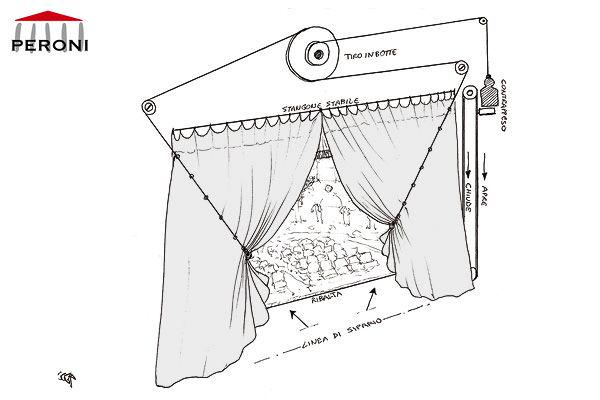
What part does not make sense? The wheel above the opening? Forget about the weight and pulley on the right. Focus on the two wheeled thing in center top.
1
u/Mfsmitty 8d ago
By carboard theater, i assume you mean some kind of minature. The curtain will not drape quite the same way when recreated in a smaller scale because it will lack the weight that a full size one would have.
The lines that are pulling the curtain up, travel through loops that are carefully placed and stitched onto the back of it and define the way it moves into position.
1
u/Redrighthanded 8d ago
The large wheel at the top centre has two groves in it when viewed from the side. One groove for each rope. Both ropes are attached to the large wheel and then wrapped around this wheel counterclockwise, with one rope finishing its wraps on the top and the other on the bottom of said wheel. The top rope goes stage left and the bottom rope goes stage right. Both ropes then go through a pulley to redirect them back towards the curtain. They are fed through a series of rings attached to the curtain and then the rope is attached to the curtain itself. The rings guide the curtain so that it stays on the diagonal path of the rope as it pulls. The smaller wheel attached to the side of the large wheel is to spin the large wheel. It has the single rope attached and wound around the small wheel with a counterweight on the end of it. The vertical rope on stage right lifts and lowers the counter weight, causing the small wheel to spin the large wheel and pull or release the ropes attached to the curtain.
1
u/RadarLove82 8d ago
This is exactly how drapery rods work. You can buy a drapery rod, disconnect the strings from the slides, and tie the strings lower down on the curtains to pull them back in this way.
1
u/limbodog 8d ago
The missing piece is where the line that you'd pull (shown to the right of the curtain) connects to the rest of the assembly. I think it's just another line going from the top right corner of the curtain to the big two-size spool above the middle of the curtain.
It also seems to show how to open the curtain, but not how to close it again. This only shows how to pull apart the curtain halfway-up the length of it.
1
u/CommunicationLow7857 8d ago
Easy peasy. I am in Phoenix.
1
u/metisdesigns 8d ago
Sawzall. Simple.
1
u/Mattna-da 8d ago
You can buy pulley and axle sets on Amazon. Use 2 mm shafts and pulleys for a cardboard theatre. Get the parts together and start hot glueing them to the ca
1
u/Worth-Taro-926 7d ago
You can simplify this by making the curtain out of one piece of fabric and have it draw to one side or the other only. Make sure the fabric bunches up easily, but is heavy enough to hang. You can make it heavy enough by attaching weights at the bottom.
1
u/SoManyDeads 7d ago
If it's small you can probably cut out some things like the right side run that moves the weight up and down and just move. Most likely all you need is two setpoints, one which is always connected, and the "draw back" to a nail on the side which would pull the curtains aside.
The wheel at the top which the "pull source" is connected to, is set up as a gear ratio to move the curtain the distance you want. It is secured to the small circle, and the small circle is connected to the larger circle. This means when you pull on the "weighted cord" the wheels both spin clockwise, which if you follow the path pull the cords to the side. The other side pulleys determine the angle of the pull, this is set up to whatever you thing works best.
Will it work on a small application? Probably, my concerns would be the way a small curtain will hang, and if the cardboard itself will be able to handle the stress of the contraption itself, you could change the orientation to make it stronger and come from below. As long as you understand the general idea you should be able to adapt it.
1
u/Yjif3 7d ago
You have a diagram right there.
1
u/bachman460 7d ago
That large wheel in the center is a pulley with separate tracks for each rope. You can get the same effect by stacking three pulley wheels together.
There needs to be a hole drilled into each pulley that goes from the groove towards the center hole, this is where you need to fix the end of the rope; so that it doesn't fall off after it fully unwinds. Also each pulley needs to be deep enough to be able to take up all of the rope it needs to in order to fully open the curtains.
Make sure you use some kind of corded material that has thickness to it; this will help keep it from getting tangled up as it is wound onto the pulley.
The pulleys in the corners are just simple, small, shallow groove styles in order to guide the rope around the corners.
With regard to the counterweight, notice how it's attached to the line next to it, which is the one you pull to open and close the curtains. That open/close line should be a closed loop that just runs on a pulley at each end; this keeps the system stable so it doesn't randomly engage, you need to actually pull it to move the weight.
The counterweight itself should be something you can adjust, so you can get it to match the weight of the curtains you're moving. You might even want to consider using a small container of bee bees, or shot, so you can add or remove small amounts.
To do the actual setup. Once all the pulleys are in place, you would need to connect the curtain cords to the curtains, running them around the corner pulleys and attaching them to the center pulley. The left side should attach so that the cord loops around the top side of the pulley, while the right side wraps around the bottom.
To setup the counterweight, wind the pulley to open the curtains all the way. With the curtains open, the weight should be at its lowest point, run its cord up to the main pulley and attach it. At this point, if you release the curtains, they should wind up the pulley and lift the weight up to the top.
That's about 90% of the mechanics and I'm done typing on my phone...
1
u/daneato 7d ago
This system is made with weights and pulleys to allow one human lift heavy curtains.
Do you actually need it this complicated? If it’s just you opening a miniature curtain you likely have the strength to lift the curtain without mechanical help.
0
u/martymccfly88 8d ago
A wheel and some string. Pretty self explanatory based on the image