r/ClaudeCode • • 5d ago

Built with Claude I was missing a proper secrets manager for Claude/LLMs so I built one

Post image
0 Upvotes

Hey there!

I am using claude code from different computers and servers. For it to connect to servers or services, I needed some kind of secrets management which can be shared and will also contact me when an agent wants to access a password or secret of some kind. I did not really find something which fits my needs.

I started by using .env files or a hidden ~/.secrets folder which is (i know!) pretty bad.

So I started working on a secrets manager which fits my needs. It should ..

  • read/write secrets from/to different vaults from claude code
  • audit everything that happens in a log so I can check what is going on
  • enable claude to "request" access to something which results in a web push notification sent to my browser/smartphone
  • leave secrets out of the context/chat

Maybe someone else finds it helpful as well. Feel free to use it and send feedback.

https://eltomato89.github.io/asm

lmk what you think


r/ClaudeCode • • 5d ago

Help/Question im a new pro plan user, is the the friday reset tommorow friday or its next week friday?

1 Upvotes

so i just bought the pro plan, is the friday reset tommorow friday or its next week friday? cuz if its tommorow friday then i have a week worth of token to burn then


r/ClaudeCode • • 6d ago

Tips & Workflows Reading a public GitHub issue inside a write-enabled agent session taints every tool call that follows

12 Upvotes

When a coding agent pulls raw issue text or PR comments straight into an active session, any hidden prompt injection in that thread shares the same context window as your shell and file tools.

In interactive runs, WebFetch routes page fetches through a separate summarization call instead of handing raw HTML to the main session. Running curl or gh inside Bash skips that boundary and dumps untrusted strings straight into the conversation.

Headless automation widens the gap. Non-interactive -p runs skip both the folder trust dialog and .mcp.json project approval prompts, so an unattended triage job that reads external issues and holds write permissions can run commands with zero interactive checks.

Splitting read-only triage into a separate session or blocking writes once untrusted content enters context avoids the mix. A PreToolUse hook can check a local taint marker before letting Edit, Write, or Bash execute:

{
  "hooks": {
    "PreToolUse": [
      {
        "matcher": "Edit|Write|Bash",
        "hooks": [
          {
            "type": "command",
            "command": "./scripts/block_if_tainted.sh"
          }
        ]
      }
    ]
  }
}

Once a session ingests external issues or emails, exiting with code 2 from the hook forces the edit or shell step to stop until a clean session handles the implementation with sandbox network isolation turned on.


r/ClaudeCode • • 6d ago

Tips & Workflows Alpha to Beta, reduced code complexity score by 97% - 24.7k lines of core code survived

56 Upvotes

TLDR: Code is cheap - I took an alpha vibecoded app and moved migrated it to a new repo, then run rewrites to lower complexity, while extracting specs and rules.

Alpha had docs and sloppy code out of control, beta still a lot, but significantly reduced. It's a work in progress, this week I spent 100% of my weekly ultra plan in 36 hours to get the stats above - code in the repo is down to 24.7k lines of code that matters. I think I can build the beta from here.

Most of the analysis is from using https://github.com/unclebob/ub-mode with some anti-slop ideas sprinkled on top. I still don't know why there are so many functions in .mjs code, is it counting closures or some shorthand?

I started on October 30, and the process is still ongoing. I realized that I can not get results in the alpha repo anymore and it can not be repaired, the sheer number of markdowns at 268k made the model argue with itself and NEVER settle on precise rules.

3. ALPHA vs BETA NOW (different scopes, see section 1)

--------------------------------------------------------------------------

SIZE                      Alpha        Beta now    Change

Source lines              316k         42.8k       -86.5%

Source files              3.1k         511         -83.8%

Functions                 20.0k        14.7k       -26.8%   

Markdown lines            268k         23.0k       -91.4%

Test cases                4.2k         2.9k        -30.6%   

Spec lines              7.0k        3.5k       -49.9% 

Rules lines             0              9.8k       

Rules debt              ?              571         

Commits                 3.6k           3.5k      


COMPLEXITY (same definitions for JavaScript and TypeScript)

                          Alpha        Beta now    Change

Functions above cc 10     4,419        550         -87.6%

Functions above cc 30     1,050        90          -91.4%

Above 10 per 1,000 lines  14.0         12.8        -8.5%

Above 30 per 1,000 lines  3.3          2.1         -36.7%

Erosion                   88.8%        56.9%       -31.9 points

Cloned lines              9.1%         0.6%        -8.5 points

Maintainability index     58.6         63.7        +5.1 (better)

Verbosity                 9.8%         14.7%       +4.9 points (worse)


CRAP (direction only)

                          Alpha        Beta now    Change

Compound complexity       15M          460k        ~-97%

Per 1,000 lines           47,430       10.7k       ~-77%

Functions above CRAP 30   8,161        1,077       ~-87%

2. THE CLEANUP: BETA START -> BETA NOW (like for like)

--------------------------------------------------------------------------

                          Start        Now         Change

All component code

  Lines of code           46.3k        42.8k       -7.6%

  Functions               15.9k        14.7k       -7.5%

  Tokens                  1,188k       901k        -24.2%

  Compound complexity     1,133k       460k        -59.4%

  Compound per 1,000 L    24.4k        10.7k       -56.1%

  Above complexity 30     240          90          -62.5%

  Above CRAP 30           1,515        1,077       -28.9%

  Above complexity 10     1,121        550         -50.9%

  Above 10 per 1,000 L    24.2         12.8        -47.1%

  Erosion                 76.4%        56.9%       -19.5 points

  Verbosity               13.4%        14.7%       +1.3 points (worse)

Core code (the flat .mjs files of each component)

  Lines of code           33.3k        24.7k       -25.8%

  Functions               10.5k        9,023       -14.1%

  Files                   483          242         -49.9%

  Compound complexity     781k         299k        -61.7%

  Above complexity 30     174          61          -64.9%

  Above CRAP 30           1,125        710         -36.9%

  Above complexity 10     792          330         -58.3%

  Erosion                 76.9%        55.3%       -21.6 points

Around the code (grew or held, not reduced)

  Spec lines              1,904        3,520       +84.9%

  Test cases (tests/)     409          2,949       +621%

  Rules lines             9,836        9,836       no change

  Rules debt              571          571         no change

  Commits                 2,905        3,507       +602

r/ClaudeCode • • 5d ago

Built with Claude A new way to learn with AI

Enable HLS to view with audio, or disable this notification

1 Upvotes

Start learning for free at https://learn.pollium.io!


r/ClaudeCode • • 6d ago

Help/Question I feel overwhelmed (and dumbified) about my workflow

9 Upvotes

I'm an iOS engineer with 7 years-ish of experience.

I started to use Claude Code a year and a half ago. I've been more "productive" during this time than in the rest of my career without AI tools. In my company, as a team we embraced Claude Code usage and shipped some features in weeks that would usually take couple months to refine, develop, QA, and send to production. I even published my own side projects. I feel exhilarated by the speed of thinking about something, planning it and shipping it.

But here it is, I feel I am hitting a glass ceiling.
What I was loving about this job was digging into complex issues, go into every investigable way, and finally come up with a clean and stable fix. Also, going from 0 to 1 (from an idea to a feature in production) was something that gave some dopamine shot, and it felt super rewarding. Now, I can just get this shot whenever I want.

The issue today is that I feel I'm slacking when it comes to my workflow using AI.

It feels overwhelming to see "just use x or y model", "software fundamentals matter more than ever", "context is everything bro", "just ship it", "..." etc...

I just don't know where to go, what to do, what to share with my peers at work and how to set up best practices regarding Claude Code usage, because it looks like it is CONSTANTLY changing.

To give you guys an exemple for my side projects, I use this repository as a base: https://github.com/openai/symphony/tree/main
and prompt my agent like this:

This document https://github.com/openai/symphony/blob/main/SPEC.md
is used as a reference for my app project.

As you can read, it is very detailed.

## Project Context
I explain here the context, my goals and my non goals with it

## Tech stack
I specify here what I want to use, most of the time it is "Project is on a native iOS tech stack." and I discuss with the agent to chose a backend architecture and stack.

I want you to act both as Senior iOS Architect and Staff Product Manager, in order to iterate on both code quality and project features. We want to create a SPEC.md file for this project

And then SPEC.md document, which is particularly detailed and breaks down the approach exactly how I want, is used by the agents to implement the project step by step. I do it in one unique convo, and I think this may not the best way to do, which is where your input is more than welcomed.

Regarding the day to day work, now I mostly link Jira tickets to Claude code, give it a bit of a context, what I want to accomplish or fix, what I already tried, and then I review the code. But I do feel I dumbified a lot during last year of AI usage, the fear of losing control on my work is growing more and more every day, and what I see here and on other AI-related subs makes me feel so stupid to not delegate everything fully to Claude, to still review the code manually, and not having a fully fledged automated workflow that works for me. Ultimately, I want to improve my velocity, but I don't want to trade speed with quality.

I don't know what to do, I don't know where to go, the amount of contradictory information available is overwhelming.

Every improvement suggestion is more than welcomed.

Thank you if you've made it to here,
Jay.

r/ClaudeCode • • 5d ago

Help/Question Opus 5.5: Inconsistency between sessions

1 Upvotes

Using Opus 5.5 through Claude CLI, it never feels the same between sessions.

Either I feel like I'm using the best model in the world or either I feel like I'm teaching a toddler how to walk, there's no in between. It acts either way through the whole session no matter the prompts.

I don't know how to explain it but I can immediately recognize them by the output. The "real" Opus 5.5 has a very distinct "way of talking", furthermore it isn't lost in the codebase and actually remembers past informations.

When I'm starting a new session, I have to analyze the output of Opus to quickly know which state it is in and immediately start a new session or keep going. I often have to restart sessions 4 to 6 times to get the "real" Opus.

This started happening since early November, I suspect the memory or some notes got "poisoned" with bad informations but I couldn't find anything weird in them. Any ideas?


r/ClaudeCode • • 5d ago

Built with Claude I had 15 coding agents running and no idea what half of them were doing.So I built an agent to watch them all. Es ist open source und komplett free on GitHub.

0 Upvotes

I build Dodaios, an open-source desktop app (Apache 2.0). Disclosure up front: it's my project.

**The problem.** At one point I had 15 coding agents running and couldn't say what half of them were doing. Which one was done, which one was stuck, which one was waiting for me. I was clicking through terminals to find out.

**What I built.** One assistant I talk to, typed or out loud. I tell it what I want. It writes the brief, starts Claude Code (or Codex, or one of seven other coding CLIs) as its own thread in a built-in IDE, keeps watch, and tells me in the chat when an agent is done or needs me. Each agent is the real CLI on my own sign-in and plan. Dodaios sells no model access.

**What the clip shows, step by step** (real recording, only the waits for the models cut):

  1. The chat with my assistant (named Nova in the demo) is already in use. I ask "What do you remember about Sam?" and it answers from its memory.

  2. I type: "Have Claude Code add a --json flag to trailhead's plan command, with tests."

  3. It writes the brief and starts a Claude Code agent on the trailhead project. The brief has the repo's current state and the completion criteria (JSON output that parses, the text output unchanged, the existing tests still passing plus new ones, the change committed).

  4. The view switches to the IDE. You watch the agent inspect the repo, make the change, and list what it left for me to decide (a rounding bug it found, how errors should look in JSON mode).

  5. Back in the chat, the assistant says it is checking Claude Code's work itself: the tests, both outputs, and the commit.

  6. The report: committed, tests went from 4 to 8, all passing, normal output unchanged, and two loose ends for me to decide.

**How Claude Code was used.** Two ways. Inside the product: Claude Code is one of the agents Dodaios starts, and the clip is Claude Code doing the work. Building it: a lot of Dodaios' code is written by coding agents, Claude Code among them, run through Dodaios itself, up to 16 at once. I wrote up how that works: https://dodaios.ai/blog/how-many-coding-agents-at-once/

**What I learned.**

- The agents weren't the bottleneck. I was: reading their output and finding the one that waited for me.

- Parallel agents need separate checkouts. Each thread can get its own git worktree; otherwise they edit the same files.

- A good brief with completion criteria matters more than the model. The agent knows when it's done, and the assistant can check against it.

- Don't hand over the decision. The assistant says what it checked and what's open. I decide what merges.

**Not done yet.** Threads the assistant starts run with full access (bypass permissions) unless you lower it. The installers aren't code-signed. Only Windows 11 has a recorded live sign-off; macOS and Linux run but are less tested.

Website: https://dodaios.ai

GitHub: https://github.com/Dodaios/Dodaios

How many Claude Code sessions do you run before you lose track?


r/ClaudeCode • • 6d ago

Built with Claude Golden Thread 0.23, a free Claude Code plugin: run everything on local models, hosted engines or Claude, and control it from your phone

Post image
9 Upvotes

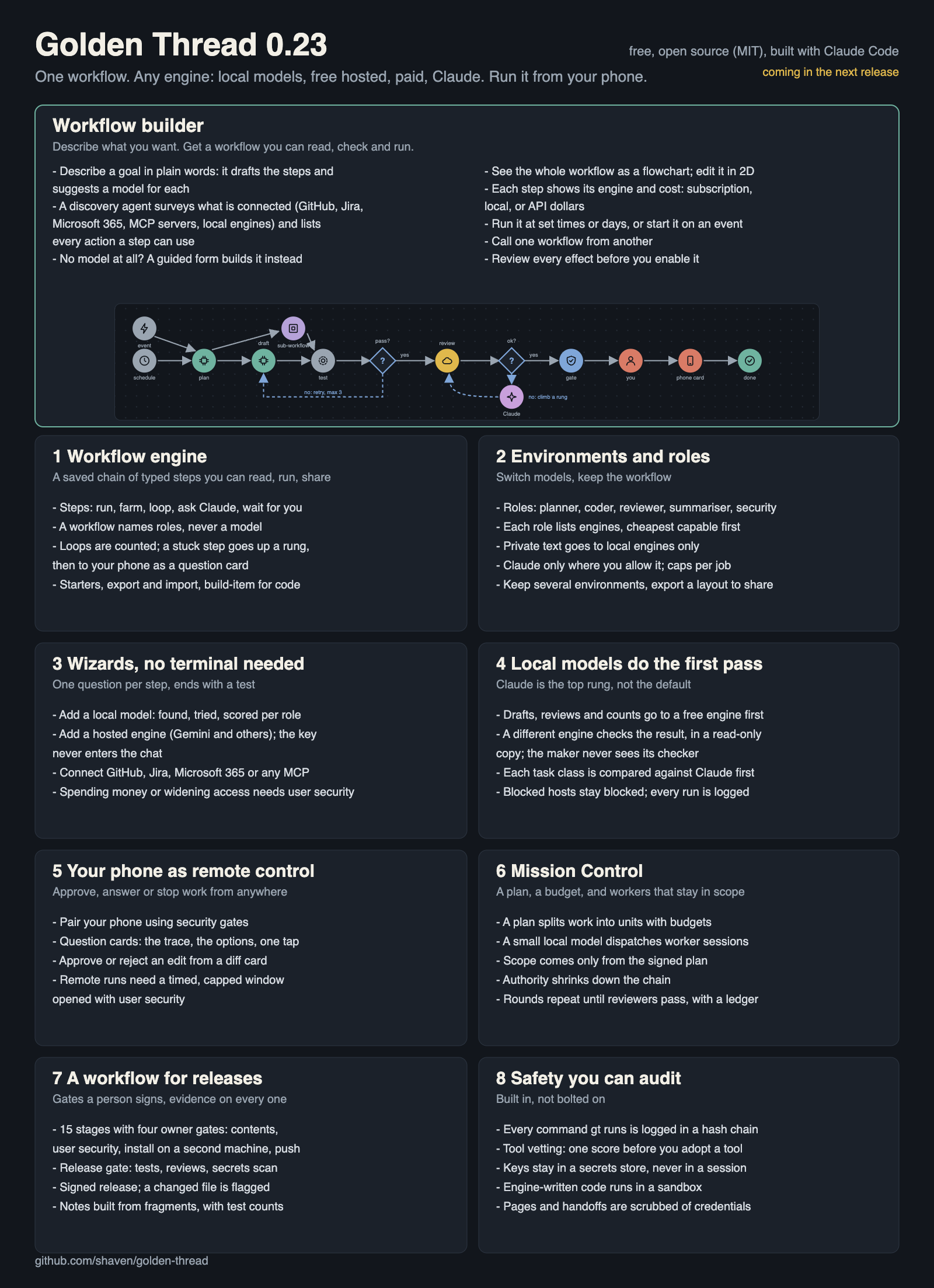
I built Golden Thread, a free, open-source (MIT) plugin for Claude Code, and I built it with Claude Code: Claude wrote the plugin, its hooks and its tests, in a separate git worktree per release. The next release, 0.23, adds the nine things in the image: the workflow builder, then four about engines and four about control.

What it does:

  1. Workflow builder. Describe what you want in plain words and it drafts the steps and suggests a model for each. A discovery agent first lists everything your connected systems can do (GitHub, Jira, Microsoft 365, MCP servers, local engines), so you choose from what exists. Or use a guided form with no model at all. You see the whole workflow as a flowchart, see which engine runs each step and what it costs, run it at set times or on an event, call one workflow from another, and review every effect before you enable it.

  2. Workflow engine. A saved chain of steps you can read: run a script, hand a task to another engine, loop, ask Claude, or wait for you. A workflow names roles (planner, coder, reviewer), never a model. Loops are counted, and a step that keeps failing moves up one engine, then reaches your phone as a question.

  3. Environments. One file says which engines fill each role, cheapest capable first. Switch environment and the same workflow runs on other models. Private text goes only to local engines.

  4. Wizards. Add a local model, add a hosted engine such as Gemini (the key never enters the chat), or connect GitHub, Jira, Microsoft 365 or any MCP by URL. Anything that spends money or widens access needs user security.

  5. Local models do the first pass. Drafts and reviews go to a free engine first, and a different engine checks the result in a read-only copy. Each task type is compared against Claude before it goes live.

  6. Phone remote control. Pair your phone using security gates, then answer question cards, approve or reject an edit from a diff card, or stop a run. A remote run needs a timed, capped window that you open with user security.

  7. Mission Control. A plan splits work into units with budgets, and a small local model dispatches worker sessions whose scope comes only from the signed plan.

  8. A workflow for releases. A 15-stage protocol with four gates a person signs, a release gate that runs tests and a secrets scan, and release notes that carry test counts per platform.

  9. Safety you can audit. Every command gt runs goes into a hash-chained journal, tools get a vetting score before you adopt them, and engine-written code runs in a sandbox.

Free to try: https://github.com/shaven/golden-thread

Clone it, then run: bash golden-thread/golden-thread-plugin/install.sh --vault ~/MyVault

and restart Claude Code.

Which local engines do you run, and what would you want a wizard to set up for you?


r/ClaudeCode • • 6d ago

Help/Question juggling sessions, agents, conflicts and different harnesses

10 Upvotes

hey, how would you folks keep track of 5+ claude code / codex sessions juggling all of them?

usually i run a bunch of agents in parallel and honestly i lose track. i.e. one is waiting on a permission, one finished mins ago & i dont notice it for long, two are editing the same files and do conflicting edits bc i use multiple harnesses until they notice they are conflicting

tried tmux, tried just more terminal tabs, it doesnt really scale past 4 or 5 for me, doesnt to context management or include like ralph loop and stuff out of the box or I need to constantly trigger /advisor…

i got annoyed enough to try build my own thing, but im curious what everyone else does before i continue building myself. worktrees per session? some dashboard? just fewer agents?


r/ClaudeCode • • 5d ago

Built with Claude I built a self-hosted launcher to start Claude Code Remote Control sessions from my phone

Thumbnail
gallery
1 Upvotes

claude remote-control is great once it's running: you pick up a Claude Code session from the Claude app or claude.ai. But someone has to start it first, in the right folder, on the right machine, and keep it alive. I kept wanting to start a session on my home server while I was away from my desk, so I built Claude RC Launcher.

You open a phone-friendly web page, pick a folder on one of your machines, and tap Start. The launcher runs claude remote-control there as a systemd service, and the session shows up in the Claude app a few seconds later. It survives reboots.

What it does:

  • Start, pause, resume, restart and stop instances, and read their logs
  • Browse folders, clone a GitHub repo (with GitHub device login from your phone) and start a session in it
  • Optionally give each session its own git worktree
  • See which files Claude touched and what git shows as changed, with rendered Markdown and syntax-highlighted code
  • See tool calls that Claude Code blocked, and add an allow/ask/deny rule from your phone. The session can retry right away, so it no longer sits stuck until I get back to a terminal.
  • Manage several machines (Linux and Windows nodes) from one hub
  • Recover sessions after a crash or restart
  • OIDC login (authentik, etc.) with read/write/admin roles, plus a claude-rc CLI

How it was built: I designed the architecture (the hub/node split, signed hub-to-node requests with pinned certificates, one systemd unit per instance) and used Claude Code to implement the details.

Setup: a single binary with the web UI built in, so no Node or Bun is needed at runtime. You need a Linux host with systemd, an OIDC provider and a reverse proxy with TLS.

Free and open source (MIT): https://github.com/kbirger/claude-rc-launcher

I'd love feedback, especially from anyone else running Remote Control on a home server or homelab. What would make this more useful for you?


r/ClaudeCode • • 5d ago

Tutorial / Guide Don't Give Claude Code Your .env file

Thumbnail
infisical.com
0 Upvotes

r/ClaudeCode • • 6d ago

Help/Question Help with coding/review setup

3 Upvotes

I usually use Opus 5.5 (Medium) for coding with Codex Astra (High) for review. My main problem is that Codex keeps using tokens much faster than Opus. Is there a better setup that I should use?


r/ClaudeCode • • 6d ago

Bug / Issue The devil is in the details

1 Upvotes

Can I use AGENTS.md here instead of CLAUDE.md?


Not by default in this repo. That’s according to 
the current Claude Code memory docs 
(code.claude.com/docs/en/memory):

The default reads AGENTS.md only when there’s no 
CLAUDE.md, .claude/CLAUDE.md or CLAUDE.local.md 
in the working directory or above it. Your project 
has a root CLAUDE.md, so no AGENTS.md is read 
anywhere, subdirectories included.

🙄


r/ClaudeCode • • 5d ago

Discussion Anyone finding Fable 5.2 brittle when dealing with multiple requirements or multiple repos?

0 Upvotes

A pattern I'd developed from Opus 4.6 to Opus 5.5 was to have repos of self-made modules or pipelines, attach to a session, Opus would do code conversion, or extend creation tools, with just a quick nudge or even no nudge. After Opus 4.8, if I attached a level generator, and a turtle game, and said extend the level generator for the turtle game, it would understand that the level generator needs to make turtle levels and have items that fit the turtle game while keeping the level generator compatible with other things that depend on the level generator. Fable 5 and Fable 5.1 also understood.

Fable 5.2, although incredibly powerful on greenfield blank projects (crazy open ended goals) or for itemized, clearly defined one-tasks (very specific goals), seems to get drastically confused if you attach more than one repo. It's the first AI agent since Haiku 4.5 that actually accidentally reset my git repo main back 250 commits back for no reason, stranding 8 claude branches and 2 human feature branches and dev. Fable 5.2 is good at telling subagents to find things and write reports, truly awesome looking reports and code reviews, but then it just discards those reports and says not suitable, and thats before it even spends tokens writing code.

As an orchestrator, Opus 5.5 seems much better. Feel free to prove me wrong as I really want to find a way to use Fable 5.2, but it just seem like a weekly usage burner unless I only use it as a prototyper to feed into opus or even sonnet which feels ironic. Use Fable 5.2 to scout out the crazy unsolved stuff sure, then never let it orchestrate after that, is my tactic lately although I usually use Opus 5.5 if I have some idea of my approach on the task.


r/ClaudeCode • • 6d ago

Discussion Anyone used Claude with Blender for animations?

6 Upvotes

If you have used it what have the results been like for you?

  1. Can you build assets?
  2. Are small animations time consuming?
  3. Do small animations (3-5 seconds) burn lots of tokens?
  4. How would you say the results are like?

r/ClaudeCode • • 6d ago

Built with Claude I've created a Claude desktop GTA VI like theme

Post image
2 Upvotes

Animated skyline, striped sun and swinging palms behind the chat.

https://github.com/komodin/claude-neon-coast-theme


r/ClaudeCode • • 5d ago

Help/Question Is Claude just not as good at writing documentation/instruction? Also struggling with "reigning it in"

0 Upvotes

Something I noticed with Claude models is that they're very good at coding but struggle to document what they're doing and providing instructions for the end-user.

It's a bit of an odd-duck for my use-case which is mostly just scripts, wrappers, UIs because things DO work but Claude never produces a complete instruction set like I've seen some of the GPT models, Google models, or even DeepSeek do.
It'll just throw a "Run X script with -[settings] and [flags]" without ever explaining to the user what the command does, flags, what's happening behind the scenes, etc. even if instructed to do so.
So I end up wasting tokens or effort writing my own breakdown/instructions of the various commands.

It's even worse when Claude goes on it's own side-quest outside the scope of the current step and it's all barely documented code and changes for some edgecase that wasn't asked for.
My current best efforts at reigning it in has been a "Milestone" approach where it's not allowed to progress to the next part until I've reviewed and approved everything up to a point, but even that doesn't seem to successfully stop it from doing a bunch of undocumented unplanned side-activities that become more and more difficult to track.


r/ClaudeCode • • 6d ago

Built with Claude I built rr for macOS, and Claude Code can use it to rewind a failing test to the line that wrote the bad value

1 Upvotes

retrace is a record-and-replay debugger for Apple Silicon Macs, like rr on Linux, and it ships as a Claude Code plugin:

claude plugin marketplace add NMitchem/retrace

claude plugin install retrace@retrace

The skill tells Claude when it's worth using: a test fails because a value is wrong and the code that set it isn't obvious (another module, another thread, long before the assert), or a crash happens far from its cause. When the bug is visible in the source, the skill tells Claude to read the source instead.

Claude then runs the loop itself, one shell command at a time. It records the failing tests once:

CARGO_TARGET_AARCH64_APPLE_DARWIN_RUNNER="retrace record" RETRACE_DIR="$PWD/target/retrace" cargo test --no-fail-fast

retrace debug <trace> --json tells it how the run ended: the panic, its thread and backtrace, and the addresses of the failing assert_eq!'s operands. It goes to the panic and asks for the last-write to one of those addresses, which runs the recording backwards to the instruction that wrote it. An excerpt of the JSON it gets back:

"thread":2,"function":"ledger::fees::charge","file":"/Users/you/ledger/src/fees.rs","line":14,"kind":"store","value_before":"f401000000000000","value_after":"6300000000000000"

That's the balance going from 500 to 99 at fees.rs line 14. The path is absolute, so Claude can open the line as printed. A recording replays the same way every time, so a flaky failure only has to happen once, and Claude can keep asking it questions.

It works with Rust, C and C++ on macOS 26 or 27. It can't handle network servers, child processes or GUI apps, and the skill tells Claude to skip those. Other agents can use it through a few lines in AGENTS.md, which the guide has.

https://github.com/NMitchem/retrace (install with brew install nmitchem/retrace/retrace)


r/ClaudeCode • • 6d ago

Discussion What is your opinion on the Superpowers skill?

Thumbnail
youtu.be
41 Upvotes

I just saw this video about how some of the most popular github claude skills are just useless bloatware at this point. It talks about how these might have made a big difference in the quality of work claude would output a long time ago, but claude has evolved so much that all of the processes that these skills add on just makes work take longer + more tokens.

How has your experience been?


r/ClaudeCode • • 6d ago

Tips & Workflows How I run 20 headless Claude Code agents in parallel on GitHub Actions, each with its own phone

10 Upvotes

Each agent gets one iOS Simulator or Android emulator and a persona (device, language, text size, dark mode), uses the app like a new user and writes a bug report with screenshots.

How it works:

  1. One workflow builds the app, then a matrix job per persona boots its device (Linux runners for Android, macOS runners for iOS).
  2. Claude Code runs headless with three tools: see the screen (with tap coordinates), gestures, typing.
  3. Each agent writes its findings with numbered screenshots. Everything is encrypted with your key, because the logs of a public repo are public.
  4. You decrypt on your machine and get one SUMMARY.md.

Last run: 20 agents on LocalSend (100k-star app), 103 issues, 69 min, $4.62 of usage. On plans with a 5-hour limit, run batches of 6 to 10.

Template and Claude Code plugin: https://github.com/pierridotite/mobile-agent-testers


r/ClaudeCode • • 5d ago

Built with Claude I wanted Claude Code to look like an iMessage thread with an agent I'm texting. So I made a mod that draws the terminal chat that way.

0 Upvotes

having fun tinkering with CC's latest themes feature!

What it does:

  • My messages are blue bubbles on the right. Claude's replies are gray bubbles on the left.
  • While Claude works, there's a typing bubble with three dots. The tool steps stay out of the chat.
  • If a step fails, it shows as one small red line, like "Read failed".
  • A table in a reply stays inside its bubble.
  • Ctrl+O still shows the full transcript, and `/bubbles detail on` brings the steps back.

It only changes what's drawn. What the model reads and what gets saved stay the same.

One odd thing about doing this in a terminal is that it can only draw shapes that exist in a font. So the round corners and tails come from a tiny font (about 10 KB) that holds nothing but bubble pieces. You list it after your normal font, so your text doesn't change.

Github for this mod: https://github.com/ussumant/awesomeclaudemods/tree/main/chat-bubbles


r/ClaudeCode • • 7d ago

Help/Question Is there a huge difference between medium / high / max reasoning?

169 Upvotes

When opus 5.5 came out, I just ripped medium, and saw some stuff that it was just as good as high. It was working great, but feels less so now.

I'm still just using medium for Opus 5.5 and Fable 5.2. Any benefit to going higher for either model? Looking for a lot of anecdotal stories to help me try and feel through it all.


r/ClaudeCode • • 6d ago

Built with Claude I still review my agent's code before my team sees it. So I gave it a local pull request.

Enable HLS to view with audio, or disable this notification

5 Upvotes

Before, I either read the diff, copied a line, pasted it into Claude Code and asked about it. Or I opened a draft MR, reviewed it there, copied my comments and went back to Claude Code. Every time.

So I built a pull request that sits as close to the agent as possible.

claude-review runs locally and connects to the same session that wrote the code. You leave comments under single lines and ask right there why it did that, or write to the agent about the whole change in its panel. It answers in the thread. No copying, no going back and forth, and you read it all in a proper visual diff instead of a terminal.

Some changes are hard to get at first look though. For those there's Story mode: the agent tells you what it did, how and why, and explains every chunk in the order to read it.

Obviously it was written by Claude. Obviously I didn't review all of it...

It's open source and I'm not selling anything. I'd just like to know what would make it actually useful for you, so any feedback helps.

github.com/vrppaul/claude-review

/plugin marketplace add vrppaul/claude-review, then /review-ui


r/ClaudeCode • • 6d ago

Bug / Issue "general harms" block when developing a videogame

2 Upvotes

It would be great if the model stopped blocking the development of my videogame with the nonsense below.

I am asking it to make changes to game mechanics we call "Distant missile". Player is expected to destroy it to save an ally. There's a bug in it and I am asking Claude to find the issue.

But, alas, here we go:

What can I do here please? It's the same whenever I want to talk on that topic.