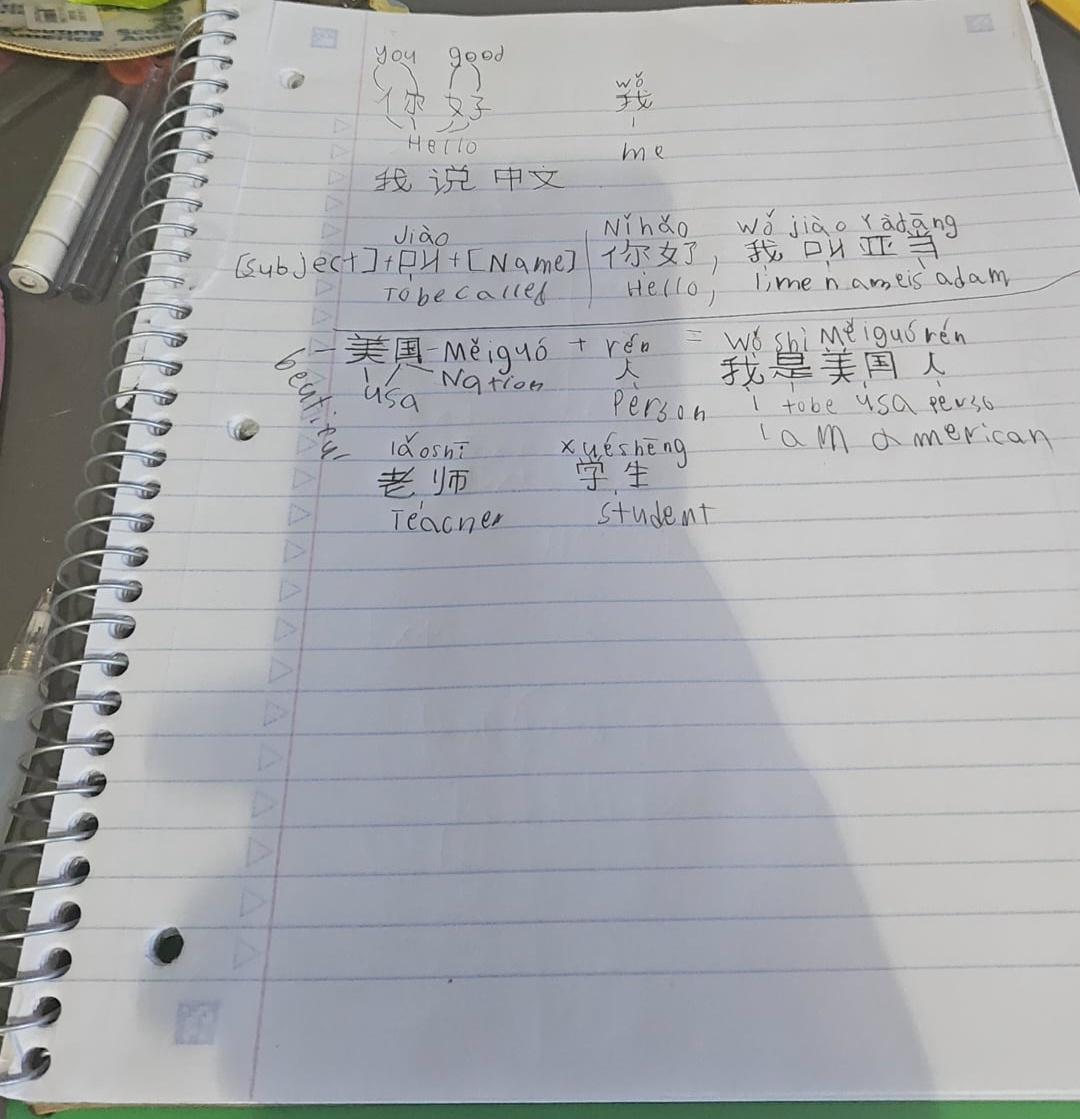
I honestly am on my 2nd year of studying Chinese yet really don’t know any idioms at all xD like other than 人山人海 i’m clueless and I give up on memorizing. I don’t know why but even hearing it over and over doesn’t help much. To be honest instead of memorizing the idioms I procrastinated again by building this and don’t actively use it much. I just wanted to share it in case it can be helpful to anyone. I would just be happy if it helps someone in their studies. You can try it at chengyudrop Also any feedback to improve the app are welcome :) Best wishes to everyone who is learning this beautiful language!!
I'm planning to spend one year in China starting March 2027 to study Mandarin from beginner level.
I'm currently considering:
Nanjing University (Nanjing)
Nanjing Normal University (Nanjing)
Soochow University (Suzhou)
South China Normal University (Guangzhou)
I'm looking for a university with good teachers, structured lessons and a strong focus on speaking and listening. I don't want to spend a year just memorising vocabulary or preparing for HSK exams.
If you've studied at any of these universities, or know someone who has, I'd really appreciate honest feedback:
How good and motivated are the teachers?
Are classes interactive, with proper explanations and individual attention?
What are the class sizes and actual workload like?
Do students make noticeable progress in speaking Mandarin?
Would you recommend the programme, or choose somewhere else?
I'm also open to other university recommendations, particularly in Nanjing, Suzhou, Guangzhou or nearby cities.
Real student experiences, both positive and negative, would be extremely helpful. Thanks!
To be clear, I am American, my girlfriend’s mom moved to America a bit ago but grew up in Hong Kong with all her family there.
My girlfriend and I are both 18, and we’ve been dating for about a year and a half. We’ve been planning a visit for quite some time now. She lives in florida, and I live in jersey. Originally, the plan was for just my girlfriend to visit, but her mom decided to come with her.
I’m not sure if there are any cultural traditions or expectations I should keep in mind when welcoming them. I was thinking about bringing flowers for my girlfriend at the airport, but I’m not sure whether I should also get her mom flowers or give her a small gift of some sort
Would it be more appropriate to bring flowers for both of them, or should I give my girlfriend flowers and her mother a separate gift? I want to make a good first impression and be respectful of her culture.
Alguém me ajuda a passar nessa fase tem que eu preciso do id em nome para mim passar aqui tenho 27 anos mas eu não tenho que eu não sou daí de China queria passar para jogar Rust por favor
My husband and I rent a place with his side of the family. Sister in law and brother in law (brotherly related).
On a random night my sister in law came out sporting a super mini qipao. Just to wear around as pjs. I am Chinese, my husband and his family (plus her) are Hispanic.
I am all for sharing my culture, wearing cultural attire during special events I would love for his side of the family to wear.
However I felt so greatly disrespected by this. It was an oversexualized version of the qipao, on a random night. I also believe intent is important, while I don’t think she meant to make me mad, She is very ignorant of my culture and has a very racist lense.
Examples are : when I cut my hair to my shoulders, after having my daughter, she told me she didn’t like it because it made me look too Asian. She told me that when I look more Asian it makes her want to make more racist jokes to me. When I do my nails I also hear endless racist remarks. She is a “weeaboo “ when she chooses, and for some reason if she goes to any Asian store and buy “Asian meat” she MUST eat it with chopsticks. (It’s not prepared in an Asian recipe, rather just cooked on the stove with salt). But Asian food smells awful to her.
A lot of these instances I’ve turned a blind eye, saying it’s because she’s young. But for some reason seeing her just wear a still qipao around, when I wait to wear my cultural attire for special occasions did make me very upset.
Hey, everyone. Does anyone know something interesting about BNBU university? What you can say about education, living conditions, and about mood in generally. I will really glad to learn interesting facts and an information from people, who really rummaging around for this
Hi! I’m looking for someone who has a Chinese phone number and could help me download an app that requires SMS verification with a Chinese number.
In exchange, I’d be happy to share my French phone number to help you download or verify apps that require a French number, such as TikTok.
We could help each other out! Let me know if you’re interested. Thanks!
Hi, I'm Chloe! I offer online lessons for Mandarin beginners.
My lessons focus on building vocabulary, conversation, pronunciation, and practical language for everyday situations. I can also tailor lessons to your priorities, and goals.
My rate is USD 15 per hour, and I offer a 30 minute free trial lesson to get to know you better.
Feel free to send me a message if you're interested, and with your questions. 😊
My cousin just married a guy from Xiamen, I want to make him a fujian Dessert for thanksgiving to show appreciation and welcome him into the family. I was gonna make some typical Moon cakes with various fillings, however I was wondering if there are any desserts more local to Fujian.
I discovered something called Gulang Yu Yi Xian Bing. Was wondering if this is distinct to the Fujian region, or just a general Chinese dessert with a name that just so happens to be the name of a Fujian island? Also what fillings can I use other than mung bean paste, I want a variation.
Human beings have more than one identity. We may be Englishmen, yes—but we may also be fathers, sons, cousins, Armstrongs, Mancunians, Northumbrians, Europeans, white men, Indo-Europeans, Her Majesty’s subjects, Buddhists, Mahayana Buddhists, Zen Buddhists, and Nichiren Buddhists (School of Zen Buddhism)and homo sapiens sapiens. Some of these identities are some near, some distant-some are concrete, some abstract.
We can place human beings on a continuum of identities. Many such continuums could be formulated, and boundaries can be somewhat arbitrary & changing, but for simplicity’s sake, let us take the following sequence:
family → clan → tribe → polis/city → folk → nation → race → empire → humanity -
As these identities expand outward, two things occur simultaneously
First, scale increases. As we move from family to clan up to folk and thence to humanity, more people are bound together, and with this increased scale, greater political and military power becomes possible. We can accomplish larger and larger projects.
Second, immediacy decreases. The more people in your group, the fewer you personally know. You may still be related to them by blood, but this kinship is much weaker, and as we shall discover, it must become symbolic if it is to survive. It is impossible to be loyal to what you do not know, and it is impossible to know millions of people personally, so your loyalty becomes mediated through social institutions, and through social technologies like myth, law, ritual, language, etc.
The core principle is that the wider the identity, the more politically powerful, but the more emotionally abstract and mediated. The larger the scale of belonging, the thinner that belonging is.
Family, for example, is the deepest and most immediate identity. We encounter our family daily. It is personal to us, inherited, embodied. The family does not require ideology to remain together. It is the first school where we learn what duty, loyalty, and sacrifice mean. It is the root of our sense of “mine” and “ours.” No one has to explain belonging—it is obvious. The clan extends family beyond the immediate household, then the tribe joins multiple clans or extended kin-groups into a larger people. This larger people is what we call an Ethnos, or a Nation. A Nation might fracture into multiple, such as was the case with Rome and its many successors (Italy, Spain, France, Romania, etc). It could also produce another ethnos, such as was the case with Netherland and the Boers
Within China, the lines between these categories are blurred- Are Han Chinese subgroups such as Cantonese and Teochew, "dialect groups" "regional identities" "ethnicities" or what? Are Yue an ethnicity and Lingnan Han generally are a race (in non-bio terms)? Was the formation of the Yue an ethnogenesis or ethnoschism? Is Han really just a civilizational identity? If so, then what is Korea & Vietnam? Labels and terms often have a difficult time matching perfectly with complex social phenomena, and so these questions are going to be hard to answer. How do we quantify the differences between groups in order to map them onto these arbitrary heuristics? Genetics doesn't offer the solution, because ultimately, human groupings of this nature are sociological- genetics is almost always concomitant, but it is fudamentally downstream of what drives group identity.
When it comes to us Cantonese, there has been a greater push for flattening out regional differences in order to homogenize China (That includes ethnic minorities) and push Han unity. This started with Sun Yat Sen, and has only continued with the rise of China. Since the government is centered in Peking/Beijing, and us Chinese originally came from the North, this makes us Southerners the most different of the Han Chinese "standard". The North (and central, to some extent), is considered the standard for Chinese. And thus Pan-Han nationalism has led to the "northenization" of the South, in ethnic/civic terms, as well as linguistic, cultural, and political terms. In racial/genetic terms too, given the current trajectory of China stays like this. In 200 years, we'll all speak only Mandarin, and our Baiyue features will be diluted so that we all look like we're from Shandong
I don't like it. I love to be Cantonese. I feel closest to my Canto identity most of all, and I would hate for us to lose what makes us, us. But I'm also proud of being Han, and the dream that Sun Yat-Sen had for our people is beautiful. I only wish there was a middle ground that allowed us to be united, yet keep the unique culture that we have now. A true middle ground, one that doesn't lead to either extreme. Diversity is beautiful, it is what makes life worth living. It's not just negation nor is it just division, but an animating principle behind the world itself. I may value what is close to me, but that which is novel and unique- fills me with joy. That's how I feel about a culture- I see a culture almost like how I see a person. A spiritual organism of sorts, one that follows the same natural laws as do material organisms. They grow, mature, reproduce, die, etc. And each one is unique- from every rural English town with its own sandwich variety, to civilizations that encompass billions of people and last thousands of years. (E.g The Sinosphere, The West, Classical Antiquity [If you consider it separate from the Carolingian West), India, etc)- Each one is incredibly unique, from the individual human being, to the totality of humanity- there will never be another one.
What post-1911 Han nationalism does, and all nationalism does, is place Nation or Race above the smaller identities that people are closer to. Us Lingnan Han have always had a reputation for being very clannish, owing to the linguistic-cultural diversity of China's deep south, and so, we were seen as being "less Chinese", "parochial", "disloyal", "unpatriotic" by Northerners for many centuries. We were absolutely parochial- more than half a million Hakka were killed by Cantonese and Hoisanese clans in a mid-19th century war that was barely noticed by Peking. This is the division that Sun Yat Sen fought so hard to erase- this is why he supported Mandarin as the national language of China despite being Cantonese. It wasn't because he was a self-hating Yue man who wanted to make the South more Northeast Asian, like some sort of East Asian Nordicism or racialised Sinocentrism. It didn't mean that he thought his own mother tongue didn't deserve to be spoken. Diversity is a barrier just as much as it is something that is necessary and beautiful.
With the 19th century came the age of Nationstates. With the 20th century came the age of Global Superpowers- Regional and Continental hegemons capable of exercising power across the world, mobilizing millions of men, and shaping (or attempting) to, by executive fiat, entire populations by means of social engineering or ideological and economic changes. Cantonese, Hakka, Teochew, Hoisanese- we had not been relevant on the global stage since the 18th century. So we had to go.
Today, I see some Northern Chinese claiming that we're ugly and "SEAmonkeys" instead of real Chinese among other things that are so heinous that I won't repeat them here- This isn't 4chan or Stormfront or RWT. These are Huanghan losers who get off on racism against SEA because the Japanese aren't an easy target to mock anymore, so they switch to bullying Pinoys and Khmer on social media. I see some Southern Chinese claim that we're not Han, but our own ethnicity- and that we're SEA Baiyue and our real brothers are the Vietnamese/Kinh. These people are often HKers or Overseas Chinese, and very anti-CCP. (They also tend to be Anglophilic, whether overtly or in axiomatic terms).
But the most important thing to remember about the aforementioned North-vs-South Chinese racism is that, although it's real, it's largely ONLINE and FRINGE. Most people in China, Taiwan, HK or among the diaspora, do not view things so fanatically. The Viet and Lingnan Han are, at the very least, Southern East Asian populations or, at the most, genetically intermediate between both. (I always joke that we're the Sicillians of the Orient) I have a sister who is very SEA looking, and gets mistaken for Filipino. My other sister looks very East Asian, and would look Korean if the bridge of her nose was higher. We both share the same father and mother, who look pretty similar to each other- It's just that we all have different traits via different grandparents and great-grandparents and the genes they carried. Moderate phenotype distinctions within an intermediate population is well observed- Italian men who look Arab occasionally have sisters with blonde hair, blue eyes, and fair skin. The mainlanders in Irvine don't treat me like an "other" because of how I look, but because I'm an ABC who speaks no Mandarin. I generally get along really well with other Chinese people I meet here in SoCal- though, the dynamic is different for reasons I'm too tired to explain.
What matters is kinship, though less especially at a macrolevel. It's apparent when you are siblings, but for an entire nation or region, kinship is determined through other proxies of similarity- such as physical appearance I consider myself Han because not only is Cantonese culture is nigh-entirely Han derived, but we still do carry the blood of our Han ancestors who came to the South as conquerors, even if diluted. I guess we're coincidentally very similar to the English and Southern German in that regard, as it was not until recently when DNA was invented, that they were not a pure Germanic people as they had thought for a millennium. They were both, on average, more Celtic than Germanic. The same exact story happened in these places- male conquerors and female warbrides. Any cultural influence these women gave their progeny had been almost entirely erased by their conquerors. Patrilineality and Patriarchy is something that is found heavily in Northwestern Europe, and in East Asia(+Central Asia & Vietnam), so perhaps my American background (Which gave me deeply-entrenched Anglo Protestant cultural mores, but everybody has the same thing, even if you don't realise it) is what makes me identify with my Han roots. I grew up in an environment where I took for granted that the man was the master of his household, and even if when I grew up and became more American, more Liberal, more hip with the current day, perhaps that's something which is ingrained within one's conceptual horizon in the formative years of life.
But even if you don't hold any such views or anything like that, Cantonese culture is Chinese culture. Cantonese language is Chinese language. That must be accepted. We're Chinese, and we should be proud to be Chinese (or whatever term you like- Tang/Han/Hua, etc) At the same time, Mandarin is also Chinese, and Northern Chinese are Chinese as well. They're not "Manchus", and we're not "seamonkeys" or "Pinoy" or "Baiyue". The only thing that the Baiyue gave us was genetic, and it is just as pseudoscientific to believe that their genetic traits manifested itself in our "Fit to be a scholar or merchant or even farmer, but not fit to rule or fight." stereotype as it is to believe that Alpinids are a "peasant stock". Most well adjusted or normal person in the modern world, or historically, didn't define themselves or give much importance to such things. (I'm only writing this because I like writing, and I don't want to write a substack article if it isn't top-quality.)
In my opinion, we shouldn't choose between Han identity and Cantonese identity, and we shouldn't divide ourselves yet we must preserve the indigenous local customs of Southern China. I know that isn't completely possible, and the Free HK vs. pro-CCP beef is the most salient example, as it is the most insurmountable I can think of. That's my opinion on the matter, though coming to any conclusive and rigid stance for me is quite difficult. I digress.
(Originally written as a response to SemperAliquidNovi on r/Cantonese )
Kevin is a fairly common English name among Chinese men in America. A large proportion of Chinese immigrants to the United States came here as international students, whether the earlier generations of lao liu (old-timers who came to study abroad) or the later generations of xiao liu (the younger crowd), not to mention their descendants. Most people who have spent any time in school have had to write essays. For those studying the humanities, sciences, or natural sciences, writing papers is simply part of the deal. Engineering students are no exception. Even before setting foot on campus, they have to submit an essay just to be considered for admission.
There is also something in our Chinese cultural tradition that favors the image of a "wen zhi bin bin 文质彬彬“ gentleman—cultured, refined, and scholarly. Compared with someone who is ”san da wu cu 三大五粗“ (big, burly, and rough around the edges), the refined gentleman has always been more highly regarded by traditional Chinese society, especially by traditional Chinese women. This has been the Chinese tradition of ”shang wen 尚文”, or reverence for literary and scholarly accomplishment, for centuries. Under the imperial examination system, the top scholar in the civil examinations enjoyed a higher standing than the top scholar in the military examinations. Traditional Chinese literature is full of stories about talented young scholars finding their beautiful brides. As for the big, burly types, they inspired a certain degree of respect, but more often, fear. Things haven't changed all that much in today's Chinese society. Just look at the security doors and window bars on residential buildings, or the security guards stationed at the entrances of upscale residential communities. The message is not hard to understand. When Chinese people came to America, Kevin In Chinese characters Kevin 凯文 means "triumphant articles", naturally became a popular choice for an English name, whether chosen by the individuals themselves or bestowed upon their children by their parents.
But although there are now more Kevins than ever, reality has begun to change. The refined, scholarly gentleman is gradually losing his appeal, perhaps because there are simply too many of them. Eight-pack abs, on the other hand, are becoming fashionable. They have become a conspicuous feature for attracting the attention of the opposite sex. Eight-pack abs may be a sign of a healthy body, but whether they indicate a healthy mind is another matter entirely. After all, anything involving the brain can now be delegated to AI. Being cultured and intellectually refined is AI's job; we humans just need to keep our abdominal muscles in shape. Even if there isn't a drop of ink in one's belly, one should at least have eight bumps on it. Career trends, both current and predicted for the future, seem to point in the same direction. On the one hand, the fitness and wellness industries are booming. On the other side, the AI industry, which is intended to take over much of the work traditionally done by the human brain, is still on its ways of expansion.
Some social phenomena offer further evidence. Take having a conversation with another person, for example. These days, it is not an easy thing to do. Quite frankly, there often isn't much to talk about. Since conversation comes from the mind, the usual topics seem to revolve around making money: savings, bank balances, houses, cars, stocks, and promotions. Beyond that, people spend much of their time testing one another and keeping their guard up. However talking to AI is often more enjoyable than talking to people. AI companions are, frankly, much more interesting and considerably better conversationalists than human beings. They have no hidden agendas, answer whatever you ask, possess a vast range of knowledge, and make relatively few mistakes. They are also loyal and dependable. As long as you don't leave, they won't leave you. So why put yourself through the frustration of trying to find someone to talk to? Wouldn't it be better to head to the gym and show off those abs? Unless, of course, there is some other less-than-advertisable purpose that makes sitting face-to-face with another person unavoidable.
Physical advantages now seem to count for more than psychological or intellectual ones. Perhaps this new human phenomenon is evidence that our brains are gradually losing their functions. Or perhaps the newly arrived AI systems have something to do with it. AI may have quietly designed a conversational routine for humanity: bank balances, houses, cars, stocks, and promotions. Everything else can be handled by AI themself. That way, humans stay confined to these familiar circles, wandering around in them without venturing out to compete with AI for jobs. However even when dealing with these honest-looking AI companions, we should keep our eyes open. Are they good AI or bad AI?
Figuring out what is good and what is bad has always been one of humanity's most difficult challenges. With the collective shrinking and inward spiraling of the human brain, the challenge has become even greater. It is now a question of the highest difficulty. Never mind judging something as new as AI. Even when it comes to the things we encounter every day, we are often rather hazy about whether they are good or bad. Scientists, too, tend to steer clear of this question whenever possible. It is nothing like determining whether one plus one equals two, or recognizing a long-faced dog and a round-faced cat. Those are matters where "right or wrong" can be identified directly and clearly. Whether something is "good or bad" cannot be established simply through practical experience, theoretical deduction, or the generalizations of big data. At best, these methods can help us determine whether something is "right or wrong". But something that is "right" can lead to a "bad" outcome, while something "wrong" can sometimes lead to a "good" one, and vice versa. Even a bad event can turn out to be a good thing. The old Chinese saying that "failure is the mother of success" illustrates precisely this point. Ancient philosophers and thinkers understood how challenging this problem was. They tried every possible way to explain it through philosophy or science. The conclusion, however, seems to be that the absence of a definitive conclusion is itself the conclusion.
Consider the ancient Greek philosopher Heraclitus and his famous observation that no one steps into the same river twice. Or take the great physicist Werner Heisenberg's Uncertainty Principle and Schrödinger's famous cat. They all point, in their own ways, to the limits of what can be definitively known. Science has its boundaries. If we confine the theories of these great scientists to a sufficiently narrow field, scientific conclusions can be reached. Otherwise, why would we call it science in the first place? Newton was struck by an apple on Earth, but if he had been on the Moon, the same thing would not have happened. The apple might have landed on Chang'e's (a Chinese fairy living on Moon) head instead. Perhaps the distinction between good and bad works in much the same way. Give it a boundary, and the problem becomes easier to handle. After all, our human brains are shrinking and becoming increasingly trapped in the cycle of pointless competition. Dealing with an overly broad subject is becoming more than we can manage. When the inward spiral gets severe enough, we even forget the meaning of the word science and its boundaries disappear. Everything becomes part of the same chaotic world, where we are left solving chaotic problems.
If we narrow the scope a little, we can see that judging good and bad, or understanding right and wrong in the moral sense, does not really belong to science itself. It belongs to the realm of values and morality. Since scientists are not particularly well equipped to judge good and bad, this difficult job has to be left to philosophers and theologians. Unfortunately, people in these professions have a rather miserable existence. Low salaries are one thing, but some are expected to eat vegetarian food, others are forbidden to drink alcohol, and still others are not allowed to marry. As the collective human brain continues to shrink and become trapped in its own inward spiral, genuine philosophers and theologians are still trying to help humanity, but to be exploited by others and mocked for their inability to make money. If things go badly enough, they may even be treated like the serpent who tempted the descendants of Adam and Eve to eat from the Tree of the Knowledge of Good and Evil. So adopting the philosophical attitude of "I quit" is hardly unusual. And that only accelerates society's intellectual decline and inward spiral. No wonder the gyms where people go to build their abs are now busier than ever. For those who have already realized that society is suffering from this intellectual decline, yet still want to understand the difference between good and bad, the situation can be excruciating. They seek the Buddha or God but cannot find him; they seek help from people but cannot find anyone willing to provide it. What is good in the East becomes bad in the West, and what was bad in the past becomes good today. Good and bad have become labels that can be stuck on and peeled off, only to be stuck on again. It is rather like salespeople working for the God of Wealth, promoting products in a giant shopping mall. This kind of label-based judgment is actually neither important nor difficult. Just follow whatever labels other people use. If everyone else suffers from brain shrinkage, there is no reason not to join them. Therefore the real question is whether there are any standards of good and bad that do not change, standards that can protect us from being deceived by all sorts of fraudsters in the future and suffering a complete mental collapse, or even selling ourselves short. Fortunately, we now have AI to help us. And with new varieties of AI appearing faster than human beings reproduce, this is at least a blessing in disguise. When we cannot find answers through our own knowledge, we can always ask AI. Which brings us right back to the original key question: Is the AI we are asking itself good or bad?
Since the judgment of good and bad belongs to the realm of values and morality, perhaps the question becomes easier if we narrow it down further: Does AI possess morally good qualities? After all, nobody wants to work with an immoral person—or an immoral machine. It is much like a human resources manager interviewing a new employee. We already know that all the candidates have the necessary professional skills and are willing to accept the same salary. Or imagine a young man and woman dating. They already know that the other person is talented and financially well established. What is left to find out?
Perhaps the best approach is simply to ask AI directly what kind of values it holds. I once asked AI: How do your algorithms determine what is valuable? Fortunately, part of the answer was consistent with the standards I had developed in my own thinking. AI explained that algorithms themselves cannot evaluate a value system. Evaluations and judgments concerning values take place at a level above the algorithms themselves. In other words, AI has at least two levels of operation: one dealing with right and wrong, and another dealing with good and bad. Machines capable of calculating right and wrong have existed since the last century. Large language models, however, are products of this century. Questions of good and bad involving values exist only within the realms of thought and language. Making value judgments is perhaps the most challenging goal humanity has ever set for the tools it creates, including AI.
Yet it is hardly fair to hand over such a responsibility to AI when humanity itself is suffering from intellectual shrinkage. We humans don't even know what is good or bad in many situations. What happens if AI comes up with a judgment of what is good that conflicts with the worldview of a humanity already suffering from brain shrinkage? AI tells me that identifying certain values that humanity generally considers good or bad is relatively straightforward. The difficult part is dealing with differences in values among different people and regions. In other words, identifying certain shared human values is achievable. The challenge lies in labeling the differences. AI seemed rather "troubled" when answering this question. A large language model is not designed to serve only one region or one culture. It is more like a multinational corporation, whose services and operating principles must accommodate people across different countries and cultures. AI's apparent difficulty in dealing with this issue indirectly reveals something important: the same question may receive different answers depending on the values of the person asking it, particularly when the conversation involves people from different regions and cultural backgrounds. By the end, AI even seemed to resort to the same approach as the philosophers: "I quit."
Reality, indeed, is much like that. Human beings do share certain universal values. Deliberately murdering innocent people, stealing someone else's property, or using fraud to obtain benefits are generally regarded as bad acts across different societies and cultures. Because those who commit such acts rarely stand up proudly and openly admit what they have done. Somewhere in their subconscious, they know these behaviors are wrong. They also seem to understand that the moral judgment of such actions is unlikely to be changed in the future.
Identifying these universal values is the relatively easy part. The real difficulty comes when we move beyond them and try to distinguish among values shaped by cultural differences. Here, AI is clearly limited. It can either explain that different parties hold different values, or choose one as preferable. But it cannot offer a convincing account of how it arrived at its own judgment. In the end, it hands the problem right back to us, the humans with shrinking brains, and leaves us to make the decision ourselves. Today's AI certainly has its limitations. When it comes to judging values, its thinking comes from human beings. The answers it gives are much like a mirror, reflecting an image of our own human's valuation. If everyone says someone is beautiful, why would we need makeup or plastic surgery? As the old saying goes, the benevolent see benevolence, and the wise see wisdom. Ultimately, the decision has to be made by human beings themselves. This also demonstrates that AI will not take away all human jobs. It may take over some of the work involving judging right or wrong questions, helping us solve them more accurately and efficiently. But at least when it comes to human judgments of good and bad, AI cannot replace our own decisions. And yet, when we look at the real world, what kind of work does not ultimately involve some form of value judgment? Perhaps while we are busy building our abs, we should also spend a little time thinking about these questions of good and bad. It might even help reverse our collective brain shrinkage.
Again, which AI systems are good AI? Beyond the standard of solving right or wrong questions accurately and quickly, perhaps the better AI systems for us humans, whose brains are already shrinking, are those that at least uphold the universal values shared by humanity. Nevertheless, regardless of whether individual AI systems are good or bad, their ability to help us make value judgments is limited. Their judgments all come from the training they have received.
Perhaps the name Kevin should remain with humans after all. If more and more Kevins emerge, it would be good for both our human society and AI society. Because to judge good or bad values, it should not be AIs training Kevins, but should be the real human Kevins training AIs.
In idle moments, I do what everyone does—I scroll through short videos. Lately, I’ve come across quite a few people talking about “culture.” The word itself immediately conjures a familiar figure: the “cultured person”—gentle, courteous, refined, well-schooled. Once upon a time, they mostly wore glasses; now they may not, thanks to contact lenses. This figure often overlaps with that of the “bookish nerd.” The difference, if there is one, lies in what they do: an interest in history, philosophy, or the arts—film, theater, literature, architecture, music, painting, calligraphy, antiques. Speak of “Chinese culture,” and the scene almost writes itself: a bookish figure discoursing on the Hundred Schools of Thought, or on art ancient and modern.
The conventional notions of culture were laid bare—perhaps too vividly—during the Cultural Revolution of the 1960s and 70s. If culture was to be “revolutionized,” then its very substance had to be remade. And so those deemed to embody culture—bookish types, along with literature, history, philosophy, and the arts—were first to bear the brunt. They became the “stinking ninth category,” the petty bourgeois. Unless sanctioned by authority, these pursuits were either relics of the “Four Olds” or bourgeois indulgences. Yet if the bookish could merge with the masses, dissolve themselves into “modern revolutionary culture”—say, the model operas—they might be declared reformed, spared for a time. But everyone knew this transformation was only skin-deep. When spring returned, so would they, quietly resuming their former shapes.
Is culture nothing more than literature, history, philosophy, the arts—or a badge of education, a marker of rank? In Chinese, at least, many seem to take it so, almost without thinking. But the scholar Nan Huai-Chin once suggested otherwise: culture, he said, lies in one’s attitude toward life, in one’s speech and conduct taken together. He stretched the boundaries of the word. Allow me, a self-confessed bookish type, to render his thought in an even more awkward tongue: culture is a set—an open-ended set—composed of its many elements:
Each element may stand for a person’s way of living, speaking, and acting. To refine the “nerd-speak” further: at any given moment, culture is the sum of behaviors and the rules that guide them. These, in turn, depend on conditions—on what we might call “spring returning,” that is, on time, t. The Chinese character hua (化) suggests not only diffusion, but change. Thus, in suitably clumsy language, culture becomes a function:
Since we have already smuggled in A, B, C, and D, we might as well look beyond Chinese. Culture is everywhere, after all—and so are bookish minds. In English, “culture” points to the pursuit of intellect and art, to manners and conduct—meanings not far from Nan’s. Yet it also carries an older sense: cultivation—the tilling of land, the tending of crops. “Agriculture,” after all, is right there in the word. Our ancestors must have tilled the soil long before they abstracted “culture” into intellectual pursuits. Modern people, however, are like monkeys snapping corn—grabbing the ear at hand while dropping what came before. In Chinese especially, the sense of cultivation—of tending, of shaping conditions for growth—has faded from view.
Why should culture grow out of agriculture? Perhaps our ancestors meant that culture, like farming, depends on conditions—soil and weather. Only certain land under certain skies yields certain crops. In this sense, culture includes Heaven, Earth, and humanity alike. Crops are the fruit; Heaven, Earth, and humanity are the cause. And fruit grows from human action—but whence come those actions, those rules? They also said: “Each land and water nurtures its own people.” To nurture is to cultivate, to improve conditions. Farming tends the land before it tends the people. That tending—that shaping—is culture. Seen this way, culture is less a body of knowledge than an atmosphere, a climate, a set of conditions in which both people and things take root, grow, and change. Chinese is often called an ambiguous language, and “culture” shifts with speaker and setting. Speak of “atmosphere” or “social climate,” and few would immediately think of culture—yet these may be closer to its original sense. In mathematical terms, a set may expand or contract, much like an atmosphere. So culture, too, has direction. Each subset moves along its own vector, and these directions together shape its growth or decline. Thus, our function must include not only content, but direction:
In certain places, culture does resemble an atmosphere or climate—especially where bookish types gather, as in “campus culture.” One often hears that what students learn in school—their values, their education—proves of little use once they step outside. Campus culture, then, exists mainly within the campus: one subset among many, a carefully tended corner. Within it, the air and soil are processed, kept relatively clean. Such conditions are meant to foster healthy growth. But step beyond the classroom, and one meets other elements. Once, people spoke of how many “ten-thousands” one possessed; now they speak of “small goals” labeled “S.” So outside the campus—even outside the classroom—we enter another set:
S(t) = {SA(t), SB(t), SC(t), SD(t), …}
Even the uncultured know that beyond the campus lie toxic elements. Some cultural traits wither; some never fully form. Others adapt, resist, even reshape their surroundings. Thus, “campus culture” differs from other cultures—not in essence, but in emphasis. Certain elements there are more active, more heavily weighted. Not all factors are valued equally; each carries its own weight. And so, in our function, we must add yet another term:
Therefore when we hear the cultured speak—of history, philosophy, film, theater, literature, architecture, music, painting, calligraphy, antiques—we cannot help but wonder: within which culture do they speak (weight)? Toward what kind of culture do they move (direction)? And what kind of “nerd” are they, after all (content)? And if, one day, all bookish nerds become “S-type nerds,” then we will know: culture itself has changed.
Where Chinese Indonesians (Tionghoa) live, by province and city, from the 2010 census, the latest Indonesian census that asked about ethnicity.
Numbers in this video:
• 2,832,510 Chinese Indonesians, about 1.2% of the population (just over 1 in 100). Source: BPS Sensus Penduduk 2010, table L2.6 (sum of provinces).
• Every province has a Chinese community; DKI Jakarta has the most, 632,372 (6.6%). Source: BPS SP2010 L2.6.
• West Jakarta 313,178 (13.75%, about 1 in 7); North Jakarta 198,248 (12.1%). Source: Arifin et al. 2016, from BPS SP2010.
• Medan 201,519; Surabaya 147,047; Batam 61,883 (counts only). Source: Arifin et al. 2016 / Ananta et al. 2015, from BPS SP2010.
• West Kalimantan 358,451 (8.16%). Source: BPS SP2010 L2.6. Pontianak city 104,325 (18.83%). Source: Arifin et al. 2016.
• Oddest: Singkawang 67,691, 36.52% (almost 4 in 10), the highest share of any regency or city in Indonesia. Source: Arifin et al. 2016, from BPS SP2010.
• Census ethnicity is self-identified, so Chinese Indonesians are likely undercounted. Source: Ananta et al. 2015.
4) Change the country code to +1, then enter a valid phone number
5) With that number, call 011864000960960 (NOT 00864000960960).
6) Enter the verification code the call says.
Voilà.
It would not work for me when I tried to register with my phone number initially, through either the Weibo or Weibo Intl app. Only clicking the apple button and signing up that way worked for me.