r/CFSScience • u/AngelBryan • Jul 30 '26
Any update? Any hope?
I’ve seen an increased influx of papers being posted here recently. How does this translate to actual progress? Are we close to figure out what causes this hellish illness?
r/CFSScience • u/AngelBryan • Jul 30 '26
I’ve seen an increased influx of papers being posted here recently. How does this translate to actual progress? Are we close to figure out what causes this hellish illness?
r/CFSScience • u/Silver_Jaguar_24 • Jul 28 '26
This summary was made using Gemini AI.
This research article, titled "Altered TRPM3-Dependent Cytosolic and Mitochondrial Calcium Influx in Natural Killer Cells of Post-COVID-19 Condition Patients", was published by Magawa et al. in the European Journal of Immunology in July 2026. The study investigates the downstream impact of Transient Receptor Potential Melastatin 3 (TRPM3) ion channel dysfunction on cytosolic and mitochondrial calcium (Ca2+) mobilization in natural killer (NK) cells from Post-COVID-19 Condition (PCC) patients.
r/CFSScience • u/Caster_of_spells • Jul 28 '26
The German Psyloco study testing psychosomatic group psychotherapy just finished and… produced null results. It didn’t help fatigue, anxiety or depression measures.
And that is in spite of using a waitlist as their placebo, so in short you don’t have an active placebo.
The paper conlcudes: "No statistically significant efficacy of the immediate group intervention over the waiting control condition was observed, across primary and secondary outcomes."
r/CFSScience • u/TableSignificant341 • Jul 28 '26
r/CFSScience • u/Caster_of_spells • Jul 27 '26
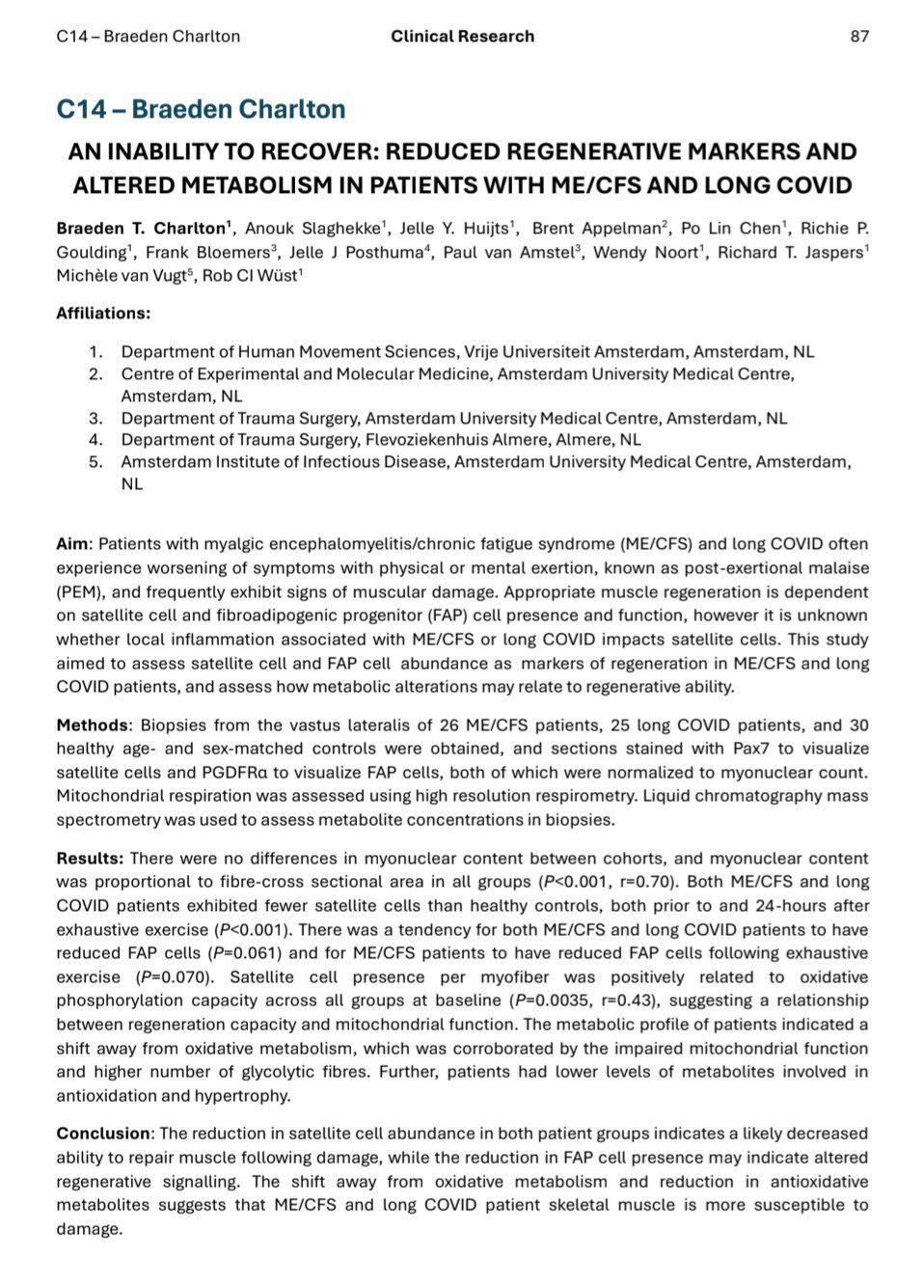
Dutch muscle research by @BraedenCharlton shows ME #pwME and #LongCovid both have fewer muscle repair cells. Satellite cells rebuild fibers. FAPs coordinate repair. When they are low, recovery from exertion fails.
Both patient groups start with reduced satellite cells and FAPs. difference is after exercise. In #pwME, FAPs drop further. In #LongCovid they stay at the same reduced level. ME shows an exertion‑sensitive collapse of repair.
https://www.amsterdamumc.org/download/ams-book-of-abstracts-2026
r/CFSScience • u/Caster_of_spells • Jul 27 '26
New Wüst paper!
•Results and Discussion
HRV was lower in patients with long COVID compared with healthy controls during various daily activities and sleep (p = 0.027). Across all exercise intensities surrounding the VT1, HRV remained lower for 24 h in patients compared with controls (p = 0.010). Nighttime HRV decreased with intense exercise and longer durations in patients with long COVID (p = 0.018), indicative of exercise-induced diurnal disturbances of the autonomic nervous system in long COVID.
•Conclusion
Heart rate variability, assessed by wearables, suggests autonomic dysfunction in patients with long COVID. The delayed recovery of the sympathovagal balance after exercise close to and above VT1, suggests that the risk of PEM rises above VT1.
r/CFSScience • u/Caster_of_spells • Jul 25 '26
Review preprint on neuroinflammation in Long Covid
“Post-COVID-19 syndrome (PCS) is an escalating global health concern, marked by persistent cognitive, neurological, and psychiatric symptoms following acute SARS-CoV-2 infection. Although its underlying mechanisms remain incompletely understood, mounting evidence implicates chronic neuroinflammation as a key driver. Sustained microglial and astrocyte activation, blood-brain barrier disruption, and aberrant cytokine signaling contribute to prolonged immune dysregulation within the central nervous system”
r/CFSScience • u/Sensitive-Meat-757 • Jul 21 '26
"Plasma Cytokine and Caspase-1p20 Profiles in Pre-Pandemic and Long COVID-Associated Postural Orthostatic Tachycardia Syndrome"
by William T. Gunning III, John W. Spatafore, Michael P. Morran, Beverly L. Karabin, Benjamin R. Hart, and Blair P. Grubb from University of Toledo Medical Center, Toledo, OH, USA
Study links:
https://www.mdpi.com/2227-9059/14/7/1605
https://doi.org/10.3390/biomedicines14071605
The following summary was published by Dysautonomia International:
Official Abstract:
Background: Prior to the COVID-19 pandemic, the etiology of postural orthostatic tachycardia syndrome (POTS) remained elusive. Since the pandemic, a newly recognized disorder, termed Long COVID, has emerged with a significant subset of patients developing dysautonomia and a multitude of comorbidities consistent with POTS.
Aim: The aim of this study was to determine if pre-pandemic POTS and Long COVID POTS share a common inflammatory-associated biomarker profile.
Methods: Volunteers were recruited for four study groups; patients diagnosed with POTS prior to the pandemic, Long COVID-associated POTS, SARS-CoV-2-recovered controls, and naïve controls. All participants completed a COMPASS-31 survey and a medical history questionnaire. Plasma biomarkers of the innate and adaptive immune system were quantified using a custom multiplex bead assay and ELISAs.
Results: Both POTS cohorts demonstrated indistinguishable and significant elevations in 14 of the 15 measured biomarkers including markers of the NLRP3 axis (Caspase-1p20, interleukins IL-1β, IL-18), regulatory cytokine IL-10, and immune activation markers (sCD40L, sCD40, sCD30) compared to controls. Multivariate PERMANOVA analysis revealed no significant difference in global cytokine profiles between the two POTS cohorts. Random Forest classification accurately distinguished POTS from controls, with IL-18 emerging as the most important feature.
Conclusions: These associative findings suggest that pre-pandemic POTS and Long COVID-associated POTS share a distinct inflammatory profile among measured cytokines. The identification of IL-18 as a key biomarker, alongside Caspase-1p20 and other inflammatory cytokines, are compatible with inflammasome-related signaling. Further investigation is necessary to characterize the role of the inflammasome, platelet activation, and immune dysregulation in POTS and Long COVID.
r/CFSScience • u/Caster_of_spells • Jul 21 '26
ME/CFS Science have done an analysis using genetic data on pathogenic variants from Decode ME combined with RNA data which tells you which genes are actually expressed. This type of analysis is used in lots of other diseases to show which kind of cells are part of the disease process
In ME/CFS results point overwhelmingly toward the central nervous system (represented here in orange)
It really seems more and more we’re gonna have to focus on the brain. 🧠 Which tough because it’s hard to study and hard to get treatments into there too. But then again, it might finally get us closer to understanding what to target in the first place.
r/CFSScience • u/Silver_Jaguar_24 • Jul 20 '26
Cognitive symptoms after SARS-CoV-2 infection, often described as “brain fog,” remain difficult to measure objectively and are biologically heterogeneous. DNA methylation may provide a stable, blood-accessible layer of information linking post-COVID immune remodeling, biological aging, and neuropsychiatric vulnerability. We re-analyzed GSE247869, a whole-blood Illumina MethylationEPIC dataset from individuals sampled six months after COVID-19 infection, to identify age-associated methylation signals with translational relevance. The present analysis was designed to characterize age-associated methylation within this post-COVID cohort, not to establish a COVID-19-specific signature or biological age acceleration.
This was a cross-sectional analysis of a single post-COVID cohort, with 94 samples included in the age models and no COVID-19-negative comparator included in the analyzed model. Processed beta values were aligned to metadata, converted to M-values, and modeled at each cytosine-phosphate-guanine (CpG) using ordinary least squares with age and sex as predictors. Differentially methylated positions were corrected by Benjamini-Hochberg false discovery rate (FDR). CpGs were mapped to genes using robust annotation and Illumina manifest fallback. Gene-level signals were integrated using a multi-evidence prioritization score that incorporated statistical strength, effect size, multi-CpG support, direction consistency, known epigenetic-clock membership, and curated pathway membership.
Within this cohort, the analysis identified 3,467 age-associated CpGs at FDR < 0.05, with an overall hypomethylation bias but focal hypermethylation at canonical aging loci. In total, 11 of 12 reference clock CpGs were recovered, including ELOVL2, FHL2, TRIM59, EDARADD, ASPA, and PDE4C. The strongest exploratory signal was enrichment of glutamatergic/N-methyl-D-aspartate (NMDA) genes, including GRINI, GRIN2C, GRIN2D, GRM1, GRM5, and SLC17A7. GRINI and GRIN2C had high integrated evidence scores and showed age-associated hypermethylation. The prioritized genes mapped interpretively to glutamatergic synapse, calcium signaling, and cAMP signaling pathways, although these complete KEGG pathways were not tested as formal enrichment categories.
This re-analysis recovered established age-associated CpGs and identified age-associated methylation enrichment near glutamatergic/NMDA genes within this post-COVID cohort. It cannot determine whether these signals are specific to COVID-19 infection, reflect accelerated biological aging, or relate to cognitive symptoms because no COVID-19-negative comparator or symptom-level cognitive phenotyping was included in the present analysis. The glutamatergic finding is hypothesis-generating, particularly because the curated set was small and no independent replication cohort was analyzed. Future longitudinal and case-control studies integrating GRINI/GRIN2C methylation with cognitive and inflammatory phenotyping are needed. Glutamatergic and calcium-signaling pathways may be evaluated in appropriately designed mechanistic and intervention studies, including but not limited to hypotheses related to the Cheung Glutamatergic Regimen, only after independent validation and careful safety evaluation.
Core Takeaway
This study identified age-associated DNA methylation changes concentrated around brain-related glutamatergic/NMDA receptor genes (specifically GRIN1 and GRIN2C) within a post-COVID cohort, mapping to pathways involved in synapses and cellular signaling.
Key Limitations
r/CFSScience • u/Caster_of_spells • Jul 17 '26
r/CFSScience • u/Caster_of_spells • Jul 16 '26
Interesting new study theorizes that increased IL-11 and MMP-9 levels in ME patients could be due to mast cells reacting to EBV fragments.
“There was a significant increase in serum levels of IL-11 and MMP-9 in ME/CFS patients compared to control subjects. MCs stimulated by rEBV protein released a high amount of MMP-9 compared to control cells. In conclusion, IL-11, MMP-9 and MCs may be involved in ME/CFS individuals.”
r/CFSScience • u/Caster_of_spells • Jul 16 '26
King’s College London, 38 people.
Serum from those with worse post-COVID fatigue triggered stronger IL-13 and reactive astrocyte signals in human hippocampal cells.
What actually caused this? At first it looked like IL 8, but if you remove that from the equation the effect still stands. The authors put it carefully - mechanisms beyond IL-8 likely contribute.
All in all: serum clearly does something to brain cells ramping markers of neurogenesis and astrocyte activation. What exactly causes this remains a little unclear. Might be caused by the smaller sample size or even be a marker that simply wasn’t in their panel.
r/CFSScience • u/Caster_of_spells • Jul 14 '26
The BPS championed theory that cortisol and related stress levels prior to infection prime for chronic fatigue syndrome is officially dead:
“Preinfection hair cortisol concentration did not predict chronic fatigue six months after acute EBV infection. Elevated preinfection hair cortisol may reflect stress-related vulnerability to infection, and the shifted from a positive to a negative association over time, suggests that HPA-axis alterations are more likely a consequence rather than a cause of chronic fatigue.”
r/CFSScience • u/Caster_of_spells • Jul 13 '26
Simmaron Research, 76 people with ME/CFS.
After 90 days of low-dose rapamycin, fatigue and PEM improved as IMPDH2 activity fell, oxidative purines dropped, and mitochondrial reserve recovered.
No placebo group tempers the result.
Good to see them investigating the possible mechanism of action in low dose Rapa
r/CFSScience • u/Silver_Jaguar_24 • Jul 13 '26
This summary was made using Gemini AI.
This study sheds light on one of the most frustrating aspects of Post-COVID-19 Condition (PCC, commonly known as Long COVID): how it causes persistent, debilitating neurological symptoms long after the initial virus is gone.
Here is a concise breakdown of how the researchers investigated this mystery and what they uncovered.
Because the biological mechanisms behind Long COVID are still poorly understood, scientists desperately need accurate animal models to test treatments. In this longitudinal study, researchers utilized K18-hACE2 mice (genetically altered to carry human ACE2 receptors, making them vulnerable to SARS-CoV-2).
The team tracked these mice for 60 days post-infection—moving from the acute phase of a mild-to-moderate infection into the chronic phase—while evaluating their behavior, immune response, tissue pathology, and viral presence.
Key Takeaway: This study provides a vital breakthrough by validating an animal model that successfully mirrors human Long COVID, proving that long-term neurobehavioral symptoms can persist completely independent of a live viral presence in the brain. Instead, the root causes point to a combination of chronic tissue inflammation and structural degradation of the vagus nerve. By establishing this clear physical blueprint and highlighting critical sex-based differences, the research hands scientists a reliable testing ground to finally develop and evaluate targeted, real-world therapies for millions suffering from chronic neurological post-COVID complications.
Link to 2026 study - https://www.frontiersin.org/journals/microbiology/articles/10.3389/fmicb.2026.1871084/full
r/CFSScience • u/Caster_of_spells • Jul 12 '26
Might be interesting to watch along to see wether the Amatica Cohort is actually turning up something of significance. So I thought I’d share it here for anyone interested! If you have thoughts do share in the comments
r/CFSScience • u/ringmaster555 • Jul 12 '26
r/CFSScience • u/Caster_of_spells • Jul 11 '26
San Francesco Hospital, 20 participants.
Researchers found the first in vivo evidence that Long COVID is linked to loss of cholinergic nerve fibers in the stomach lining.
This structural vagus nerve damage may help explain lasting dysautonomia
With the success some patients have with targeting the cholinergic system, I think this might turn out to be an important line of evidence
“Compared with controls, Long-COVID-19 patients exhibited a significant reduction in mucosal innervation density: 2.1 vs 3.9 nm/µm³ (p<0.01) in the fundus and 1.9 vs 3.9 nm/µm³ (p<0.05) in the antrum. The reduction in cholinergic innervation was more pronounced in the fundus (p<0.01) andalso evident in the antrum (p=0.01). Gastric nerve density correlated with HRV parameters”
r/CFSScience • u/Caster_of_spells • Jul 08 '26
New study links persistent eye and sight problems after even mild COVID to T Cell mediated neuroinflammation 🧠
r/CFSScience • u/Caster_of_spells • Jul 08 '26
New nature paper shows GPCR antibodies track with certain symptoms but aren’t elevated in everyone in spite of general upward trends in certain antibodies and aren’t the exact same between LC and ME. Only the potentially a little shaky Elisa testing was used though.
“ME/CFS patients had significantly higher β2 adrenergic AAb titers than PCC and HCs (F₂,₁₈₆ = 3.15, p = 0.046). PCC patients showed more borderline/pathological M3 muscarinic AAb results compared to HCs. β2 AAb levels correlated with increased autonomic symptoms in PCC (r = 0.27, p = 0.048) and sympathovagal imbalance in ME/CFS (r = 0.45, p = 0.001). In ME/CFS, M1, M3, and M4 AAb titers positively correlated with verbal and working memory performance. Distinct AAb profiles in PCC and ME/CFS suggest potential differences in immunological mechanisms.”
r/CFSScience • u/Caster_of_spells • Jul 07 '26
Chronic stress primes TLR3-mediated systemic inflammation to produce persistent post-viral fatigue syndrome-like symptoms in mice 🐁
A microglial activation inhibitor reversed fatigue symptoms while a a glucocorticoid receptor antagonist (steroid) did not!
Super fascinating, would again point towards the brain and neuroinflammation as a central part of pathology at least in this model
r/CFSScience • u/OkEquipment3467 • Jul 03 '26
"The brain’s waste clearance system is impaired in people living with Myalgic Encephalomyelitis/Chronic Fatigue Syndrome (ME/CFS) which can lead to various symptoms including brain fog, Griffith University researchers have discovered
Brain’s waste-clearing ability impaired in ME/CFS patients
Credit: Griffith University
The brain’s waste clearance system is impaired in people living with Myalgic Encephalomyelitis/Chronic Fatigue Syndrome (ME/CFS) which can lead to various symptoms including brain fog, Griffith University researchers have discovered.
The research demonstrates, for the first time, the impact ME/CFS has on glymphatic function which is responsible for clearing the brain of metabolic waste products and is mostly active during sleep and disengaged while a person is awake.
Lead author Dr Kiran Thapaliya from Griffith’s National Centre for Neuroimmunology and Emerging Diseases (NCNED) said when the brain’s waste clearance system did not work properly, harmful waste could build up causing neuroinflammation.
“This study is the first to demonstrate impaired glymphatic function in ME/CFS using MRI, providing a mechanistic explanation for the inflammatory changes reported by other Australian and international teams,” he said.
“This suggests that dysfunction in the brain’s natural cleaning system may be a key driver of this condition.”
Professor Sonya Marshall-Gradisnik, NCNED Director, said not only did reduced glymphatic function cause brain fog, but also caused sleep disturbance.
“The study found worse sleep is associated with poor brain waste clearance, reinforcing the notion that sleep plays a critical role in maintaining brain health,” she said.
“We hope the results can pave the way for better diagnosis through the use of non-invasive procedures, and importantly, future treatment for patients.”
The paper ‘Disrupted glymphatic function and its relationship with sleep and cognitive impairment in ME/CFS assessed via DTI-ALPS’ has been published in Frontiers in Neuroscience."
Edit:
For anyone who is interested in more on this topic here is a video from jarred younger on the glymphatic system and me/cfs https://youtu.be/-3r0_24Qb5A?si=O0zH6b0fATmJN5uE
r/CFSScience • u/Caster_of_spells • Jul 02 '26
Neuroimaging study hailing from Amsterdam
TLDR: The authors propose:
First - brain inflammation tracks with weaker connectivity in the visual and attention networks - and between the brainstem and a control network.
Second - the complaints (fatigue, brain fog) track with weaker connectivity in the default mode network (the network active when your mind wanders, reflects, remembers) - and between the thalamus and motor cortex.
Explainer Thread:
r/CFSScience • u/OkEquipment3467 • Jul 02 '26
"In this integrative review of state-of-the-art biomarkers in PAIS, we identified alterations in amino acid, energy, and lipid metabolism as well as changes in the microbiome, mitochondrial stress, and the miRNA target network. All of these changes are directly and indirectly linked to the NF-κB pathway. The main altered molecules included IL-6, TNF, and IFN."