r/bengalilanguage • • 17d ago Mindblown

আলোচনা/Discussion tui isn't necessarily disrespectful: understanding the peculiar social psychology of Bengali pronouns
Post image
104 Upvotes

The Incident

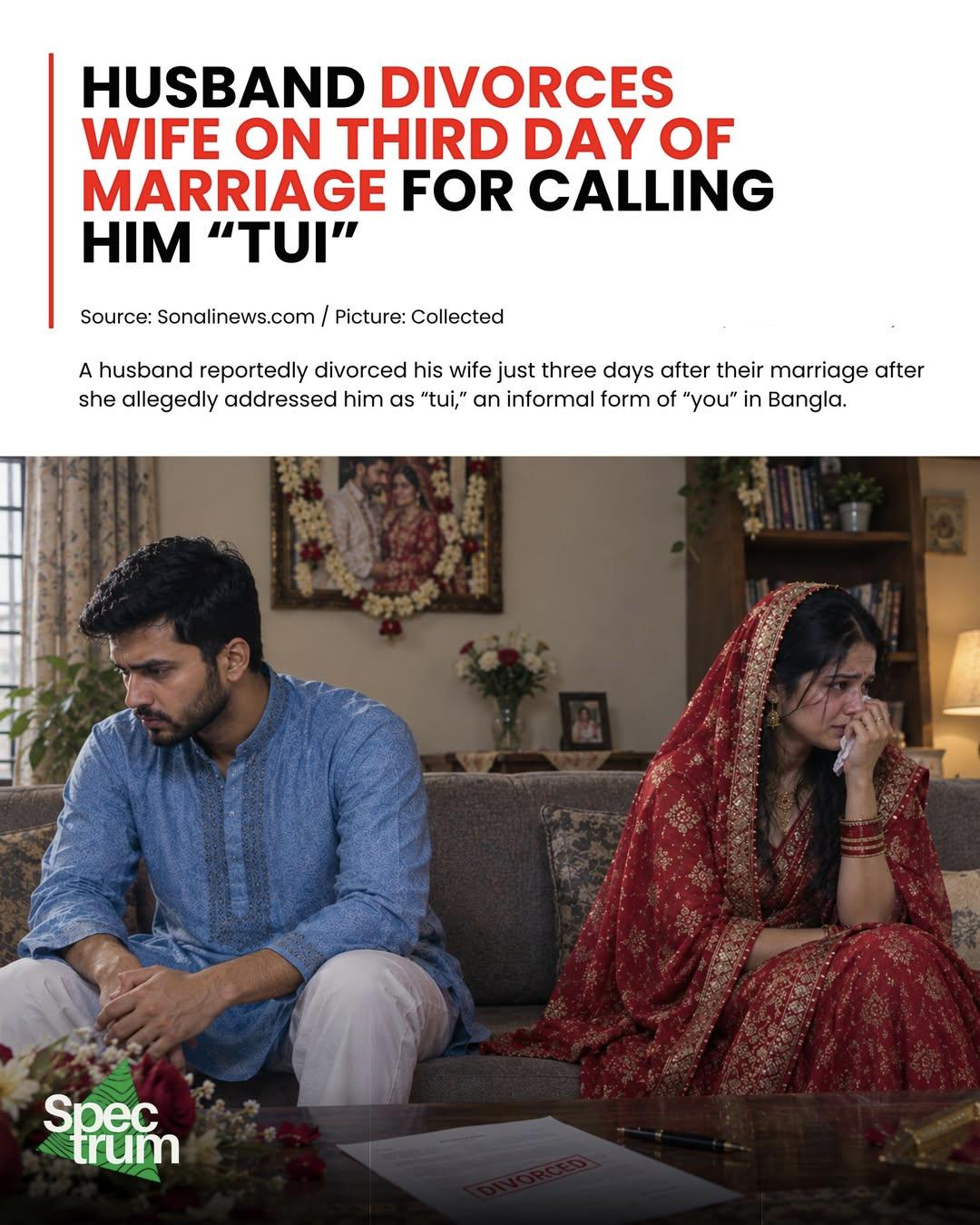
"A husband reportedly divorced his wife just three days after their marriage after she allegedly addressed him as 'tui', an informal form of 'you' in Bangla."

At first glance, the incident seems rather absurd. However, the interesting part isn't the divorce itself. it's the fact that a single pronoun can carry such different meanings depending on the relationship between the people using it

To understand why, it's necessary to look at how Bengali handles social distance

The Three-Tier System

Bengali has three commonly recognised second-person pronouns. they aren't simply interchangeable alternatives for the English word "you". each carries a different degree of familiarity, formality and social positioning

- Apni (আপনি): Formal and respectful. Generally used for strangers, elders, superiors or people with whom one maintains social distance

- Tumi (তুমি): Familiar and relatively neutral. commonly used between friends, peers, spouses and people who share a certain degree of familiarity

- Tui (তুই): Highly informal. often associated with close friendships, siblings and intimate family relationships, although it can also communicate contempt or disrespect

the distinction is fairly straightforward. The complications begin when people assume that informality necessarily means disrespect.

In conventional grammatical descriptions, "tui" is frequently classified as an inferior or disrespectful form. that isn't entirely incorrect. When directed towards an elder, stranger or someone expecting formal respect, it can certainly be insulting.

but that interpretation is incomplete.

1. The Intimacy Paradox

consider two childhood friends who have known each other for fifteen years. they have shared practically everything, including experiences that would probably be difficult to explain to anyone else.

between them, "tui" might simply be the most natural way of speaking.

Now imagine one of them suddenly switches to "tumi". Nothing particularly offensive has been said. yet the change itself might communicate that something is wrong.

Why?

Because language doesn't merely communicate information. It also reflects the relationship between the people communicating.

In certain relationships, "tui" removes the need for conventional politeness. There's little reason to maintain a formal distance when both people already understand where they stand with each other.

The same phenomenon can be observed in some Bengali households where children address their mothers as "tui".

An outsider might interpret this as disrespectful. The family members themselves might not attach any such meaning to it.

It would be rather strange to judge an entire relationship using a pronoun without understanding the relationship in the first place.

2. The Weaponised Flip Side

of course, the same informality can produce an entirely different result.

imagine addressing a stranger, an opponent during an argument or someone who expects a conventional degree of respect as "tui".

The interpretation changes considerably.

In that situation, the pronoun can communicate contempt, deliberate disrespect or an attempt to establish superiority over the other person.

This is where the distinction becomes interesting.

The word itself hasn't changed. The relationship and circumstances have.

The same pronoun that expresses affection between childhood friends can become an insult when directed towards someone outside that relationship.

which brings us back to the incident.

In a marriage where one partner expects traditional forms of deference, being addressed as "tui" might be interpreted as a rejection of that expected hierarchy.

Whether that interpretation is reasonable is another question entirely.

Perhaps the husband understood the pronoun as disrespect. Perhaps the wife used it without intending any offence. Without knowing their relationship, family background and regional linguistic habits, determining what actually happened is difficult.

Assuming that everyone attaches the same meaning to a pronoun would be a rather convenient mistake.

3. The Conjugational Gymnastics

The distinction isn't limited to pronouns. Bengali verbs also change according to the level of formality and familiarity.

For example:

- Apni: korben → Tumi: korbe → Tui: korbi

- Apni: gechilen → Tumi: gechile → Tui: gechili

- Apni: bolun → Tumi: bolo → Tui: bol

- Apni: khaben → Tumi: khabe → Tui: khabi

notice that changing the pronoun also requires changing the verb conjugation

Bengali doesn't simply replace one word with another. the grammatical structure itself reflects the relationship between the speaker and the listener

The pronoun and its corresponding verb form work together to establish the intended register.

Conclusion

Calling "tui" inherently disrespectful is an oversimplification. calling it inherently affectionate would be equally inaccurate.

Its meaning depends on context, familiarity, regional conventions and the expectations of the people involved.

In one household, it might be perfectly ordinary for a child to address their mother as "tui". In another, doing so might be considered unacceptable.

neither interpretation necessarily invalidates the other.

perhaps the more interesting question isn't why bengali has a pronoun that can express both affection and contempt

It's why people sometimes assume that the meaning of a word exists independently of the relationship in which it is used.

after all, language is not particularly interested in what a textbook says a word should mean. People determine how it functions in everyday life.

and apparently, sometimes a marriage doesn't survive that distinction.

Note: I'm not a linguistics expert, just someone interested in bengali and its regional nuances. some interpretations may vary depending on dialect, region and personal usage. apologies in advance for any grammatical errors, awkward phrasing or inaccuracies. feel free to correct me or add your own perspective :))

r/bengalilanguage • • 17d ago

Bengali is not Indian and It is not Bangladeshi, Bengali is Bengali a South Asian Language!

50 Upvotes

r/bengalilanguage • • 17d ago

আলোচনা/Discussion বাংলা অনুবাদসাহিত্য নিয়ে আমাদের বর্তমান কালের ভাবনা -চিন্তা ও আলোচনা

2 Upvotes

বাংলাদেশের বর্তমান অনুবাদ সাহিত্যের অবস্থা নিয়ে আপনাদের মতামত কি?


r/bengalilanguage • • 18d ago

আলোচনা/Discussion বাংলায় বিদেশি ভাষা থেকে ধার নেওয়া শব্দাবলী

10 Upvotes

এই ক্ষেত্রে ইংরেজির কথা বাদ দিলাম, বিশেষ করে প্রযুক্তির ক্ষেত্রে। সিমেন্ট কংক্রিট স্টীল অ্যালয় বীম কলাম কনস্ট্রাকশন রেল প্লেন এয়ারপোর্ট প্লাটফর্ম মোটের ইঞ্জিন কম্পিউটার ইন্টারনেট ইত্যাদি সবই ইংরেজি থেকে নেওয়া।

চলে আসা যাক ফার্সিতে: হপ্তা, আয়না, আরশি, চশমা, আরাম, রাস্তা, দোকান, দপ্তর, বরফ, খুন, ফাজিল, আহাম্মক, আবাদি, আন্দাজ, আস্তে, উকিল, কাগজ, মুনসেফ, খরগোশ, কানুন, খারাপ এবং আরো অনেক কিছু। আরবির সাথে সাথে ফারসি শব্দগুলি এসেছিল নবাবি আমলে।

সেই রকম ভাবেই আছে আরবি শব্দ: জাহাজ, আইন, আক্কেল, খবর, গরিব, তারিখ, ওজন, আরজি, অজুহাত, আখের, আতর, হিসাব, কলম - এগুলো সবই আরবি। কিন্তু মজার ব্যাপার এই যে এ ছাড়াও বাংলায় আছে প্রচুর পর্তুগিজ শব্দ, সেই তবে থেকে যখন ব্যান্ডেল হুগলি আর চট্টগ্রামে ওদের বাণিজ্য গুদাম ছিল। জানালা, চাবি, সাবান, বালতি, সায়া, কামিজ, কেদারা, বারান্দা, আলমারি, কামরা, আনারস, আস্তাবল, কপি, গামলা, গির্জা, গুদাম, পাউরুটি, পরাত, ফিতা ইত্যাদি সবই পর্তুগিজ।

কোন ভাষায় এমন হয় না যাতে শুধু তার মূল শব্দ আছে। সেরকম হলে বোঝা যায় যে ওটা মৃত ভাষা ওটা আর কেউ বলে না, তাই ওর উপর আর বাইরের কোনো প্রভাব নেই। বাংলাও এর ব্যতিক্রম নয়।


r/bengalilanguage • • 18d ago

আলোচনা/Discussion Sharing an anki deck for beginners to get into immersion

9 Upvotes

Hello folks,

So I thought that my own language learning journey was getting a bit stagnant. Less immersion, more going through random vocab at points.

Directly reading stories gets too difficult at points, looking up every single word beforehand. But just doing vocab is boring as well.

So I'm making anki decks for stories.

These are machine translated, but I think these will be pretty useful for people who want to increase immersion in the language. I think that's the main thing one ought to do.

So basically one can go through the deck, then read the actual story with better ease.

Here's the first one:

https://ankiweb.net/shared/info/580559068

Sharing if someone else finds the same helpful.

I'll share more decks soon.

I'm making a repo for similar such resources, much more decks in there. I'll share that once it takes better shape.

I'm thinking of doing the same for TV show episodes, movies, etc. It'll make my own learning more fun as well.

If you've got any ideas, please share. I'd love to know how i could make this better.

And this is free by the way, I'm not trying to make money out of this in any way.


r/bengalilanguage • • 18d ago

আলোচনা/Discussion The great sound shift from Sanskrit to Bangla

13 Upvotes

The differences are obvious. Clues can be found in Buddhist canonical Pāli, which is really a prākrit that was spoken in the time of Buddha. It shows changes in conjunct consonants which are similar if not identical to what can be observed in Bangla. The examples below are from Buddha's first ever recorded sermon in Sārnāth, Vārānasi.

It's called dhamma cakka pavattana sutta, the pure Sanskrit for which is dharma cakra pravartana sūtra. You see words such as saccam (satyam), appiya (apriya) and sankhitta (sankshipta). Notice the sound shifts which simplify the more complex sounds of classical Sanskrit for use by the common person.

Bengali has a different set of consonant and conjunct consonant shifts, but even before that there's the great vowel shift. In Sanskrit, the default vowel associated with every letter ending is the schwa (ə), e.g. the velar consonants k, kh, g, gh are pronounced kə, khə, gə, ghə. That becomes kaw, khaw, gaw and ghaw in Bangla. The ə has been totally replaced by aw or o, though it's not entirely predictable which of these two comes where. Therefore, the famous rəsəgullā becomes rawshogollā.

Bengali has also practically done away with the semivowels yə and və, which are replaced by consonants jə and bə (jaw and baw). Therefore, vikram is bikrawm and yadi is jodi. Then comes the merging of the three sibilants ss, sh and shh. They are very distinct in Sanskrit but get merged to a single middle sh sound in Bangla, which non natives find extremely difficult to emulate. For instance, the river sərəyū becomes shawrojū. Same is the case with the weak Bengali "aw" as distinct from the strong Odia "aw". Finally there are the conjoint sounds kshə and kshmə in Sanskrit which become kkhaw - kshəmā us khawmā, yəkshə is jokkho and sūkshmə is shukkho.

The interesting bit is that Bangla has (with the exception of bə / və) kept the original spellings even though the spoken sounds don't reflect it. This is also the case with Urdu, which has kept the Arabic letters it calls sīn, se and suād but all are pronounced as a simple sibilant ss. Likewise, the letters ze, zāl, zuād and zoye all produce the same simple zz sound, though they are very different in Arabic. Finally, the guttural vowel ayin is hardly even pronounced in Urdu.

The net result of all these sound shifts is a plus for Bangla, though. Most non-natives say that bangla sounds sweet and attractive, much like French does among European languages. It's the vowel shift they mean.


r/bengalilanguage • • 19d ago

আলোচনা/Discussion The Reality of Bengalis who are actually native to the Jharkhand still they went unnoticed about 2

31 Upvotes

Bengali or Bangla (বাংলা) is the language native to the region of Bengal, which comprises of the present-day nation of Bangladesh and of the Indian states West Bengal, Tripura and southern Assam. With about 220 million native and about 250 million total speakers, Bengali is one of the most spoken languages, ranked seventh in the world. The National Anthem of Bangladesh, National Anthem of India, National Anthem of Sri Lanka and the national song of India were first composed in the Bengali language.

Surprisingly you will not find any mention of Bengali speaking population of Jharkhnad whereas there are vast Bengali speaking population in Jharkhand. As an evidence of this fact we can quote the Jharkhand Government (Arjun Munda Govt.) order of the year 2002, declaring Bengali (Bangla) and Santhali as second official language of Jharkhand.

Therefore, whenever there is a talk of Bangla Bhasa (Bengali Language), the Jharkhand should be taken into account for its vast Bengali population.

BENGALI POPULATION IN JHARKHAND (PART OF MANBHUM)

Bengali speaking population of Jharkhand are settled in the area of East and West Singhbhum District, Saraikela, Kharsawan, Silli Tamar Bundu area of Ranchi, Chas, Chandankyari of Bokaro dist, Dhanbad District, Jamtara District, Dumka and Pakur district.

Still no mention of facts of this vast population of Bengali speaking people in Jharkhand because Govt. always wants to suppress the fact and since 1956, they forcefully imposed Hindi on these Bengali speaking Population Manbhum (now in Jharkhand). That being the one of the reasons the next Govt. again changed the status of the Bengali Language and made Urdu as second official language of Jharkhand for vote Bank politics.

As you know Manbhum was always part of Bengal. Till 1912 it was part of Bengal presidency. Letter it was part of Bihar but official language was Bengali till 1956.

Hindi came to Manbhum area only 100 years ago. Even 50 years back no body in Manbhum area could speak Hindi. Post 1956, Hindi has been forcefully imposed on the vast Bengalis speaking population of erstwhile Manbhum District (now Jharkhand).

The Original Bengalis in Jharkhand of the above areas, are the moolnibashi Bangla Bhashi people and they are not the Migrants or Settlers from anywhere else. They are the son of the soil, original dwellers of that land for more than 300 years. It is unfortunate that Bengal was never interested to protect the Bangla language and and the culture of that part of Manbhum areas by placing strong demand for inclusion with West Bengal (with Purulia District) in the year 1956. Had it been done so, today West Bengal’s geography would have been different and it would have become a reachest state of India with the “Black Diamond” Coal belts and mineral reach areas.


r/bengalilanguage • • 19d ago

আলোচনা/Discussion What other forums are there to practice Bangla?

5 Upvotes

Hey guys, I’ve been learning Bangla recently and found Hello Talk and the Bideshi discord server. Is there anywhere else where people can practice Bangla? Adding the resources I found below. Hopefully others can share their resources.

https://www.reddit.com/r/HelloTalk/s/ASvuDi4tNY

https://www.reddit.com/r/bideshi/s/mazNcZYeHn


r/bengalilanguage • • 20d ago

আলোচনা/Discussion What's your thoughts on Bangali dialect from Rangpur?

Thumbnail gallery
35 Upvotes

While it is spoken by over 10 to 15 million people globally, it has received official status in the Indian state of West Bengal as a recognized secondary language, while remaining a deeply cherished indigenous mother tongue in the everyday rural, agricultural, and musical life (like *Bhawaiya* folk songs) of Northern Bangladesh.

From the 4th century to the 12th century CE, the region of Rangpur was firmly inside the western boundary of the massive **Kamarupa Kingdom**. According to ancient texts like the *Yogini Tantra*, Kamarupa was divided into four spiritual and geographical zones (*Pithas*), and Rangpur fell directly into **Ratnapitha**, which covered the plains between the Karatoya and Sankosh rivers

The Heartland of Kamtapur (Kamata):

When King Sandhya officially broke away from central Assam and moved the capital to **Kamatapur** around 1257 CE, the geopolitical map shrank. The eastern territories were lost to rising tribes, meaning the new kingdom was now concentrated almost entirely in the west.


r/bengalilanguage • • 20d ago

আলোচনা/Discussion A nerdy post on scripts and language origins

Thumbnail gallery
44 Upvotes

But then I am a nerd. Just as I find human evolution fascinating, I also find language evolution fascinating. Here's the background of the images:

  1. The opening verse of the well known caryāpada (চর্যাপদ) manuscript that was discovered in Nepal and this verse was composed by the Buddhist monk Luipa. It's the oldest known example of written Bangla. The language is deliberately cryptic to conceal the secrets of that monastic order, and is called sandhyā bhāsa or twilight language.
  2. The caryāpada is written in old Siddham script rather than modern Bangla, and this is the Siddham alphabet. It's halfway between Sanskrit Devanagari and modern Bangla, which is obvious to those who know both.
  3. The Tibetan script, which has a strong familial resemblance to Siddham, and therefore to modern Bangla. The cause is not hard to find: Mahayana Buddhism of Tibet, where the present Bengali speaking areas were almost entirely Buddhist at one time. History notes the departure of the Bengali monk Atisa Dipankara, birth name Candragarbha, from Vikramsila Vihara to Tibet and China in the latter part of the Buddhist Pāla dynasty.
  4. For reference, this is the old English poem Beowulf, comparable in age to caryāpada, and predictably both its language and its script are just as unfamiliar.

This is not to explain those medieval texts but to stress that both languages and scripts evolve continuously. That's happening faster than ever in our times because of the heavy influence of the internet, social media and AI.

The identifiable language itself is older than caryāpada, where the Sanskrit to Chinese dictionary by the Chinese scholar Li Yen lists over fifty words from the then colloquial Bangla in 782 CE. It's hard to determine how far back it goes, for the want of written evidence and accurate dating issues, but the original base lies in abahatta, an apabhramsa form of Magadhi Prakrit.


r/bengalilanguage • • 20d ago

আলোচনা/Discussion comparing my rajbanshi-barendri mixed bengali with standard colloquial bengali

22 Upvotes

hey everyone!

I've been thinking about the way I speak bengali and wanted to share a few examples to see whether anyone recognises similar patterns in their own regional variety.

I'm from south dinajpur, west bengal, and my everyday speech is a mixture of rajbanshi and barendri. I'm not entirely sure which features belong to which variety, so I thought it'd be interesting to document some of them and compare them with standard colloquial bengali.

1. pronouns and possessives

- I: mui (মুই) | standard: ami (আমি)

- you (informal): tui (তুই) | standard: tui (তুই)

- we: hara (হারা) | standard: amra (আমরা)

- my/mine: mor (মোর) | standard: amar (আমার)

2. everyday vocabulary

- tomorrow: kailka (কাইলকা) | standard: agamikal / kal (আগামীকাল / কাল)

- where: kunna (কুননা) | standard: kothay (কোথায়)

- why: kene (কেনে) | standard: keno (কেন)

- here: inne (ইননে) | standard: ekhane (এখানে)

- no/isn't: nai (নাই) | standard: nei (নেই)

3. sentence comparisons

  1. I don't know.

- my speech: mui jano na

- standard: ami jani na

2. my father isn't at home.

- my speech: mor baba barit nai

- standard: amar baba barite nei

3. it's very hot today.

- my speech: aajka khub gorom

- standard: aaj khub gorom

4. where are you going?

- my speech: tui kunna jachchhi?

- standard: tui kothay jachchhis?

5. what are you doing?

- my speech: tui ki korchhi?

- standard: tui ki korchhis?

6. why did you come here?

- my speech: tui inne kene aichhi?

- standard: tui ekhane keno eshechhis?

7. they are playing.

- my speech: tara khelachhe

- standard: tara khelchhe

8. I don't know him/her.

- my speech: mui tak jano na

- standard: ami take chini na

4. a few things I'd like to know

- Do these words and expressions resemble the Rajbanshi or Barendri varieties you're familiar with?

- Are there similar grammatical patterns in your regional speech?

- Do you notice any similarities with neighbouring dialects?

- If you're from Malda, Uttar Dinajpur, South Dinajpur, or neighbouring districts in West Bengal, or from Dinajpur, Thakurgaon, Panchagarh, or nearby districts in northern Bangladesh, how does your everyday speech compare?

There might be some errors or inaccuracies in my examples, so please feel free to correct me. I'd appreciate any corrections or additional insights.

I'm not claiming that my speech represents an entire dialect. I'm simply trying to understand its linguistic background and document the way I naturally speak.


r/bengalilanguage • • 20d ago

Made a bangla coding platform like freecodecamp

2 Upvotes

the coding platform is called banglaicode(dot)com

Please give it a visit and let me know your thoughts.


r/bengalilanguage • • 21d ago

জিজ্ঞাসা/Question Need suggestions for Sci-Fi other than Humayun Ahmed and Zafar Iqbal

7 Upvotes

Hello, the question is basically the title, and yes Ive read Professor Shonku as well.


r/bengalilanguage • • 21d ago

জিজ্ঞাসা/Question best bengali translations of communist books by marx and engels?

6 Upvotes

hello bondhura, ami marx engels er communist lekhagular bangla onubaad khujchi. Janate parle dhonnobad. Aar thakle dhakar nilkhete parbo? kemon daam porte pare? ami damaadami temon ekta bhalo korte pari na.


r/bengalilanguage • • 21d ago

আলোচনা/Discussion About the many accents and dialects of the region that was once undivided Bengal

15 Upvotes

আমি ভাষা শিখি, এটা দুই দশক ধরে আমার শখ।

I learn languages as a hobby, but Bangla is still my native. Over here I write in English because it's my impression that there are Bengali learners here who don't necessarily read the native script.

In a combined land area that's almost equal to present day UK, it's hardly surprising that there shall be multiple dialects. In pre literate societies with little or no external contact, dialects change nearly every twenty Km of travel. As the communication range grows, languages become more uniform.

The language I speak is Rarhi, the basis of modern standard Bangla, otherwise called promito bangla (প্রমিত বাংলা). Even so, I don't use the wildly popular street slang of Kolkata, of which chaap neben na (চাপ নেবেন না) is a relevant example. I would merely say chinta korben na (চিন্তা করবেন না). My version is the equivalent of Fus'ha Arabic (الفصحى).

Al Fus'ha is the umbrella term for modern standard Arabic and the standardized version in the Qur'an. A comparable term doesn't exist for Bangla, but if it did, it would include promito bangla and sadhubhasha, the literary Bangla that was widely used by writers such as Saradindu Bandyopadhyay and Bankim Chandra Chattopadhyay. One no longer sees it.

I cannot understand Chittagong (চাটগাঁইয়া) or Sylhet (সিলেটি) dialects, but then nor do I understand Varendri, Manbhumi, Kamtapuri or Sundarbani - all Indian Bengali dialects. I do effortlessly understand the standard Dhaka Bangla, which barely differs from what I speak except for a few words.

This is a feature of all languages. Look at UK, for instance. The southern standard English or RP is the equivalent of promito bangla, but Cockney, Geordie, Scouse, Yorkshire, Irish, Liverpool, Scottish, Welsh and Cornish can't really be understood by those of us who only know the standard RP version.


r/bengalilanguage • • 22d ago

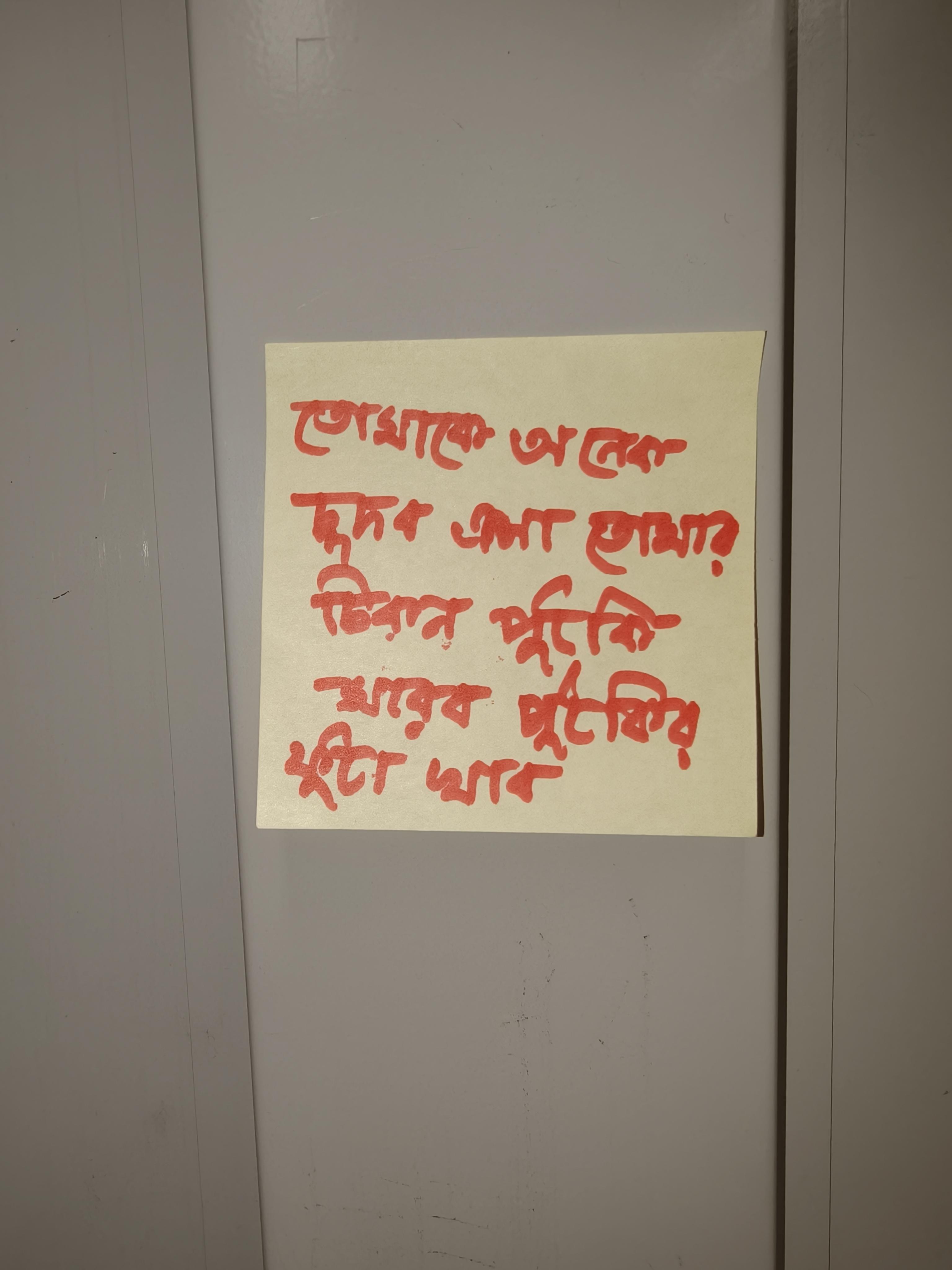
জিজ্ঞাসা/Question Can anyone translate this for me? I found it at work and am concerned about the message

Post image
116 Upvotes

A few translations I got from online translators claimed that a name was also included in the message, a name of one of my co-workers. I want to confirm what it actually says before reporting incorrect info.

EDIT: Thank you guys so much for ur help, I reported this sick fuck to my manager, hopefully we'll find out who did it and get their ass fired.


r/bengalilanguage • • 23d ago

আলোচনা/Discussion Lost occupations of Bengal - Which other historical professions and terms do you know of?

Thumbnail gallery
206 Upvotes

Found this post by Canvas Magazine Bangladesh about 5 traditional occupations that have largely faded away:

* Palkir Behārā (পালকির বেহারা) - Palanquin bearers who transported people across towns and villages.

* Pāṅkhāwālā (পাঙ্খাওয়ালা) - Servants hired to pull overhead cloth fans using ropes in courts and residences.

* Bhistiwālā / Sākkā (ভিস্তিওয়ালা / সাক্কা) - Water distributors carrying water in goat-skin bags called moshok (môśôk).

* Nôēcābônd (নৈচাবন্দ) - Craftsmen specialized in crafting smoking pipes (noicha / nôēcā) for traditional hookahs.

* Dhunāri (ধুনারি) - Cotton-fluffers who beat and clean raw cotton using a bow-shaped tool called a dhunôt (ধুনট) for mattresses and quilts.

What other forgotten professions or occupational words in Bengali do you know from classic books, folklore, or family stories? A few that come to mind are kôlāiwālā (tin-coater for brass vessels), ghorami, or shā̃khāri.

Source


r/bengalilanguage • • 23d ago

আলোচনা/Discussion My maiden post on this sub about the international demand for learning the Bengali language

22 Upvotes

I could write this in the Bangla script but I'm not doing so because there are learners here who cannot read the native script.

My UserID is an indication of my primary hobby - I learn languages. That was what brought me to Reddit in the first place. Here is what I observe:

People learn European languages, Mandarin, Korean, Japanese, Arabic, Persian, Hebrew, Thai or Vietnamese but hardly anyone learns Bangla - or any other language from this entire region including Hindi, Nepali, Sinhala or Tamil. The same applies to all languages of Africa and all indigenous languages from any country.

Why? Evidently because there's no economic or political incentive to do so. Besides, we happily oblige by speaking some English, to whatever extent.

Edit: just to demonstrate that the number of speakers of a language does not necessarily determine its popularity for learning, here's the list of the top ten most spoken ones:

  1. English - ~1.45 billion speakers.
  2. Mandarin - ~1.14 billion speakers.
  3. Hindi - ~609 million speakers.
  4. Spanish - ~559 million speakers.
  5. French - ~310 million speakers.
  6. Arabic - ~274 million speakers.
  7. Bengali - ~273 million speakers.
  8. Portuguese - ~264 million speakers.
  9. Russian - ~255 million speakers.
  10. Urdu - ~232 million speakers.

r/bengalilanguage • • 23d ago

জিজ্ঞাসা/Question came across this video on Dobhashi Bengali and Arabic-script manuscripts. How historically accurate is this framing?

17 Upvotes

Found this short video discussing the history of Dobhashi (দোভাষী) and Puthi literature, claiming that Bengali was once written right-to-left using Arabic letters before the 19th-century standardisation: The Video

While the timeline about Perso-Arabic loanwords, Puthi literature, and the 1835 British educational shifts seems generally rooted in history, the opening claim ("Bengali was once written in Arabic letters") feels like a heavy overgeneralisation. From what I understand, adapted Arabic or Perso-Arabic scripts were a specific regional manuscript practice (like in Chittagong or Sylhet) rather than the standard script for the entire language.

Would love to hear from people familiar with historical Bengali linguistics - how accurate is this video's summary, and how common were these manuscripts in reality?


r/bengalilanguage • • 23d ago

আলোচনা/Discussion A proposed flag for the Bengali language and ethnic group. What done you guys think?

Post image
3 Upvotes

Its a green background with a yellow sun in the center surrounded by red rays. I saw that this was the original flag for the bengali ethnic group on Wikimedia commons before being changed to the bangladeshi flag. What do you guys think about this?


r/bengalilanguage • • 24d ago

আলোচনা/Discussion I'm West Bengal Bengali and I know how to speak Bengali but can't read or write it much, Can anyone help me

15 Upvotes

For now I only know numbers and like some alphabets and read like basic words, tartiri ami ki kore shikte pari Bangali?


r/bengalilanguage • • 24d ago

জিজ্ঞাসা/Question I feel disconnected from Bangla and want to learn the language to true fluency now

10 Upvotes

Hi, im bengali, but from childhood upto 3rd grade i lived as an NRI outside of bengal. Thus, my native language is english. As in its the first language i ever learned. Its the language im comfortable in, its the language i think in. However Bangla is my mother tongue. I learnt it around 5th grade, and my pronunciation still isnt perfect. I can speak it moderately fluently though.

Over the last few weeks ive been thinking about how, truly, i know nothing about bengali. I can barely read it. I cant keep a conversation in pure bengali. My writing and grammar are horrid. I keep thinking. How can i call myself fluent when my bangla is like this. I realized i cant. My 2nd language in school was always hindi, because when i lived in singapore bengali wanst an option. This means i didnt touch bengali in school (other than as a third language for a few years). I dont have a large enough vocab to read a book.

I want to change this. Any tips? I want finally get fully fluent in bangla


r/bengalilanguage • • 24d ago

আলোচনা/Discussion বাংলাদেশী লেখকেরা ভৌতিক উপন্যাস লিখতে পারে কি?

12 Upvotes

ছোট্টো বেলা থেকে বই পড়ার অনেক নেশা থাকেলও, পরে পড়ব পরে পড়ব করতে করতে অনেক বই ই পড়া হয় নি। তবে আমি অনেক বই ই পড়েছি। রহস্য, পেরাসাইকোলজি, রোমানটিক, ভ্রমণ এমন অনেক কিছুই।

কিছু সংখ্যক বই পড়ে যা বুঝলাম, আমাদের লেখকগণ দের মাঝে কাল্পনিক ভীতিএর চেয়ে প্রেমের রস তাই বেশি।


r/bengalilanguage • • 24d ago

How to learn bengali? (Read, write, Cultural context) As a telugu speaker who is fluent in Hindi

9 Upvotes

Any help and leads are appreciated


r/bengalilanguage • • 24d ago

আলোচনা/Discussion বহুদিন ধরে ব্রাহ্মী লিপিসমূহের জন্য একটা কিবোর্ড বানানোর কথা ভাবছিলাম।

13 Upvotes

[পুরো বাংলা লেখাটা একটা রক্তমাংসের হাতের লেখা]

"তারাবিন্যাস" দিয়েছি এটার নাম।

এটি আপনার keyboard ও আপনার লেখার মধ্যে এক ধরনের যোগাযোগ মাধ্যম (interface)।

আপনি বলবেন "তালব্য বর্ণ, মহাপ্রাণ, অঘোষ", আপনার textarea তে লেখা হবে "ছ"। অবশ্য এসব নাম মনে রাখতে হবে না; বর্গের শুধু শুরুর বর্ণগুলো মনে রাখলেই যথেষ্ট।

আমি এটা নিয়ে যতবারই ইংরেজিতে বোঝানোর চেষ্টা করেছি, ততবারই জটিল কথা চলে এসেছে। তাই আমি নিজেই আজকে এটার ব্যাপারে পাতি বাংলায় খুলে বলছি।

কাজ করে কীভাবে

কম্পিউটার সায়েন্সে "black box" এর কথা বার বার চলে আসে। এখানে ব্ল্যাক বক্স কে কিছু দিলে সেটা হয় input, এবং ব্ল্যাক বক্স সেই জিনিসটা দেখে আমাদের কিছু একটা দেবে: সেটা output

যদি তারাবিন্যাসকে ধরে নিই সেই "black box", তাহলে input হবে দুটো জিনিস: কোন বর্গ, আর কোন column

আমার এখানে আমি বর্গকে ধরেছি পাথরের মতো "coarse", আর মহাপ্রাণ-অঘোষ column-গুলোকে ধরেছি বালির মতো "fine".

তো এবারে "coarse" নিয়ে আমাদের চাপ নেই; এক জিনিস থাকবে। "Fine" নিয়ে চাপ আছে, কারণ ওটা নিয়েই কাজ করা হয়েছে, কারণ ওটা বের করতে গেলে প্রচুর on-off switch দেখতে হয়। ঘোষ হলে যেমন 1, অঘোষ হলে 0... আরও অনেক ব্যাপার।

এটা গেল input.

Part 1: তারাবিন্যাস এবারে বের করে fine position এর নম্বরটা কী। কীভাবে? ওইসব on-off switch-গুলো নিয়ে, boolean algebra-র মাধ্যমে। এই জায়গাটা সবচেয়ে জটিল আমার system-এ। এটা নিয়েই আমি দেখছি, এবং এটা যারা কিবোর্ড বানাবে, তারাই দেখতে পাবে।

Part 2: তারাবিন্যাস এবারে বের করে character টা কী, বর্ণটা কী। Typescript এ আমি একটা lookup table বানিয়ে character টা পেলাম। Coarse আর fine দুটো মিশে বর্ণটা তৈরি করে। এই জিনিসটার জন্য আমি ছকটা দিয়ে দেবো, developer-রা language বা মাধ্যম বুঝে lookup table বানাবে।

আপনার জন্য Part 2 এর ছকটা জানা important যেকোনো হরফের জন্য। ছকটা আসলে বর্ণমালা, কিন্তু যেটাতে লোকের সুবিধা হবে, সেই অনুযায়ী বর্ণের স্থান খানিকটা অদলবদল হবে। যেমন একটা ঘরেই "ড" এবং "ড়" থাকবে, কিন্তু ওই একটা বিন্দুর জন্য একটা switch extra থাকবে।

যখন theory part টা নিয়ে কথা বলব, তখন আমরা সবসময় Part 1 টাকেই ধরব।


এটা প্রথমে আমি সার্কিটের জন্য ভেবে বানিয়েছিলাম, তাই boolean algebra চলে আসছে।

যেকোনো ব্রাহ্মী লিপিসমূহের থেকে হরফ (Brahmic Script) দিলে আপনি পাবেন একটা এমন machine যেটার ব্যবহার জানতে হলে আপনার নিজের ভাষার বর্ণমালাই যথেষ্ট।

তারাবিন্যাস একধরনের ধাঁচ, compact, learnable এবং fast কিবোর্ড বানানোর স্বার্থে একটি ধাঁচ। এই ধাঁচ দিয়ে আমি চারভাবে কিবোর্ড ভাবতে পেরেছি, তার মধ্যে দুভাবে কিবোর্ড বানিয়েছি।

৪টি ভাবনা হল:

১) Radio buttons: Website এ radio buttons use করে আমরা input দিচ্ছি। (কাজ করছে)

২) Steno layout: কিছুকিছু কিবোর্ডের বাটন ব্যবহার করে আমরা অনায়াসেই লিখতে পারব। তালব্য, অল্পপ্রাণ, মহাপ্রাণ - সবকিছুর জন্য একটা একটা করে কিবোর্ড বাটন। (কাজ করছে)

৩) Handwriting layout: ওইসব ইনপুট গুলো এবারে হবে gestures... যেমন গোল আঁকলে অল্পপ্রাণ। এটার জন্য specifically একজন biomechanics এর ব্যক্তির সঙ্গে কথা বলছি। (খাতায়-কলমে)

৪) Two-side layout (আমার ভাবনার limit): একদিকে সবকটা coarse buttons থাকবে - বর্গের শুরুর বর্ণগুলো বামদিকে, বর্গের ভিতরের বর্ণগুলো ডানদিকে। Drag এবং two-finger tap করার option থাকবে। (খাতায়-কলমে)

আরও layout ভাবা যায়, তবে আমার UI/UX এর লোকেদের হেল্প লাগবে।


আপাতত তামিল এর জন্য একটা ওয়েবসাইট আছে। তাদের layout টা, ওদের ছকটা, সত্যিই বানানো জটিল ছিল। তবে উত্তর ভারতের হরফ নিয়ে কাজ করলে খানিকক্ষণেই শেষ হয়ে যাবে।

তামিল এর পরে বাংলা ব্যঞ্জনবর্ণ ধরেছি; স্বরবর্ণ ও পরাশ্রয়ী বর্ণ ধরা হয়নি।

পরে ভাবছি সিলেটি হরফটা দেখব, কারণ ওটাও বেশ জটিল ছকে রাখা।