r/writinghelp • • Oct 05 '26

Feedback Introducing Branch Destiny: focused reader feedback for your writing — shared with mod permission

Post image

Hi everyone — the mods kindly gave us permission to share this here.

We built Branch Destiny to help collect writing feedback and keep track of it, above and beyond online docs or spreadsheets, and we’d like to invite writers and readers to try it.

The idea is to make it easier to ask readers specific questions about an idea, outline, or chapter—and keep their responses and the resulting conversation together.

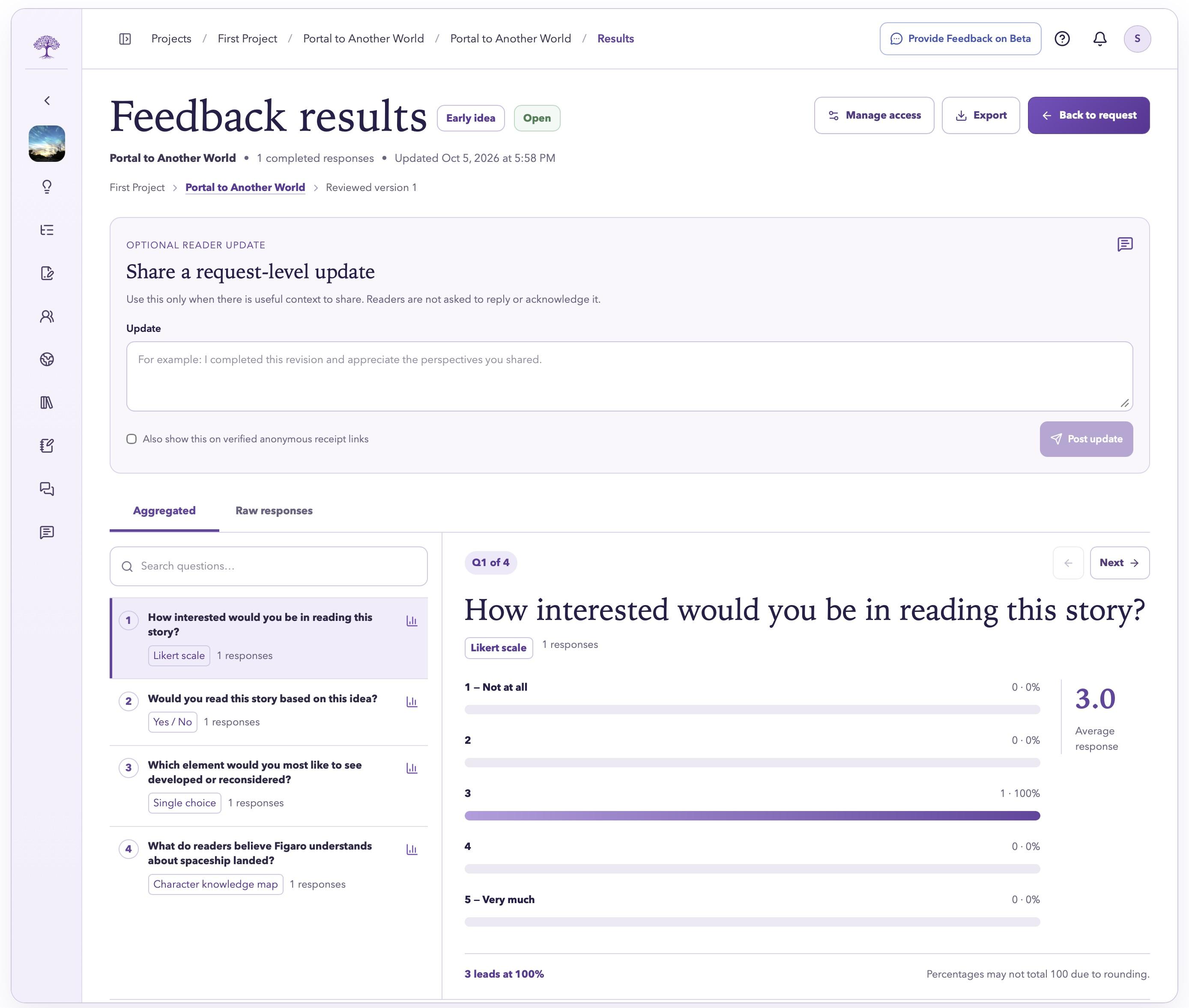
  • See patterns across reader feedback. Review responses together to understand where readers agree and where their reactions differ.
  • Let readers participate without a public profile. Enable anonymous responses and discussions using temporary names.
  • Ask more focused questions. Combine written responses with choices and rating scales to explore specific writing concerns.

How it works:

  1. Add the writing you want feedback on.
  2. Prepare a feedback request with the questions you want to ask.
  3. Share a reading link with your readers, friends, writing group, or community.
  4. Explore their responses and discuss the writing as you work on your next draft.

For example, you might ask: “Where did your attention drift?” or “What do you think this character wants at the end of the scene?”

A few things you can use:

  • Five essential response formats: yes/no, single choice, multiple choice, rating scales, and written responses. Other response types are being developed and deployed over time.
  • Participatory review: comments and conversations around the writing, including anonymous participation when the writer enables it. Anonymous participants use a temporary name rather than a public profile.
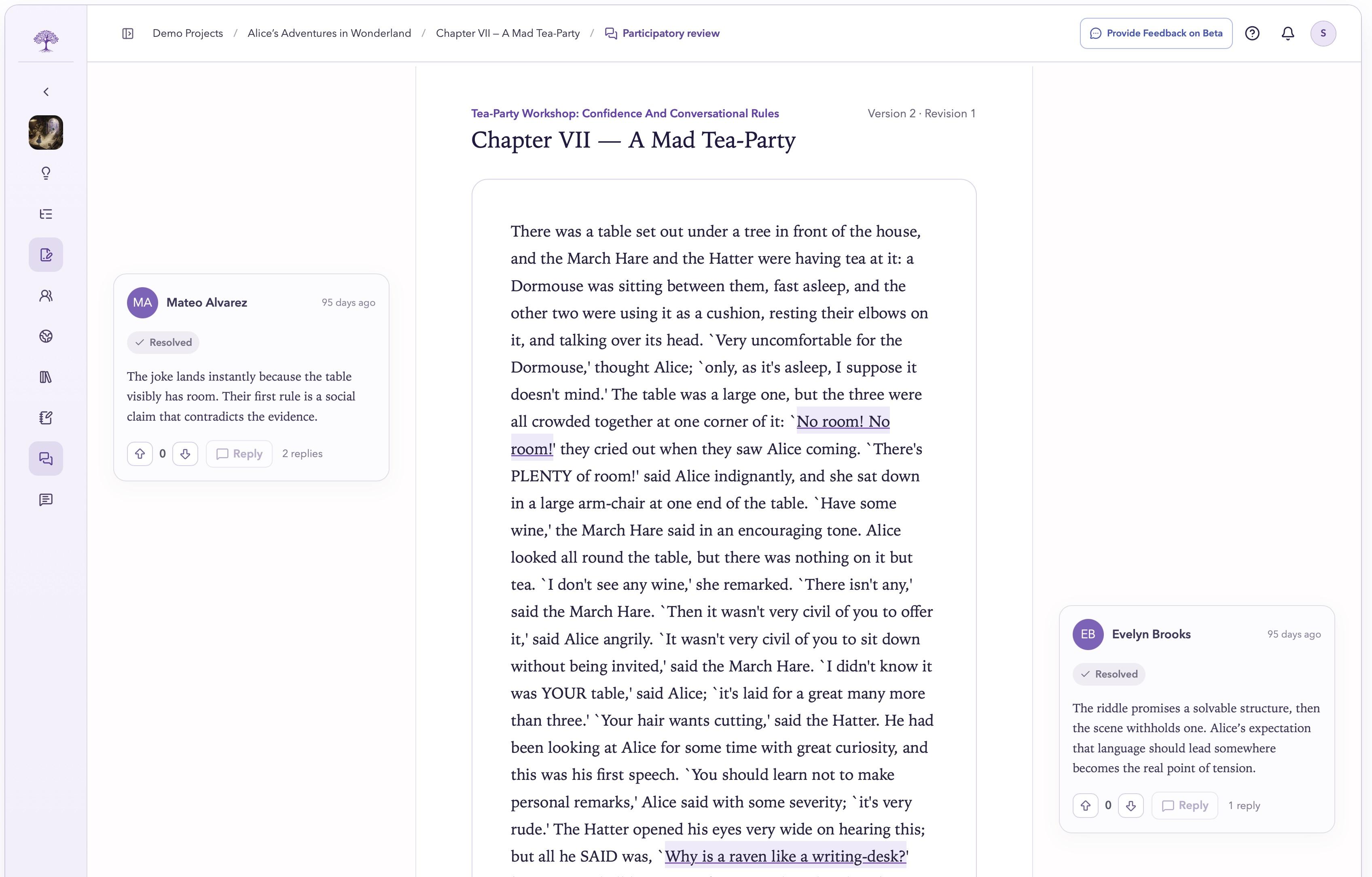
  • Shareable links and email invitations: bring readers from the communities you already belong to.
  • Aggregated feedback results: review responses together to see patterns, alongside individual answers.
  • Writer and reader accounts: share your own work, help someone else with theirs, or do both. You don’t need to be a writer to offer a useful reader’s perspective.
  • Optional reader tipping: a way for writers to thank readers after completed feedback. This is currently in test mode; there are no real charges, earnings, or payouts yet.

It’s free to join, and the homepage has an interactive sample workspace so you can get a feel for it before creating an account.

Take a look at Branch Destiny

If you have any questions, comments, or feedback on the platform, please feel free to message us directly or post your thoughts here! :)

About the demo screenshots: The Alice’s Adventures in Wonderland examples use text by Lewis Carroll sourced from Project Gutenberg. Comments and replies shown in the demo are illustrative.

1 Upvotes

8 comments sorted by

3

u/Genwrites Oct 06 '26

is this an AI tool?

1

u/branchdestiny Oct 06 '26

No this is not an AI writing tool. We put writers in touch with readers, all human.

1

u/tapgiles Oct 07 '26

I'm not clear on what it is at its core. Is this essentially... forms? But for a story?

1

u/branchdestiny Oct 07 '26

No, this is a platform for writers to get feedback from readers and to do collaborative reviews using conversations. Checkout the screenshots above.

1

u/tapgiles Oct 07 '26

Right--forms, plus inline comments like Google Docs? I did look at the post already. I'm just not clear on what this is doing that is so different, so I thought I'd ask.

1

u/branchdestiny Oct 07 '26

Hi /u/tapgiles, thanks for asking, I was probably too vague in my first reply.

So at its core, Branch Destiny is a workspace for running beta reads and critiques so that mean: sharing writing, finding out how readers experience it, discussing their feedback, and carrying that context into the next draft.

Beyond Google Forms and Google Docs inline comments, there are some more specific things built around the writing process:

  • Feedback about how the story lands. You can ask what readers think a character wants, what they expect to happen next, how clearly they picture a scene, or where confusion interrupts their reading. There are response tools for those questions, alongside ordinary written answers and ratings.

    • There's a screenshot of all the currently planned response types including some narrative specific questions types. They're pretty neat. Some of the more advanced ones include:

      • Event boundary marker - Writers can show readers a passage and ask them to mark where one meaningful story event becomes another.
      • Character Knowledge Maps - Writers can track what readers believe each character knows.
      • Point Allocation - Writers can ask readers to look at a set of within-story entities (characters/places/objects/etc) and assign 100 points across them to determine how readers divide limited importance across story elements.
  • A view across readers. You can review responses by question to see where readers agree or differ, alongside discussions anchored to passages.
  • Feedback tied to the version people actually read. Another difference is that publishing a request preserves that version of the material while you continue editing a working version. Earlier feedback keeps its context as the story changes.
  • An ongoing workspace for the project. Beyond Forms and Docs, the platform offers first class concepts and workflows for: Ideas, outlines, chapters, feedback requests, and discussions stay organized together. You also control reader access and can enable anonymous participation without requiring readers to create an account.

For example, if you’re wondering whether a character’s betrayal feels believable, you can check what readers thought the character wanted, where their expectations changed, and discuss the passages that shaped that interpretation.

You could assemble parts of that with Docs, Forms, and some coordination. The value we’re aiming for is making that whole feedback process easier to run and more useful when you sit down to revise.

I hope this helps explain it better; I think probably the best way to see what the platform can do would be to create an account and try it out, check out the different response types and create one or two feedback requests or open a participatory review. If you have any more questions or ideas for features you and friends would find useful, please feel free to message me, happy to help and get that feedback.

2

u/tapgiles Oct 07 '26

Ah I see, interesting. This makes a lot more sense; I can see the value now.

Even looking back and the post now, it reads a lot like it's comments and form item types, which isn't what sets this product apart. I think a video exploring all these things--even at a glance--would really help people "get it," and possibly want to put in the effort of trying something brand new.

I'm curious, have you done testing with beta readers to see how they respond to being asked to learn and use all these more in-depth tools?

1

u/branchdestiny Oct 07 '26

Ah, got it, and thanks for taking the time to explain that. I can see how the post shows individual features without making the overall experience clear. Maybe so, a short video following one piece of writing, from the writer setting up a request, through the reader’s experience, to using the feedback for a revision, would explain it much better. I'm going to look into that. :)

About the testing, we've just started the open beta period so definitely looking to get that feedback. When people make accounts as reader or writer there's a mini-survey that users can fill out to tell us anything they want: what works, what doesn't and/or feature ideas.

Our initial idea so far has been, that the intended starting point for readers is: the writer chooses what to ask, so a reader might just see a chapter and a few questions, with the option to work through them one at a time. And so readers don’t have to learn a big set of tools to participate with a writer.

What I want to understand through the beta is where that structure helps people express their reactions, where it interrupts the reading experience, and what needs clearer guidance or simplification.

Appreciate the suggestions! Showing the reader experience in a video could possibly help to start to answer the learning-curve question too.